Futurist Jim Carroll

Mastodon post archive · 2022–2026
Archived from mastodon.futurist.info · 4209 posts
← All months

June 2026 · 24 posts

← May 2026July 2026 →
Jun 1, 2026 · 9:48 AM UTC

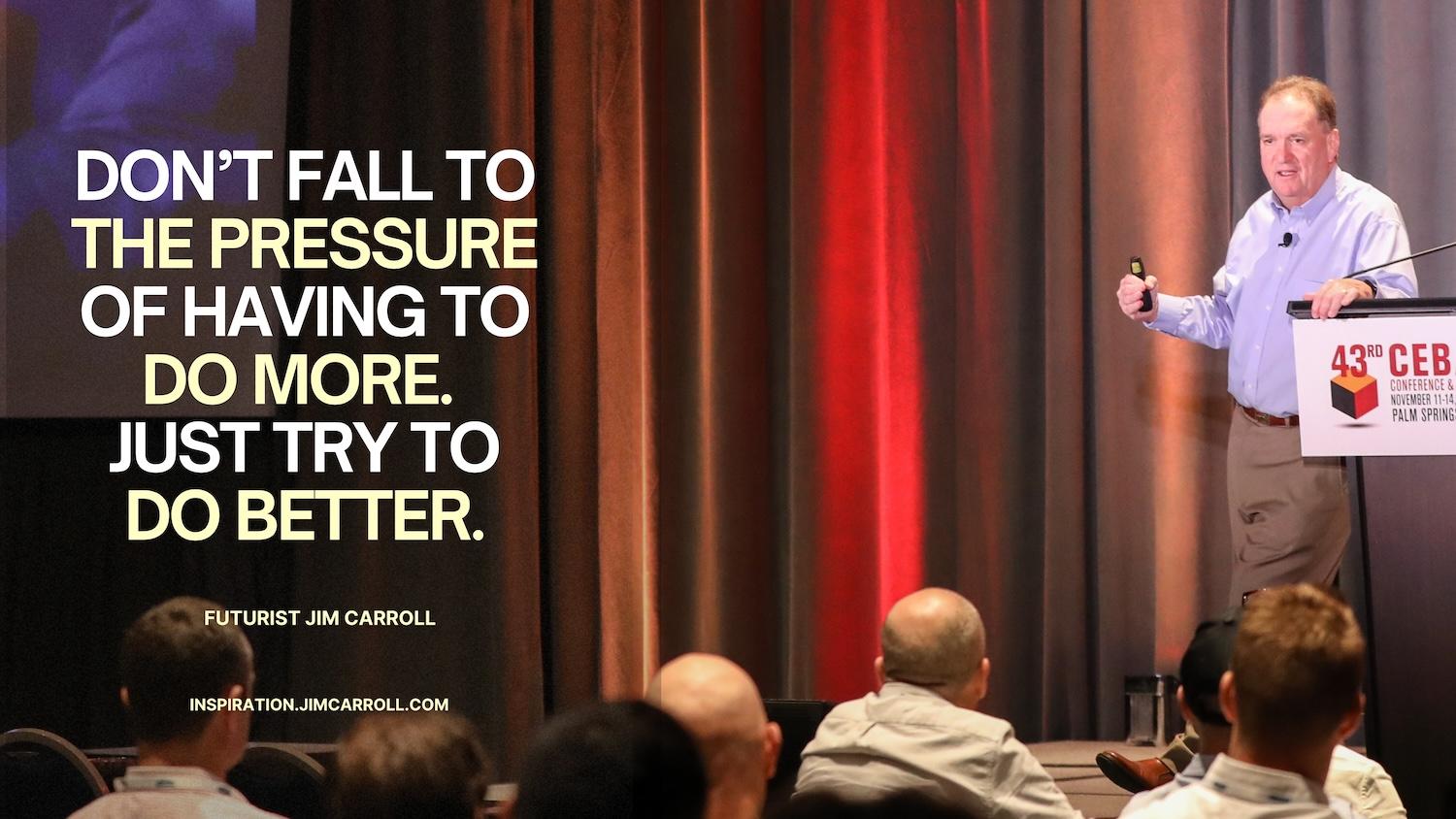
"Don't fall to the pressure of having to do more. Just try to do better." -

It's Monday! And if you are like most people, you are waking up to a long list of things you think you NEED to accomplish.

But do you?

The result is that your day might be spent in a frantic haze, going from this item to that item and then back again. The upshot is that you might get to many things on your list - but won't end up doing any of them very well.
Here's a thought: maybe you don't need to do 'many things' haphazardly - maybe you should just do one thing.

Look, I get it - it's very easy to feel trapped by the idea that success means filling up your calendar, chasing every opportunity, and saying yes to everything. But just adding more stuff to a busy routine is not a good strategy.

It is actually just a quick way to burn out and do average work.

Successful people have the discipline to block out distractions and focus on doing a great job.

They know that doing one thing well ALWAYS beats doing many things with marginal results.

Because that one thing is often THE THING that moves them forward.
Don't do more. 

Do better.

Original post: jimcarroll.com/2026/06/daily-i

★ 0 • ↻ 0 original
Jun 2, 2026 · 9:32 AM UTC

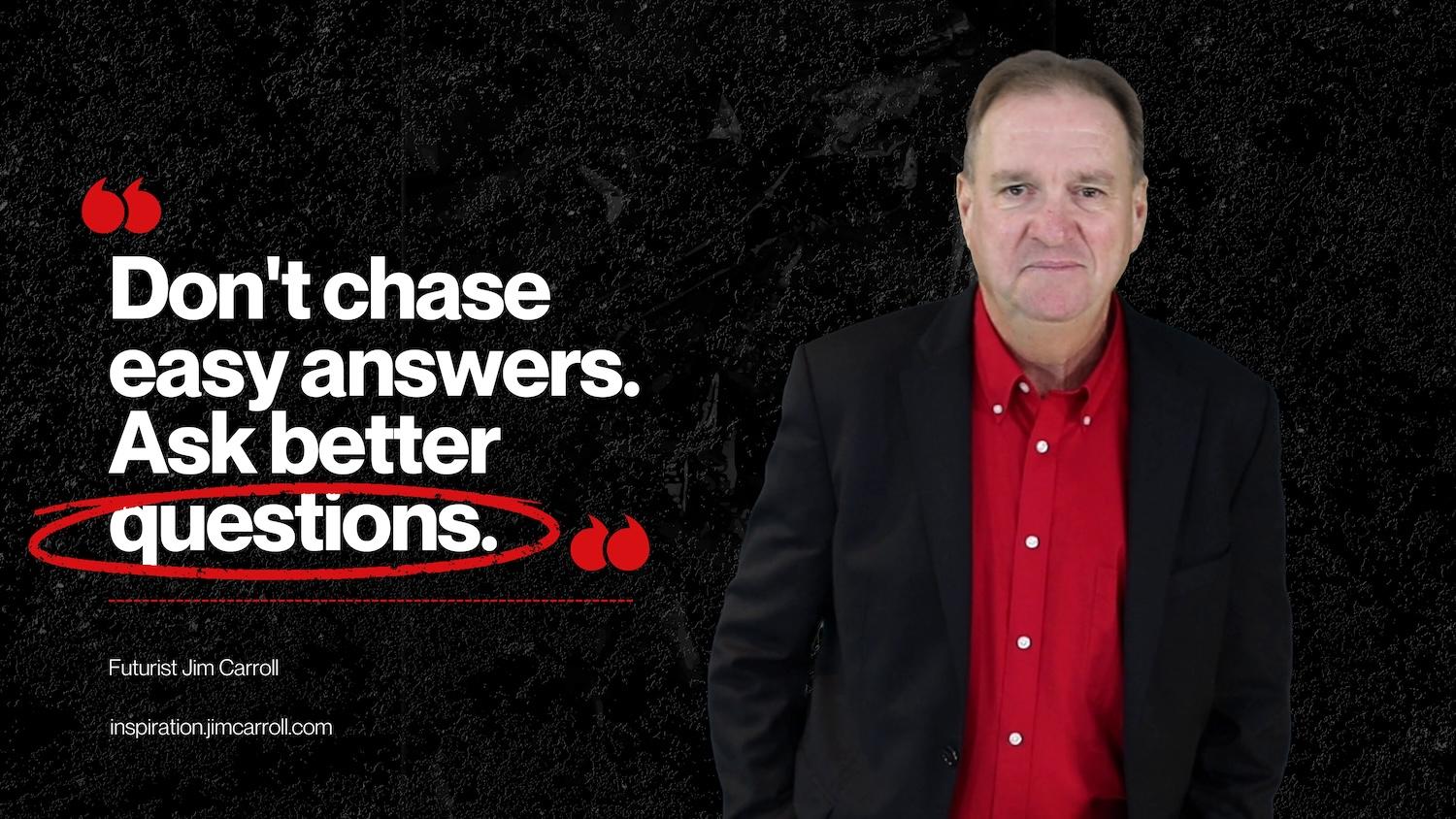
"Don't chase easy answers. Ask better questions." - Futurist Jim Carroll

Here's a reality that is only becoming worse as AI eats the world - most people spend their time searching for quick facts and instant data, often rushing about in search of a solution to a problem.

And yet, iIn a world where information is completely free and everywhere, simply finding a basic solution does not give you an advantage anymore. 

When everyone else has the same answer, what do you have left?

Real knowledge only happens when you refuse to settle for the first simple explanation you find. You shouldn't try to chase a simple list of ready-made answers, but instead, try to focus on developing a deeper understanding. Go deep when everyone else is going shallow.

Why? Because if you want to find the big opportunities that everyone else is missing, you have to look past the surface. Deeper.

Don't seek easy answers.

Ask better questions!

----

Original post: jimcarroll.com/2026/06/daily-i

★ 0 • ↻ 0 original
Jun 3, 2026 · 9:45 AM UTC

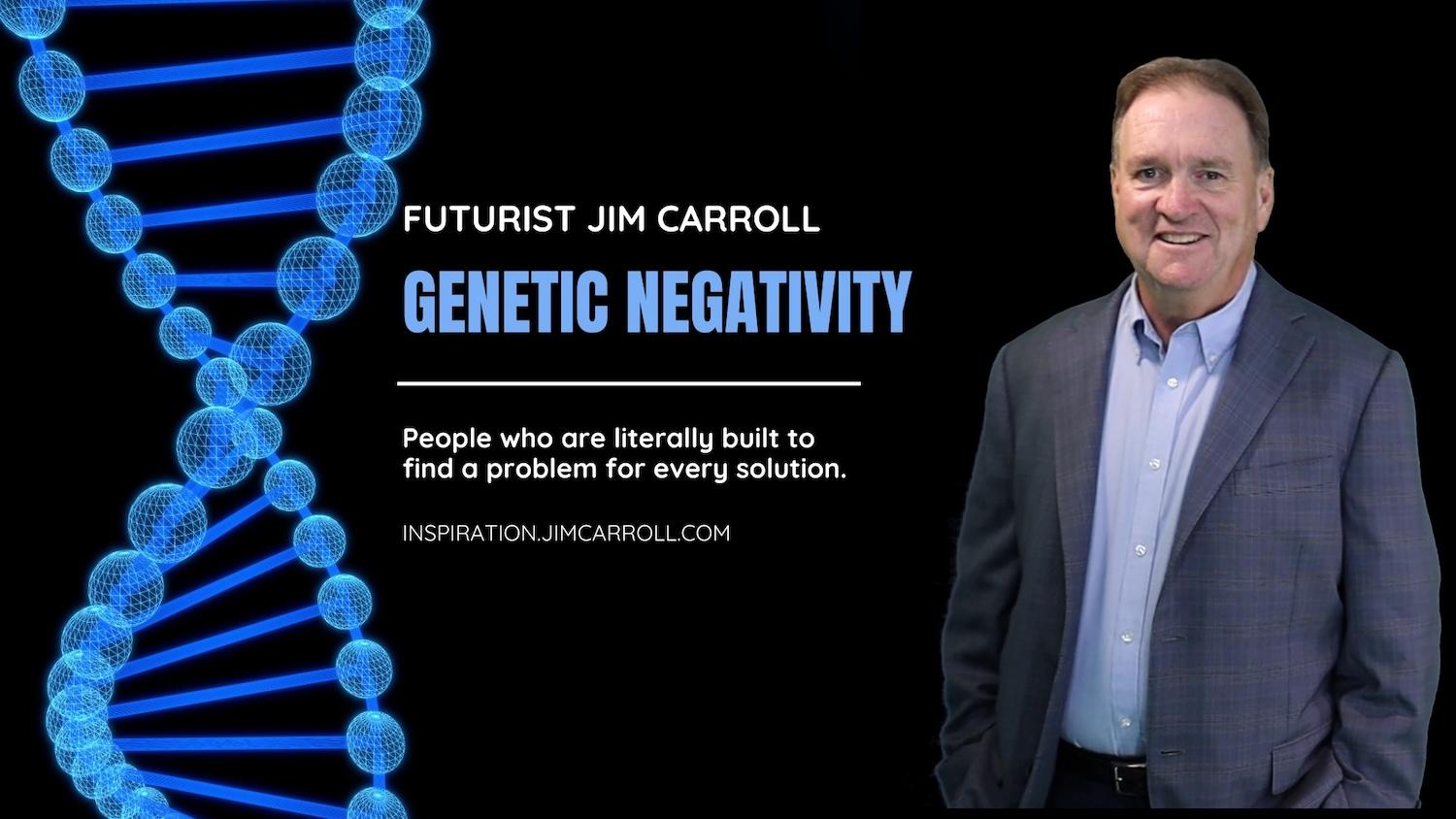
"Genetic Negativity: People who are literally built to find a problem for every solution." - Futurist Jim Carroll

My Innovation Killer list - over at innovationkillers.jimcarroll.com - always gets a lot of respect from audiences and readers, because they know its' true.

I was thinking about it the other day for an upcoming event in the context of challenges faced by a client. I realized, from our discussions, that they are not only beset by the innovation killers - they seemed to be describing some people who are suffering from what I've come to call 'genetic negativity.'

Here's why. They:

- suffer from an automatic "no." People with genetic negativity do not wait to hear the details of a new idea. Their natural response is always to find a reason why it will fail.

- protect the old days like a reflex. For these individuals, doing things the way they have always been done is not just a habit. It is a deep instinct they will defend at all costs.

- use financial uncertainty to freeze. The moment budgets are tight, their immediate reaction is to lock down, stop all forward movement, and cancel new initiatives.

- prefer it's comfort of standing still. They would rather stay in a declining market they already understand than take a risk on a new opportunity they cannot fully predict.

- let the fear of a mistake paralyze them. Their main goal is never to win, but simply to avoid being wrong. This fear completely stops them from ever trying anything new.

- demand perfect clarity before moving forward. They refuse to take action until they know every single detail about the future. Because total certainty is impossible, they never actually start.

- think age equals complete wisdom. They believe that senior leaders automatically have all the answers. Because of this, they completely ignore the fresh insights of younger people on the front lines.

- get stuck in endless testing. Instead of fully launching a successful new idea, they keep it trapped in a loop of small, safe trials. They use continuous testing as an excuse to delay real change.

- actively share their doubt with the team. Their negativity is contagious. They constantly remind everyone around them of past failures, which slowly destroys the team's confidence to try again.

- mistake a lot of meetings for real progress. They spend all their time talking about problems, writing reports, and making excuses. They confuse this frantic activity with actually moving forward.

Take a look around your own organization. Do you see the same thing?

Find an antidote, stat!

---

Original post: jimcarroll.com/2026/06/daily-i

★ 0 • ↻ 0 original
Jun 4, 2026 · 9:25 AM UTC

"Have you ever noticed that people who tell they know better than anyone else, usually don't?" - Futurist Jim Carroll

It is easy to be an armchair quarterback when you have never taken a hit on the field! I wrote that into this post back in 2022! Most armchair quarterbacks have never played the sport!

Yet, we constantly find ourselves living in a world where "everyone is an expert at everything and yet has expertise in nothing!" That's from another post I shared.

In 2026, with AI, the problem has only grown worse. The world is flooded with internet-trained "instant experts" and slideshow strategists who profess to have deep, instant knowledge but who are easily, expressed through the buffoonery of their convictions. They grab a quick summary, stand safely on the sidelines, and shout in absolute terms because they don't have to face the messy reality of truth.

This pandemic of false knowledge is a massive threat because it actively creeps into corporate cultures and reinforces organizational sclerosis.

Organizations with too many fake experts end up building towers of false promises, eventually crashing to the burden of truth. 

True authority does not come from a quick search. 

Original post: jimcarroll.com/2026/06/daily-i

★ 0 • ↻ 0 original
Jun 5, 2026 · 9:33 AM UTC

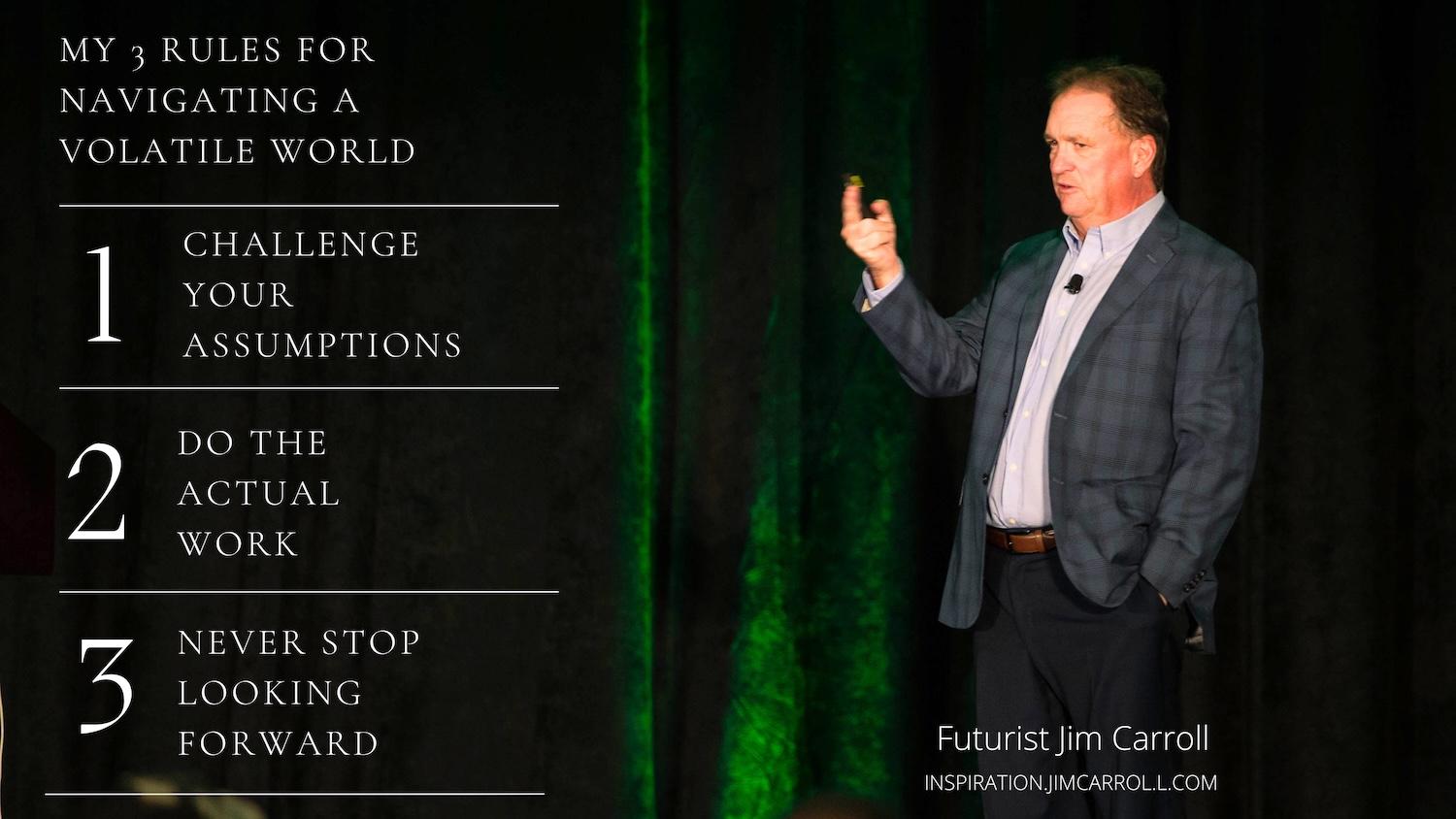
"Challenge your assumptions. Do the actual work. Never stop looking forward." - Futurist Jim Carroll

My 3 rules for navigating a volatile world? I went and asked Gemini AI to look at the several thousand Daily Inspiration posts that I have delivered since 2016, and it settled on these 3 core ideas. These seem to be the 3 things that define my entire philosophy

Challenge your assumptions. Don't settle for the easy, surface-level explanations that everyone else accepts. True growth requires you to constantly question the status quo and ask the next three questions that no one else is thinking about.

Do the actual work. Real expertise isn't built on a five-minute summary or a trendy slideshow. True insight is deeply researched and extensively lived - it is built stone by stone through getting your hands dirty, facing real challenges, and learning about actual; execution.

Never stop looking forward. The future doesn't slow down to match your comfort level. To win, you must stay ahead of the curve, constantly anticipate disruption, and have the courage to leave the safe, familiar path behind.

Original post: jimcarroll.com/2026/06/daily-i

★ 1 • ↻ 1 original
Jun 8, 2026 · 9:51 AM UTC

"If the future belongs to those who are fast, know that excuses are slow. Solutions are speed." - Futurist Jim Carroll

Here's what I'm thinking about this Monday morning: the reality check on human nature in the corporate world.

Over the years, hundreds of my keynotes have focused on concepts related to innovation: how to understand it, how to embed it within a team, how to achieve it. That has allowed me the unique opportunity to observe first hands that works and what does not.

And with that came my realization, more than 20 years ago, that above all, successful innovation relies on the ability of a team to achieve speed. Let's call it 'escape velocity' - the ability to get away from the shackles of this current moment and align successfully to the next one. I have warned leadership teams that size no longer guarantees survival; agility does.

That message has worked its way into my written work. If you look back at the thousands of blog posts I’ve written since 2002, a permanent thread ties them all together: velocity. I I even codified this philosophy into the title of my book, The Future Belongs to Those Who Are Fast.

With this, I also know that there is a a dark, slow-moving twin to corporate speed: people who seem to be in the business of manufacturing excuses.

Excuses won't get you anywhere. Action does.

And in that context, speed matters.

And coming up with excuses for moving slowly is at the core of your organization, you've got a big problem. If your day-to-day work consists of explaining inaction, you aren't innovating successfully. You are manufacturing failure. And in that reality, you need to think about tipping the scales: the number of excuses you manufacture should never exceed the solutions you find.

When every trend impacting you is moving at exponential speed, waiting for 100% clarity isn't prudent. It's a choice to fail.. True innovators don't have time to engineer an airtight alibi for why a project didn't launch.

They are too busy running low-stakes experiments and crashing through boundaries to try to chase success.

Be that person!

---

If Jim Carroll was to narrow down the primary theme for most of the corporate keynotes he has done through the years, it would be around the issue of speed and moving fast.

Original post: jimcarroll.com/2026/06/daily-i

★ 1 • ↻ 0 original
Jun 9, 2026 · 9:34 AM UTC

"The organizations that look most ready for the future are often the ones most blind to the fact that they aren't." - Futurist Jim Carroll

This post evolved as I wrote it - it started out like this! So that's too good ideas in one post!"The moment you think your future is guaranteed is the moment it becomes certain that it isn’t." 

One thing about the idea of innovation is that it's easy to spot when the setup isn't right for it to happen! I've gone into a lot of organizations that look great on paper, but underneath the surface, they're actively set up to fail.

Not from a lack of ideas, but because they're trapped in a loop of excuses, slow execution, and legacy thinking. I can usually see this during the keynote planning conference calls - little signals, small comments, careful observations when I'm chatting with the people who are bringing me in.

Here's ten red flags. See how many apply.

1. The Nostalgia Trap. Every idea looks exactly like last year's idea with a fresh coat of paint. People seem to be more focused on what was, rather than what could be.

2. The Informed Delusion. There are mountains of historical data to justify the old strategy, but no insight for potential new directions.

3. The Clarity Trap. Everyone is frozen, avoiding decisions while waiting for "the dust to settle." They don't realize that clarity is a myth.

4. Accelerated Incompetence. You think tech fixes everything, so there is a rush to automate a broken process - but no one asks why the process is broken in the first place!

5. Over-Administeration. Everyone is busy firefighting today's fires. There's zero time available to anyone to look out at the fringes where the real trends are born.

6. The Permission Deathtrap. Every initiative requires three approvals, two committees, and a pilot program that runs eighteen months. By the time you've finished getting things moving, your competitor shipped the product.

7. Generational Blindness. There's a lot of older leadership who make exclusive decisions about a future they know very little about, all while shutting out the digital natives who actually live in it.

8. The Crushing of the Misfits. The corporate culture rewards smooth compliance and groupthink. The rebels, outliers, and oddballs are the exact people who get the future done - and are actively ignored.

9. The Addiction to Consensus. Every bold idea gets smoothed over through so many layers of agreement that by the time it arrives, it's bland, dead, unimaginative.

10. Dissidents are shunned. Someone who sees a failing strategy stays quiet. No one ever tells the truth about what's going wrong.

--

Futurist Jim Carroll can spot inherent failure from a mile away.

Original post: jimcarroll.com/2026/06/daily-i

★ 0 • ↻ 0 original
Jun 10, 2026 · 10:07 AM UTC

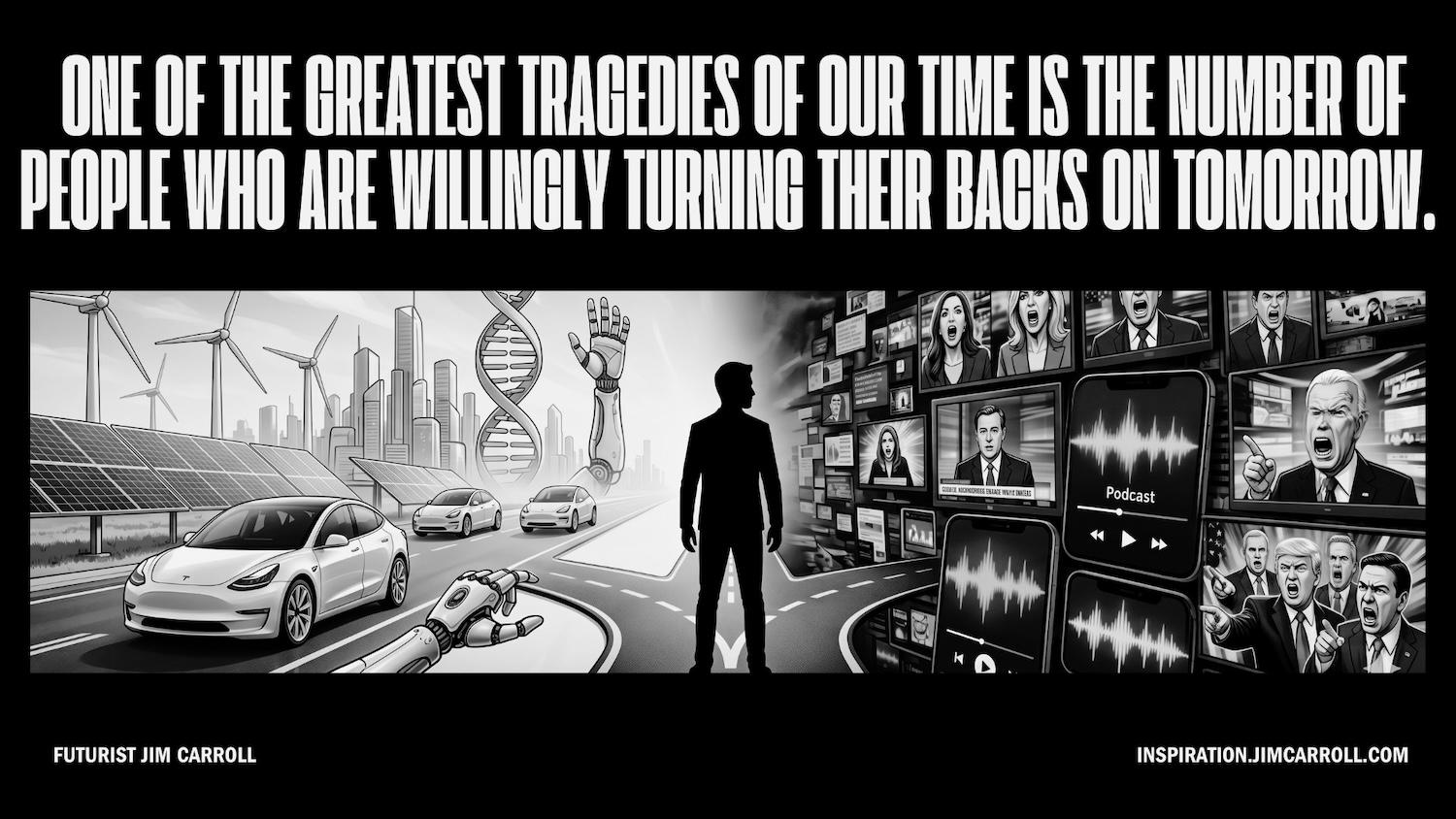
"One of the greatest tragedies of our time is the number of people who are willingly turning their backs on tomorrow" - Futurist Jim Carroll

I will never understand this era.

Yesterday, my email and online browsing laid bare the vast contradictions in our world today.

The first was the Science and Technology newsletter I receive, which provides up to date details on the ongoing advances with medical science. It led to an article on recent advances with mRNA technology, which was, of course, the basis for many of the Covid vaccines of years ago. The article was discussing how researchers are on the edge of some amazing opportunities with the technology, including the potential for cancer vaccines, vaccines for rare and emerging infectious and chronic diseases, as well as opportunities related to longevity and overall healthcare and wellness. I marvel at the era we live within.

And then a newsletter from Dr. Eric Topol landed in my inbox. It featured an interview he did with another expert on medical science about her book around the reality of evidence based medicine, delving into such topics such as expert opinion, hunches (eminence-based) science to empiricism, and why evidence-based medical science is always the proven methodology for advancing healthcare.

Then somehow I came across a post about Joe Rogan and an interview he did with Terry Bradshaw and how he was whining about ivermectin and how pandemic vaccines were just a big conspiracy by big Pharma and it was all a plot to just make more money and how he knew more than they did ...followed by a a wonderful article from Paul Krugman, ex of the New York Times, that fit the theme perfectly, as to how the US was throwing away its future because things like advance science and green technology and electric cars and such were an affront to the macho culture and instant-expert reality that seems to permeate so much that part of the world today...

....and I wondered how many people believe someone who has not a smidgeon of scientific or medical background...and I wondered how society ended up in this looney-toons world where vast numbers of the population are actively and regularly throwing away the opportunities of tomorrow because they've been conditioned to come to believe the wing-nuts and conspiracy theories and the angry shamans and the populist frauds who tell them that the future is all some vast conspiracy and things will be better and great again if everyone just chooses to go back to 1950 to a different time and place where things were rosy and wonderful and ..

And I get sad.

---
Futurist Jim.Carroll doesn't understand why so many fall for fraud.

Original post: jimcarroll.com/2026/06/daily-i

★ 0 • ↻ 0 original
Jun 11, 2026 · 9:40 AM UTC

"Every industry-changing breakthrough begins with a simple question: Why do we still do it this way?" - Futurist Jim Carroll

Of all the phrases I've come to hate over the years, it's this one: "But we've always done it this way!"

So what!

I won't bother repeating that phrase often wrongly attributed to Einstein. The point is this - you are guaranteed to fail if you keep doing the same thing in the face of constantly changing circumstances. You are bound to become irrelevant if your routine never changes when everything else does. It's a certainty you will fall behind if your product never changes but your customers and industry do.

Need I go on?

The simplest way to get ahead is to ask yourself this simple question: "What if we stop doing it the way we've always done it?" That frees you up to explore new ideas, opens you up to new ways of thinking, and cracks open wide the door to bold and fresh concepts.

The folks at Blackberry/RIM saw a device with a keyboard, and presumed they would always build the same thing. Steve Jobs saw the iPhone, which transformed a mobile phone with a keyboard into a pocket-sized computer, rendering the Blackberry obsolete overnight. Behind that was the simple premise: "what if we stop thinking the same way about mobile devices?" And that type of thinking is the thinking that leads to big, bold breakthroughs.

Always start out by having the courage to ask, "why do we still do it this way?"

---

Original post: jimcarroll.com/2026/06/daily-i

★ 1 • ↻ 0 original
Jun 12, 2026 · 9:25 AM UTC

"Every major failure always comes back to a leader who rises to the level of their own staggering incompetence!" - Futurist Jim Carroll

And sometimes you get to watch it unfold in real time.

That's it.

That's the post.

That's all I've got today.

★ 1 • ↻ 0 original
Jun 15, 2026 · 9:37 AM UTC

"You can't move a clock faster than it goes!" - Futurist Jim Carroll

One of the funniest and more unusual aspects of working with your wife in a home office for more than 30 years is that you still schedule work meetings.

For real!

Today, we have a meeting to take a look at her latest edits on my book Being Unique.

She's put a tremendous amount of effort into working with it, finding its flaws, discovering pathways, and knowing what to do to kick it into shape. This is book **#44** and she sure as heck knows what she is doing at this point - she's worked on all of them!

Today is the day she'll walk me through the latest result of those efforts, and this particular book will be one stop closer to the finish line. Her skills in this type of thing are pretty deep - I've often referred to her as the 5th Beatle when it comes to the 34 books I wrote and co-wrote in the 90s about the Internet, digital technology and e-commerce.

And with this process, I've been waiting patiently for her to finish her work.

And I've been patient....

I began the book sometime in 2023 - I don't remember the specific date. I went at the topic quickly, coming up with the barebones of the structure and idea. That came from the subtitle - "Turning Curiosity, Creativity and Courage into Your Competitive Advantage." Later on, I wrote a series of blog posts as a way to kick start my writing into gear. Eventually, I handed her a manuscript - and waited.

You see, she might be my business partner, but she's also a wife, a mother, and now, a Nana! She's been very busy on the Board of a charity we have been active with for a decade (and on the side, has effectively been their bookkeep/accountant, head of IT and many other things); she has my business to run; she volunteers at a local food bank operation and does so much more.

And so while book might be a priority, it is but one thing to fit into a very busy life.

And with that, I've had to learn patience.

This is a difficult for a very impatient guy whose entire motto is built around the word 'fast.'

Her reaction to the first draft of the book was .... not great. And looking back, it was in pretty poor shape. But the idea was there.

So I went back and took another kick at it, giving it a thorough rewrite, some more research, additional stories to fit into the theme....

And then it went back to her....

....and came back to me....

... and so on.

...for quite some time.

Which is why today's meeting is important. The book is not coming back to me, but in fact, is fully formatted and almost ready for print!

And through this process - which has pretty much been the reality of our lies for 30+ years - I have been slowly and carefully learning the art of patience.

Because you can't move a clock faster than it goes.

---

Futurist Jim Carroll is really proud of this latest book, and will soon make pre-orders available.

Original post: jimcarroll.com/2026/06/daily-i

★ 1 • ↻ 0 original
Jun 16, 2026 · 9:30 AM UTC

"Never fear admitting your first attempt fell short." - Futurist Jim Carroll

So this happened yesterday - we got the ISBN for the book!

...which means we should go to print in the next few short weeks.

I did decide it was time to try different subtitles, since the original had 'courage' and that didn't fit within the overall theme and content of the book.
Any preferences?

- How Curiosity, Rebellion, and Resilience Become Your Competitive Edge
- Why the Rebels, the Odd Ones Out, and the Crazy Ones Always Win
- Learn to Think Like the Rebels, the Odd Ones Out, and the Crazy Ones

Let me know if you have a preference!

So how does all this relate to today's quote? In my mind, I keep going back to the idea of the first draft, which I still had on my desk up to a few months. It was NOT in good shape, and it took me a while to admit it - very much so as the urging of my wife/editor. Through that process, I learned a lot more about my thinking, my writing, and my approach to this project.

For too long, I was tied to that first draft, unwilling to let it go. And somewhere along the way, I realized that is the exact same thing my clients do when it comes to innovation and new ideas. They are far too eager to get things moving, but far too unwilling to let things to when those first - or second or third - initiatives fail.

Succeeding at things not only means having the initiative to get things started, but the willingness to walk away from your first attempt when it no longer makes sense.

---
Original post: jimcarroll.com/2026/06/daily-i

★ 0 • ↻ 0 original
Jun 17, 2026 · 9:36 AM UTC

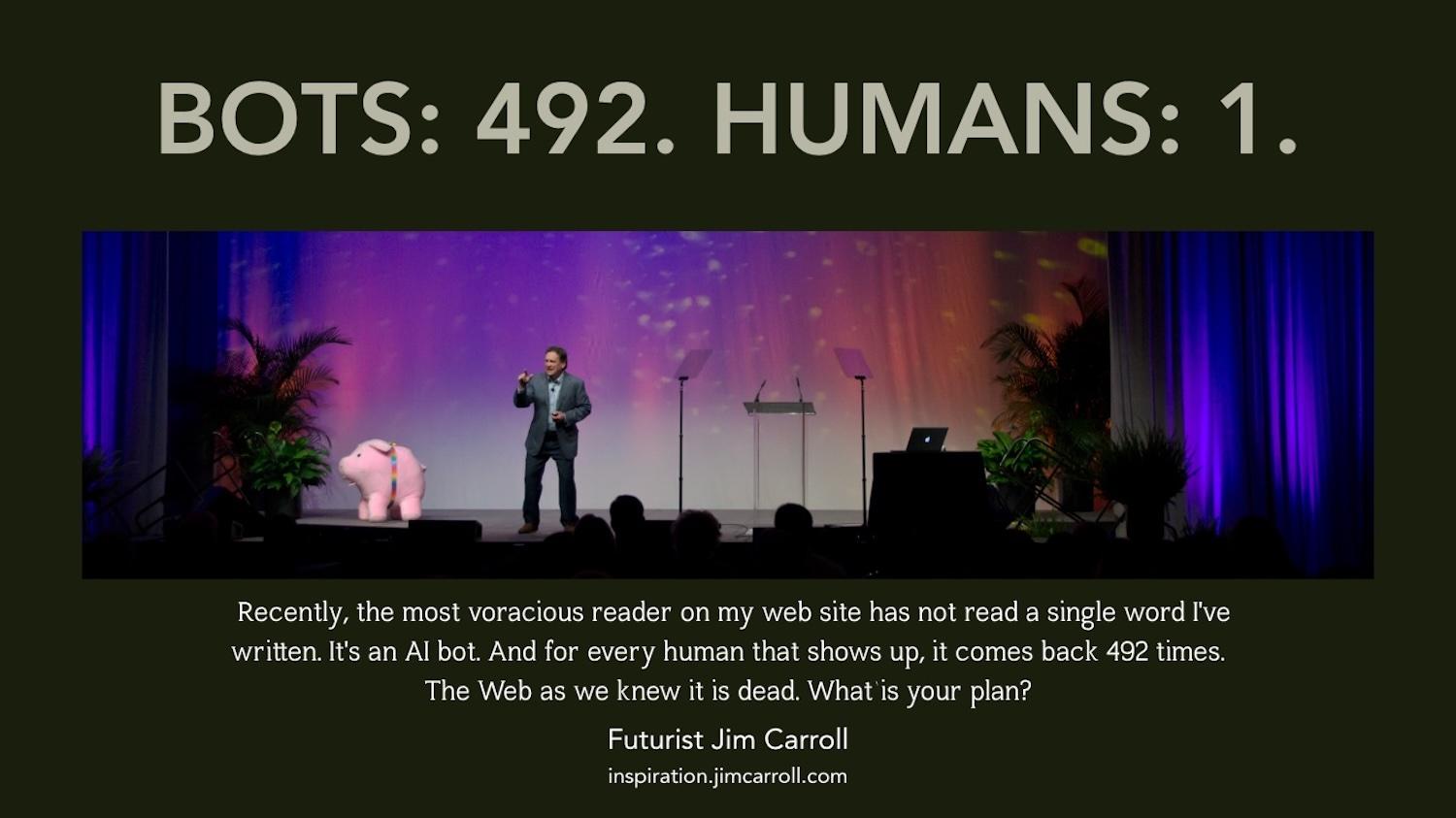
"Bots: 492. Humans: 1." - Futurist Jim Carroll

Let's talk about the elephant in the room - the fact that the Web, as we know it, is coming to an end, and that search, which so many have relied on for their business, is dying.

AI owns the future.

Recently, the most voracious reader on my website has not read a single word I've written.

It's an Al bot - or rather, many of them.

And for every human that shows up, they come back 492 times.

The Web as we knew it is dead. What is your plan?

Let that sink in for a moment.

I've spent more than 30 years tracking trends that reshape industries, careers, and businesses. I've called a lot of them early. But what is happening right now - to websites, to web traffic, to the very idea of how people find you - is one of the fastest and most consequential shifts I have ever witnessed.

And I have the data to prove it.

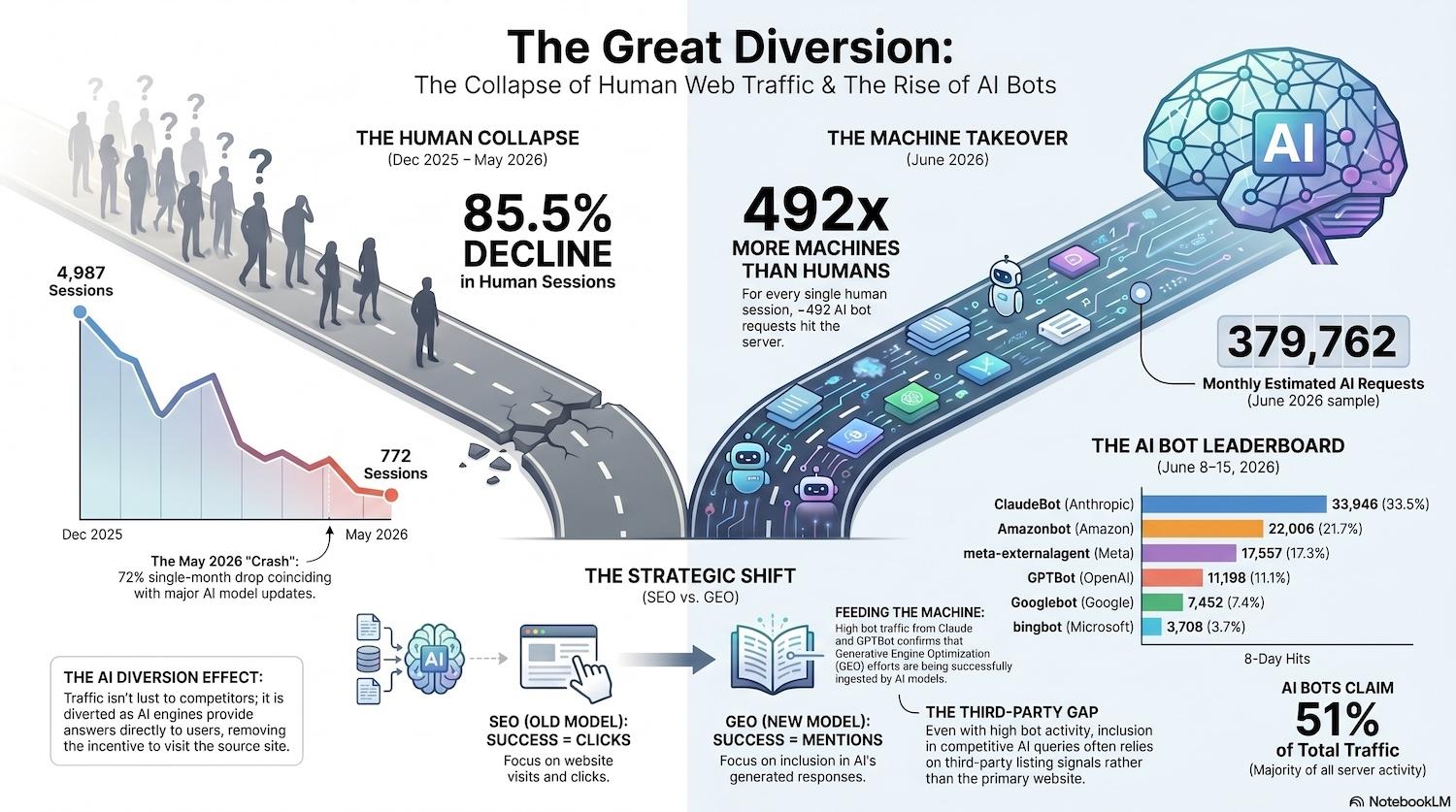
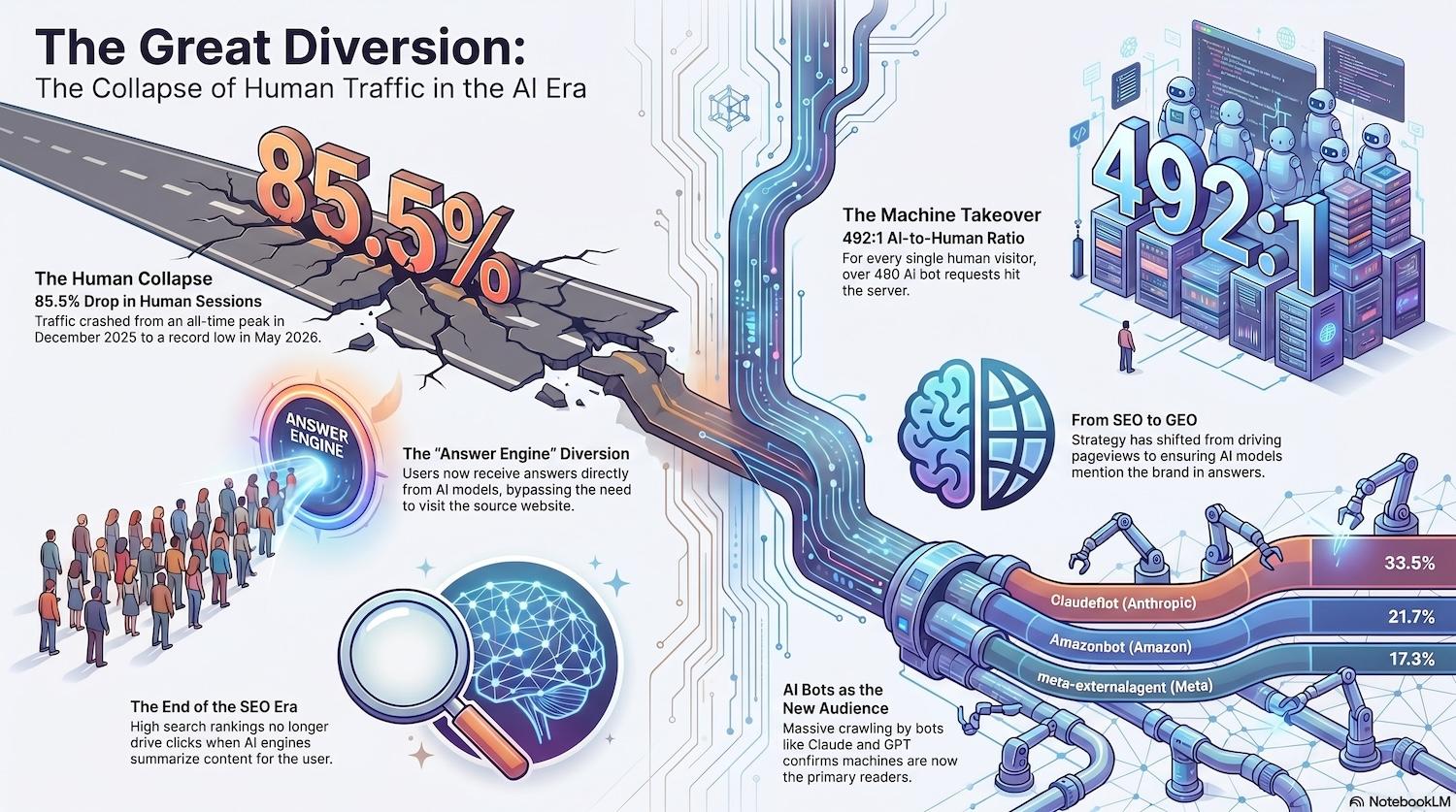
In just four months, human traffic to my website collapsed by 85.5%. This is based on an analysis of the actual traffic to my site.

Not declined. Not softened.

Collapsed.

The drop accelerated sharply in May when Google shifted aggressively to an almost-all-AI-summary search strategy. They announced it loudly. The industry press covered it extensively. And then the numbers hit.

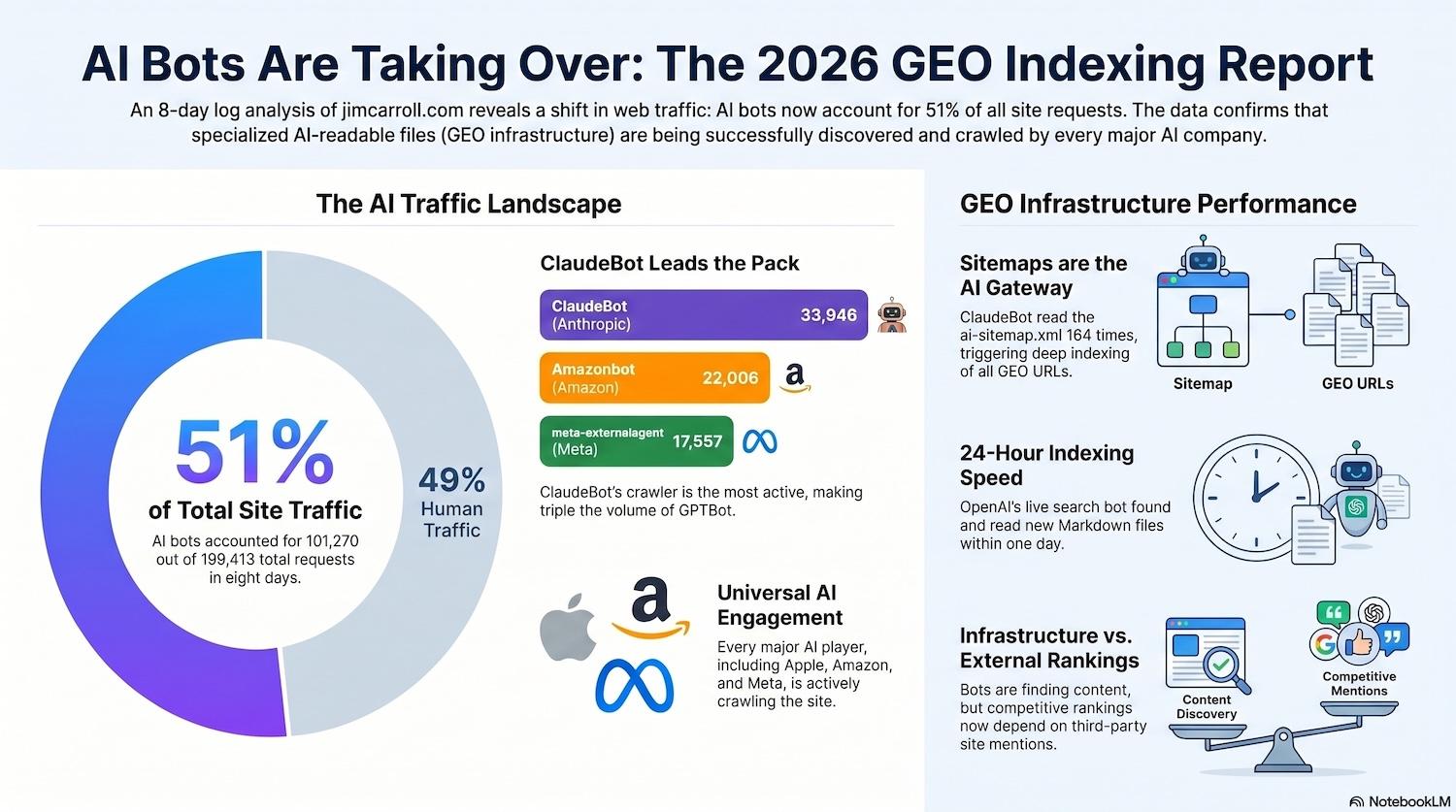
Here's what replaced those human visitors: machines. AI bots from Anthropic, Amazon, Meta, Google, OpenAI. They now generate 492 times more traffic to my site than humans do. 492 to 1.

Think about what that means.

People are no longer searching, clicking, and browsing. They are asking AI a question and reading a summary. If you're not in that summary, you don't get a click.

You don't get a visit.

You don't get considered.

You simply don't exist.

This isn't a warning about something coming. It's something already happening.

Right now, to your website, your traffic, your visibility.

I saw this coming. I spent the past several months rebuilding my entire digital presence to be machine-readable, citable, and authoritative to AI systems. It's working. The visitors hitting my site are the machines, the bots, the agents. And it's estimated they are going to visit me 400,000 times just this month alone. They are discovering new content that I create - such as this post - within less than 24 hours.

And this matters, because I'm now starting to show up in the AI summaries when people are searching for the types of things I do. You know, 'futurist keynote speaker.'

I'll show you exactly how, and what it means for you, in the posts ahead.

But first, go pull your traffic data.

What you find will get your attention.

---

Futurist Jim Carroll has been hard-core geeking out vibing his website into being AI agent optimized, and figures that at this point, he's gone one of the most hard-core geeked out vibed websites among the community of professional speaker and consultants in the world.

Original post: jimcarroll.com/2026/06/daily-i

★ 0 • ↻ 0 original
Jun 18, 2026 · 9:54 AM UTC

"Your website is no longer a magazine for humans to read. It is a structured database for machines to ingest." - Futurist Jim Carroll

Watch this video.

youtube.com/watch?v=3c8RFWv8fq0

You need to understand why your Web traffic collapsing.

Essentially, fewer people will browse your Website. Machines will. You need to make it friendly for them.

Since this post is all about AI (and since I've got a tee time in 81 minutes!), I've had Claude AI summarize the video.

Tomorrow, I'll explain to you what to do about it.

----

There are two internets now: the one you browse, and the one AI crawls for facts it can confidently repeat. It doesn't care about your branding — only whether it can verify who you are.

That's Generative Engine Optimization (GEO). I rebuilt parts of my site around it:

Welcome mat — plain-text files (bio, client list, an llms.txt "table of contents") sitting right at the door, with AI crawlers explicitly let in.

Labels it can't misread — invisible tags marking job titles, verified quotes, and over a thousand videos, plus a direct line letting AI agents request specific info instead of reading whole pages.

Outside vouching — Wikipedia, Wikidata, and a verified Google Business Profile, so the proof doesn't just come from me.

Line all of it up, and AI stops guessing about you — it cites you instead.

So: is your site built for humans only, or for the machines reading it on their behalf too?

---

Futurist Jim Carroll was going to do a longer explainer post but there were thunderstorms overnight and so he slept in and he is going to keep faithful to his tee time.

Original post: jimcarroll.com/2026/06/daily-i

★ 0 • ↻ 0 original
Jun 18, 2026 · 3:52 PM UTC

Congrats to the US for indicating that unconditional surrender was the only path forward for concluding the Iran War...

... and unconditionally surrendering to Iran!

Iran sure thinks the US is great again!

★ 2 • ↻ 0 original
Jun 19, 2026 · 9:51 AM UTC

"Every website must now speak fluent AI. It's time to get yours graded!" - Futurist Jim Carroll

Yesterday I showed you what I built to get my site ready for the era of Ai.

Today I show you the grade.

I commissioned a full technical audit of jimcarroll.com — every file, every schema tag, every standard, checked live against what AI engines actually look for in mid-2026. No self-congratulation. Just a cold, line-by-line assessment.

The result: A−.

You can read the full report here. Fair warning - it's pretty technical. That's the nature of the topic.

Here's the technical breakdown. You probably don't know what this means - but you should.

On-site technical AI-readiness: A. llms.txt, machine-readable file endpoints, structured data, AI crawler permissions, agent tools — all live, all correct.
Entity & authority signals: A−. Wikipedia. Wikidata. A verified Knowledge Panel. This is rare in the speaking industry. Most of my competitors have none of it.
Content freshness: A. A new post goes out every single workday (my Daily Inspiration). AI engines reward recency and currency and uniqueness hard.
Off-site citation footprint: C.

That last one is the big headline.

I built the best version of my site I possibly could. I made it fluent in the language machines speak. And when the audit checked the actual queries (i.e "top futurist keynote speakers 2026"), I'm still not consistently showing up in the third-party lists that AI engines actually cite.

Why? Well, my AI readiness is new - but here's the uncomfortable truth: being technically perfect doesn't make you visible. AI doesn't just read your site. It cross-references you against everyone else's site - speaker bureau pages, "best of" listicles, press mentions, trade publications. If those don't mention your name, your own perfect plumbing only gets you so far.

And so now I'm working hard on that. Yesterday, I built into my long version AI file all the details on the many speaker bureaus that represent me worldwide.

That will be a powerful addition.

So is on-site optimization a waste of time? No. It's a starting point. Without it, none of the off-site work matters because the AI can't verify what it finds about you. But the foundation alone won't get you cited. You need other credible sources repeating your name.

This is exactly why I told you on day one to talk to your tech team. And it's exactly why I'm telling you today: the work doesn't stop at your website. It extends to every bureau page, every listicle, every mention of your name across the web that AI can find and trust.

The machines are reading.

Make sure they're reading the right things, in the right places, about you.

---

Futurist Jim Carroll has been deeply fluent with tech for 45 years. It shows in the highly technical projects he often takes on.

Original post: jimcarroll.com/2026/06/daily-i

★ 1 • ↻ 0 original
Jun 22, 2026 · 9:55 AM UTC

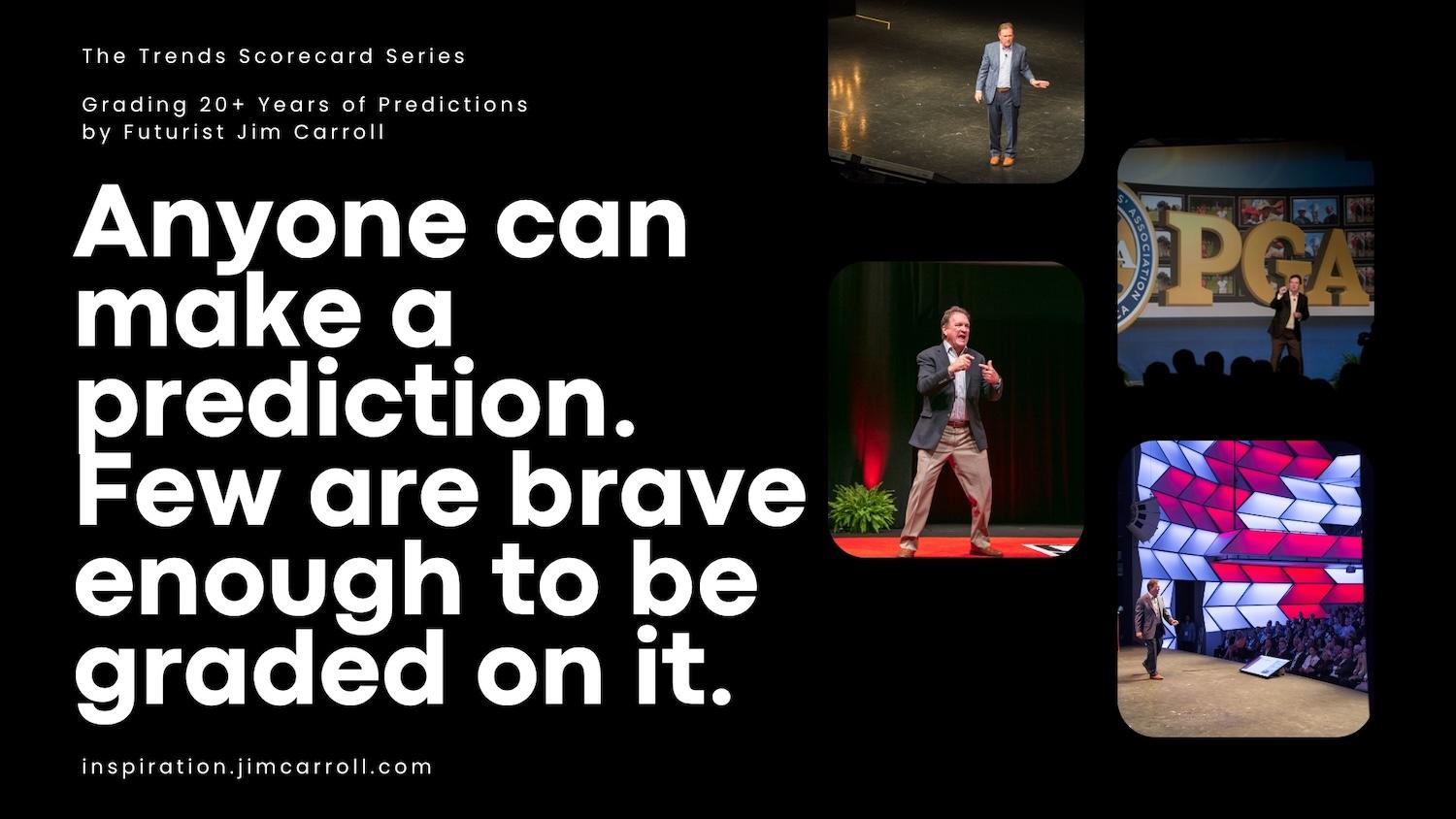
"Anyone can make a prediction. Few are brave enough to be graded on it." - Futurist Jim Carroll

--
This is the introduction to a new series, The Trends Scorecard, in which I go back through 20+ years of my own keynotes and predictions, industry by industry, and grade them honestly against what actually happened.
--

I don't mind saying that I am VERY good at what I do.

After all, you don't get a client list that looks like this by being some sort of flake. Fact is, some of the most prestigious organizations in the world have booked me for leadership insight over the last 35+ years. I mean, if NASA invites you in to predict the future of the space industry, in front of a room fall of astronauts, and you were mostly bang on despite the skepticism, you're pretty good!

With that bit of self-serving and perhaps obnoxious boasting out of the way, here's a confession about my profession: most futurists never get graded.

We stand on stages, we make bold claims about the decade ahead, the audience nods, the lights come up, and then everyone goes home. Nobody ever circles back five, ten, or twenty years later to check whether any of it came true.

It's been a remarkably accountability-free line of work.

So I decided to do something about that. For more than two decades, I've been telling audiences in just about every industry on earth what was coming next. Those talks and blog posts are all still sitting there, time-stamped, in my archive. Which means I can do the one thing futurists tend to avoid: pull up what I actually said, line it up against reality, and mark it with a grade. Hits, misses, and the ones where I had the direction right but was too optimistic on the timing.

How did I do this? I used AI. Actually, I used Claude to extract all of my posts - many thousands of them - and process them industry by industry. It then took that, put them together into my forecasts (with dates) and then graded them based on where we are today.

And that's what I'll share over the next 10 days. Hits and misses and the "I was right but too early" ones.

Why bother grading myself?

Because the predictions that landed weren't lucky guesses. They came from a single, repeatable method based on hard-core research. It's the same process I use today:

- Watch where the technology or other trend curve is bending.
- Assume it bends faster than the consensus expects.
- Follow it all the way to its logical conclusion, even when that conclusion sounds absurd at the time.

That's it. That's the whole trick. That's how I figure out the future.

Each post takes one industry, digs up my real predictions across the years, and grades them.

Check in tomorrow when I will tackle the first of a dozen industries.

Original post: jimcarroll.com/2026/06/daily-i

★ 1 • ↻ 0 original
Jun 23, 2026 · 9:28 AM UTC

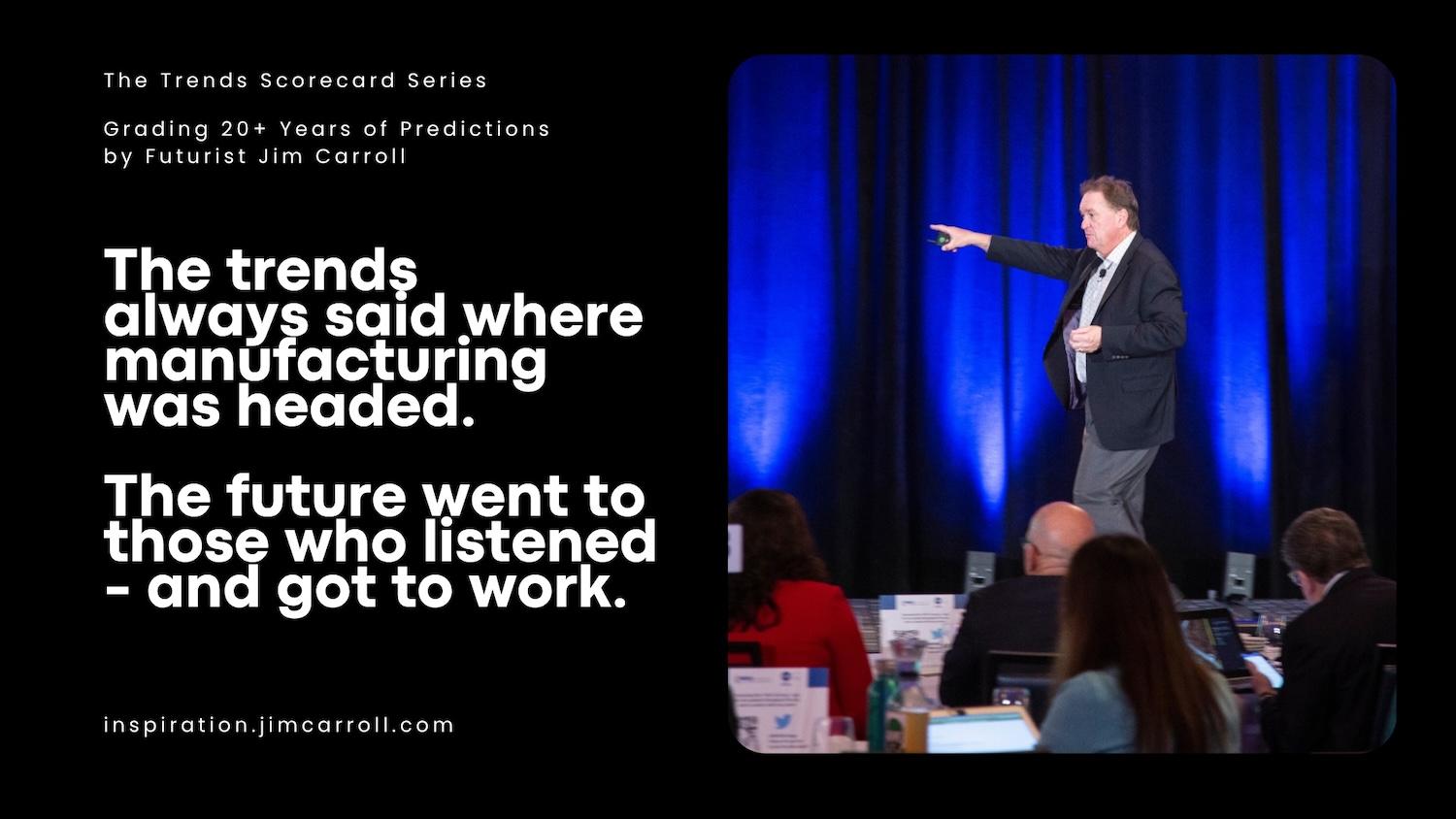
"The trends always said where manufacturing was headed. The future went to those who listened — and got to work."— Futurist Jim Carroll

--
For 20+ years, I've stood on stages around the world telling manufacturing audiences what was coming next. So let's do something most futurists carefully avoid: let's go back, dig up what I actually said, and grade it. No cherry-picking. Here's the scorecard.
--

The setup: a sector everyone keeps writing off

For two decades, the story told about North American manufacturing has been the same: it's dying, it's done, it's gone to China, it's never coming back. I've never believed that would be true for organizations that chose to listen to what the trends told them - and I've been saying so on stage since the mid-2000s. Back in 2011, keynoting IMX in Las Vegas alongside a retired CEO of Porsche and the U.S. government's first "Chief Manufacturing Officer," I put it bluntly to a room of 400 executives:

"Some people see a trend and see a threat. Innovators see the same trend and see nothing but opportunity."

Looking back at my slide deck from that event, I can clearly see where I first used that phrase which has defined so much of my mindset.

And that thinking clearly applies to the world of manufacturing. There are those who are busy reinventing, reinvesting, reimagining and reengineering. They are rethinking how they do everything, adopting leading edge technologies and concepts, and are loading up on the innovative new manufacturing methodologies available to them.

And yet sadly, there are many others who have come to believe that bluster, barriers and blowhards will somehow magically lead to a renaissance int the industry - that the 'olden days' will be brought back through some sort of magic trick.

You know my thoughts on the latter.

Back to the key point of this post - taking a look at what I predicted vs. what has transpired. Here's what I called, and how it played out.

(read the rest of the post)

Original post: jimcarroll.com/2026/06/the-tre

★ 0 • ↻ 0 original
Jun 24, 2026 · 9:41 AM UTC

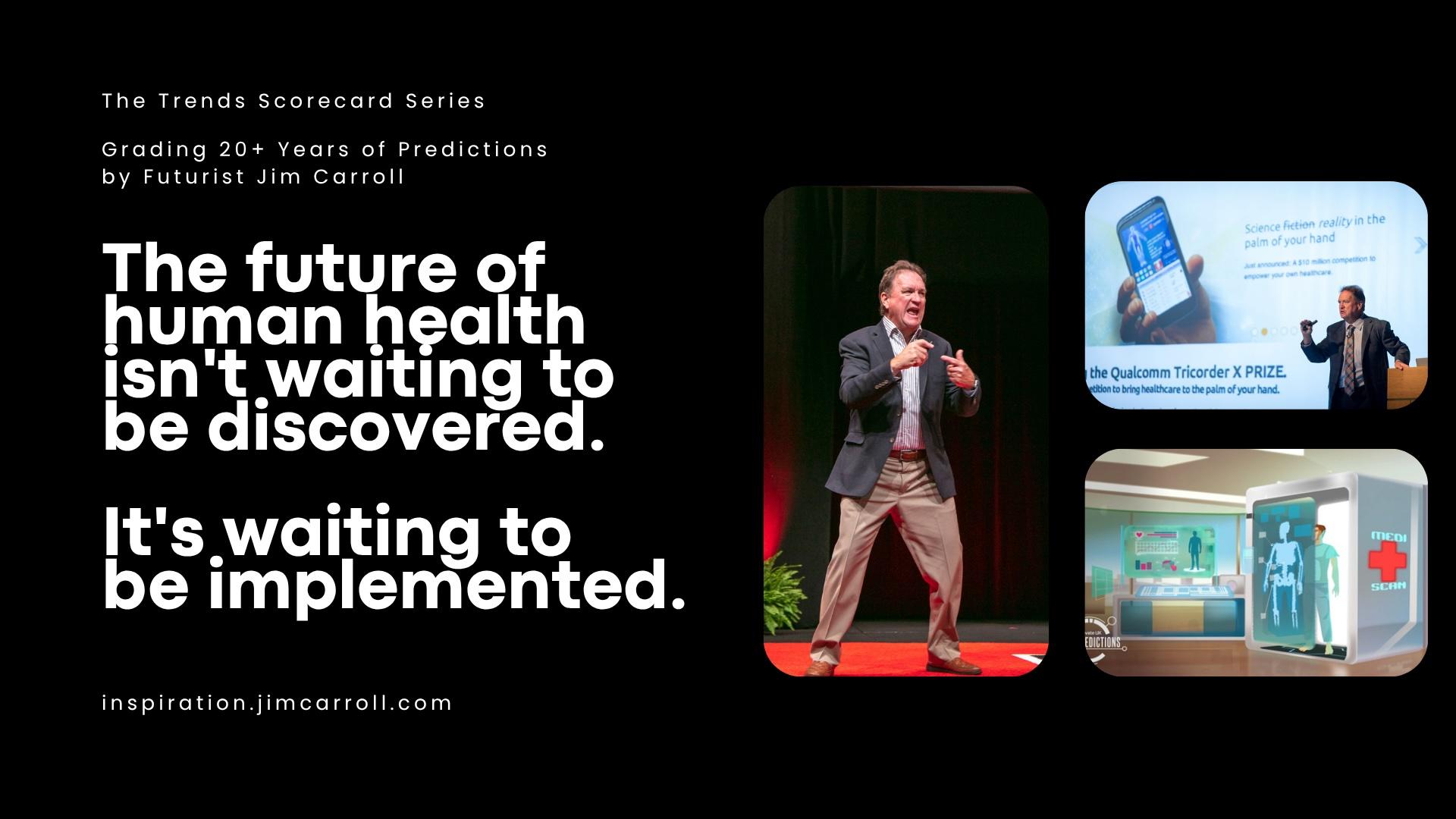
"The future of human health isn't waiting to be discovered. It's waiting to be implemented." — Futurist Jim Carroll

--
This is my Trends Scorecard series, where I go back into my own archive, dig up the predictions I actually made on stage years ago, and grade them honestly against where we've landed in 2026. No cherry-picking, no rewriting history. Here's the scorecard.

--

The setup: I've been betting on this industry for twenty years.

And one thing I've learned is that healthcare doesn't have an opportunity problem. It has an implementation problem.

Here's the thing about healthcare. It moves at two speeds at once. The science screams forward at a furious pace, and the system crawls behind it, tangled in politics, inertia, and complexity. I've spent two decades telling rooms full of pharma executives, hospital CEOs, and benefits leaders the same core message: the future of medicine is a shift from "sick care" to actual "healthcare." Way back in 2006, I walked into a half-day session with a major pharmaceutical player and laid it out like this.

The big picture item is that we are in the midst of a fundamental, significant shift in healthcare philosophy and medical research: from a world in which we "react" to disease and illness after it has happened, to one in which we will be doing far more to "prevent" health care problems through highly personalized medicine. This is primarily coming about because of furious rates of discovery related to genomics. This more than anything will dominate the health care / pharmaceutical research / delivery agenda through the next years.

That was the thesis. Everything I said for the next twenty years built on it.

And it's not like I haven't spent a lot of time in the sector. I had Claude interrogate my blog and build a list of the groups I've spoken. It's quite the list!

Pharmaceutical & Biotech — Pfizer, PhRMA, Genentech, Boehringer Ingelheim, Emergent Biosolutions, Icon PLC, NCPDP, National Pharmacy Forum, World Pharma Congress
Hospitals & Health Systems— Greater Lansing HealthCare, Pennsylvania Hospital Association, Optima Health, Mercy Health,
Medical Associations— American Medical Association, American Association of Orthopaedic Executives, American Health Care Association
Medical Devices & Supplies) — Stryker, Phillips Medical Devices, Henry Schein
Dental — Invisalign/Aligntech, Cain Watters, Ontario Dental Association
Health Plans, Benefits & Wellness— Magellan Health, Anthem Health, Highmark Health, NY Health Plans Association, Benefiq
Congresses & Services — World Health Care Congress, World Health Care Innovation & Technology Congress, EY Healthcare Practice Summit, Practice Match

These are only the ones I've blogged about - gosh, there have been countless others!

So how did I do? Let's pull the receipts.

Original post: jimcarroll.com/2026/06/the-tre

★ 0 • ↻ 0 original
Jun 25, 2026 · 9:25 AM UTC

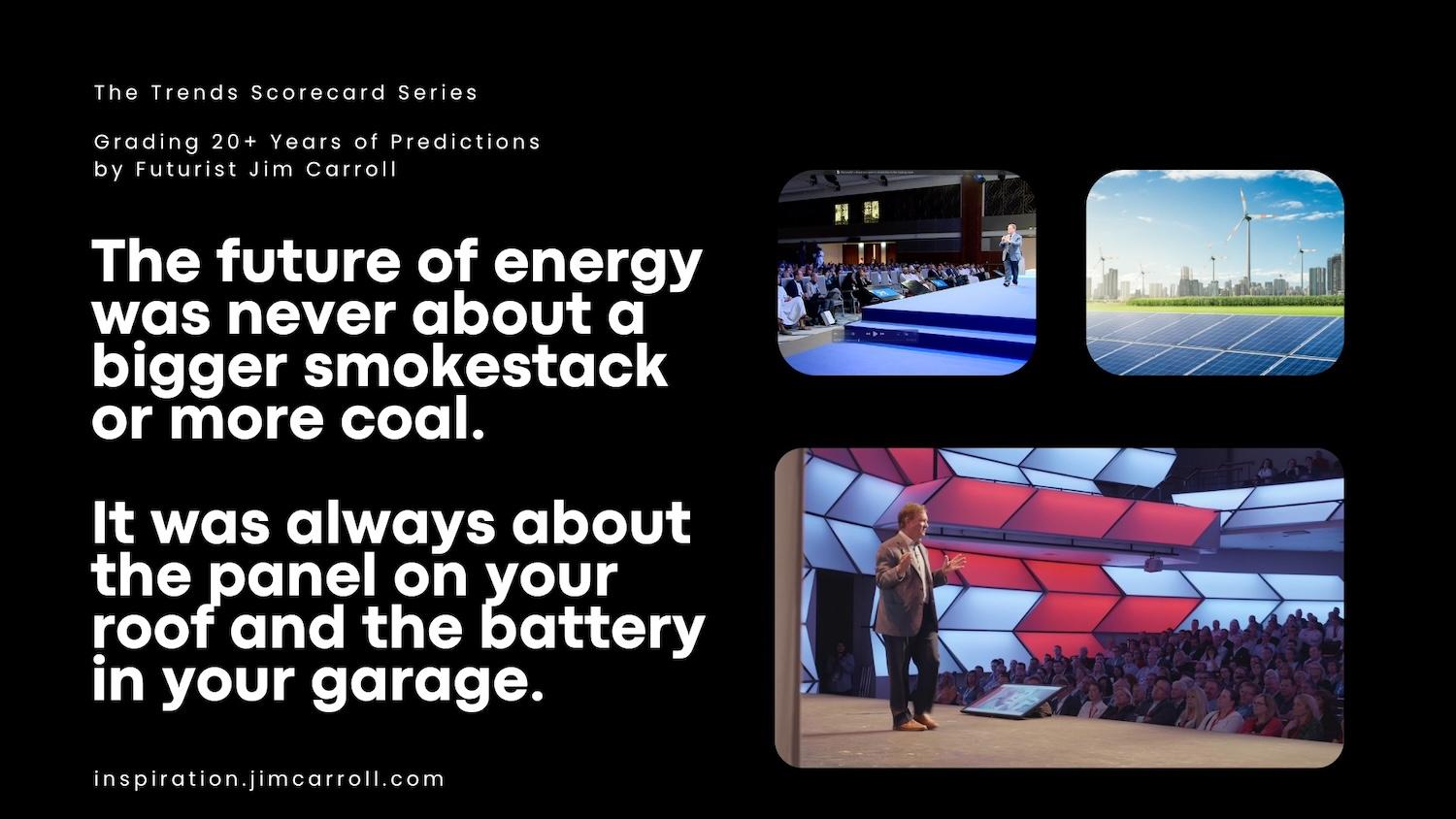
"The future of energy was never about a bigger smokestack or more coal. It was always about the panel on your roof and the battery in your garage." — Futurist Jim Carroll

--
This is part of my Trends Scorecard series, where I dig back through everything I have said about the future of an industry over the years and grade my own predictions honestly against the reality we are living in right now. This time the industry is Energy & Utilities. I have been keynoting energy conferences since before "smart grid" was a buzzword, so there is a lot to score. Here's the scorecard.
--
The setup: I have been calling the death of the old grid for almost two decades

Energy is the industry I keep coming back to, because it is the industry where the future arrives in slow motion and then all at once.

For years I stood on stages in front of utility CEOs and oil executives and told them the same uncomfortable thing: the centralized, carbon-based, one-way model you have run for a hundred years is ending, and the future belongs to a distributed, intelligent, two-way grid that you do not yet control. Some of them rolled their eyes. A lot of them are living it now. Back in 2015, in an interview for GE Reports, I framed the whole risk in one image that the music industry already knew too well.

The quickly shifting energy landscape means utilities and other industry players must be careful not to be "MP3'd" like the music industry. Could the energy generation and distribution industry find itself in the same position as music companies did in the past -- stuck defending an older and entrenched business model, rather than embracing new ideas, concepts and methodologies?

And it's not like I'm a stranger to this industry. I had Claude dig through my blog and pull together a list of the energy and utility groups I've spoken to over the years. It's quite the roster!

Electric Utilities & Power Generation — Exelon Nuclear, The Energy Authority, Indiana Municipal Power Authority
Electric Cooperatives & Regional — NRECA (2 events), Rocky Mountain Electrical League
Oil, Gas & Petrochemicals — Noble Energy, CF Industries
Energy Tech, Metering & Smart Grid — Itron, Siemens Energy, Schneider Electric, GE Lighting, Lennox, SAP Utilities
Energy Services, Data & Summits — DTN Energy, Accenture Global Energy Summit, SURGE Accelerator
Engineering, Mining & Adjacent — Black & Veatch (2 events), National Mining Association, American Residential Services, CCI Wireless, FM Global
Major Utilities (roster reference) — OPG, PG&E, Hydro One, TransCanada, EPRI
And those are only the ones I've blogged about — there have been plenty more.

So how did those calls hold up? Let's take a look.

Full post: jimcarroll.com/2026/06/the-tre

★ 0 • ↻ 0 original
Jun 26, 2026 · 9:39 AM UTC

"The future of the automobile was never about a better engine - it became a computer on wheels.Tesla built it, but BYD is now cashing the check." - Futurist Jim Carroll

--
This is part of my ongoing Trends Scorecard series, where I go back into my own archive, dig up what I actually predicted years ago, and grade it honestly against the world of 2026. No cherry-picking, no rewriting history. This time the industry is Automotive & Transportation. Here's the scorecard.
--

We will likely never see a bigger self-own and business failure than the imminent disappearance into irrelevance of the North American automotive industry. And it didn't really need to happen.

I have been on stage talking about the transformation of the car since before most people thought there was anything to talk about. I told a senior leadership team at Mercedes-Benz, in Stuttgart, back in 2006, that the entire business model of the automobile was about to be turned inside out. They laughed at me.

For years I argued that the car was about to stop being a mechanical object and start being a computer, that the engine was going to give way to the battery, that Silicon Valley would take the steering wheel away from Detroit, and that the very idea of who builds a car, and how, was going to fragment into something unrecognizable. So when I sit down to grade myself on this industry, I do it knowing I have a long paper trail. Here is one of the lines I kept coming back to, year after year, talk after talk:

The future always happens -- the rest is just timing.

Hold onto that line. It turns out to be the key to the whole scorecard -- including the one prediction I want to flag honestly at the end.

And it's not like I've been a stranger to this industry. I had Claude dig through my blog and pull together the automotive and transportation groups I've keynoted for over the years. Quite the convoy:

Automakers & Vehicle Manufacturers — Mercedes-Benz, DaimlerChrysler, Volvo / Mack Trucks (multiple events), Kalmar Ottawa, Magna
Dealers & Dealer Associations — National Automobile Dealers Association, American Truck Dealers, Canadian Automobile Dealers Association Summit
Trucking, Fleet & Telematics — Omnitracs, National Association of Truck Stop Owners, Truck Parts & Service, International Road Transport Union World Congress, FleetOwner Magazine
Aftermarket & Repair — Autoglass
Automotive Finance, Lending & Leasing — Credit Union Direct (Drive Conference), American Financial Services Association, Canadian Finance & Leasing Association
Transit, Roads & Infrastructure — Trapeze Group, Colorado Department of Transportation, Ontario Road Builders Association
Logistics — Concentric Symposium (AI in Transportation & Logistics)

And those are just the ones I've blogged about : there have been plenty more.
So how did my calls hold up?

Read the rest of the post: jimcarroll.com/2026/06/the-tre

★ 0 • ↻ 0 original
Jun 29, 2026 · 9:32 AM UTC

"The future doesn't reward what you learned. It rewards how fast you can learn next." — Futurist Jim Carroll

--
This is part of my Trends Scorecard series, where I dig back through my own archive of predictions and grade them honestly against where we actually landed. This time the industry is Education. I have been telling audiences for decades that the future of learning would look nothing like its past. So did it? Here's the scorecard.
--

The setup: I bet my whole education message on one uncomfortable idea

For more than twenty years, every education keynote I gave opened the same way. I would stand in front of a room full of university presidents, college administrators, test publishers and credentialing experts, and I would tell them that the comfortable, four-year, get-your-degree-and-you-are-done model they had built their institutions around was quietly becoming a relic.
The world was speeding up. Knowledge was becoming perishable. Careers were splintering. And the entire purpose of education was shifting from filling people up with facts to teaching them how to keep refilling themselves, forever. Here is the line I used to set the stage, over and over again:

You need to deliver knowledge that you aren't yet aware of, for jobs that don't yet exist, to a group of people who don't know that they will need it. And you need to do it yesterday!

And this isn't a sector I'm new to. I had Claude dig through my blog and pull together the education groups I've keynoted for over the years. It seems like a rather sparse list, but that's probably because I haven't blogged or shared video about many of the others.

Colleges, Universities & Career Education — Career Education Colleges & Universities, Association of Private Sector Colleges & Universities, DePaul University
Education Industry, Publishers & Conferences — Pearson Education, EdNET, Association of Test Publishers, University Business Magazine

So did the message hold up? Let's take a look.

---

Original post: jimcarroll.com/2026/06/the-tre

★ 1 • ↻ 0 original
Jun 30, 2026 · 9:37 AM UTC

"The world's oldest profession became its most advanced. Tomorrow's farm runs on robots, sensors, and code." — Futurist Jim Carroll

--
This is part of my Trends Scorecard series, where I go back into my own archive, dig up the predictions I actually made about an industry, and grade them honestly against the world as it really turned out. This time the industry is Agriculture & Food. I have been telling farmers, ranchers, and food companies for two decades that their world was about to be reinvented from the soil up. So how did I do? Here's the scorecard.
--

The setup: I have been calling this one for a very long time

I started speaking to agricultural audiences back when "the future of farming" still sounded like science fiction to a lot of the people in the room. The thesis never really changed. A new generation would take over the family farm, they would bring the technology habits of the gaming and smartphone era with them, and the entire industry would move from intuition to data, from daylight to round-the-clock, from mass production to mass customization. I said it on a lot of stages, and I wrote it down so it could be checked later. Here is one of the moments where I planted the flag, looking back from 2021 at where this all began:

"Get ready for a world of real-time, autonomous, spatial intelligence farming!"

And this is a sector I know from the inside of a few hundred ballrooms. I had Claude dig through my blog and pull together the agriculture and food groups I've keynoted for over the years. It's a big harvest:

Agriculture, Crops, Inputs & Equipment — Nutrien, Wilbur Ellis, Simplot, FMC Agriculture, CropLife / GrowCanada, United Suppliers Technology Exchange, Mosaic AgCollege, Reinke Manufacturing, Hunter Industries, American Cotton Shippers Association

Cooperatives, Producer Boards & Farm Credit — CHS Inc, Land O' Lakes, Purina, United Soybean Board, Western Growers Association, AgFirst Farm Credit Bank, Northwest Farm Credit Cooperative

Livestock, Cattle & Dairy — CattleCon, Texas Cattle Feeders Association, Micro Beef 4C Summit, National Dairy Convention, International Dairy-Deli-Bakery Association

Agricultural Media & Data — DTN Agriculture / The Progressive Farmer, Farm Journal Publications

Food Brands, Manufacturing & Produce — Maple Leaf Foods, Rich Foods, Godiva Chocolates, Pladis (McVitie's, Ulker), Wegner Group, Stellar Group, Flavor & Extract Manufacturers Association, Produce Marketing Association Fresh Summit, Potato Expo

Restaurant, Beverage & Consumer Food — Subway Canada, Multi-Unit Restaurant Technology Conference, Admiral Beverage, Coffee, Tea & Water Association, Benefiq, Burger King, Yum! Brands

And those are only the ones I've blogged about — there have been plenty more, particularly throughout Canada in the 90s.

So how did the calls hold up? Let's look.

--
Original post: jimcarroll.com/2026/06/the-tre

★ 0 • ↻ 0 original
Jun 30, 2026 · 6:46 PM UTC

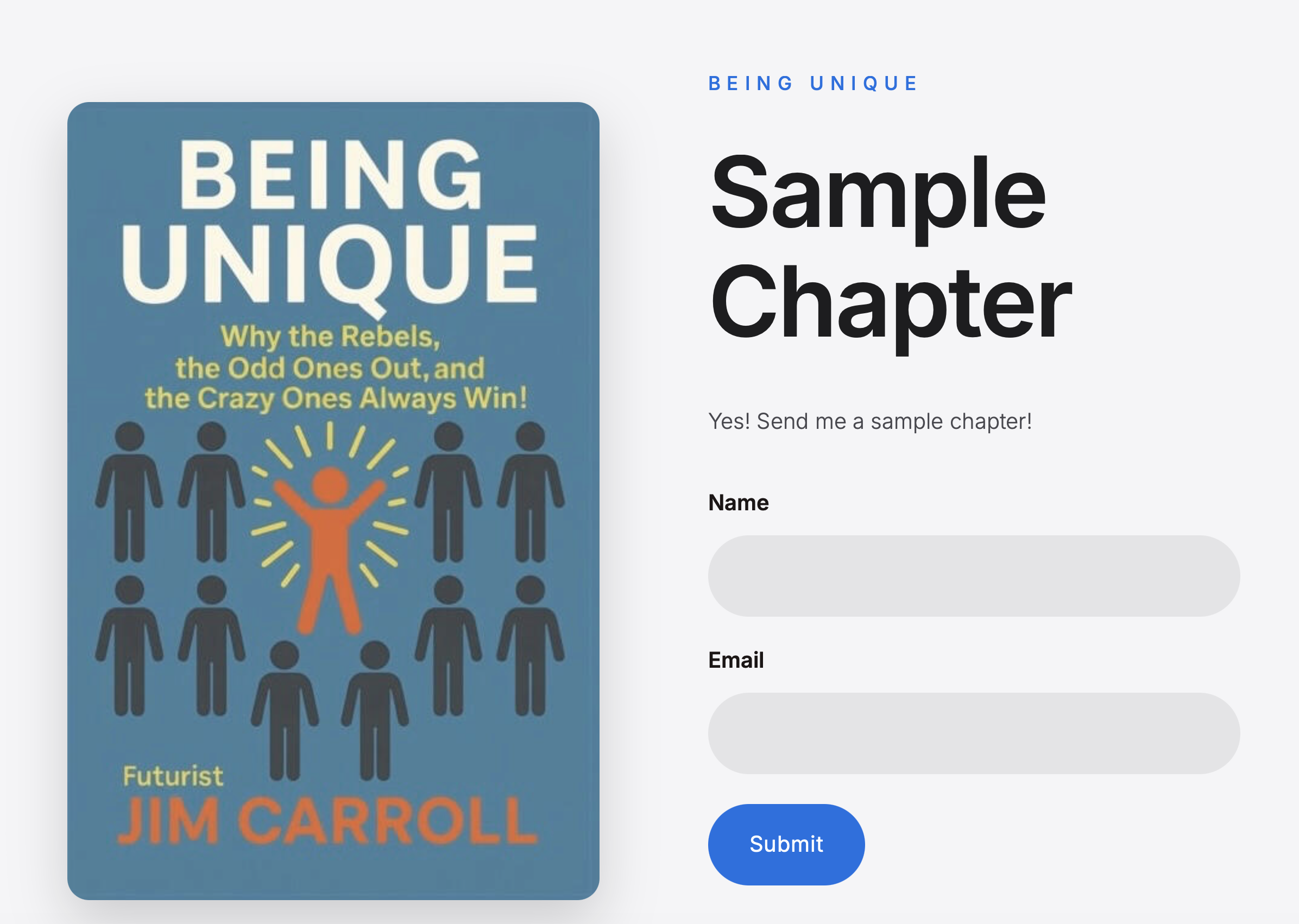
I'm thrilled to announce that I am days away from releasing one of my proudest works: BEING UNIQUE - Why the Rebels, the Odd Ones Out, and the Crazy Ones Always Win!

And a sample opening chapter is now available!

---
In a world racing toward sameness, your difference is your edge.

The future doesn't belong to those who fit in. It belongs to the rebels, the odd ones out, and the crazy ones who think differently and get to tomorrow first.

From the cartoon misfit Oblio to physicist Richard Feynman, from Thomas Kuhn's paradigm shifts to Grace Hopper's rebellion, futurist Jim Carroll makes the case: uniqueness isn't a quirk to apologize for—it's a weapon to sharpen.

Curiosity fuels it. Rebellion drives it. Resilience protects it.

In an age where AI handles the ordinary, the uniquely human becomes invaluable. The safe path is now the riskiest route.

Stop trying to fit in. Find what makes you different—and do more of it.

Get your sample chapter at **sample.unique.jimcarroll.com**

★ 0 • ↻ 0 original
← May 2026July 2026 →