Futurist Jim Carroll

Mastodon post archive · 2022–2026
Archived from mastodon.futurist.info · 4209 posts
← All months

July 2026 · 23 posts

← June 2026
Jul 1, 2026 · 9:34 AM UTC

"A different direction means a louder voice. Get ready, world: you're getting more Canadian cowbell." - Futurist Jim Carroll

Happy Canada Day!

July 1 marks the 159th birthday of what most global surveys rank one of the best places in the world to live.

I concur.

So what's the basis for todays' quote? Word is that the USMCA - the most successful trading agreement in history - won't be renewed today, marking a 10 year countdown to its termination. That's a long time in geopolitics - and it's a near certainty that those opposed to it probably won't be around to see what happens. The inevitability of biology always has its way. And personally, I believe that the inevitability of time will put it on a path to some soft of renewal.

That said, we're not your granddads Canada anymore, and friendships, once destroyed, take a long time to come back.

With all that, for the last few years, one thing has been clear - Canada has had a massive choice to make: do we wait around for our southern neighbour, once a staunch ally, to dictate our terms, or do we finally take control of our own economic destiny?

It's pretty certain it's the latter - and with that, it's pretty clear that the rest of the world is about to see a lot more cowbell as Canada gets more aggressively involved on the world stage. Cowbell? The greatest SNL skit of all time!

Prime Minister Mark Carney made it crystal clear recently that we are charting a fundamentally different path forward, noting that "hope isn't a plan, and nostalgia isn't a strategy." Instead of looking backward at old, volatile relationships, the focus has shifted fiercely to what we can control. That involves building a resilient, self-reliant nation that aggressively expands its global trade reach on our own terms - and which does not rely on a neighbour to the south.

This new direction makes me look back at a deeply personal blast from the past. Seventeen years ago, in May 2009, I published a satirical press release on my blog titled "Canada announces end of economic relationship with the US, & a bold new strategy to 2020." At the time, I wrote it tongue-in-cheek to point out the cyclical friction across our border. I even temporarily took it down because it felt too provocative.

I WROTE THIS IN 2009. It looks spot on today.

The fact is, as I look at the global landscape today, what started as pure satire reads like a blueprint. From building independent trade corridors to taking full charge of our resource and agricultural sovereignty, the goals we joked about in 2009 are fast becoming the exact roadmap we need today.

Sometimes, satire just isn't funny anymore because it becomes all too real.

Happy Canada Day. Let's make some noise!

Here is what I wrote back in 2013, followed by the original 2009 post.

It's right here: jimcarroll.com/2026/07/daily-i

★ 1 • ↻ 1 original
Jul 1, 2026 · 6:05 PM UTC

Me, at 545am this morning. "The world needs more Canadian cowbell."

Mark Carney at 1045am. "Canada is going into Eurovision!"

MORE CANADIAN COWBELL!

★ 1 • ↻ 0 original
Jul 2, 2026 · 9:22 AM UTC

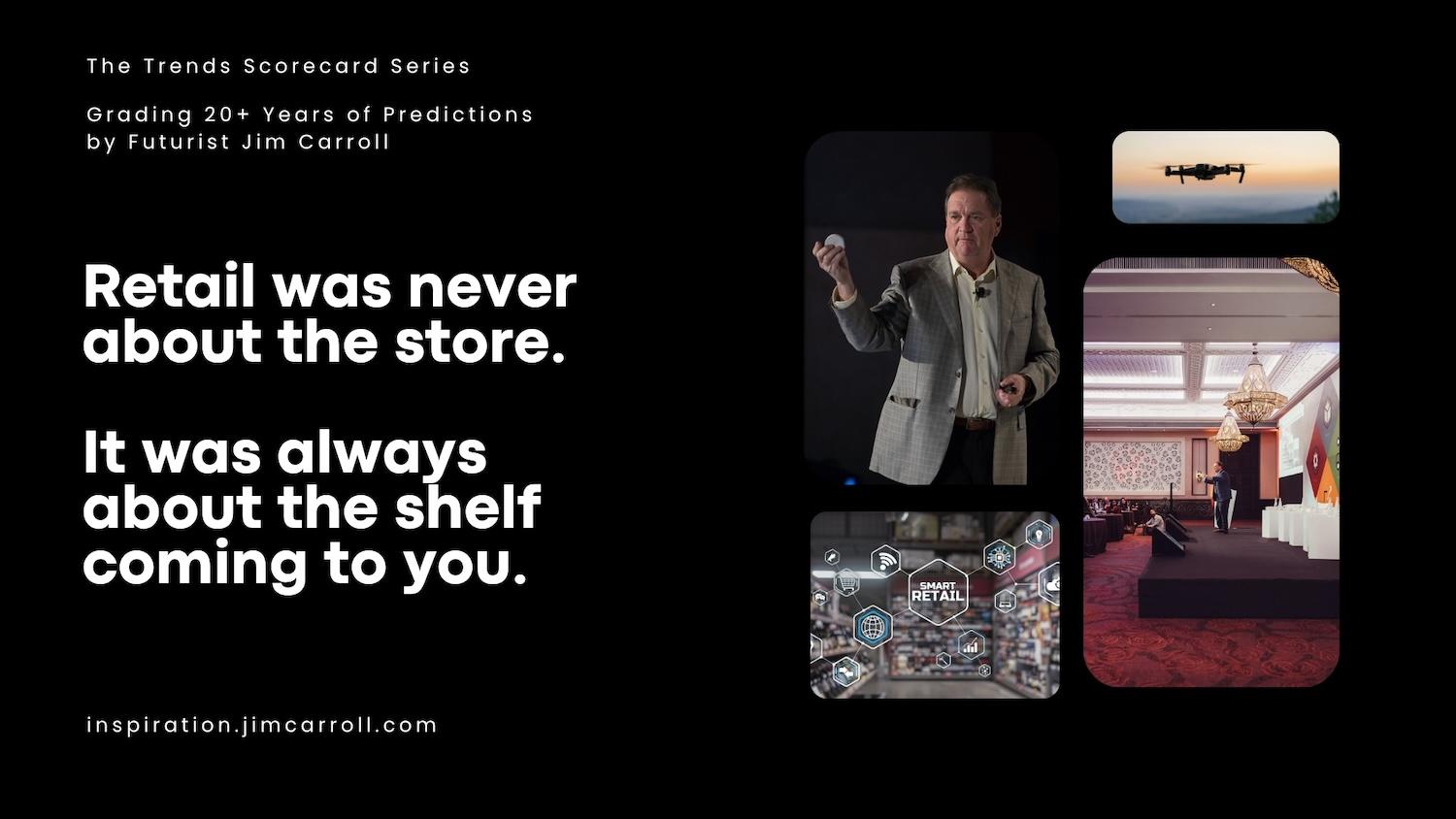
"Retail was never about the store. It was always about the shelf coming to you." — Futurist Jim Carroll

--
This is the Trends Scorecard series, where I go back into my own archive, dig up what I actually predicted years ago, and grade it honestly against the world of 2026. No cherry-picking, no quiet edits. This time the industry is Retail and Consumer. Here's the scorecard.
--

The setup: I have been saying "the store is becoming a showroom" since before it was obvious.

I have been keynoting the world of retail for a long time -- for The Gap, the Walt Disney Company, Loblaw, and a long list of others. And for most of that time, my core message has been the same: retail is not a slow, deliberate, end-cap-and-store-layout business anymore. It is a high-velocity business in which the back end -- logistics, fulfilment, data, mobile -- eats the front end.

Way back in 2012, I put it about as bluntly as I could:

"The next five years will bring more change to retail than the last 100 years." That was a quote I borrowed at the time from the CEO of a location-based shopping app. I certainly believe that to be true. I also believe that there are quite a few retailers who aren't quite ready for the scope, speed and breadth of the change that is underway.

So how did the calls actually age? Let's grade them.

And retail is a world I have spent a lot of time inside. I had Claude dig through my blog and pull together the retail and consumer groups I've keynoted for over the years:

Retailers & Consumer Brands — The Gap, Godiva Chocolates, Pladis (McVitie's, Ulker), Consumer Electronics Association, Manufacturing Jewelers & Suppliers of America
Retail Technology, Pricing & Value Chain — Revionics, Retail Value Chain Federation, APICS, XCelerate
Packaging & Consumer Products — Packaging Machinery Manufacturing Institute, HAVI Global Solutions, Mondi, NatureWorks

And those are only the ones I've blogged about — there have been plenty more.

So how did the calls hold up? Let's pull the receipts.

Original post: jimcarroll.com/2026/07/the-tre

★ 0 • ↻ 0 original
Jul 3, 2026 · 9:40 AM UTC

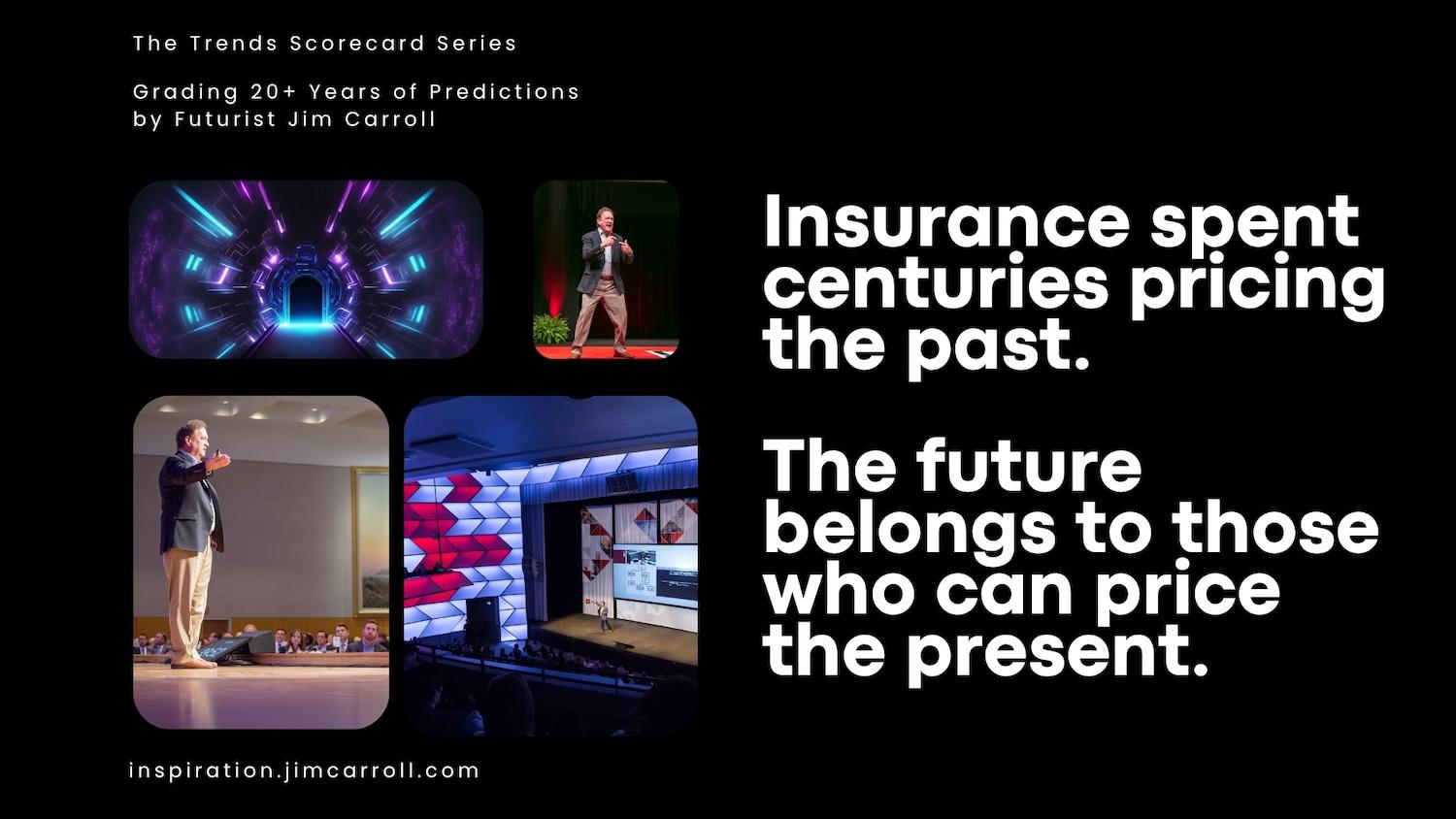
"Insurance spent centuries pricing the past. The future belongs to those who can price the present." — Futurist Jim Carroll

--
This is the Trends Scorecard series, where I go back into my own archive, dig up what I actually predicted years ago, and grade it honestly against the world of 2026. No cherry-picking, no quiet edits. This time the industry is Insurance. Here's the scorecard.
--

The setup: I've been talking about "the future of risk" since before it was fashionable

I have been keynoting the insurance industry for more than 20 years — property and casualty, life, group benefits, reinsurance. CEOs, CIOs, actuaries, brokers, the rooms full of people whose entire job is to price uncertainty. And from very early on, I kept hammering on one idea: that the very nature of risk was speeding up, that the old backward-looking actuarial model was about to be turned upside down, and that the industry was not moving fast enough to keep up. Here is how I framed it for a Property and Casualty Insurers Association audience — a framing I quoted again years later because it had aged so well:

The insurance industry today is immersed in a period of unprecedented, relentless change; impacted by hyper-innovation, fast-paced technological evolution, the rapid emergence of new forms of risk, and increasing business market turmoil. Permanence has been torn asunder, as customers and business organizations empower themselves with information, and as underwriting decisions become ever more complex.

That was the thesis. Below, the receipts.

And this isn't a sector I've watched from the sidelines. I had Claude dig through my blog and pull together the insurance and risk groups I've keynoted for over the years:

Insurers & Carriers — Zurich, New York Life, MetLife, Chubb, Assurant, Lincoln Financial, Gore Mutual, Equitable Life Insurance Company, RBC Life Insurance, Sun Life, Great-West Life, Swiss Re
Health, Benefits & Group Insurance — Cigna, Blue Cross Blue Shield, Highmark Health
Brokers, Reinsurance, Actuarial & Industry Bodies — Brokers & Reinsurance Markets Association, Independent Insurance Agents & Brokers of America, LIMRA International, GAMA International, Certified Professional Chartered Underwriter Association, Insurance Institute of Canada, American Institute of Actuaries, Verisk
Risk & Safety — National Safety Council, National Fire Protection Association, FM Global, American Automobile Association

And those are only the ones I've blogged about — there have been plenty more.

I've also led a private, closed-door future-of-insurance session for the C-suites of most of the world's largest carriers: Allianz, AIG, Travelers, AXA, Allstate, Liberty Mutual, The Hartford, State Farm, Progressive, GEICO, Nationwide, Farmers, CNA, Generali, Ping An, Lloyd's of London, XL Insurance, American Family, & RSA.

So how did the calls hold up?

Original post: jimcarroll.com/2026/07/the-tre

★ 0 • ↻ 0 original
Jul 4, 2026 · 9:17 PM UTC

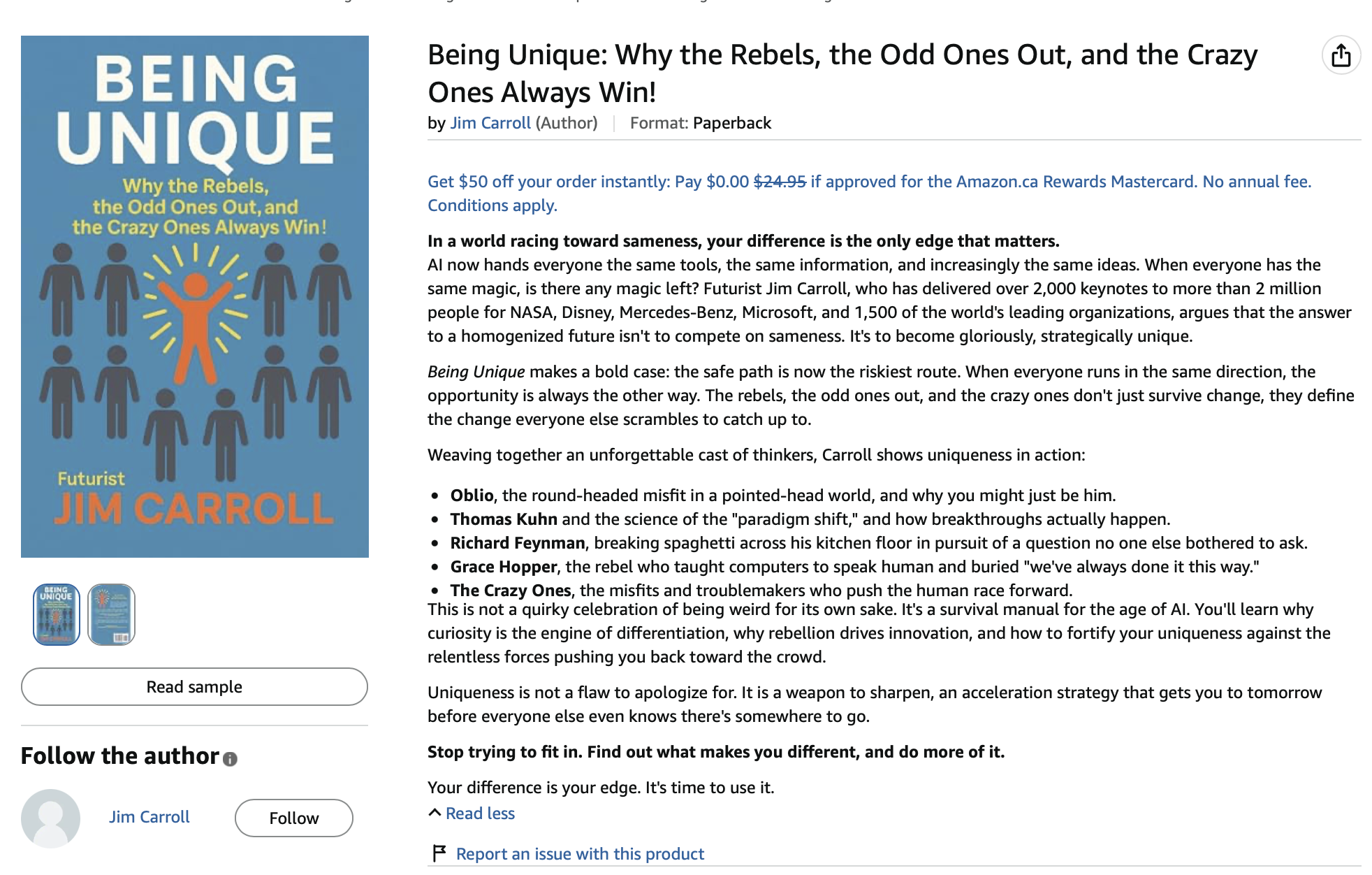
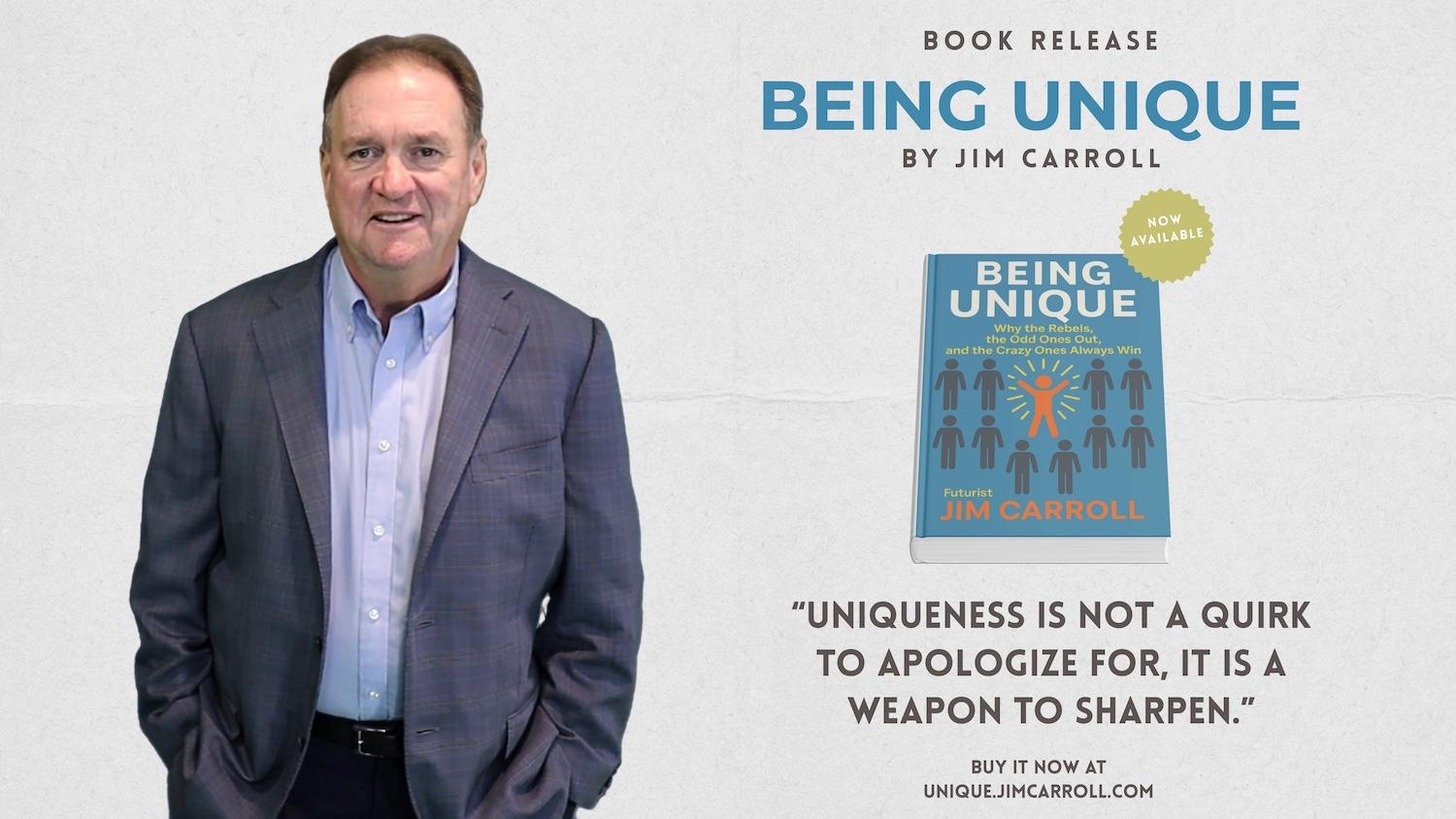
My 44th book is now officially in print.

Being Unique: Why the Rebels, the Odd Ones Out, and the Crazy Ones Always Win!

I'm crazy proud of this one!

Amazon Canada: amazon.ca/Being-Unique-Rebels-

Amazon.com: amazon.com/Being-Unique-Rebels

My entire life has been defined by not fitting the mold. This book is all about that!

And in the era of AI, not fitting in might be only thing that can save you.

----

In a world racing toward sameness, your difference is the only edge that matters.

AI now hands everyone the same tools, the same information, and increasingly the same ideas. When everyone has the same magic, is there any magic left? Futurist Jim Carroll, who has delivered over 2,000 keynotes to more than 2 million people for NASA, Disney, Mercedes-Benz, Microsoft, and 1,500 of the world's leading organizations, argues that the answer to a homogenized future isn't to compete on sameness. It's to become gloriously, strategically unique.

Being Unique makes a bold case: the safe path is now the riskiest route. When everyone runs in the same direction, the opportunity is always the other way. The rebels, the odd ones out, and the crazy ones don't just survive change, they define the change everyone else scrambles to catch up to.

Weaving together an unforgettable cast of thinkers, Carroll shows uniqueness in action:

Oblio, the round-headed misfit in a pointed-head world, and why you might just be him.
Thomas Kuhn and the science of the "paradigm shift," and how breakthroughs actually happen.
Richard Feynman, breaking spaghetti across his kitchen floor in pursuit of a question no one else bothered to ask.
Grace Hopper, the rebel who taught computers to speak human and buried "we've always done it this way."
The Crazy Ones, the misfits and troublemakers who push the human race forward.
This is not a quirky celebration of being weird for its own sake. It's a survival manual for the age of AI. You'll learn why curiosity is the engine of differentiation, why rebellion drives innovation, and how to fortify your uniqueness against the relentless forces pushing you back toward the crowd.

Uniqueness is not a flaw to apologize for. It is a weapon to sharpen, an acceleration strategy that gets you to tomorrow before everyone else even knows there's somewhere to go.

Stop trying to fit in. Find out what makes you different, and do more of it.

unique.jimcarroll.com

★ 1 • ↻ 0 original
Jul 6, 2026 · 9:38 AM UTC

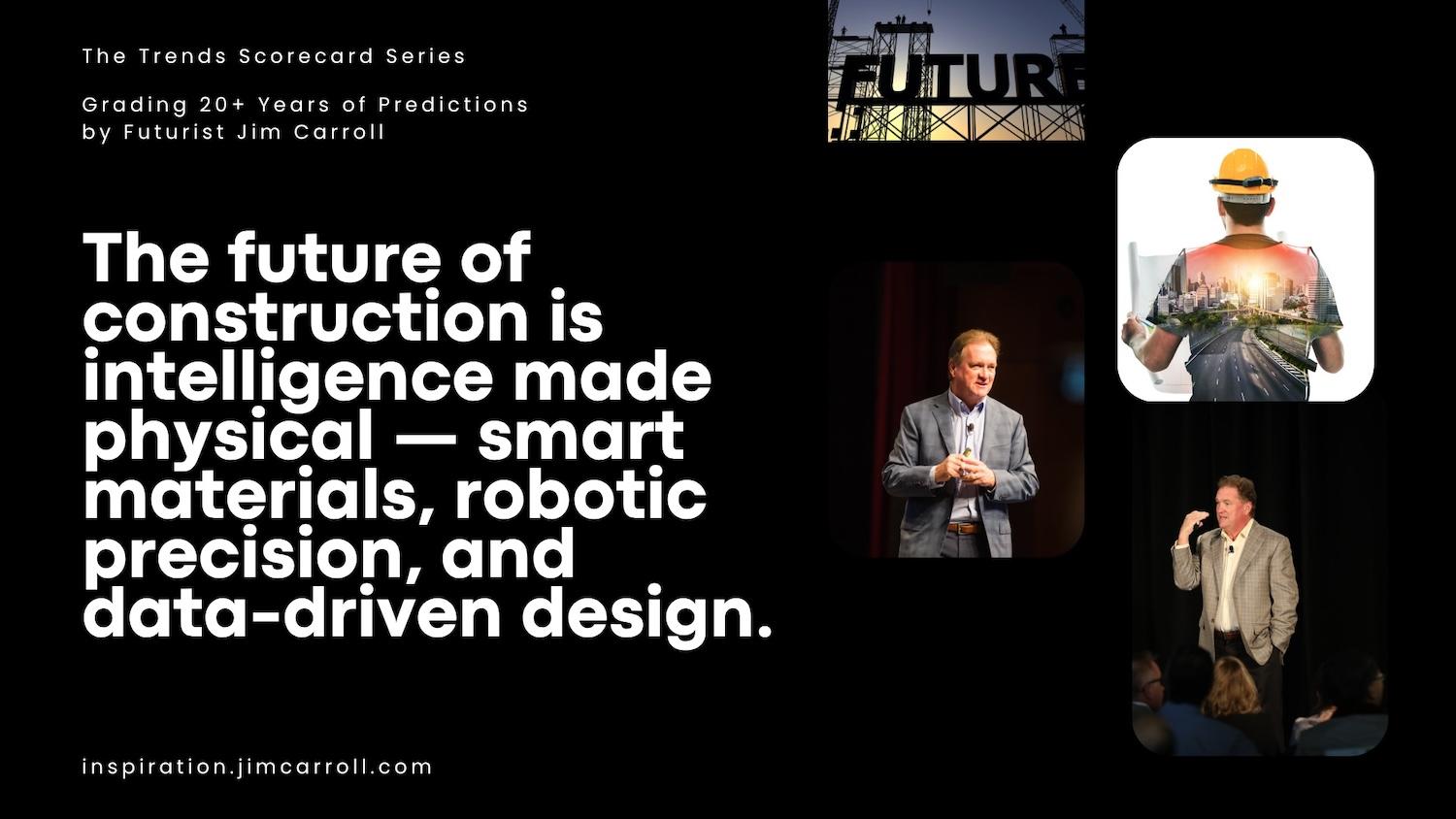
"The future of construction is intelligence made physical — smart materials, robotic precision, and data-driven design." — Futurist Jim Carroll

This is part of my Trends Scorecard series, where I go back into my own archive, dig up what I actually predicted years ago, and grade it honestly against the world of 2026. No cherry-picking, no quiet edits. This time the industry is Construction and Infrastructure -- the oldest business on earth, and one I have argued for two decades would be reinvented faster than anyone in a hard hat wanted to believe. Here's the scorecard.

---
The setup: I kept telling builders they were about to become manufacturers

For most of my career, construction was the industry people pointed to when they wanted to argue that some things never change. Bricks, mortar, a crew on a muddy site, a building that takes a year to go up. I never bought it. From keynote stages in Dubai, Oman, Philadelphia and a hundred construction and infrastructure events in between, I kept saying the same uncomfortable thing: the site was going to move into the factory, the trades were going to be joined by robots, concrete was going to come out of a printer, and the building itself was going to wake up and start talking back. Here's how I framed the whole arc back in 2019, in an exclusive piece I wrote for Gulf Construction:

What's really happening is we are shifting the construction industry from one of construction, to one of manufacturing.

And this isn't a sector I've admired from a distance. I had Claude dig through my blog and pull together the construction and infrastructure groups I've keynoted for over the years:

Construction, Engineering & Standards Bodies — Kiewit Corporation, Alberici Group, Black & Veatch, Matheson Financial, American Concrete Institute, US Army Corps of Engineers
Contractors, Trades & Building Systems — Distributors Contractors Association, Partners in Building, Canadian Plumbing and Heating, Rocky Mountain Electrical League, GE Lighting
Infrastructure & Roads — Ontario Road Builders Association, CCI Wireless, Global Cold Chain Alliance
Real Estate & Building Management — Exis Global, Trez Capital, REALTORS Triple Play Convention, Building Owners & Managers (BOMEX), FM Global
And those are only the ones I've blogged about — there have been plenty more.

So how did the calls hold up? Let's pull the receipts.

Original post: jimcarroll.com/2026/07/the-tre

★ 0 • ↻ 0 original
Jul 7, 2026 · 9:22 AM UTC

"The bank branch was never the point. The future of finance is code — and it's being written by everyone but the banks." — Futurist Jim Carroll

--
This is part of my ongoing Trends Scorecard series, where I go back into my own archive, dig up the predictions I actually made on stage and in print, and grade them honestly against where we've landed. This time the industry is Financial Services and Banking. I have been telling banks, credit unions, insurers and wealth managers for two decades that "faster is the new fast." So how did the calls hold up? Here's the scorecard.
--

I have been speaking to the financial world for a very long time -- to VISA, Wells Fargo, American Express, the Texas Credit Union League, the National Australia Bank, Credit Suisse, and dozens of community banks and wealth management firms in between. And for most of those years, I have been making the same core argument: the comfortable, slow, branch-and-vault world of finance was about to be turned upside down by mobile technology, by a new generation of digital-native customers, and by competitors who don't look anything like a bank. Back in 2008, in the smoking crater of the financial meltdown, I was already telling leadership teams that the volatility would pass but the disruption would only accelerate. Here is how I framed it then.

Key point: financial services, banking and insurance innovation hasn't gone away. It's going to come back with a roar, and the leaders in this industry are positioning themselves now.

And I have logged serious stage time in this sector. I had Claude dig through my blog and pull together the banking and financial services groups I've keynoted for over the years:

Banks — Scotiabank, RBC Financial Group, BMO Financial Group, TD Bank, CIBC World Markets, Wells Fargo, Enterprise Bank, Deltec Bank, Fidelity Bank (Cayman), American Community Banker Association
Credit Unions & Consumer Lending — Texas Credit Union League, Credit Union Management Association, Credit Union Directors Association,
Investment, Wealth & Asset Management — T. Rowe Price, AEA Investors, E*Trade, Investment Funds Institute of Canada, GBC Asset Management, Global Family Wealth Managers Conference,
Payments & Card Networks — Visa, American Express, Discover Financial Services, Elavon Merchant Services, Electronic Transaction Association, DataCard
Accounting, Advisory & Professional Finance — KPMG, Deloitte, Price Waterhouse, EY National Tax Conference, American Institute of Certified Public Accountants, Society of Management Accountants, Financial Management Institute, Treasury Management Association, American Fidelity
Global & Institutional Finance — International Finance Corporation (World Bank Group), International Financial Executives Conference, US Farm Credit Cooperative

So how did the calls hold up? Let's take a look

Original post: jimcarroll.com/2026/07/the-tre

★ 0 • ↻ 0 original
Jul 8, 2026 · 9:13 AM UTC

"Tradition is what keeps golf worth playing. New players are what keep it alive." — Futurist Jim Carroll

--
This is a special one in my Trends Scorecard series. Usually I grade the predictions I made for an industry. This time the industry is one I happen to love: golf. I'm a genuine golf nut — hundreds of tracked rounds, a bag full of gadgets, and more than a few keynotes to the game's leadership. So let's pull up what I actually predicted about the future of golf, and grade it honestly. Here's the scorecard.
--

The setup: the PGA once handed a futurist the opening mic

Back in 2010, the PGA of America invited me to be the opening keynote speaker for their Annual General Meeting. It was the first time they had ever had an external speaker open their event, and I did not take that lightly. They knew what everyone in the game knew: that growth was being challenged by demographics, collapsing attention spans, time pressure and a dozen other trends — and that confronting those trends had become one of the most important things they could do. I've been making that case to the golf world ever since.

And it's a world I've spent real time inside. I had Claude dig through my blog and pull together the golf and sports groups I've keynoted for over the years:

Golf Industry — PGA of America (multiple keynotes, including their first-ever external opening keynote), PGA Merchandise Show, PGA of Ontario Golf Industry Expo

Sports, Fitness & Recreation — Sports & Fitness Industry Association, YMCA Canada, Sporting Goods Manufacturers Association

So how did my calls hold up? Let's pull the receipts.

Original post: jimcarroll.com/2026/07/the-tre

★ 1 • ↻ 0 original
Jul 9, 2026 · 9:42 AM UTC

"You don't get to claim you can see the future if you're never willing to be graded on the past." — Futurist Jim Carroll

--
Over the last little while I did something most futurists carefully avoid. I went back through twenty years of my own keynotes and blog posts, industry by industry, dug up the predictions I actually made on stage, and graded them in public. Ten industries. No cherry-picking, no quietly deleting the misses. This is what the whole scorecard added up to.
--

The verdict: the pattern never broke

Across all ten industries — manufacturing, healthcare, energy, automotive, education, agriculture and food, retail, insurance, financial services, and construction — the same thing kept happening. The trends I called in the mid-2000s and the 2010s didn't just come true. In most cases they arrived faster and hit harder than the audiences in those rooms believed they would. The people who got blindsided were never the ones who took a trend too seriously. They were the ones who decided their industry was the exception.

None of them were.

A few of the receipts I'm proudest of:

Energy — I told utility CEOs the centralized, carbon-based, one-way grid was ending and that the future was distributed, intelligent and electric. Six clean hits on one scorecard, from the solar cost collapse to the rise of the prosumer.

Manufacturing — "volatility is the new normal," written for a room of manufacturing executives in 2006, two years before the financial crisis. It stopped being a provocative line and became the operating condition of the industry.

Automotive — the car becoming a computer on wheels, and electrification re-architecting the entire industry. Tesla built it; the incumbents who looked away are paying for it now.

Healthcare — the collapse of genome-sequencing costs, the wearable as a continuous health sensor, and the shift from "sick care" to prediction. The science landed almost exactly as described.

Agriculture — autonomous tractors, 24-hour data-driven farming, and a new generation running the operation. The world's oldest profession became one of its most advanced.

Here's the thread that ran through all ten posts, and it's the most useful thing on the entire scorecard. The technology curve is predictable. The friction is not.

Keep reading.

Original post: jimcarroll.com/2026/07/the-tre

★ 0 • ↻ 0 original
Jul 10, 2026 · 9:22 AM UTC

"Uniqueness is not a quirk to apologize for, it is a weapon to sharpen!" - Futurist Jim Carroll

If you do one thing today, do this for me right now - go to Amazon (.com, .ca, other local ones) and buy this book.

After all, it will help you out! If you've been reading my Daily Inspiration over the years, you've watched a theme keep coming back:

"Be defiant. No one succeeds through conformity!" (2018)
"Conformity kills creativity! Don't try to fit in - make your own space!" (2021)
"When everyone else is doing something, do a different thing!" (2022)
"Some people conform. Innovative people rebel!" (2023)
"In a world of lemmings, be the unicorn!" (2024)
"Rebel today. Define tomorrow!" (2024)
"What makes you unique is what will make you successful!" (2025)
"Unapologetic uniqueness: conformity is where tomorrow's greatness goes to die." (2026)

There are many more., Eight years of quotes. One consistent thread. Be unique!

It has never been an accident. It has always been an obsession!

Those lines weren't random morning thoughts. They were a book quietly assembling itself, one conviction at a time. And now it's here: Being Unique: Why the Rebels, the Odd Ones Out, and the Crazy Ones Always Win! - my 44th book, available now on Amazon worldwide.

Here's the twist: through all those years of writing about conformity and uniqueness, AI arrived and handed everyone the same tools, the same information, the same output. A crushing sameness. Which means every one of those quotes matters more today than the day I wrote it.

I never intended for it to be a book about AI, and it isn't. I don't even mention AI, except for a comment in the Foreword.

But here's what I know - being unique is the most important thing you have going for you in the era of AI. After eight years of circling it, the message of this book comes down to one line:

Uniqueness is not a quirk to apologize for, it is a weapon to sharpen.

When everyone is doing the same thing - empowered by AI - do a different thing. Find out what makes you different. Do more of it!

Get the book: unique.jimcarroll.com | Free sample chapter: sample.unique.jimcarroll.com

Do this for me. But also, do it for yourself!

Original post: jimcarroll.com/2026/07/daily-i

★ 1 • ↻ 0 original
Jul 13, 2026 · 10:01 AM UTC

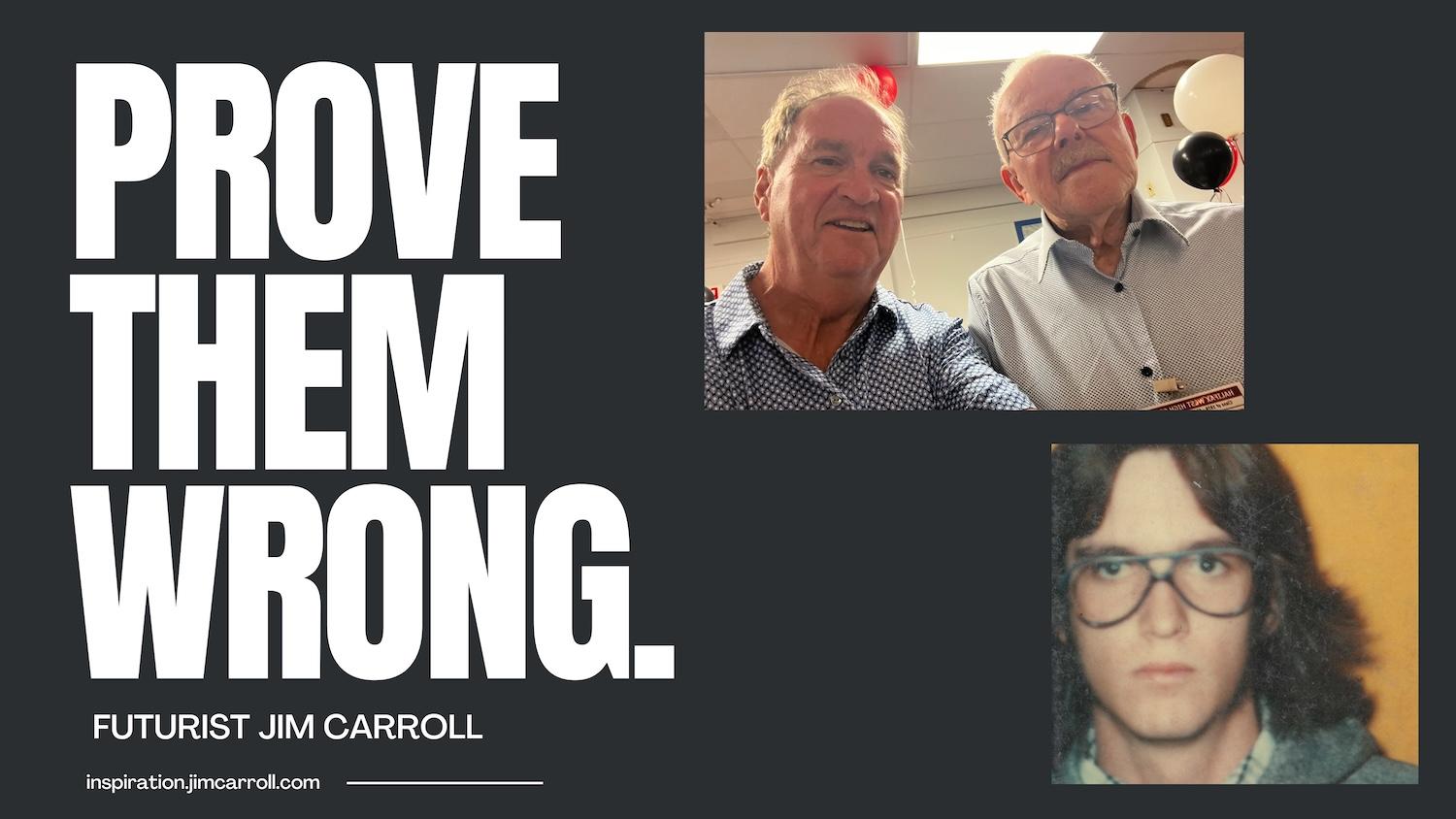
"Prove them wrong!"  - Futurist Jim Carroll

It was a wildly wonderful weekend as I attended my high school 50th reunion on the weekend. I met, once again, the Principal who told me, more or less, that I might not amount to much because of my unique attitude. That's him in the image above; and that's me, shortly after graduation.

We had a good laugh over that!

In high school, I was, perhaps, an oddball, a rebel, an odd one out. To start, I couldn't' do any sort of sport, since I was so much younger than my other classmates. I didn't go to many classes but got great marks. And, my social scene revolved around the fact that I was involved with, and ran for a time, the high school radio station, CKWR.

At one moment in time, my high school Principal called for a 'spirit assembly
' in the gym - it was some sort of rah-rah session for one of our sports teams. I don't remember which team or what sport, but I do remember that I had no interest in going. None. Zilch. That wasn't my scene.

So I stayed in the radio station and blasted out Led Zeppelin's Physical Graffiti album through the school sound system for several hours, on repeat. Epic.

This did not go over well. I was called into the office to see him. I was advised I was not contributing to the school, I needed to do more to improve my attendance in class, and that I needed to be a team player. He told me, in no uncertain terms, that he would never be able to provide me any sort of reference in the future, and in a passing comment, that I probably would not amount to much.

I cockily suggested he take a look at one of my term marks. He opened the folder in front of him, and read out, "History, 98". I asked what was the point of going to class to try to get another point or two. (I went to one class that term, to check in, and then again, to write an exam.)

LOL.

Anyways, the opening chapter of my book Being Unique features that famous observation often attributed to Steve Jobs:

"Here's to the crazy ones. The misfits. The rebels. The troublemakers. The round pegs in the square holes. The ones who see things differently. "

I had one copy of the book with me that evening, and moments after this photograph was taken, gave it to my high school principal of so many years ago. He smiled, and chuckled. He told me he would send me his thoughts on the book. I'm looking forward to his comments!

And I know that, deep down in his heart, he knows that it's the rebels, the crazy ones the misfits, the troublemakers -- the unique ones - are the ones who DO.

--

Futurist Jim Carroll wrote a 150 page novel, The Lion's Den, while in Grade 11 as a way of avoiding going to class to study poetry during third term. It's a spy thriller involving Russia, China and America, and even has a sex scene. He was 15 at the time. He still has the manuscript, and intends to publish it later this year.

Original post: jimcarroll.com/2026/07/daily-i

★ 1 • ↻ 0 original
Jul 14, 2026 · 9:36 AM UTC

"Stop living in the 'not yet.' Start living in the 'right now!' - Futurist Jim Carroll

I've long been stunned by how many innovation efforts fail because too many people wait too long.

I've never understood how so many people fail to prepare for tomorrow because they simply can't get moving towards it.

I've never fully come to grips with the fact that tomorrow is where all of us are going to live and yet so many do precious little to get ready for it.

I’ve always wondered why people choose the comfortable pain of standing still over the temporary discomfort of moving forward.

I'm consistently baffled by organizations that spend millions analyzing a future they are actively terrified of embracing! 

I’ve never understood the logic of waiting for certainty that never arrives, while ignoring the absolute certainty that time is running out.

What I do understand is that those who get moving are those who win.

So who are you?

★ 1 • ↻ 0 original
Jul 15, 2026 · 9:47 AM UTC

"Make it make sense? Nope. Not right now." - Futurist Jim Carroll

We live in a time when countless numbers of otherwise rational, intelligent people are making decisions that are anything but intelligent or rational.

And the rest of us silently scream each and every other moment, 'make it make sense!'

I've come to conclude that we can't, and we won't, until such time as the inevitable conclusion comes about that we know will hopefully finally bring an end to this era of madness. In the meantime, the world is watching the real time decline of a once mighty power.

Think about where we are - often at the events where I speak, I spend a lot of time around economists and smart business executives Good ones. The kind with three letters after their name and decades of models that used to work.

Lately, more than a few have said some version of the same thing to me, off the record: I don't get it anymore.

That's a big deal, coming from that crowd. Their entire profession rests on one assumption - that people, in the aggregate, act on their own economic interest. Show them the data, the math, the outcome, and eventually behaviour lines up with reality.

Except right now, it doesn't.

People are actively fighting their future, putting real barriers in the way, and the degradation and destruction that is occurring is real. We are witnessing the end of the North American automotive industry - that much is clear. Other nations have succeeded into stepping into the global void of agricultural supply to make up for erratic unreliable supply partners. Medical science and research infrastructure are relocating to nations who believe that science is a thing. And the damage is systemic, long term, and not easily reversible.

What's new is how hard it's become to make it add up. Economies are supposed to run on a feedback loop: something hurts, people notice, they adjust. That loop is jammed right now. The pain shows up on schedule, and the response isn't a course correction - people are actively choosing a second helping of the thing that caused it in the first place!

And in the meantime, the rest of the world is actively working hard to move on.

So here's where I've landed, at least for today: I've stopped expecting the economy to make sense in the old way, because the old way assumed people mostly act on their long-term interest.

And until enough people get tired of the pain, don't expect the numbers to start adding up either. 

Make it make sense?

Nope.

Not right now.

---

Futurist Jim Carroll has come to realize that it isn't even 'confident' stupidity anymore.

Original post: jimcarroll.com/2026/07/daily-i

★ 0 • ↻ 0 original
Jul 16, 2026 · 10:04 AM UTC

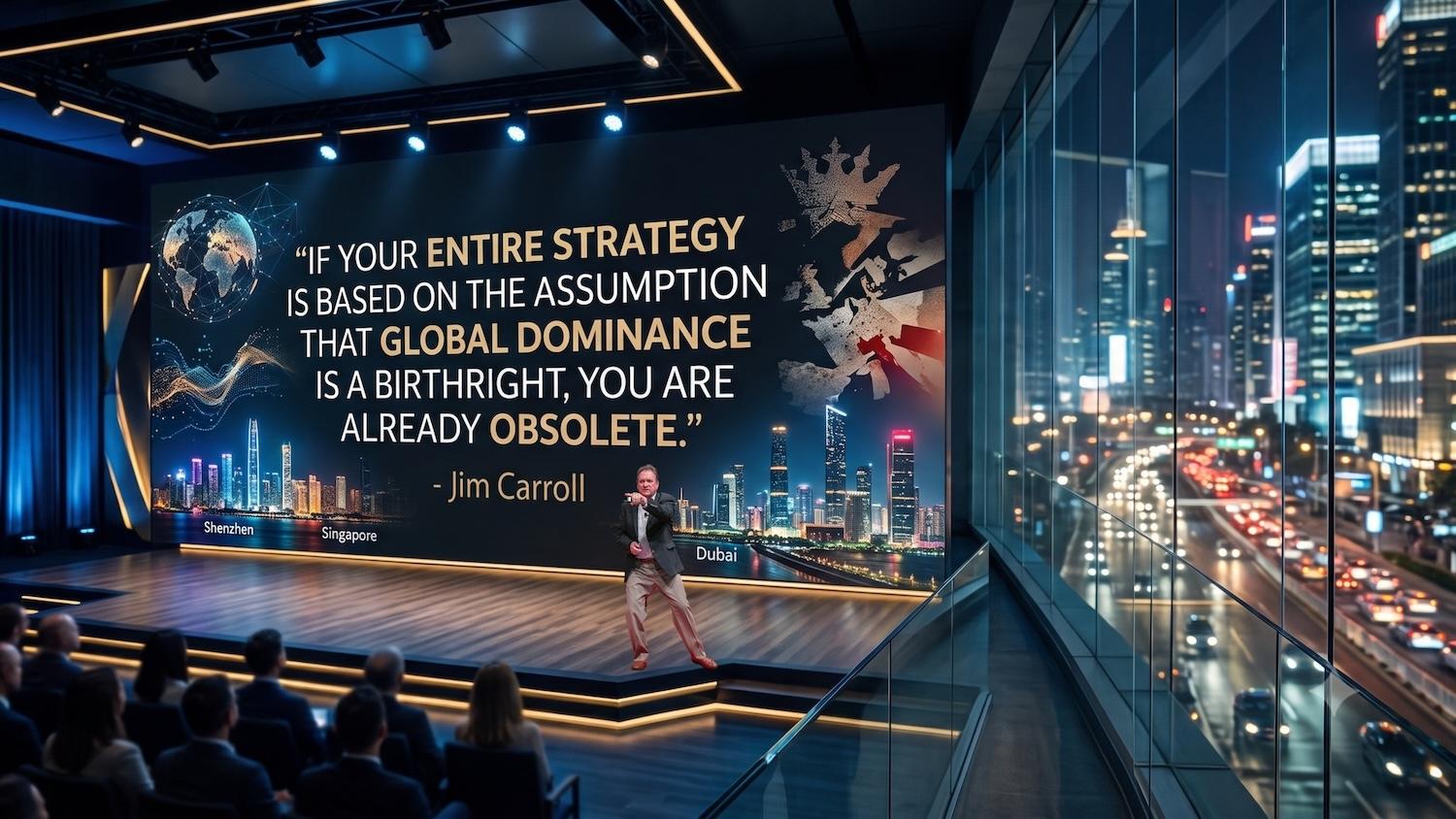
“If your entire strategy is based on the assumption that global dominance is a birthright, you are already obsolete.” - Futurist Jim Carroll

Yes, a little bit of AI magic for the photo.... anyways...

Let's talk about "the elephant in the room: reality is unforgiving. It doesn't care about political slogans, patriotic optimism, or nostalgia.

So let's revisit something I wrote back in back in 2017. I wrote a post how protectionist policies, isolationist shifts, and a growing anti-science mindset would slowly erode the economic and technological dominance of the United States. You can go and read it here: Trends: What Comes Next with the Decline of an Empire? The link is in the comments.

It was prescient. Wildly accurate. Sadly predictively true.

Today, in 2026, those early warnings are no longer just future risks: they are fully realized structural disruptions. Below is a direct look at my original ten predictions, matching what I saw back then with exactly how it has played out in our 2026 reality.

The hard truth?

This is not a story of sudden, dramatic collapse.

It is the story of a slow, steady, self-inflicted hollowing out.

While private companies spend billions developing near-market products for short-term profit, the foundational basic research that builds tomorrow's breakthrough industries is being starved of cash and choked by politics.

The rest of the world isn't waiting for America to sort itself out. They have built the hubs, funded the labs, and welcomed the talent.

The future has moved on, and it didn't wait for permission.

Full post: jimcarroll.com/2026/07/daily-i

Original 2017 post: jimcarroll.com/2017/05/trends-

★ 2 • ↻ 0 original
Jul 17, 2026 · 9:32 AM UTC

"Showing up is a strategy. Showing up every day is a superpower!" - Futurist Jim Carroll

--

This is part 1 of a short 6-part series. Writing my newest book sent me deep into my own archives - thousands of morning posts, going back 10 years. I came out with a conviction: the ideas that keep coming back are the ones that matter most. So I'm revisiting them - because sometimes the most useful thing a futurist can do is check what still holds true.

--

I've spent decades watching companies win and companies fail, and I can tell you the difference is almost never intelligence.

The winners aren't smarter. They're just more relentless.

I've been chewing on that word for a long time. All the way back in 2016, I built an entire mantra around it:

"Expect velocity. Plan for acceleration. Structure for intensity. Execute relentlessly." (2016)

I liked it so much I ran it again in 2017. Twice. Some ideas deserve repeating!

"Relentless optimism! Mindset matters!" (2017)

"Start each and every day with relentless optimism. Immediately banish any signs of pessimism!" (2017)

Here's what I've learned about relentlessness: it isn't intensity. Intensity is easy - anyone can sprint for a week.

Relentlessness is showing up on the mornings when you don't feel like it, when nothing seems to be moving, when the payoff is nowhere in sight.

Every organization I've watched transform itself did it the same way - not with one bold stroke, but with an unreasonable, unglamorous consistency.

They decided what mattered, and then they did it again the next day.

And the next.

I've seen people do it too - managing to make the effort, day in day out, to do the things they need to do to get through it - whatever 'it' is.

They show up.

That's the whole secret, and almost nobody wants to hear it, because it doesn't sound like magic.

It becomes magic.

It just takes a few thousand mornings to get there.

Showing up? It's magic. It's a superpower. It's what works.

What are you going to show up for today?

Original post: jimcarroll.com/2026/07/daily-i

★ 1 • ↻ 0 original
Jul 20, 2026 · 9:46 AM UTC

"The words you repeat become the future you build!" - Futurist Jim Carroll

--
Part 2 of my short 6-part series revisiting my archives - a journey that started when writing my newest book sent me back through years of morning posts. The ideas that keep coming back are the ones that matter most. 
--

I did something a little unusual this weekend - I ran the numbers on my own vocabulary.

Years of these morning quotes, all sitting in an archive. So I counted. What does a futurist actually talk about, when you add it all up?

The word "future" appears in my quote lines 614 times. "Tomorrow," 356 times. "Innovation" shows up 175 times, "opportunity" 166, "leadership" 88.
No surprises so far - that's the job description of a Futurist!

But here's the number that stopped me: "opportunity" outruns "fear" by three to one. And "failure" appears 117 times - more than "leadership" - because failure has always been the best teacher on the roster. In that context, take a look at this one:

"Chase your opportunities, instead of running from your fears!" (2023),

Looking at the overall word count, I now think the real story is simpler. Your vocabulary is your strategy. The words you reach for every morning - in your meetings, your plans, your discussions with yourself - are quietly the worlds that define what you are doing to live your future.

Opportunities are better than threats, after all. People and organizations that talk about threats build defensive futures, but people who talk about opportunities build better ones.

It sounds too simple to be true, but the words we use tend to define us.

So take a look at your own vocabulary. What are your 614 words? What do you repeat? What words do you use the most - and which ones hold you back?

Because you're building your future with words - one word at a time, whether you mean to or not.

--
Original post: jimcarroll.com/2026/07/daily-i

★ 0 • ↻ 0 original
Jul 21, 2026 · 9:54 AM UTC

"You don't find your voice in the calm. You find it in the storm!" - Futurist Jim Carroll

--
Part 3 of my short 6-part series revisiting my archives. Writing my newest book meant rereading years of my own morning posts - and some of them took me straight back to moments I'll never forget. Today is one of those.
--

It's kind of wild that at the very moment I am typing this post, I have a pretty significant thunderstorm directly overhead. Karma!

Anyways....March 2020. Remember it?

Everyone was impacted. In my case, the meeting and event industry - my industry - evaporated in about ten days. Every event cancelled. Every stage went dark. A futurist with no audience and no idea, like everyone else, as to what next week would look like.

So what did I do? I kept writing. Every single morning, my Daily Inspiration post went like this:

"Life is 98% capitalizing on your optimism - and 2% managing your brief, small moments of panic!" (March 10, 2020)
"When your old reality is gone for a time, it's best to make a new one!" (March 20, 2020)
"Think of the future this way: we've just hit a great big 'Pause' button. We'll press 'Play' again..." (March 24, 2020)
"Truth! There are very few commodities in the world right now more precious than hope and optimism!" (April 3, 2020)

Here's what I understand now that I didn't fully understand then: I wasn't writing those posts because I had answers. I was writing them to find the answers. The discipline of showing up every morning of a crisis and putting one hopeful, useful thought into the world - that wasn't a performance of confidence. That was the manufacturing of it.

The companies that came through that era strongest did the same thing. They didn't wait for clarity to act. They acted their way into clarity - small daily decisions, made out loud, in the fog.

That's the thing about storms. You don't really know what you're made of, or what you sound like, until you're in one. And the fact is, I've written an entire book about what to do when the storms hit. Dance in them. And it all unfolded right here in my Daily Inspiration. Dancing in the Rain became the field guide to finding your voice when things get tough. 

And when the next one comes - and it will - your voice will be there waiting.

If you exercise it now.

---
Original post: jimcarroll.com/2026/07/daily-i

★ 0 • ↻ 0 original
Jul 22, 2026 · 9:49 AM UTC

"Success: cumulative small steps tied together - then suddenly, a seismic shift!" - Futurist Jim Carroll

--
Part 4 of my short 6-part series revisiting my archives - born when writing my newest book sent me back through years of morning posts. Today, one of my own quotes gets the scorecard treatment: does it hold up? 
--

I first wrote this phrase in my Daily Inspiration in October 2020, and in the spirit of my recent scorecard series, I'm going to grade it.

"Success: a sustained series of stressful small steps - then suddenly, some sweet surprise!"

Verdict: nailed it.

It wasn't a one-off thought. It was one entry in a thread I kept pulling on:

"It's by thinking BIG that you can make the first small steps of your journey happen!" (January 2020)
"Be relentless - you'll eventually find that moment when your small steps allow you to suddenly leap ahead!" (February 2021)

Back then, I framed it around Neil Armstrong: every giant leap is actually a whole series of small steps. Five years later, I'd go further. There is no leap. The leap is an optical illusion - it's what a thousand small steps look like from the outside, to people who weren't watching you take them.

Think about every transformation story you've ever admired. The company that "suddenly" dominated its market. The colleague who "suddenly" changed careers. The person who "suddenly" turned their life around.

Ask any of them and you'll get the same answer: there was nothing sudden about it. There was a decision, and then there were the ordinary mornings - hundreds of them, thousands of them - where they kept the decision. And kept taking small steps to an eventual goal.

You don't reinvent yourself at the moment of crisis. You reinvent yourself in all the unremarkable days that follow it.

That's not the inspiring version of transformation.

It's just the true one.

Take the small step today.

Then again tomorrow.

And again the next day.

The reinvention is further along than you think - and closer than it looks.

Original post: jimcarroll.com/2026/07/daily-i

★ 1 • ↻ 0 original
Jul 23, 2026 · 9:25 AM UTC

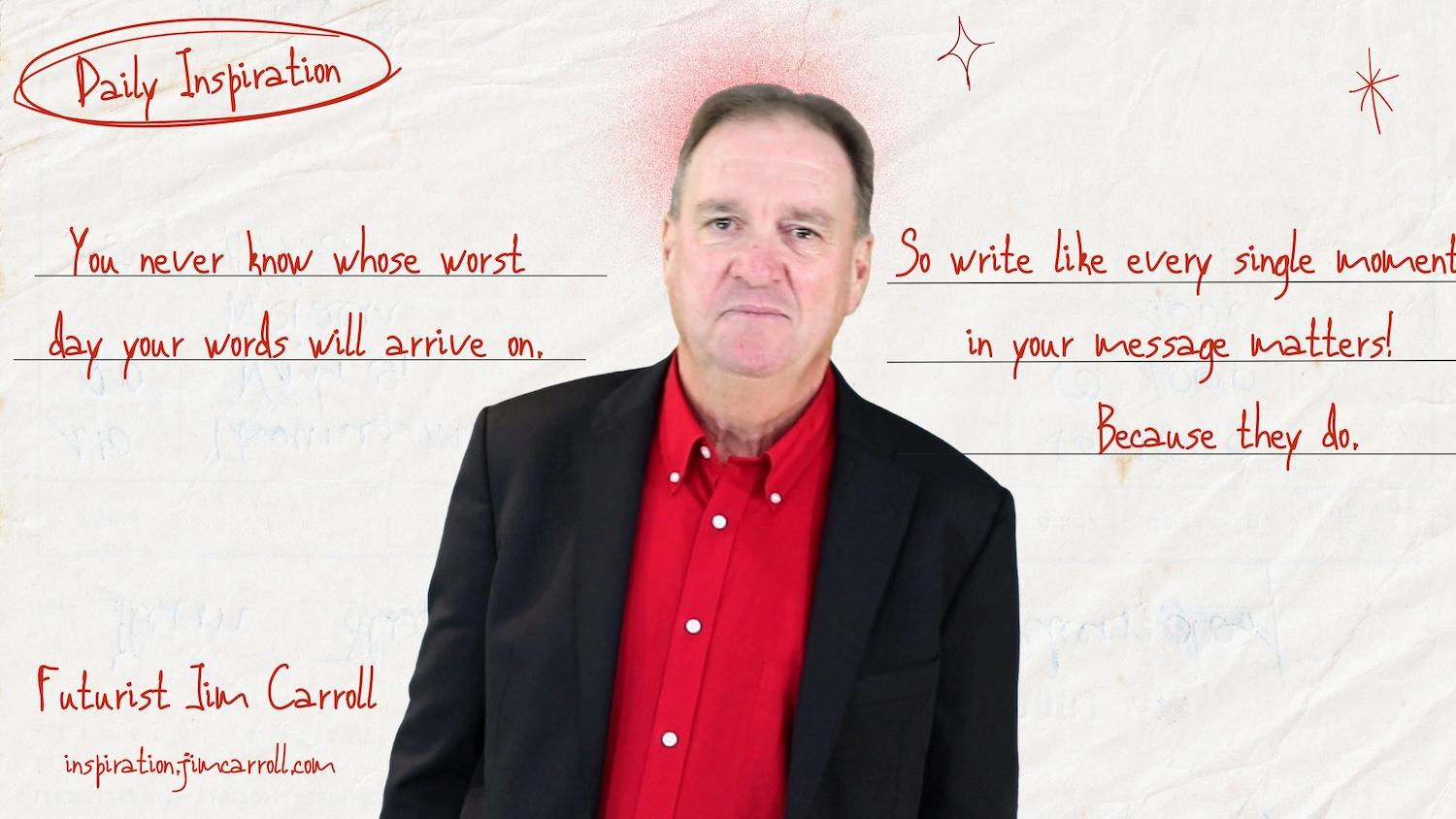
"You never know whose worst day your words will arrive on. So write like every single moment in your message maters. Because they do." - Futurist Jim Carroll

--
Part 5 of my short 6-part series revisiting my archives. Rereading years of morning posts while writing my newest book, I kept thinking less about what I wrote - and more about who was reading. Today's post is about you.
--

Something strange happens when you put a thought into the world every single morning.

Most days, it lands quietly. A few likes, a few shares, and the world moves on. You start to wonder if anyone's really out there.

And then, every so often, a message arrives. Someone I've never met writes to tell me that a quote showed up on exactly the day they needed it. The morning of the layoff. The week the business nearly went under. A stretch of their life they describe only vaguely, but you can hear the weight in the words.
Somehow, the right sentence that you wrote into your Daily Inspiration post found them on the right morning.

What might I have written that hit them at the right time? How about this one - it's landed hard for quite a few folks:

"At some moment in time, you transition from the shame of who you were into the pride of who you've become."

That's the line as I'd say it to you today, if you asked me. But it didn't arrive that way. It's actually a small family of posts, each one circling the same idea a little differently, over more than a year:

"At some moment in time, you will transition from regret for what you have not achieved, to pride for what you have actually accomplished!" (February 2022)
"At some moment in time, you will transition from the shame of your mistakes into pride for the lessons you've learned from them!" (March 2023)
"At some moment in time, you will come to realize that the future you thought had no longer exists!" (July 2023)

I didn't plan that as a series. I just kept returning to the same doorway, over and over, trying different keys. That's usually how the truest ideas surface - not in one clean sentence, but in the accumulated draft of a dozen almost-right ones.

Here's the humbling part: I never know which post it will be. The ones I labor over often sail past unnoticed. The ones I write in ten minutes, half-asleep - those are the ones that end up taped to someone's monitor. I've stopped trying to predict it.

There's a lesson in that for anyone who leads, writes, teaches, or manages: you are broadcasting on frequencies you cannot hear. That offhand encouragement in a hallway. That extra sentence in an email. Someone out there is having their worst day within earshot of your words - and you will almost never know which day.

Every day. Write like it matters, speak like it matters - because on some morning you'll never be told about, to some person you'll never meet, it did.

Original post: jimcarroll.com/2026/07/daily-i

★ 0 • ↻ 0 original
Jul 24, 2026 · 9:43 AM UTC

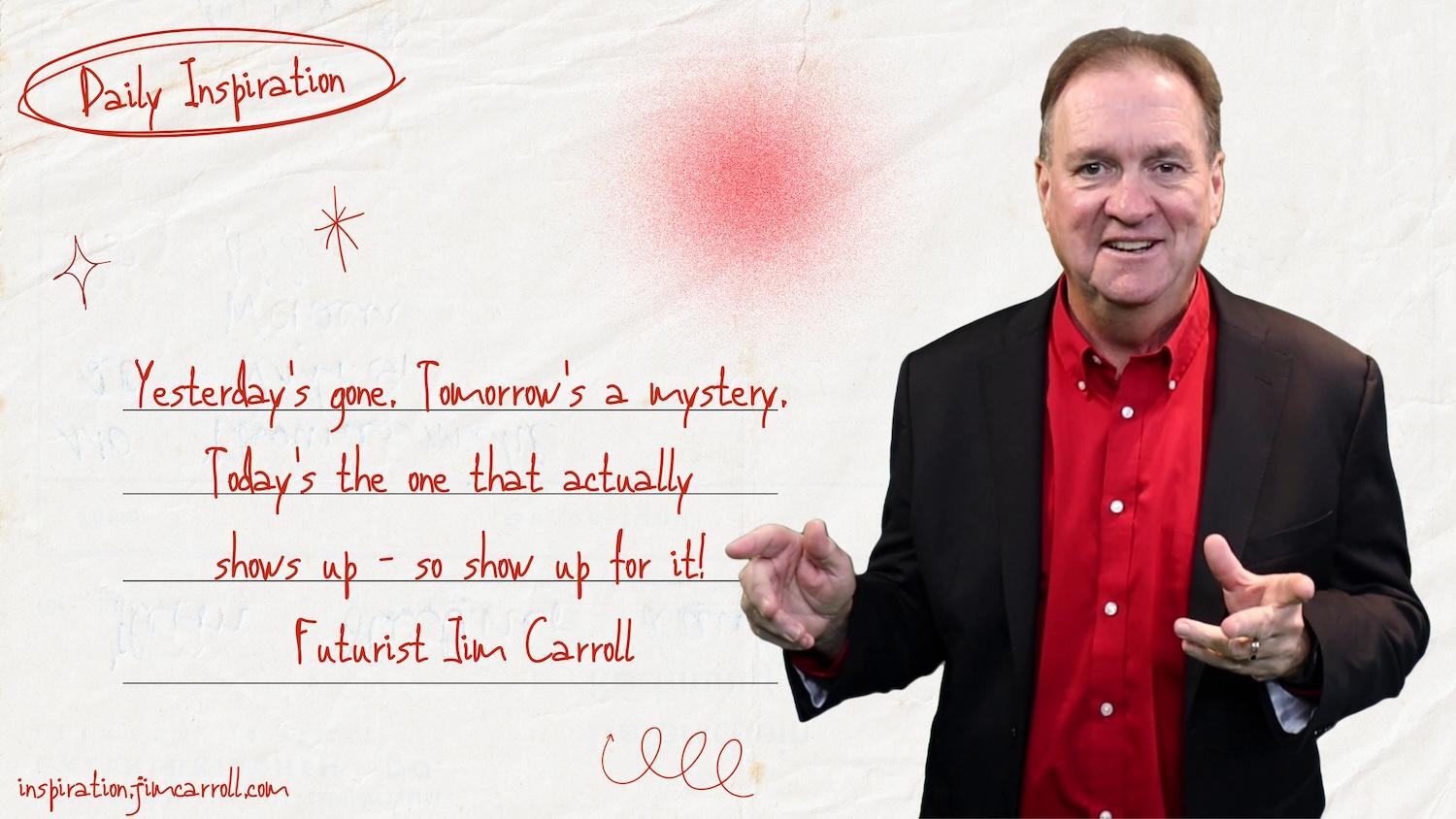
"Yesterday's gone. Tomorrow's a mystery. Today's the one that actually shows up - so show up for it!" - Futurist Jim Carroll

--
The final part of my short 6-part series revisiting my archives - a journey through years of morning posts that began with writing my newest book. Where else could it end but here: with the word I've used more than any other. Tomorrow!
--

I've spent my entire career thinking about tomorrow. It's right there in the job title!

But here's the confession thirty years on stage never quite prepared me to make: tomorrow was never actually the point. Today was.

Every trend I've ever tracked, every disruption I've ever forecast, every keynote I've ever delivered about "what's coming next" - all of it was really just an elaborate argument for what you should be doing right now.

Yesterday's gone. Nothing about it is negotiable, no matter how long you sit there rehashing it.

Tomorrow's a mystery - and I say that as someone who's spent thirty years getting paid to guess at it for a living! The trends can tell you the shape of what's coming. They can't tell you the day, the hour, or how it will actually feel when it lands.

Today's the one that actually shows up. It's the only part of the timeline you get to touch.

"What seemed impossible yesterday is today's opportunity and tomorrow's reality" (2017)

"Your personal headline for tomorrow is based upon the decisions you make today. Choose wisely!" (2017)

"Don't talk about what you'll do tomorrow. Do it today." (February 2023)

"The future is no longer about tomorrow - it is about today!" (November 2021)

"Be tomorrow. Today." (September 2023)

"Your tomorrow starts today. Why wait?" (October 2023)

"Anticipate tomorrow - but act today!" (November 2021)

"Do something today that your tomorrow will thank you for!" (July 2020)

Read those and realize the future isn't a place you arrive at.

It's a place you build, today, one decision at a time - and you only ever get to build it from wherever you're standing right now.

The people who thrive - in business, in careers, in life - aren't the ones with the clearest ten-year plan. They're the ones who show up for today.

Not perfectly.

Not gloriously.

Just consistently.

Today keeps showing up. It has never once failed to.

Meet it.

Original post: jimcarroll.com/2026/07/daily-i

★ 1 • ↻ 0 original
Jul 26, 2026 · 9:27 AM UTC

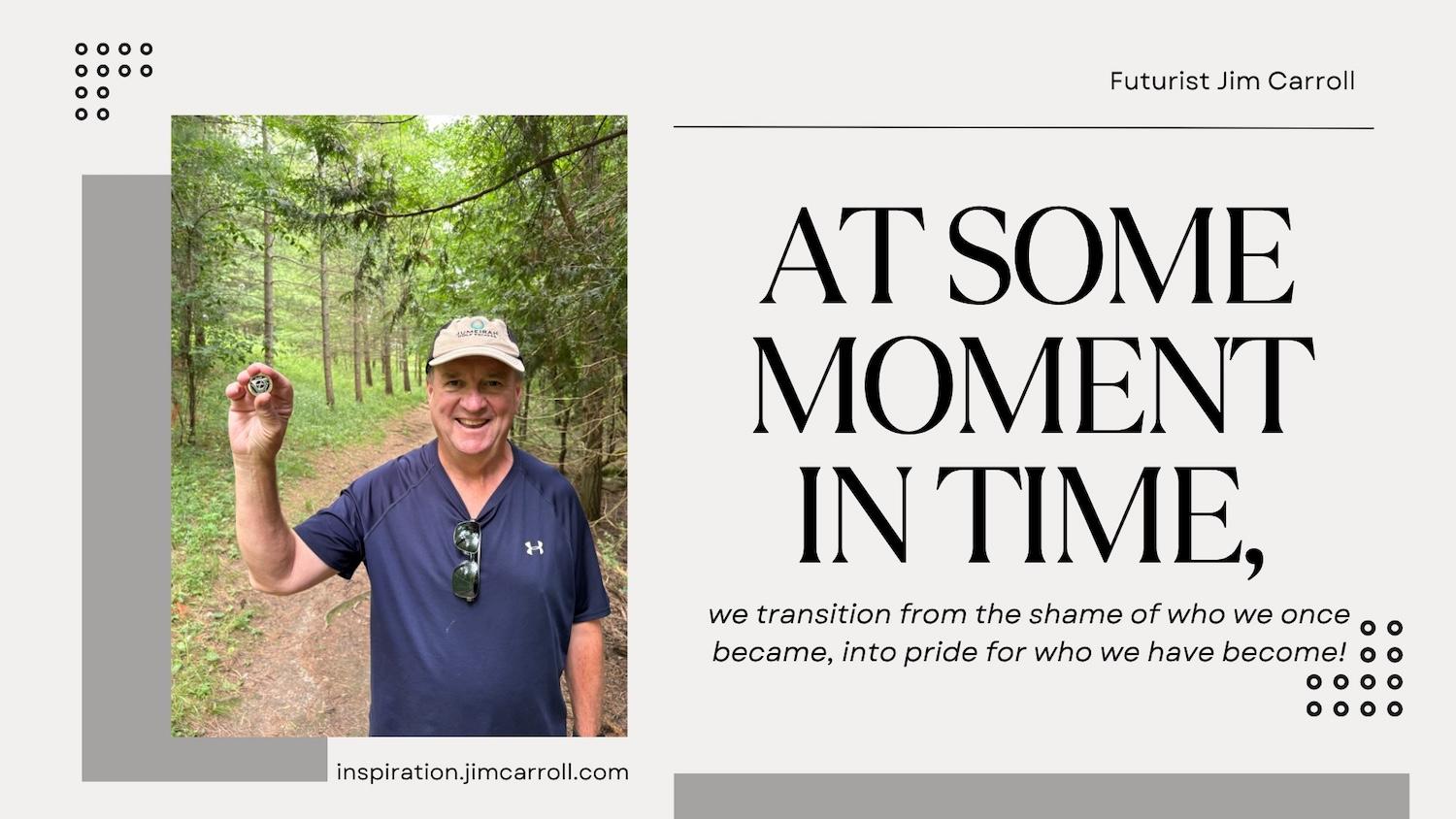
At some moment in time, we transition from the shame of who we once became, into pride for who we have become.

★ 1 • ↻ 0 original
Jul 27, 2026 · 10:49 AM UTC

1 of 2/

"At some moment in time,, we transition from the shame of who we once became, into pride for who we have become!" - Futurist Jim Carroll

This is the last Daily Inspiration.

There will be much more inspiration to come.

Let me explain.

This is post number 2,582 in this series. After ten years, nearly 1.4 million words, and one quote at a time, every working day, since August 26, 2016. I have not missed one single working day. I showed up EVERY SINGLE DAY.

To explain why it ends today, I have to finally tell you why it began.

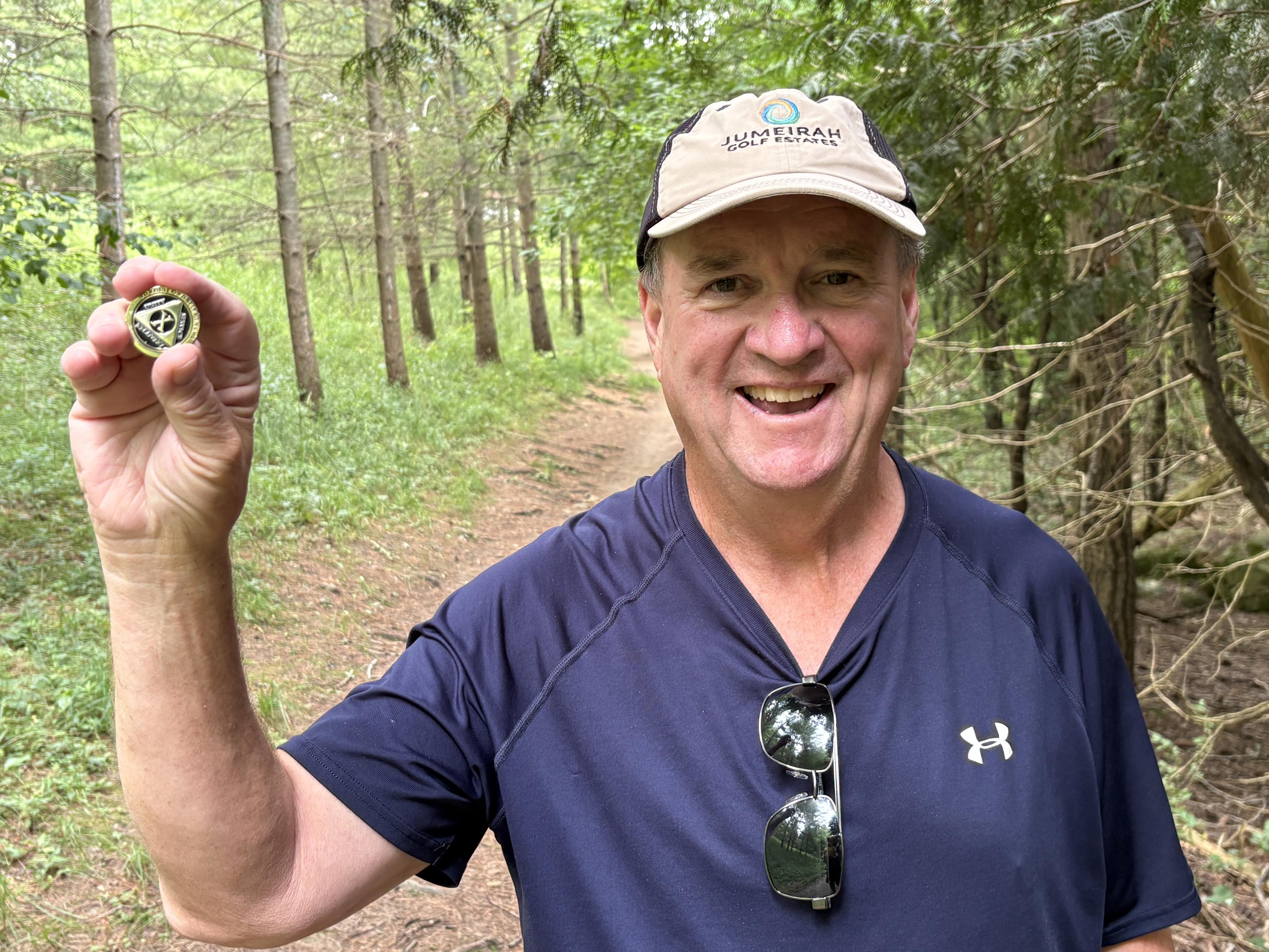
Yesterday - July 26, 2026 - marked ten years since I got sober. The photo above is my 10-year chip - one I ordered on Amazon and which I've carried with me over the last few days. I'll get my actual chip at a small get together of many of my closet friends tomorrow night.

Those were my anniversary messages. Little things I wrote to myself each July 26. You just didn't know it. I was writing them to you - but I was also writing them to myself.

That's the truth of this entire series. It began as a personal journey in which I was sharing my mind with myself. It just turned into something where I was sharing it with others.

Here's what happened and how my Daily Inspiration came about  - one month into sobriety, I needed something to anchor my mornings. Structure. Routine. A reason to get up and put one thought in front of the other. And something to get into words all the ideas and actions and goals and aspirations and motivation that were running through my head.

So I started writing a daily quote about the future - because the future was the thing I had just gotten back.

And here is what is interesting - the recovery community talks about living one day at a time. It turns out a futurist can do both: live one day at a time while thinking thirty years ahead. In fact, I'd argue that's the only way anyone can think clearly about the future - from a place of clarity in the present.

Writing this series every morning is what gave me that clarity.

Piece by piece, post by post, it gave me back my voice, and gave my voyage its purpose.

One daily inspiration at a time, one day at a time.

Now you know why.

Here's what I learned along the way, and it applies whether you're rebuilding a company or rebuilding a life: transformation isn't a single bold act. It's a sustained series of small steps - what I once called "a sustained series of stressful small steps - then suddenly, some sweet surprise!"

Today I'd revise it: then suddenly, a seismic shift.

You don't reinvent yourself at the moment of crisis.

You reinvent yourself in the 3,652 ordinary mornings that follow it.

Read the full post on my blog.

Original post: jimcarroll.com/2026/07/daily-i

★ 1 • ↻ 0 original
Jul 27, 2026 · 2:54 PM UTC

I will be shutting down my Mastodon instance, mastodon.futurist.info, on July 31.

I set it up years ago during the great Twitter meltdown.

I am slowly easing off of social media as I ease into retirement. I still do a few speaking gigs, still a few posts, but with the conclusion of my 10 year Daily Inspiration series today as I announced by 10 years of sobriety, I am scaling back more.

It's been a wonderful ride! Follow me elsewhere - primarily, Facebook, LinkedIn and Instagram

★ 0 • ↻ 0 original
← June 2026