Futurist Jim Carroll

Mastodon post archive · 2022–2026
Archived from mastodon.futurist.info · 4209 posts
← All months

April 2026 · 23 posts

← March 2026May 2026 →
Apr 1, 2026 · 9:54 AM UTC

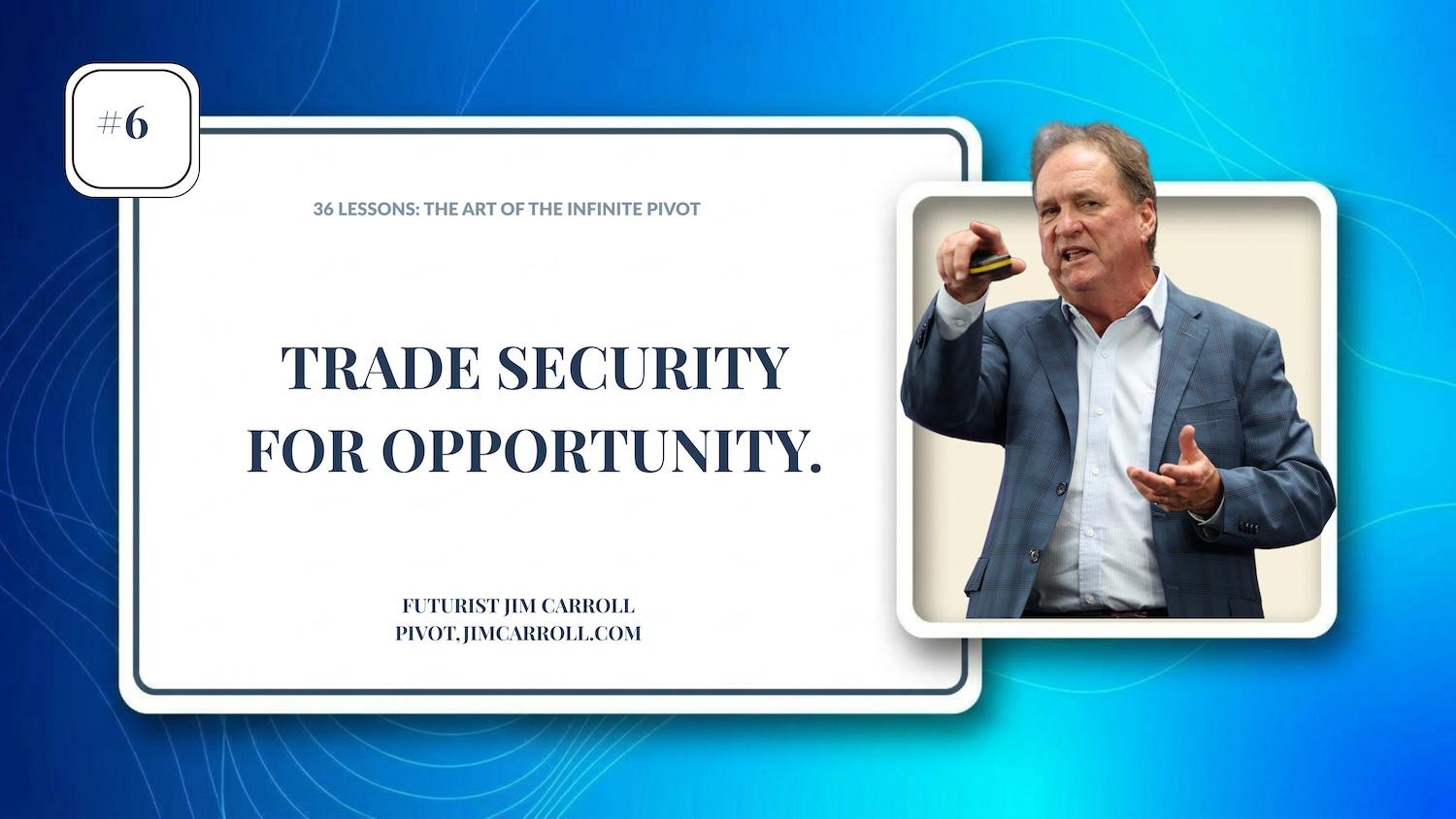
"Trade security for opportunity." - Futurist Jim Carroll

---
Futurist Jim Carroll is writing a series, The Art of the Infinite Pivot, based on 36 lessons from his 36 years as a solo entrepreneur, working as a nomadic worker in the global freelance economy. The series is unfolding here, and at pivot.jimcarroll.com.
---

You'll never pivot if you don't take on the risk!

When I was trying to decide many years ago if I should leave the corporate world and become a freelancer, my fear told me I was trading a "sure thing" for a "wild gamble." My colleagues thought I was leaving a safe harbor for a volatile ocean. Even before that, they were busy hammering home to me that I was making a mistake by abandoning the safe world of accountancy for some unknown career emerging in global connectivity.

But I also knew that something big was happening, and I wanted to be a part of it. I traded my future security for the opportunity that lay in front of me.

That taught me a valuable lesson that not only guided me throughout my career, but also became core advice for my corporate clients. And in fact, three decades of advising global leadership teams have taught me a brutal truth: the gamble isn't the pivot; the gamble is staying put.

As someone who speaks and writes about disruptive trends, I’ve watched far too many "safe" industries dry up and "secure" corporate giants crumble because they were anchored to a past that no longer existed. They refused to take on bold new risks to chase a disruptive opportunity. And in a high-velocity economy, here's what we know: focusing on certainty is the wrong thing to do.

The fact is, if you are anchored to a static model, you aren't safe.

You are a stationary target for disruption.

True security doesn't come from chasing safety; it comes from the agility you build when you choose to navigate change. The wrong path is the one that promises safety because it's often a dead end.

The right one - the one that involves risk and uncertainty - is the one that usually offers growth.

---

Futurist Jim Carroll discovered, over time, that the risk of the infinite pivot was well worth it.

**** **** **** **** **** **** **** **** **** **** **** **** **** **** **** **** **** **** **** **** **** **** **** **** ****
****
Original post: jimcarroll.com/2026/04/decodin

★ 1 • ↻ 0 original
Apr 2, 2026 · 9:48 AM UTC

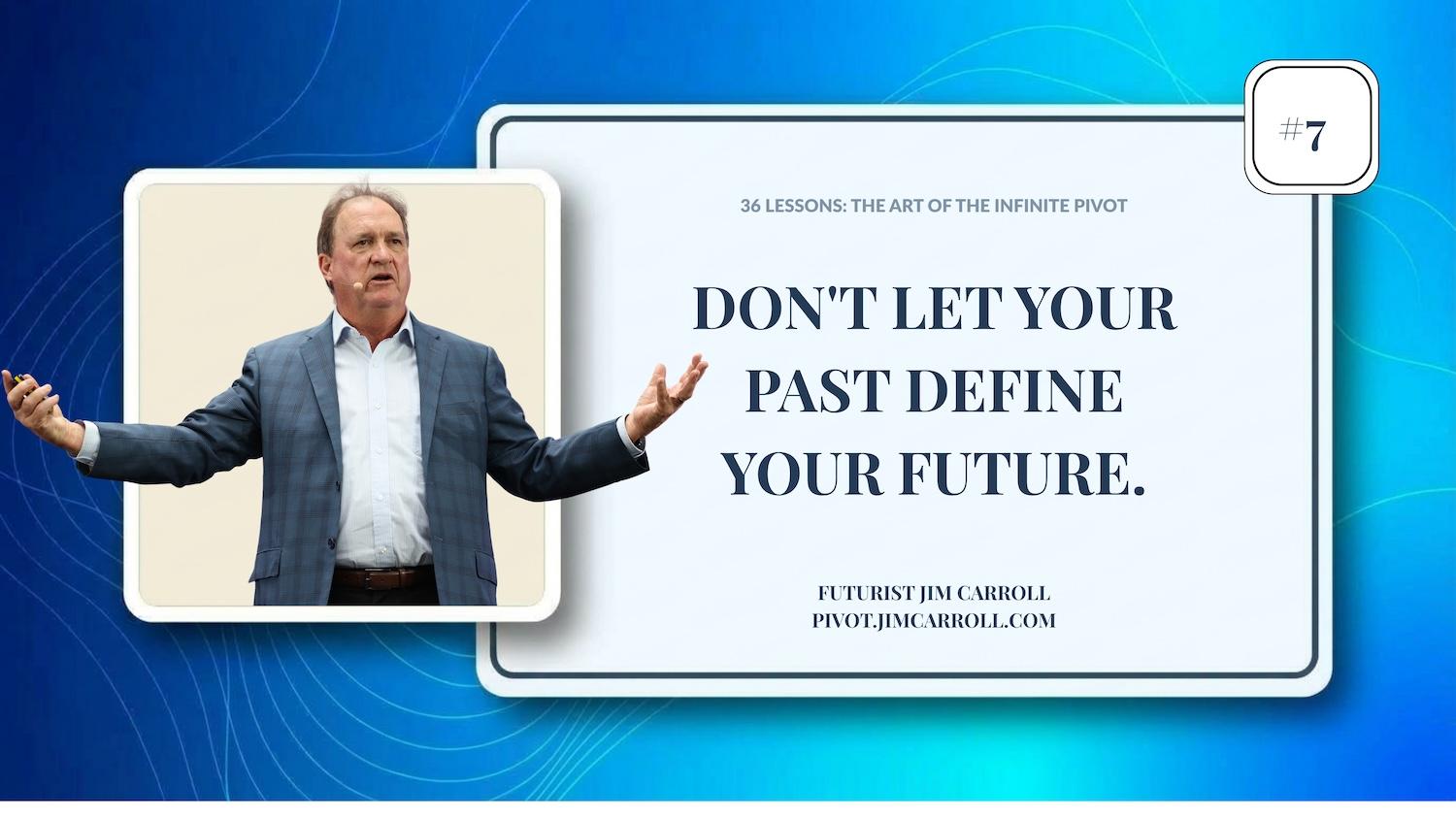
"Don't let your past define your future" - Futurist Jim Carroll

--
Futurist Jim Carroll is writing a series, The Art of the Infinite Pivot, based on 36 lessons from his 36 years as a solo entrepreneur, working as a nomadic worker in the global freelance economy. The series is unfolding here, and at pivot.jimcarroll.com.
--

In the late 1990s, I was at the top of my game.

I had written 34 books and was the go-to expert for the "Information Highway." I literally did thousands of interviews with the media - and can still find many of them online. On paper, in print, and in broadcast, I had 'arrived.'

I did so many interviews that for a long time, I was pegged everywhere I went as 'that Internet guy.' And yet, when the dot.com collapse happened around 2001, many people thought the disruptive impact of the Internet had come to an end.

So too did my career - the result was that my bread and butter dried up.

People no longer wanted 'Internet strategy.' They wanted the next big thing, and that 'big thing' was a broader range of trends and disruptive innovation.

Since I was spending all my time on stages and boardrooms speaking about those issues, albeit with a technology and Internet focus, I decided I would be a "Futurist, Trends & Innovation Expert," a self-anointed title I carry with me to this day. That's when I came to realize that the "Infinite Pivot" isn't a one-time event.

Why did I shift? By 2002, I realized being "The Internet Guy" was a brand with a shelf life. The world was moving from how to use the web to what the world would look like next. I had to do something uncomfortable: abandon a successful brand to build a significant one.

At the time, it felt like a massive risk to leave the security of a known niche.
But by choosing my own title, I was claiming the future. I stopped being defined by the tools I explained (the Internet) and started being defined by the perspective I provided (the future).

I was NOT letting my past define my future. Just as I refused to let my accountancy career and designation define my technology role. (I'm still, at this moment, a CPA! I just don't talk about it much!)

And wow, was this pivot a success!

It took hard work but from about 2005 to this day, I've built an entirely new career with an entirely new brand. And in this is a critical lesson for any organization: you might be the market leader today, but if you allow that success to define your identity forever, you will become a legacy act.

True agility requires the courage to "self-title" into your next phase before the market forces you to.

--
Futurist Jim Carroll is still known to some folks as 'that Internet guy.'

**** **** **** **** **** **** **** **** **** **** **** **** **** **** **** **** **** **** **** ****

Original post: jimcarroll.com/2026/04/decodin

★ 2 • ↻ 0 original
Apr 3, 2026 · 5:36 AM UTC

"The best way to predict your future is to put it on the calendar—and then earn the right to be there." - Futurist Jim Carroll

--
The Art of the Infinite Pivot has been paused until next Tuesday.
--

Looking at my app today, these aren't just tee times. They are a receipt.

I mean, you don't often get to see something like this on your phone!

Let the bucket begin!

I'm sending this out just as my flight is coming up over the Irish coast - we should be landing in Edinburgh within the hour. My son Tom and I will get at least 4, and perhaps 5 or 6 rounds in. But, we might have—as they say in Scotland—a wee bit o' weather! Hi Dave! LOL!

I never thought I'd see it come to fruition, but I was determined.I certainly won't let a little storm get in the way of a bucket list!

Look, I know I was going to stop posting about this, but not yet.

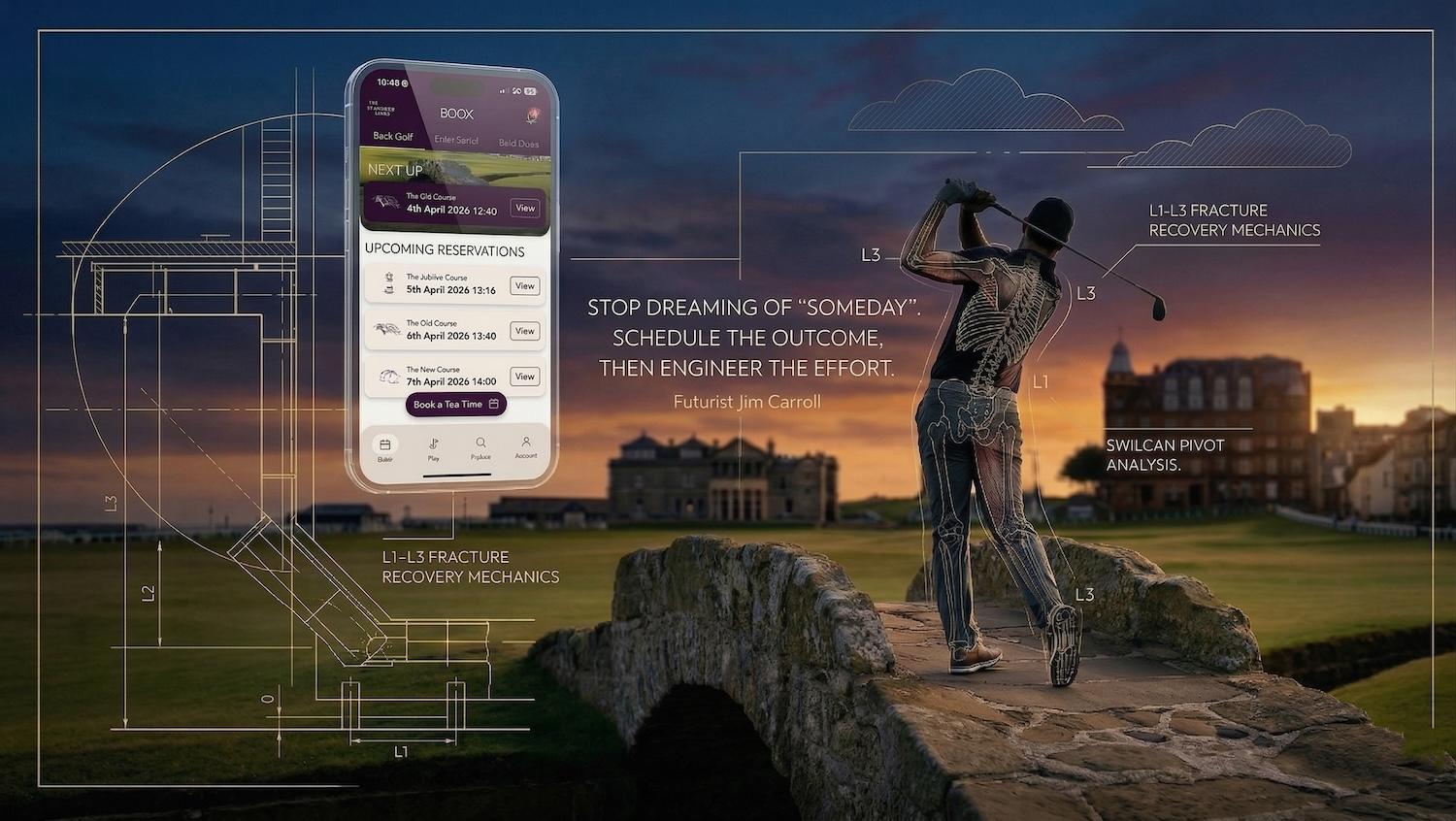
You might remember that back in March, I was in the thick of "Rotation Day"—the grueling first steps of twisting a spine that had been fractured in three places. I talked then about "engineering the outcome" and following a blueprint. I did the cardio. I did the heavy lifting. I did the work. I wrote about it in this post, with this image:

Today, the "blueprint" phase is officially over. The "Upcoming Reservations" are no longer abstract goals—they are the next 5 days of my life. If we are lucky, we'll get out for a round on arrival today, simply as a part of the process of staying awake!

I've learned a lot through this whole ordeal. Perhaps its that that we often spend too much time hoping for a "bucket list" moment and not enough time building the bridge to get there. If you are currently in your own version of "Rotation Day"—recovering from a setback, pivoting a business, or grinding through a tough project, keep your eyes on the calendar.

Because the future arrives for those who do the heavy lifting to meet it.
(I'm pretty certain I'll be sharing another golf photo in Monday's inspiration!)

---
Futurist Jim Carroll just hopes he doesn't shank off the first tee on the Old Course.

**** **** **** **** **** **** **** **** **** **** **** 

Original post: jimcarroll.com/2026/04/decodin

★ 2 • ↻ 0 original
Apr 4, 2026 · 2:06 PM UTC

128 days since breaking 3 small bones on my spine.

Determination, effort, courage, put in the work.

--

★ 1 • ↻ 0 original
Apr 6, 2026 · 6:04 AM UTC

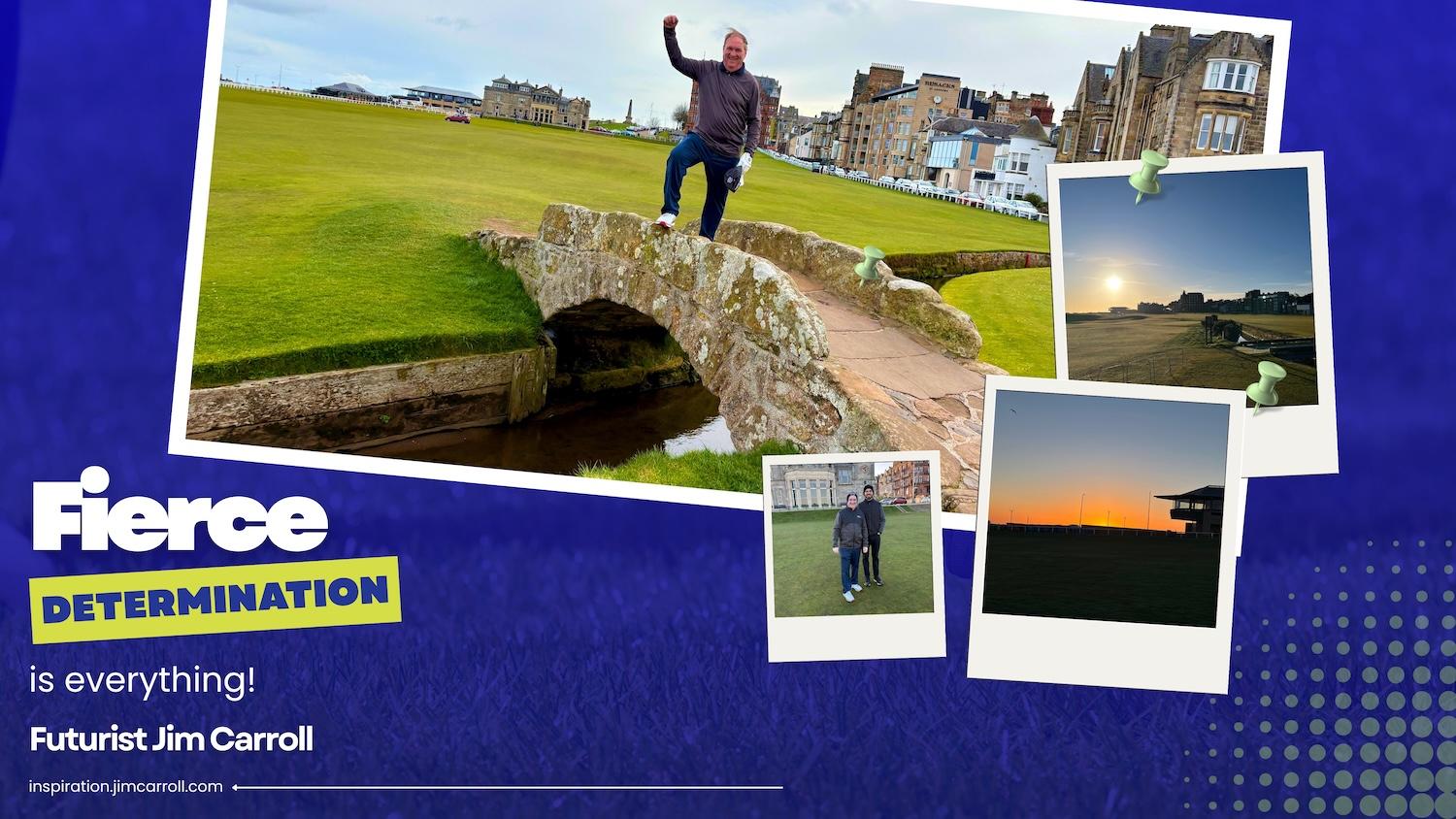
"Fierce determination is everything!" - Futurist Jim Carroll

---
The Art of the Infinite Pivot has been paused until tomorrow.
---

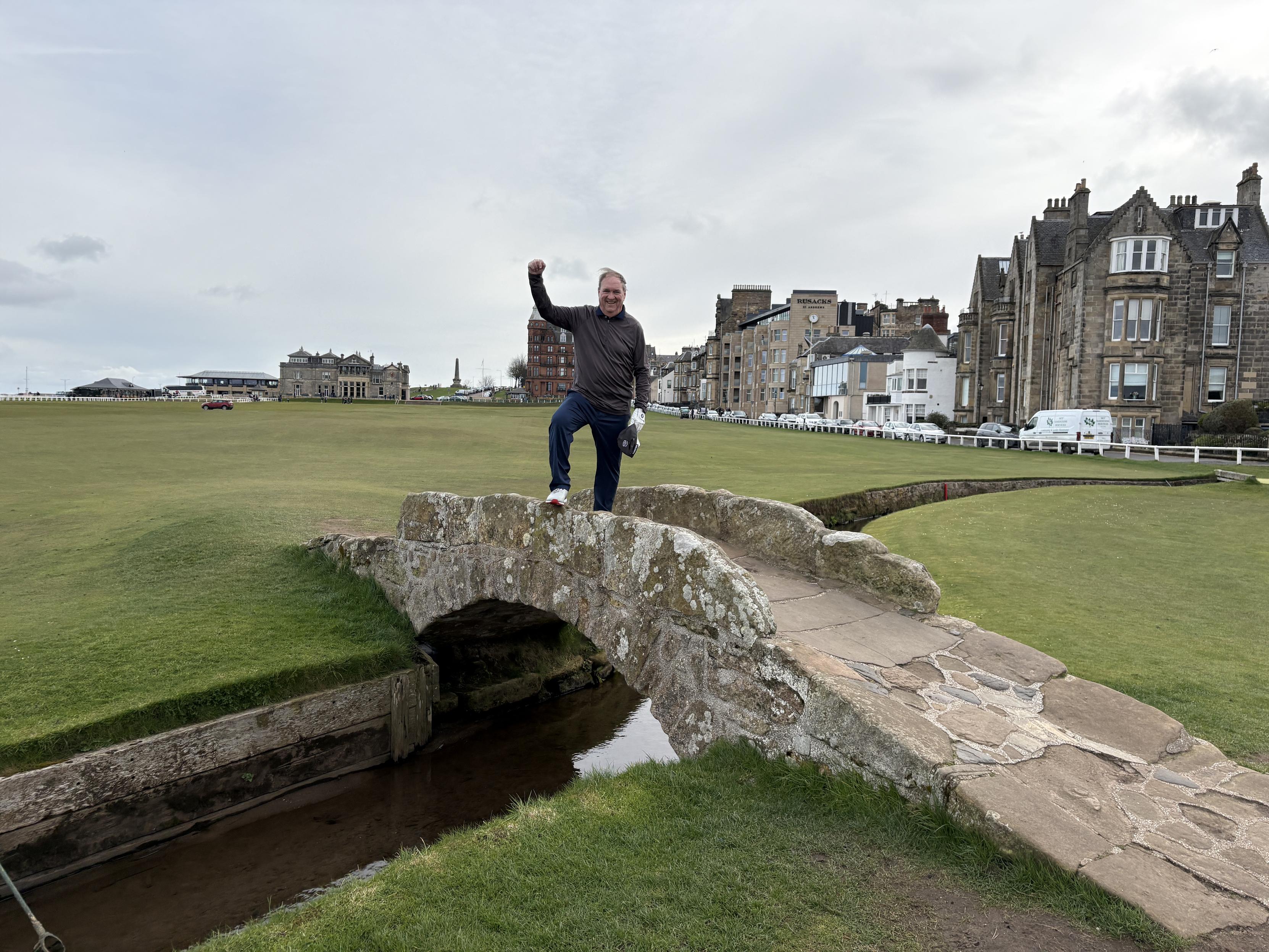
A bridge is meant to be crossed, not lived on.

Once you cross it, you'll know the difference between surviving a setback and totally conquering it.

I promise this will be the last post about my injury and recovery. But what a moment on Saturday! It could not have been scripted better!

Exactly 128 days ago, a severe fall left me lying on the ground with three fractured vertebrae in my lower back. At the time, I had all kinds of negative thoughts - skiing was out for the season, I might not be able to golf, things might go from bad to worse. I also know my fall could have been worse - nerve damage, a concussion if I hit my head, and worse.

From that moment, I didn't let the fear drive me - I reached out to various medical and sports experts to get a clear assessment of my condition and path forward. And I decided early on that rather than living in the fear of what the injury did to me, I'd build a foundation of hope for where I could go.

Picture this - just days after the 'incident', I was recording 5km walks on Strava of walks inside my house. 1000 meters at a time, headphones on, speed walking loops through my living room and kitchen. Just a few weeks later, I started "mall-walking." Two months in, I went back to the gym. At the three-month mark, I began working on pivot exercises and doing actual golf swings.

St. Andrews and a tee time on the Open Course became my entire focus, my goal, my objective.

I put in the work.

The fact is, I was building a foundation for this goal of teeing off!

The ultimate payoff came Saturday - my son and I managed to snag a second tee time on the Old Course - my original prebooked one happens later today. (Two rounds!) I'll admit. I almost cried with joy and relief.

My drive was perfect. My second shot was too perfect, running long and rolling right into the Swilcan Burn. No problem - my drop had me chipping perfectly onto the green, and draining my 10-foot putt for an opening double.

Looking back, I knew I was on my way and that the injury was behind me.
It got better from that point - after a bit of a challenging start, I managed par on the next hole - and then proceeded to play one of the greatest rounds of my life! (That's not an understatement. I had 107 rounds last year.) And walking the back nine of the Old Course at St. Andrews, hitting 100% of my fairways off the tee, and shooting an 88—the greatest victory was that I didn't think about my back a single time.

No flinching, no muscle spasms, no hesitation.

Nothing. I was just enjoying my time! And for me, breaking 90 on the Old Course was a remarkable achievement.

With that, the ghost of the injury is officially gone.

---

Futurist Jim Carroll is out for another round on the Old Course later today.

Original post: jimcarroll.com/2026/04/daily-i

★ 1 • ↻ 0 original
Apr 7, 2026 · 5:46 AM UTC

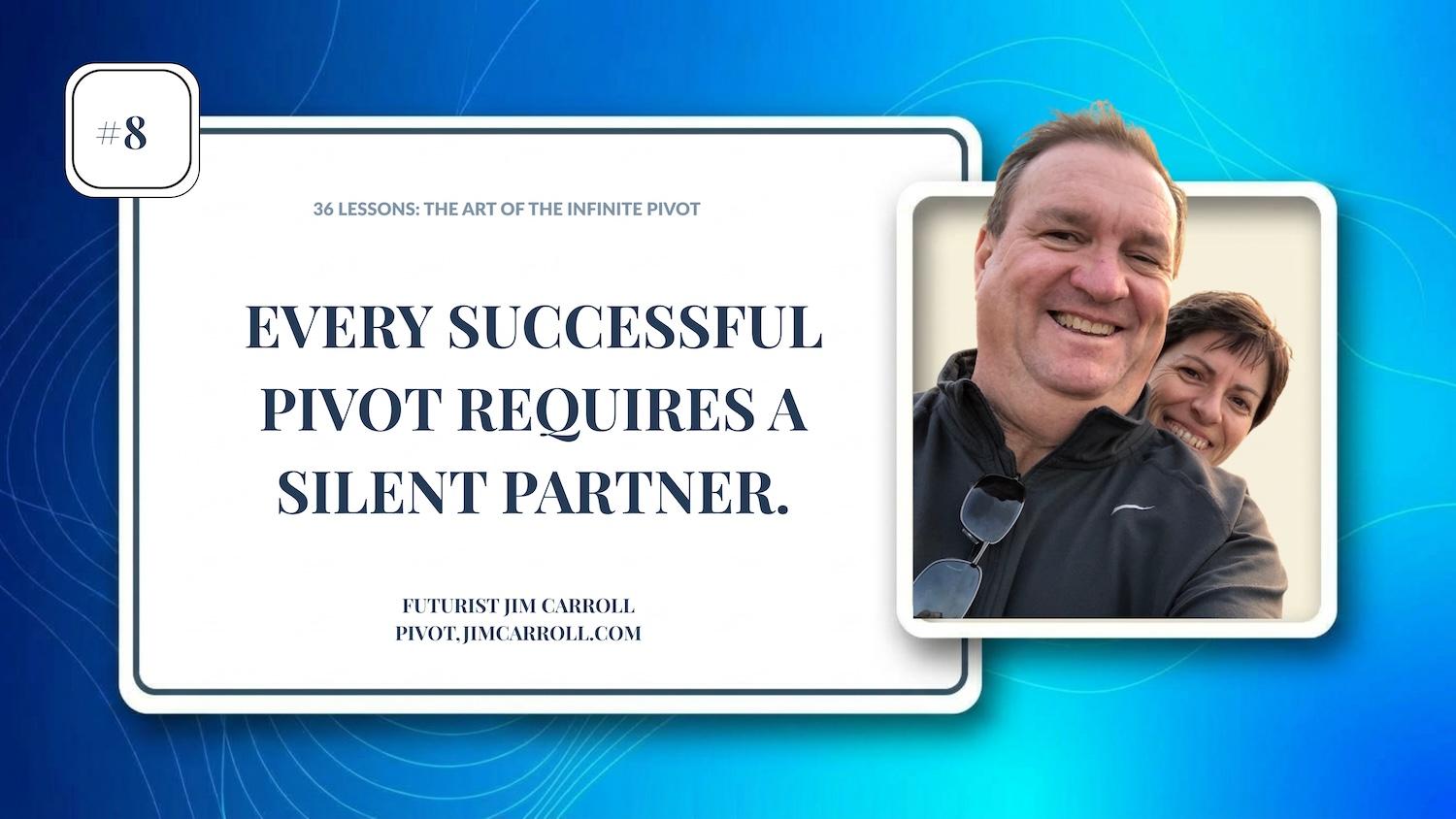
"Every successful pivot requires a silent partner" - Futurist Jim Carroll

--
Futurist Jim Carroll is writing a series, The Art of the Infinite Pivot, based on 36 lessons from his 36 years as a solo entrepreneur, working as a nomadic worker in the global freelance economy. The series is unfolding here, and at pivot.jimcarroll.com.
--

For 36 years, I’ve been the one on the stage, the one with the "Futurist" title, and the one writing the books.

But none of it would have been possible without my wife Christa. When I walked out of my job in 1990, we were in it together. I was tired of the corporate world and wanted to chase the future - she had a stable and lucrative executive position in a global multinational and could help to finance the risk. We decided - together - that I could take the plunge - into the world of technology consulting.

Then, as I pivoted to the Internet in '94 and then to the "Futurist" role in 2002, she wasn't just supporting the move. She was the rock of stability that allowed the move to happen, all while raising our two young children. But she wasn't just the mom - she was the master organizer of complicated logistics, contracting, and so much more. Oh, and at the same time, she was the rock-solid editor of the (soon to be) 44 books that I have written or co-written throughout my career.

I've written about her role before, and in one post, referred to her as the 'Fifth Beatle' - the George Martin of the operation, the Bernie Taupin partner, the one whose role is often unseen but absolutely critical to the overall success.
Every creative person needs their fifth Beatle, George Martin, their Bernie Taupin.

Christa is mine.

In the world of the Infinite Pivot, everyone talks about the effort involved in changing. They focus on the speed, the risk, and the vision of the person at the helm. The key person, so to speak.

But they forget that if you try to pivot without a solid foundation, you don’t manage to succeed. Often, you just spin out of control. Christa has been my business partner, my office manager, and my reality check for nearly four decades. She provided the structural and emotional "anchor" that gave me the freedom to be bold, all while raising our sons.

You need a rock.

The boldest moves aren't made by those who have nothing to lose; they are made by those who have a solid place to stand. Before you make your next turn, make sure you know who, or what, is holding the ground for you.

In my case, it's Christa.

--

Futurist Jim Carroll believes there are countless unsung heroes of the freelance economy out there in the world.

**** **** **** **** **** **** **** **** **** **** **** **** **** **** **** **** **** **** **** **** **** **** **** **** ****

Original post: jimcarroll.com/2026/04/decodin

★ 0 • ↻ 0 original
Apr 8, 2026 · 4:24 AM UTC

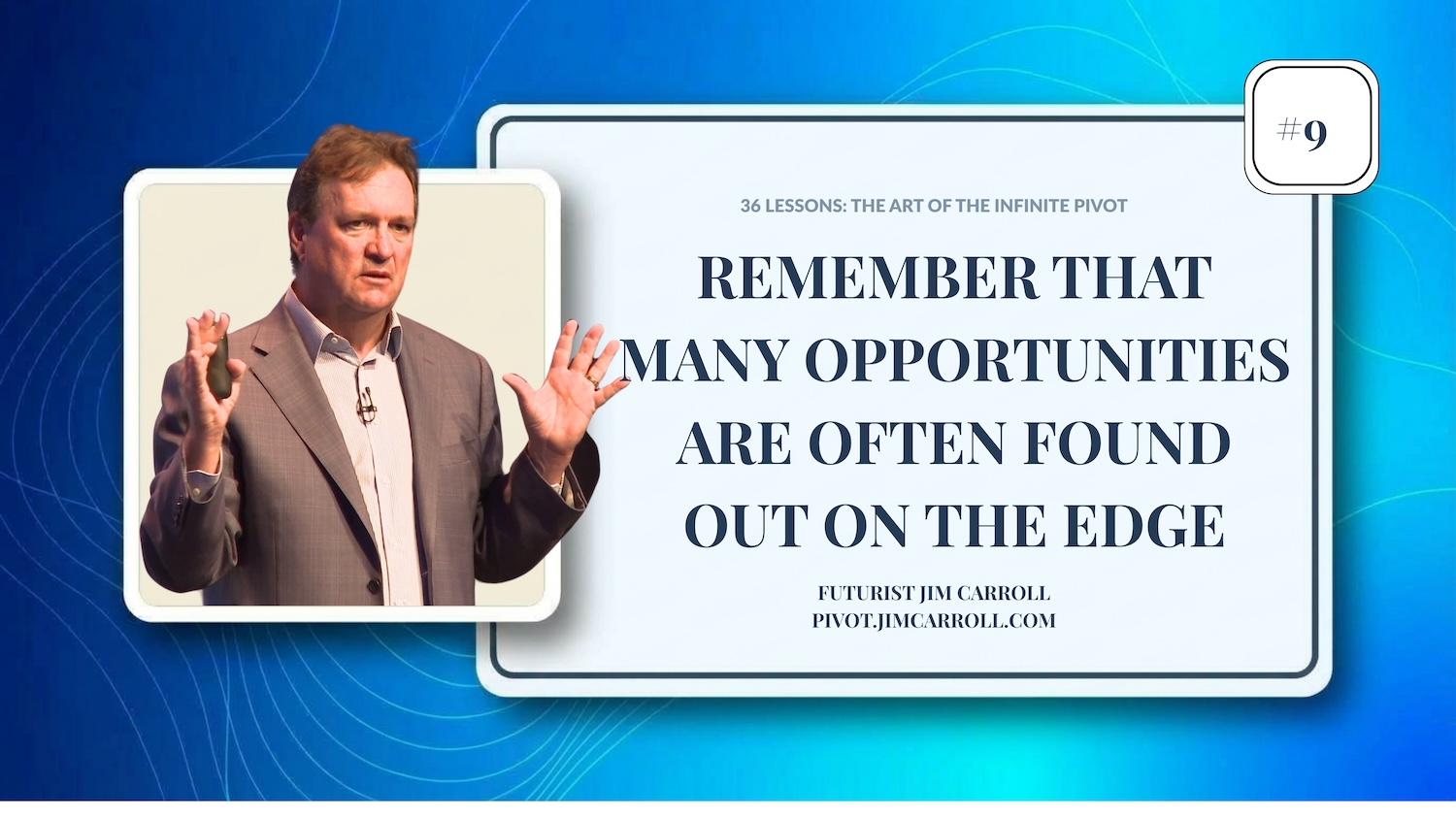
"Remember that many opportunities are often found out on the edge" - Futurist Jim Carroll

--
Futurist Jim Carroll is writing a series, The Art of the Infinite Pivot, based on 36 lessons from his 36 years as a solo entrepreneur, working as a nomadic worker in the global freelance economy. The series is unfolding here, and at pivot.jimcarroll.com.
--

If you want to know where your next pivot is coming from, stop looking at the center of your industry.

Look to the edges instead.

Why is that? The center is crowded, safe, and focused on yesterday’s success, and that fact often means that not much innovative, disruptive thinking is occurring there. To pivot is to chase new opportunities, and I've followed that reality: throughout my 36-year voyage, every major shift I made, from the Internet in '94 to AI in '26, was found by looking at the outliers on the outskirts of the mainstream.

1994 and earlier? The "serious" business world dismissed the Internet because it looked unpolished and unprofitable. It was an anomaly on the periphery. But I wasn't looking for "safe"; I was looking for the unique opportunities this rapidly emerging world of global connectivity provided. I realized that the people on the edge were building a new reality while the people in the boardroom were busy defending an old one. (The telecom world of the time, a true dinosaur, had a vastly different view of how the future would unfold, one which they dramatically and fully controlled.)

To make the pivot, I had to stop trying to fit in with the "standard" view of tomorrow and start to follow an unconventional path.

I chased many similar future opportunities in the same way, which led me to realize that much of what is involved with 'edge-thinking' makes you someone with a unique viewpoint. Today, that has led to my forthcoming book, Being Unique, which takes a look at how 'edge thinkers' approach opportunities. Uniqueness? It’s not just a personality trait; it’s a competitive research strategy. Whether you are an individual reinventing your career or a CEO repositioning a global brand, you have to develop an ear for signals on the periphery. These are the small, quiet developments happening far away from the "proven" markets or the 'expected' future.

The standard worldview is designed for stability, but the edge is designed for experimentation. If you wait for a trend to be "proven," you've already missed the window for a high-value pivot.

You have to be willing to leave the comfort of the "known" and spend time out on the edge.

Because that is often where the future happens.

---
Futurist Jim Carroll will be releasing his book, Being Unique, within the month. He hopes you'll grab a copy. More information can be found at unique.jimcarroll.com.

Original post: jimcarroll.com/2026/04/decodin

★ 0 • ↻ 0 original
Apr 9, 2026 · 9:34 AM UTC

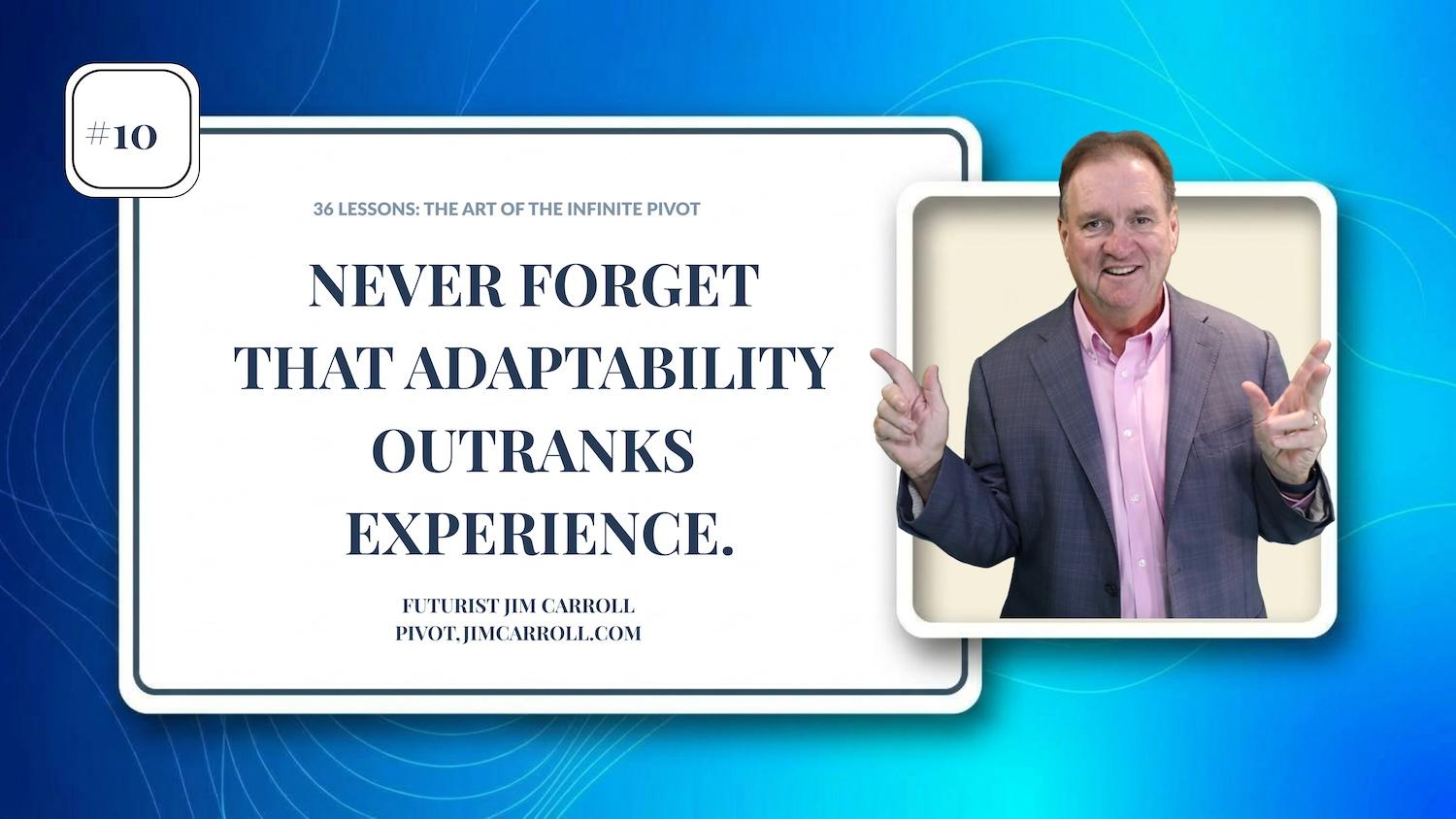
"Never forget that adaptability outranks experience." - Futurist Jim Carroll

--
Futurist Jim Carroll is writing a series, The Art of the Infinite Pivot, based on 36 lessons from his 36 years as a solo entrepreneur, working as a nomadic worker in the global freelance economy. The series is unfolding here, and at pivot.jimcarroll.com.
--

The future doesn't care about your resume.

It only cares about your ability to adapt.

Don't let your experience become the baggage that holds you back.

If you think about our world of rapid change, you can easily appreciate that experience is a double-edged sword. It gives you the confidence to go forward, but it can also hold you back by encouraging you to be complacent, trying the 'same old things' instead of trying new things. In my 36-year voyage, I’ve come to realize that the more you "know" about how something works, the harder it is to see how it is about to change.

Think about it this way: the experience that you have in adapting to change has become more important than experience itself.

What does this mean? To master the art of the infinite pivot, you have to be willing to fire yourself as an expert every few years and reinvent yourself. You need to be willing to trade your "Expert" badge for a "Beginner" badge, admitting that the knowledge that made you successful yesterday might be the very thing that makes you obsolete tomorrow.

This is not only a personal skill but also the ultimate test for any leader in an era of disruptive change. Most organizations are run by experts who are conditioned to protect their "proven" success. When disruption occurs, these experts are often the first to dismiss it, discount it, and label it as unimportant because it threatens their identity, status, and power. They aren't just protecting the business; they are protecting their status.

To master the Infinite Pivot, you must be willing to unlearn and relearn. You have to be comfortable being the student in a room full of people who have less "experience" but more "adaptability" than you do.

The future rewards your ability to learn, not your ability to remember.

Don’t let your years of experience become years of baggage!

--

Futurist Jim Carroll is always trying to learn new stuff, knowing that it is better to know what you don't know than to try to rely on what you do know.

**** **** **** **** **** **** **** **** **** **** **** **** **** **** **** **** **** **** **** **** **** **** **** **** ****

Original post: jimcarroll.com/2026/04/decodin

★ 0 • ↻ 0 original
Apr 10, 2026 · 9:32 AM UTC

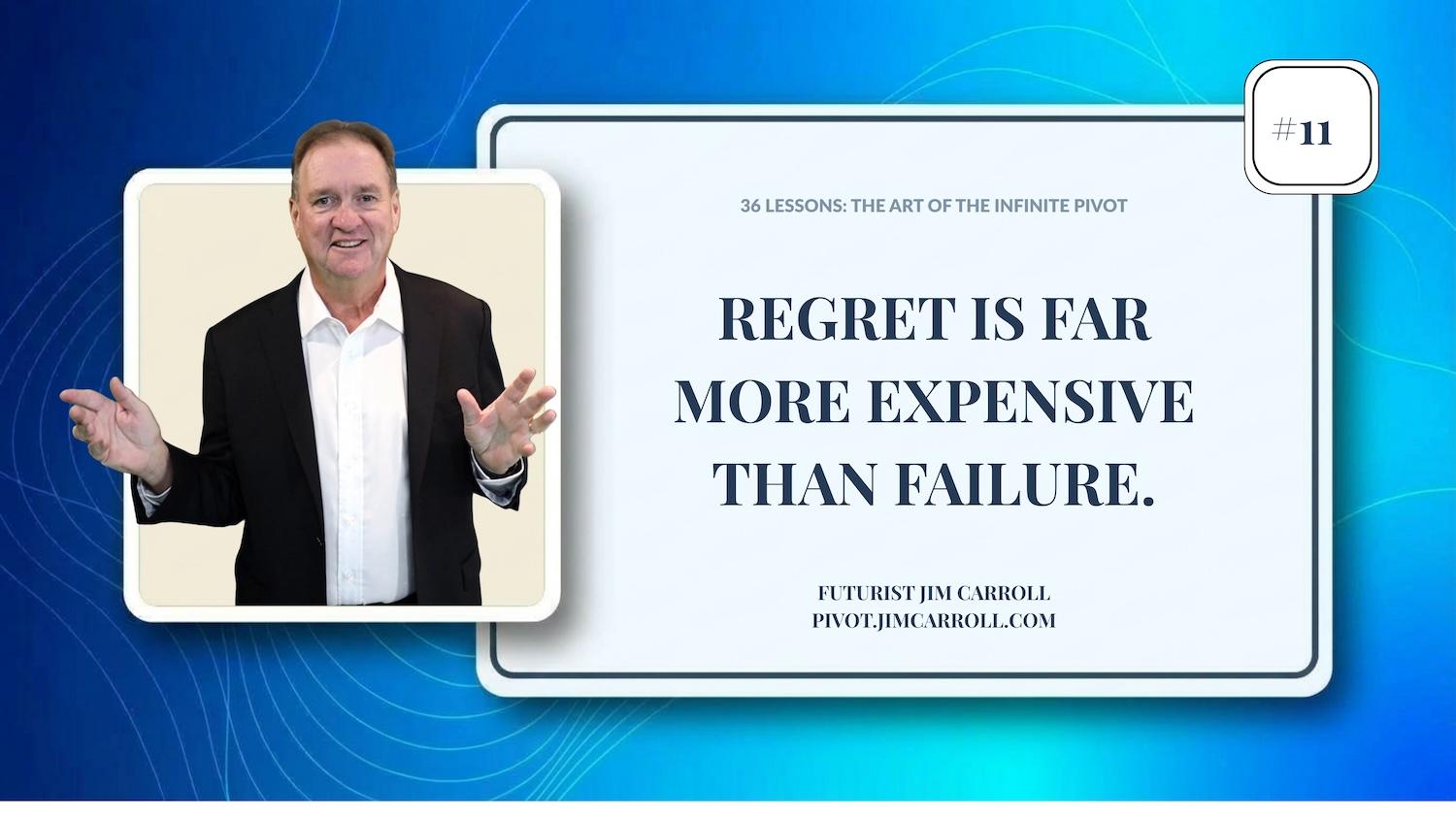
"Regret is far more expensive than failure" - Futurist Jim Carroll

--
Futurist Jim Carroll is writing a series, The Art of the Infinite Pivot, based on 36 lessons from his 36 years as a solo entrepreneur, working as a nomadic worker in the global freelance economy. The series is unfolding here, and at pivot.jimcarroll.com.
--

Most people and organizations are paralyzed by a single, haunting question: "What if I fail?"

They spend months (sometimes years) conducting risk assessments and feasibility studies, all designed to protect themselves from the sting of a mistake. They personally try to avoid risk, or in the case of companies, have entire risk management teams, whose goal is to minimize and eliminate risk. They insulate themselves from bold moves because they cannot bear to see things go wrong.

And in doing so, they miss out on a lot of opportunity - and come to regret it later.

What's worse? Trying to do something and seeing it go wrong? Or thinking back years later, "I should have tried to do it!"

In my own 36-year voyage, I’ve learned that the most dangerous risk isn't the pivot that goes wrong: it's the pivot that never happens. We need to stop obsessing over the cost of a "miss" and start focusing on the only question that truly matters: "What if I never try at all?"

Think of it this way: failure is a temporary setback but a valuable asset. You can learn from it, adjust, and pivot again. But the idea of never trying at all results in a permanent loss of potential. You don't learn and become stuck where you are, missing out on the chance to go where you should be going.

I’ve sat in boardrooms with legacy companies that are now obsolete, not because they made a bad bet, but because they were too afraid to place a bet at all. They chose the "safety" of the status quo, only to find that the status quo had moved on without them.

The Infinite Pivot isn't about being fearless; it’s about being more afraid of standing still than you are of moving forward. When you look back at your career or your company’s history a decade from now, you won't remember the small stumbles.

You will only remember the doors you were too scared to open.

Remember: the risk of the unknown is manageable.

But the cost of "what if" or "if only" is infinite.

---

Futurist Jim Carroll believes that having a case of the 'if-only's' is worse than suffering from a case of the 'whoops!'

**** **** **** **** **** **** **** **** **** **** **** **** **** **** **** **** **** **** **** **** **** **** **** **** ****

Original post: jimcarroll.com/2026/04/decodin

★ 1 • ↻ 0 original
Apr 13, 2026 · 8:48 AM UTC

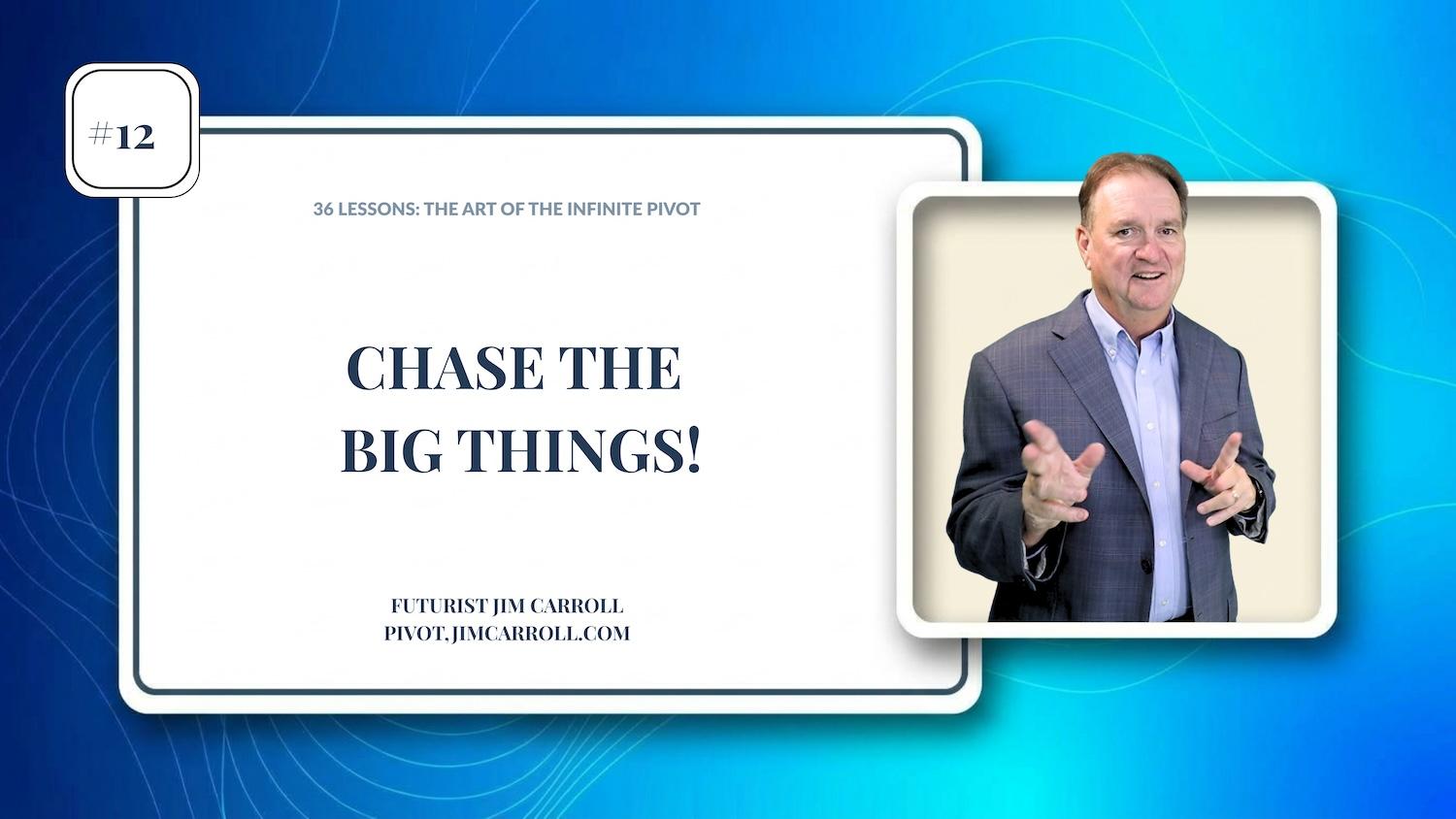
"Chase the BIG things!" - Futurist Jim Carroll

--
Futurist Jim Carroll is writing a series, The Art of the Infinite Pivot, based on 36 lessons from his 36 years as a solo entrepreneur, working as a nomadic worker in the global freelance economy. The series is unfolding here, and at pivot.jimcarroll.com.
--

When big, bold opportunities are unfolding, do you chase the big ideas or keep doing small things?

The art of the infinite pivot involves the former, obviously, not the latter.

Big trends involve big opportunities, but only come around so often. So why would you wait?

Think of it this way: the biggest pivot of your life won’t start with a spreadsheet or a market report.

It starts when you finally choose to listen to the quiet, internal voice inside you telling you to leave the safety of "certainty" for the risk of something bigger.

When I quit the corporate world in 1990, I didn't have a 50-page business plan. What I had was a gut feeling that something massive was happening with global networking. I just knew I had to be a part of it. I had no idea where it was going to take me, what I might do, or how I might shape my tomorrow.

But I just knew... so I traded a predictable salary for the unpredictable thrill of the unknown.

I stopped chasing the "safe" path and started chasing the thing I actually wanted to chase.

It worked out pretty well!

Unknown to me at the time, I was deeply caught up in one of the most important aspects of innovation of all - emotional commitment to a bigger trend. And that is the lesson many leaders miss: true innovation requires an emotional investment in a bold future. You'll only accomplish big things if you innovate within the bigger trend.

My early pivot has continued through my career. In fact, throughout my 36-year voyage, the moments of greatest growth always happened after I abandoned the "proven" model to follow a bigger signal that only I could hear.

Look, certainty is comfortable, but being bold takes you further.

Don't wait for the world to permit you to change.

Listen to your internal voice.

Chase the thing you want to chase.

Because it might be in front of you right now.

---

It's no wonder that the title of one of Jim's books starts with Think BIG...!

**** **** **** **** **** **** **** **** **** **** **** **** **** **** **** **** **** **** **** **** **** **** **** **** ****

Original post: jimcarroll.com/2026/04/decodin

★ 2 • ↻ 0 original
Apr 14, 2026 · 10:27 AM UTC

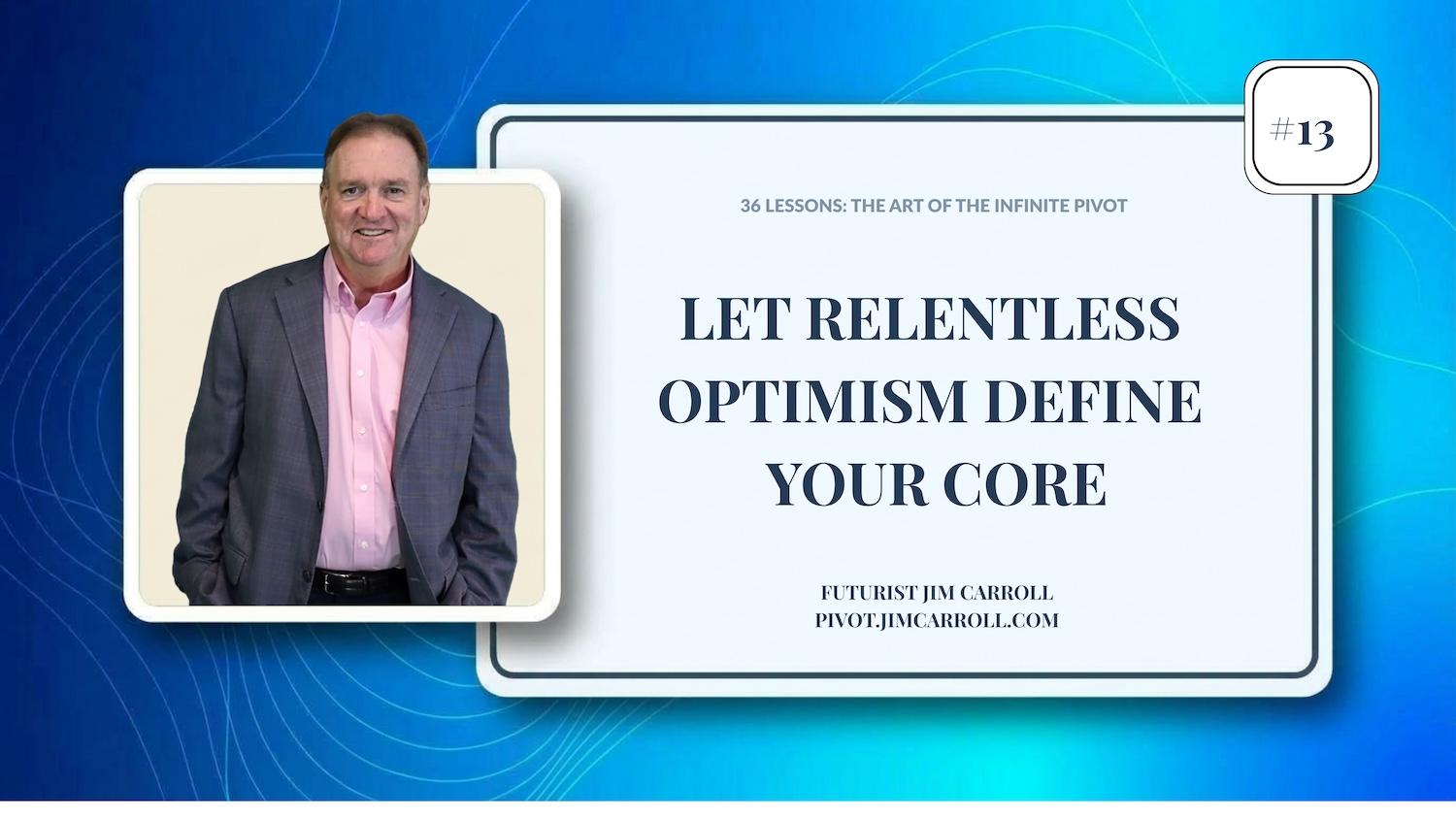
"Let relentless optimism define your core!" - Futurist Jim Carroll

--
Futurist Jim Carroll is writing a series, The Art of the Infinite Pivot, based on 36 lessons from his 36 years as a solo entrepreneur, working as a nomadic worker in the global freelance economy. The series is unfolding here, and at pivot.jimcarroll.com.
--
For those who might ask, I'm in California today, on stage at 9 am with a keynote for a packaging conference. if the weather gods are willing, I'll be landing back at YYZ about 910pm, and should see a splashdown at perhaps 1030pm. Traditions and all!
--

On a milestone like today, you realize that the most important piece of "gear" you’ve carried through 36 years isn't a laptop or a library of data.

It’s your outlook.

In a world of relentless change, volatility, and a staggering rate of change that always seems to directly impact you, the most radical mindset you can adapt is to stay relentlessly optimistic.

Optimism isn't about being naive; it’s about being strategic. It's about making a conscious decision that you are always going to try to find the upside, instead of obsessing over the downside. You are going to find the opportunities rather than becoming distressed about the negatives. It means you are going to always act to keep moving forward, even though personal circumstances seem to be trying to drag you backward.

And it always involves thinking about a potentially better future. Look, if you don't believe the future can be better, you won't do the hard work required to pivot toward it. In my voyage, I’ve seen that the cynics are usually right in the short term, but the optimists are the ones who build the long term. Cynicism is a destructive force: optimism is a powerful flex.

This is the secret to longevity. When you choose optimism as your core, every disruption becomes an opportunity rather than a threat. Throughout my 36 years, the pivots that felt the most effortless were the ones fueled by a genuine excitement for what was coming next.

If you let fear define your core, you will build a career based on standing still.
Doing small things. Making small steps. Chasing small goals.

But if you let optimism define your core, you build a career based on possibility.

Big ideas. Big trends. Big opportunities.

As I stand at this milestone today, I’m not looking at the challenges that exist around me today.

I'm looking at what comes next and what I will do to be a part of it.

That being the case, think about this: the future belongs to those who are excited to meet it!

---

Futurist Jim Carroll believes that optimism is at the core of all success.

**** **** **** **** **** **** **** **** **** **** **** **** **** **** **** **** **** **** **** **** **** **** ****

Original post: jimcarroll.com/2026/04/decodin

★ 2 • ↻ 0 original
Apr 15, 2026 · 10:26 AM UTC

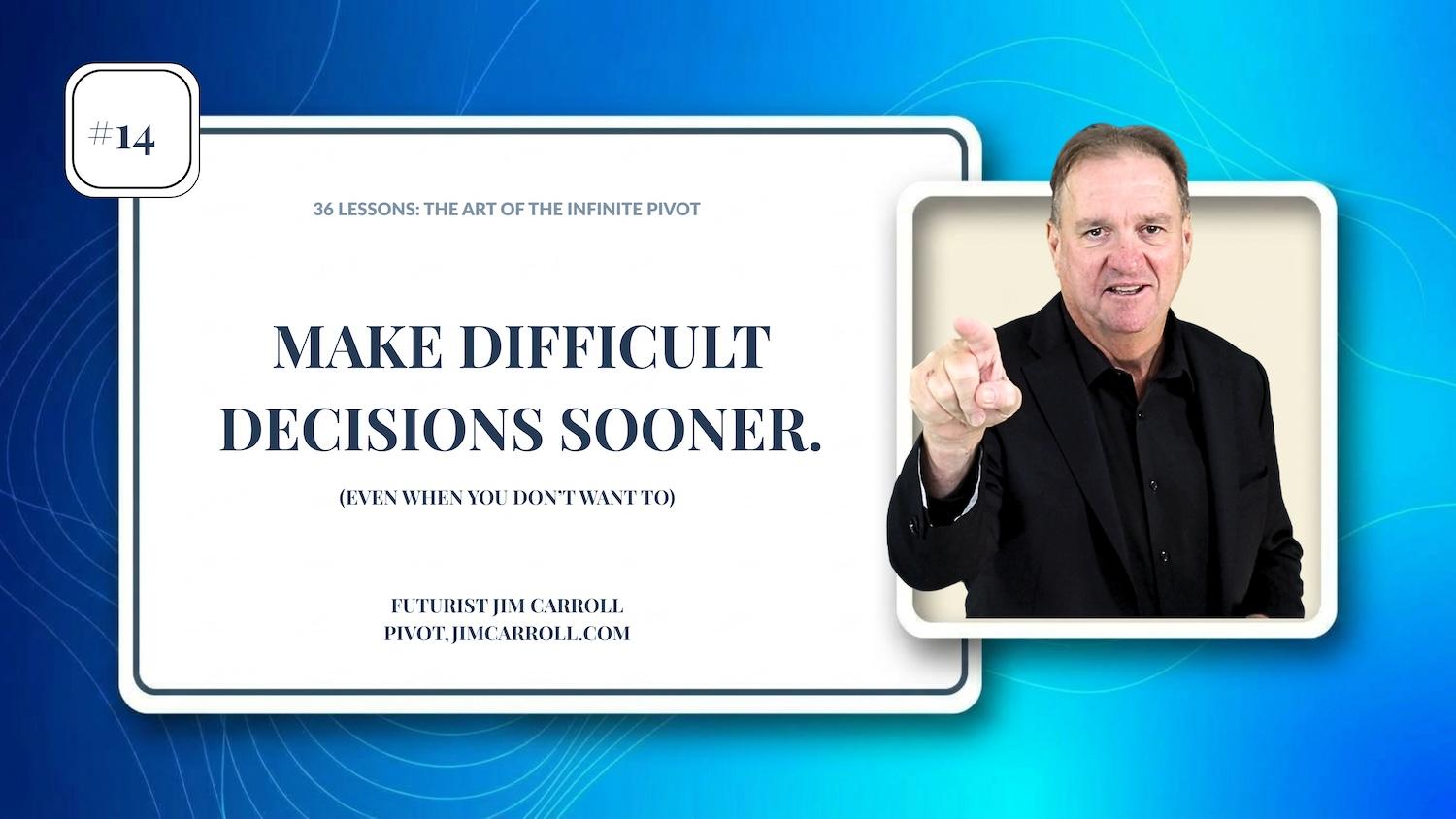
"Make difficult decisions sooner. (Even when you don't want to)" - Futurist Jim Carroll

--
Futurist Jim Carroll is writing a series, The Art of the Infinite Pivot, based on 36 lessons from his 36 years as a solo entrepreneur, working as a nomadic worker in the global freelance economy. The series is unfolding here, and at pivot.jimcarroll.com.
--

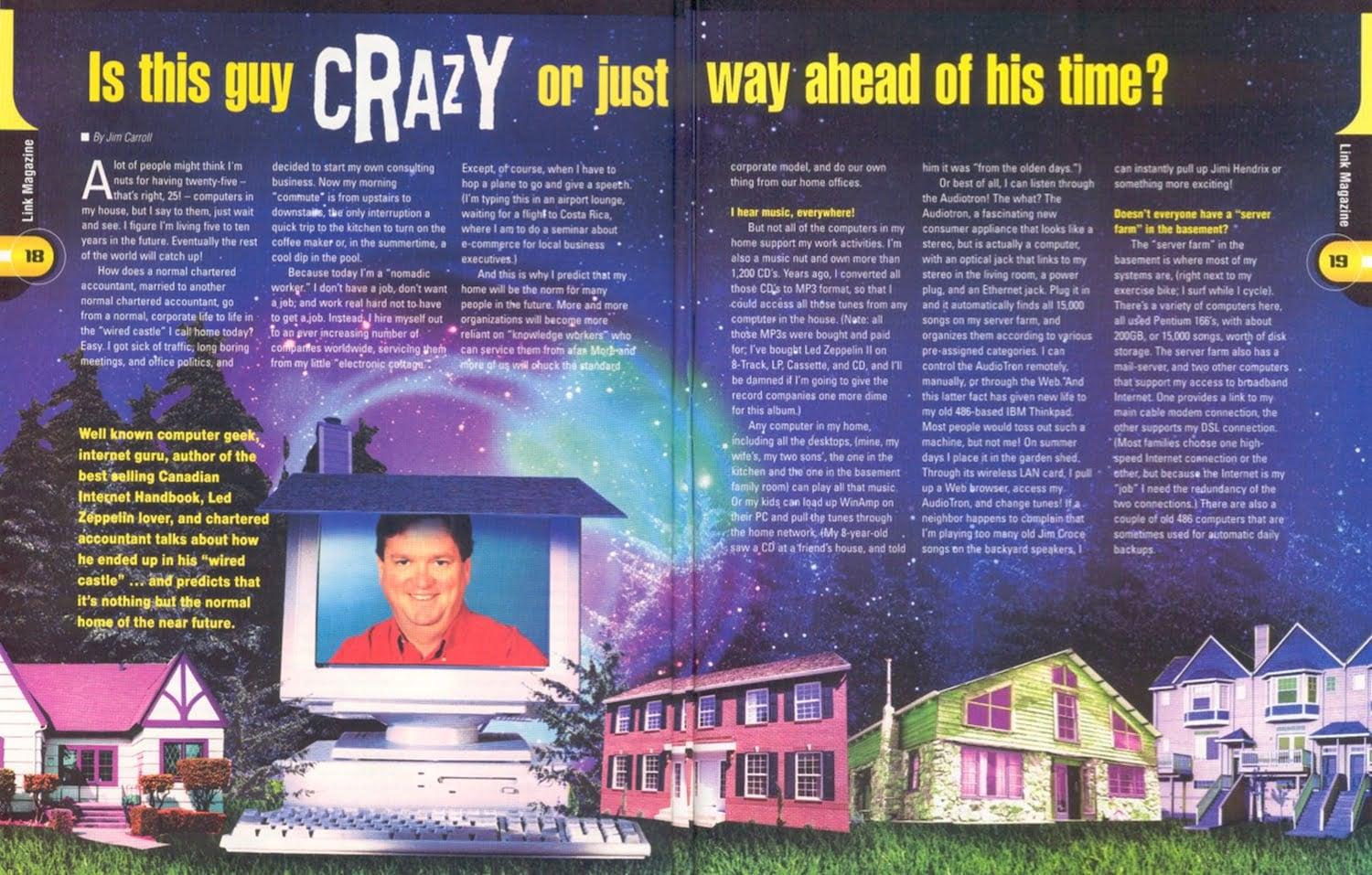
At one moment in time, I had Google Claude analyze the thousands of blog posts I've written since 2002, to try to come up with a list of the unique phrases I've come up with through the years. It came back with a massive list. and called them "Jim'isms." I'm pretty proud of the list, since these phrases often capture the essence of the ideas I share with my clients and readers.

The one I am proudest of is probably the one with which you are most familiar: "aggressive indecision." I coined it back in 2002 to describe the tendency among my clients to make the tough decisions that need to be made, particularly when uncertainty reigns.

And it led me to believe that the most dangerous words in any business or life are, "Let's wait and see."

When we wait, we fail. We might tell ourselves we are being prudent, being cautious, but usually, we are just being hesitant. In my 36-year voyage, I’ve learned that the difficulty of a decision doesn’t decrease with time: it only compounds. To stay ahead of the curve, you must learn to make difficult decisions sooner, especially when you don't want to.

Every successful pivot I’ve made in my career and business required me to cut ties with something comfortable but declining. Whether it was walking away from a stable career path or sunsetting a keynote topic that was still "doing okay," the hardest part identify8ing what I needed to do. It involved actually doing it.

As humans, we are engineered, it seems, to avoid the tough decisions. And yet often, that's the only way to get ahead!

The simple fact is this: if you wait until you are forced to make a decision, you aren't pivoting; you’re reacting.

Making decisions sooner -m even when you don't want to - is the antidote to aggressive indecision. Most organizations and people stay stuck because they treat difficult choices like a burden to be avoided rather than a strategic advantage to be seized. By making the tough call early, when you still have resources and momentum, you control the future to the extent you can. If you wait until your hand is forced, the market (or the crisis) controls you.

Don't let the weight of a difficult choice paralyze you.

Make the call.

Futurist Jim Carroll believes that 'aggressive indecision' is the root cause of most failure.

**** **** **** **** **** **** **** **** **** **** **** **** **** **** **** ****

Original post: jimcarroll.com/2026/04/decodin

★ 2 • ↻ 0 original
Apr 16, 2026 · 9:41 AM UTC

"Waste time on frivolous things!" - Futurist Jim Carroll

--
Futurist Jim Carroll is writing a series, The Art of the Infinite Pivot, based on 36 lessons from his 36 years as a solo entrepreneur, working as a nomadic worker in the global freelance economy. The series is unfolding here, and at pivot.jimcarroll.com.
--

Here's something you need to think about if you are considering a pivot in your career or business: the next big thing often starts looking like a toy.

When big shifts happen, the world usually misses them because they look like hobbies.

The Internet? People were hanging out on clunky "bulletin board systems" just to chat online. Most people looked away while a global, disruptive communications network was being born. Farmville? Critics see kids wasting time on a digital farm. The reality? Those kids are learning the real-time resource management skills needed to run the autonomous, 24-hour farms of the future. How about Minecraft? It looks like digital LEGOs, but a whole generation is learning how to develop sophisticated, interconnected infrastructure for the smart cities of tomorrow.

Or take drones. What started as a "toy" in a park has become the foundation for a revolution in precision agriculture, building inspection, autonomous logistics, and the future of war. How about crypto "gamers"? A decade ago, they were "wasting" money on digital skins. Today, they are the architects of a decentralized finance system that is rewriting the rules of global banking.

Then there are folks all around you playing with OpenClaw and other AI systems. Skeptics see people talking about 'relationships' with their agents, but the fact is, they are busy building one of the most powerful collaborative tools in human history.

Need I go on?

In every single case, frivolous, fringe activities emerged on the edges but exploded into the mainstream, resulting in massive disruption - and HUGE opportunities.

That's why you need to know this simple fact: if you are doing a lot of frivolous things, you aren't wasting time; you are building expertise. You are learning the rules of a new game while everyone else is still playing by the old ones.

But here's the thing: most corporate cultures are designed to kill this "wasted" time. They want efficiency, ROI, and measurable outcomes. But i, I’ve discovered that the most valuable pivots always start as "frivolous" experiments.

If you only spend time on things that are "proven," you will only ever achieve what has already been done.

--

Futurist Jim Carroll is probably going to waste some time today doing unimportant things.

**** **** **** **** **** **** **** **** **** ****

Original post: jimcarroll.com/2026/04/decodin

★ 7 • ↻ 3 original
Apr 17, 2026 · 8:43 AM UTC

"Invest in your own experience. Do the work." - Futurist Jim Carroll

--
Futurist Jim Carroll is writing a series, The Art of the Infinite Pivot, based on 36 lessons from his 36 years as a solo entrepreneur, working as a nomadic worker in the global freelance economy. The series is unfolding here, and at pivot.jimcarroll.com.
--

Yesterday, I told you to waste time on frivolous things.

I encouraged you to play with the "toys" that others dismiss, because that’s where the future hides. But once you find a "toy" that hums with the signal of a major disruptive trend, you have to make a choice: do you stay a spectator, or do you become a practitioner?

The Infinite Pivot requires you to move from "playing" to "doing," and in doing so, developing the critical skills and insight you need to successfully pivot into your next version of you.

A key philosophy I’ve followed throughout my 36-year voyage is that if I’m going to speak or write about a disruptive trend, I’ve got to have hands-on experience with it. I refuse to be a "slideshow strategist" who simply repeats what they read in a trade magazine. If I haven't touched it, I don't feel I have the right to talk about it.

It's one thing to see the "frivolous" potential of a trend; it's another to understand its soul.

So with that being the case, I learn through doing.

Linux as a foundation? I didn't just read about it; I became a Linux geek, building and managing the very server infrastructure that powers my digital presence. Smart home trends? I didn't just buy a hub; I built a living laboratory of interconnected sensors and complex logic. Self-driving cars? I didn't just watch the videos; I invested ten grand in Tesla's FSD. (The hands-on "phantom braking" moments taught me more about the reality of AI than any white paper ever could, and the fact it won't be real for quite some time. DNA-based preventative medicine? I didn't just track the news; I had my 23andMe done and took a deep dive into my personal healthcare genome to see the future of personalized wellness firsthand.

Do you get the point? I can’t go on stage and speak about future trends if I don't have a deep, visceral understanding of those trends.

In an era of shallow, AI-generated summaries and surface-level takes, your greatest competitive advantage is tactile truth. While everyone else is talking about the future, you are busy wiring it. Putting it together.Making it real. Getting into the weeds with it.

Don't just watch the future happen.

Get your hands dirty.

Put in the work.

----
Futurist Jim Carroll believes that learning is what most of us are doing for a living.

**** **** **** **** **** **** **** **** **** **** **** **** **** **** **** **** **** **** **** **** **** ****

Original post: jimcarroll.com/2026/04/decodin

★ 1 • ↻ 0 original
Apr 20, 2026 · 9:59 AM UTC

"Never trade your future reputation for a short-term paycheck" - Futurist Jim Carroll

--
Futurist Jim Carroll is writing a series, The Art of the Infinite Pivot, based on 36 lessons from his 36 years as a solo entrepreneur, working as a nomadic worker in the global freelance economy. The series is unfolding here, and at pivot.jimcarroll.com.
--

When you are working on your own, you are tempted to chase every single opportunity - but often,you should question if you should.

Think about it - in the global freelance economy, the temptation is to be a mercenary. To chase the quick win, the easy gig, or the trendy buzzword that pays today but disappears tomorrow. But in my 36-year voyage, I’ve learned that the Infinite Pivot is only possible if you plan to make sure your reputation is one of your most important assets.

In my career, I’ve walked away from lucrative opportunities because they didn't align with what I thought I should be doing. I’ve turned down gigs that would have compromised my voice for a short-term gain - those that were from obvious hustlers promoting conferences or events that seemed rather shady or dubious. Why? Because when the world shifts—and it always does—your only real security is the integrity of your long-term perspective.

A few weeks ago, I turned down an inquiry from a tobacco company. A few years back, I told a client I wouldn't take on the topic they wanted around cryptocurrency because I thought they were pretty unrealistic with what they wanted me to promise. (I turned out to be right.) I've passed on certain healthcare events where the topic bordered on fraud. Beyond that, I feel pretty confident to say that I can easily discern a hustler as soon as they start talking with me or send an email. It's an invaluable skill.

Short-termism is a trap. It makes you a slave to the current market cycle, or being associated with things you shouldn't be associated with.

Most profound pivots don't happen in a vacuum; they happen because you’ve spent 30 years building a foundation of trust. People don't just listen to me because of the data; they listen because I’ve been consistently right about the direction of the curve for three and a half decades. That kind of authority can't be bought; it can only be built, stone by stone.

When you build for the long term, the short-term disruptions become minor weather events rather than catastrophic storms.

---

**** **** **** **** **** **** **** **** **** **** **** **** **** **** **** **** **** **** **** **** **** **** **** **** ****

Original post: jimcarroll.com/2026/04/decodin

★ 2 • ↻ 0 original
Apr 21, 2026 · 9:59 AM UTC

"Never let a win get to your head, or a loss to go to your heart." - Futurist Jim Carroll

--
Futurist Jim Carroll is writing a series, The Art of the Infinite Pivot, based on 36 lessons from his 36 years as a solo entrepreneur, working as a nomadic worker in the global freelance economy. The series is unfolding here, and at pivot.jimcarroll.com.
--

When you decide to pivot your career or your business, you are making an implicit agreement with your emotions that you will ride an emotional roller coaster.

That being the case, I've learned, often the hard way, that it's critical not to become overconfident with every win. But it seems even more important that we shouldn't internalize every loss.

In a 36-year voyage, I've learned this truth through experience: the world will try to convince you that you are a genius when you win and a failure when you lose. You need to know that both are lies and are just a part of the ongoing process of building your future. To survive, you must develop a profound sense of emotional detachment from both. You cannot afford to become overconfident with every victory, nor can you allow yourself to internalize every defeat.

Why is that? If you internalize the win, you become arrogant and stop "putting in the work" (Lesson **#16**). You start believing your own press releases. If you internalize the loss, you become paralyzed by fear and stop "wasting time on frivolous things" (Lesson **#15**).

Both extremes are wrong. A "win" is just a signal to you that your current strategy worked for this specific moment. It is not a guarantee of future success, because it's not always the case that what worked in the past is what will work in the future. A loss? Often it's just a signal that your strategy was a bit off, your delivery a little out of alignment, or your actions a bit stifled.

It is not a reflection of your worth.

The highs and lows can be exhilarating or crushing. Throughout my career, I’ve had standing ovations in front of thousands, and I've had audiences that have stared at me with misunderstanding. The secret to longevity is treating both with the same degree of curiosity. When you win, ask: "What went right?" When you lose, ask: "What was the lesson?"

When you stop letting the scoreboard of wins and losses define your identity, you gain the ultimate freedom: the freedom to pivot without stress. You aren't your last keynote, and you aren't your last failed experiment.

You are the architect of your future.

Keep your head level.

The future is too volatile for anything else.

---

Futurist Jim Carroll used to obsess over audience reviews until he realized he was focusing too much on the extremes of the bell curve and not enough on the middle.

**** **** **** **** **** **** **** **** **** **** ****

Original post: jimcarroll.com/2026/04/decodin

★ 1 • ↻ 0 original
Apr 22, 2026 · 9:38 AM UTC

"If you are the expert in the room, you are in the wrong room!" - Futurist Jim Carroll

--
Futurist Jim Carroll is writing a series, The Art of the Infinite Pivot, based on 36 lessons from his 36 years as a solo entrepreneur, working as a nomadic worker in the global freelance economy. The series is unfolding here, and at pivot.jimcarroll.com.
--

I had a variation of this idea in my 26 Principles for 2026 series: “If you are the fastest person in the room, you are in the wrong room.”

So too it is with expertise!

In the early stages of a career, we strive to be the "expert." We want to be the ones with the answers, the ones people look to for guidance. But in my 36-year voyage, I’ve discovered that the most dangerous place to be is to have a mindset of overconfidence, a belief that you have all the answers, and that you know enough. To maintain the Infinite Pivot - to be able to change at the speed of change - you must have the humility to constantly seek out people who make you feel like a beginner.

That's why you should always try to surround yourself with the smartest people you can find.

When you surround yourself with the smartest minds - the coders who know more than you about Linux, the scientists who understand the genome deeper than you ever will, the young disruptors who see "toys" you haven't even noticed - you are forced to expand your own mind. You are encouraged to explore more, discover bigger ideas, and chase things you don't know about that you should know about!

Throughout my 36 years, some of my most profound breakthroughs and opportunities didn't come from my own isolated "big thinking." They came from conversations with people who fundamentally challenged my assumptions, changed my beliefs, or pointed me in different directions. I remember being the "dumbest" person in a room full of NASA engineers at one point, and an audience literally full of nuclear scientists at another. Both situations taught me some things I ight not have otherwise learned about change, the future, trends, and disruptive opportunity, because I saw those things through a new and fresh set of eyes. That was an invaluable experience - I've had many, many more.

Think of it this way - if you are the smartest person in your inner circle, you are putting yourself in a situation where your progress might stall. But if you expand your circle, you have a bigger opportunity for new knowledge, and in that way, your intelligence is a reflection of your proximity.

So seek out the minds that intimidate you.

Ask the questions that reveal your ignorance.

Surround yourself with brilliance, and let it pull you toward the next opportunity in your pivot!
--

One of the most important things that Futurist Jim Carroll knows is that he knows there is a lot he doesn't know!

**** **** ****

Original post: jimcarroll.com/2026/04/decodin

★ 3 • ↻ 0 original
Apr 23, 2026 · 9:48 AM UTC

"It’s harder than they tell you, and more rewarding than you imagine.” - Futurist Jim Carroll

--
Futurist Jim Carroll is writing a series, The Art of the Infinite Pivot, based on 36 lessons from his 36 years as a solo entrepreneur, working as a nomadic worker in the global freelance economy. The series is unfolding here, and at pivot.jimcarroll.com.
--

Most people want the future to be a smooth, linear progression; their career to follow the same path. And in that context, they want any business or career pivot to feel like a graceful turn on a dance floor.

That will never be the case.

But in my own voyage through several decades of being self-employed - a member of the global freelander economy -I’ve learned that it can often feel like a grueling, uphill climb in a windstorm. Running a business, reinventing your identity, and staying ahead of the curve is significantly harder than the books and the "gurus" ever tell you.

But here is the secret: The struggle is what makes you succeed.

If the path to the future were easy, everyone would be there already. The "difficulty" is actually a protective barrier that weeds out those who aren't fully committed. Throughout my career, the moments that felt the most difficult - the technical failures, the market shifts that wiped out old revenue streams, the long nights in the "lab" (Lesson **#16**) learning new things, were exactly the moments that were building the most value.

After all, hardship is where your expertise is forged.

When you realize that the struggle and difficulty are a mandatory part of the process, you stop trying to avoid it and start trying to master it. There's no doubt that carving out your own path and then pivoting when you need to is way harder than they tell you. It will exhaust you, challenge your certainty, and occasionally make you wonder why you didn't just take a "safe" job.

But the rewards along the way? Incomparable. Overwhelming. Mind-bogglingly satisfying! The freedom of the "Infinite Pivot"?
It’s worth more than you can imagine!

---

Futurist Jim Carroll knows that successful careers are those that have the most volatility along the way!

**** **** **** **** **** **** **** **** **** **** **** **** **** **** **** **** **** **** **** **** **** **** **** **** ****

Original post: jimcarroll.com/2026/04/decodin

★ 1 • ↻ 0 original
Apr 24, 2026 · 10:53 AM UTC

"Stop underestimating the future value of your current insight.” - Futurist Jim Carroll

--
Futurist Jim Carroll is writing a series, The Art of the Infinite Pivot, based on 36 lessons from his 36 years as a solo entrepreneur, working as a nomadic worker in the global freelance economy. The series is unfolding here, and at pivot.jimcarroll.com.
--

Back in 1989, while I was in the midst of my career crisis that would ultimately see me leave the corporate world and start my own freelance "thing," I obsessed over thinking about what possible value my unique skills might be.

After all, I had gone far from my original professional accounting roots, and was deeply involved in all the merging technology, culturem and opportunities of what was then the emerging Internet. I wasn't on the leading edge - I was somewhere far out ahead of most other people in the world - my skills were so niche, so unique, so narrow that I couldn't think of what possible value they might be to any organization in the world.

Five years later, I had a **#1** national bestselling book, my business was thriving, and I had people begging me to come into their organizations to explain this strange new world - for money.

With all that, I learned a very powerful lesson: one of the hardest things to do in a long-term career is to accurately value what you know. It's still the case for me - when you’ve spent 36 years "putting in the work" (**#16**) and "frequenting the fringes" (**#15**), your intuition becomes so sharp that you often mistake it for common sense.

You assume everyone sees the world the way you do.
They don't.

And that might be the most important skill you have - a theme I explore in depth in my upcoming Being Unique book. (It's still in editing!)

In my voyage, I’ve realized that the "Infinite Pivot" isn't just about moving to the next thing. It’s about recognizing the massive value of the distance you’ve already traveled. What takes me five minutes to "see" today took me three decades to learn. What I knew in 1994 that propelled my success forward took me from 1982 to learn.

So what's your value worth? The amateur prices by the hour. The expert prices by the decade.

Own your expertise.

Stop apologizing for your rate.

The value of your insight isn't measured by how long it takes you to say it, but by how much it changes the world for the person who hears it.

---

Futurist Jim Carroll now realizes that what he knew in 1989 was unbelievably invaluable at the time. It just took him a few years to recognize it.

**** **** **** **** **** **** **** **** **** **** **** **** **** **** **** **** **** **** **** **** **** **** **** **** ****

Original post: jimcarroll.com/2026/04/decodin

★ 1 • ↻ 0 original
Apr 27, 2026 · 9:48 AM UTC

“Remember that the future won’t wait for you to be ready.” - Futurist Jim Carroll

--
Futurist Jim Carroll is writing a series, The Art of the Infinite Pivot, based on 36 lessons from his 36 years as a solo entrepreneur, working as a nomadic worker in the global freelance economy. The series is unfolding here, and at pivot.jimcarroll.com.
--

Never wait.

Don't hold back.

Get going - right now.

Because the world as you know it at this very moment won't exist beyond the next moment. And by the time you get going, the opportunity it might present will be long gone.

And yet, you are probably like most people - you're going to wait. For the 'perfect moment' when 'the time is right.' And with that, you fall behind.
Look, throughout my 36-year voyage, I’ve seen the same pattern repeat in every industry: leaders waiting for the "perfect moment," the "final report," or the "economic recovery" to begin their next move. They treat readiness as a destination they need to reach before they can start. People do the same thing - if we have a major career opportunity, a freelance idea to chase, or a new skill we need to adapt.

We wait until we are ready.

But here is the brutal reality of the Infinite Pivot: The future doesn't care about your hesitation.

In my book, Dancing in the Rain, I explored why you have to build while it’s pouring rain. Why did I write it? Because I know most people view a period of volatility or a period of chaos as a reason to delay. They think they are being "prudent" by waiting. In reality, they are being overtaken.

Here's what I know: you need to establish a dual mindset, in which you:

Rebuild during the lows: The rainy periods, aka volatility, are the only time you have the quiet to master the next tool, learn new skills, or overhaul your infrastructure. If you are waiting for things to "get back to normal" to start your growth phase, you have already lost opportunities due to the speed of change

Pivot during the highs: When things are going well, that is exactly when the next disruption is cutting to the front of the line. It won't wait for you. You need to jump.

The Infinite Pivot is about realizing that the idea of being "ready" is a myth, a trap, a barrier. The future tends to arrive on its own schedule. If you spend your time waiting for clarity, you’ll find yourself standing in a world that has already moved on without you.

You can't control the timing, but you can control your motion.

Don't wait for the future to invite you.

--

Jim Carroll's book of 2007, Ready, Set, Done: How to Innovate When Faster is the New Fast, emphasized the need to be ready.

**** **** **** **** **** **** **** **** **** **** **** **** **** **** **** **** **** **** **** **** **** **** **** **** ****

Original post: jimcarroll.com/2026/04/decodin

★ 1 • ↻ 0 original
Apr 28, 2026 · 10:03 AM UTC

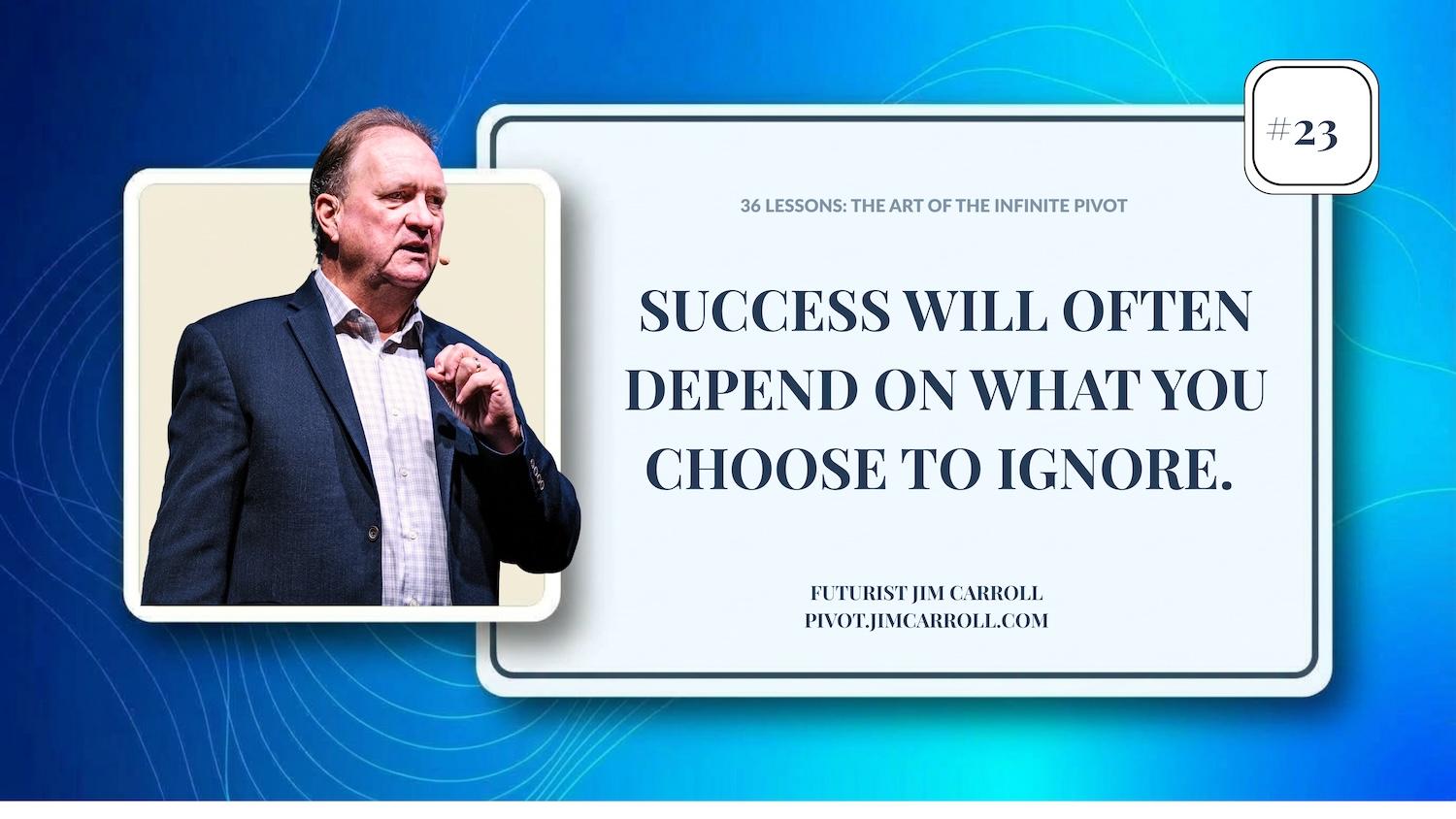
"Success will often depend on what you choose to ignore.” - Futurist Jim Carroll

--
Futurist Jim Carroll is writing a series, The Art of the Infinite Pivot, based on 36 lessons from his 36 years as a solo entrepreneur, working as a nomadic worker in the global freelance economy. The series is unfolding here, and at pivot.jimcarroll.com.
--

If you follow me, you will know I'm very big on not following big hype. Far too many trends are overplayed and overemphasized, and yet under-reach with unrealistic potential.

Why is that? Because I've seen over and over and over again what happens when excessively hyped trends don't become real in the short term. But here's a fun fact - I also believe the observation by Bill Gates that we tend to overestimate the impact of a trend in the short term, but underestimate it's impact its impact in the long term.

Which means timing is everything!

So let's put this conundrum into perspective. Many of us are conditioned to believe that success is about absorption. More information, more networking, more trends, more hustle leads to more success - that type of thing. But my own voyage through the global economy has taught me that the opposite is true. As the world gets louder, your success doesn't depend on what you take in. It depends on what you ruthlessly exclude.

The "Infinite Pivot" isn't just about moving toward the new; it's about knowing which 'new' to avoid, and when.

Fast-moving trends can often be a powerful distraction. The buzz they generate It is a chaotic mix of breaking news, viral hype, and the promise of quick riches. But if you jump on too soon, you'll get burned. Too late, and you'll miss the opportunity. Did I mention timing is everything?

There's also the aspect of how real any particular trend might be - and which should be ignored. The most profound shifts in my career happened when I finally built a "cognitive firewall" against trivial trends.

In an era of infinite distraction, the person who can choose what not to care about is the only one who can truly see what's coming.

Don't just filter the future.

Manage your attention.

---
Futurist Jim Carroll has developed a well-honed skill for discovering and managing hype.

**** **** **** **** **** **** **** **** **** **** **** **** **** **** **** **** **** **** **** **** **** **** **** **** ****

Original post: jimcarroll.com/2026/04/decodin

★ 1 • ↻ 1 original
Apr 29, 2026 · 9:50 AM UTC

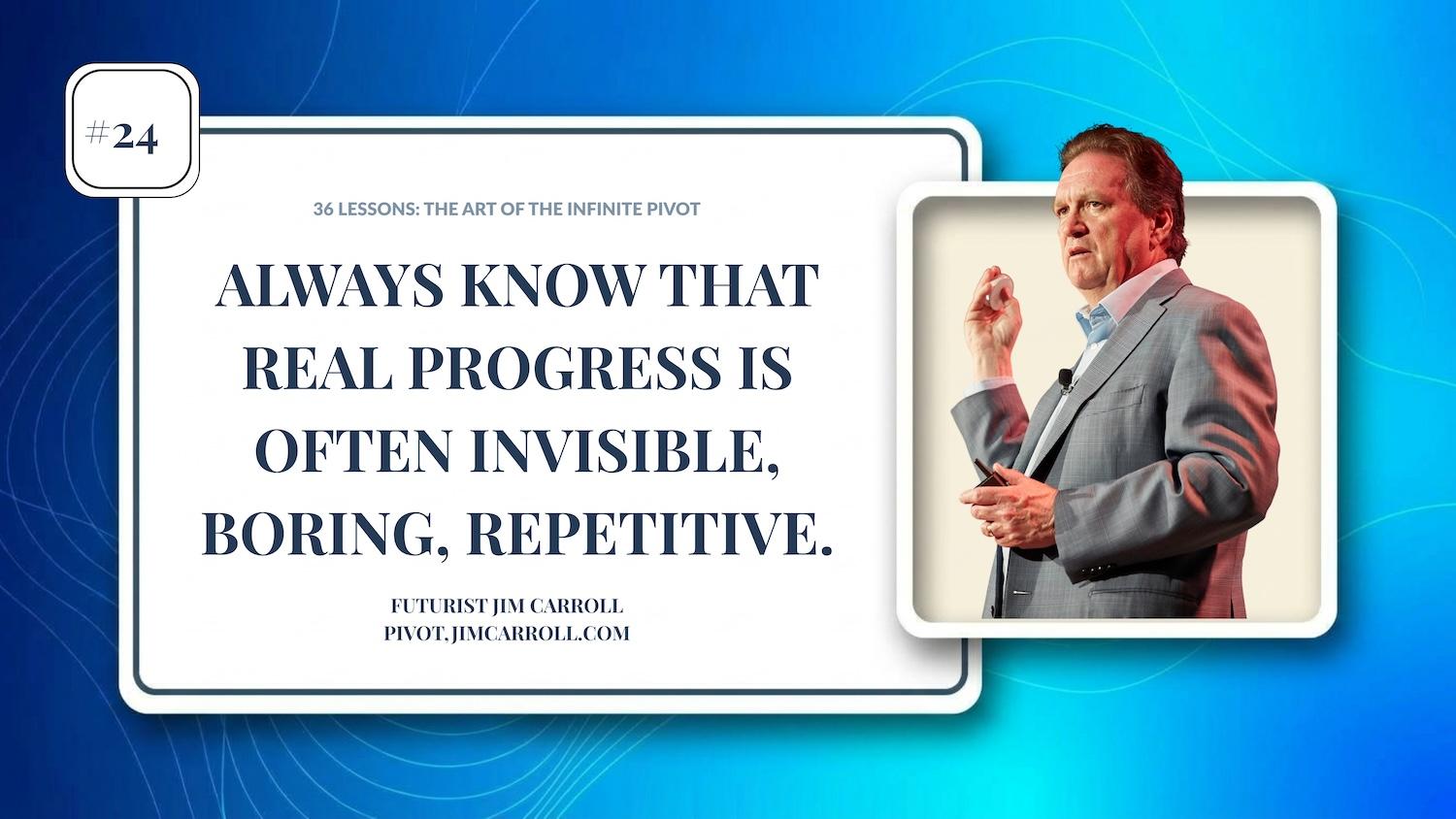
“Always know that real progress is often invisible, boring, repetitive.” - Futurist Jim Carroll

--
Futurist Jim Carroll is writing a series, The Art of the Infinite Pivot, based on 36 lessons from his 36 years as a solo entrepreneur, working as a nomadic worker in the global freelance economy. The series is unfolding here, and at pivot.jimcarroll.com.
--

Your success will often not involve huge home runs that have you cheering with joy. It will come about through small bunts, working the bases, advancing slowly but surely towards a goal, and muttering about the pace.

Treat your progress as such.

Right now, this can be a challenge. After all, we live in a "highlight reel" culture. We see the successful keynote, the published book, or the smooth career pivot and assume that it all happened in a flash of inspiration. But in my 36-year voyage, I’ve learned that the most profound breakthroughs and the biggest wins are rarely the result of a sudden lightning bolt. They are the result of the quiet, daily discipline of showing up when it feels like nothing is changing. Playing the clubs. Putting in the work. Advancing slowly but steadily.

I did a lot of small events in rural America and small towns in Canada before I hit the big stages of Las Vegas. It was often boringly dull, excruciatingly tiring, and sometimes, with a detached audience, not terribly motivating. But through that, I learned that success is often built on "invisible progress." The small steps that get you closer to a big goal.

For me, success and learning are about the hundredth hour spent in the lab struggling with a Linux configuration.

It’s the years of writing a Daily Inspiration post without missing a single workday.

It’s the repetitive act of studying a disruptive trend long before the world notices it.

It was spending time on stages that sometimes I did not want to be on.

Most people quit during this "boring" phase. They mistake the lack of immediate feedback for a lack of progress. They want the dopamine hit of a "win" every day. But as a practitioner, you have to realize that you are building up your skills, capabilities, and knowledge.

The amateur waits for the quick hit.

The master relies on patience and effort.

Success isn't a sprint; it’s the compound interest of your daily discipline.

---

Futurist Jim Carroll has put in the work. He still does. Every day.

**** **** **** **** **** **** **** **** **** **** **** **** **** **** **** **** **** **** **** **** **** **** **** **** ****

Original post: jimcarroll.com/2026/04/decodin

★ 0 • ↻ 0 original
Apr 30, 2026 · 9:50 AM UTC

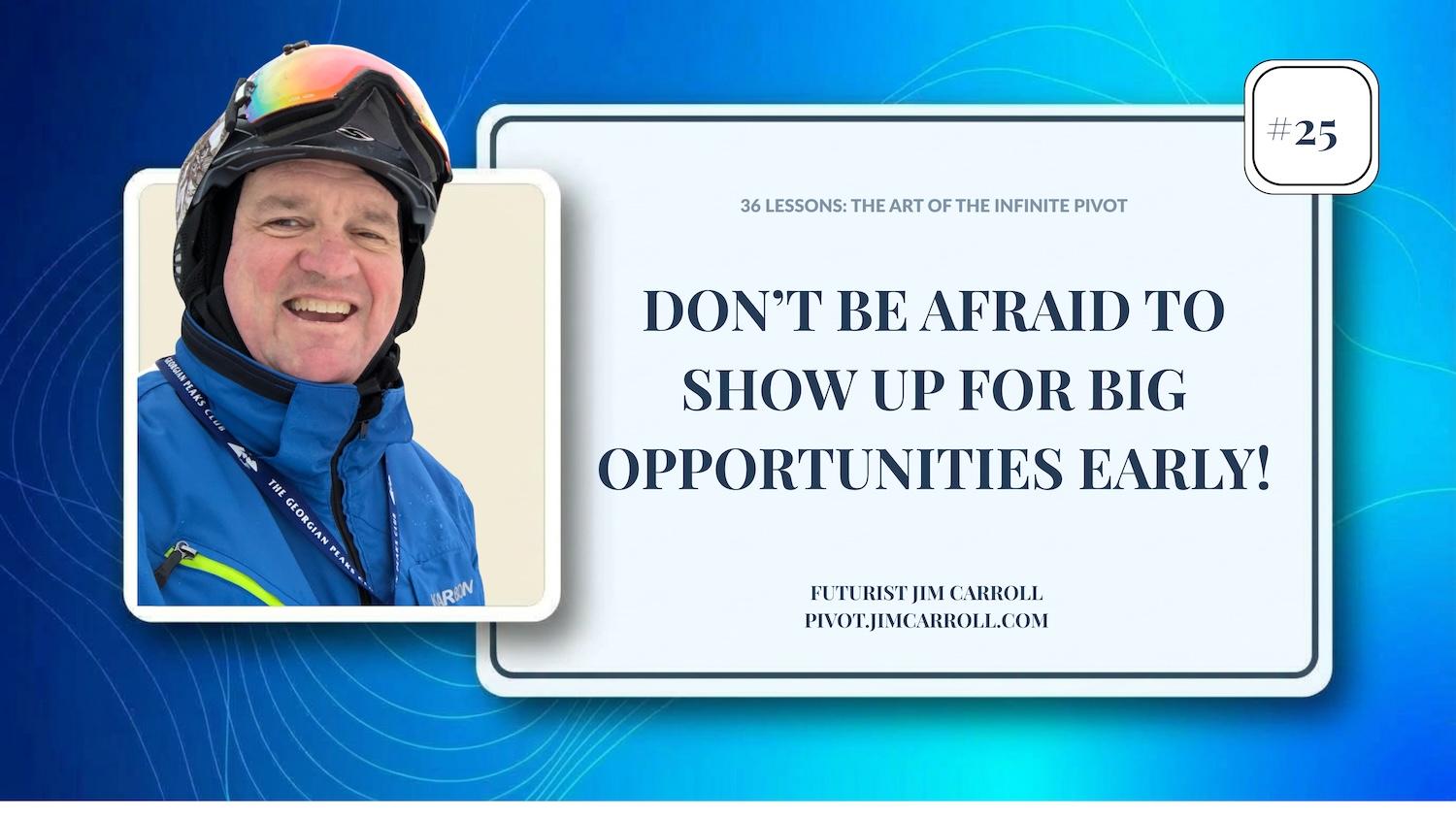
“Don’t be afraid to show up for big opportunities early!” - Futurist Jim Carroll

--
Futurist Jim Carroll is writing a series, The Art of the Infinite Pivot, based on 36 lessons from his 36 years as a solo entrepreneur, working as a nomadic worker in the global freelance economy. The series is unfolding here, and at pivot.jimcarroll.com.
--

At the ski club, I'm known as the guy who is first at the chairlift most mornings and at the golf course as the first tee guy. For a sound check for my keynotes? If they ask me to be there for a 7 am AV test, I'm there at 655AM.

And yes, I'm the guy who is first in line for the flight.

Annoying? Maybe.

Rewarding? Definitely!

Whether it’s a fresh dump of powder on the slopes or a pristine morning on the Old Course, I've long thought that there is a profound advantage to being first. And looking back at my 36-year voyage, it seems I’ve applied this "First Chair" philosophy to every disruptive trend I’ve covered. If you want the best "runs" in the future, you can’t wait for the crowd to wake up; you have to be there when the light is just hitting the snow.

Being early isn't just about speed; it's about finding opportunity before everyone else does. And that becomes critical to your ability to pivot into a new career or business opportunity.

If showing up early means showing up at 6 AM to "do the work" while the rest of the world is still hitting snooze, then I'm all in. Most of these Daily Inspiration posts are written during my first moments of clarity after 5 am, coffee in hand, mind abuzz with ideas.

Many people fear being "too early" because they worry about looking foolish or standing alone. But the reality might be that it means they miss out on the opportunities that others see.

The "Infinite Pivot" requires the stamina to be an early riser. You have to be willing to stand at the lift while no one else is there, because that’s the only way to get the best snow of the day.

The fact is, the freshest snow—and the most profound insights—belong to those who refuse to wait.

---

Futurist Jim Carroll believes that being ahead of your time is one of the greatest opportunities to move your career forward through continual pivots.

**** **** **** ****

Original post: jimcarroll.com/2026/04/decodin

★ 1 • ↻ 0 original
← March 2026May 2026 →