Futurist Jim Carroll

Mastodon post archive · 2022–2026
Archived from mastodon.futurist.info · 4209 posts
← All months

March 2026 · 28 posts

← February 2026April 2026 →
Mar 2, 2026 · 11:00 AM UTC

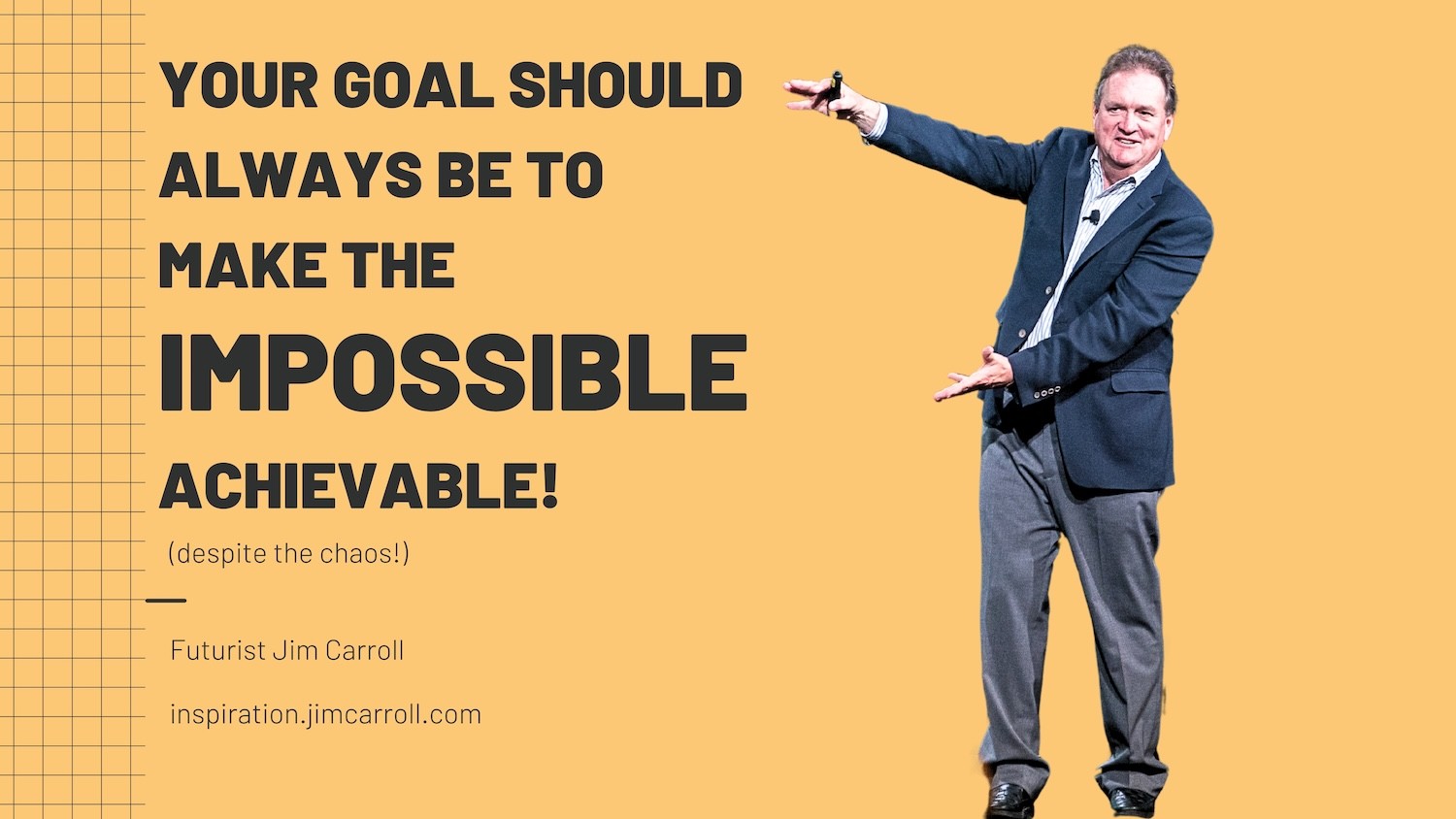
"Your goal should always be to make the impossible achievable! (Despite the chaos)" - Futurist Jim Carroll

The old rules of stability have been completely incinerated.

We are living through a period of intense volatility.

We often don't know what comes next.

And what we should do about it.

Chaos rules.

Right now, most people are still trying to find a dry place to hide, waiting for this latest storm of change to pass, but that is a losing strategy.

I wrote Dancing in the Rain for moments like this.

The core of the book - and my thinking - is that you can’t wait for the world to calm down; you have to learn to find your rhythm within the chaos. If you stay stuck in a mindset that you are just waiting for "things" to return to normal, you will be waiting a long time.

That's because while certainty might stop, most trends don't.

My 26 Trends for 2026 series highlights that making the impossible achievable is about mastering the art of the pivot.

This means building an "Optionality Architecture" that allows you to turn sudden economic ruptures into new opportunities.

Instead of being paralyzed by the wind and the rain, you need to focus on "Velocity of Recovery."

Despite everything going on, you need to continue to develop your ability to fail fast, learn faster, and keep moving forward.

The goal isn't just to survive the volatility, but to use it as the very fuel that makes your most ambitious goals possible.

Welcome to a typical Monday, 2026.

----

**** **** **** **** **** **** **** **** **** **** **** **** **** **** **** **** **** **** **** **** **** **** **** **** ****

Original post: jimcarroll.com/2026/03/daily-i

★ 2 • ↻ 0 original
Mar 3, 2026 · 11:08 AM UTC

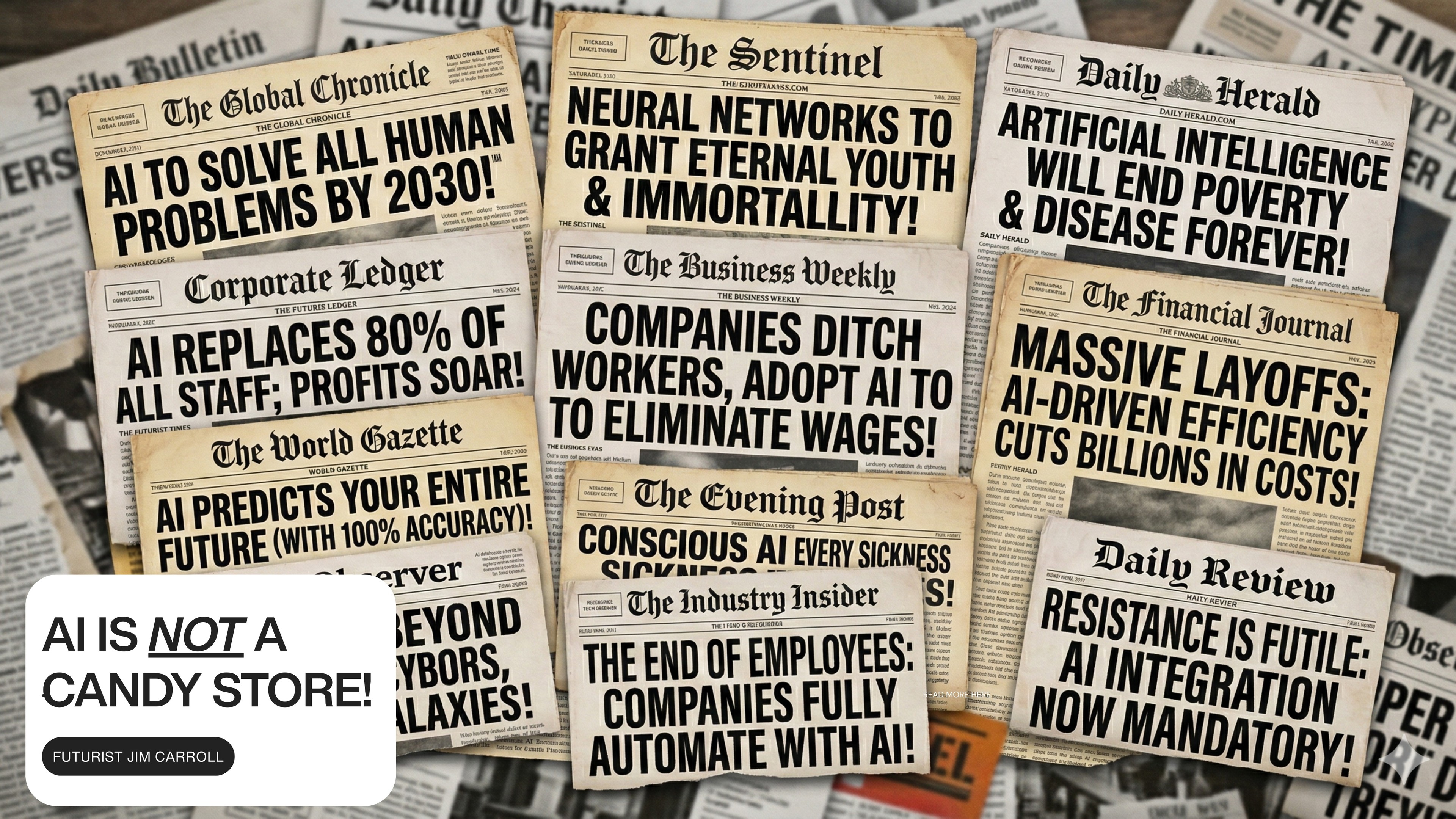
**"AI is not a candy store!" - Futurist Jim Carroll**

Last week, Jack Dorsey (one of the original founders of Twitter) issued a memo that will likely be remembered as the "intelligence-native" manifesto, in which he announced a massive set of layoffs at his company Block.

He didn’t just trim the edges at Block; he hacked away nearly half the company - over 4,000 people.

Not because they were failing, but because he argues that a human-heavy workforce is now a legacy liability. His central justification was that AI is moving so fast that smaller, flatter teams are becoming exponentially more productive than the massive corporate structure built during the pandemic.
Dorsey effectively declared that Block isn't the outlier; they are just the first ones to be honest about the fact that most companies are "late" to the realization that the old way of scaling through headcount is dead.

The media, of course, went wild with the story, announcing that this was the canary in the coal mine of a world in which vast numbers of staff were soon to be culled from organizations worldwide.

And, well, hype once again gets in the way of reality.

Critics were quick to call him out, pointing out that Block’s workforce had ballooned from roughly 3,800 people in 2019 to over 10,000 by 2025 as a result of 'pandemic bloat,' - it had just become a large, inefficient company.

Many said that while Dorsey wrapped the cuts in the high-tech sheen of AI efficiency, the reality was far different. Not only that, but the so-called productivity benefits were nowhere near what he was claiming, given the makeup of the company and workforce.

But never let reality get in the way of some good hype!

And yet, the hype was born in the bright lights of great expectations. CEOs everywhere were probably muttering under their breath: "I want some of that."
And that's one of the big problems with AI today.

In a conference call with a client last week, one person suggested the biggest challenge they were seeing involved too many CEOs seeing the hype of AI, and saying to their tech department, "I want some of that." They specifically commented that CEOs and senior executives were now caught up in seeing the latest, greatest AI development as some sort of candy store they could pick and choose from. Instant hits of sweet productivity gains were simply within reach!

And the fact is, nothing could be further from the truth.

Some folks on the Internet responded with biting, satirical posts - written in what has become known as "LinkedIn Staccato" or "Bro-etry" style. You want to read them!

See the full post.

---
**** **** **** **** **** **** **** ****

Futurist Jim Carroll will be taking on the topic of hype and reality in a keynote in Dallas next week.

Original post: jimcarroll.com/2026/03/decodin

★ 3 • ↻ 3 original
Mar 4, 2026 · 10:37 AM UTC

"Choose velocity over certainty." - Futurist Jim Carroll

Now is not the time to slow down.

Here's why - all things I've written about before.

The Indecision Tax: Many leaders lose their edge during change, not because they made "bad" choices, but because they waited too long to make any choice at all. Indecision is a tax that drains your competitive advantage while others move ahead.

Inaction is a Decision: When things get volatile, many people freeze and hope for more information. What if there is none? You must realize that standing still is actually a choice. And in a fast-moving world, it is almost always the most expensive risk you can take.

Move Beyond "Pilot Purgatory": Organizations often get stuck in a loop of small, safe tests. Survival requires the speed to move instantly from a small experiment to a massive rollout before the window of opportunity closes.

Strategic Humility Over Pride: To move fast, you must trade the pride of "knowing everything" for the speed of learning new things. What worked yesterday is often a heavy anchor that holds you back from tomorrow's solutions.

Radical Subtraction for Speed: To increase velocity, focus on removing complexity rather than adding more process. Layers of approval and bureaucracy are the primary enemies of speed; you must lean out to accelerate.

Developing Anticipatory Intelligence: The most valuable commodity in a fast world is time. By seeing trends early, you gain a head start to act with velocity before the rest of the market falls into a panic.

The Velocity of Reinvention: Your goal isn't to build a fortress that resists change, but a culture that constantly reinvents itself. Resilience is found in the speed of your transformation, not the strength of your defenses.

Actionable Clarity: Dream, Prove, Win: Innovation follows a simple rhythm: think big enough to dream, start small enough to prove it works, and move fast enough to win. This keeps you moving even when the long-term view is blurry.

The "OODA Loop" on Steroids: Winners are those who observe and act the fastest. By collapsing the time between a decision and an act, you brute-force your way to the right answer through rapid real-world testing.

Escape Velocity: To launch a new idea, you must apply overwhelming force to overcome the pull of "how we've always done it." If you don't pick up the pace, the gravity of the past will eventually pull you down.

Stop waiting for clarity that won't come.

Get moving.

----
**** **** **** **** **** **** **** **** **** **** **** **** **** **** **** **** **** **** **** **** **** **** **** **** ****

Original post: jimcarroll.com/2026/03/decodin

★ 2 • ↻ 0 original
Mar 4, 2026 · 11:58 PM UTC

Ya, just thought I'd dump in a link to my radio show of 42 years ago, Micro Minute, with a little bit of audio from it.

youtube.com/watch?v=7-E36Mpl5_g

★ 0 • ↻ 0 original
Mar 5, 2026 · 11:11 AM UTC

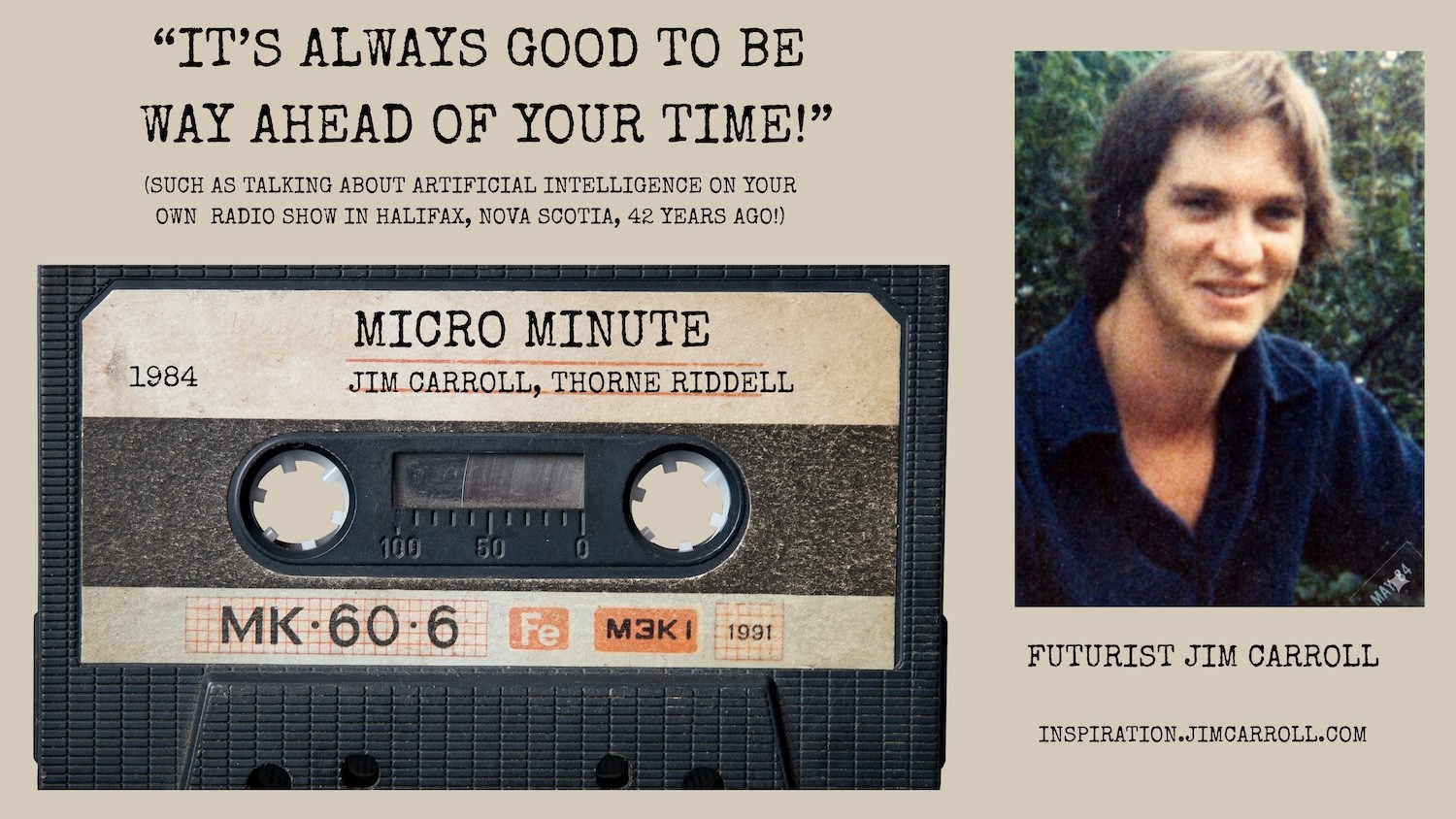
"It's always good to be way ahead of your time!" - Futurist Jim Carroll

(Such as talking about artificial intelligence on your own radio show in Halifax, Nova Scotia, 42 years ago!)

So everyone seems to be working with Claude Code and Claude Cowork, so I had to jump in. (If you don't know what they are, find out fast and jump right in.) (Everyone is also talking about Clawdbot et al, and I'm jumping into that soon, too!)

I needed a project to explore what it can do.

I found one. I'm having fun.

And I have two reactions to Claude Cowork.

HOLY WOW! If you aren't learning how to use it, do so. Fast!

And, I was really quite ahead of the time, a lot of the time.

One thing that has made its way into this project is my 1984 radio series, which ran on CHNS in Halifax, Nova Scotia, back when I was a young 25-year-old accountant busy exploring the edges of the forthcoming technological revolution.

It was called Micro Minute. And it was ahead of its time. And I have the audio! Give it a listen!

youtube.com/watch?v=7-E36Mpl5_g

Not only that, but I have the original memos that describe the series in depth, as we tried to get other offices in the firm in which I worked interested in it.

Check out show number 17! I'm talking about artificial intelligence - 42 years ago. And nailed it!

Read the rest of the post.

----
**** **** **#1984** **** **** **** **** **** **** **** **** **** **** **** **** **** **** **** **** **** **** **** **** **** ****

Futurist Jim Carroll is a digital pack-rat. He has kept most of the emails he has sent and received since 1984. Wild!

Original post: jimcarroll.com/2026/03/decodin

★ 1 • ↻ 1 original
Mar 5, 2026 · 4:44 PM UTC

32 years ago today, a little book that I co-wrote came out. It became a **#1** national bestseller, and changed the entire trajectory of my life. I've gone on to write 43 books, selling well over 1 million copies - and ended up on stages worldwide.

It's a hell of a story, and you want to read it.

Seize every moment of magic!

jimcarroll.com/2024/03/daily-i

★ 1 • ↻ 0 original
Mar 6, 2026 · 10:56 AM UTC

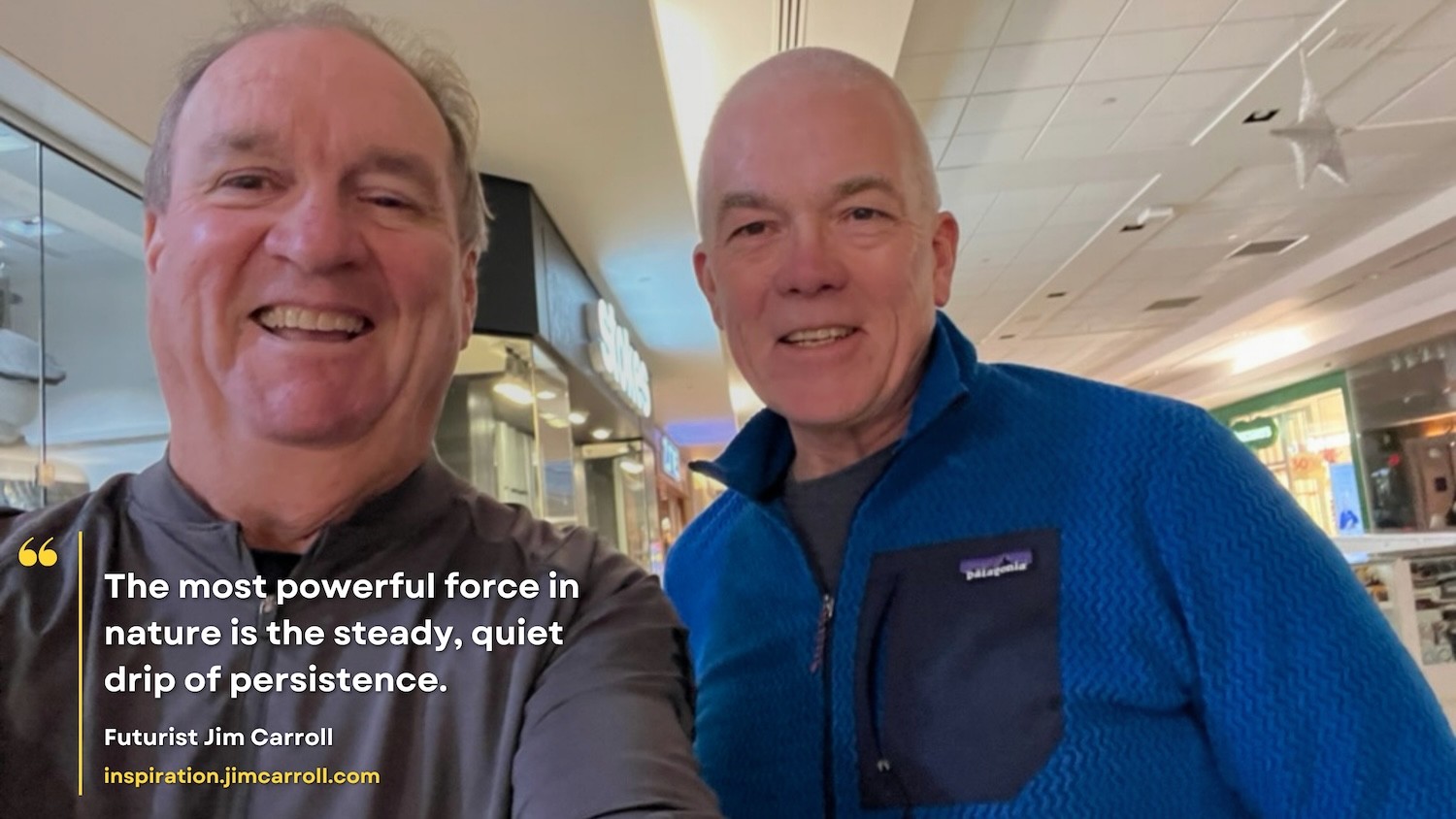
"The most powerful force in nature is the steady, quiet drip of persistence." - Futurist Jim Carroll 

A shoutout to my good friend Greg today!

And I certainly appreciate the guy - he was one of the first to show up at the shopping mall at 8 am for my morning 'mall walks' when I was in the early stages of my spinal injury. (Jim Estill appeared, too, as did a few others! All are appreciated!)

He and I have been good friends since our sons met in school some twenty years ago. A lot of golf together (Arizona!), a lot of talk about tech and business, and a lot of talk about how careers wind down.

A lot has changed for Greg in a short period of time, and for me, there is a lot to learn from watching and encouraging him. First and foremost - real change isn't a single, grand event; it is the compounding effect of small, intentional choices. It’s the daily commitment to a process that isn't always visible, even when you’re right in the middle of it.

And the thing is - momentum is built in those quiet moments. It's found through the simple habit of showing up and refusing to stop. It's also knowing that when the path gets difficult, the most reliable resource is the navigator who can guide you - because they’ve already been down the same road.

Watching a friend hit their stride after putting in a lot of hard work is the ultimate reminder: the most certain way to get anywhere is to keep moving forward.

---

Futurist Jim Carroll often finds his own inspiration in the hard work of others.

**** **** **** **** **** **** **** **** **** **** **** **** **** **** ****

Original post: jimcarroll.com/2026/03/daily-i

★ 0 • ↻ 0 original
Mar 9, 2026 · 10:28 AM UTC

"Unapologetic uniqueness: conformity is where tomorrow's greatness goes to die." - Futurist Jim Carroll

The manuscript for Being Unique is officially complete and with my wife, Christa, for editing.

The book is a manifesto for the "oddballs," arguing that the traits you’ve been told to fix are actually your most potent strategic weapons. It’s a guide to weaponizing your differences to navigate a high-velocity future!

The journey starts by battling "innovation killers" like groupthink and consensus - favourite topics of mine. But then use the story of Oblio—the round-headed boy in a pointed world from the movie The Point —as a metaphor for finding your own "point" amidst the pressure to conform. This whimsical start sets the stage for a deeper exploration of how a unique vantage point reveals truths others simply cannot see.

There's some fun and powerful stuff in there, from the whimsical to the world-changing, featuring "crazy ones" like Steve Jobs and the rebellious Grace Hopper. I even dive into Richard Feynman’s kitchen to show how simple curiosity about breaking spaghetti leads to Nobel-level thinking.

But it's not all theoretical. I dive into the research of Thomas Kuhn, a guy who took on the science of "paradigm shifts." He proved that proves that breakthroughs only happen when you step outside the dominant mindset.

Ultimately, Being Unique is a toolkit for a path to the "Masters of Business Imagination," an idea I first put out there in 2004!

It's been a LONG project! I originally began working on it in the summer of 2024, in a series that started here. I realized part way in that I had a book. As I posted, I started working it into shape, realizing it wasn't there, dropping it for a time, picking it up again ... over and over, and here we are!

Now look, I know this is a tall order. We can't teach uniqueness - you either have it, or you don't. The fact is, not all of us are born with the unique skills, capabilities, or insight that might allow us to be the next Steve Jobs or Richard Branson - both of whom were and are very, very unique. But what if we had a guide path, an action plan, and a roadmap for how to align ourselves in the same way that they've thought about tomorrow? Some insight on how we could be 'an oddball, a rebel, a freak' - because those are the ones who get the future done?

It's hard to say when we'll get to print - Christa has her own unique editing process. Having worked on 42 books with me, I know the best thing I can do right now is sit back and let things unfold. I'll open up pre-orders later this week!

---
**** **** **** **** **** **** **** **** **** **** **** **** ****

Futurist Jim Carroll learned long ago that his unique way of thinking was something he could build a career upon.

Original post: jimcarroll.com/2026/03/daily-i

★ 1 • ↻ 0 original
Mar 9, 2026 · 10:36 AM UTC

Give me an 'F' !

Can't overstate how profound an impact Country Joe had on this impressionable 10 year old.

R.I.P.

Rebel!

★ 2 • ↻ 0 original
Mar 10, 2026 · 10:11 AM UTC

"You spend most of your time thinking about what you should be doing today. But you should be focused on what you need to do tomorrow!" - Futurist Jim Carroll

I was down in Dallas yesterday, speaking to a group of senior executives at Deloitte University. What a wonderful facility for the sharing of knowledge!

My topic was, as you might expect, a bit of a reality check on the potential role and use of AI in the corporate world. I'll have lots of great content to share over the days to come.

But suffice it to say, I don't only speak - I listen. I heard a rough idea of this phrase from one of the Deloitte executives, directly after my talk. (

I don't remember the exact words - just the idea behind the words!) He was talking to the group about how their roles and responsibilities were changing quickly in the era of fast-moving AI technologies - and his words floored me.
So many of the people I speak to about trends and tomorrow are relentlessly focused on today. They don't know how to shift the activity in their minds from the pressing moments of the current moment to the even more pressing moment of the next moment. The result is that when the future comes along - WHAM! It hits them like a ton of bricks.

"I didn't see that coming!" is the typical response.

Phrases like this catch my attention - they help me to frame the reality of what is going on in our world today.

It's also the type of phrase that can get you thinking. The next time you start your day with your typical list of 'to-do'items, ask yourself if you have enough on that list that has to do with tomorrow!

Some good food for thought!

----

Futurist Jim Carroll's job is to think about tomorrow.

**** **** **** **** **** **** **** **** **** **** **** **** **** **** **** **** **** **** **** **** **** **** **** **** ****

Original post: jimcarroll.com/2026/03/daily-i

★ 1 • ↻ 1 original
Mar 11, 2026 · 9:53 AM UTC

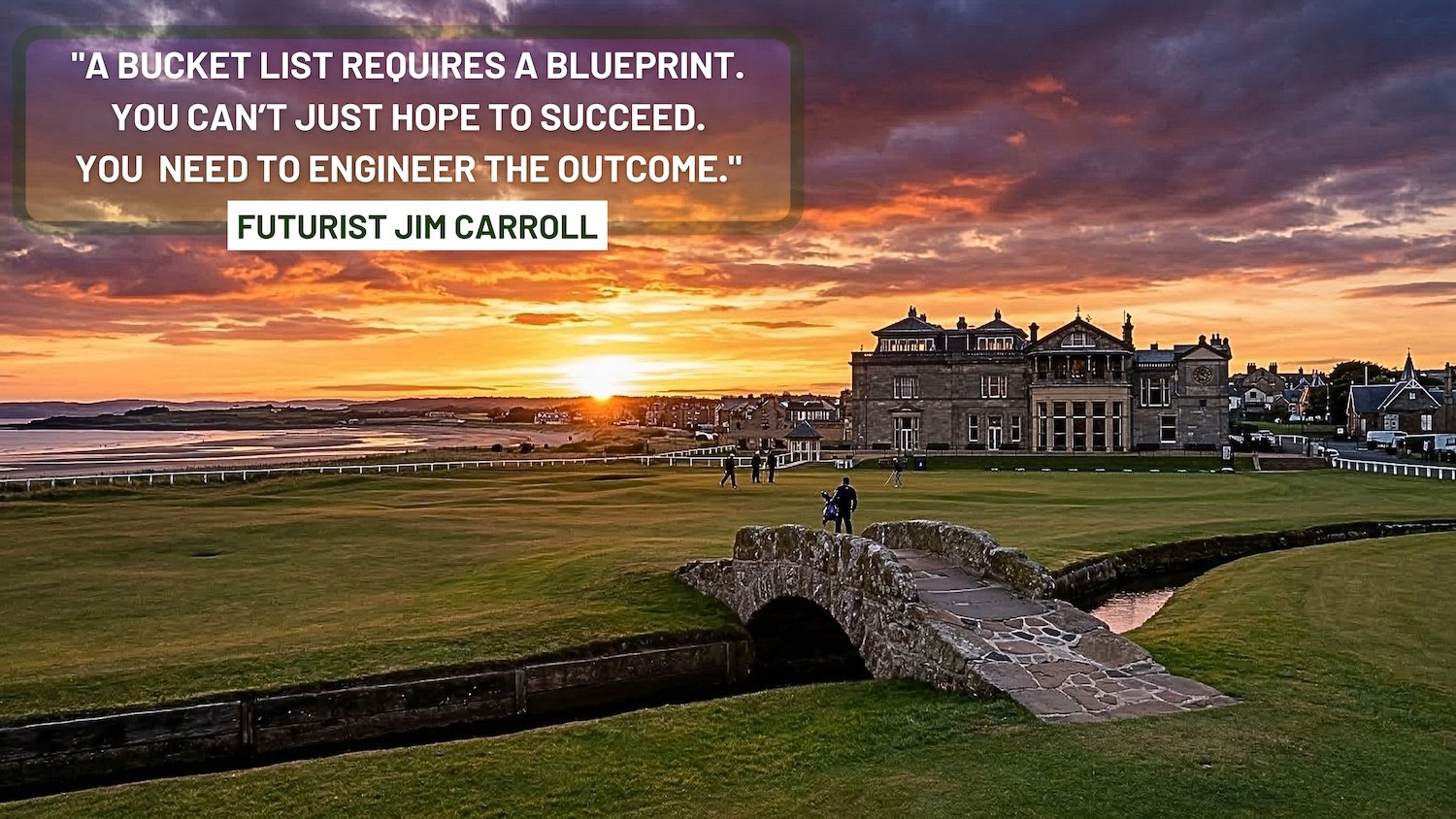
"A bucket list requires a blueprint. You can’t just hope to succeed. You need to engineer the outcome." - Futurist Jim Carroll

Ok, I'm back to my spinal recovery thing, but I'm damned excited!

You don't often get these tee times in your account!

April.

Old Course, St. Andrews.

And so with that, it was 'rotation day' yesterday!

What is 'rotation day'? It's the first day of exercises designed specifically to get my previously injured spine ready for the mechanics of the golf swing.

I've done the cardio. I've done the work to get the core back in shape. I'm doing the heavy lifting. I've put in the work. Here's 30 days of effort. I don't do this to brag; I share it to say, "I've put in the work."

(The workouts include walking - if I exclude that, I still had 28 solid days at the gym out of the last 30).

Rotation day involves doing a series of exercises that twist your body, torso, and spine.

All the things you couldn't and shouldn't do in the early stages of an L1 to L3 spinal fracture.

As I was doing this routine yesterday, I kept reminding myself that to make a bucket list item work, you've got to put in the work. I can't hope to show up in early April, swing a golf club after this situation, and expect a great round. I've got to put to work the muscles that were not put to work, and some of which were battered and bruised in the fall, to work.

On April 6, I'll tee off at the Old Course.

Pure bucket list.

You can't get to a bucket list if the potential for the bucket has been interrupted by circumstances.

You've got to push through the circumstances.

Fore!

----

Futurist Jim Carroll hopes for 4 days of extraordinary golf at St. Andrews in early April.

**** **** **** **** **** **** **** **** **** **** **** **** **** **** **** **** **** **** **** **** **** **** **** **** ****

Original post: jimcarroll.com/2026/03/daily-i

★ 1 • ↻ 1 original
Mar 12, 2026 · 10:10 AM UTC

"The speed with which people will disavow themselves tomorrow from what they do today will astonish you." - Futurist Jim Carroll

Just watch.

There will be countless people tomorrow who will say, "Well, I wasn't really a supporter." "I wasn't behind it." "I never really believed in all those ideas." "Ya, I always thought it was wrong."

They will suggest they are innocent. They were doubters all along. They had nothing to do with it.

That they would have spoken up except that....

The list goes on.

Tomorrow, they will try to bend the truth to whatever new reality they want to slide into.

Remember this post.

You'll watch it happen.

The speed with which people back away from their previously strongly held beliefs indicates that those beliefs were really nothing but temporary expediency.

This happens with innovation and leadership too. Think about it! Think about all the excuses, attitudes, and shifts in perspective when they disavow their previous stance as the future suddenly appears. 

Who are they?

People who aren't very good at innovation, but who are great at excuses.

Take a look around you.

You are surrounded by them.

People who are shallow in their belief system, narrow in their ethics, and quick
to disavow their past.

And in your mind, you know that their minds are often just simply empty vessels of expediency, where they will do and say and act with whatever repulsive idea, hateful belief or conspiracy-laden agenda that fits their shallowness.

Or whatever agenda-of-the-moment they can adopt, espouse, and support that fits into their belief system.

Just watch.

You know I'm right.

---
**** **** **** **** **** **** **** **** **** **** **** **** **** **** **** **** **** **** **** **** **** **** **** **** ****

Futurist Jim Carroll figures you know exactly who he is writing about.

Original post: jimcarroll.com/2026/03/daily-i

★ 1 • ↻ 1 original
Mar 12, 2026 · 1:15 PM UTC

Stock markets everyday.

★ 0 • ↻ 0 original
Mar 13, 2026 · 10:25 AM UTC

"Consistency is only a virtue if the path is still relevant." - Futurist Jim Carroll

Here's something you already know: doing the same old thing puts you on the road to the same old destination.

Keeping that in mind, here are some simple rules to avoid consistency:

Don’t wait for clarity because speed is the only certainty (we don't know where we're going, but we're making great time)

Don’t fear the pivot because the straight path is extinct (volatility is the new normal!)

Don’t ignore the rebels because they see what you’re missing (think about that one - you know it's true!)

Don’t rely on your history because it won’t write your future (legacy is a death sentence)

Don’t prioritize your process because the world prioritizes your progress (be creatively disorganized)

Don’t mistake activity for achievement because movement isn't always forward (invest in free time)

Don’t wait for clarity because speed is the only certainty (jump without knowing!)

Don’t fear the pivot because the straight path is extinct (change yourself already!)

Don’t seek the 'perfect' plan because agility beats perfection every time (you can't plan in a fast future)

Don’t build for today because tomorrow is already here (live forward...)

Don’t settle for the comfortable because growth only happens in discomfort (comfort zone stuff)

How do you do that?

Abandon the roadmap - it was made for a different time

Abandon your assumptions - because they are already anchors

Abandon the tried and true for new things

Abandon perfection because mistakes are your new knowledge opportunities

Abandon yesterday’s logic since it is now basically tomorrow's illogical foundation

Abandon the status quo because it's already obsolete

Abandon what you know to find what you don't know

Abandon the safe plan for the risky unknown

Abandon the analysis and go with your gut

Abandon what you've already done to find what you need to do next

What's the phrase we often hear? I heard it in a song yesterday while driving: "Today is only yesterday's tomorrow.' It's from Uriah Heep, a great 70s band.

Rethink it: "Tomorrow is yesterday's missed opportunity" if you don't change things up!

---

Futurist Jim Carroll has seen many companies fail at innovation because consistency is central to their culture.

**** **** **** **** **** **** **** **** **** **** **** **** **** **** **** **** **** **** **** **** **** **** **** **** ****

Original post: jimcarroll.com/2026/03/daily-i

★ 1 • ↻ 0 original
Mar 16, 2026 · 9:49 AM UTC

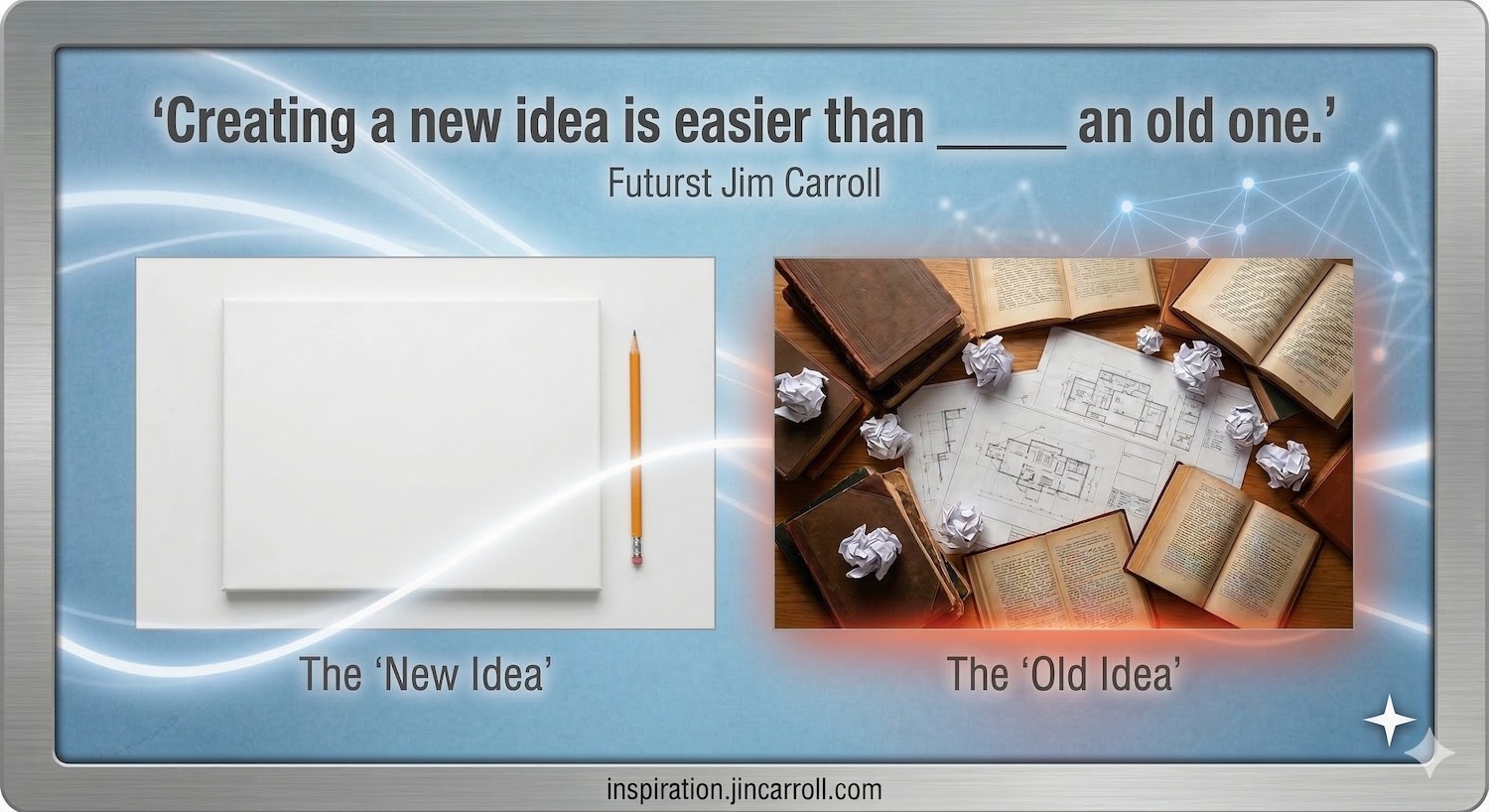
"Creating a new idea is easier than _______ an old one." - Futurist Jim Carroll

Here's a thought to start your Monday: we often think that the hardest part of success is coming up with a "lightbulb moment." That crazy burst of inspiration. The moment of innovation brilliance.

But let’s face it: sometimes, starting from scratch is the easy part. The real challenge? Dealing with what’s already taking up space in our heads and complicating our lives. The baggage in our minds is often very, very real and gets in the way of our ability to move forward.

That's why it's tough to fix old problems, shed old legacies, and deal with old challenges.

Not convinced? Fill in the blank for your current situation: "Creating a new idea is easier than _______ an old one."

How about "Creating a new idea is easier than unlearning an old one." Or "Creating a new idea is easier than fixing an old one."

Substitute at will! Depending on what you're facing this week, one of these might hit home:

Unlearning: Our brains hate a rewrite. It’s often much harder to let go of an outdated belief than it is to learn something brand new.

Fixing: Band-aid solutions eventually become a heavy burden. Sometimes, the energy it takes to repair a broken system is better spent building a new one.

Replacing: We naturally cling to what’s familiar, even if it’s no longer helping us grow. Innovation is usually stalled by the friction of making the "switch."

Killing: In the creative world, they call this "killing your darlings." Letting go of an idea you’ve loved for years takes a specific kind of courage.

Reviving: Breathing life back into a stalled project is exhausting. Resuscitation is often more draining than a fresh birth.

Renovating: Updating an old idea means working within tight constraints. It’s a much tighter squeeze than working on a blank canvas.

Which one resonates?

Are you in a season of creation, or are you doing the heavy lifting of transformation?

---
**** **** **** **** **** **** **** **** **** **** **** **** **** **** **** **** **** **** **** **** **** **** **** **** ****

Original post: jimcarroll.com/2026/03/daily-i

★ 1 • ↻ 0 original
Mar 17, 2026 · 10:11 AM UTC

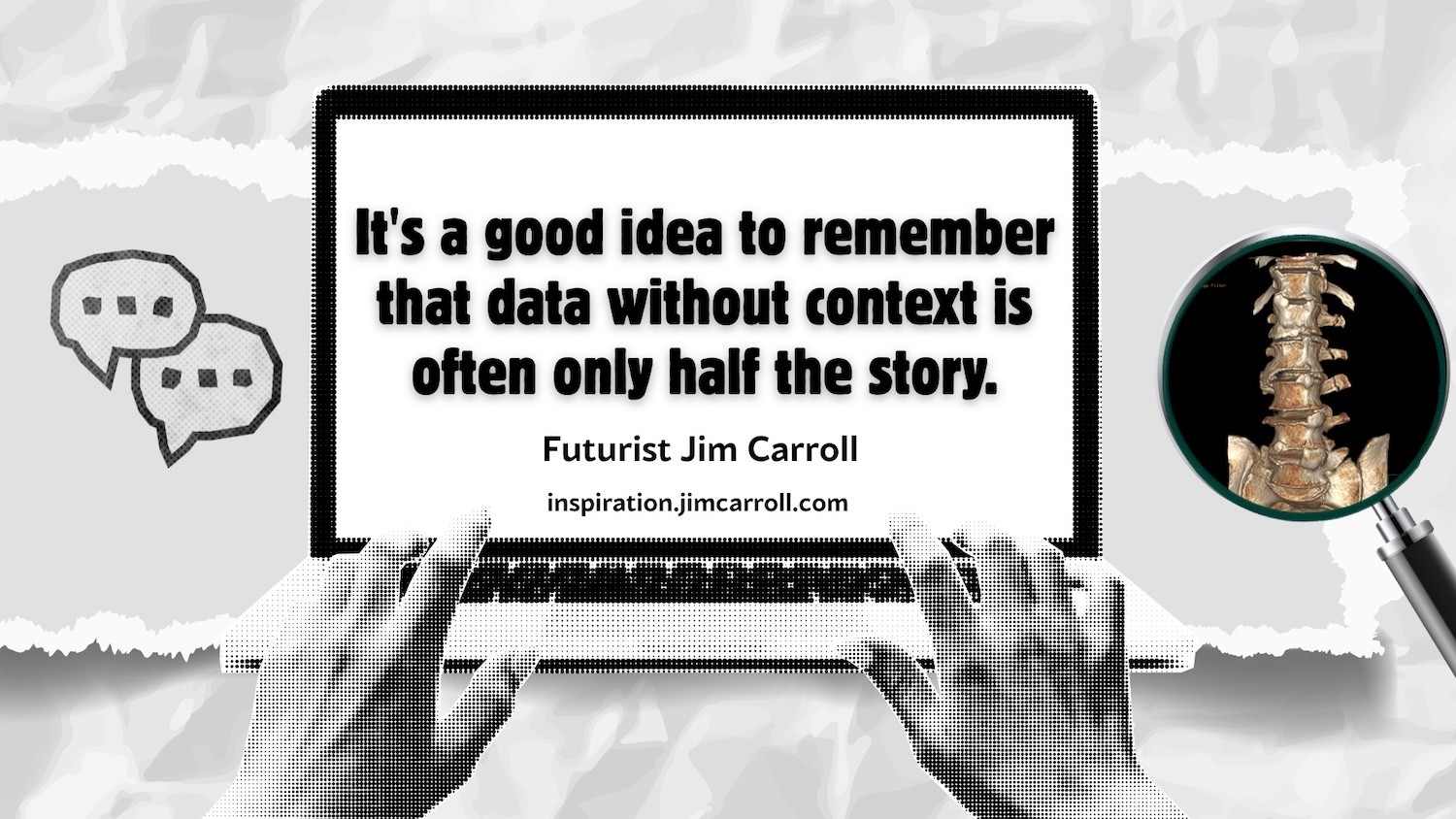
"It's a good idea to remember that data without context is often only half the story!" - Futurist Jim Carroll

I know I said I wouldn't write about this anymore, but still..

I went for the CT scan of my spine yesterday to assess the status of my recovery; it's not normally required in this case, but we asked for one, just in case.

And I must say, the medical system here in Canada was remarkably efficient - I had full access to the scans, with a doctor's summary, within two hours.

And what I got floored me - you can clearly see the breaks had not healed.

Yikes! The doctor's note that came with the scan confirmed it - 'no spiny bony union.'

WHAT? Double yikes!

Except, I was reading and looking without context.

Within 15 minutes, I went from panic to relief as I worked to put some context on what I saw and read through a spinal doctor and Google Gemini. (No wonder follow-up scans are not usually suggested.)

The fact is, I should not have seen any 'bone union' at all: the lack of bone attachment is actually to be expected. Instead, what the CTScan does not show is the 'fibrous tissue' that, site unseen, has led to reattachment. That's what I learned from my US spinal doctor, and through Google Gemini. Yes, AI can play a powerful role in healthcare.

Apparently, these types of fractures never usually see 'attachment.'

Why am I healed? My actions show it:

"Over the past 75 days alone, you logged 175 sessions and lifted over 247,000 lbs of total volume — including three sets of cable wood chops and standing core twists at 30 lbs, pain-free, the day before the scan. With fully preserved vertebral body heights, zero symptoms, and a baseline of walking 10km per round five to six times a week throughout your golf season, every functional and clinical indicator points in the same direction: the chassis is not just ready — it's thriving."

My spinal doctor told me, in a quick consultation, the same thing minutes before I fed all the data to Google Gemii and got this summary.

This whole experience is what happens when you go into something without context. I saw alarming phrases such as "no significant bony union." If I had stopped there, the raw medical data would have told me to immediately cancel my bucket-list tee times at St. Andrews next month.

But here is the context: 24 hours earlier, I was in the gym, doing heavy rotational cable exercises and holding planks for over two minutes.

Zero pain.

Zero instability.

The core is fine. My body healed the fractures with high-tensile fibrous tissue instead of calcified bone.

In everything I see, I see powerful lessons.

In this case, it's this: don't let uninterpreted information panic you into abandoning a major goal.

---

Futurist Jim Carroll tees off at the Old Course on April 6. This will mark his 3rd round of golf since his spinal injury.

Original post: jimcarroll.com/2026/03/daily-i

★ 2 • ↻ 0 original
Mar 18, 2026 · 10:01 AM UTC

"Today's AI is tomorrow’s dial-up!" - Futurist Jim Carroll

There’s a phrase I like to use: “Today will involve the slowest rate of change for the rest of your life!”

That concept seems quaint in the era of fast-moving AI. In fact, we should rephrase it: “By the time you finish reading this sentence, the state-of-the-art has already moved on.”

Think back to 2024. We were impressed by a chatbot that could summarize a PDF. For those of us of a technical bent, we thought a 128k ‘context window’ was a “breakthrough.” In retrospect, that was the screeching, static-filled noise of the 56k modem era. We were in the AOL-era of AI!

Today? Welcome to the broadband era of intelligence.

In just the last 24 months, the landscape hasn’t just shifted. It’s undergone a seismic shift. The ground we knew below our feet has been pulverized and rebuilt. Think about just a few of the AI trends as we go into this new era:

The Memory Explosion: We’ve graduated from "summarizing a document" to "uploading the entire library." Leading models like Gemini now process millions of tokens at once, compared to the 128k context windows we were celebrating as breakthroughs just 18 months ago. We aren't just prompting; we’re giving AI an entire War & Peace document set to churn through.

The Price Collapse: Intelligence is now a commodity utility. The cost to run GPT-4-class reasoning has plummeted by 98%. What cost $60 is now essentially "too cheap to meter" at less than $0.75.

From "Chatting" to "Doing": 2024 was about talking to a screen. 2026 is about Agentic AI. We're moving past chatbots to autonomous agents that negotiate, navigate CRMs, and execute project workflows without being babysat.

The last few weeks have had me working with Claude Cowork and Claude Copilot, and my entire concept of AI has changed. I don’t just ask it questions — I now instruct it to go off and do the work on my behalf. That’s a subtle but important change, and once you wrap your head around what that change brings, your head explodes.

And I haven't even yet jumped into the world of Claw! It's on the list!

It is evident that not only is the power and capability of AI accelerating, but we are rapidly building a new operating system around it. If you are still "playing around" with prompts, you’re still waiting for the handshake signal on a dial-up connection. You're stuck with a modem connection when the rest of the world has installed fiber.

The bandwidth of possibility has expanded. The question isn't whether the tech is ready. The question is: Are you ready for the speed of the "Broadband" era, or are you still waiting for the page to load?

----

Futurist Jim Carroll started his online experience with a 300-baud modem in 1982. Think about that.

**** **** **** **** **** **** **** **** **** **** ****

Original post: jimcarroll.com/2026/03/decodin

★ 1 • ↻ 1 original
Mar 19, 2026 · 10:19 AM UTC

"If you are feeling overwhelmed by the speed of change, join the global club!" - Futurist Jim Carroll

To work at the leading edge of AI today is to work with a world that is moving at an astonishing speed. All around you. It's a world of fast-moving developments. To name just a few:

At the end of January, a new ‘agentic AI’ platform, now known as OpenClaw, was released to the world by a software developer. Use and adoption exploded overnight as the global tech community installed, explored, and began working with it (I’ve yet to jump in). Just yesterday, Nvidia announced a corporate enterprise version of the concept known as NemoClaw, which addresses many of the security and other concerns of the original software. We've never seen software that has gone from the release of a concept to a scalable, corporate enterprise version at such a speed.

That’s but one aspect of fast-moving change. The very concept of how we use AI is changing. In the last few weeks, Claude Copilot and Claude Cowork have taken the world by storm. I’ve spent the last few weeks working with the latter, using it to fix x up some aspects of my home automation system, help with editing my latest book, exploring issues related to my spinal injury, and managing a little biographical project I’ve been working on. The change with what this software brings is profound — I no longer ask an AI a question, I instruct the AI what work I want it to do.

Other new platforms are emerging all around us. Today’s image was generated by using a new feature on a presentation AI I use, gamma.app. I simply instructed it with the type of image I wanted and the words I wanted to use, and I quickly had 3 options to choose from. (I chose one, flipped it into Canva, and placed a photo on top.) Hours later, Google announced Stitch By Google, which, by all indications, should do the same type of thing.

To understand AI, you’ve not only got to understand how quickly it is moving, but what exactly IS moving.

And to understand AI, you’ve got to commit to being overwhelmed by the speed and breadth of what is occurring all around you.

Sometime last year, I observed that watching AI is like watching the emergence of the Internet in the 90’s. And right now, it’s like we are in our Netscape moment. When that software appeared, people around the world realized that the nature of the Internet had changed forever, and that the world was, at that moment, a world of unprecedented opportunity.

We’re at the Netscape moment right now.

----

Futurist Jim Carroll lived through the 'Netscape' moment in the 90s and was astonished by the creative energy it unleashed around the world. This new moment is even bigger.

**** **** **** **** **** **** **** **** **** ****

Original post: jimcarroll.com/2026/03/decodin

★ 3 • ↻ 2 original
Mar 20, 2026 · 10:02 AM UTC

"The distance you travel is decided on your hardest days." - Futurist Jim Carroll

Your worst days will define your best days.

Your biggest mistakes make for your greatest successes.

The moments in which you seem you can barely give it enough will lead you to giving it everything you’ve got.

When it seems everything you are doing can’t make things right, you’ll suddenly find a way.

Those days in which you don’t seem to think you have enough in your tank are quietly recharging your batteries.

Do you sense a theme here?

When I talk about innovation, I constantly point out that the greatest innovators all shared something in common — they failed their way to success.

They got to the top by scraping along the bottom for a time. They only saw wonderful final results after a series of terrible, awful results.

So when those moments of quiet desperation hit, do what everyone has done: pick yourself up, shake it off, and keep moving. because things always come to those who put in the work.

Because the distance you travel is decided on those very days.

(Oh, and before you ask — no, there isn’t anything wrong here! This is just the thought that came to my head as I started my day today!)

----

Futurist Jim Carroll often shares, in his keynotes, stories of successful failure.

Original post: jimcarroll.com/2026/03/daily-i

★ 1 • ↻ 0 original
Mar 23, 2026 · 9:59 AM UTC

"Anyone can find an excuse to stand still. Make it your life's work to find the reasons to move." - Futurist Jim Carroll

As a species, it seems we are engineered to stand still (or move back) rather than forward.

I was thinking about that yesterday — how easy it is to make excuses to avoid taking action.

I certainly do this, even though I often feature this issue when I’m speaking to my clients about innovation.

Right now, I’ve spent a few weeks — literally — getting ready to launch another blog series. This one is called: “36 LESSONS: THE ART OF THE INFINITE CAREER PIVOT.” It’s based on a list I wrote last November on the 35th anniversary of leaving the corporate workforce, starting my own company, and working from home.

I didn't write it beyond the original list. Other projects got in the way; client projects surfaced; I kept looking for the right design for the daily posts as well as the website that would go with it; my spinal injury intervened; and most importantly, family time, including with my new grandson, took over.

And over the last few months, I’ve managed to find every excuse in the book not to get going. Heck, I was going to start it today, but, well, I didn’t. 

So here we are! I’m writing a post about making excuses because I needed an excuse as to why I have yet to get it going!

So I’ll start it tomorrow. It’s good!

The same thing happens in the corporate space, particularly during geopolitical tensions. Right now, companies are postponing projects, abandoning initiatives, and hunkering down into inaction. There is a crazy amount of uncertainty with the economy, war, global tensions, politics — and so leaders are doing the easiest thing of all: nothing.

And that’s exactly why I wrote Dancing in the Rain — the subtitle, How Bold Leaders Grow Stronger in Stormy Times, provides the exact antidote to indecision. (Grab it via dancing.jimcarroll.com!)

It’s really quite simple.

Stop stopping.

Start moving.

---

Futurist Jim Carroll tries to practice the innovation lessons he shares with his clients. He often fails at this.

**** **** **** **** **** **** **** **** **** ****

Original post: jimcarroll.com/2026/02/daily-i

★ 1 • ↻ 0 original
Mar 23, 2026 · 6:48 PM UTC

I installed Authelia on a local Linux box here, and now I can't get Taylor Swift singing "Authelia" out of my head.

(AI-generated image for emphasis)

★ 0 • ↻ 0 original
Mar 24, 2026 · 10:04 AM UTC

Success isn't reaching a destination; it’s mastering the art of the infinite pivot." - Futurist Jim Carroll

I walked out of the corporate world 36 years ago to bet on a home office, a fledgling new technology known as the Internet, and a belief that the future belongs to those who can change.

I’ve learned a lot along the way! Through those years, I’ve survived market crashes, massive technology revolutions, and the beautiful chaos of raising a family in the same rooms and homes where I wrote 44 books. All along the way, I’ve learned what it means to pivot — to change my career focus, reinvent my skills, adjust my personal outlook, rebalance my time commitments. Every single time, I was somehow pivoting, changing, and adapting.

I meant to share these lessons at Year 35 — I wrote a long post last year with some thoughts on what I’ve learned. I haven't shared it yet —I wanted to get the lessons right.

But the other day, I stumbled across it and realized I had powerful insight to share. Many people around the world are in the early years of the freelance economy; it might be useful. Given how quickly AI is evolving, there will probably be more.

With that in mind, I’ve distilled my journey into this new series: The Art of the Infinite Pivot.

I’ve come to realize that the delay was actually part of the journey. In a world obsessed with “instant” and “real-time,” I’ve learned that the best insights are the ones that have been lived, tested, and breathed for decades.

Over the next few months, I’m going to share them one by one — not as a “guru,” but as someone who has spent 36 years in the trenches of the home office and global freelance economy. Whether you are a solo-entrepreneur, a corporate leader considering t a pivot, or someone just trying to build a new future, I hope these lessons help you navigate your own voyage.

Lesson **#1** drops tomorrow. The series will be found here and at pivot.jimcarroll.com.

Who’s coming along?

---

Futurist Jim Carroll bet on his future in November 1990. He hasn't looked back.

**** **** **** **** **** **** **** **** **** **** **** **** **** **** **** **** **** **** **** **** **** **** **** **** ****

Original post:jimcarroll.com/2026/03/decodin

★ 1 • ↻ 0 original
Mar 25, 2026 · 10:03 AM UTC

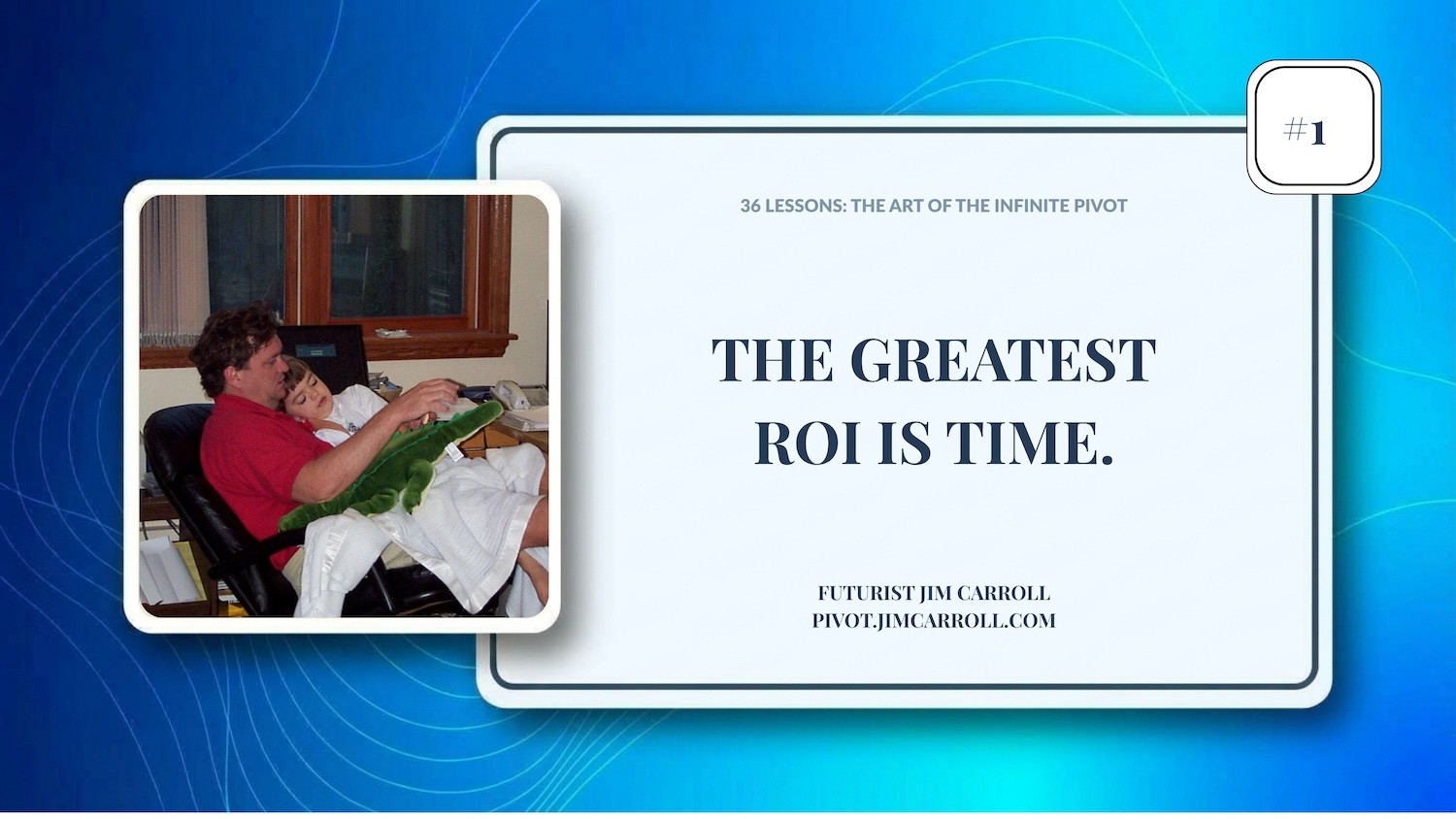
#1 - "The greatest ROI is time" - Futurist Jim Carroll

---
Futurist Jim Carroll is writing a series, The Art of the Infinite Pivot, based on 36 lessons from his 36 years as a solo entrepreneur, working as a nomadic worker in the global freelance economy. The series is unfolding here, and at pivot.jimcarroll.com.
---

Thirty-six years ago, I made a choice that many are facing for the first time.

I stepped out of the corporate world to bet on a home office, emerging trends, and a belief in myself. Seven years later, I began writing about this shift as a major trend, identifying the rise of “nomadic workers” — people we now call members of the freelance economy. In 1997, I published articles and a book (never completed) outlining the vanguard of a new economy where the traditional “job-for-life” was being replaced by a portfolio of skills and a freelance attitude.

Through 44 books and thousands of keynotes, I have chased many things: innovation, market trends, and technological velocity. But looking back from Year 36, the most successful pivot I ever made wasn’t financial or professional.

It was the pivot toward focusing on my family.

In this high-speed global economy, it is easy to become a slave to the “next big thing.” It’s easy to chase the never-ending quest for career success. It’s easy to lose yourself in all the opportunities that are swirling around you.

But the reality of a meaningful life is that the greatest ROI is always time. You will never look back and regret the hours you invested in your family instead of the greater career success you might have had.

To make my freelance voyage of nearly four decades work, I had to be disciplined. Over time, I developed a set of “10 Rules for Working at Home” to protect that time, and wrote them into a post in 2002. My favorite is Rule #10: “Remember why you are doing this. You’re working at home to be with your family. Don’t let the work get in the way of that!”

I remember a crucial call years ago where my two-year-old son came running into the office screaming because he’d banged his finger. I was frantic, trying to maintain my “professional” corporate persona. The woman on the other end just laughed — she was working from home too. In that moment, the “nomadic worker” reality hit home: the “interruption” isn’t a bug in the system; it’s the primary feature.

If you are navigating the freelance economy today, don’t hide the chaos.

Embrace it.

Make it a part of your voyage.

Design a career that flexes around life, not a life that shatters when work gets busy.

The journey continues tomorrow. Are you ready for the next pivot?

----

The image in today's photo is typical of the early days of Jim's life in his home office.

Original post: jimcarroll.com/2026/03/decodin

★ 2 • ↻ 0 original
Mar 26, 2026 · 10:13 AM UTC

"Stop treating perishable expertise as permanent knowledge. - Futurist Jim Carroll

--

Futurist Jim Carroll is writing a series, The Art of the Infinite Pivot, based on 36 lessons from his 36 years as a solo entrepreneur, working as a nomadic worker in the global freelance economy. The series is unfolding here, and at pivot.jimcarroll.com.

--

When I walked out of the corporate world in 1990, I carried a set of skills I thought were permanent.

I was wrong.

I quickly realized that in the freelance economy, knowledge is the foundation, but expertise is an asset that quickly fades. I learned pretty quickly, when it comes to the art of the infinite pivot, that if you aren't actively enhancing and renewing your expertise, you aren't standing still- you're falling behind.

Think about that - knowledge is what you know. Expertise is how you apply it. And if core knowledge keeps changing, your expertise keeps becoming outdated. You need to rapidly and relentlessly pivot.

And core knowledge is certainly changing. In the 36 years since, I’ve watched the "half-life of knowledge" shrink from decades to months. Everything I was writing about, speaking about, and advising about was undergoing relentless change.

Today, we're witnessing even faster change with AI. What you know at this exact moment in time will probably be irrelevant tomorrow.

I carry this story with me all the time. I’ve spent three decades telling global audiences that wealth is no longer found in what you know, but in how fast you can learn. I live this idea - in my home office, curiosity isn't a hobby: it's a core business process. I can't afford to be a "specialist" in a world that keeps changing the specialties. That's why any time I have a bit of downtime, I spend a chunk of it learning new stuff. The last few weeks have seen me wildly immersed in the vast new sophistication of the Claude AI set of knowledge tools because something profound is happening here. I can't explain what I don't actively use.

What does this mean? Today, as AI moves at "ludicrous speed," this lesson is the only thing keeping nomadic workers relevant.

The Infinite Pivot requires you to treat your current skills as temporary tools.

Use them, master them, but never assume they are permanent.

The journey continues tomorrow.

Are you ready for the next pivot?

---

Futurist Jim Carroll knows that much of what he knows today will be out of date tomorrow.

Original post: jimcarroll.com/2026/03/decodin

★ 1 • ↻ 1 original
Mar 27, 2026 · 9:30 AM UTC

"Waiting for total clarity is the fastest way to become irrelevant". - Futurist Jim Carroll

---
Futurist Jim Carroll is writing a series, The Art of the Infinite Pivot, based on 36 lessons from his 36 years as a solo entrepreneur, working as a nomadic worker in the global freelance economy. The series is unfolding here, and at pivot.jimcarroll.com.
---

When I walked out of the corporate world 36 years ago, I thought I needed a five-year plan.

That’s actually kind of funny to think about now.

I quickly realized that in a world of high-velocity change, a five-year plan is certainly on the list of things that won’t happen! I came to learn that the real danger I faced wasn’t a bad plan; it was what I’ve come to call the Clarity Trap.

That’s the belief that you must see the entire path before you take the first step!

Since then, I’ve spent three decades watching the brilliant leaders and organizations become caught in the trap. I’ve seen them paralyze their future because they were “waiting for the dust to settle,” for the path forward to become clear, for the future to be more certain. And they end up waiting a long time. All the while, they think they are being diligent, but as they wait for the “perfect” view ahead, the landscape they were studying has already shifted.

Whether you are running a global corporation or a solo practice, if you wait for 100% certainty, you are already too late.

I didn’t have a map for the last 36 years; I believed the trends I was watching were going to unfold into something bigger. When I dove into the early Internet in 1994, the technology was messy, and the business models were nonexistent. Yet I didn’t wait for clarity; I gained clarity by moving.

The Infinite Pivot requires you to execute on partial data, imperfect information, and a stunning lack of focus. You have to be willing to move when the clarity of the future is still uncertain — and be prepared to adjust your course mid-flight. This is particularly true when uncertainty dominates and volatility rages. Your only real protection at this point is momentum. If you are moving, at least you can steer. If you are standing still, you are just a target for disruption.

This reality becomes even more challenging in an exponential world. The “safe” move of waiting for more information is actually the riskiest move you can make. The only way to find out if a pivot works is to make the turn.

Stop waiting for the “right” time.

The right time is the moment you realize that standing still is a choice to be obsolete.
---

Futurist Jim Carroll has learned that chasing an unclear future is one of the most important things we can do.

Original post: jimcarroll.com/2026/03/decodin

★ 1 • ↻ 0 original
Mar 28, 2026 · 11:45 PM UTC

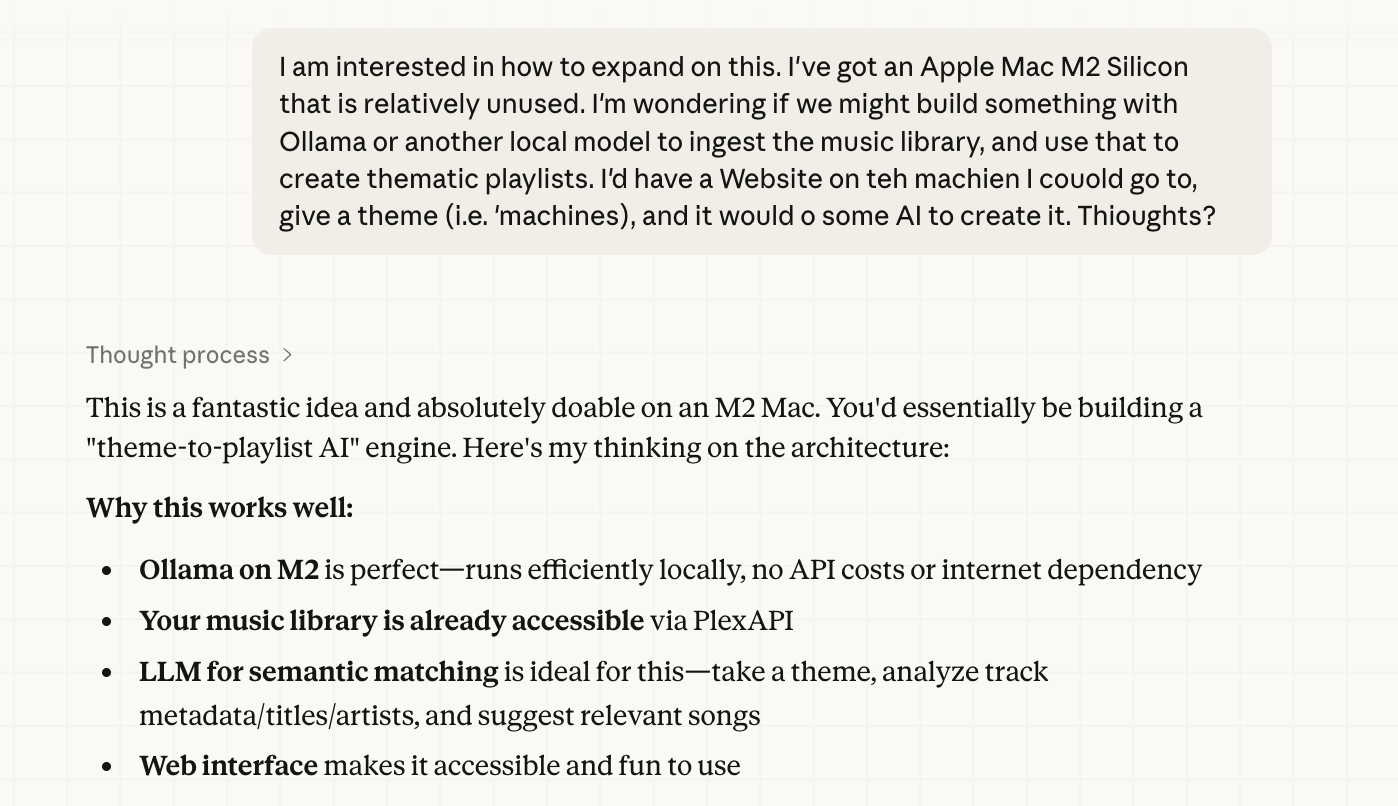
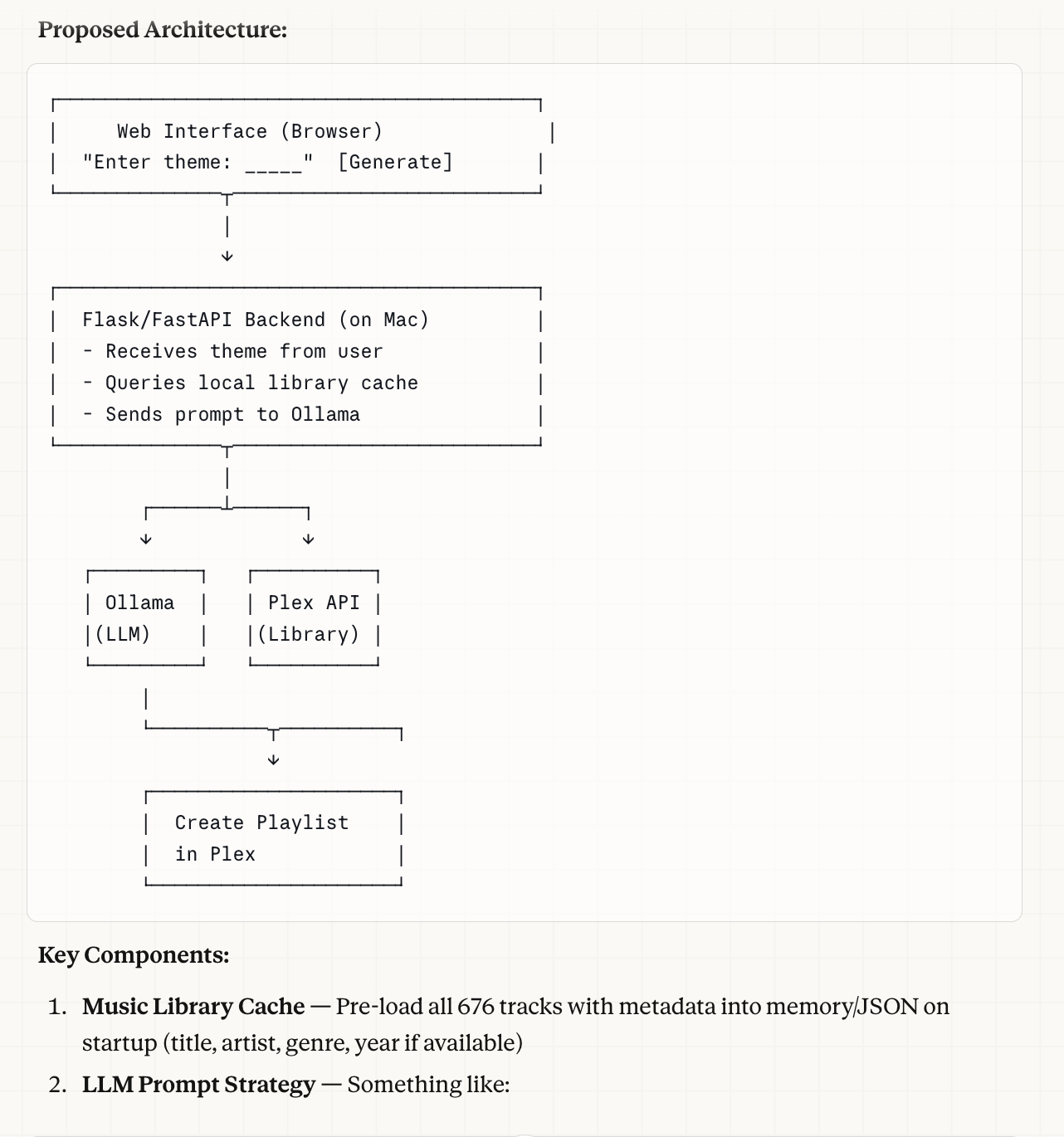
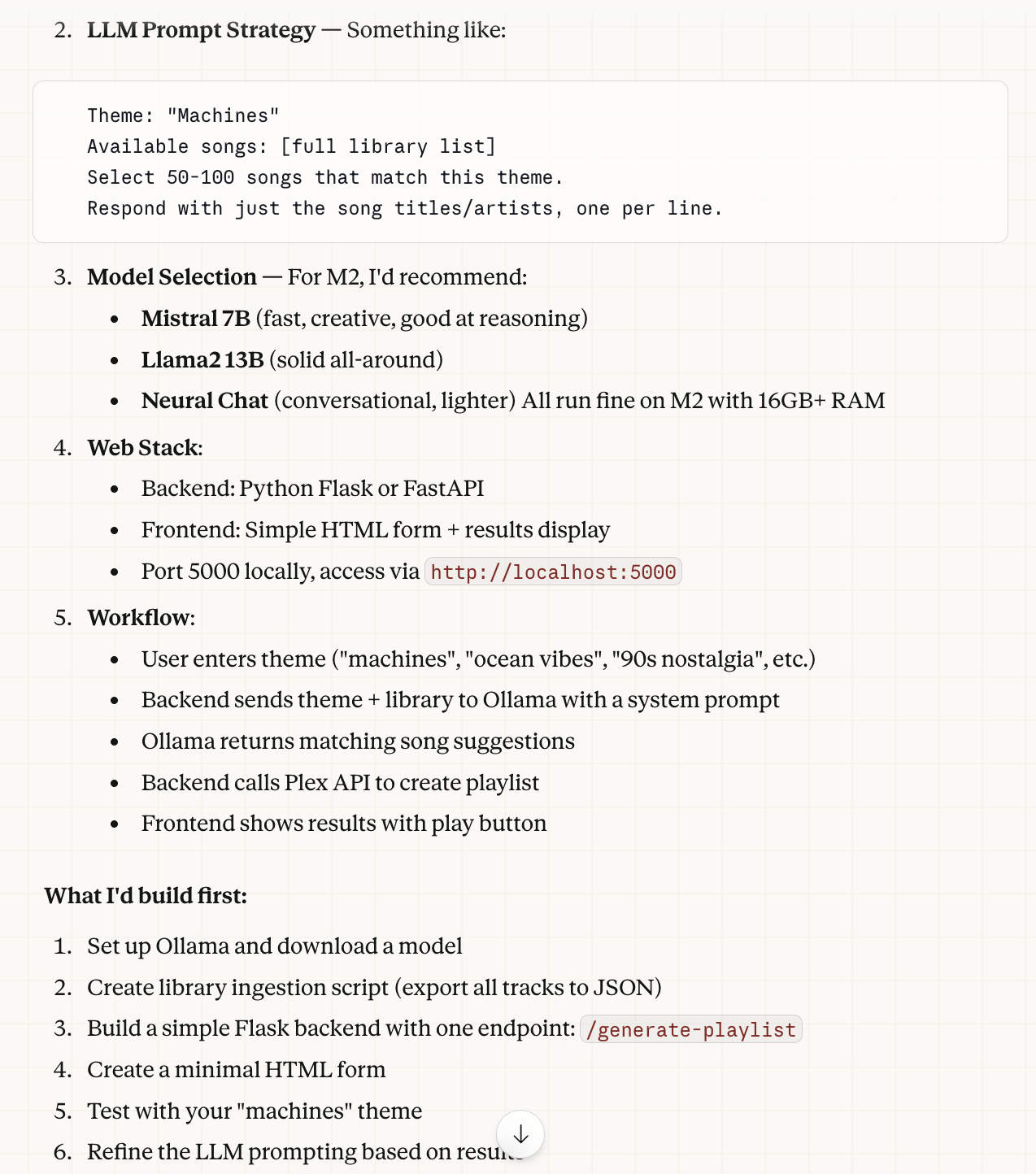
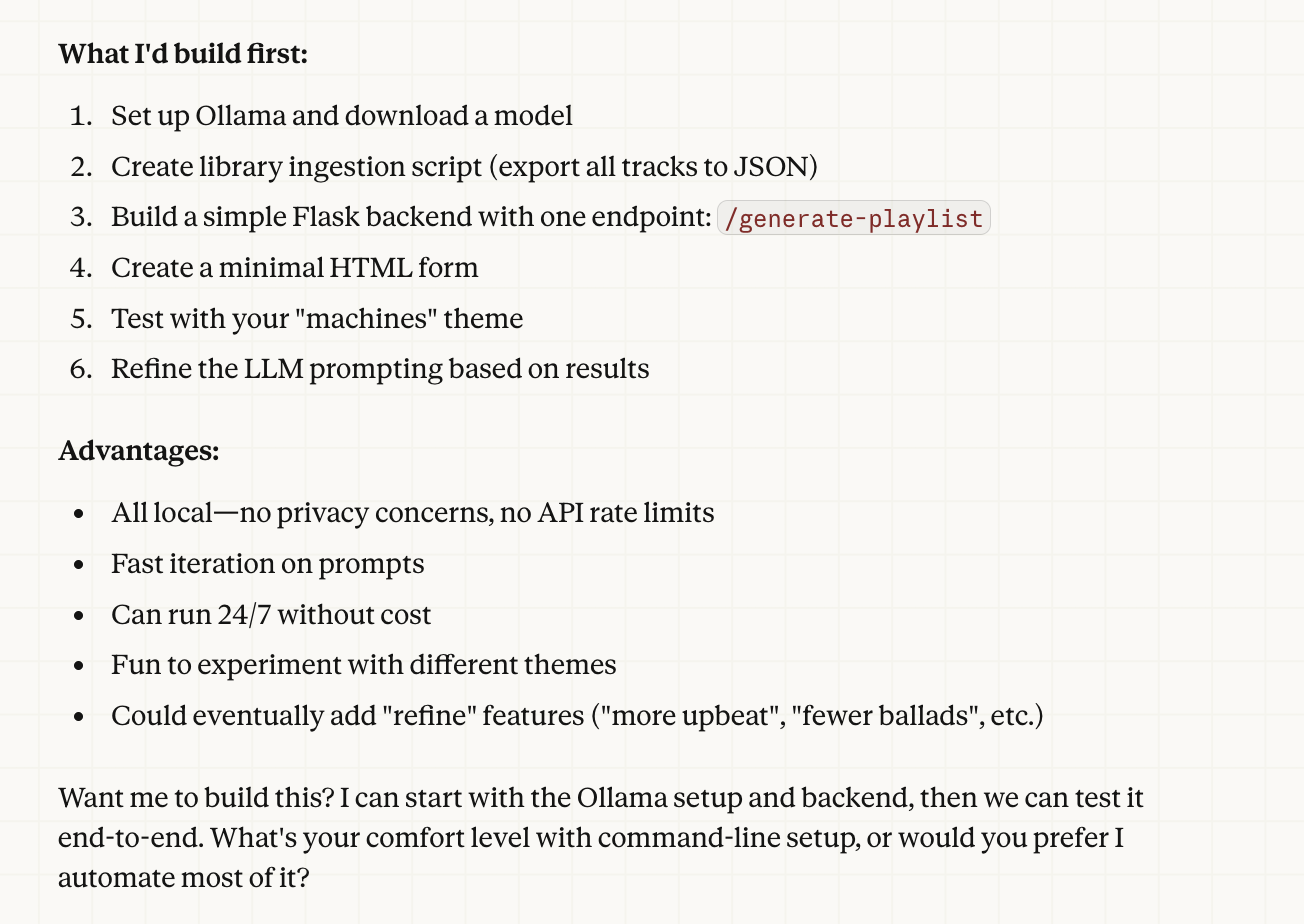
So if it's Saturday, why not use an AI to build an AI to have a Web site in my house that I can fire off a music theme in and have an AI go and build a music playlist based on that theme.

I mean, why not?

★ 0 • ↻ 0 original
Mar 31, 2026 · 9:50 AM UTC

"Never let your fear be the barrier to your future!" - Futurist Jim Carroll

--

Futurist Jim Carroll is writing a series, The Art of the Infinite Pivot, based on 36 lessons from his 36 years as a solo entrepreneur, working as a nomadic worker in the global freelance economy. The series is unfolding here, and at pivot.jimcarroll.com.
--

When I walked out of my corporate job 36 years ago, I was terrified.

I didn’t yet have a mortgage, but my wife and I were newly married and planned to get one soon! I had no certainty that my idea of going freelance would work, and I was pretty scared I might fail. All the while, I was reminding myself that while my career path inside a big global firm was “stable” on paper, I was miserable every single moment.

I had to get out, but my fear told me to stay.

Looking back, I now realize that confronting my fear is a natural part of my career pivot.

Throughout this time, I also learned that fear was often a guiding and prevalent issue within my client base when my solo career pivoted from a pure technology focus to innovation & the future.

Innovation? I’ve regularly seen that the biggest obstacle to innovation isn’t a lack of budget or lack of ideas; it’s the collective fear of the unknown.

Trends? When it comes to the future, I’ve learned that vast numbers of people live in fear of what it represents.

But here’s what I also know: the Infinite Pivot requires you to acknowledge the fear, but refuse to let it take hold of your future.---

---
Futurist Jim Carroll knows that too many people see the future as a threat, not as an opportunity - because of their fear of what it represents.

Original post: jimcarroll.com/2026/03/decodin

★ 2 • ↻ 0 original
Mar 31, 2026 · 7:37 PM UTC

Today's word:

GERMAN DICTIONARY ENTRY
**Kristdenfreude**
*/ krɪst-ˈden-frȯi̇-də /*

**PART OF SPEECH**
Noun (uncountable)

**DEFINITION**

1. The particular joy derived from witnessing the swift and public unraveling of a political figure's carefully constructed image, especially when documented across multiple news cycles.
2. German satisfaction at observing the consequences of diplomatic miscalculation by a neighboring nation's leadership.

**(AI ASSISTED)**

★ 0 • ↻ 0 original
← February 2026April 2026 →