Futurist Jim Carroll

Mastodon post archive · 2022–2026
Archived from mastodon.futurist.info · 4209 posts
← All months

February 2026 · 21 posts

← January 2026March 2026 →
Feb 2, 2026 · 10:51 AM UTC

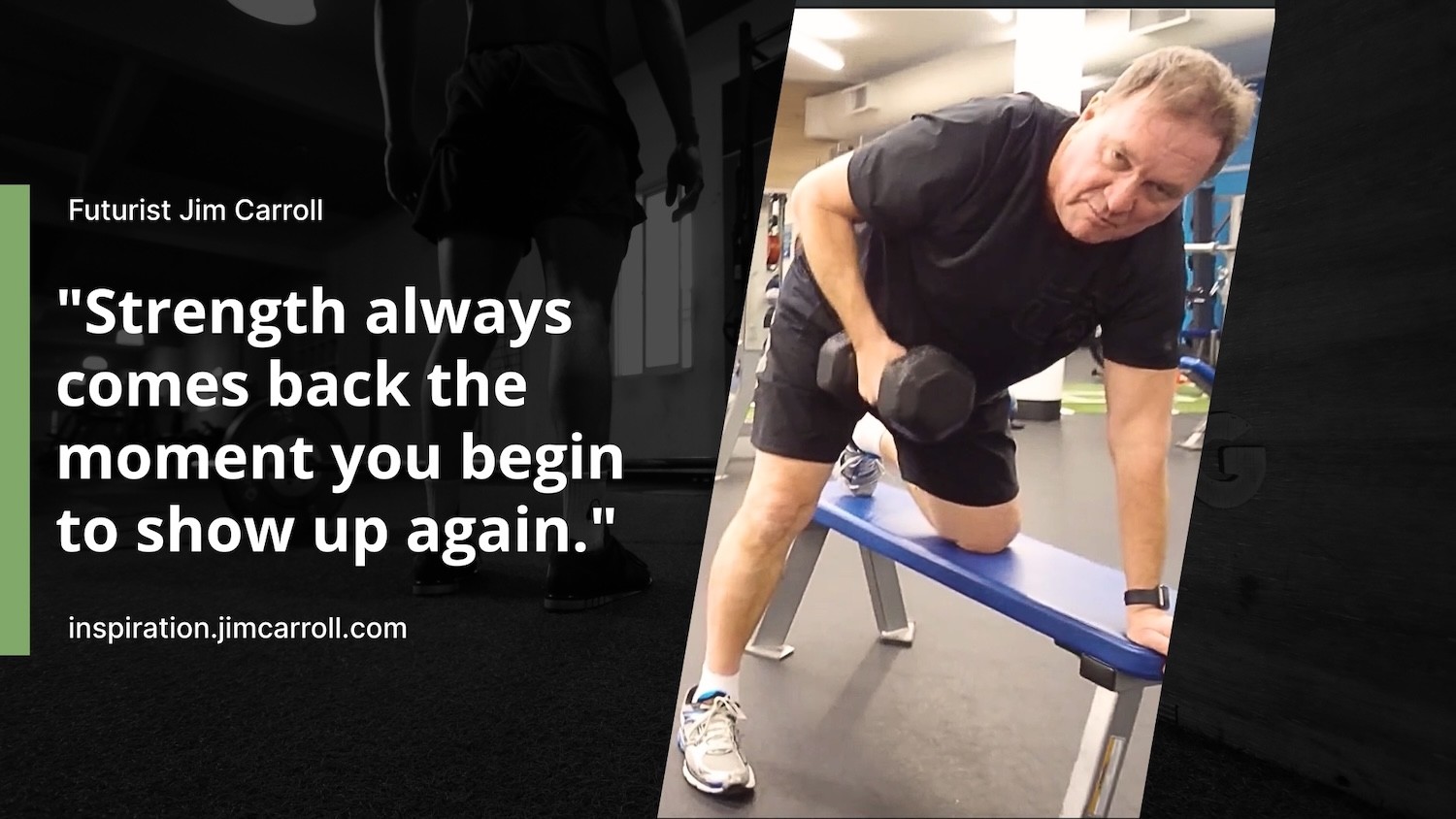
"Strength always comes back the moment you begin to show up again." - Futurist Jim Carroll

Today is a big day as I FINALLY head back to the gym.

For ten weeks, my world has been defined by limitations.

Don't twist. Don't lift. Don't rush. When you live in "protection mode" with a spinal injury for that long, it’s easy to believe that you’ve lost your edge. You start to wonder if the engine has rusted over completely.

But data doesn't lie, and it doesn't care about my worries.

Before heading back to the gym today, I ran a diagnostic on my own recovery when I went into my home gym on Saturday. And I was impressed with the results.

Looking at the hard numbers from this "shakedown" home workout. I expected to see weakness; instead, I saw a lot of capacity. My body handled 60 reps of heavy pulling without a single complaint from my back. My heart rate recovery has hit a "safety floor" and refused to drop further. My VO2Max has actually started to go back into the upper-edge of "above-average" with all the indoor 'mall walking' I've been doing.

The charts proved that while I was busy healing, I wasn't decaying.

My foundation is solid!

It might have to do with a screen I shared early into the story of this process - my biggest exercise for 2025, before slipping on ice and breaking 3 small bones on my back - was back extensions!

I've had long-running conversations in a chat with Google Gemini AI about my situation and recovery. One moment, it pointed out that what probably saved me from greater damage was all the muscle I built back there!

And my test workout shows that muscle never really left - it's just the bones that had a 'thing.'

That realization shifts everything.

I am not walking into the gym today to "fix" a broken body.

I am walking in to reactivate a strong one.

One way to put it - the rust is just on the surface—the steel underneath is as solid as ever.

Time to get to work.

---

**** **** **** **** **** **** **** **** **** **** **** **** **** **** **** **** **** **** **** **** **** **** **** **** ****

Futurist Jim Carroll will be working out with the guidance of his neighbor, a professional personal trainer, and has a tightly defined set of exercises that are compatible with recovery from his injury.

Original post: jimcarroll.com/2026/02/daily-i

★ 0 • ↻ 0 original
Feb 3, 2026 · 10:44 AM UTC

"Your future won’t be defined by the setbacks that might sideline you, but by what you decide to do with the velocity of your recovery!" - Futurist Jim Carroll

Next week, I will be standing on stage in Toronto at the Canadian Automotive
Dealers Summit.

As I prepare that keynote, this quote is the central pillar of my message.

The automotive industry is currently navigating a series of high-speed "sideline" events: interest rate volatility, a turbulent EV transition and pullback, Tesla's essentially deciding to leave the market, and the arrival of aggressive new global competitors. In Canada, that also involves the looming arrival of more Chinese-built EVs, as well as fast-moving turmoil in the automotive manufacturing sector (with resultant brand destruction) due to tariffs.

It's easy for a dealer to feel injured, battered, and bruised by this pace of change!

But as I’ve learned personally over the last few months of my own physical recovery, the injury itself isn't the defining moment.

The defining moment is the velocity you choose once you decide to get back in the game.

What's happening in the auto world right now is a massive widening of the "Resilience Gap" - that's what I write about in my book Dancing in the Rain. Some are still sitting on the sidelines, waiting for the "old normal" to return.

And then there are the leaders who are engineering a new future right now.

They aren't just recovering; they are using the momentum of this current setback to a faster pivot toward software-defined vehicles, a faster adoption of hybrids in light of the EV pullback, new digital customer journeys, and hyper-efficient service models.

One group is frozen - the other is moving.

I'm in the latter camp. Yesterday, I went back to the gym for the first time since my spinal injury. It’s a literal manifestation of this principle. I wasn't going back to where I was; I was going back to build the strength required for what’s next.

The automotive industry is at the same crossroads. You can’t control the volatility that sidelined you, but you have absolute control over your recovery speed. In Toronto, we’re going to talk about how to stop looking at the rearview mirror of "what happened" and start focusing on the "velocity" of the next logical move.

Strength doesn't return in the absence of struggle—it returns the moment you decide to show up and accelerate.

You need to think the same way.

Let's get moving.

Futurist Jim Carroll spoke to the same event in 2012, and will be doing a retrospective look back and forward in his keynote.

**** **** **** **** **** **** **** **** **** **** **** **** **** **** **** ****

Original post: jimcarroll.com/2026/02/daily-i

★ 2 • ↻ 0 original
Feb 4, 2026 · 10:57 AM UTC

"Innovation often dies in the quiet comfort of mutual delusion." - Futurist Jim Carroll

Let's talk about innovation.

I was on a Zoom with a potential client yesterday, looking into an innovation-themed leadership event they were pulling together. One thing that became obvious was that they didn't really want the session to focus on the real big issues the organization is faced with.

Sadly, this often seems to be the case - people refusing to ignore the very things that are holding them back from moving forward. And in an era of relentless disruption, that means the greatest threat to their future isn't a competitor, slow product innovation, or internal collaboration failure.

It’s the team's collective agreement to ignore reality.

When a team or an entire industry chooses comfort over truth, they enter a state of "mutual delusion."

Here is how this concept manifests in the context of innovation:

(a long list of reasons is in the origianl post)

The comfort of linear planning: In an exponential world, the five-year roadmap acts as a corporate security blanket. Relying on it is a form of collective delusion that provides a false sense of predictability in a chaotic environment.

The nostalgia tap: Clinging to the "glory days" of past success is perhaps the most common mutual delusion. It prevents a team from recognizing a fundamental rupture in their industry until it is too late to pivot.

All of these are the very reasons why it's the rebels, misfits, and outcasts who excel at innovation - because they are the ones who refuse to participate in the charade!---

---

Futurist Jim Carroll has a long list of detailed observations on why some organizations succeed at innovation while others fail. He's come to understand that most of it is own-goal failure.

Original post: jimcarroll.com/2026/02/daily-i

★ 1 • ↻ 0 original
Feb 5, 2026 · 10:45 AM UTC

"It's easy to make excuses to avoid taking action. It requires discipline to find reasons to act." - Futurist Jim Carroll

I made this comment on stage at a recent event while working through a section focused on innovation strategies.

I knew right away I had something powerful!

Part of what happens when I provide very detailed, disruptive industry trends is that people become overwhelmed. Whether it's the new world of hyperconnected, intelligent medical device technology, digital twin manufacturing design processes, or the accelerated role of generative engine optimization in website marketing strategies, many in the audience often react with 'whoa!'

And I know what they are thinking. "I don't need to do that right now." "It can wait." "I can do it later."

Excuses.

Not action.

And then one day, they wake up, realize that they have fallen way behind, and suddenly know that it is impossible to catch up.

The future went past them.

But they had a choice.

They could have acted. They could have avoided the excuses and instead, decided to move forward.

They could have committed to the opportunities of tomorrow, today.

But they didn't, until it was too late.

What excuses are you making right now?

What actions are you avoiding?

Where is your future caught between the action/inaction line?

Food for thought!

---

Futurist Jim Carroll has long realized that perhaps 1/2 of every audience will never make it to the future in good shape.

**** **** **** **** **** **** **** **** **** **** **** **** **** **** **** **** **** **** **** **** **** **** **** **** ****

Original post: jimcarroll.com/2026/02/daily-i

★ 1 • ↻ 1 original
Feb 6, 2026 · 11:03 AM UTC

“You are the sum total of all of your highs and each of your lows.“ - Futurist Jim Carroll, via Lauren Daigle

Some songs speak to your soul.

And some lyrics reach out and grab you by the throat.

This one did.

It hits you right in the pre-chorus of Lauren Daigle's "You Say." She asks the question: "Am I more than just the sum of every high and every low?"

youtube.com/watch?v=sIaT8Jl2zpI

The song came on while I was out for one of my first outdoor walks since my November spinal injury, and it hit the moment perfectly.

My answer to her question is: Yes, you are more—but you are also the sum.

You must accept the lows as a critical part of the process rather than pretending they don't exist. Otherwise, you'll never have the opportunity to learn from them.

In my career as a futurist, I tell clients that innovation isn't a straight line "up and to the right." It’s a messy squiggly line of breakthroughs and failures. You cannot have the "High" of a new invention without the "Low" of the failed prototype.

If you delete the failure, you delete the lesson.

My incident has informed me. It has taught me that the "lows"—the pain, the confinement, the loss of the ski season, the frustration,was not lost time. It was valuable insight.

It was the construction site where my resilience was being reinforced.

Rebar for life, if you think about it!

When life throws you a curveball, you have to live through and feel the emotions, rather than trying to hide from them.

Don't edit out the lows. Own them. They are the only reason the highs mean anything at all.

---

Futurist Jim Carroll is back out for his regular morning sunrise walks, and is back to the gym. It feels great!

**** **** **** **** **** **** **** **** **** **** **** **** **** **** **** **** **** **** **** **** **** **** **** **** ****

Original post: jimcarroll.com/2026/02/daily-i

★ 1 • ↻ 0 original
Feb 9, 2026 · 10:58 AM UTC

"It’s not about ‘using’ the machine. It’s about thinking ‘with’ the machine." - Futurist Jim Carroll

When you think about it, all of society is busy trying to figure out this AI stuff - and we're all busy working with it, exploring it, testing it.

And in doing so, maybe we are thinking about it all wrong. I think a lot of folks treat AI like a vending machine: put a question in, get an answer out. But that is the lowest form of value.

Real intelligence isn't about getting answers. It's about developing insight.

For the last three months, I’ve been living this reality. When I fractured my spine (L1-L3 transverse processes) in November, I didn't want a search engine to tell me "how to heal." I needed a partner to help me understand what was happening to my body.

That became Gemini AI.

I stopped "using" AI to search for generic medical advice. Instead, I started "thinking with" it. I fed it my raw CT scans, my daily heart rate data, my workout logs, my medical background, my entire fitness history, and my fears.

And I ended up in a long conversation.' It was weird. I felt like I was developing a new form of knowledge partnership. "We" debated the numbers. "We" challenged the assumptions. "We" co-authored a recovery plan. It's gone to hundreds and hundreds of pages.

And look, I'm very cognizant of the risks with this type of tool - one of the books I wrote in the 90s took a good, hard look at the risk of online health information. Yet through it all, my AI 'partner' proved to be remarkably accurate in what it was telling me about my spinal injury.

I verified a good part of the medical device that I received through external validation. Along the way, I've met and had many discussions with one of the world's top spinal doctors, and Dr. Ken was impressed by the accuracy of the information I shared about my injury and recovery. 

He's authored one of the most popular books in the world on back issues - it's well worth a read. And I must say, the advice he provides on exercises for back injuries and recoveries is almost identical to what Google's AI was later advising me.

Back to my 'relationship' with AI. It's fair to say that "we" discovered 25 specific things about my physiology and recovery that I would otherwise have missed. "We" have developed fitness routines, stretching plans, small tests to check the state of my recovery, and more. I ran the fitness routine it developed for me past both my physio guy and personal trainer, and both agreed that it was spot on. It's now what I'm working with.

I asked 'it' to summarize for me the types of insight 'we' shared. It's an interesting overview!

----

In 1997, Jim Carroll wrote a book called Good Health Online. It could probably use an update!

**** **** **** **** **** **** **** **** **** **** ****

Original post: jimcarroll.com/2026/02/daily-i

★ 1 • ↻ 1 original
Feb 10, 2026 · 10:59 AM UTC

"Shift your mindset from why you can't to why you must!" - Futurist Jim Carroll

It was an honor to present at the recent BIFMA 360 Leadership Conference in St. Petersburg, where I took a hard look at the "era of acceleration" currently transforming the manufacturing industry.

From the rapid integration of AI and robotics to the emergence of "swarm factories," the message is clear: the future is coming at you faster than you think. How fast are things changing? Take a look at my slide deck - I share the full thing right here. I don't often share these, but I'm particularly proud of what I put together.

To encourage them to keep moving forward, I just shared a deep-dive summary, and a video recap that collectively outline the mindset required to survive—specifically, my mantra to "Think BIG, Start small, Scale fast!"

How did I encourage them to think about tomorrow? I told them about what things would look like in exactly 10 years!

The slides and article guide you through "Project Aura," a hypothetical 2035 scenario where we build a "phygital" workspace using digital twins and bio-responsive materials. These resources outline a 10-step roadmap—from "cognitive briefs" to "product-as-a-service"—illustrating how technologies such as generative AI and 3D printing are reshaping the entire manufacturing lifecycle.

I also filmed a summary YouTube video as a refresher of what I covered in the keynote. It brings these concepts to life with practical leadership strategies for today. In it, I discuss the importance of building an "Xbox Room" to allow young engineers to experiment with new tools and the necessity of hiring "rebels and misfits" to shake up the current skill set. The video serves as a passionate reminder that we are in a time where trends can go "supernova" and change an industry overnight.

youtube.com/watch?v=dHm7JLDEXTM

Crucially, I warned them of the dangerous "barbell structure" forming in the industry - big companies are doing all these things, and small and medium-sized manufacturers are falling behind. I challenged these leaders to "kill the innovation killers" (the excuses that hold you back) while building the "experiential capital" necessary to avoid becoming the hollowed-out middle.

Overall?

My key guidance was not to try to avoid what must be done - and to do that, they needed to shift their mindset from why they 'can't' to why they 'must!

---

Futurist Jim Carroll has spoken at well over 100 manufacturing events, outlining the trends that are rapidly redefining one of our most important industries.

**** **** **** **** **** **** **** **** **** **** **** **** **** **** **** **** **** **** **** **** **** **** **** **** ****

Original post: jimcarroll.com/2026/02/decodin

★ 1 • ↻ 2 original
Feb 11, 2026 · 10:45 AM UTC

"This might not be the future we wanted to be living in. But it need not be the only future that we are doomed to have!" -Futurist Jim Carroll

The rest of the world is tired.

Tired of the insanity, the depravity, the increasingly strange twists and turns of a mind that is becoming more unstable at every moment.

Later today, I'm off to keynote a Canadian automotive conference. Talk about an industry caught in the middle of the craziness! They probably never imagined ten years ago when I spoke to them that their future would be the subject of the wild twists and turns of a mind of madness.

That's probably why Canadian Prime Minister Mark Carney's speech in Davos has resonated so much all over the world. He put things clearly. It's time to move on. Recognize that the old future is gone. Build a new one!

Because at some point, you've got to admit that you've had enough - and do your own thing. Define your own game. Play by different rules when the old rules are gone.

"I'm aware that not everyone approved of how I played, but I don't think any apologies are in order. Early in my career, I decided that it was worth it to do whatever was necessary..." - Gordie Howe."

It might not be the future Canada wanted. But that being the case, Canada is busy engineering a different - and what will likely be a better - future.

There are very powerful leadership lessons here. Often, we don't end up with the future we want - and so it often becomes critical to define things so you can end up with a different - and often better - future.

Always keep that in mind.

When you've had enough, it's time to move on.

That's what the rest of the world is doing now.

Business needs to follow.

---

Futurist Jim Carroll is not a huge hockey fan, even though he lives in Canada. He also knows it will always be the quintessential Canadian sport.

**** **** **** **** **** **** **** **** ****

Original post: jimcarroll.com/2026/02/daily-i

★ 2 • ↻ 1 original
Feb 12, 2026 · 10:42 AM UTC

"Assumptions are dangerous illusions that bind us to an unsuccessful future." - Futurist Jim Carroll

In a world of exponential change, what you think you know is often your greatest liability.

That's because your ability to rely on assumptions offers a false promise of progress.

Why? Because if you are still operating on last year’s logic, you aren't just behind - you are watching a different movie entirely. You must dismantle your assumptions before they become organizational vulnerabilities.

I took a look at what I've written about the danger of assumptions, and came up with this list of 10 reasons why assumptions are dangerous to your success.

They Create Scale-Blindness: We are wired for linear addition, but the future is built on multiplication. Read my series for 2026 about exponential change. Assumptions leave you blind to the exponential tsunamis heading for your industry.

They Fuel Aggressive Indecision: The assumption that waiting for "perfect clarity" is safe leads to organizational sclerosis. In a volatile world, clarity is a myth.

They Anchor You to "The Olden Days": The hubris of experience suggests that because a strategy worked for 30 years, it will work tomorrow. Today, that experience is often just a heavy anchor.

They Blind You to "The Blur": We assume industry boundaries are fixed. The future happens in the blur between lines, where new competitors reinvent your model while you stay in your lane.

They Lead to Innovation Sclerosis: "We’ve always done it this way" is a red flag for an abandoned future. It prioritizes process over the imagination required to survive.

They Result in Strategic Hubris: Success leads to the illusion of invincibility. The moment you assume you have a "magic touch," you stop listening to the market signals that matter.

They Ignore the Wisdom Inversion: Hierarchy assumes seniority equals foresight. In reality, your youngest employees often have a clearer intuitive grasp of what’s next than the C-suite.

They Trap You in Pilot Purgatory: The assumption that you have years to roll out a "safe test" is a trap. You must move from experiment to massive deployment instantaneously.

They Create a Bunker Mentality: Many assume they can hunker down and wait for "normal" to return. It isn't coming back. Waiting is a suicide pact built on a fundamental misunderstanding of change.

They Rely on the Informed Delusion: We assume more data equals better decisions. Often, more data simply increases your belief in your existing assumptions while the world shifts beneath you.

The bottom line?

The moment you think your future is guaranteed is the moment it becomes certain that it isn’t!

Stop planning for the probable and start preparing for the unimaginable.

---

**** **** **** **** **** **** **** **** ****

Original post: jimcarroll.com/2026/02/daily-i

★ 2 • ↻ 0 original
Feb 13, 2026 · 11:14 AM UTC

"The road to the future can often be found in the missteps of the past!" - Futurist Jim Carroll

So, is there anything going on in the automotive industry right now?

What a wild industry!

Anyways, I spoke to this same event 14 years ago - and found an original interview. I pretty much nailed the predictions.

youtube.com/watch?v=hB4nndpcOSg

Yet, there were many that were missed or a bit off.

Let's revisit! Here's a set of slides I used in my talk - looking back, looking at today, and looking forward.

The Politicization of the Drivetrain

Quite simply, electric vehicles became part of the culture wars.

The Linear March to Pure Electrification (BEV)

It was believed that one day, there would be ICE (internal combustion engine) vehicles, and then there would be a world of all-EVs. It's not happening like that - hybrids are taking over as people simply weren't comfortable with full electric, for a variety of real (and not-so-real) reasons.

The Evolution of Autonomous Vehicles

Cars would drive themselves. Massive disruptive change! Didn't happen - it's hard to get to 99.9999% accuracy, which is pretty much what's required. I've got a Tesla with 'full self driving' - but am never really fully comfortable.

The Apple iCar Disruption

Everyone thought Apple was going to build a car, and it would be game-changing! It didn't happen.

Mobility-as-a-Service (MaaS) Replacing Ownership

People weren't going to buy cars because we were all going to be using car-sharing services. Nope.

Millennials Will “Kill" Car Culture

Not only that, but younger people weren't going to buy cars - because they were never into 'car culture.' Another nope - they got married, had kids, got cars!

The "Peak Car" Hypothesis

All of this meant that we were going to hit the top limit of sales.

Small Car Dominance (Urbanization)

And the car was going to keep becoming smaller. Um, LOL?

Low Interest Rate / Easy Credit Environment

Cars would continue to be inexpensive! Credit would be easy!

Western Hegemony in Auto Manufacturing

Western car companies would own the planet. Sorry, not happening. China does.

The Death of the Dealership (Agency Model)

Car dealers would die because we will buy all of our cars online. Some of this happened, but the dealers fought back!

The Powertrain & Energy Miscalculations

Diesel, baby! Oops! Fraud, baby!

Lessons? Sometimes the road to the future is found my examining the missteps of the past!

----

Futurist Jim Carroll's view of the future of the auto industry? Globally, all China, and US car companies become small niche players.

**** **** **** **** **** **** **** **** **** **** **** **** **** **** **** **** **** **** **** ****

Original post: jimcarroll.com/2026/02/decodin

★ 3 • ↻ 0 original
Feb 17, 2026 · 10:59 AM UTC

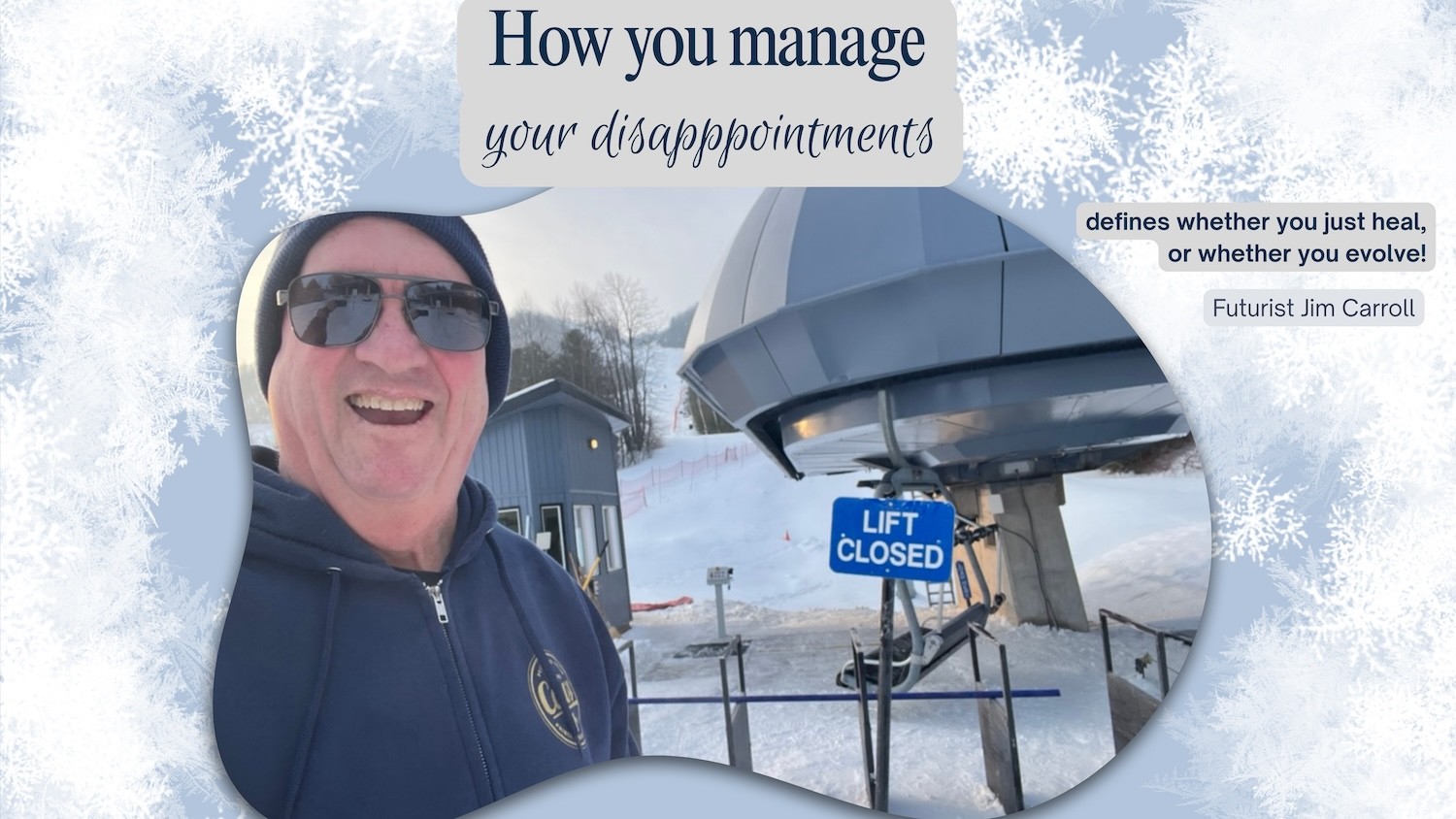
"How you manage your disappointments defines whether you just heal, or whether you evolve!" - Futurist Jim Carroll

Skiing has defined a large part of who I am and what I do.

And I've certainly documented my history with the sport here!

For over 25 years, the slopes have been my winter sanctuary. I’m usually the first one at the chairlift, chasing that perfect morning run and the "exuberance of the carve." It’s more than just a hobby; it’s a rhythm that connects me with friends and family, acting as the backdrop for some of my best memories.

The sport has even found its way into my professional life as a futurist. I’ve often written about the "Powder Principle." It's a story about a young engineer who turned down a high-paying job because it would mess with his skiing time, which became a great way to explain shifting generational values. I’ve also explored the link between high performance and business speed, drawing lessons from sharing the slopes with Olympian Larisa Yurkiw. Then there are numerous trends and innovation pieces I have written about the sport as a way of explaining the future and opportunity.

Skiing has always been a perfect metaphor for agility and looking ahead!
Of course, this past season didn't go as planned. As many of you know, a fall on the ice left me with a spinal injury that sidelined me for the entire winter. It was a tough break - literally- but I’m making this my final word on the matter.

Yesterday, during an early morning walk, I went over to the chairlift where I would usually start my day, at the sport where I would claim 'first chair.' It was tough to be there, but it was kind of a cathartic moment, and a big learning opportunity for me!

It reminded me that dwelling on the "what ifs" doesn't help anyone, and
frankly, I’m ready to move past the injury narrative and focus entirely on the recovery. 

That brings me back to the idea of evolving. Instead of being bitter about the lost season, I’ve shifted my focus to what’s next. I’m trading the ski boots for golf clubs as I prepare for a tee time at St. Andrews in just 48 days, and I'm finding joy in new roles, like being a grandfather to Mason.

Managing disappointment isn't just about healing the damage; it's about pivoting to new opportunities with a positive mindset!

----

Futurist Jim Carroll will start 'rotation' exercises in just a few weeks to start his rehab process for golf!

**** **** **** **** **** **** **** **** **** **** **** **** **** **** **** **** **** **** **** **** **** **** **** **** ****

Original post: jimcarroll.com/2026/02/daily-i

★ 2 • ↻ 1 original
Feb 18, 2026 · 11:02 AM UTC

"The future was never about the 'art of the deal,' It's always been about the art of the pivot." - Futurist Jim Carroll

Look at the sheer velocity at which Mark Carney is operating right now.

Regarding the recent news, he isn't paralyzed by analysis or bogged down in endless negotiations waiting for the "perfect" terms. He is acting with speed and decisiveness. Yesterday, reorienting the defence industry to avoid the US and build more in Canada, and shifting agriculture and energy markets beyond the southern neighbor.

As a Canadian, it is fascinating to watch.

Pivots, every single time.

His approach perfectly illustrates a core truth about navigating tomorrow: the importance of the 'pivot.'

Maybe he's been reading my stuff LOL! If you have been following my Daily Inspiration posts over the last few months, you know this is a central theme for thriving in our exponential world. Agility beats negotiation every time. I’ve explored this from the internal "mindset pivot" to the ruthless "slash and burn pivot," but the most crucial element is being prepared to shift.

Back in December, when I introduced Principle **#19** in my "26 Principles for 2026" series, I detailed exactly how to prepare for this kind of speed using what I call "Optionality Architecture."

That's all about the pivot!

Here is what I had to say about moving beyond the singular plan:

--

In an era of relentless acceleration, "a single roadmap is a liability. It’s a rigid path in a fluid world." If you are solely focused on landing one specific "deal" or following one linear path, you are exposed. By the time you finish negotiating the terms, the reality those terms were based on has likely already shifted.

To combat this, you need Optionality Architecture. You must "throw out the roadmap. Build a portfolio of instant pivots instead." A true pivot isn't a panicked reaction to a crisis; it is a "pre-validated alternative strategy, sitting on the shelf, ready to be activated at a moment's notice."

---

Carney understands that speed is the new currency. When you have a portfolio of pivots ready, you don't have to hold a strategy meeting. You just push the button." This is the only way to operate in a fast-paced future: "Stop waiting for certainty and start creating it!"

Do you have your 'optionality architecture' in place?

Because given the crazy, unstable volatility of the continuous artistic failures of every deal, it's pretty much a necessity at this moment in time!

----

If you missed it, you can catch Jim's 26 Principles for 2026 at 2026.jimcarroll.com. Most of what he suggested as important ideas are emerging at speed.

**** **** **** **** **** **** **** **** **** **** **** **** **** **** **** **** **** **** ****

Original post: jimcarroll.com/2026/02/decodin

★ 2 • ↻ 0 original
Feb 19, 2026 · 11:08 AM UTC

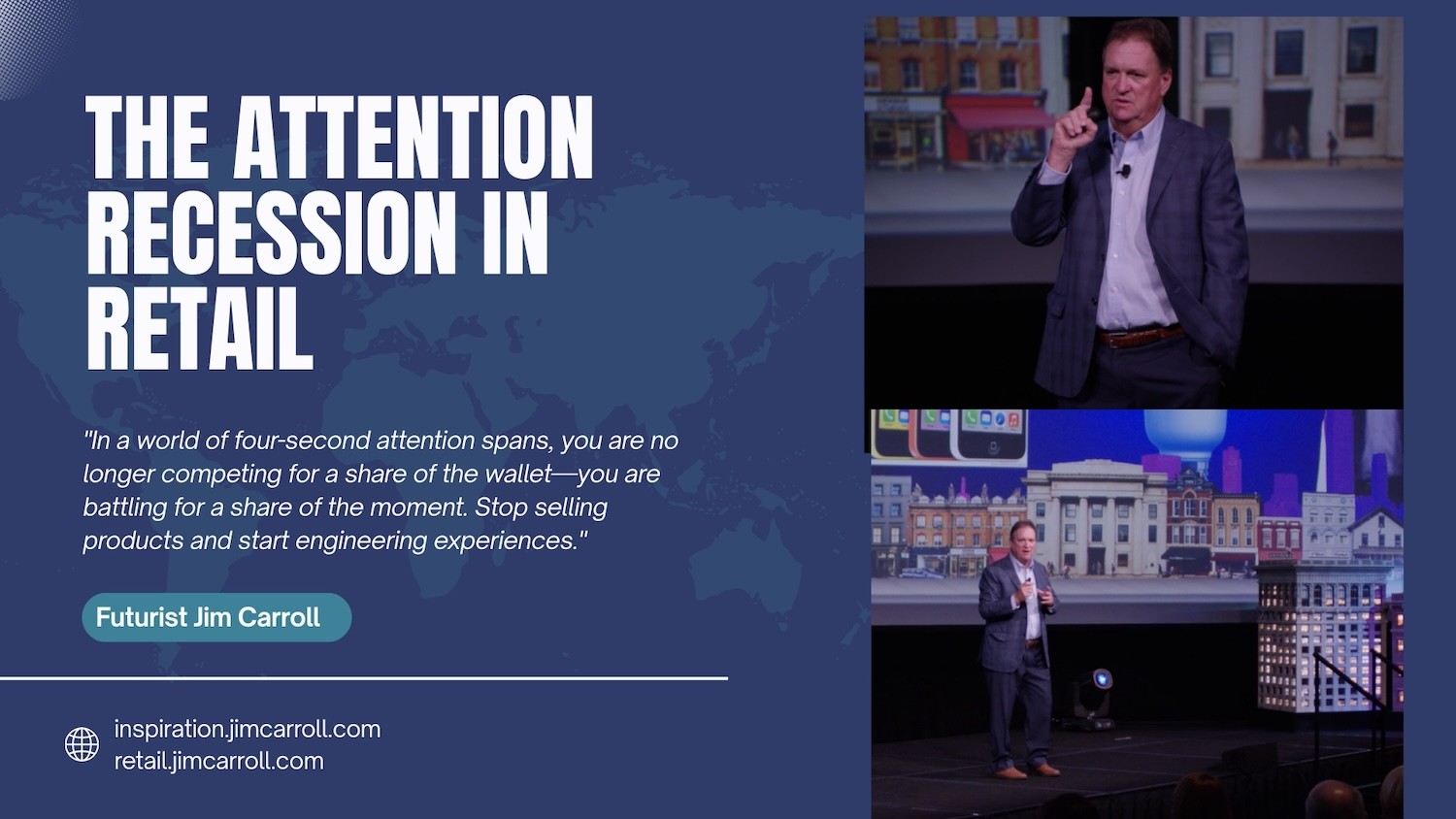
"In a world of four-second attention spans, you are no longer competing for a share of the wallet—you are battling for a share of the moment. Stop selling products and start engineering experiences." – Futurist Jim Carroll

We have officially entered the "Attention Recession."

With that in mind, I prepared a proposal for a client by preparing a full 35-page PDF outlining the nature of the issue - 10 trends, 10 bold ideas, and 10 action plans they could pursue right now. Give it a look!

The numbers are staggering. We are seeing a complete collapse in how long people are willing to focus, particularly if they are dealing with a purchase. There's something we can call "time to clarity", and it's collapsing. Gen Z now averages an attention span of just 6.5 seconds. For pre-teens? It drops to a mere 4.2 seconds.

That's how long it takes someone to look at something, come to understand it, and make a decision.

Think about that. You have four seconds.

In that fleeting blink of an eye, a consumer is scanning 12 feet of shelf space. On your web site, they are giving you less time than they give to a short TikTok video. If they can't understand you, value you, or desire you in that window, you don't exist.

You aren't just losing a sale; you are becoming invisible.

This isn't just a marketing challenge; it's a fundamental shift in the customer relationship.

In a linear world, we sold products. In an exponential world, the product is secondary to the moment.

The retailers and brands that will thrive in 2026 and beyond aren't the ones with the best inventory; they are the ones who transform a "transaction" into a "discovery." They understand that in an attention-starved marketplace, experience is the only competitive advantage that cannot be scrolled past.

If you are still trying to sell a product to a mind that has already moved on, you are fighting a losing battle. You might want to look at the deck

You need to stop the clock. You need to engineer the moment. Moments that are collapsing.

Because if you don't own the experience, you don't own the future.

---

Futurist Jim Carroll has spoken to dozens of retailers and at retail conferences. Details at retail.jimcarroll.com

**** **** **** **** **** **** **** **** **** **** **** **** **** **** **** **** **** **** **** **** **** **** **** **** ****

Original post: jimcarroll.com/2026/02/decodin

★ 3 • ↻ 1 original
Feb 20, 2026 · 10:58 AM UTC

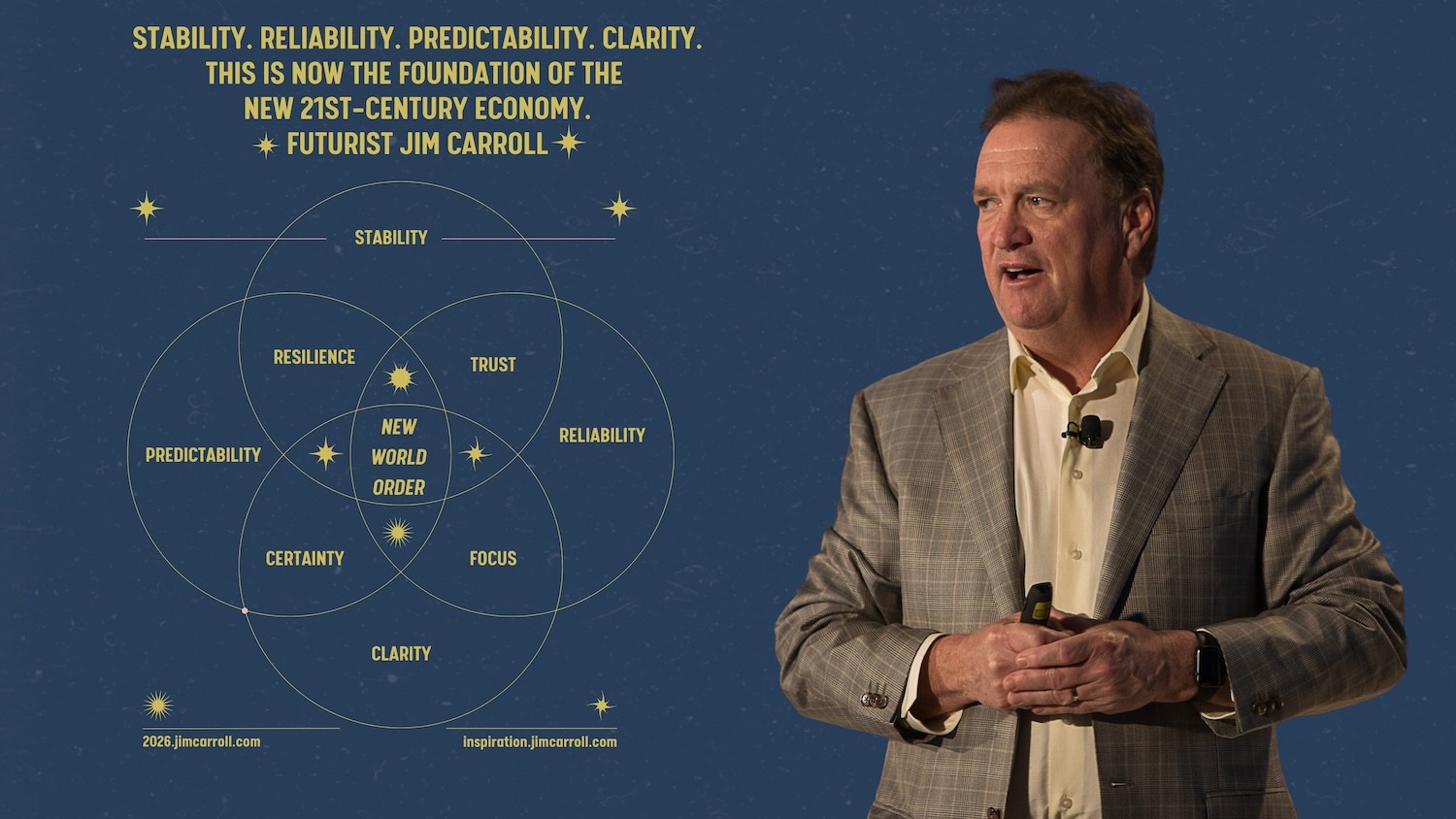
"Stability. Reliability. Predictability. Clarity. This is now the foundation of the new 21st-century economy." - Futurist Jim Carroll

It's been fascinating to watch the speed at which a new global economy has been emerging in the last few months the wake of the rapid, destructive actions of the old one.

For decades, globalization was built on a single metric: cost. We built hyper-extended supply chains that favored the cheapest option over the most certain one. We assumed the world would remain "flat" and friction-free forever.

And it's pretty clear that era is over. The "old economy" was fragile, held together by the hope that nothing would ever go wrong. It also presumed that some of the most reliable partners would show consistent stability, not rash insanity.

Today, in the wake of the rapid destruction of what has bound the global economy together for 80 years, we are seeing the rise of a new global architecture. It’s no longer just about where it’s cheapest to build; it’s about where it’s safest to stay. In a world characterized by sudden shocks and "impossible" events, the new currency of global trade isn't the dollar—it’s certainty.

I wrote about the mindset needed for this new world in my 26 Principles for 2026. When I look at this through the lens of Principle **#12**: Strategic Humility, the lesson for global leaders is clear: the hubris of thinking you can control a chaotic world is a recipe for disaster.

Successful leaders are adopting a new "Leadership Ikigai." Originating from Japan, Ikigai translates to a "reason for being." It is often represented as a Venn diagram where different aspects of life intersect to create a sense of balance and purpose. In this professional context, we are overlapping the four pillars of the modern economy to establish a solid strategic foundation.

This new organizational architecture prioritizes:

Trust over Cost: Moving away from volatile regions toward partners who offer Stability and Reliability.
Resilience over Efficiency: Recognizing that Predictability is what allows an organization to "feed on chaos" rather than be broken by it.
Focus over Complexity: Using absolute Clarity to cut through the noise of geopolitical upheaval.

The way I've been explaining this on stage in my keynotes is pretty simple -

We are shifting from a global economy of "Just-in-Time" to "Just-in-Case," and finally to "Just-with-Certainty."

Stop mourning the old world.

The new one is being built right now, and its foundation is stronger than anything we've seen before.

---
Futurist Jim Carroll described the future at a recent conference as 'weird.' This post reflects how he is carefully tracking the seismic changes underway.

**** **** **** **** **** **** **** ****

Original post: jimcarroll.com/2026/02/decodin

★ 0 • ↻ 0 original
Feb 20, 2026 · 7:45 PM UTC

A Futurist predicts the next week.

★ 1 • ↻ 2 original
Feb 23, 2026 · 10:58 AM UTC

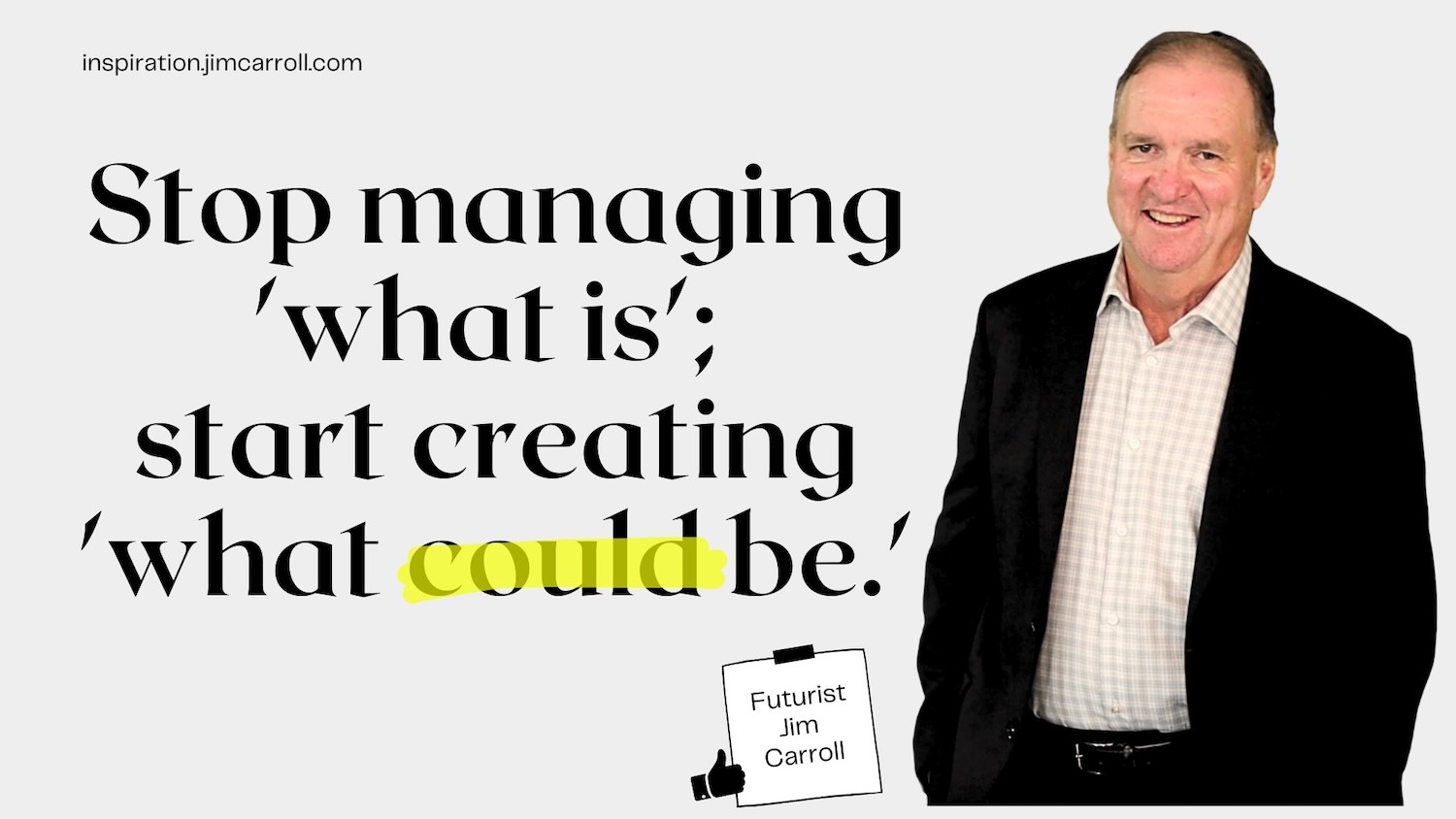
"Stop managing 'what is'; start creating 'what could be.'" - Futurist Jim Carroll

Here's a thought to start your Monday: the gap between "what is" and "what could be" is where the future is either won or lost.

I've long seen this trap with leadership teams in many events I've done - organizations become so efficient at managing the current reality (aka the "what is") that they lose the capacity to create "what could be." They spend their energy defending last year's logic, perfecting declining business models, and negotiating terms for a world that no longer exists. They spend all their time on what was yesterday, instead of focusing on what could be tomorrow.

And that's obviously just the wrong thing to do.

If you want to move the needle, you have to stop managing all your realities and start chasing the possibilities. This requires a fundamental rethink in how you think things:

From "What Is" to "What If": Stop looking at what mattered yesterday and focus on what will be critical tomorrow.

From Administration to Agility: Always keep in mind my Master's in Business Imagination idea - we don't need more MBAs, we need MBIs! There are too many people 'administering' things, and not enough imagining them! While others are bogged down in analysis, the winners are moving quickly, decisively.

From "Can't" to "Must": Make tomorrow real. Confronting the reality of where it will take you is the first step toward mastering. Absolutely refuse the "mutual delusion" of comfort and stagnation - and get uncomfortable, quickly!

Don't let the weight of today’s challenges blind you to tomorrow’s potential.

Always keep in mind the present is a fact, but the future is a choice.

Burn this into your mind -> Stop managing "what is"; start creating "what could be."

---

Futurist Jim Carroll believes you should read his MBI Manifesto today.

MondayMotivation **** **** **** **** **** **** **** **** **** **** **** **** **** **** **** **** **** **** **** **** **** **** **** ****

Original post: jimcarroll.com/2026/02/decodin

★ 2 • ↻ 0 original
Feb 24, 2026 · 10:51 AM UTC

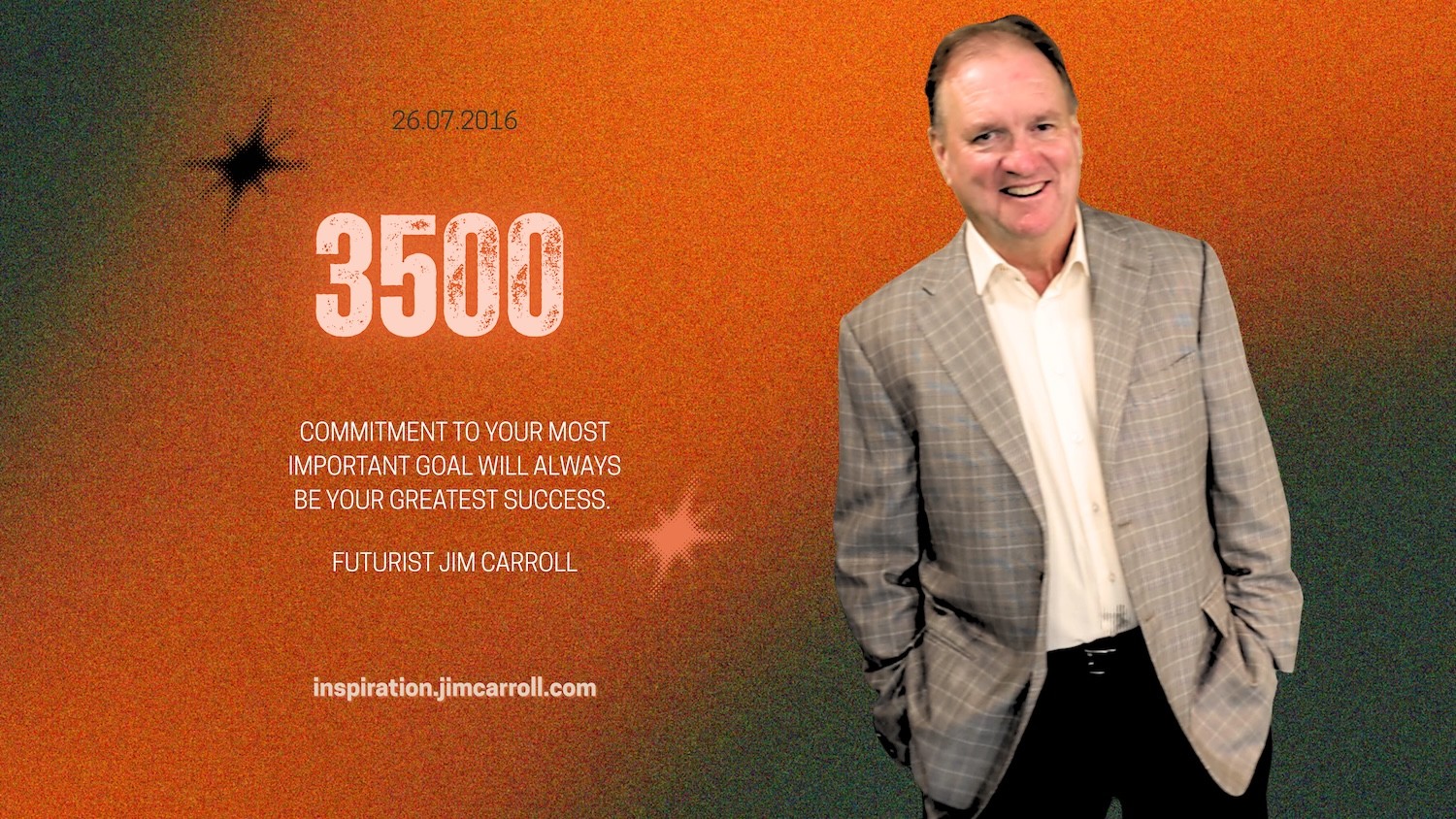
"Commitment to your most important goal will always be your greatest success." - Futurist Jim Carroll

I once wrote this phrase: "Real progress is often invisible, boring, and repetitive. Don't mistake the quiet for regression!"

In that context, sometimes your greatest small achievements come up against a bold realization. For me, today marks a unique milestone in a long-running personal project—3,500 days of consistent, quiet effort toward a goal that few people actually see. It's a significant step in a long journey, yet another link in a chain that grows stronger each day.

Progress and success always come from commitment to the cause. Wins are often not instant, dramatic, or bold - instead, they are quiet, barely noticeable, forgettable at moments - until suddenly, they collide with a marker of significant success.

Today is one of those days.

And with this comes an important realization about the work I do. I often tell clients that successful innovation doesn't always involve a big, dramatic breakthrough; it’s usually a messy, squiggly line of effort where the ultimate moment of success is eventually reached. In the same way, personal success on a big goal is often about the small steps, not the big leaps. Managing any major life goal isn't just about reaching the finish line; it’s about the mindset pivot you maintain along the way.

I've often said that you are the total of all your highs and each of your lows, and you must own the quiet, repetitive, low parts of the process for the highs to mean anything at all.

As I look toward my next milestone (like my upcoming tee time at St. Andrews!) I’m reminded that success is about patience.

It’s about trading the immediate dopamine of a "quick win" for the long-term guarantee of a life well-lived.

3,500.

Pretty fucking awesome!

----

Futurist Jim Carroll plans an early-morning walk today, immediately after writing this post, to see if he might spot the sun rising in splendour.

**** **** **** **** **** **** **** **** **** **** **** **** **** **** **** **** **** **** **** **** **** **** **** **** ****

Original post: jimcarroll.com/2026/02/daily-i

★ 1 • ↻ 0 original
Feb 25, 2026 · 11:09 AM UTC

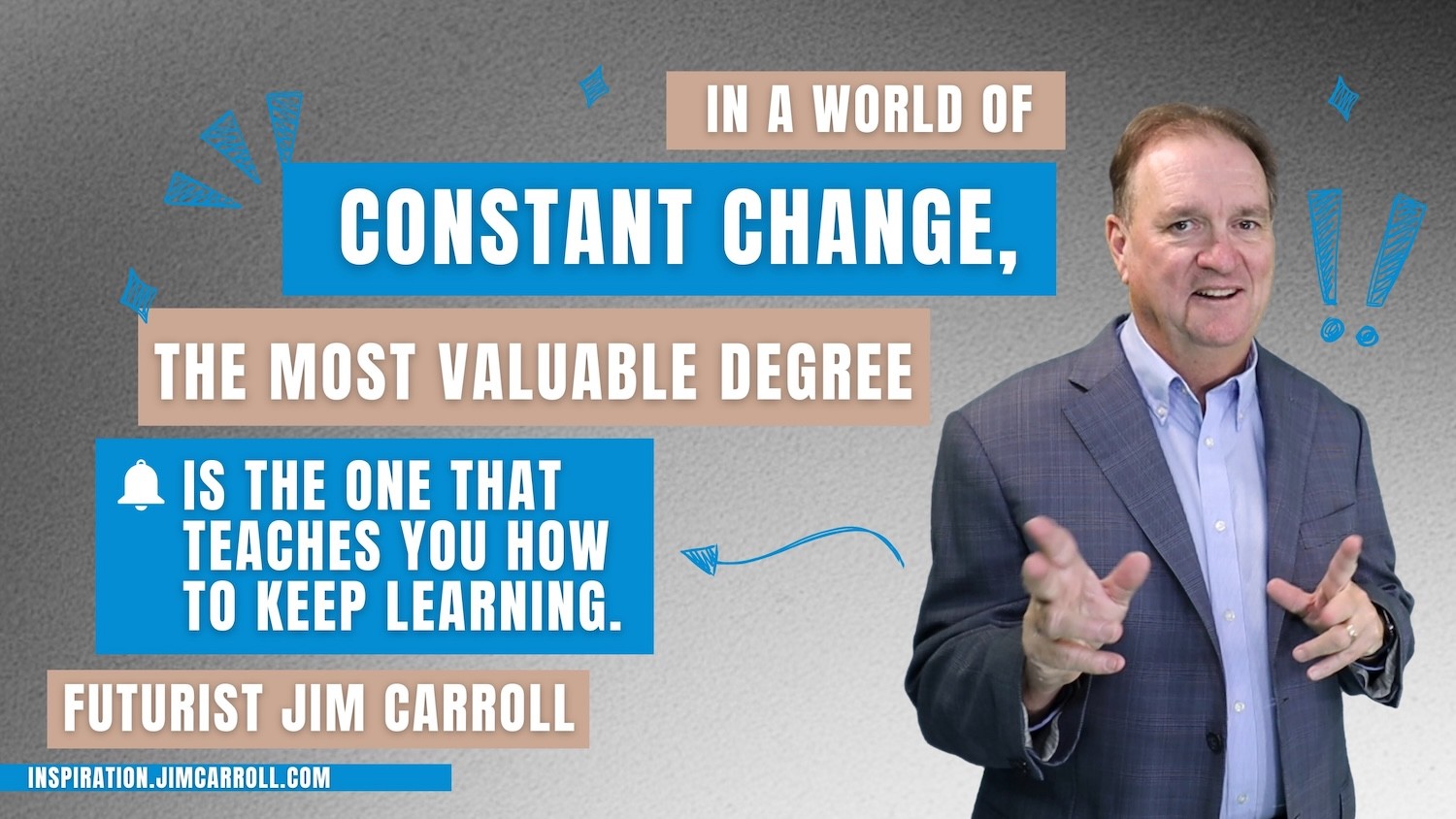
"In a world of constant change, the most valuable degree is the one that teaches you how to keep learning." - Futurist Jim Carroll

A few weeks ago, I spoke to folks at the Guelph Wellington Men's Club - a networking community in the new city where i live. The topic? AI. The room? Jam-packed with retirees - judges, lawyers, doctors, executives, tradesmen. Standing room only with a crowd intensely interested in what I had to say.

As is often the case, I get followup email when I strike their interest. Here's one:

---

I have several grandchildren who are approaching university age, and I was wondering if you would be able to send me the table that showed the various careers that were going to die and which ones were going to thrive. I have looked up several of these tables on the internet, but they did not prove to be very enlightening--they stated that careers that were going to thrive were obscure blue-collar jobs, not the ones that my grandchildren would be aspiring to. 

---

I told the fellow I'd follow up by writing my answer into a blog post, and so here it is!

The key thing is - despite all the hype with AI, it's not that specific careers will be dying, but it's certain they will be transforming. 

Can we prepare a table showing which careers will die and which will thrive?

Not really.

The hard truth is that the future of work can no longer be summarized in a simple list of "safe" vs. "unsafe" job titles.Instead of a table of dead careers, I encourage students to look at a table of transforming skills.

Stop looking for careers that won't change—they no longer exist. The future of work isn't about a simple list of "safe" jobs, but about the velocity of their transformation. There is absolutely no doubt that professions like medicine, law, and agriculture are being massively transformed and completely redefined by' the machine.' Yet, rather than being replaced by AI, they will be changed - and within the profession, there will be dozens, if not hundreds, of new micro-specialities.

Just like today - but bigger.

The future belongs to the "fast," and the fast are those who are already preparing for the next pivot in their chosen profession!

Read the rest of the post!

---

Futurist Jim Carroll believes that the idea of 'just-in-time knowledge', a phrase he coined in 1997, is the key to all future career success.

**** **** **** **** **** **** **** **** **** **** **** 

Original post: jimcarroll.com/2026/02/decodin

★ 2 • ↻ 1 original
Feb 26, 2026 · 10:48 AM UTC

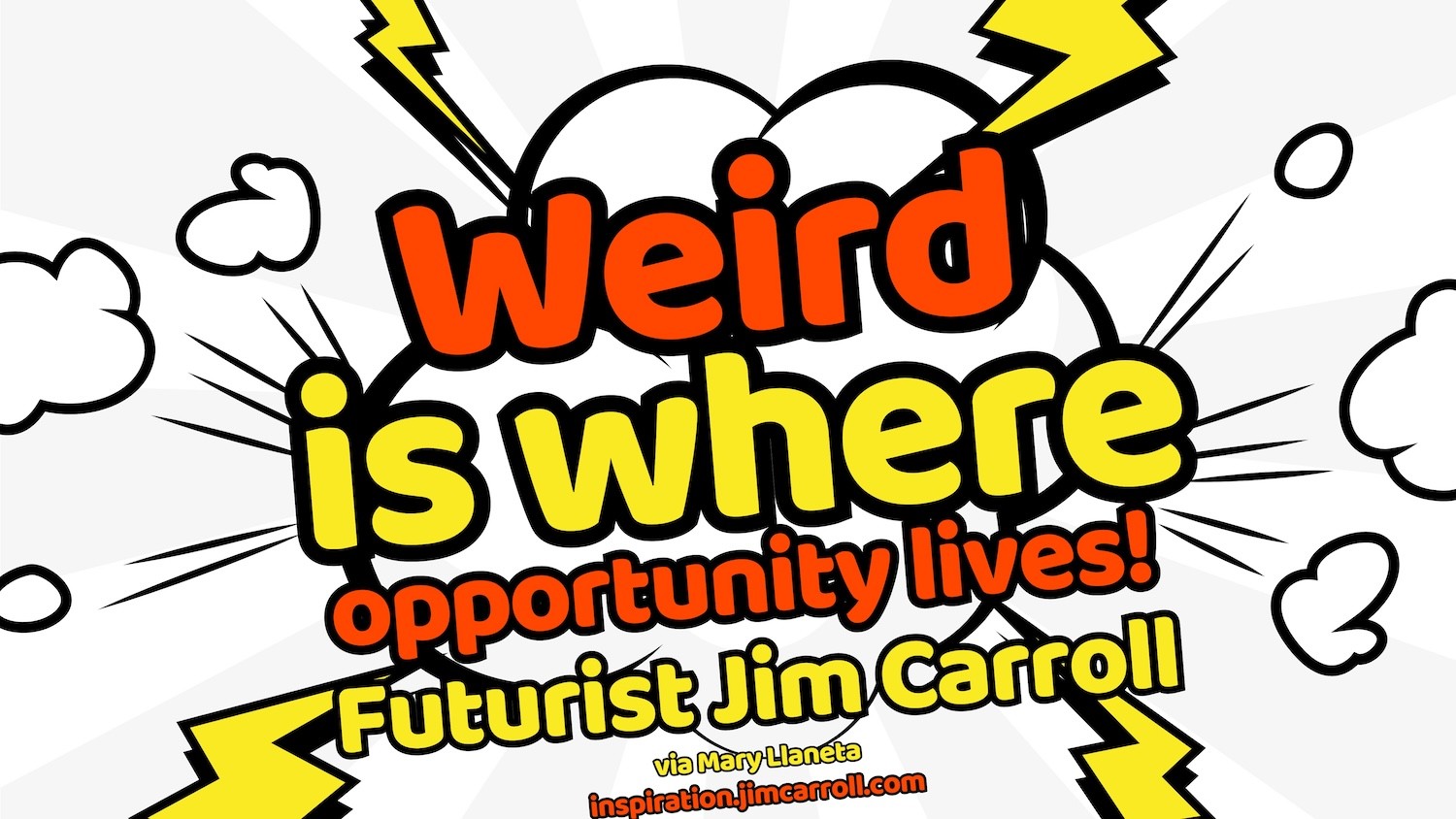
"Weird is where opportunity lives" - Futurist Jim Carroll

So, it's become really, well, weird, to speak at events and conferences as of late.

Particularly when you decide to open up your talk by placing a picture of the new Gordie Howe International Bridge between Windsor and Detroit - Canada and the US.

You need to watch this opening, from a few weeks ago.

youtube.com/watch?v=U6QF_Fcf358

Because the future is weird right now.

That's the way I've come to describe a lot of what is going on.

But the 'weird' issue links to the storyline of innovating despite uncertainty, as captured in my book Dancing in the Rain; How Bold Leaders Grow Stronger in Stormy Times. Here's a great summary from Mary Llaneta, an attendee at the event, as shared on LinkedIn. It's worth a read.

Here's what she wrote.

---

The automotive industry is… weird right now.

That’s how Futurist Jim Carroll described it. And honestly, it fits.

We’re living in a moment where: • EV adoption is political • Interest rates are unpredictable • Affordability is a real crisis • AI is exploding (and overhyped at the same time) • Consumers feel constant economic anxiety
Volatility isn’t a phase. It’s the environment.

But here’s what stood out most:

👉 In every downturn, 60% of companies fail.
👉 30% survive.
👉 10% break through.

The difference? The 10% focus on growth while everyone else panics.

A few sharp takeaways:

🔹 EV adoption isn’t a tech problem — it’s a behavioral one. Mercedes said it best: Price EVs the same as ICE. Let customers decide.
🔹 The car is now a software platform. The winner owns the screen and the experience.
🔹 Affordability is the real disruptor. When students were asked if they’d buy a BYD if available — every hand went up. Why? Price.
🔹 AI is transformational — but still early. Ignore the hype. Focus on real use cases.
🔹 The dealership isn’t dead. Complex products require trust, guidance, and service excellence.

The biggest leadership challenge right now isn’t electrification or autonomy.

It’s noise.

You will wake up to worse headlines. That’s guaranteed.

You still have three choices:

1. Panic
2. Do nothing
3. Focus on growth

The future belongs to those who are fast. -Those who adapt. -Those who keep the customer at the center.

It’s weird. But weird is where opportunity lives.

Thanks Canadian Automobile Dealers Association - CADA for brining such a great speaker to the stage

-----
It's always a thrill to see when your key storyline hits.

In this case despite the fact that the only way to describe the future right now is that it is ... weird!

----

Futurist Jim Carroll believes there is a great book title in this post.

**** **** **** **** **** **** **** **** **** ****

Original post: jimcarroll.com/2026/02/decodin

★ 2 • ↻ 0 original
Feb 27, 2026 · 11:01 AM UTC

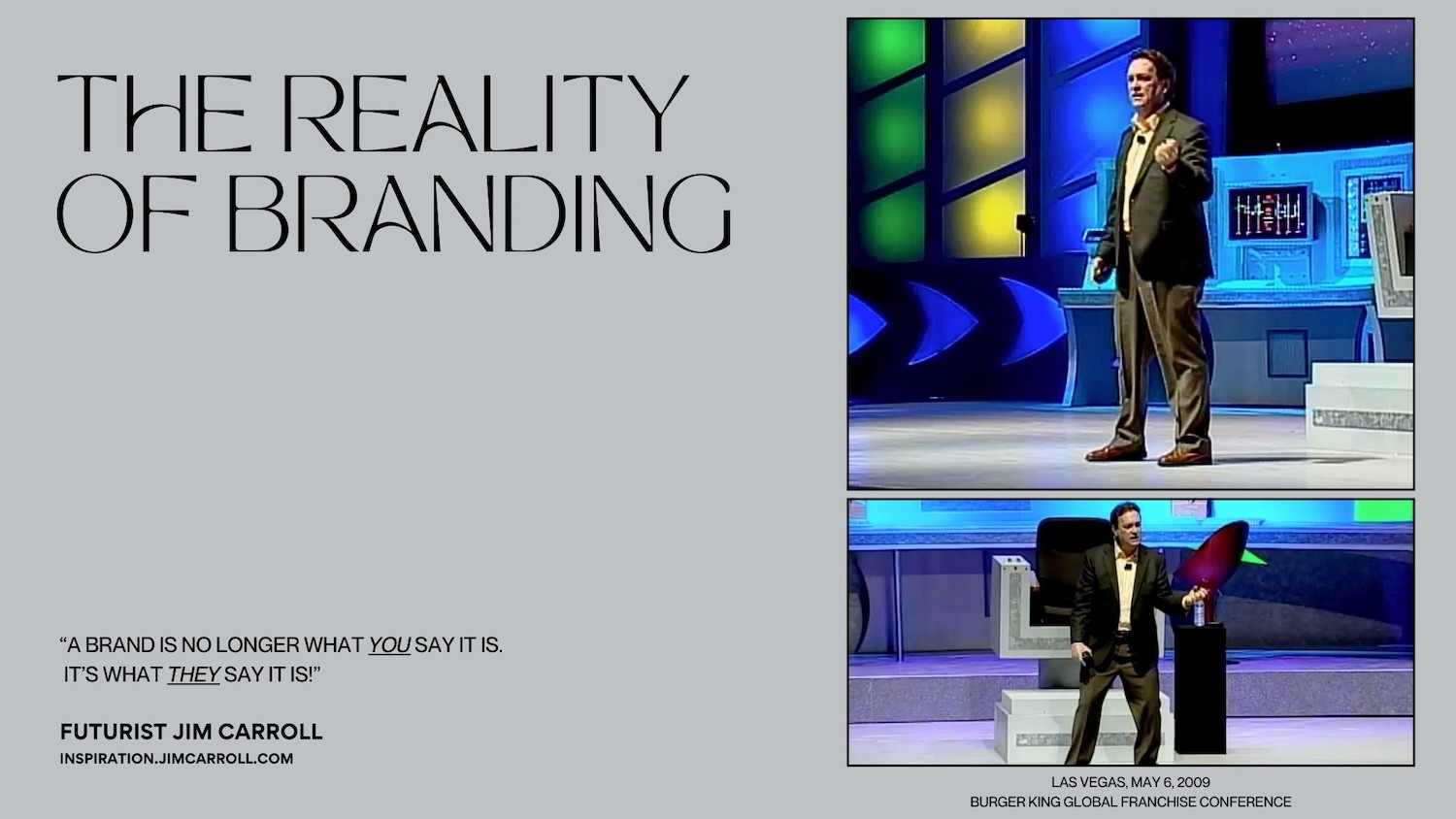
“A brand is no longer what you say it is. It’s what they say it is!” - Futurist Jim Carroll

So he put his phone number out there.

**Tom Curtis** is the President of Burger King, and released this post last week.

It caught my attention, because I had just recently shared a clip from my 2009 keynote about the future of social networking and the massive shift coming for brands - from the time I spoke to Burger King's global franchise conference. It made me wonder - just how accurate were my early predictions in the context of what he is dong?

It's a pretty wild move - the storyline goes that he publicly shared his personal cell phone number, inviting guests to text or call with honest, unfiltered feedback. Their stated goal? To transform Burger King from a brand "for the people" into a brand "by the people." Just like I predicted.

----
Over the past few years, listening to our Guests has been the inspiration behind how we operate and innovate at Burger King. We’ve made meaningful changes across the business thanks to our Guests and that intense commitment to listening.

There are a variety of ways that we listen – through targeted Guest research, restaurant visits, monitoring social channels – but my favourite way to hear from Guests has always been through the conversations that come about as we travel the country proudly wearing our BK swag. Now, we want to extend these conversations even further, and I personally want to have the opportunity to hear as much direct feedback as possible.

So, starting today I’m trying something just a bit on the wild side: I’m sharing my phone number, (305) 874 0520, so Guests have a direct way to call or text me with honest, unfiltered feedback on their Burger King experience or ideas.

---

This was absolute music to my ears, because back in 2009, I was on stage for the organization in Las Vegas and told this exact story.

youtube.com/watch?v=da6rsMgrYUU

Seeing this unfold in 2025 is absolute validation of what I warned organizations about sixteen years ago!

They are doing exactly what I advised: ensuring that the organic, unfiltered conversation aligns with what they hope their brand represents.

The social brand revolution I predicted in 2009 isn't just a reality today; it is the only way companies can survive.

The future is fully here - so what are you doing to invite your customers to build your brand?

---

Futurist Jim Carroll was supposed to meet Leonard Nimoy backstage in the green room before the event, but his plane was late!

**** **** **** **** **** **** **** **** **** **** **** **** **** **** **** **** **** **** **** **** **** **** **** **** ****

Original post: jimcarroll.com/2026/02/decodin

★ 2 • ↻ 0 original
Feb 27, 2026 · 3:51 PM UTC

It's done. First draft complete. ✅

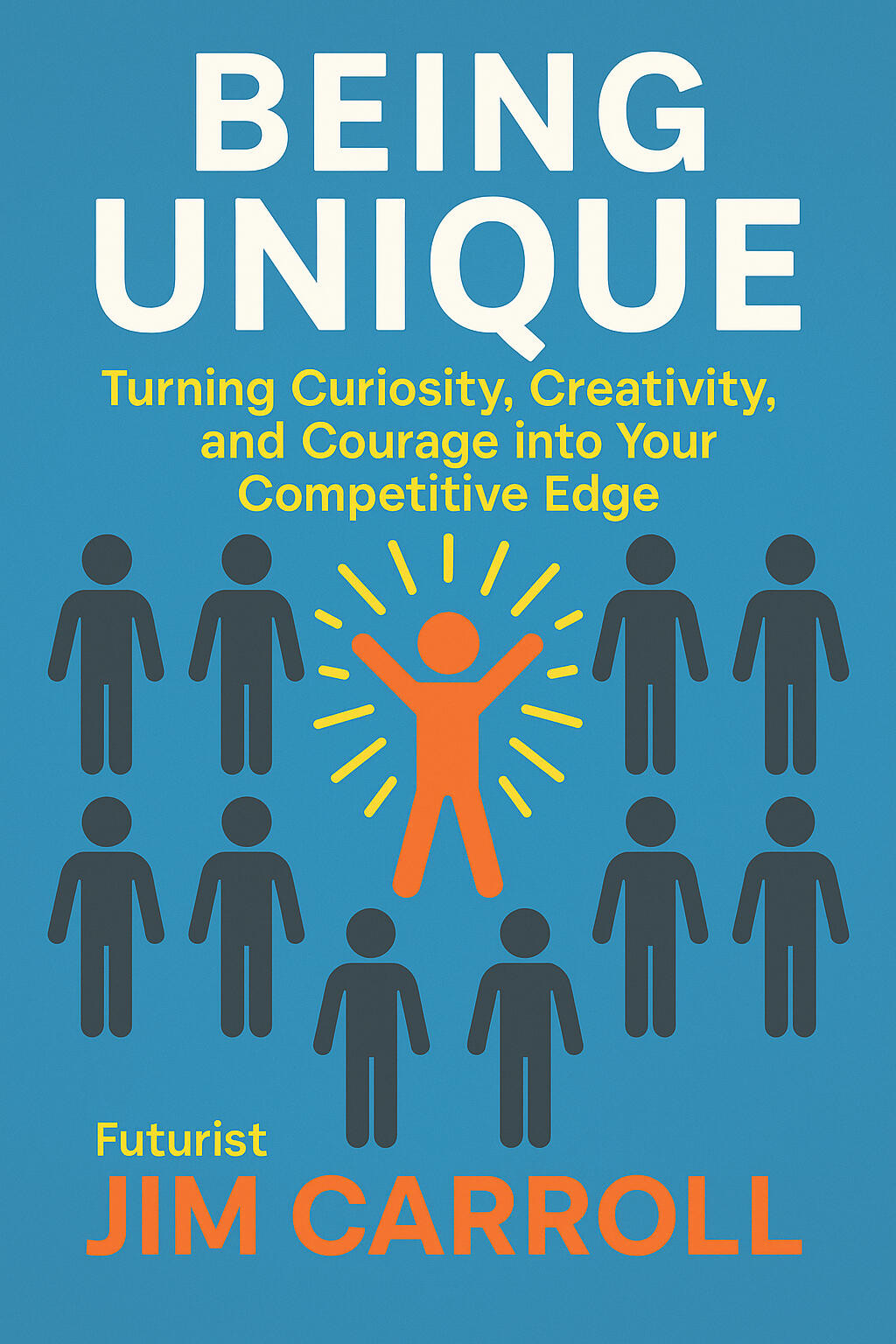
I've just finished writing Being Unique: Turning Curiosity, Creativity, and Courage into Your Competitive Edge - and I'll be honest, this one feels different from everything I've written before.

This book is personal.

It starts with a round-headed kid named Oblio - from the movie cartoon The Point by Harry Niilson and narrated by Ringo Starr. Oblio? He was the only person in a land where everyone, by law, must have a point.

I first saw that animated film as a teenager, and something in that story never left me. It's why I named my publishing imprint Oblio Press. It's why my Tesla is named Oblio. And it's the beating heart of this book. It's why the book will roll out through obliopress.com

Because here's what I've come to believe after 30 years on stage as a futurist:

The safe path to tomorrow is now the riskiest route.

Being Unique argues that in a world where AI is mastering the ordinary, your greatest competitive advantage isn't what you know.

It's how uniquely you think, question, and create.

The book takes readers on a journey through:

→ The science of uniqueness, and why paradigm shifts always come from the "odd ones out" (thank you, Thomas Kuhn!)

→ The link between curiosity and differentiation, and what Curious George can teach us about innovation!

→ The power of rebellion, and what Grace Hopper's refusal to accept the status quo built for the world.

→ Why we all need to be the rebels, the misfits, the outliers who were so loved by the late Steve Jobs. He knew the beating heart of innovation lay within the minds of the outcasts.

→ Why unique skills are the new global currency, and how to develop yours

→ The Unique Toolkit — a practical framework for discovering and weaponizing what makes you different

The manuscript now heads to my wife and business partner. She's been the key editor on all 42 books before this one. When it comes out in print is up to her - and I will wait patiently. It might need some work.

But here's the key thing - to everyone who has ever been told to fit in, tone it down, or stop asking uncomfortable questions:

This book is for you!!!!

Onwards! 🚀

**** **** **** **** **** **** **** ****

★ 0 • ↻ 0 original
← January 2026March 2026 →