Futurist Jim Carroll

Mastodon post archive · 2022–2026
Archived from mastodon.futurist.info · 4209 posts
← All months

November 2025 · 22 posts

← October 2025December 2025 →
Nov 3, 2025 · 10:46 AM UTC

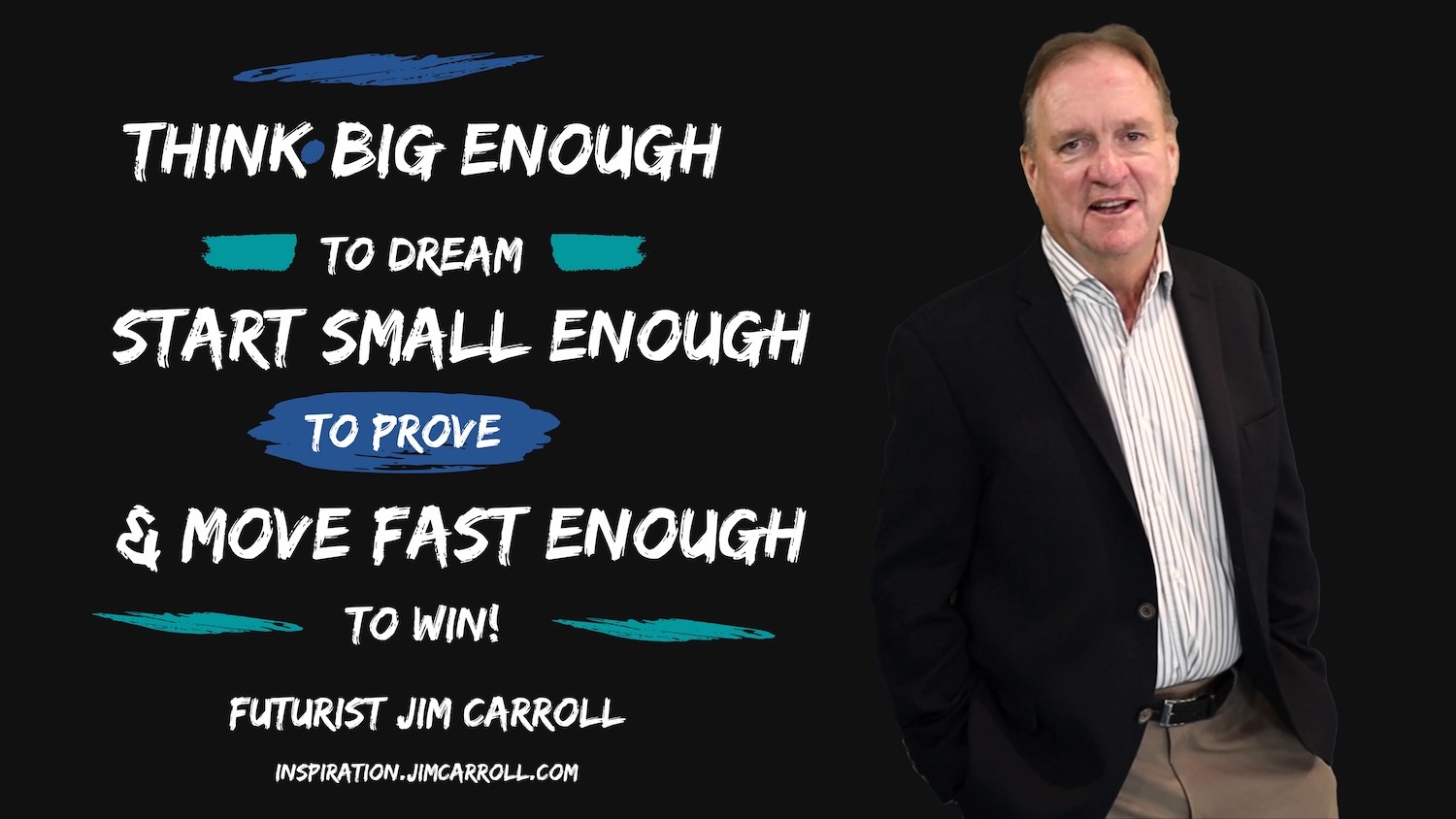
"Think big enough to dream, start small enough to prove, & move fast enough to win!" - Futurist Jim Carroll

A variation on my original innovation phrase!

Here's why it matters!

Visionary Ambition. The size of your vision determines the size of your potential success, so think big and pursue audacious goals. Reject self-imposed boundaries because the only thing limiting your opportunity is the limitation in your inspiration.

Velocity of Action. Speed is a superpower, and decisiveness is non-negotiable. Slow is the true risk, often resulting from aggressive indecision. Narrow the gap between opportunity and action by always prioritizing execution.

Strategic Experimentation. Clarity isn't found; it’s created through action. Champion small, rapid tests and prototypes—or "experience sprints"—to generate valuable experiential capital. The goal is to build fast, test cheap, and learn always.

Continuous Reinvention. The only strategy that guarantees long-term survival is the velocity of continuous reinvention. You must reject the notion of a guaranteed legacy, as future success won't come from chasing the ideas of the past.

Defiance of Complacency. Never be comfortable in your complacency, as it creates an illusion of invincibility that prevents necessary adaptation. Innovation demands you demolish your fears and challenge assumptions before they become organizational vulnerabilities.

Disruption Over Maintenance. A downturn is the ideal time for strategic action; leaders build while managers cut. Choose to disrupt rather than simply maintain outdated models. \

Embrace Uncertainty. When "clarity is not an option," you must choose ambition and maintain focus on long-term growth. Contradictory uncertainty is your new normal, and your ability to act despite it is key to securing a long-term win.

Radical Skills Architecture. To maintain pace, you must be a perpetual skills architect, relentless on knowledge discovery and continuous learning. This prepares you for the Acceleration Skills Gap, ensuring your team is ready for the different jobs of tomorrow.

Failure as Fuel. You must take pride in your losses because they teach you about your wins. Failure is a necessary exercise and a powerful learning opportunity to be embraced.

Battle Internal Barriers. Address the internal obstacles that derail bold ideas, recognizing that committees are an infrastructure designed to race you to the bottom of opportunity. Achieving a bold future involves intentionally demolishing your fears and confronting the internal issues that hold you back.

----

Futurist Jim Carroll first started using this mantra in a keynote in 2007.

**** **** **** **** **** **** **** **** **** ****

Original post: jimcarroll.com/2025/11/decodin

★ 1 • ↻ 0 original
Nov 4, 2025 · 10:34 AM UTC

"When you look back in 5-10 years, history will tell you that it’s what you did today that pivoted you into tomorrow." - Futurist Jim Carroll

It's a series of choices.

Will you start making decisions?

Will you start moving forward?

Will you start studying what matters for tomorrow rather than obsessing over what's not working today?

Will you start making time to master your next critical skill, or will you let your knowledge become obsolete?

Will you start viewing your mistakes as your most powerful step forward, or will the fear of failure paralyze your best ideas?

Will you start actively building a network of people that challenges you, or will you just keep talking to the same old people?

Will you start investing your energy in what you can build today, or will you keep wasting it on what you can't change right now (or won't ever change?_

Will you start scheduling your most important work first, or will you let your days be filled with other people's emergencies?

Will you start being honest about what you need to fix in your own behavior, or will you keep looking for reasons to blame others?

Will you start owning the outcome of the next five years, or will you keep managing the complexity of the last five?

Just asking.

After all, it's a series of questions!

-----

Futurist Jim Carroll believes that the best way to get lots of answers is to ask a lot of questions.

**** **** **** **** **** **** **** **** **** ****

Original post: jimcarroll.com/2025/11/decodin

★ 0 • ↻ 0 original
Nov 5, 2025 · 12:04 PM UTC

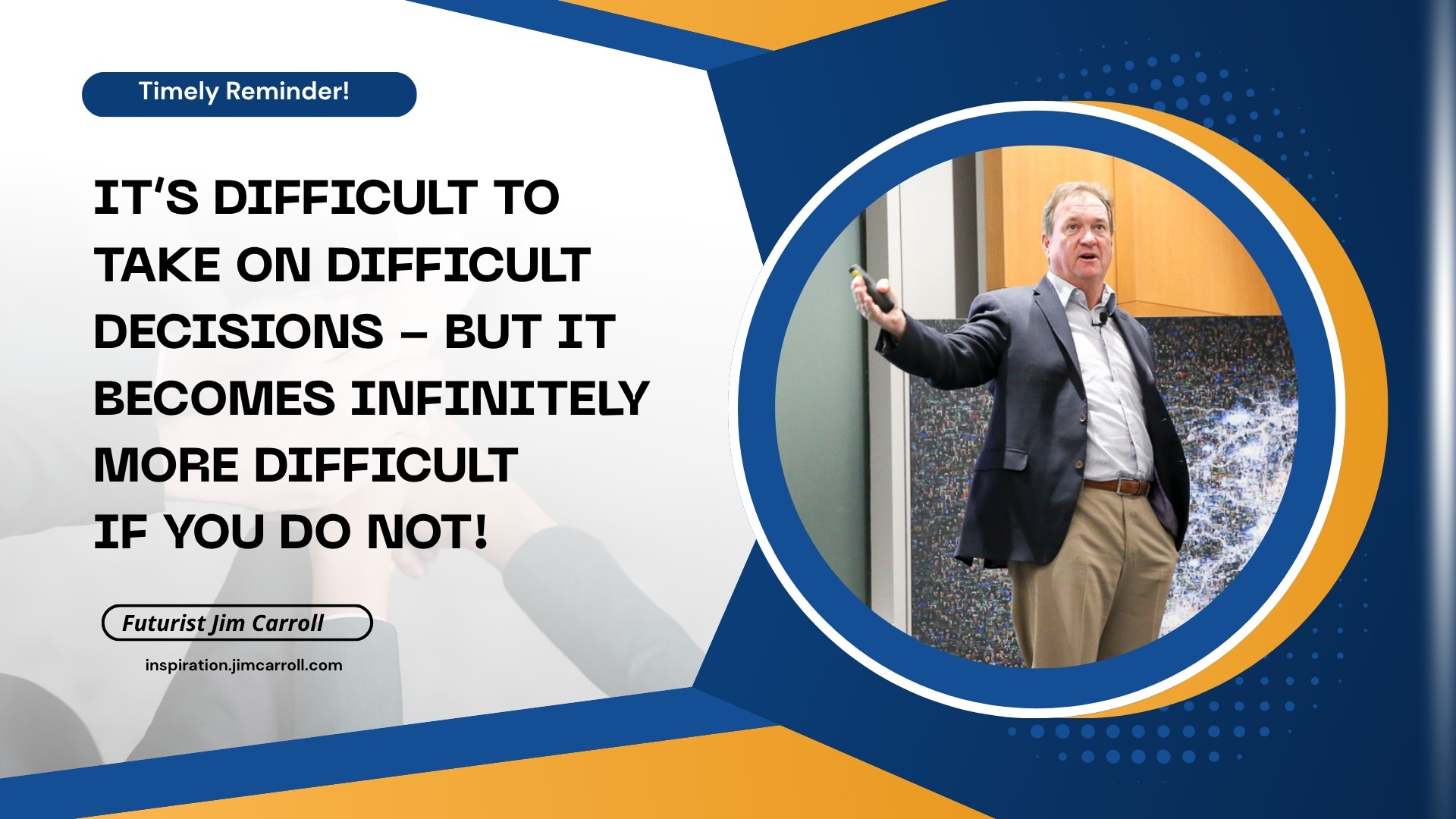
"It’s difficult to take on difficult decisions - but it becomes infinitely more difficult if you do not! - Futurist Jim Carroll

Hard decisions get harder when you wait.

Particularly when uncertainty rules and volatility rages.

Have you noticed the signals coming out that in the US, people aren't thinking that the economy is as rosy as they thought? Strip away the massive AI capital spending, and you've got a dismal picture of layoffs, tariffs, a cutback in spending and investment, and a general malaise. Welcome back, Jimmy Carter!

My wife and I were talking yesterday about this in the context of what we see in the speaking business. Not a day goes by that a speaker bureau owner or agent posts about trends they see in the industry - a slowdown in bookings, client indecision, shortened lead times. Want a good example? Read this post by **Dogan Altindag** Altinda, "The New Urgency": How the Keynote Speaker Market Is Transforming" - it's over on LinkedIn here: linkedin.com/pulse/new-urgency

One of the key findings? What was once 6-12 months is now 1-3 months, with 45% of keynote speakers booked with less than three months' notice, driven by economic caution and volatility.

I'm certainly seeing it - and one of the reasons why is because my topics often take on difficult topics: business model disruption, technological acceleration, the rapid emergence of new competitors, generational change, and more. I'm usually brought in by the CEO or senior executive of an organization to open a corporate offsite meeting or event, to set the stage for the difficult decisions that will be covered in the next day or two.

And quite simply, organizations are not taking on those difficult decisions - they are treading water, waiting and watching, waiting for some sort of major event to set the world on a more even path going forward.

And the fact is, the longer organizations wait, the tougher the future will be to navigate.

---

Futurist Jim Carroll believes that indecision is the cardinal sin of failed leadership.

**** **** **** **** **** **** **** **** **** ****

jimcarroll.com/2025/11/decodin

★ 2 • ↻ 0 original
Nov 5, 2025 · 6:29 PM UTC

Each day, tens of thousands get my Daily Inspiration straight to their inbox.

Are you?

It's gone out every workday since August 2016 - not one day missed.

Sign up now ----> subscribe.jimcarroll.com

I think you'll enjoy it.

★ 0 • ↻ 0 original
Nov 6, 2025 · 10:52 AM UTC

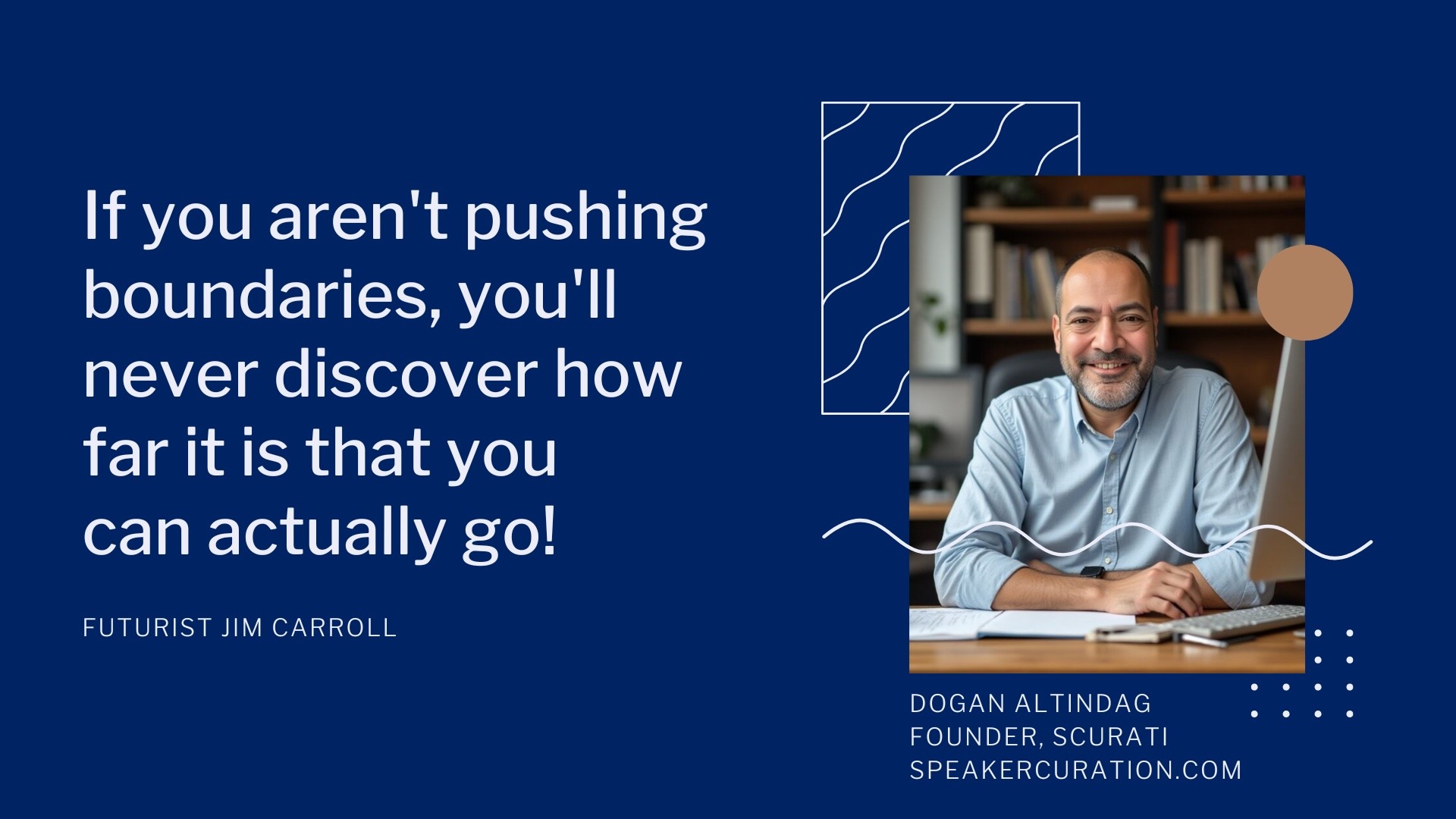
"If you aren't pushing boundaries, you'll never discover how far it is that you can actually go!" - Futurist Jim Carroll

35 years ago this week, I quit a comfortable, well-paying job with what is now KPMG (and for a time, the particular company I was with was part of what is now Ernst Young as well - and started working on my own, in my home, developing into a career that eventually positioned me as a globally recognized futurist.

4 years later, my wife quit her comfortable job as a senior executive at Unilever to help me out.

We were pushing boundaries.

And at any given moment, we are surrounded by those who are doing the same - pushing boundaries to find the magic. All around us, we are surrounded by those who are busy working to discover the magic that exists in pushing boundaries, to see how far it is they can actually go. And in that context, we should watch them, learn from them, get inspired by them, and chase our own actions from the actions we observe from them.

Which brings me back to **Dogan Altindag**. I mentioned him in my post yesterday about 'difficult decisions,' particularly in the context of a post he wrote about trends in the speaking industry. Our paths have crossed in the last few years, and with that, I became aware of a project he has been working on, Scurati, found over at speakercuration.com.

It's an AI speaker booking engine - give it a short brief, and in an instant, you'll get back a pretty detailed response with 3 speakers that match your requirements, plus one bonus idea.

Will the initiative take off? Will Dogan's bold bet pay off? Can he build up the awareness, momentum, and traction to put a ding in the global speaker universe?

Hard to say - that's the thing about big, bold bets. But the most important thing isn't just the tremendous amount of effort he has put into the initiative - It's the fact that he has taken the initiative.

Far too many people never chase their bold ideas. They never change their dreams. They never push the envelope. They never explore the boundaries of what's possible.

And with that, they live a life of regret for what might have been, rather than enjoying the moments of what is.

Just like my wife and I took that big, bold bet 35 years ago this week, and have never looked back.

Push your boundaries. Discover how far you can go.

Start now.

----

Futurist Jim Carroll is forever grateful to his wife for supporting his big, bold bet 35 years ago.

**** **** **** **** **** **** **** **** **** ****

Original post: jimcarroll.com/2025/11/decodin

★ 2 • ↻ 0 original
Nov 7, 2025 · 10:38 AM UTC

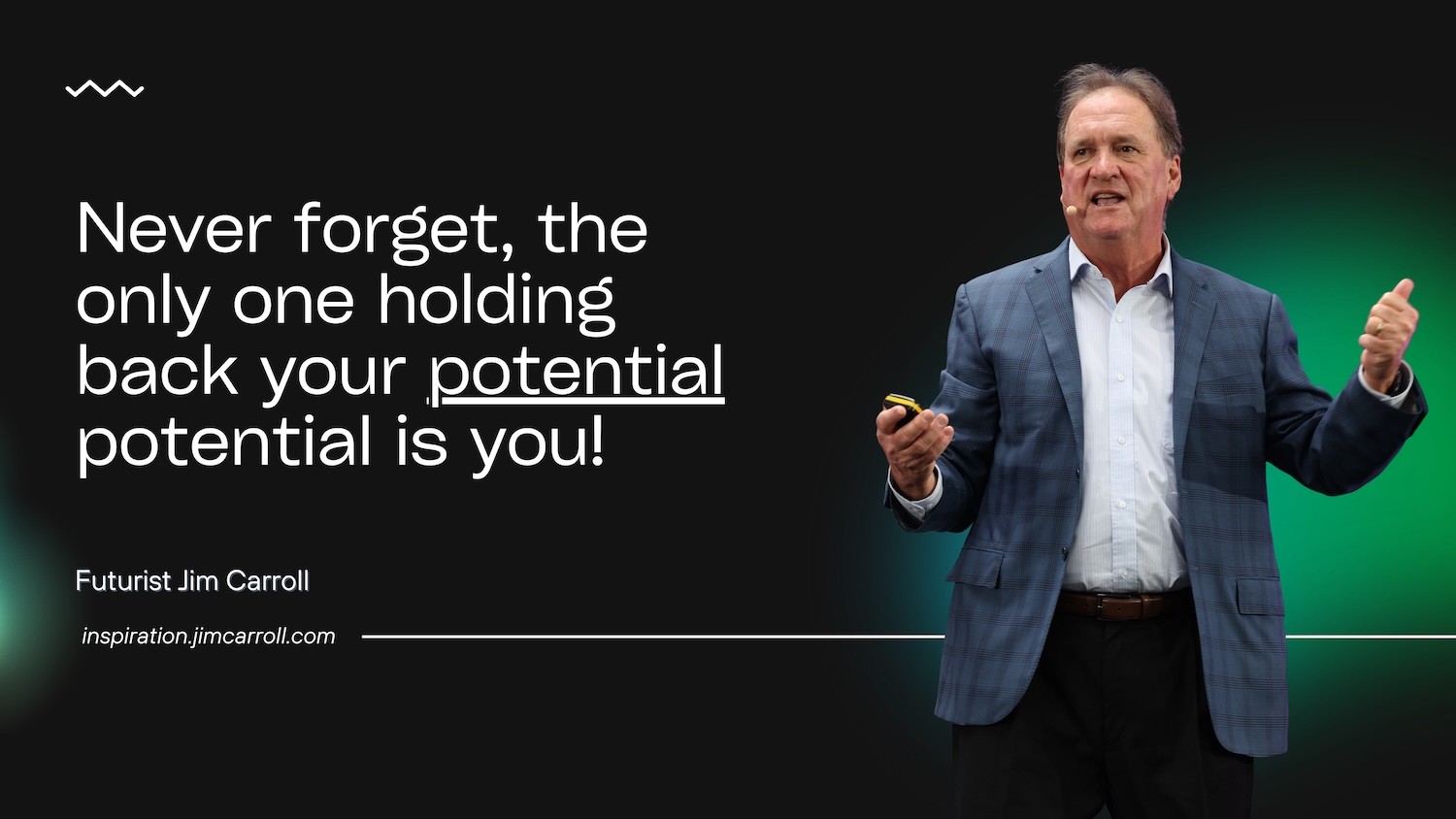
"Never forget, the only one holding back your potential potential is you!" - Futurist Jim Carroll

We all have potential.

It's what you do with that fact that matters.

I know far too many people who give up on their potential. It's easy to do - there are so many things in the way. And yet, by doing so, they never see the potential in their potential. Yes, I mean to use the word twice!

I know in far too many cases I haven't accomplished what I might have accomplished if I had just pushed a little harder. I'm aware that the potential in our potential can often be one of our greatest untapped assets, and if we recognize it for what it is, we can push ourselves a little further.

Think about it!

We all have the potential to chase our dreams.

To learn new things.

To try bold ideas.

To take big risks.

To develop new skills.

And in doing so, to achieve our wildest imagination.

We all have the potential to care about others.

To serve our communities.

To stand up for what's right.

To call out what's wrong.

To heal and help.

To help those who are weak.

And to try to get help from those who are strong.

And to imagine brighter futures for everyone.

To persist through setbacks.

To persevere when tired.

To overcome the big obstacles.

And to thrive in the uncertainty.

To rebuild what's broken.

To restart after failure.

To unlearn the bad habits.

And develop better ones.

To pivot when needed.

To prioritize what matters.

To challenge ourselves more.

And to believe we can do it.

To commit to our goals.

To hope and act.

To finish what we started.

And to abandon what we shouldn't have.

To start when necessary.

To start right now!

----

Futurist Jim Carroll is a big believer that everyone has potential in their potential!

**** **** **** **** **** **** **** **** **** ****

Original post: jimcarroll.com/2025/11/decodin

★ 1 • ↻ 0 original
Nov 10, 2025 · 10:55 AM UTC

“Yet - many forgot." - Futurist Jim Carroll

Tomorrow marks Veterans Day in the US, Remembrance Day in Canada, and similar memorial days elsewhere around the world.

It's a day to pause and reflect on the memory of the sacrifice made by many in World Wars I and II in defence against tyranny, fascism, and terror. Tomorrow, I will share the story of my dad, heavily researched, with the small role he played on the battlefields of the Second World War. The phrase "Lest we forget" is used in Canada and many Commonwealth countries to mark the day; the most common phrase in the US is "Thank you for your service."

And yet, with the continued rise of the alt-right, the devolution of political parties into foundations for racism, and the elevation of platforms of hate, it would seem that for many, they've either forgotten the lessons of history or choose to willfully ignore them.

The result is that in many areas of the world, history seems doomed to repeat itself.

I write this today because I was sparked to think about this when I attended a Celebration of Life for an elderly member of my ski club yesterday. It was a glorious service, with her family and a few friends telling her remarkable story, sharing memories, and offering up life lessons from "Dorothy."

And yet, as a Japanese-Canadian and a child in the early 1940s, she was, like others from her ethnic background, sent to an internment camp during the war. The fact is, Canada forcibly removed about 22,000 Japanese Canadians from the British Columbia coast, confiscating their property and imprisoning them - simply because of who they were. This happened in other countries around the world at the time, and remains as one of many stains on the history of those who often try to hold themselves as better than others.

We're repeating the same mistakes today, particularly with appalling force, speed, and brutality in the US.

It would seem that lessons have not been learned, history is repeating itself, and the 'remembrance' by many tomorrow will be but a hollow, hypocritical statement by people who should know better.

Why do I write this? I don't know - perhaps as a small attempt to try to help refocus on the importance of what tomorrow actually represents, rather than being some sort of ritual day in which so many simply go through the motions.

If you are, like one of many, who will say "lest we forget" or "thank you for your service," and yet are someone who has forgotten our history, check your thinking.

----

Futurist Jim Carroll writes about many issues involving trends, innovation & disruption - but will occasionally wander into other topics that cross his mind.

**** **** **** **** **** **** **** **** **** ****

Original post: jimcarroll.com/2025/11/decodin

★ 2 • ↻ 0 original
Nov 11, 2025 · 11:09 AM UTC

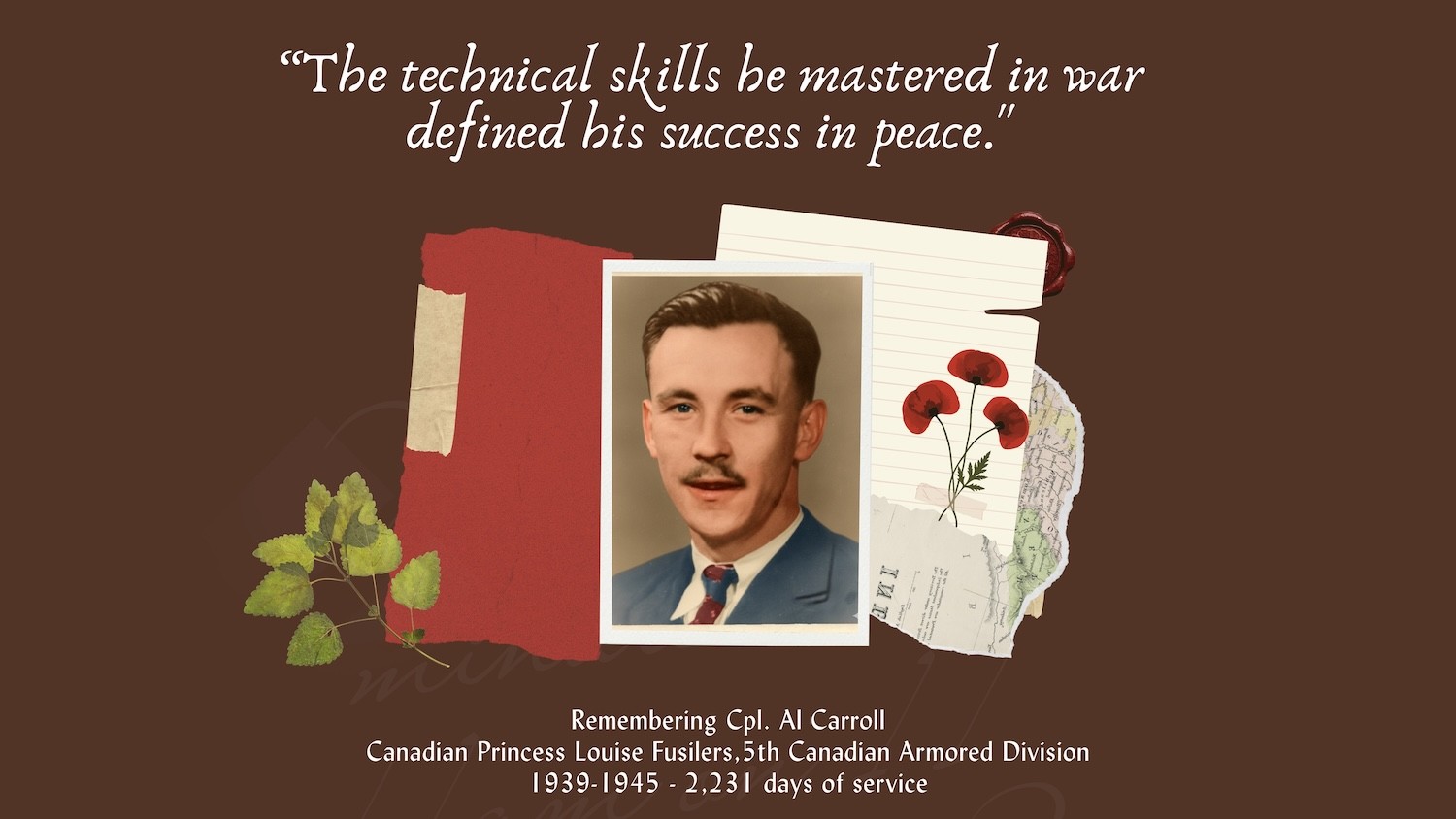
"The technical skills he mastered in war defined bis success in peace." - Futurist Jim Carroll

Today, as we mark November 11 - known as Remembrance Day in Canada - I'll share the details I learned about my dad's service in World War 2 after finally obtaining his war records.

One key point - one of his primary roles as an intelligence scout had him busy on motorcycles on the front lines for a time. In that context, tomorrow, I will I will tell the story of how his father, who went by the stage name Cannonball Mack as a stunt motorcycle rider but with the real name Alred Morrell, died in a motorcycle accident when my dad was but 3 years old! Wait until you see that story!

My dad was actually born in the USA, in Norwich, Connecticut, and after that accident, he moved with his mom to Halifax, Nova Scotia. She remarried to an Edmond Carroll, who was a soldier in WW1 and subsequently worked in the merchant marine. And then, at the age of 16 - after backdating about his age on his signup sheet - he joined the Canadian Army and began to serve.

That was one bit of remarkable insight. The second, which I share below, was that he voluntarily downgraded his military rank while in the Italian theater to be an intelligence scout for his unit - the eyes and ears out on the front lines - instead of being a corporal back of the active lines. He sought combat - and he sought to play a role.

To piece all this together, I dug deep. Many years ago, I sought his war records from Library and Archives Canada. Tremendously overworked and underfunded, this proved to be a process, but I eventually received them in two tranches, spread over a decade. I just received the second set a few weeks ago and began to summarize what I could find.

This is where AI proved to be wonderfully remarkable, particularly Google Gemini. Many of the records were barely legible, given the cursive writing, but it was able to extract relevant details.

And some of it is absolutely fascinating! It turns out he was, somewhat, as he often joked, a little bit of a 'spy!'

You'll want to read this story in the blog post, right here: jimcarroll.com/2025/11/daily-i

★ 0 • ↻ 0 original
Nov 12, 2025 · 2:09 PM UTC

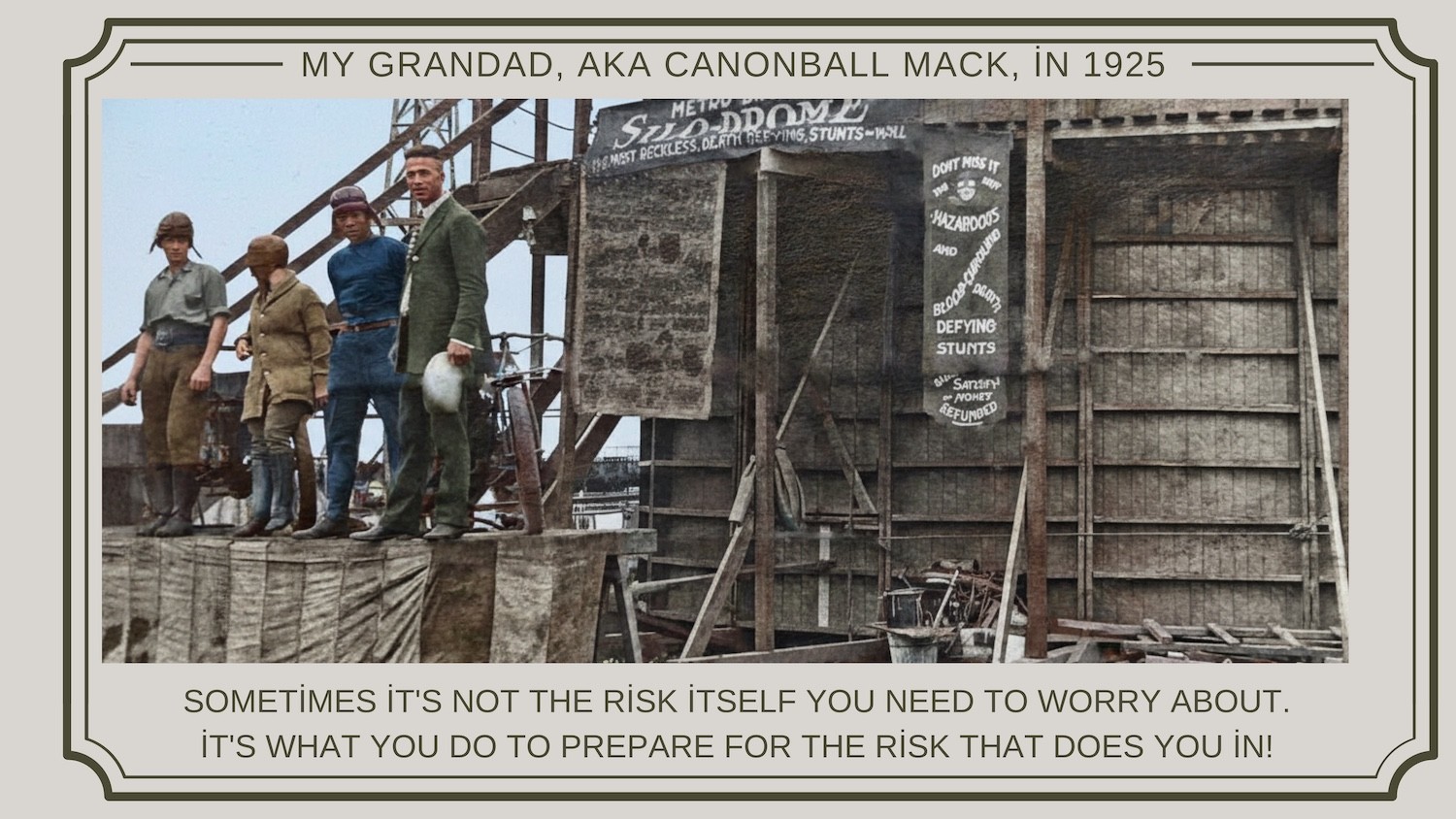
"Sometimes it's not the risk itself you need to worry about. It's what you do to prepare for the risk that does you in." - Futurist Jim Carroll

One day, a few years ago learned that my biological grandfather died in 1925 in a stunt-motorcycle accident - on an Indian motorcycle, nonetheless -  after he rode his 'show' which was known as the "Wall of Death." Not only that, but his death appears to be due to a malfunction of the front fork of the Indian motorcycle he rode to perform the 'death-defying stunt' - only to have that front fork fail as a result of the modifications that he likely did himself necessary to perform the stunt!

That means, he didn't die from the inherent risk that came from participating in a wildly dangerous carnival stunt - it came from the careful preparation! And so sometimes it's not the risk itself that gets you, but what you've done to prepare for the risk that does you in.

How's that for the opening line to a blog post!

Let's dig in! Today is a good day to share the story - after sharing the story of what I learned about my dad in World War 2, once I obtained his war records, I thought I would once again dig into my history. The essence of the story is this: my biological grandfather on my dad's side, an American citizen, was actually a stunt motorcycle rider - and it cost him his life. I only discovered the whole story and my genetic relatives a few years ago, due to the connective power of DNA tracing.

What follows below is what I found and what my long-lost relative found. Once I had all that information, I fed a lot of the news articles and background below to Gemini AI, and then built two slide decks that tell the story. I do this for ultimately sharing with my grandchildren, so that the legacy might live on.

An interesting angle? The analysis concluded, from its research, that it was likely the modifications to the front fork were what caused his tragic accident:

The backstory? Growing up, I always knew that my original name was not Carroll, but Morrell. I knew my dad lost his dad at the age of 3, and that he was raised by his mom and stepfather. Beyond that, all I ever knew was that he had died in a motorcycle accident.

Fast forward to December 2018, when, through a DNA match, I began to find the real story.

To make a long story short, by the very next morning, I was standing at the grave of my biological grandfather with my long-lost 2nd cousin Ken Keeley of Norwich. He had, some months earlier, taken the time to do all the research that I had never managed to do, such as finding my grandfather's gravestone. He, too, had grown up hearing the mysterious stories of a great-uncle who met an untimely end.

What a story it is! When we met, Ken had unearthed some photos ... including this one of my grandfather at the "Metro Bro's Silo-Drome" which features "The Most Reckless, Death Defying Stunts." My grandad is on the far left.

The wording on the Silodrome itself says it all:

"Don't miss it, so hazardous and blood-curdling. Death-defying stunts or satisfactory money refunded."

Read the rest of the post for this fascinating story!

---

---

Futurist Jim Carroll has never been, fortunately, a big fan of motorcycles.

Original post: jimcarroll.com/2025/11/daily-i

★ 0 • ↻ 0 original
Nov 13, 2025 · 6:07 AM UTC

“Don’t worry about what everyone else is doing. Do what you need to do!” — — Futurist Jim Carroll

I’m in the final stretches of finishing off my Being Unique book, and it has been a project — I’m about 1 1/2 years into it, and in the meantime, released 3 other books! (Embracing Mediocrity, Escaping Mediocrity, and Dancing in the Rain!)

While the work is focused on the urgency of uniqueness as a strategic advantage, I realized I had left out a crucial part of the conversation: the human cost of being different.

Here’s where I am — the first ten chapters are mostly written, and are high-energy. They are the call to action, the blueprint, and the payoff: I cover some inspirational stories of unique people, give you the toolkit for unique thinking, and show you the economic rewards of niche skills in the global market. But what happens after the initial victory? How do you keep your uniqueness intact when the world is constantly pushing you back toward conformity?

You don’t just win the battle against conformity once; you have to fortify your uniqueness every single day.

And trust me, it’s a battle!

One of the first steps is not to worry about what everyone else is doing, what everyone else is telling you to do, what everyone else is giving you advice on.

It’s doing what you need to do.

With that in mind, I’ve decided to add a new chapter, which will be the penultimate chapter of the book: “Sustaining and Fortifying Uniqueness.” This chapter is the emotional and psychological scaffolding that the rest of the strategy rests upon. It transitions from the “how-to” to the “how-to-survive-long-term.”

And as of today, it seems that the role model that will open the chapter will be… get ready … Lady Gaga! She’s the perfect model for being unique, the power of being unique, and what to do to guard your uniqueness!

The reality of being unique is that it comes with immense pressure, a heavy psychological toll, and difficult relationship dynamics. This new chapter will guide you through the three essential pillars for protecting your unique self

With that, I’m back into the grind of the book — most of the other chapters are already close to done, I need to write this, and then it goes to my wife for the sometimes complex process of editing.

Stay tuned!

----

Being Unique will mark Jim’s 43rd or 44th book; he plans on going back and checking the math!

**** **** **** **** **** **** **** **** **** ****

Original post: jimcarroll.com/2025/11/decodin

★ 1 • ↻ 0 original
Nov 14, 2025 · 10:54 AM UTC

“Don’t worry about what everyone else is doing. Do what you need to do!” — — Futurist Jim Carroll

I’m in the final stretches of finishing off my Being Unique book, and it has been a project — I’m about 1 1/2 years into it, and in the meantime, released 3 other books! (Embracing Mediocrity, Escaping Mediocrity, and Dancing in the Rain!)

While the work is focused on the urgency of uniqueness as a strategic advantage, I realized I had left out a crucial part of the conversation: the human cost of being different.

Here’s where I am — the first ten chapters are mostly written, and are high-energy. They are the call to action, the blueprint, and the payoff: I cover some inspirational stories of unique people, give you the toolkit for unique thinking, and show you the economic rewards of niche skills in the global market. But what happens after the initial victory? How do you keep your uniqueness intact when the world is constantly pushing you back toward conformity?

You don’t just win the battle against conformity once; you have to fortify your uniqueness every single day.

And trust me, it’s a battle!

One of the first steps is not to worry about what everyone else is doing, what everyone else is telling you to do, what everyone else is giving you advice on.

It’s doing what you need to do.

With that in mind, I’ve decided to add a new chapter, which will be the penultimate chapter of the book: “Sustaining and Fortifying Uniqueness.” This chapter is the emotional and psychological scaffolding that the rest of the strategy rests upon. It transitions from the “how-to” to the “how-to-survive-long-term.”

Stay tuned!

----

Being Unique will mark Jim’s 43rd or 44th book; he plans on going back and checking the math!

**** **** **** **** **** **** **** **** **** ****

Original post: jimcarroll.com/2025/11/decodin

★ 2 • ↻ 0 original
Nov 17, 2025 · 2:28 PM UTC

"Invest in your next future, not your previous one!" - Futurist Jim Carroll

Too many people live for yesterday, today, instead of living today for tomorrow.
Think about that.

You know it's true if you can go through this list of the 10 we make when we invest more in "yesterday" (the past) than in "tomorrow" (the future). As a futurist who lives in tomorrow, I'm deeply sensitive and aware of these issues!

Clinging to an outdated identity or past glories: People can remain focused on previous success, titles, or achievements. If you see your legacy as an anchor rather than actively working toward the next achievement, you are doing it all wrong./

Mistaking inaction for caution: You know I'm going to say it, so I will - falling into "aggressive indecision" (the absence of initiative), delaying important decisions, and believing that waiting will somehow provide necessary clarity. It is one of the worst things you can do.

Fearing failure and avoiding calculated risk: You'll never move forward if you stick to safety. Letting the fear of negative outcomes will absolutely prevent your forward motion, viewing failure as fatal instead of recognizing that missteps are often the foundation for success.

Refusing to unlearn: Continuing to use old, familiar methodologies because of the "we've always done it this way" mentality, leading to complacency and inertia.

Letting the negativity of others define our path: Allowing "dream killers," narrow-minded and closed-minded people, to define your future will discourage your ambitions. Reject their pessimism - prove them wrong!

Focusing on problems instead of opportunities: Let things go! Becoming a "problem identifier" rather than a "solution generator". Oh, and never let a mindset of gloom overshadow potential growth.

Failing to invest in experiential capital: I've been preaching this for years. Not actively learning by doing is a huge mistake. We're in the era of a shrinking half-life of professional skills, and job **#1** has to be to solve the knowledge velocity problem by acquiring new knowledge through testing and trying.

Choosing short-term comfort over long-term relevance: You'll never win in the long term if you keep playing a short-term game. Making quick-fix decisions rather than confronting long-term realities will result in long-term complications and a failure to align with future opportunities!

So what should you do? These things -- all of which I've covered in my Daily Inspiration over the last 9 years. They all involve forward thinking, reinvention, action, movement, and initiative!

Keep reading for the list!

---

Futurist Jim Carroll, by virtue of his job, is always thinking about tomorrow, today.

**** **** **** **** **** **** **** **** **** ****

Original post: jimcarroll.com/2025/11/decodin

★ 0 • ↻ 0 original
Nov 17, 2025 · 5:59 PM UTC

A year ago, just about now, I put together this powerful website on 'coping'

You might need it today.

I hope it helps.

coping.jimcarroll.com

★ 0 • ↻ 0 original
Nov 18, 2025 · 10:26 AM UTC

"Invest in your next future, not your previous one!" - Futurist Jim Carroll

Too many people live for yesterday, today, instead of living today for tomorrow.
Think about that.

You know it's true if you can go through this list of the 10 we make when we invest more in "yesterday" (the past) than in "tomorrow" (the future). As a futurist who lives in tomorrow, I'm deeply sensitive and aware of these issues!

Clinging to an outdated identity or past glories: People can remain focused on previous success, titles, or achievements. If you see your legacy as an anchor rather than actively working toward the next achievement, you are doing it all wrong./

Mistaking inaction for caution: You know I'm going to say it, so I will - falling into "aggressive indecision" (the absence of initiative), delaying important decisions, and believing that waiting will somehow provide necessary clarity. It is one of the worst things you can do.

Fearing failure and avoiding calculated risk: You'll never move forward if you stick to safety. Letting the fear of negative outcomes will absolutely prevent your forward motion, viewing failure as fatal instead of recognizing that missteps are often the foundation for success.

Refusing to unlearn: Continuing to use old, familiar methodologies because of the "we've always done it this way" mentality, leading to complacency and inertia.

(more)

So what should you do? These things -- all of which I've covered in my Daily Inspiration over the last 9 years. They all involve forward thinking, reinvention, action, movement, and initiative!

Keep reading for the list!

---

Futurist Jim Carroll, by virtue of his job, is always thinking about tomorrow, today.

**** **** **** **** **** **** **** **** **** ****

Original post: jimcarroll.com/2025/11/decodin

★ 0 • ↻ 0 original
Nov 19, 2025 · 10:42 AM UTC

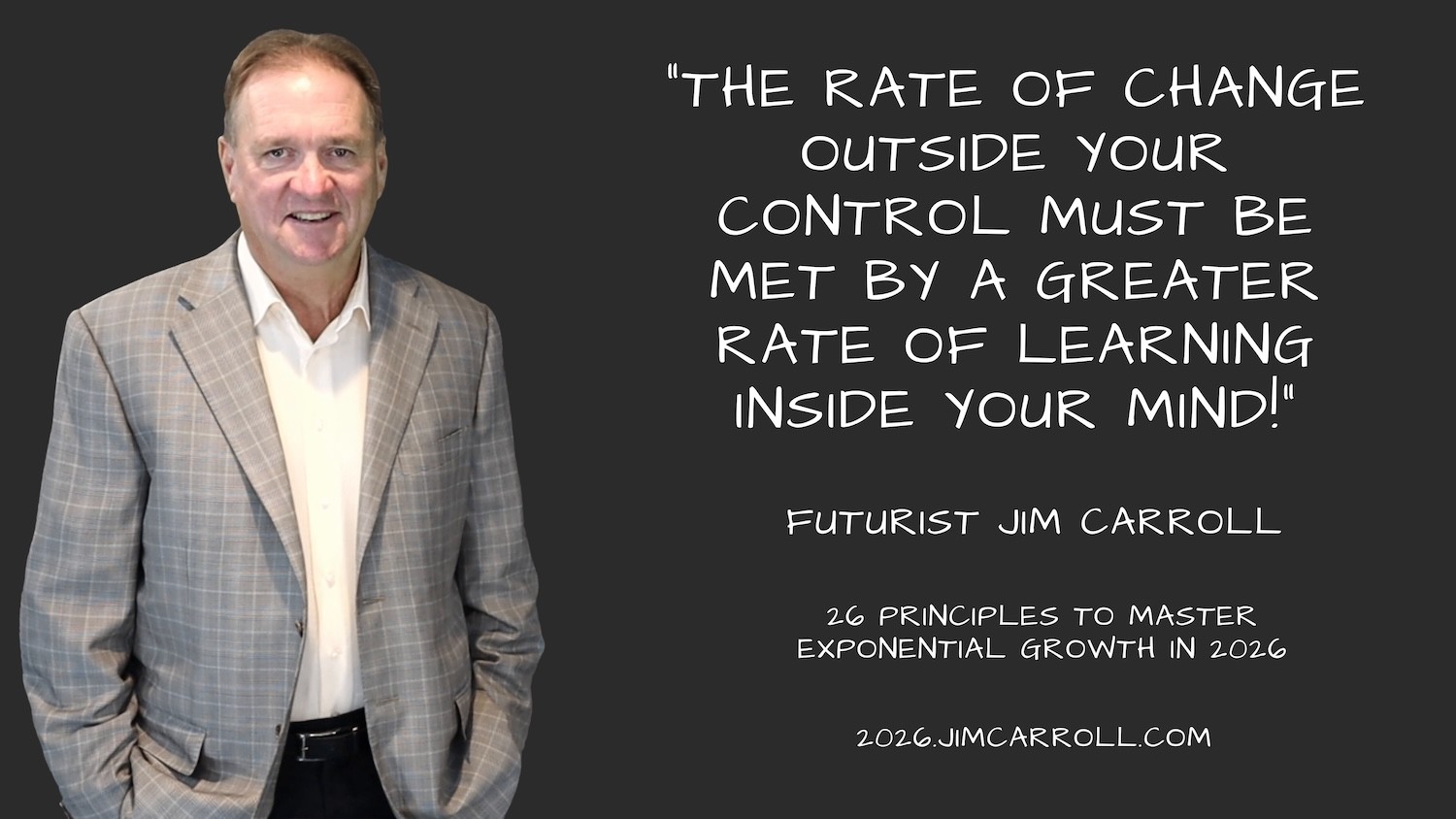
"The rate of change outside your control must be met by a greater rate of learning inside your mind!" - Futurist Jim Carroll

Most people don't realise what is happening with the exponentiation of trends. And yet, it is and will continue to have a p[profound impact on them. That's why I'm writing this new 2026 series, launching tomorrow.

It's best to put this into perspective in the context of the reality of trends today.

A year ago this month, I was invited by the Office of the Prime Minister of the United Arab Emirates to address the annual AGM of the region - a room full of 700 cabinet ministers and government executives. We spent a lot of time polishing my slide deck, and here are a few key slides. (Forgive the small type - these were prepared for a really big room with a really big LED screen!)

The first had to do with what I call 'the era of acceleration.'

Consider these numbers:

- Amazon Robots: from 1,000 (2012) to 75,000 ↑ Significant Increase (Volume)
- Cost of Human Genome Sequencing: from $100 million (2001) to $200 ↓ Massive Cost Reduction
- Solar Energy: $76 per watt (1977) to $0.20 ↓ Cost Reduction
- 3D Printing: $50 per cm³ (2010) to $0.50 ↓ Cost Reduction
- Battery Storage: $1,100 per kWh (2010) to <$100 ↓ Cost Reduction
- AI Inference Cost, $20.00 / Million Tokens (Nov 2022) to $0.07 / Million Tokens (Oct 2024)
- Access to Space (Low Earth Orbit): $54,500 per kg (Space Shuttle Era) to $2,720 per kg (Falcon 9)
- IoT Capacity (5G), 4G: 100,000 devices per km² to 5G: 1,000,000 devices per km²
- General knowledge doubling : 100 Years (Until 1900) to 12 Hours (Projected 2020)
- Medical knowledge doubling time, 50 Years in 1950 to 73 Days in 2020
- Professional skills relevance: from 30 years historically to a half-life of 6 years today

What' the impact? Skills obsolescence, opportunity blindness, and the drag of legacy!

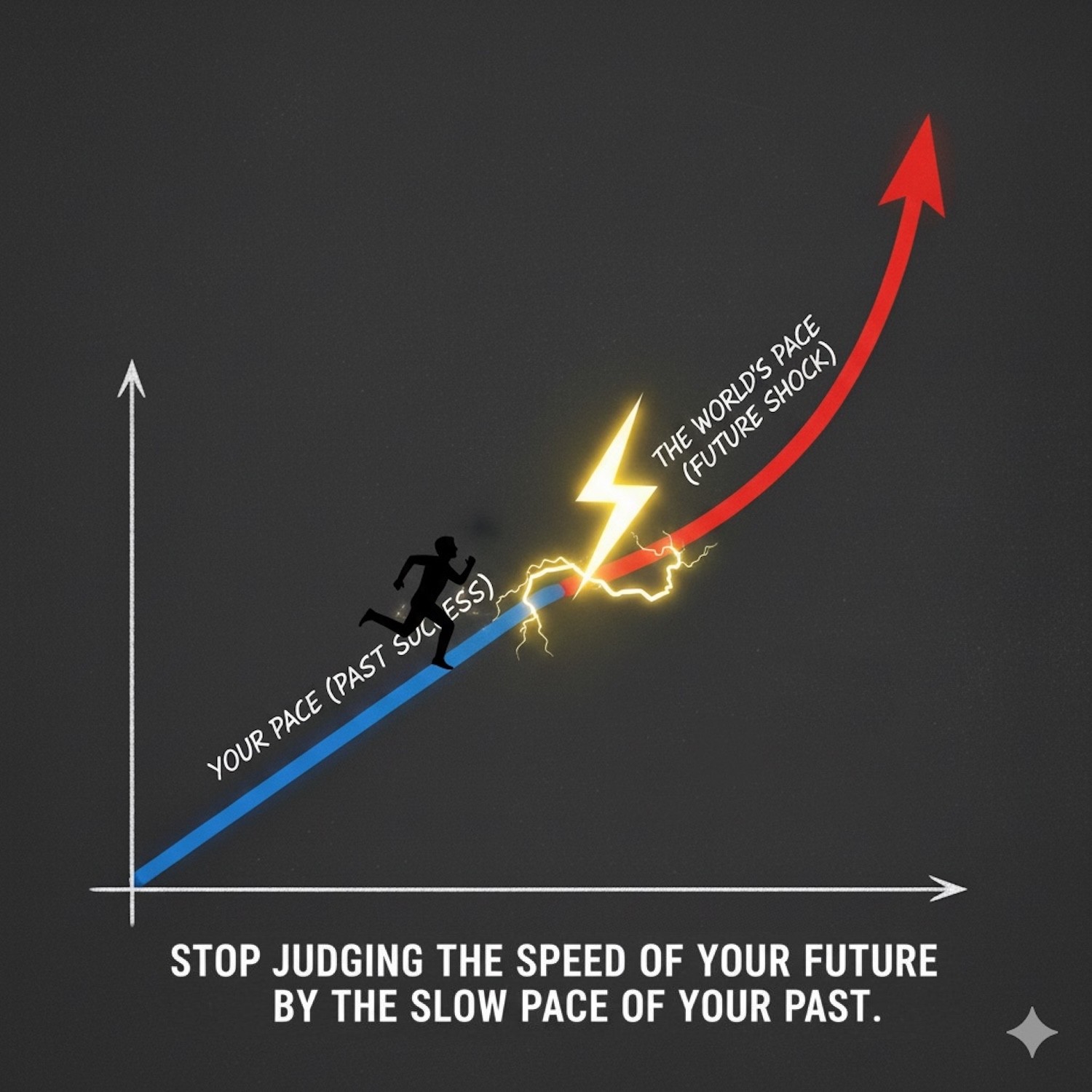
Starting tomorrow, I'll be taking you on the first principle of adaptation: Temporal Literacy. This is the foundational skill for every futurist, leader, and individual aiming for reinvention. It's the ability to stop judging the future by the slow pace of the past.

Get ready to reset your internal clock!

---

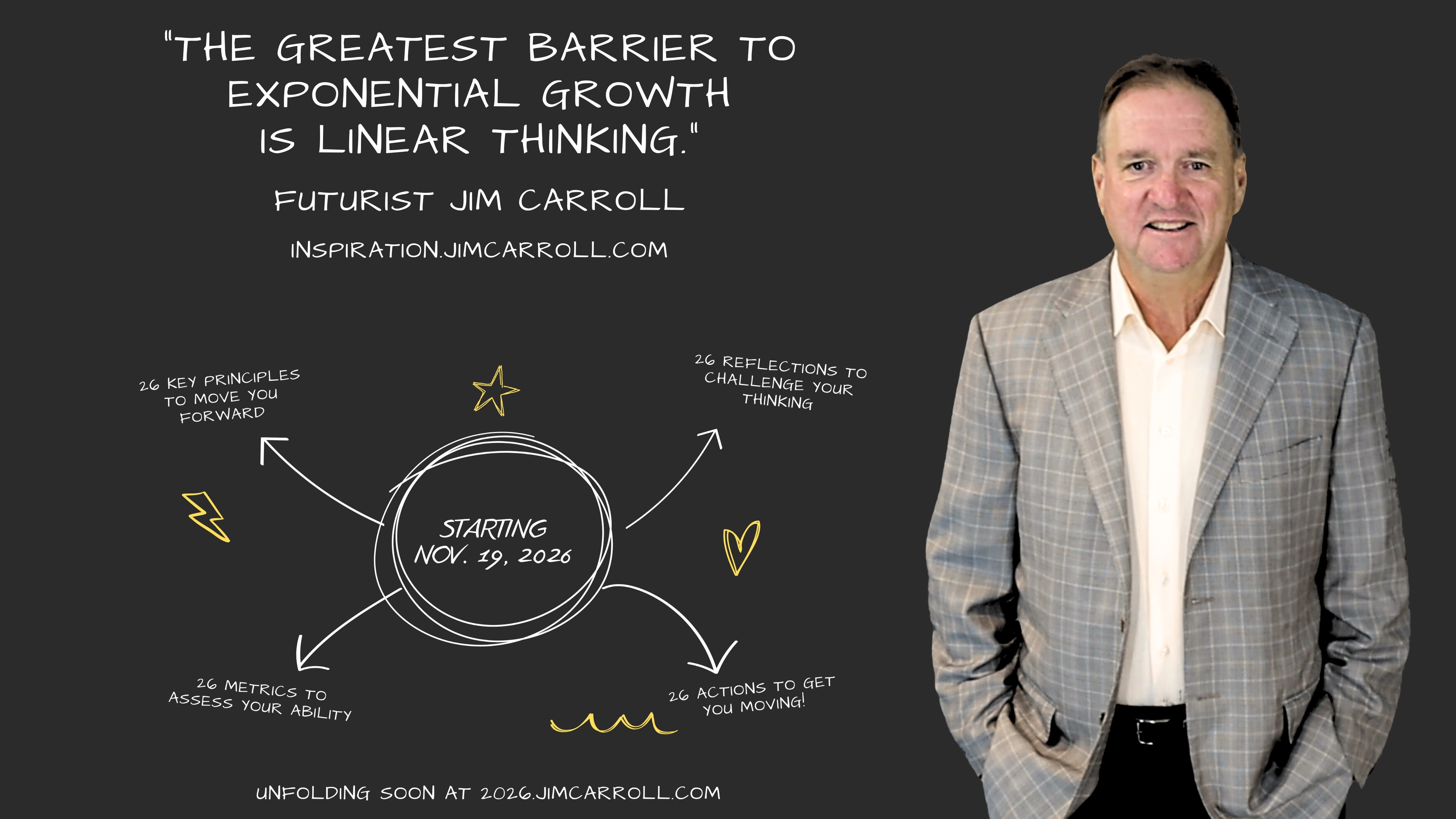
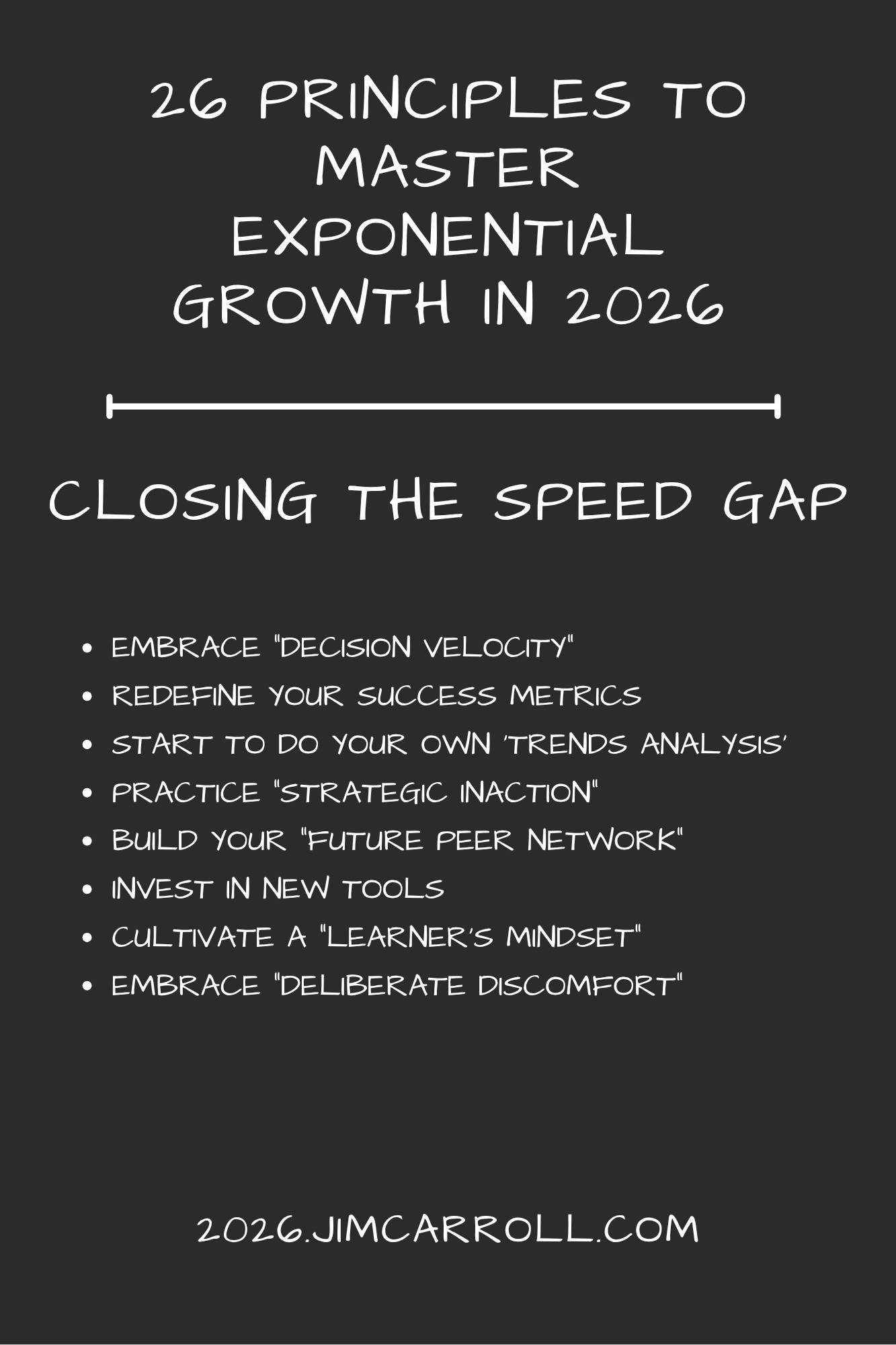
Each year, leading into the New Year, Futurist Jim Carroll writes a series designed to get you into the right headspace for what's to come. This year, his "26 Principles to Master Exponential Growth" will take you further into the world of speed. The series starts tomorrow, November 20.

**** **** **** **** **** **** **** **** **** ****

Original post: jimcarroll.com/2025/11/decodin

★ 1 • ↻ 0 original
Nov 20, 2025 · 2:12 PM UTC

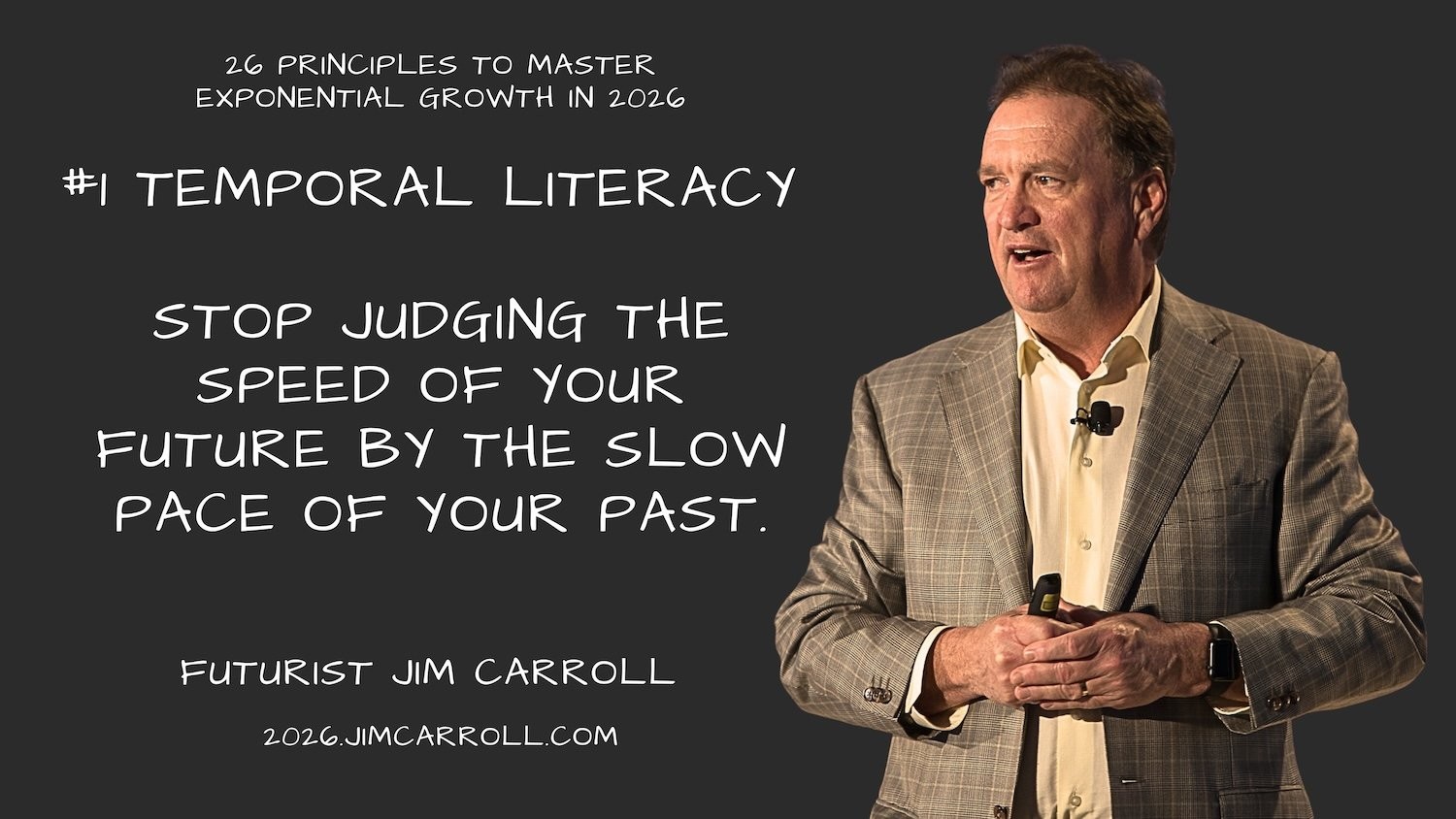
"Stop judging the speed of your future by the slow pace of your past." - Futurist Jim Carroll

26 Principles to Master Exponential Growth in 2026 - **#1** Temporal Literacy

It's Day 1 of your new path for 2026! 26 days, 26 principles to get you into the exponential mindset.

Step 1? Master "Temporal Literacy" - in which you stop judging the speed of your future by the slow pace of your past!

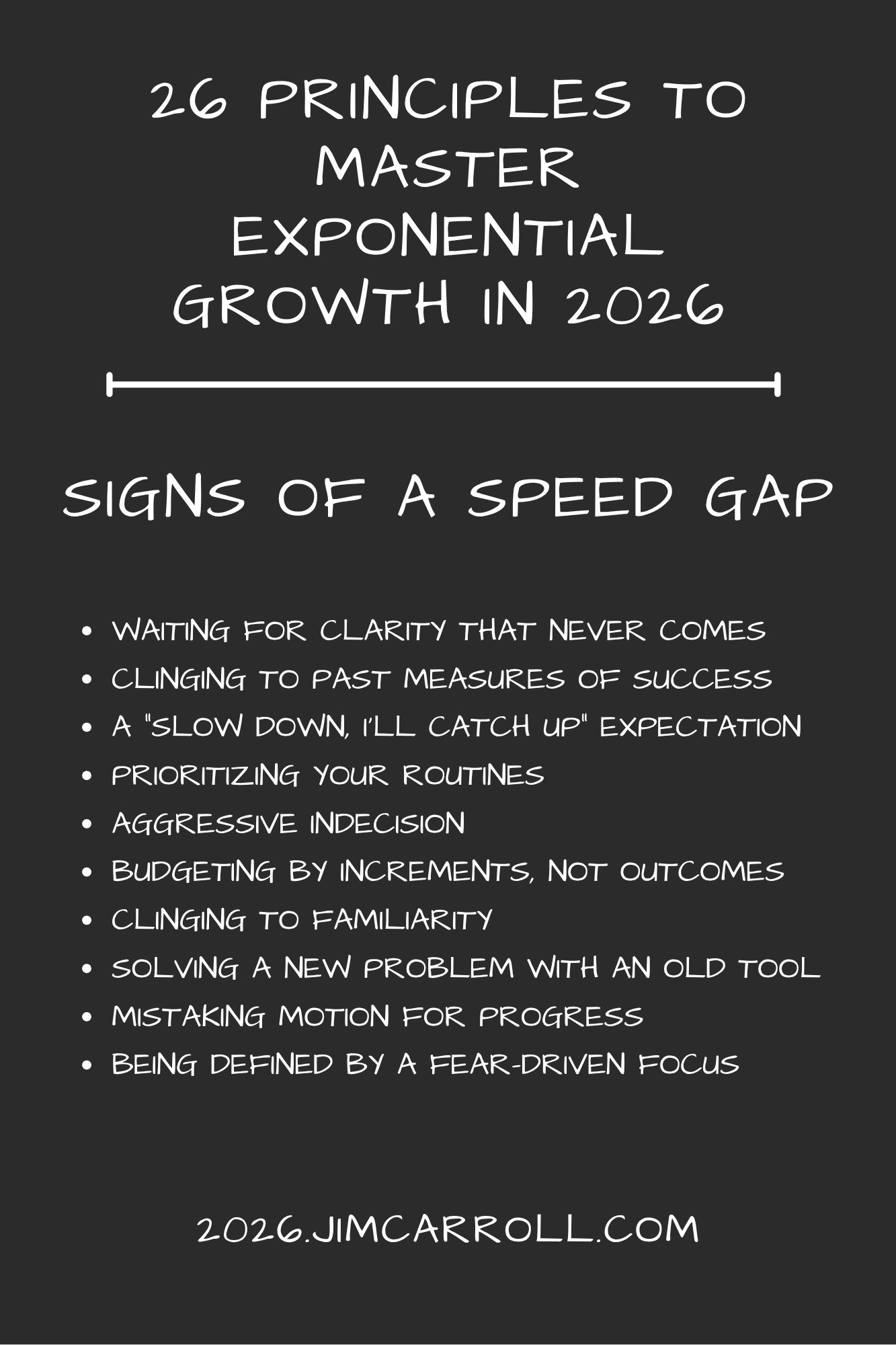
The single biggest mistake you can make right now is to believe that you can just keep doing the same old things at the same old deliberate pace that worked for you yesterday.

You can't.

Think about it - your past career success, your accumulated knowledge, and your daily routine have all been built on a 'linear' world - one that involves a slow, steady and expected rate of change. That's gone. The world is accelerating exponentially, creating a massive Temporal Lag between the speed you move and the speed the world demands.

Alvin Toffler called it "Future Shock." You are in the middle of that right now.

Here's what you need to do ....read the full list for insight.

Keep reading.....

----

Futurist Jim Carroll is writing a series, 26 Principles to Master Exponential Growth in 2026. You can follow the series here: 2026.jimcarroll.com

**** **** **** **** **** **** **** **** **** ****

Original post: jimcarroll.com/2025/11/decodin

★ 1 • ↻ 0 original
Nov 21, 2025 · 11:08 AM UTC

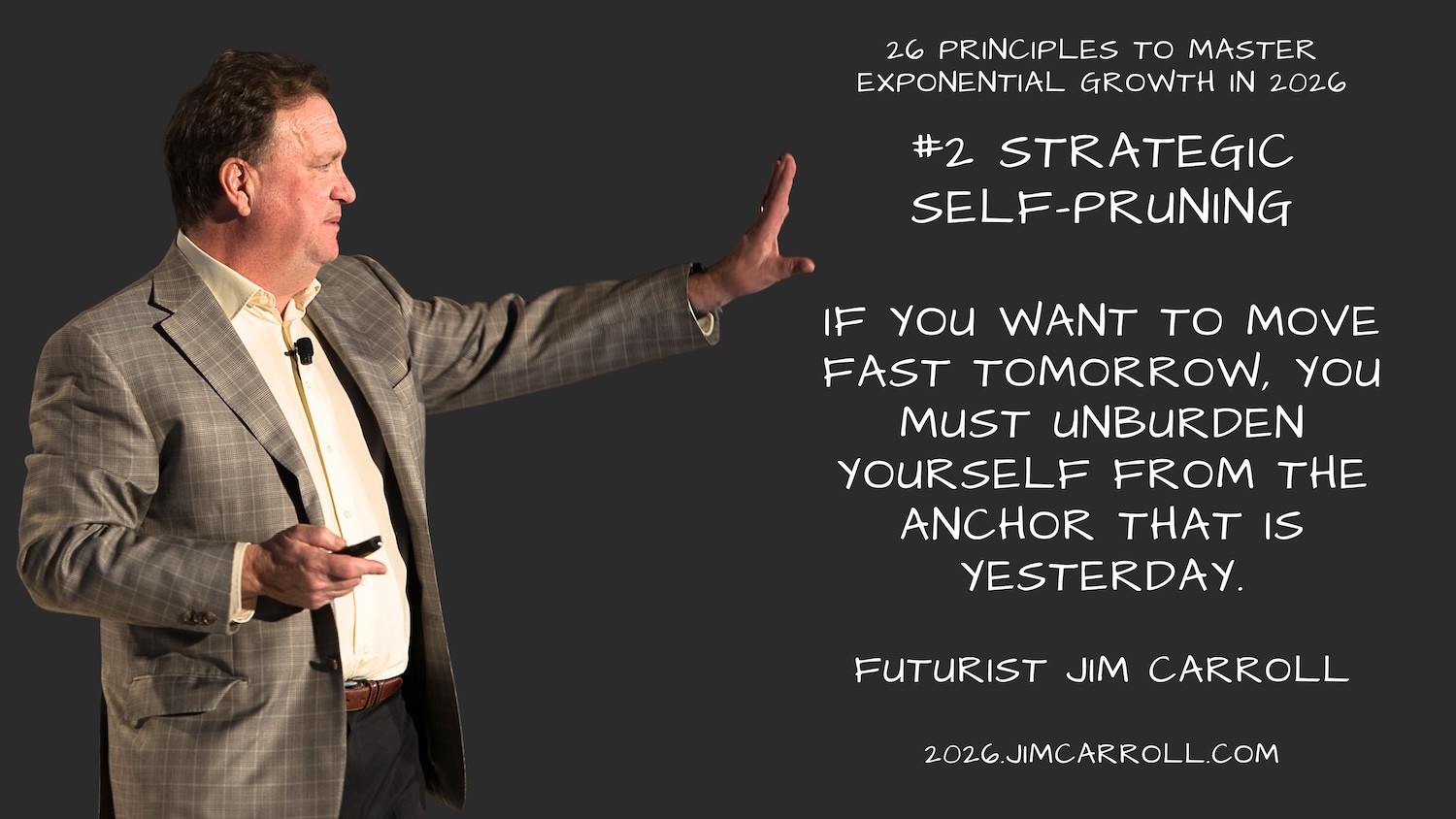
"If you want to move fast tomorrow, you must unburden yourself from the anchor that is yesterday." — Futurist Jim Carroll

---
Futurist Jim Carroll is writing his end-of-2025 / introduction-to-2026 series, 26 Principles for 2026. You can follow along at 2026.jimcarroll.com. He welcomes your comments.

---

Day 2: It's all about "Strategic Self-Pruning" - think of it as shedding your past to fuel your future speed.

Let's start here.

Old habits die hard. In an exponential world old habits need to die faster.

If Day 1 was about resetting your internal clock, Day 2 is about getting a new clock altogether.

We live in an era where the half-life of a profitable business model, a valuable skill set, or a dominant market position is shrinking exponentially. Remember that line I often share? What used to last a career now lasts a decade; what lasted a decade now lasts a few years. 

That skill you had two months ago? It's out of date already!

How do you possibly keep up in a world which is changing so crazy fast?

By getting rid of your anchors! You need to learn how you can run free and figure out what the heck is going on, and what you need to do be a part of it. And to do that, you need new habits - to ingest new knowledge, learn new skills, scan new horizons, take new risks, and chart a new path forward.

Look, I think you might be reading this series because you really want to figure out how to move forward in 2026. So here's the thing - one of the most important things you need to do is get rid of your past habits, ideas and routines to build a different future.

In my work with global organizations, I see the same pattern repeat: the greatest barrier to future velocity isn't a lack of new ideas; it's the crushing weight of old ones. Let's call it the "Legacy Load"—the accumulated mental habits, comfortable routines, and once-valuable expertise that now act as an anchor in a tidal wave of change.

To catch the exponential wave, you must stop hoarding the past.

Here's what you need to do -> read the post for my overview!

---

Futurist Jim Carroll wastes a lot of time playing with new ideas in order to discover the ideas that will help him learn the new things that matter.

**** **** **** **** **** **** **** **** **** ****

Original post: jimcarroll.com/2025/11/decodin

★ 1 • ↻ 0 original
Nov 24, 2025 · 11:28 AM UTC

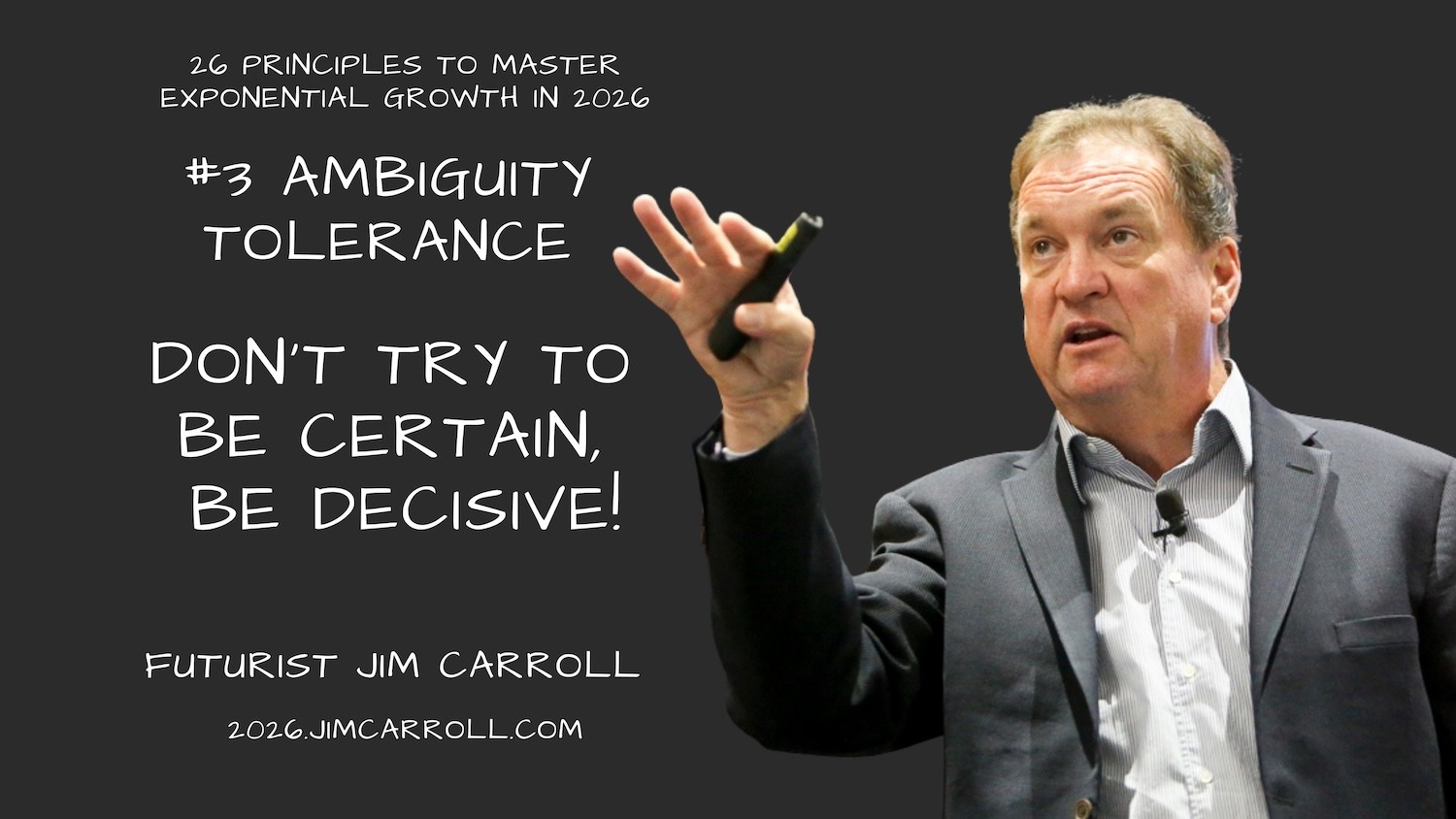
"Don't try to be certain, be decisive." - Futurist Jim Carroll

---
Futurist Jim Carroll is writing his end-of-2025 / introduction-to-2026 series, 26 Principles for 2026. You can follow along at 2026.jimcarroll.com. He welcomes your comments.
---

If Day 1 was about seeing the speed of the future, and Day 2 was about clearing the path, Day 3 is about finding the courage to walk it.

Particularly when you don't know what the hell is going on. Welcome to 2026!

Here's the thing about where we are today - in a linear world (aka "the olden days", say, 2 or 3 years ago), you could wait for clarity. You could gather 95% of the data, build a perfect consensus, and then make a low-risk decision.

That world is gone.

Today, the speed of change outpaces the speed of data collection.

You need to learn to make decisions despite a wild lack of clarity, a stunning amount of uncertainty, a scary amount of volatility, and a staggering degree of velocity.

Take a look around - everyone is faced with big, fast change, and don't know what to do about it! We've become a society of deer in the headlights, staring at the bright lights of oncoming exponential change, and yet don't know how to move out of the way - or jump right into it. (Weird metaphor, I know!)

Here's the thing - In every sector, the core uncertainty is the same: Trends are moving exponentially faster than our linear ability to regulate, build, or adapt to them.

If you wait for perfect clarity in this environment, you are waiting for a moment that will never arrive!

The discipline required to thrive here is Ambiguity Tolerance, and you need to master it.

---

**#2026** **** **** **** **** **** **** **** **** ****

Original post: jimcarroll.com/2025/11/decodin

★ 0 • ↻ 0 original
Nov 25, 2025 · 11:10 AM UTC

"Know that the future whispers before it shouts. Listen now." - Futurist Jim Carroll

---
Futurist Jim Carroll is writing his end-of-2025 / introduction-to-2026 series, 26 Principles for 2026. You can follow along at 2026.jimcarroll.com. He welcomes your comments.
--

We are three days into resetting your mindset for 2026. You understand the speed of change (Temporal Literacy), you’ve started clearing the deadwood (Self-Pruning), and you’re building the courage to act without perfect clarity (Ambiguity Tolerance).

Now, you need a radar system! One that allows you to do a better job of understanding what comes next, and what you need to know about it, long before you have to do anything about it! Way back in 2007, I wrote about the idea of this when I outlined my 'Trends & Innovation' Model.' Right there, at the top of this iterative loop, is the 'radar'. It's what you do to find the signals through the noise.

I'll come back to this in a moment - for now, keep the idea in mind.

Here's how things have changed with the model. In a linear world, change happened slowly enough that you could afford to be reactive. You could wait until a trend became obvious, analyze it, and then adapt. 

In an exponential world, by the time a trend is obvious, it's usually too late to leverage it.

That means if you are reading about a disruptive technology on the front page of a mainstream business site, the exponential opportunity phase is likely already over. You are now in the reactive phase, playing catch-up against those who saw it coming three years ago. And that's why the idea of Anticipatory Intelligence has become so important in 2026 - you need to work harder to stay ahead of the trends that might impact you, before the trends actually impact.

This is a problem for most folks. The mistake most professionals make is that they are so obsessed with managing the present—the daily fires, the quarterly results, the immediate emails—that they never lift their heads to scan the horizon. They are driving a 200-mph Ferrari while staring intently at the dashboard indicators, oblivious to the cliff approaching up ahead.

To lead in 2026, you need to shift from being reactive to being anticipatory. The discipline for this is Anticipatory Intelligence.

Here's what you need to do....

(Keep reading!)

---
**#2026** **** **** **** **** **** **** **** **** ****

Futurist Jim Carroll believes that developing his ability to do effective online research in the mid-1980s is one of the key skills that has allowed him to chase the unique career that he has!

Original post: jimcarroll.com/2025/11/decodin

★ 0 • ↻ 0 original
Nov 26, 2025 · 11:20 AM UTC

"Learn faster than knowledge appears. It’s your only sustainable advantage." - Futurist Jim Carroll

---
Futurist Jim Carroll is writing his end-of-2025 / introduction-to-2026 series, 26 Principles for 2026. You can follow along at 2026.jimcarroll.com. He welcomes your comments.
----

We are three days into resetting your mindset for 2026.

Day 5? It's all about learning velocity, and the fact that you need to stop relying on your degree and start learning for your life!

I want you to implant this idea firmly in your mind right now: skills decay. Add to that concept the idea of the half-life of knowledge. Layer on top of it my often-repeated phrase - the ability to master just-in-time knowledge is key.
The former is happening faster because the latter is becoming smaller. Once you understand that, you need much of what you need to know for 2026 - your ability to align and realign to the new velocity of knowledge will be key to everything you do.

Think about the change we are in the midst of. In a linear world, your education was a finite event. You went to college, got a degree, learned a trade, or got a set of professional skills, and that block of knowledge was something you could rely upon for a 30-year career with only minor maintenance.

But in an exponential world, knowledge is not just growing; it’s exploding. I've written about this a lot, but it bears repeating. I often share on stage the fact that the average half-life of a professional skill has collapsed from 10-15 years to just 5 years today. Or the fact that it is said that half of what you know today will be obsolete in five years, if not sooner. In some high-tech fields, that timeline is compressed even further, with knowledge potentially doubling in a matter of months or even hours.

This means that if you are relying on what you already know, i.e, with your past degree, your decade of experience, to carry you through 2026, you are driving on fumes. Your battery is empty, your mind is out of gas, and you'll soon hit the limit of where you can go.

Bottom line? The knowledge that got you here is decaying faster than you can replace it with linear learning methods.

In that context, the defining characteristic of a successful professional in 2026 will not be their stock of knowledge, but their rate of learning.

Principle 6? The discipline you must master is Learning Velocity.

Learn more in the post!

---

Futurist Jim Carroll spends a LOT of time learning new stuff, knowing that this is the key to everything!

**#2026** **** **** **** **** **** **** **** **** ****

Original post: jimcarroll.com/2025/11/decodin

★ 0 • ↻ 0 original
Nov 27, 2025 · 11:47 AM UTC

"Make more 'better' mistakes!" - Futurist Jim Carroll

---

Futurist Jim Carroll is writing his end-of-2025 / introduction-to-2026 series, 26 Principles for 2026. You can follow along at 2026.jimcarroll.com. He welcomes your comments.

---

In 2026, your new ROI should be ROF - "Return on Failure"

We are on Day 6. We've reset your clock, cleared the path, built your courage, turned on your radar, and accelerated your learning.

Now, we need to completely rewire your relationship with failure.

Why? Because, as the saying goes, in a fast world, innovators fail faster!

Think about it. In a linear, slow-paced world, mistakes were expensive, permanent, and career-limiting. You spent years perfecting a product or strategy behind closed doors to ensure a flawless "Big Bang" launch. The ultimate metric was ROI—Return on Investment—and "failure" meant negative ROI.

Those days are gone. In an exponential world, that math is backwards. The new reality is that not making mistakes fast enough is the biggest mistake of all.

If you aren't making mistakes, you aren't moving fast enough. You aren't testing the boundaries. You are operating on old assumptions while the world shifts beneath your feet.

In that context, your goal isn't to avoid failure; it's to maximize what you learn from it to do it better the next time, right away. Every failure gives you invaluable data, insight, and lessons about speed. You need to make more mistakes, make them faster, and make them better, meaning they are small, calculated experiments designed to yield maximum learning, not sloppy errors born of carelessness.

In other words, make more better mistakes!

You really need to understand why this is so important - read the post for more.

---

Futurist Jim Carroll can count the mistakes he's made on many hands.

**#2026** **** **** **** **** **** **** **** **** ****

Original post: jimcarroll.com/2025/11/decodin

★ 0 • ↻ 0 original
Nov 28, 2025 · 12:06 PM UTC

"Remember - in an exponential world, the static become extinct." - Futurist Jim Carroll

---
Futurist Jim Carroll is writing his end-of-2025 / introduction-to-2026 series, 26 Principles for 2026. You can follow along at 2026.jimcarroll.com. He welcomes your comments.
---

Day 7? Let's focus on Relentless Reinvention, and why "staying the course" is the most dangerous strategy of all

Days 1 to 6? We've reset your clock, cleared your path, built your courage, turned on your radar, accelerated your learning, and embraced rapid mistakes.

Now, we arrive at the hardest emotional discipline of them all: knowing when to change - and doing the change.

In our old, slow-moving linear world, "staying the course" was a supreme virtue. Once you set a career path or a long-term leadership strategy, you stick to it. Changing direction mid-stream was seen as a sign of weakness, indecision, or flakiness.

But in an exponential world, "staying the course" when the terrain is fundamentally shifting beneath your feet isn't grit; it's suicide.

When technology, industries, or market dynamics shift exponentially, your current role, skill set, or leadership approach can become obsolete overnight. The most successful leaders in 2026 won't be the ones who cling the hardest to their past identities; they will be the ones with the agility to abandon a doomed path instantly and reallocate their personal energy to a new one.

In that context, the discipline you must master is Relentless Reinvention.

Reinvention? It's often known as 'the pivot.'

What Reinvention Looks Like in Real Life

It is easy to discuss the concept of the "pivot" in the abstract—as a strategic necessity on a whiteboard. It is much harder to recognize what it looks like in the trenches of real life.

In my book Now What? Reinvention and the Role of Optimism in Finding Your New Future, I documented the journeys of individuals who faced this exact precipice, with several of the stories looking at their pivot during the pandemic of 2020. They didn't just "change jobs"; they fundamentally reinvented their skills, their time, and their identities to align with a new reality. You can get the book here.

Here is what Relentless Reinvention looks like in practice:

(keep reading)

----

**#2026** **** **** **** **** **** **** **** **** ****

Futurist Jim Carroll has reinvented his future multiple times throughout his career, considering it to be just like a regular software upgrade.

Original post: jimcarroll.com/2025/11/decodin

★ 0 • ↻ 0 original
← October 2025December 2025 →