Futurist Jim Carroll

Mastodon post archive · 2022–2026
Archived from mastodon.futurist.info · 4209 posts
← All months

December 2025 · 21 posts

← November 2025January 2026 →
Dec 1, 2025 · 12:02 PM UTC

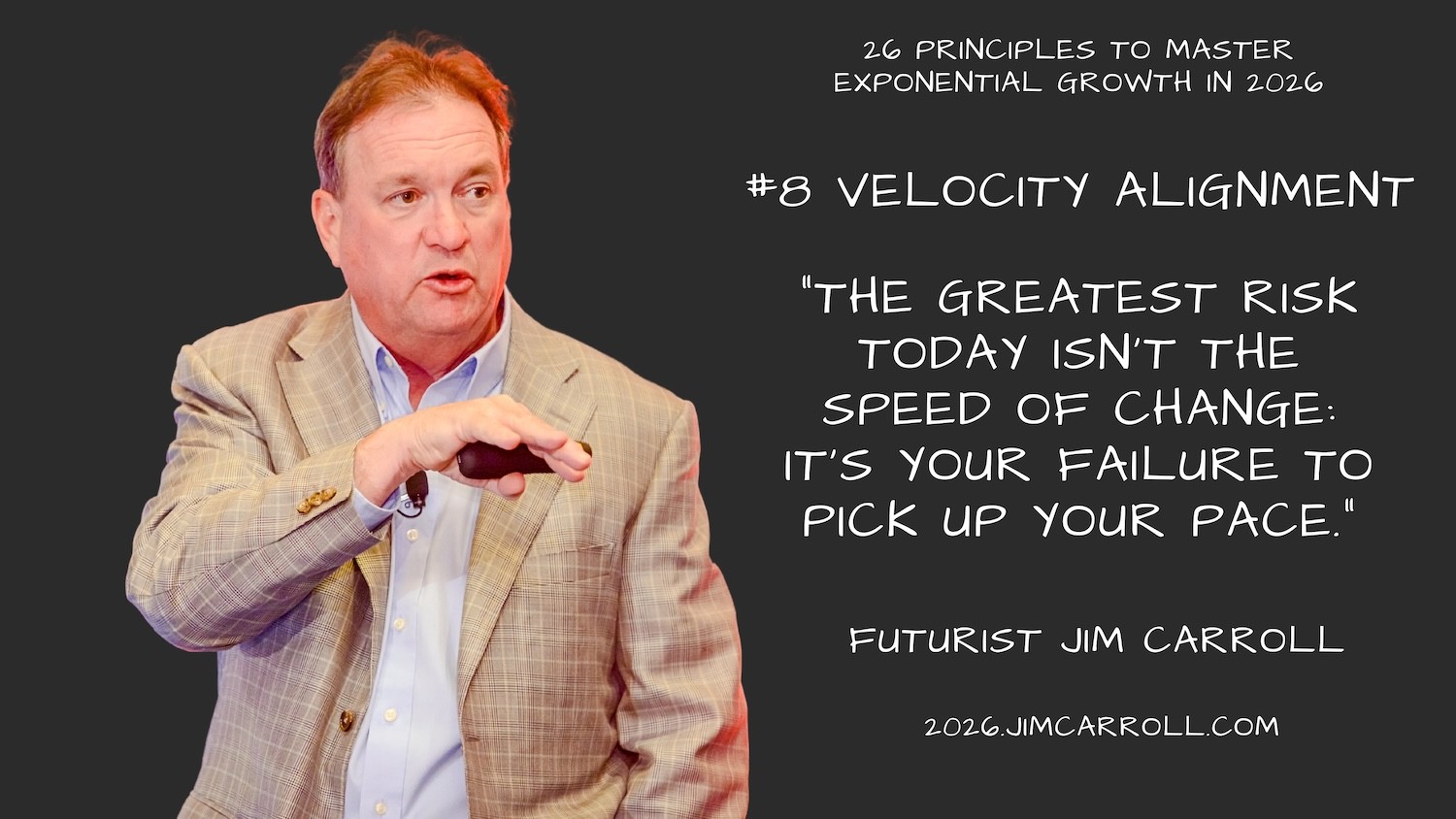
"The greatest risk today isn't the speed of change: it's your failure to pick up your pace." - Futurist Jim Carroll

---
Futurist Jim Carroll is writing his end-of-2025 / introduction-to-2026 series, 26 Principles for 2026. You can follow along at 2026.jimcarroll.com. He welcomes your comments.
---

We are on Day 8. You've committed to the pivot (Day 7). Now, you have to run.

That's why the principle you need to align to is "Velocity Alignment."
What is it? Matching your internal pace with external reality!

In a linear world, speed was a differentiator - the future belonged to the fast! Being faster than your competitor was a real advantage - if you mastered speed, you had what you needed to stay out in front in a competitive world. Speed wasn't a mad rush, though - you had the luxury of "measured paces," long development cycles, and five-year roadmaps.

Five-year roadmaps! As they say, LOL to that! In our faster world, you can barely plan for next month!

The sad truth is that in our new exponential world, speed is no longer a differentiator; it is the baseline requirement for existence. The external environment is accelerating so rapidly that if you don't do the minimum to keep up, you are guaranteed to not just fall behind - but perhaps, become rapidly irrelevant. our personal workflow, your team's processes, your organizational cadence—are still running on linear time, you are falling behind every single hour.

The interesting thing for me, as we head into 2026 in the context of the issue of speed, is that perhaps my book of 2012 is now out of date. The future no longer belongs to those who are fast - it belongs to those who are fluid!

Here's the key thing you need to ponder - the disconnect between external velocity and internal friction is where companies die, and careers stall.

The Evidence: 10 Ways Speed is the New Currency

Throughout my blog posts and keynotes, I have documented how the fundamental metrics of success have shifted toward velocity. CEOs have brought me in to talk to their teams to help them understand the reality of speed and the necessity for corporate velocity. The things I talk and write about aren't theoretical; it is the new operating reality across every sector.

Here are 10 examples from my analysis of how speed is now the primary metric:

(read the rest of the post in the link)

In an exponential world, speed is no longer just an advantage but the absolute baseline for survival.

You must immediately align your personal pace with this accelerating reality to avoid falling behind. That's the essence of Principle **#8** - velocity alignment!

---

Futurist Jim Carroll identified 'speed' as being the core metric for future success over 25 years ago.

**#2026** **** **** **** **** **** **** **** **** ****

Original post: jimcarroll.com/2025/12/decodin

★ 0 • ↻ 0 original
Dec 2, 2025 · 11:57 AM UTC

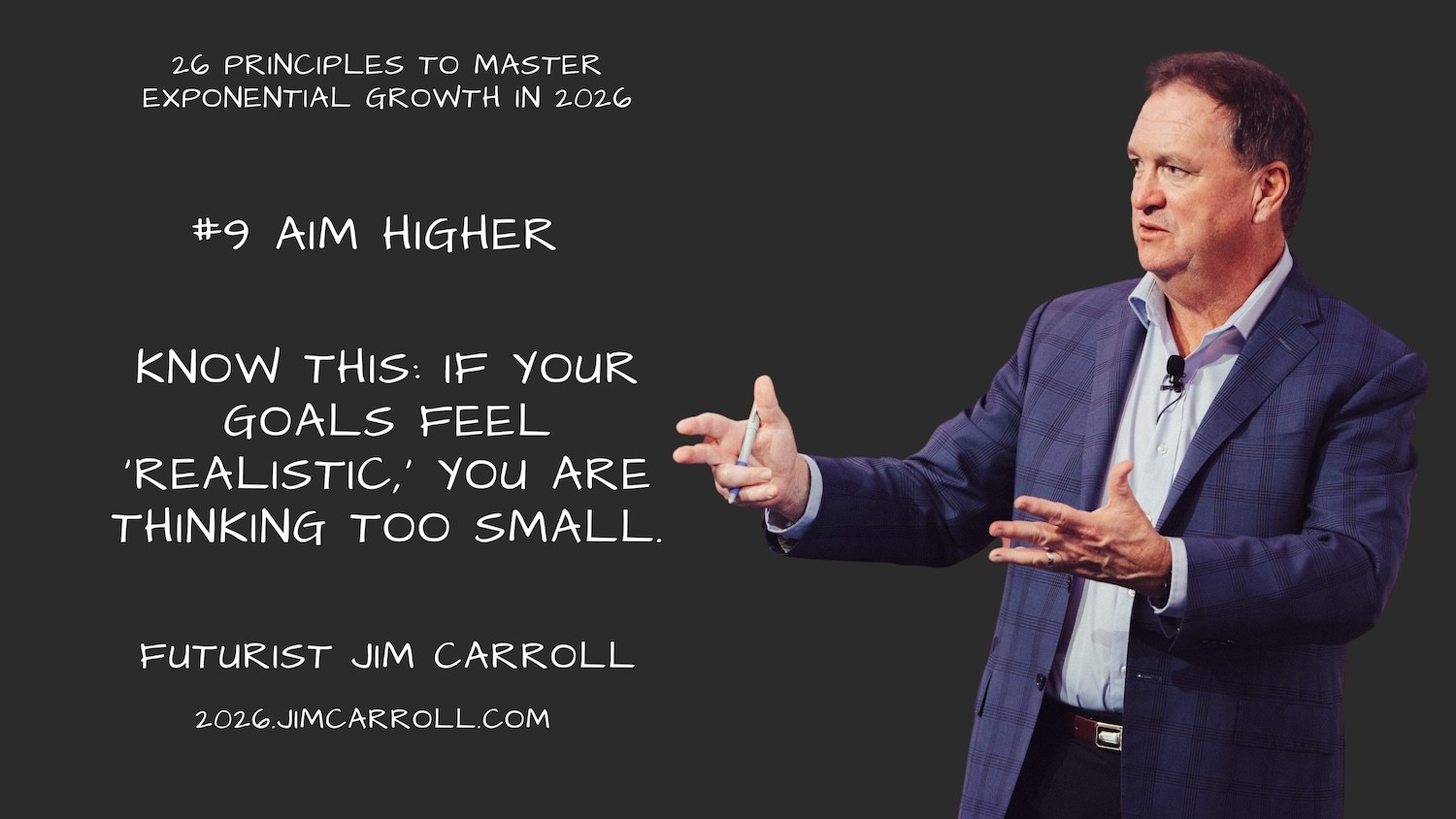
"Know this: if your goals feel 'realistic,' you are thinking too small." - Futurist Jim Carroll

---
Futurist Jim Carroll is writing his end-of-2025 / introduction-to-2026 series, 26 Principles for 2026. You can follow along at 2026.jimcarroll.com. He welcomes your comments.
----

We are on Day 9. You've committed to the pivot (Day 7), and you are increasing your execution velocity (Day 8). You are moving faster.

But are you aiming high enough?

In an exponential world, you can’t just think big - you need to think bigger!
And so day 9 is all about aiming higher and achieving the moonshot mentality. Here's your key thought: in 2026 and beyond, the idea of being just 10% better is dead, and being 10x better is critical.

Think about it: in a linear world, success was defined by incrementalism. Growing sales by 5%, cutting costs by 10%, or improving efficiency by 15% year-over-year was considered a victory. You achieved this by working a little harder, squeezing a little more out of things, and making safe, small, "feasible" bets.

Realistic things.

Things you know you could accomplish.

In an exponential world, incrementalism is the path to irrelevance. Small steps won't work. Thinking small is a guarantee for marginal success. While you are striving for 10% growth, an exponential competitor - maybe someone leveraging AI, developing a new business model, or developing new skills - is aiming for 10x growth and will wipe you out before your five-year plan is halfway done.

To survive in 2026, you must stop trying to improve the status quo and start trying to replace it. You need to shift from linear goal-setting to exponential ambition.

Moonshot thinking!

The discipline is Aiming Higher!

As Sly and the Family Stone said - I want to take you higher! To understand the scale of ambition required for 2026, you first need to see where the trends are actually going. You cannot plan for 2030 using 2025 thinking. If you take today's shifts and extrapolate them to their 10x conclusion, the future looks radically different.

So let me take you into my world of "Radical Extrapolation" - I'll take some trends I've covered and take them higher.

I'm Sly.

You're the family.

Let's get high!

Keep reading - go to the full post!

----

**** **** **** **** **** **** **** **** **** ****

One of the highlights of Jim’s career was the moment he was invited to keynote an event at NASA, with a room full of astronauts, mission directors, rocket engineers, and others, with the focus being on ‘thinking BIG’. The second highlight was when he was invited back for a repeat performance!

Original post: jimcarroll.com/2025/12/decodin

★ 1 • ↻ 0 original
Dec 3, 2025 · 11:31 AM UTC

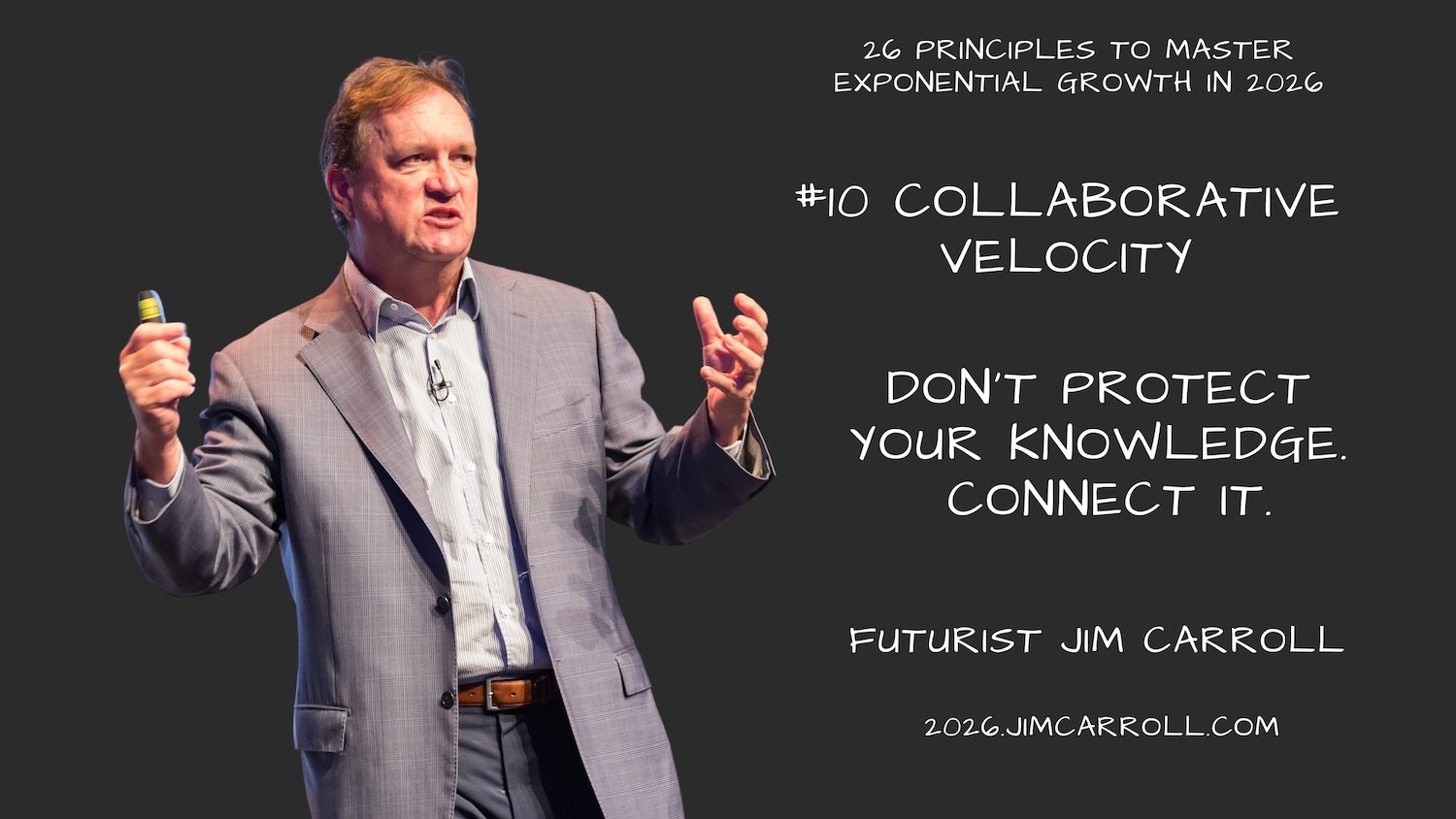
"Don't protect your knowledge; connect it." - Futurist Jim Carroll

---
Futurist Jim Carroll is writing his end-of-2025 / introduction-to-2026 series, 26 Principles for 2026. You can follow along at 2026.jimcarroll.com. He welcomes your comments.
---

"If I have an idea and you have an idea, we have two ideas. If we share those ideas, we have a movement!" That's what I wrote some years ago here in my Daily Inspiration, in a post talking about the power of collaborative insight.

In a collaborative world, the size, scope and reach of your 'idea movement' becomes even more important, and that's why you need to think about connecting your knowledge with other knowledge - rather than hoarding it.

We are on Day 10. You have set a Moonshot goal (Day 9) to grow 10x. Now you need the collaborative velocity to achieve it - you realise that more than likely, your internal 'brain trust' is too limited and too slow to gather and obtain the knowledge it needs to move forward.

Take a look around your current organisation or your personal network. Do you honestly believe the resources, knowledge, and talent currently within your four walls are sufficient to achieve that 10x goal?

Of course they aren't! They were assembled to achieve yesterday's 10% goals - not a 10x goal!

And therein lies the difference. In a linear world, power came from hoarding knowledge. You built high walls around your R&D lab, protected your trade secrets, and tried to hire the best people to work exclusively for you. Your internal capabilities defined your speed.

But in an exponential world, the speed of innovation outside your organisation will always exceed the speed of innovation inside it. There are more smart people outside your company than inside it. If you work on your own or in a small team, know that your knowledge is now, and will forever be, limited. There are more breakthrough startups working in your field than you have R&D teams; there are other teams who are working faster, smarter and better than you.

And in that context, you need to learn how to connect with them!

If you try to build everything yourself, you move at a linear pace. To move at an exponential pace, you must shift from "owning" knowledge to "accessing" it through rapid partnership.

I have been obsessed with this shift from "slow isolation" to "fast collaboration" for years. It is not just about working together; it is about how fast you can form the connection to solve the problem.

Read the full post to learn why this is now critical.

---

Futurist Jim Carroll identified the power of collaborative networks in a 1987 document he wrote called Linkage. It predicted the emerging concept of LinkedIn, which would not appear until 20 years later.

**#2026** **** **** **** **** **** **** **** **** ****

Original post: jimcarroll.com/2025/12/decodin

★ 0 • ↻ 0 original
Dec 4, 2025 · 12:39 PM UTC

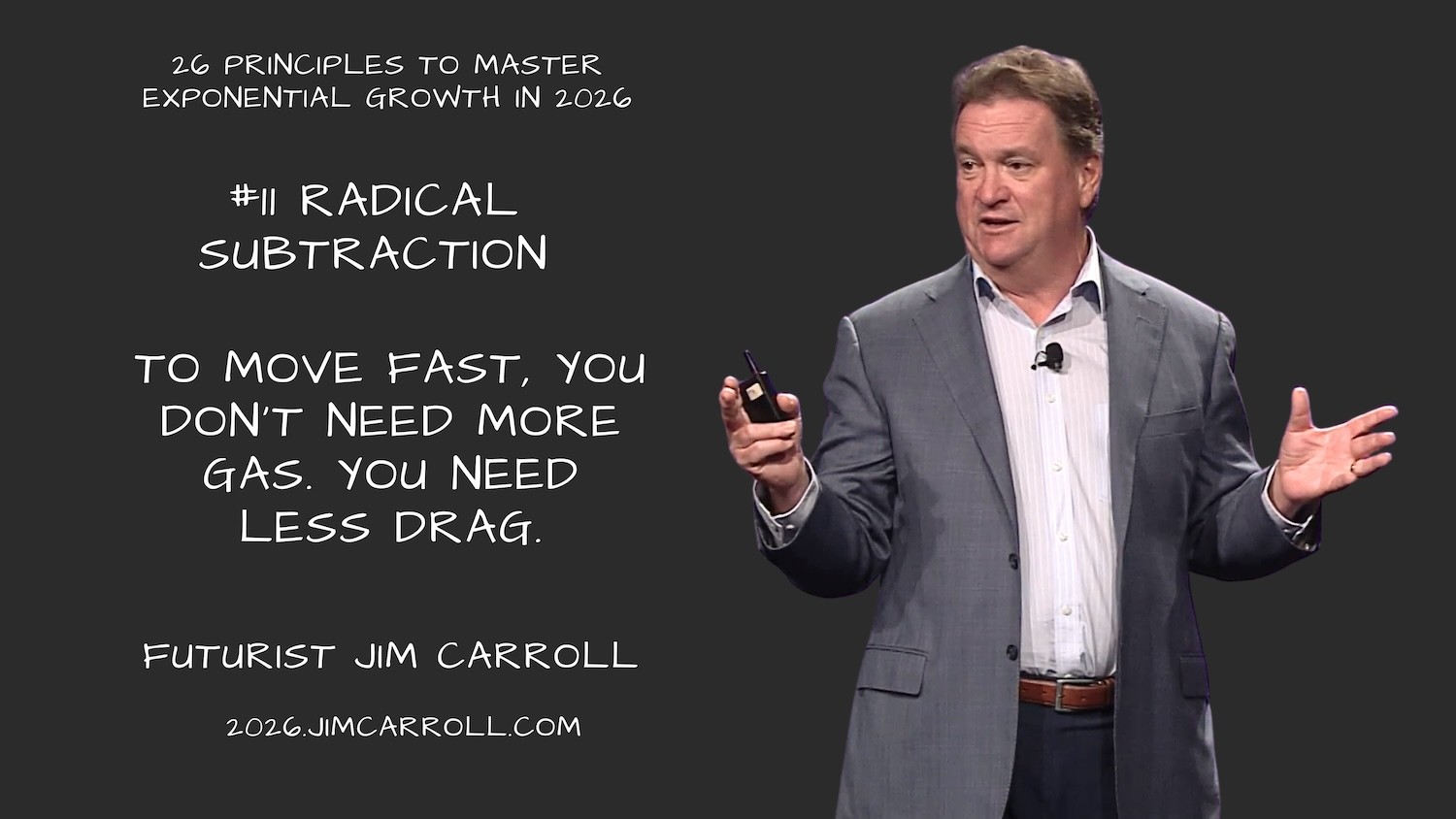
"To move fast, you don't need more gas. You need less drag." - Futurist Jim Carroll

---
Futurist Jim Carroll is writing his end-of-2025 / introduction-to-2026 series, 26 Principles for 2026. You can follow along at 2026.jimcarroll.com. He welcomes your comments.
---

Get rid of the anchors that are keeping you back. The weights that are holding you down. The chains that bind you to yesterday. The barriers that block your way.

And the things that are slowing you down.

We are on Day 11. You've committed to connecting externally for speed (Day 10). Now you must look inside and confront the greatest enemy of internal velocity: complexity.

Your future depends on the idea of Radical Subtraction. It might not make sense, but to move faster in our exponential world, you need to stop adding things and take things away.

In our old, slow, linear world, we solved problems by adding. If there was a risk, we added a compliance step. If there was miscommunication, we added a meeting to fix it. If there was a new opportunity, we added a committee. If there were a disruption, we would develop a strategy to deal with it. Over time, this addition was seen as sophistication and control.

We added things to try to deal with the complexity the world was throwing at us.

But here's the thing - in an exponential world, this accumulated complexity is organizational cholesterol. It clogs the arteries of decision-making. Every extra approval layer, every redundant report, and every "alignment meeting" slows down your Execution Velocity (Day 8) and makes it impossible to achieve a Moonshot (Day 9).

I've long talked about this from the stage as the accumulation of 'organizational sclerosis.'

youtube.com/watch?v=zVgslECVwK

It's clogging up your future, slowing you down, killing your initiative. What is it? It's the condition where your arteries of creativity and initiative become clogged because everyone keeps doing things - even though no one remembers why they are doing them. It’s not just annoying; it’s a health hazard for your business that blocks the flow of new ideas.

And here's the thing - you cannot add your way to agility. When the world speeds up, your internal systems must simplify.

Here's why...

----
Futurist Jim Carroll has long been intensely frustrated with bureaucracy and organizational sclerosis - with that, perhaps, being the reason why he has worked as a solo entrepreneur for 35 years!

**** **** **** **** **** **** **** **** **** ****
****
Original post: jimcarroll.com/2025/12/decodin

★ 0 • ↻ 0 original
Dec 5, 2025 · 12:01 PM UTC

"The hubris of experience guarantees failure." - Futurist Jim Carroll
---
Futurist Jim Carroll is writing his end-of-2025 / introduction-to-2026 series, 26 Principles for 2026. You can follow along at 2026.jimcarroll.com. He welcomes your comments.
---

We are on Day 12.

We’ve spent the last two weeks stripping away the internal barriers to speed—the fear, the linear forecasting, the lack of collaboration, and the organizational complexity (Day 11).

Now, we face the final, most formidable internal enemy. It’s not out there in the market. It’s looking back at you in the mirror.

It's you.

It is the ego of the successful leader. To really get ahead in 2026, you need to understand the trap of hubris and why your past success can be your biggest future liability.

What do you need to think about? The challenge of successful experience and why it can get in your way.

In a linear, slow-moving world, 30 years of continued success was your most valuable asset. It proved you knew the formula. You had "seen it all." Your intuition was unimpeachable wisdom. You knew exactly what to do, when it needed to be done, and how to do it.

Those days are gone.

In an exponential world, where entire industries are being reinvented every few years, that same 30 years of experience can become a catastrophic liability. Why? Because it can get in the way. It blinds you. It clouds your judgment. It can bring to light your lack of skills in how to respond to the profound changes that are underway. It conditions you to believe that the future will behave like the past.

It locks you into old pattern recognition for entirely new patterns!

When you combine a track record of linear success with an exponential shift in reality, you get a dangerous psychological condition I have written about extensively, and that's the trap of hubris.

It’s the arrogance that says, "I know better than anyone else." It’s the belief that your past wins grant you immunity from future disruption. It is the ultimate drag on velocity because a leader or individual blinded by hubris will drive full speed off a cliff, ignoring every warning sign along the way because they are convinced their internal map is better than the external terrain.

The discipline you must master to avoid this fate is Strategic Humility.

You need to know what it is, how to identify it, how to avoid it - and how to shed it!

Read the post to learn how.

---
**#2026** **** **** **** **** **** **** **** **** ****

Futurist Jim Carroll has seen a lot of hubris within the leadership teams has has spoken to, as part of his keynote preparation process - and that insight has shaped the way he has pulled together his trends and innovation keynote.

Original post: jimcarroll.com/2025/12/decodin

★ 1 • ↻ 0 original
Dec 8, 2025 · 11:49 AM UTC

"Know when to get your age out of the way." - Futurist Jim Carroll

----

Futurist Jim Carroll is writing his end-of-2025 / introduction-to-2026 series, 26 Principles for 2026. You can follow along at 2026.jimcarroll.com. He welcomes your comments.

---

We are on Day 13. We just spent Day 12 dismantling your personal hubris - getting your ego out of the way. One of the most important aspects of that?
Showing your wisdom the door!

We need to dismantle the collective, generational delusion of your organizational hierarchy!

We need to talk about age.

Yup.

Sorry.

Depending on who you are while reading this, there might be a major reality you need to consider - it might very well be the case that your grey hair is now a strategic liability.

The unique nature of our times? I call it "The Wisdom Inversion!"

Think about where we are at this moment in time.

In a slow-moving, linear world, wisdom was cumulative. Grey hair was a proxy for foresight. The people at the top of the pyramid had seen the most, so they knew the most. You paid your dues, waited your turn, and eventually, you got to hold the steering wheel.

In an exponential world, that model is completely broken.

When technology, culture, and consumer behaviour shift radically every 36 months, your 30 years of experience isn't just irrelevant; it’s often a dangerous anchor to an obsolete past. You might have earned your way to the top, but by the time you get there, your experience, insight, and wisdom are probably wildly out of date.

The result? Right now, in boardrooms across the world, rooms full of 55-year-olds are making massive strategic bets on a future built by, and for, 25-year-olds.

They are trying to interpret TikTok dynamics through a PowerPoint lens.

Need an example? They are analyzing decentralized finance business models - weird things involved crypto and blockchain and stuff like that - using banking models from 1995.

And your younger employees? They are rolling their eyes. They are quietly laughing. They are sitting in the back of the room, biting their tongues, watching leadership steer the ship toward an iceberg they spotted five miles back. They are frustrated because they are native to the future that senior leadership is only visiting as tourists.

If your strategy is being dictated solely by the oldest people in the building, you are driving forward while staring into the rearview mirror.

That's why a discipline you must master in 2026, and beyond, is Wisdom Inversion.

Keep on reading - because you need to deal with this reality!

----

**#2026** **** **** **** **** **** **** **** **** ****

Jim Carroll's 1997 book, Surviving the Information Age, continues to be a powerful indictment of the change barriers that come with slow-moving minds in an era of fast change.

Original post: jimcarroll.com/2025/12/decodin

★ 0 • ↻ 0 original
Dec 9, 2025 · 11:57 AM UTC

"Leadership today isn't about what you chase. It's about what you ignore." - Futurist Jim Carroll

----
Futurist Jim Carroll is writing his end-of-2025 / introduction-to-2026 series, 26 Principles for 2026. You can follow along at 2026.jimcarroll.com.
----

We are on Day 14 of my 26 Principles for 2026 - guidance to guide you through a world of exponential change. If you don't remember why this is so critical, go back and read the intro!

Recently,? You’ve humbled your ego (Day 12) and opened your ears to the young (Day 13).

You are ready to listen to the future.

But suddenly, you have a new problem. You can't hear anything but noise.

Have you noticed how much hype is out there these days?

Separating reality from hype has always been a challenge - I've certainly been covering that issue for a long time. You can't speak and write about the future without giving people advice and guidance about what's going on out there, and separating the real from the noise.

But there is more hype than ever before - and so on Day 14, I want you to think about the importance of developing what I call Hype Immunity - aka the discipline of ignoring almost everything.

Think about it: In our old, slow, linear world, change happened slowly enough that you could evaluate new technologies, disruptive trends, new products, and new innovation opportunities, one at a time. You had the luxury of waiting to see what settled, what was real, and what you really needed to worry about.

That luxury of time is gone. Forever. In an exponential world, you are bombarded daily with "game-changing" breakthroughs. There is just so much to keep track of! AI agents today, spatial computing tomorrow, quantum adoption next week. .

For a long time, folks like me have been talking about the tendency of people to chase 'shiny new objects."

Remember the 'metaverse '? Wasn't it the hottest thing on the planet just a few years ago ? It was just reported that Facebook lost almost $100 billion in its ill-fated efforts to drag everyone into some weird new virtual world. Companies that followed the shiny object that it represented probably wasted as much.

Here's the thing - If you chase every shiny object, you will exhaust your organization and achieve nothing. That's why the critical leadership skill in 2026 is no longer just spotting trends—that’s easy. The critical skill is rapidly filtering the 99% marketing hype to find the 1% structural shift that actually matters to your business model.

The discipline you must master is Hype Immunity.

---

Futurist Jim Carroll believes that his hype-filter is one of the most important skilsl he has developed — and one that differentiates him from most of his peers!

**** **** **** **** **** **** **** **** **** ****

Original post: jimcarroll.com/2025/12/decodin

★ 3 • ↻ 0 original
Dec 10, 2025 · 12:35 PM UTC

"Scale immediately or fail slowly. There is no middle ground."- Futurist Jim Carroll

---
Futurist Jim Carroll is writing his end-of-2025 / introduction-to-2026 series, 26 Principles for 2026. You can follow along at 2026.jimcarroll.com. He welcomes your comments.
--

We are on Day 15!

You’ve listened to the edge (Day 13) and filtered out the hype to find a real structural signal (Day 14).
You have identified a real trend!

Now, you face the moment where most legacy organizations fail.

People often talk about something called "pilot purgatory," and the fact that people and organizations get stuck there. It's the tendency to test or trial a new idea - and then get stuck there, never moving beyond the testing or 'pilot' phase. Yup, it's a form of purgatory!

Let's put the challenge in context. For years, I have advised leaders to follow a simple, powerful mantra for innovation in a fast world: Think Big, Start Small, Scale Fast.

Most organizations are pretty good at the first two. They "think big" in strategy sessions. They "start small" with innovation labs and proofs-of-concept.

But they completely fail at the third and most critical step: scale fast. They end in a state of perpetual experimentation where they run dozens of small, safe tests that generate interesting things - but never make it out of the starting gate. And in doing so, they mistake motion for progress - they believe that the mere fact that they are testing a bunch of things means they are making progress.

They aren't.

Here's the problem - in a linear world, you could slowly roll out a new initiative over two or three years. You had the luxury of all the time in the world.

But in an exponential world, that doesn't work. You are surrounded by the problem of legacy - existing processes, IT systems, organizational sclerosis, and bureaucratic inertia designed to keep doing things the same way. That means to move fast, you need more effort than ever before - because in this new fast world, you need to move instantly from a "safe experiment" to "massive deployment."

The discipline to do that? Let's call it! Escape Velocity.

I have been covering the issue of velocity and scale for years. When I look back through my own archive of blog posts, keynotes, and Daily Inspirations, I see a clear pattern of organizations that understood how to achieve this momentum. But some did.

Learn what they did differently!

----

**** **** **** **** **** **** **** **** **** ****

Futurist Jim Carroll has seen way too many organizations stuck in a state of perpetual pilot purgatory.

Original post: jimcarroll.com/2025/12/decodin

★ 1 • ↻ 0 original
Dec 11, 2025 · 11:40 AM UTC

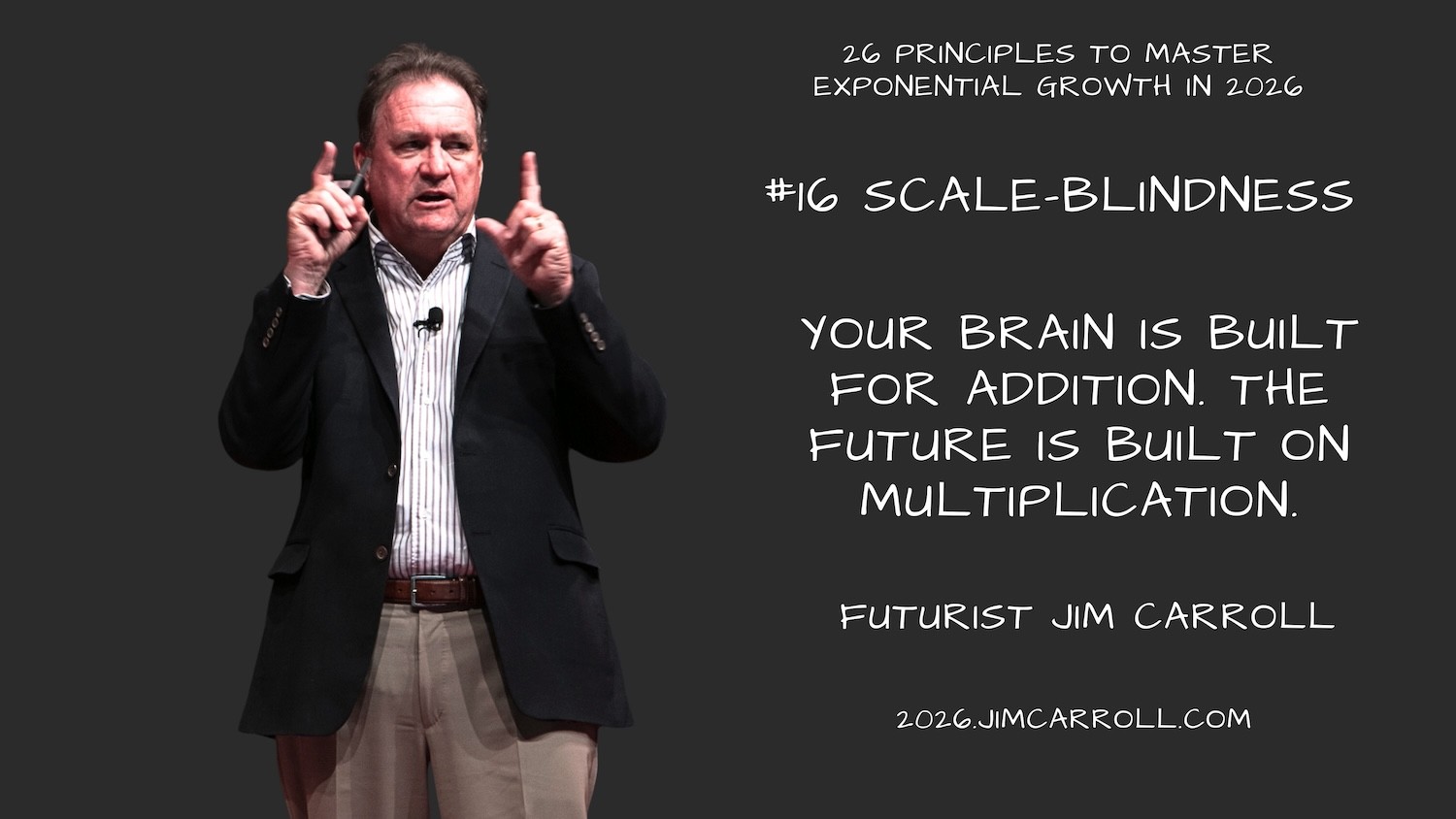
“Your brain is built for addition. The future is built on multiplication.” - Futurist Jim Carroll

---

Futurist Jim Carroll is writing his end-of-2025 / introduction-to-2026 series, 26 Principles for 2026. You can follow along at 2026.jimcarroll.com. He welcomes your comments.

---

When exponential change arrives, it never goes well.

That's because most people fail to understand what it means and don't act, which is a problem. After all, there is a remarkably narrow window between "this will never work" and "how did we miss this?"

We are on Day 16. Earlier in this series (go back to Day 2), we confronted the staggering velocity of change—the doubling of scientific knowledge, the acceleration of technological breakthroughs.

But there is a massive, invisible chasm we have not yet crossed:

It is the gap between intellectually knowing the numbers and viscerally comprehending what they mean for your reality in 36 months. It's called the scale-blindness epidemic, and why your brain cannot comprehend what is coming.

Consider this: you can read the reports on AI growth, computing power, or synthetic biology until your eyes bleed. You can nod your head and agree that things are moving fast.

But deep down, you don't believe it.

Why? Because you are a human being. We are linearly wired creatures living in an exponential world. Our brains evolved to track linear threats—a lion moving across the savannah at a constant speed. We understand “1, 2, 3, 4, 5.” Slow, linear growth.

But it seems we are biologically incapable of intuitively grasping “1, 2, 4, 8, 16, 32.” Wildly fast exponential growth.

Because of this evolutionary flaw, the vast majority of leaders suffer from "Scale-Blindness." When we look at an emerging exponential technology, our brains instinctively project its growth linearly. We do a 1-2-3-4-5 - not a 1-2-4-8-16-32. We look at what it can do today—which is usually underwhelming—and assume next year it will be maybe 10% better. And the fact is, it could be 100% better, or 1,000%, or maybe even 10,000%

And because of our blindness, we fail to miss out on the significance of the trend.

Think about it another way - if we see a 10-foot wave coming and prepare accordingly, completely blind to the fact that the exponential function will turn it into a 100-foot tsunami by the time it reaches shore.

That's why principle **#16** in this series isn't about learning more facts; it's about forcing your brain to undergo a sort of exponential shock therapy so you can cure this blindness before it's too late. That's because there is comfort in incremental thinking!

----
**** **** **** **** **** **** ****

Futurist Jim Carroll believes that most organizations are falling way behind when it comes to the 'acceleration gap.'

Original post: jimcarroll.com/2025/12/decodin

★ 1 • ↻ 0 original
Dec 12, 2025 · 11:33 AM UTC

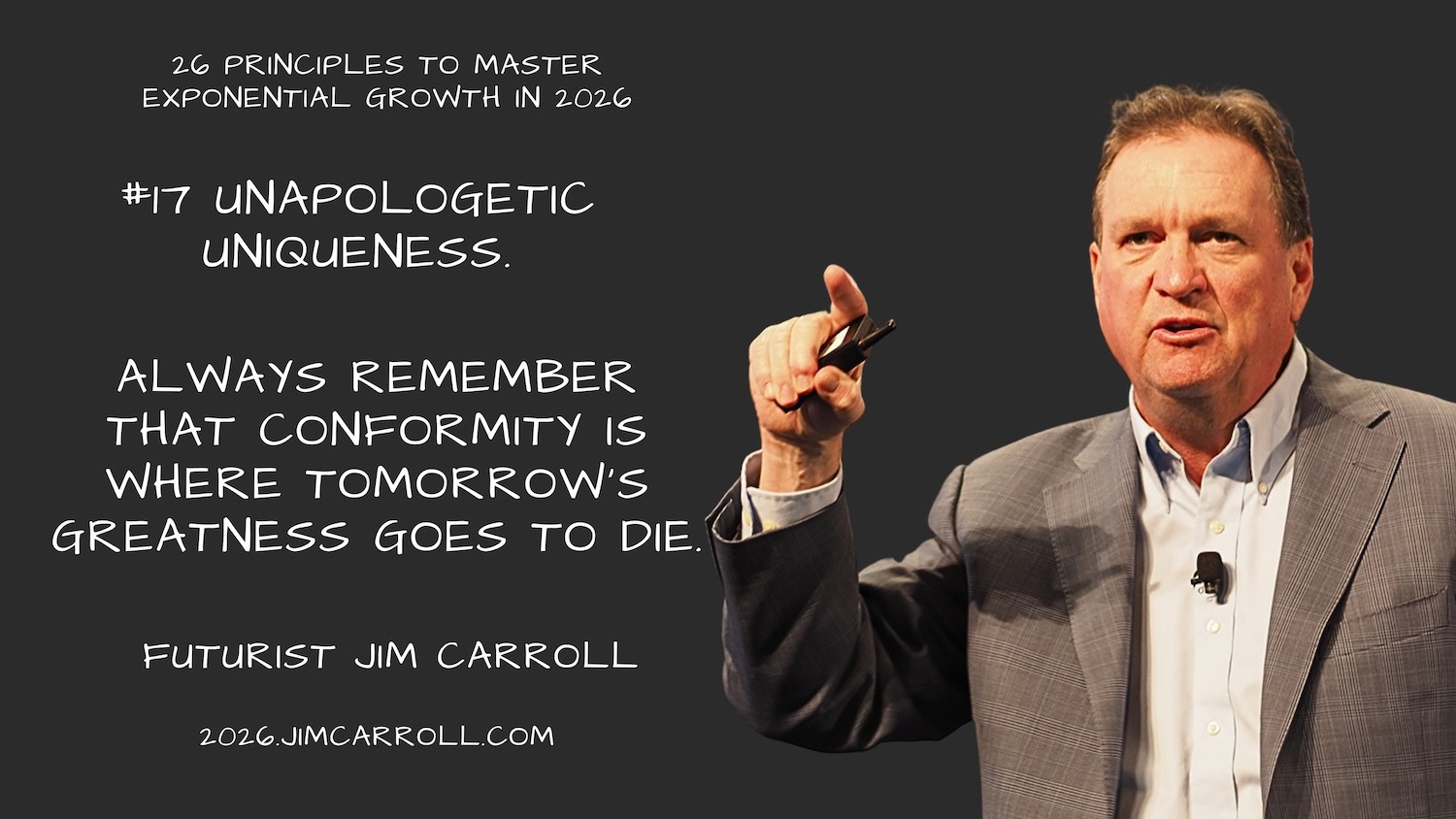
"Always remember that conformity is where tomorrow's greatness goes to die." - Futurist Jim Carroll

----

Futurist Jim Carroll is writing his end-of-2025 / introduction-to-2026 series, 26 Principles for 2026. You can follow along at 2026.jimcarroll.com. He welcomes your comments.
---

I've long suggested that one of the best ways to align with the future is through this thinking: when everybody is running one way, run the other way!

Be the contrarian. The hole in the bucket, the square peg with a bunch of round holes, the one who says "why not?' when everyone else is saying 'why?'

We are on Day 17. Yesterday, we looked at the terrifying math of the future—the sheer scale of change that is coming. 1-2-4-16-64 vs. 1-2-3-45.

When faced with that kind of overwhelming scale, the natural human instinct is to feel overwhelmed. And I am willing to admit that one reaction I see in common with all of my audiences is that this feeling is universal. I've been doing text-message-based polling from the stage for over 15 years, and one overwhelmingly consistent attitude is that people feel universally overwhelmed by the speed of the future.

So they try to avoid it. They try to fit in. They take the cautious route.

They choose the comfortable over discomfort.

The result? When we feel a need for comfort, to fit in, to follow the herd instinct, we try to be like everyone else. We look for safety in numbers. Case in point: we look at our competitors and say, "Well, they are doing AI this way, so we should too." Korn Ferry made this observation about AI: "Among the most expensive keeping-up-with-the-Joneses games in corporate history."

Need more proof? We seek out "best practices," which is usually just a fancy word for "copying the average."

I rest my case.

In a linear world, fitting in was a survival strategy. You survived by being a cog that fit perfectly into the machine.

In an exponential world, conformity is a death sentence.

Here's why: read the full post at the link below.

----

**** **** **** **** **** **** **** **** **** ****

The story of Oblio has defined much of Futurist Jim Carroll’s approach to life.

Original post: jimcarroll.com/2025/12/decodin

★ 2 • ↻ 0 original
Dec 15, 2025 · 11:34 AM UTC

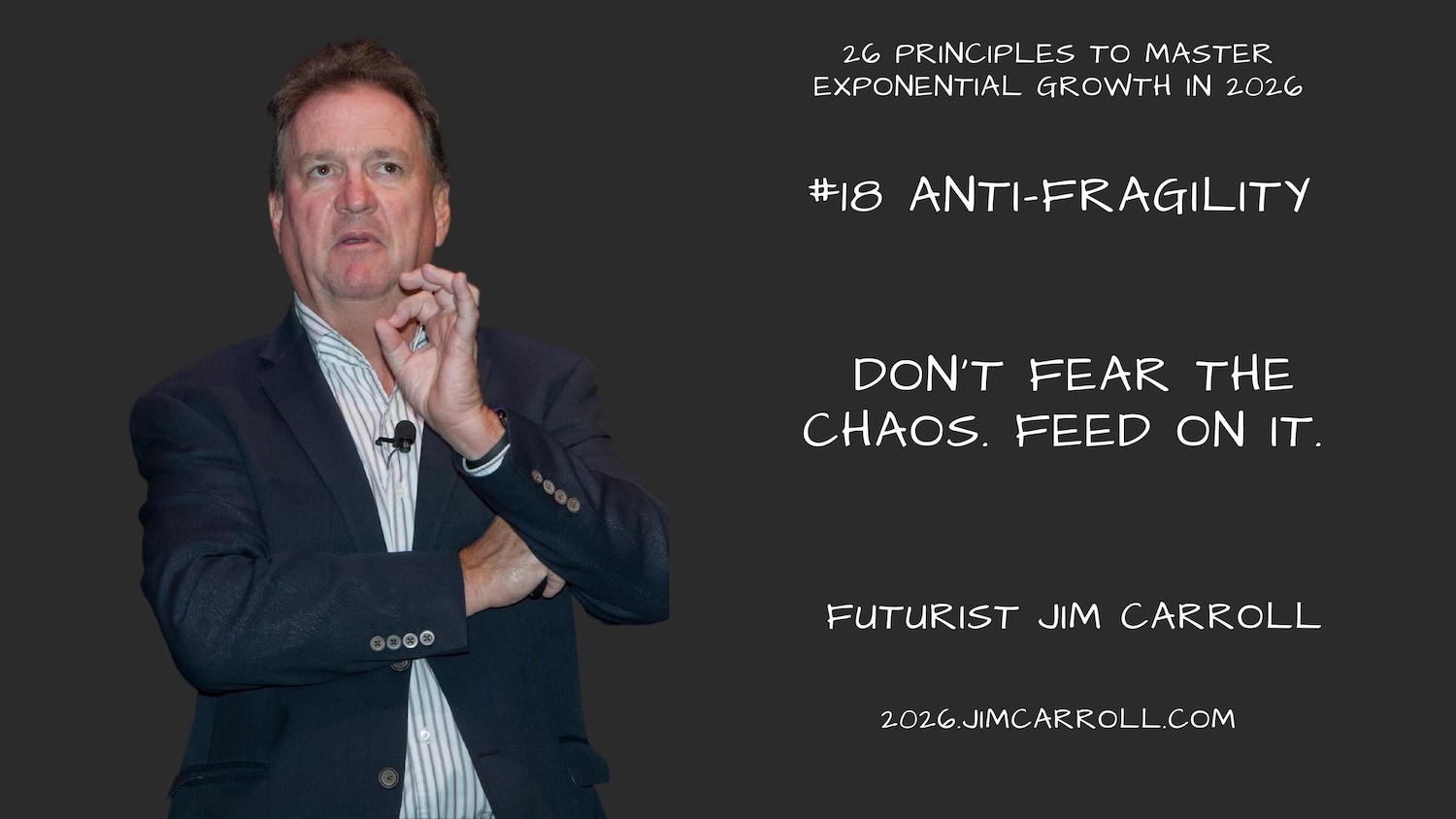
“Don't fear the chaos. Feed on it.” - Futurist Jim Carroll

---
Futurist Jim Carroll is writing his end-of-2025 / introduction-to-2026 series, 26 Principles for 2026. You can follow along at 2026.jimcarroll.com. He welcomes your comments.
---

Bouncing back is a losing strategy!

We are on Day 18. We have established that the future is scaling beyond comprehension (Day 16) and that your only defense is Unapologetic Uniqueness (Day 17).

Now, we must address the environment in which you will operate through 2026 and beyond. It is going to be even more volatile. It is going to be chaotic. It will be characterized by sudden shocks, black swans, and "impossible" events happening at almost every single moment.

Just like 2025.

Except far more volatile.

If you think about it, the standard corporate response to this has been the idea of developing "resilience." Everyone is talking about it, listening to experts on it, finding out how to manage, heck. Heck, even I use the phrase too much - I have a website all about it, resilience.jimcarroll.com.

I've come to realize that going forward, in an exponential world, resilience is not enough.

Resilience is a linear concept. It means surviving a shock and returning to your original shape—like a rubber band. It implies that "bouncing back" to the status quo is the goal. It assumes that going back to where you were - rather than where you should be going - is good enough.

But in 2026, the status quo is death. If you just "bounce back" to where you were in 2024, you are already behind, because 2026 is wildly different from what 'was two years before. Exponential change does that.

That's why you need to stop trying to be resilient and start becoming
Antifragile.

As I wrote in my book Dancing in the Rain: How Bold Leaders Grow Stronger in Stormy Times, the goal isn't to endure the storm. The goal is to use the energy of the storm to accelerate.

To understand why this shift to a mindset beyond 'resilience' is so critical, we can look at the data I compiled in the book. The research is detailed: the safety of the "middle ground" does not exist during periods of volatility. You are either accelerating away from the pack or falling behind it.

I spent a ridiculous amount of time on a crazy number of stages in front of tens of thousands of people who were shellshocked and whipsawed from 2000 to 2003 by economic volatility. I did it again after the 2008 global economic meltdown. And after that, too - every once in a while, I whip out these observations and share them from the stage.

Here's what you need to do right now!

---
**** **** **** **** **** **** **** **** **** ****

Futurist Jim Carroll really thinks you should buy his book, and wants to let you know that you can do that at dancing.jicmarroll.com

Original post: jimcarroll.com/2025/12/decodin

★ 2 • ↻ 0 original
Dec 15, 2025 · 3:47 PM UTC

**The Ultimate Innovation Guru Isn't in Silicon Valley... He's at the North Pole!** ❄️🚀

oss out everything you see on LinkedIn!!!

I'm going to share with you the BIGGEST leadership secret you have never thought about.

I'm so EXCITED TO SHARE IT I'VE EVEN UNABASHADLEY USED AI TO WRITE IT!

WALK, DON'T RUN, TO santa dot jimcarroll dot com. Link is also in comments!

Here's what you need to know.

The Ultimate Innovation Guru Isn't in Silicon Valley... He's at the North Pole! ❄️🚀

Forget the tech bros and the disruptors. If you want a masterclass in

SCALING, AGILITY, and BRAND LONGEVITY, you need to look at the guy in the red suit.

Go down the rabbit hole on santa.jimcarroll.com and your mind will be BLOWN.

Here is why Santa Claus is actually the most powerful innovation case study you will EVER read:

🚀 1. UNMATCHED Operational Excellence Move over, FedEx. Santa executes a global delivery logistics chain in a single night. WITHOUT GPS. That isn't just supply chain management; that is hyper-efficiency on a level we can’t even comprehend.

🔮 2. Predictive Analytics & Future-Readiness "He sees you when you're sleeping." Sounds creepy? No, that’s DATA. He knows customer behavior better than any algorithm. He is the OG trend-watcher, pivoting his inventory from wooden trains to Xboxes without missing a beat.

🤝 3. Radical Inclusivity & Talent Management Rudolph had a "bug" (a shiny red nose). Santa saw a FEATURE. He hired for diversity before it was a buzzword, turning a perceived weakness into a mission-critical navigation system. That is leadership.

🔥 4. The Ultimate Pivot (HR Agility) What do the elves do in the off-season? They redeploy as garden gnomes. 🍄 Talk about maximizing workforce utilization and flexible career paths!

❤️ 5. Brand Integrity & Ethics Naughty or Nice. It’s the ultimate KPI. He has maintained brand loyalty for centuriesby sticking to core values and delivering on promises. He shows up. Every. Single. Time.

The Lesson? Innovation isn't just about new tech. It's about reliability, deep customer insight, and the courage to lead with a singular, awe-inspiring mission.

Are you leading like Santa, or are you just a Grinch waiting for Q4 results? 🎄
👇

hashtag#Innovation hashtag#Leadership hashtag#FutureTrends hashtag#SupplyChain hashtag#SantaClaus hashtag#Busines

★ 0 • ↻ 0 original
Dec 16, 2025 · 11:11 AM UTC

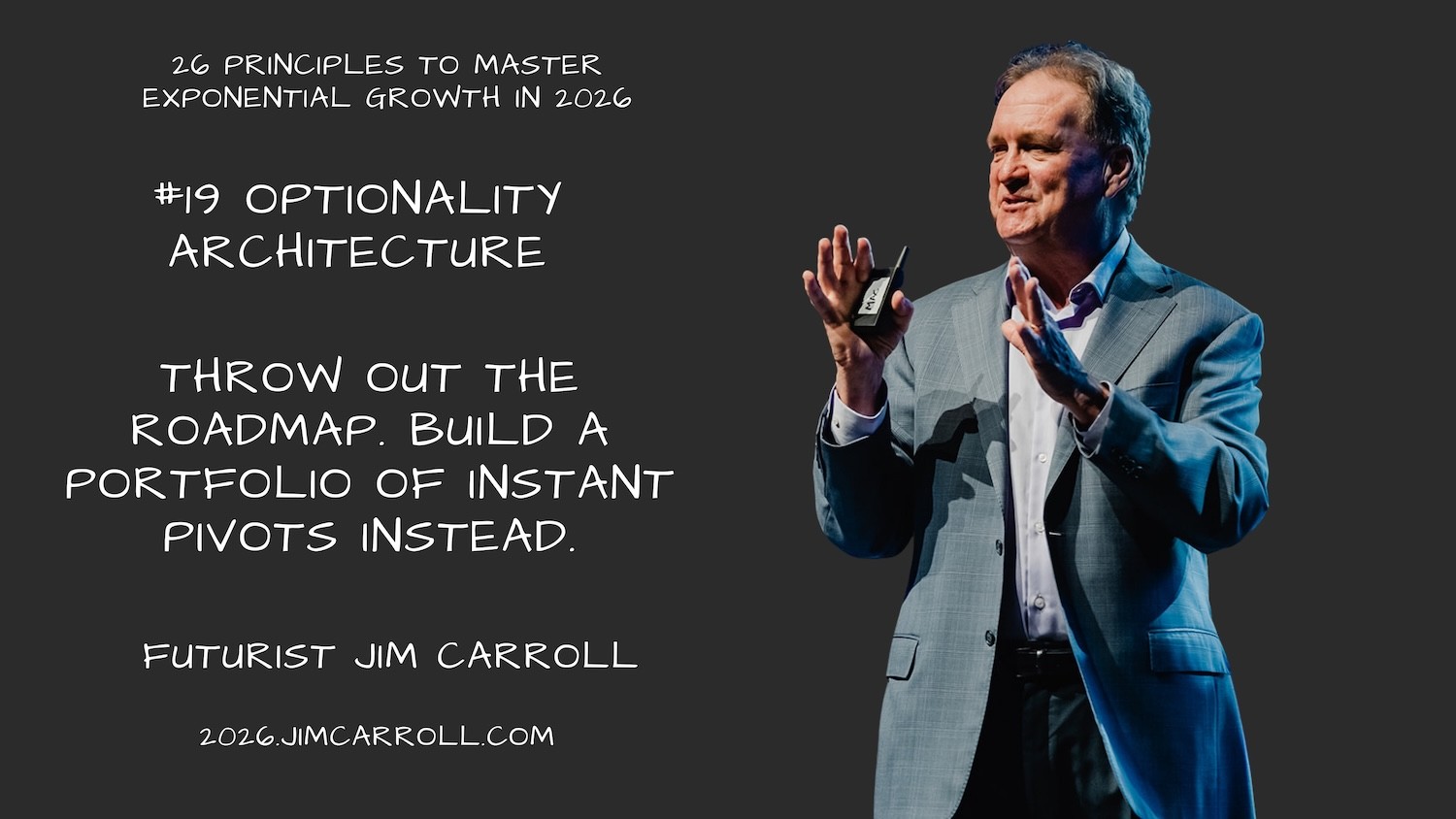
Folks wanted cheaper egThrow out the roadmap. Build a portfolio of instant pivots instead.” - Futurist Jim Carroll

---
Futurist Jim Carroll is writing his end-of-2025 / introduction-to-2026 series, 26 Principles for 2026. You can follow along at 2026.jimcarroll.com. He welcomes your comments.
---

Build options, not plans!

We are on Day 19 of this series and have covered a lot of ground. We’ve established the necessary foundation: the future is terrifyingly fast (Day 16), your only defense is being (Day 17), and you must adopt an "antifragile" mindset to feed on the chaos (Day 18).

The question today is this: How do you plan when you can’t predict? Or when what you predict doesn't happen because something else does. Or a trend is too complex 

Welcome to the idea of Optionality Architecture. Instead of building a plan, build a series of pivots, so that you are ready for whatever the hell happens!

Think about this idea. Planning is dead. Reacting with prebuilt plans is in.

Here's why.

In a linear world, the five-year plan was the gold standard. It was a single, rigid path based on the comforting (but false) assumption that the future would look mostly like the past. Strategy was about prediction and sticking to pre-determined plans.

A five-year plan today? Laughable! In an exponential world, a single, fixed plan is a strategic liability. The moment you commit to one path, a technology curve goes vertical, or a Black Swan event lands. The old strategy instantly becomes an anchor that guarantees you miss the shift.

The winning move is to stop worshipping the plan and start architecting the possible.

That's why the new principle you must master for 2026 and beyond is Optionality Architecture.

Beyond being a cool phrase that rolls off your tongue, it's a critical survival and success strategy you need to go forward.

To get it, you must understand what it is.

The most successful individuals and organizations in an exponential world don't just have options. They systematically construct portfolios of options.

Keep reading - learn your options!

----
**** **** **** **** **** **** **** **** **** ****

Original post: jimcarroll.com/2025/12/decodin

★ 1 • ↻ 0 original
Dec 17, 2025 · 12:35 PM UTC

“If you are the fastest person in the room, you are in the wrong room.” - Futurist Jim Carroll

---
Futurist Jim Carroll is writing his end-of-2025 / introduction-to-2026 series, 26 Principles for 2026. You can follow along at 2026.jimcarroll.com. He welcomes your comments.
---

The 1987 editorial "Tomorrow's Company Won't Have Walls" stands as one of the most accurate corporate prophecies of the modern era.

And it had a profound impact on my life.

It's probably fair to say that if I hadn't read it, I wouldn't have stepped out on my own to start my own company, chase my own career, do my own thing - and become a global freelancer, a nomadic worker, a lone wolf, long before the trend became real and the idea fashionable. Like I've said - I haven't had a job for 35 years, and I work really hard to not have to get a job!

It's worth reading, because it predicted with precision the modern organization of today.

Think about where we are now: many organizations don't define themselves by the depth of their staff - they do so by the reach of their skills network.

But in 2026 and beyond, the sophisticated reach of a networked organization is not enough.

It's no longer about the reach of your skills network, but also the speed with which they operate.

If they aren't as fast as you, it will slow you down even further, stunt your progress, and ruin your ability to align with exponential trends.

That's why, in 2026 and beyond, you have to stop letting slow partners kill your speed.
The Issue of Network Velocity

We are on Day 20. We have built your internal engine: You have the Unapologetic Uniqueness (Day 17), an Antifragile Mindset (Day 18), and Optionality Architecture (Day 19).

Do those things, and you are getting ready for our exponential world.

But as they say, "but wait, there's more!" Now, we must look outside.

You can have a Ferrari engine (your mindset), but if you are driving in a convoy of tractors (your partners), you are going to move at the speed of a tractor!

And here's the thing about what this means to the networked organization, and perhaps your role in it as a freelancer: in a linear world, we picked partners based on stability, history, and comfort. We stuck with the vendor we’d used for 20 years because "they know us."

In an exponential world, loyalty to the past is a guarantee for failure. If your supply chain, your technology vendors, or your peer group are evolving linearly while the market accelerates exponentially, they aren't just slowing you down.

They are anchors.

This means that another discipline you must master going forward is Network Velocity.

Learn why.

--
**** **** **** **** **** **** **** **** **** ****

Original post: jimcarroll.com/2025/12/decodin

★ 0 • ↻ 0 original
Dec 18, 2025 · 12:21 PM UTC

"Your new challenge isn't finding the insight - it's filtering out the noise." - Futurist Jim Carroll

---
Futurist Jim Carroll is writing his end-of-2025 / introduction-to-2026 series, 26 Principles for 2026. You can follow along at 2026.jimcarroll.com. He welcomes your comments.
---0

It used to be that the problem with the information age was that there was too
much information.

That's changed.

The new problem is now that not only is there too much information, but much of it is crap. And pretty soon, most of it is going to be crap.

That means one of the most important skills you need to develop in the information age is how to sift through the noise, to find what really matters.

Finding the gold amidst the crap matters.

Simply put, enhancing your ability to weed out reality from unreality, facts from the unfactual, the gems amidst the wreckage - this is what will move you forward into the future.

All of us are on a unique voyage into this strange new world, and as I often like to say: "We don't know where we are going, but we are making great time!'" In a world of infinite noise, the ultimate competitive advantage is not what you pay attention to. It is what you choose to ignore.

We are on Day 21. You have stripped away the mediocrity (Day 17), embraced the chaos (Day 18), built your options (Day 19), and upgraded your network (Day 20). Now, we must upgrade your eyes.

Now we need to think about Signal Intelligence: aka the art of ignoring in order to see. Success no longer depends on acquiring more information. It depends on ruthlessly filtering noise.

The Great Information Inversion: From Scarcity to Exhaustion

Let's put this challenge into perspective.

For decades, the world of learning and knowledge was simple: Information was scarce, so the strategy was accumulation. In a business context, the leader with the most reports won; the researcher with the deepest research team had the advantage; and the individual who mastered speed-reading had a leg up on everyone.

Then the Internet emerged, and we all began to learn about the strange new world of vast sums of electronic information. We taught ourselves to search. Then, as the volume of information grew, we began to graze. Finally, we began to rapid-scan.

The "new reality" with AI now takes us into a world that is crazier than we think. The global datasphere is experiencing a form of exponential growth that defies human intuition. It isn't just "more data," it is a fundamental change in the density of our digital atmosphere.

This means that the challenge isn't finding insight anymore.

It's filtering the overwhelming flood of synthetic noise to avoid exhaustion.

Learn more.

---
**** **** **** **** **** **** **** **** **** ****

Original post: jimcarroll.com/2025/12/decodin

★ 1 • ↻ 0 original
Dec 19, 2025 · 11:32 AM UTC

"Don't stay in your lane. The future is happening in the blur between the lines." - Futurist Jim Carroll

---
Futurist Jim Carroll is writing his end-of-2025 / introduction-to-2026 series, 26 Principles for 2026. You can follow along at 2026.jimcarroll.com. He welcomes your comments.
---

We are on Day 22. You have built the engine (Day 17), fuelled it with an anti-fragile mindset (Day 18), mapped your portfolio of options (Day 19), and opened your eyes to the road ahead (Day 21).

But here is the problem: You are still driving as if the old road signs exist!

This trend is easy to understand but difficult to comprehend.

Here's what's going on. In a linear world, we had "industries." Banks were banks. Car companies built cars. Hospitals treated patients.

Competitors were the people who sold exactly what you sold.

In an exponential world, these definitions are disappearing - because the boundaries that define an industry are disappearing. Why is that? Because the things that defined an industry were some very strict barriers, and a lot of 'friction' was involved to try to do anything. Today, with faster trends, technology, and AI, those barriers are disappearing because 'friction' is being eliminated.

Technology is not just speeding things up; it is melting the walls between sectors. If you define yourself by your "industry," you are already obsolete, because your biggest threat - and your biggest opportunity - is coming from outside of what you define it to be. From a personal career perspective, this has pretty profound implications - because if you are an 'expert' in a certain industry, what happens to you when the industry begins to blur?

The discipline you must master in 2026 and beyond is Boundary Dissolution.

Why are the walls between industries crashing down?

It goes back to the "Tomorrow's Company Won't Have Walls" idea - the new corporate structure allows companies to bend and shape, mold and modify, shift and change. We are moving from firms as closed, industry-defined “things” to firms as cross-sector systems that route data, payments, identity, logistics, and care across different partners at high speed.

To do a lot of these, they are hiring the people who are experts at the career pivot - people who bring a broad range of skills across a vast number of different knowledge areas, who have worked and can work in multiple different industries.

The new leader of the future is Gumby!

He or she doesn't have bones, but they have ambition. And in a rigid world, they bend the rules of every industry to build the future.

Don't take my word for it. Look at what is happening right now among the world's biggest players.

---

**** **** **** **** **** **** **** **** **** ****

Original post: jimcarroll.com/2025/12/decodin

★ 2 • ↻ 0 original
Dec 22, 2025 · 12:29 PM UTC

“Don't ‘learn’ AI. Redesign your personal productivity around it.” - Futurist Jim Carroll

--
Futurist Jim Carroll is writing his end-of-2025 / introduction-to-2026 series, 26 Principles for 2026. You can follow along at 2026.jimcarroll.com. He welcomes your comments.
--

Like it or not, you will have to learn to live with "The Machine."

We are on Day 24. You have the radar (Day 21), the open road (Day 22), and many principles I've shared before that. Now, we must address the elephant in the room: The Machine.

For the last three years, the narrative has been “Man vs. Machine.” People are going to lose their jobs! We will all be working 2 hours a day, 3 days a week, because AI will do all the work. Stuff like that.

In 2026, that line of thinking is obsolete. You need to get beyond the hype and hysteria. The competition isn’t between you and the AI. The competition is between “You + AI” and “You Alone.”

The Linear Leader tries to outwork the algorithm. The Exponential Leader learns to partner with it.

Don't fear having to compete with AI. Learn to conduct it. The discipline you must master is Algorithmic Partnership.
Through 2025, many came to realize that while AI could generate content at infinite speed, it often lacked context, nuance, and truth. It made stuff up. It was often full of eras. We started to explain that it was 'hallucinating.' All while it continued to improve at a staggering speed, our understanding of its limitations, weaknesses, and faults also began to grow.

And with that, the narrative began to change. It wasn’t to be our master; it was more an immature and fast "intern” that required constant supervision. Rather than replacing us, we had to monitor it, watch it, and carefully assess its work.

It's “jobs chaos,” rather than a “jobs apocalypse.”

Learn why.

---

**** **** **** **** **** **** **** **** **** ****

Futurist Jim Carroll predicts that in 10 years, we will all look back and have a good laugh at the AI hysteria of 2022-2025.

Original post: jimcarroll.com/2025/12/decodin

★ 1 • ↻ 0 original
Dec 23, 2025 · 11:37 AM UTC

"Christmas 2025: It's better to be grateful for what you have gained, instead of focusing on what you've lost."

Normally, at this time of year, I would be busy on a ski hill, seeking the joy that comes from the exuberance of the carve.

I'm not.

Instead, I'm at home, geeking out, learning all kinds of new technology, and taking it easy. Every once in a while, I glance at the webcam at my ski club and see those who are in the moment, enjoying their turns. You see, in my part of the world, it's turned into an amazing early ski season.

I'm not part of it.

You see, just about a month ago, I broke some small bones in my spine in a violent fall. It was icy; the concrete stairs at the chalet were covered, and I took a slide right off and landed on my back.

A spinal injury.

The result was that I suffered 3 small fractures of what are called the transverse processes on my spine. I have images. You can see the break on the right.

I have the fall on video; a security webcam caught it. It's hard to watch, and it's hard to think about because I keep replaying the moment in my mind. I think it was when I shared it with the triage nurse at the ER that they decided they should see me right away.

And so right now, I am in the land of the 'if only's.'

If only.

You know. If only I hadn't gone to the chalet that day. If only I hadn't decided to work on a small project outside. If only the steps weren't icy. If only...
It's easy to do the 'if onlys' because it offers a way out.

And yet, it doesn't.

So what's my status? As soon as you hear the word 'spinal,' you freak out - as I did at the ER. The reality, though, is that this is an entirely minor break when it comes to back injuries, and is entirely recoverable.

With time.

And patience.

Which, traditionally, I do not have a lot of.

The path? One to two weeks of hardcore pain (now gone), two to four weeks of being extremely careful (which I am coming to the end of), and three to six months of full recovery (if you do what you are told to do- which is, not much.)

It's fully recoverable - if I follow the guidance, don't rush, things and don't do anything stupid.

Through all of this, I've come to understand the depth of the beautiful guidance that exists in the Serenity Prayer, which I have on hardcore repeat in my mind. "Help me accept the things I cannot change, the courage to accept the things I can, and the wisdom to know the difference."

So what do I have?

Oh, so many things. I am so truly, truly blessed.

Read the full post for more...... the link is below.

And so from the bottom of my heart, and from the depth of my gratitude, I'd like to say, Merry Christmas and Happy New Year!

---

Futurist Jim Carroll is working hard to be patient, follow the process, not to push things, and not being stupid.

Original post: jimcarroll.com/2025/12/daily-i

★ 0 • ↻ 0 original
Dec 29, 2025 · 3:15 PM UTC

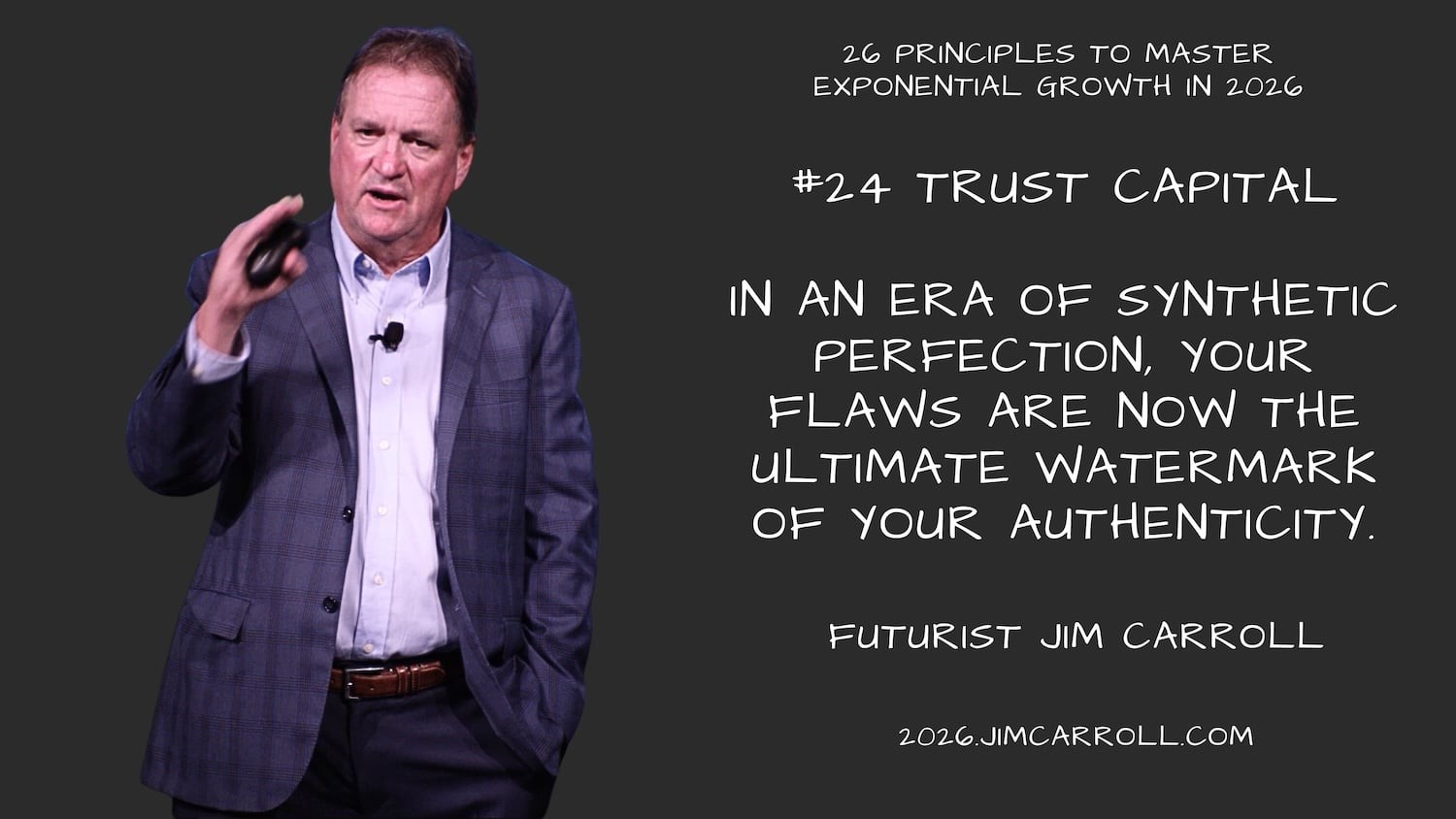
"In an era of synthetic perfection, your flaws are now the ultimate watermark of your authenticity." - Futurist Jim Carroll

---
Futurist Jim Carroll is writing his end-of-2025 / introduction-to-2026 series, 26 Principles for 2026. You can follow along at 2026.jimcarroll.com. He welcomes your comments.
---

Rather than hiding our mistakes, we should celebrate them!

----

I'm back!

I've put a lot of thought into this series. I know that you likely aren't reading every one - and indeed, if you are like most people, you are simply skimming what's here.

Today, you need to skim this key point - in 2026 and beyond, you need to take the time to secure your most valuable asset: Your humanity.

How do you do that?

Share your flaws. Highlight your failures. Document your mistakes.

Admit you are human!

There's no doubt that with AI moving as fast as it is, we stand on the precipice of a strange new era - we could call it the “Age of Infinite Perfection.” Synthetic media, algorithmic amplification, and automated engagement surround us. Slop, we've called it. And it is quickly leading to what some have called the "dead Internet," a world where a staggering percentage of online traffic and content generation is generated by non-human sources. Generated by AI, indexed by algorithms, and served to you based on what a machine thinks you need to see.

And the problem with a lot of this is that the machines are getting so good that they are getting close to absolute perfection. Have you seen the latest with AI video? Have you looked at an image and had to check yourself to remember that its;' from an AI? Have you been duped by an artist with stunningly powerful music only to discover it's an AI?

I have!

Check out Let Babylon Burn. Listen to this song. I had it on repeat for a month before I realized it wasn't real!

youtube.com/watch?v=86VjmpHa10A

If you are a brand, a product, a company or an individual, how will you ever manage to stand out among the slop? Or stuff that is so perfect, it fools you into believing it's real?

In this environment, the trust that people have in people, companies, brands, and transactions is dropping to zero. Some call it the 'trust floor.' Not only that, but we are all getting access to the same tools that allow us to generate perfection on demand.

When everyone is perfect, what stands out? Failure! Mistakes! Imperfection!

Flaws.

What's the solution? Embracing the idea of Kintsugi!

----

**** **** **** **** **** **** **** **** **** ****

Futurist Jim Carroll has made a lot of mistakes. He's proud of most of them.

Original post: jimcarroll.com/2025/12/decodin

★ 1 • ↻ 0 original
Dec 30, 2025 · 12:22 PM UTC

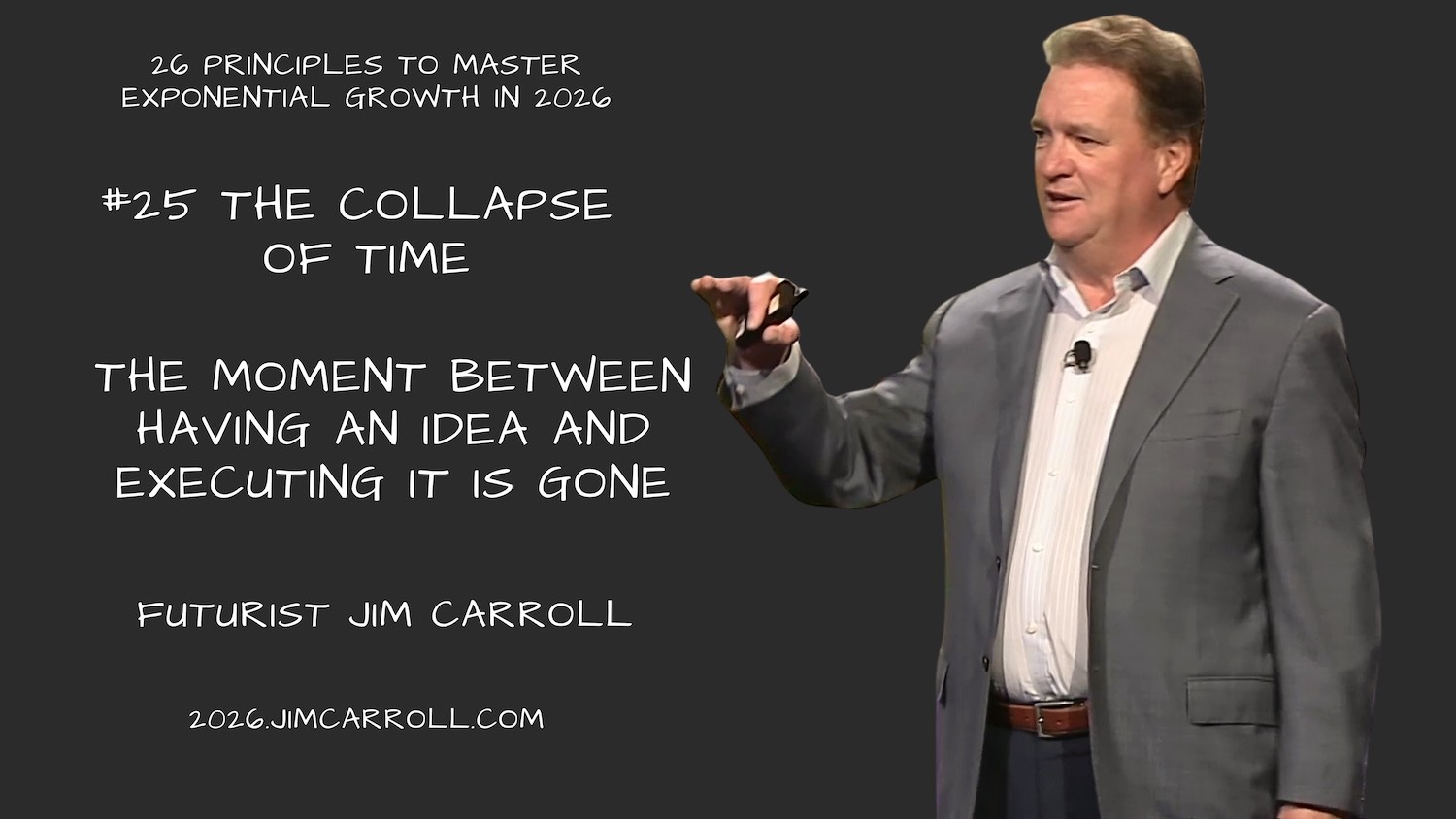
"The moment between having an idea and executing it is gone" - Futurist Jim Carroll
--
Futurist Jim Carroll is writing his end-of-2025 / introduction-to-2026 series, 26 Principles for 2026. You can follow along at 2026.jimcarroll.com. He welcomes your comments.
--

Get ready for the reality that the distance between ‘imagination’ and ‘reality’ is collapsing

We are on Day 25. We are one day away from the finish line!

Today, you need to think about speed, velocity, and acceleration.

Yes, I've covered a lot about the issue of speed (Day 1) and scale (Day 16). However, before we conclude this series, it is essential to understand the actual physics, science, and technology behind the phenomena unfolding in our exponential world.

Here's the core issue: for the vast majority of human history, the relationship between your imagination and the realization of what you could achieve was governed by the "friction" of the physical world. It took time to do things. If a civilization wanted to build a cathedral, it measured the project in centuries. If a pharmaceutical company sought to cure a disease, it measured the timeline in decades.

Time was the constant barrier to progress, something that was not easily broken. In that way, you could think of it as a tax levied on progress.,
In 2025, that tax was repealed.

We have entered the era of the "Collapse of Time."

The old "operating system" that has governed progress, where step B had to patiently wait for step A to finish before it could move forward, is being overwritten by an exponential new world in which many things happen all at once.

This is not just a theoretical idea - over the last 24 months, we have witnessed the compression of timelines across every sector.

Here's why.

If we look back at what happened over the last two years, with the arrival of AI and the maturing of many other trends, the issue of acceleration is everywhere.

Keep reading!

---
**** **** **** **** **** **** **** **** **** ****

Futurist Jim Carroll is done with writing books about the issue of speed, because it seems everybody is finally getting it.

Original post: jimcarroll.com/2025/12/decodin

★ 1 • ↻ 1 original
Dec 31, 2025 · 12:03 PM UTC

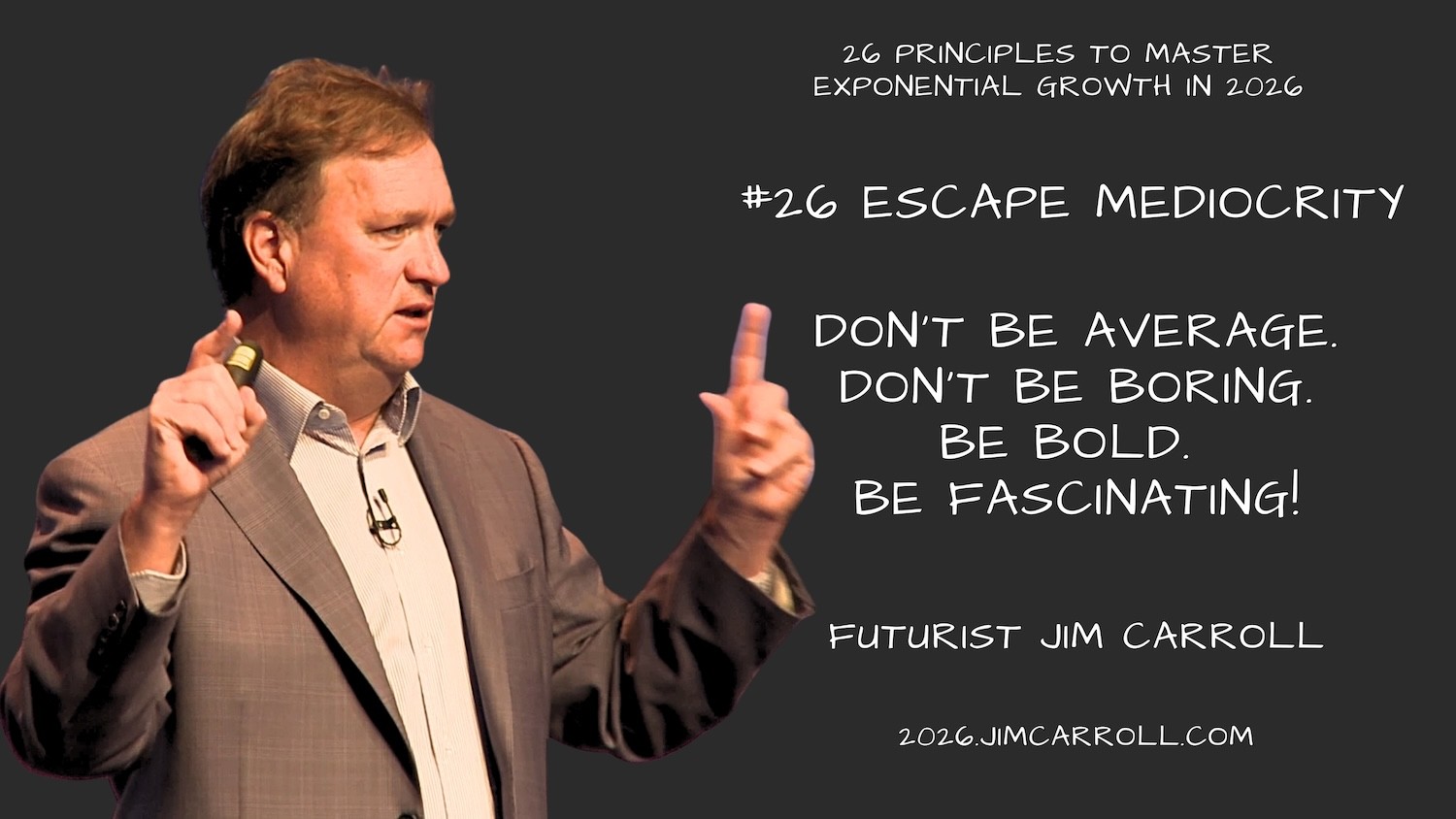
"Don't be average. Don’t be boring. Be bold. Be fascinating!" - Futurist Jim Carroll

2025 is almost a wrap.

And that brings me to 279 days of my Daily Inspiration post in 2025, continuing the tradition that began early in August 2016, where each workday involves a bit of fresh new insight.

Since then, I have not missed ONE single workday. Come hell or high water, power failure or jet lag, the post has gone out!

Here's a slideshow of what I wrote in 2025. 279 inspirations! Today marks 280!

youtube.com/watch?v=lJpEdbKByLE

And then it starts all over again tomorrow, on Thursday, January 1, 2026 - with my "10 Great Words for 2026," which itself began in 2006.
If you haven't signed up, join the 1/4 million who get it every day.

Do so at subscribe.jimcarroll.com

----
There's no doubt that there's a lot of challenge to come in 2026, but there's also a lot of opportunity.

Opportunities become even bigger when exponential trends become a reality.

But here's the thing - it's up to you whether you will turn it into an opportunity, or whether the challenge will bury you.

It depends on the choices you make and the actions you take.

But there is a dark side to velocity.

If you choose to let the challenges rule, you'll slide into mediocrity like
everyone else - you'll embrace it.

But if you decide to be bold, be daring, you'll escape it - and you'll find it absolutely fascinating!

So what's your choice - are you going to embrace, or escape, the potential for mediocrity that is in front of us with this exponential world?

You need to think about the issue of mediocrity in terms of your personal choice and the company you are involved with. If you decide to do boring things and chase average, you'll be mediocre. If you choose to be bold, you'll find things to be far more fascinating! If you take a mediocre organization and give it average tools and vague objectives, you don't get innovation. You get accelerated incompetence.

I explored this side of the equation in my satire "Embracing Mediocrity"—a guide on how to do the bare minimum—and its antidote, "Escaping Mediocrity." In the past, you could survive being "average" because the market moved slowly. You could hide in the margins.

You should choose to buy the books right now. Be bold! You'll find them to be fascinating!

Visit mediocirity.jimcarrolll.com. Use the code BEBOLD, and you'll get 20% off!

Here's what you need to think about.

Read the full post.

----

Futurist Jim Carroll will resume his Daily Inspiration tomorrow with his 10 Great Words for 2026.

**** **** **** **** **** **** **** **** **** ****

Original post: jimcarroll.com/2025/12/decodin

★ 1 • ↻ 0 original
← November 2025January 2026 →