Futurist Jim Carroll

Mastodon post archive · 2022–2026
Archived from mastodon.futurist.info · 4209 posts
← All months

October 2025 · 28 posts

← September 2025November 2025 →
Oct 1, 2025 · 10:19 AM UTC

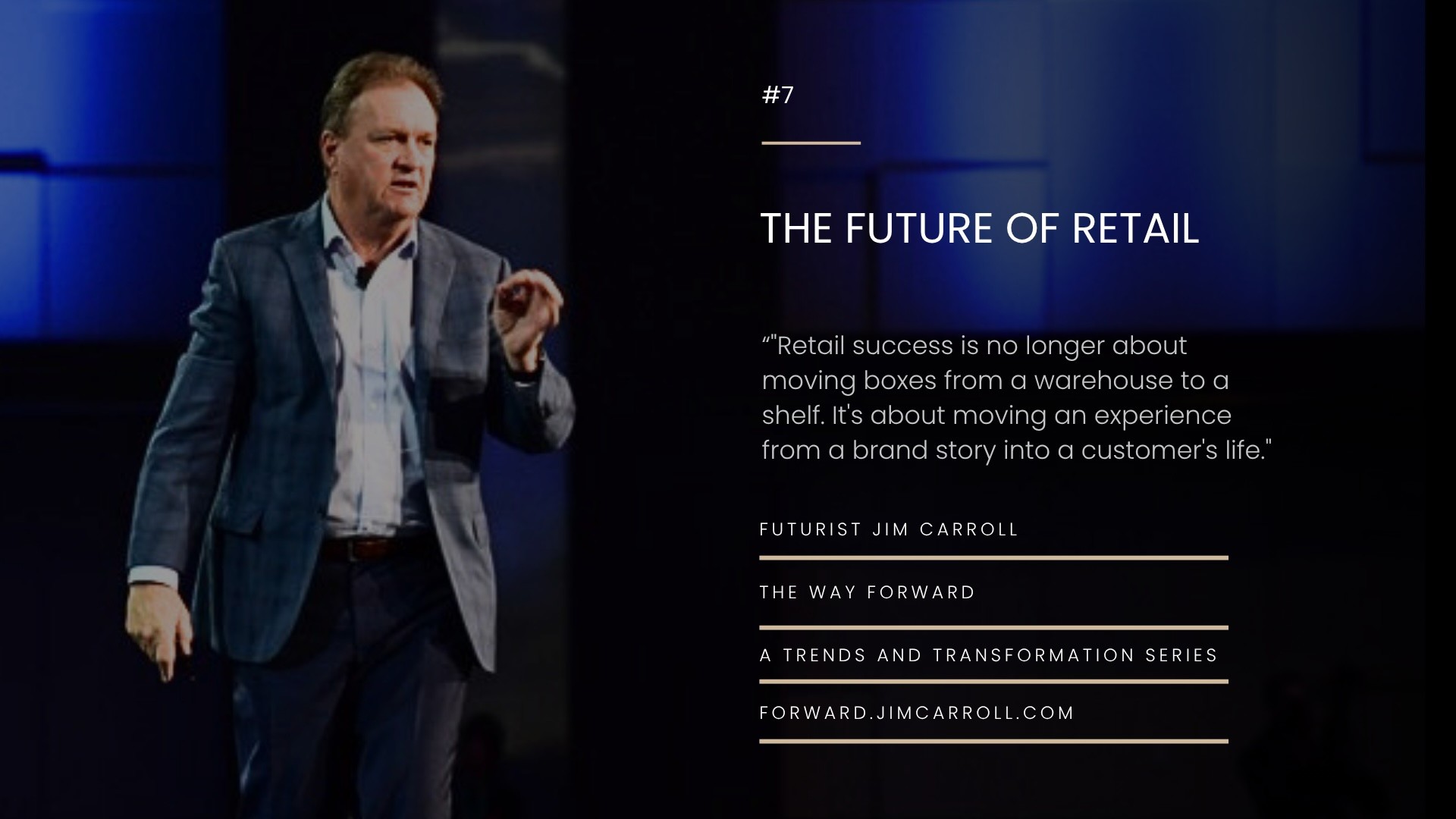
“Retail success is no longer about moving boxes from a warehouse to a shelf. It's about moving an experience from a brand story into a customer's life." - Futurist Jim Carroll

Perhaps no industry has been impacted more by the forces of disruption - the rise of Amazon, e-commerce, supply chain sophistication, changing consumers, and more.

And yet the fact is, the retail landscape is undergoing and still very much in the midst of a tectonic shift, moving decisively away from a product-centric universe to one governed by experiences, relationships, and values. It's all about the entertainment, engagement, and experience, being driven by a new generation of consumers who wield unprecedented influence through digital platforms. For retailers, technological adoption is no longer a matter of choice; it is a fundamental and urgent response to a profound change in consumer power, behavior, and expectations.

Success through 2030 will be defined not by what a retailer sells, but by how it engages, empowers, and aligns with the values of its customers. Let's start with the major trends impacting the sector.

The end of inventory
The experiential imperative
The autonomous last mile
The AI-powered supply chain
Phygital convergence
The great decoupling & supply chain resilience.
The ascendant consumer.
The circular economy.
The collapse of attention spans.
The sentient network.

While the future holds immense promise, the path to transformation is littered with significant barriers that are creating a divide between the agile innovators and the incumbents struggling to adapt.

Read the rest of the post!

----

Futurist Jim Carroll covers retail issues in his blog at jimcarroll.com/category/retail

**** **** **** **** **** **** **** **** **** ****

Original post: jimcarroll.com/2025/10/decodin

★ 1 • ↻ 2 original
Oct 2, 2025 · 10:22 AM UTC

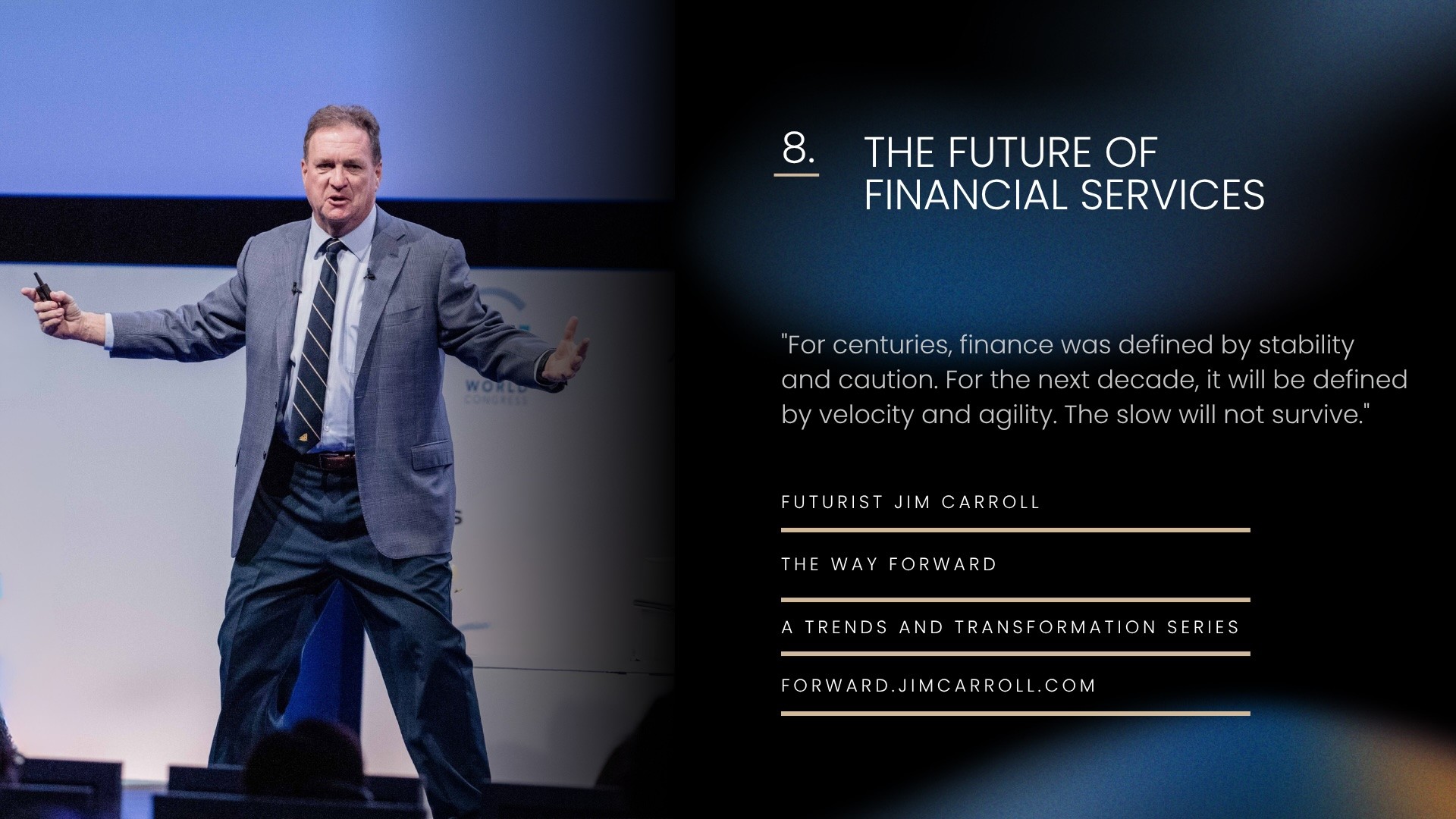
“For centuries, finance was defined by stability and caution. For the next decade, it will be defined by velocity and agility. The slow will not survive." - Futurist Jim Carroll

The financial services industry, an institution built on centuries of tradition and perceived stability, is in the midst of its most profound and disruptive transformation in history.

The very concept of money, the nature of a transaction, and the role of the institutions that manage our wealth are being fundamentally reimagined. A powerful convergence of mobile technology, artificial intelligence, and a new generation of digital-native competitors is dismantling old certainties and creating a new, high-velocity financial industry where speed matters!

The shifting landscape: 10 trends redefining financial services

To succeed in this new environment, one must first understand the powerful currents reshaping the entire industry, from retail banking to global investment.

The AI imperative.
The blockchain promise.
The API economy & open banking.
The FinTech vanguard.
The acceleration of risk.
The empowered, digital-native customer.
The reinvention of wealth management.
The human capital deficit.
The new battleground of data.
The great generational wealth transfer.

All of this means a lot of disruption, change and opportunity!

Read the full post

----

**** **** **** **** **** **** **** **** **** ****

Original post: jimcarroll.com/2025/10/decodin

★ 1 • ↻ 0 original
Oct 3, 2025 · 8:49 AM UTC

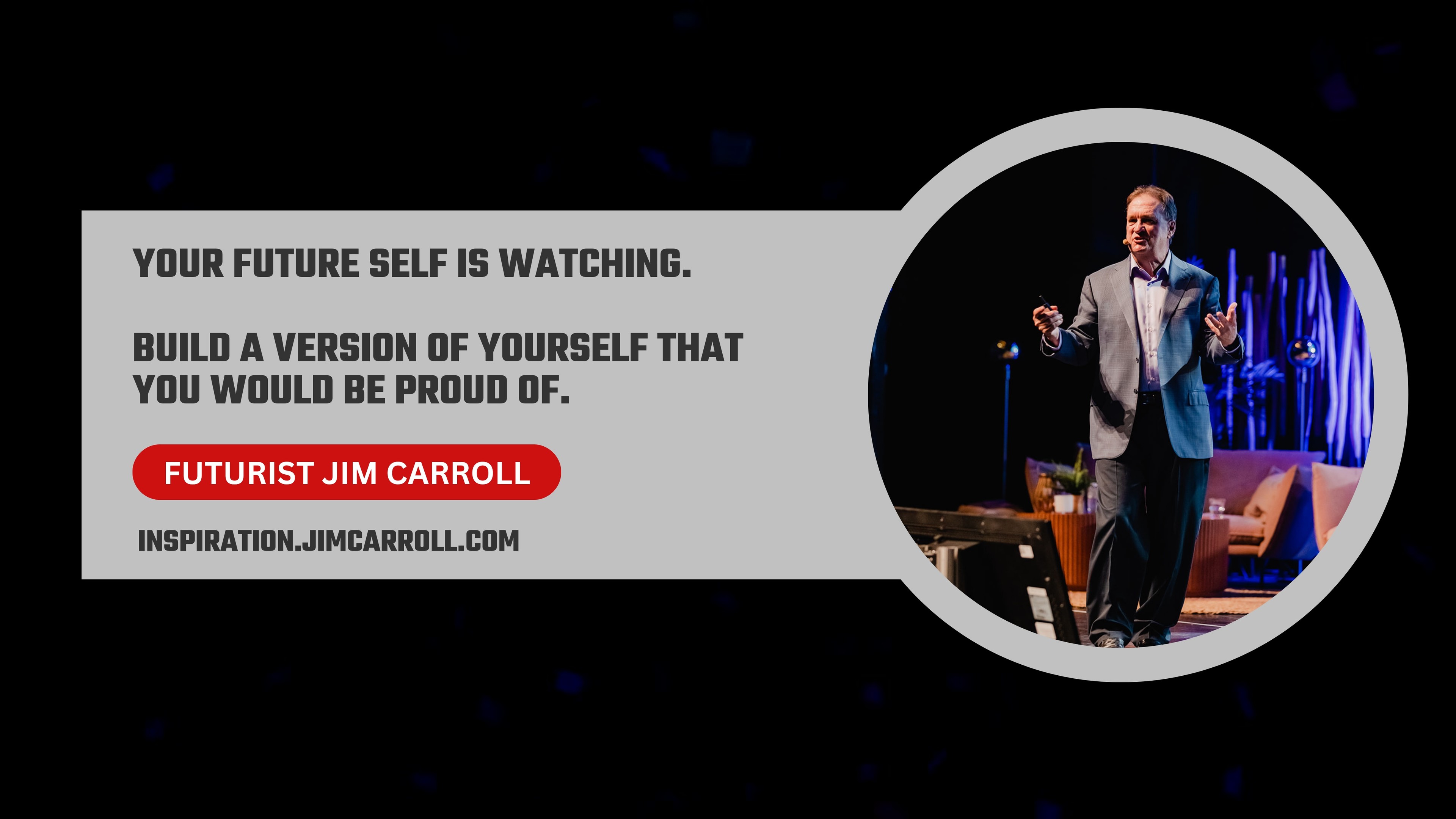
"Your future self is watching. Build a version of yourself that you would be proud of." - Futurist Jim Carroll

Here's some Friday inspiration!

I'm working on a new keynote topic - The Future of Work as a High-Speed Operating System: How to Stop Planning for the Future and Start Running On It!

You can find it over on my signature keynotes page. It's all about how organizations need to start building teams that are aligned to the speed of tomorrow, not the slow pace of yesterday.

While working on it, it got me thinking - if someone had to build a future version of their personal operating system, what would it look like? What would our version 30.0 look like? And what you have to do to get there!

The cool thing about how I'm using AI is that I can go back and quiz myself - I put this question to the thousands of Daily Inspiration posts I've written since 2016, and ti came up with this fantastic list.

25 Things to Do Right Now to Build A Better Future Self.

Become the architect of your future, not a tenant in your past

Live in "day 1"

Choose possibility over problems

Define your own success

Develop an "anti-fragile" mindset

Practice "just-in-time" learning

Build "experiential capital"

Turn "what if" into "what's next"

Launch your "version 0.1"

Reverse a "tin can" belief

Learn to "dance in the rain"

Grow from your disappointments, don't hide from them

Practice decisive optimism

Build your integrity ledger

Master the art of the "intelligent failure"

Become a "cross-disciplinary specialist"

Weaponize your curiosity

Conduct a "personal skills audit" every quarter

Master the skill of asking the right questions

Learn to "vibe code" your life

Find the visionaries, not the skeptics

Build a "knowledge farm"

Practice reverse mentorship

Be the person who asks "why not?" and then follows up with "why not now?"

Architect what isn't:

That's a pretty good starting point to build yourself a better future self!

----

**** **** **** **** **** **** **** **** **** ****-improvement

Futurist Jim Carroll has written 2,340 Daily Inspiration posts in his series so far, all of which can be found via inspiration.jimcarroll.com

Original post: jimcarroll.com/2025/10/decodin

★ 2 • ↻ 0 original
Oct 6, 2025 · 10:21 AM UTC

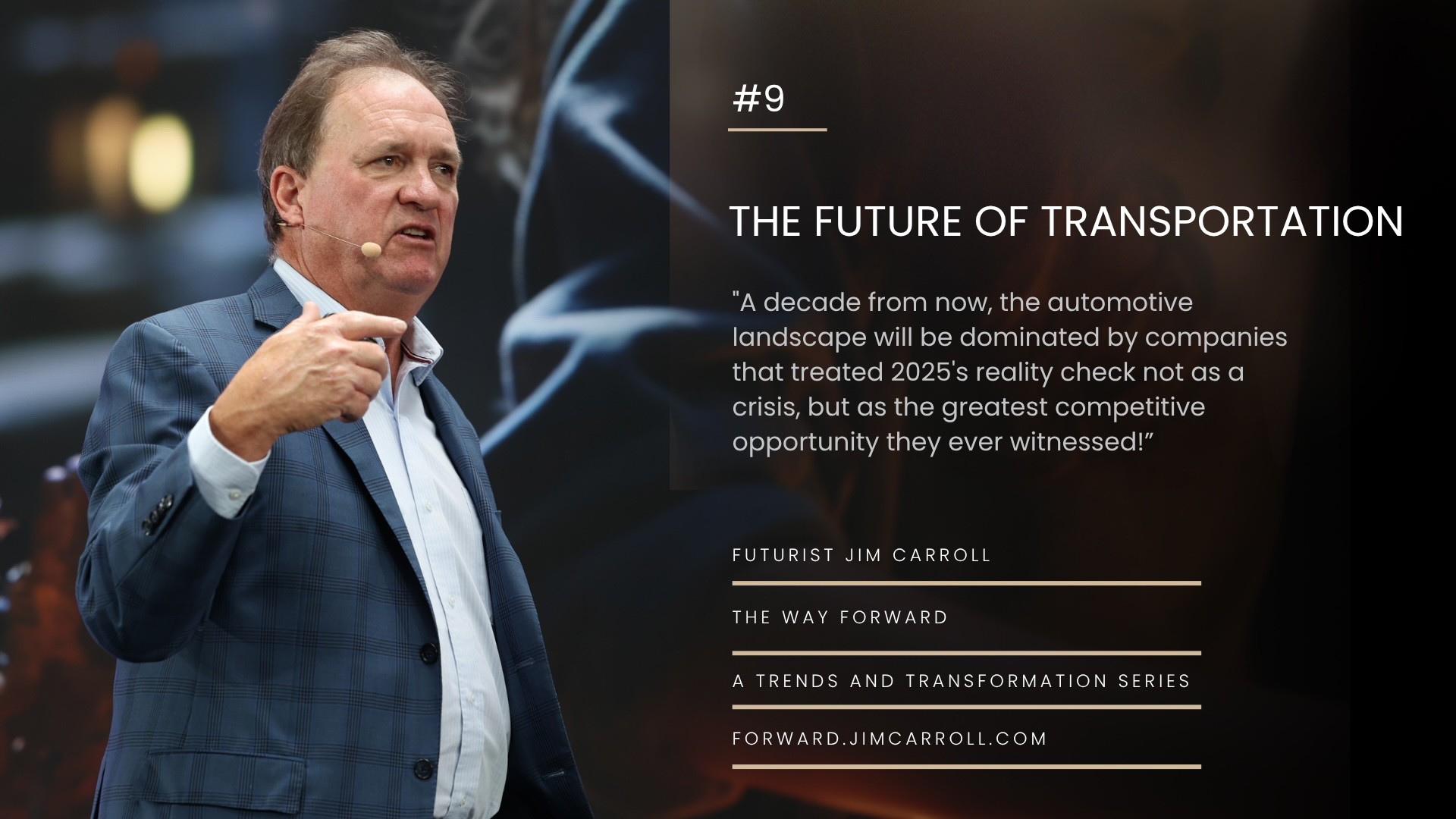
"A decade from now, the automotive landscape will be dominated by companies that treated 2025's reality check not as a crisis, but as the greatest competitive opportunity they ever witnessed!” - Futurist Jim Carroll

The year 2025 marks a fundamental "Great Recalibration" for the global automotive industry, where the trends related to electrification and autonomy have collided with economic, political, and consumer realities. And perhaps we have not seen an industry - concentrated in Detroit, Stuttgart, and Tokyo - throw away its future in such reckless fashion.

Where are we at this point, and what's the way forward? The once-unquestioned acceleration toward an all-electric, fully autonomous future has been interrupted by significant headwinds, particularly in Western markets.

This has triggered a strategic divergence: legacy automakers seem to be giving up on the trend to once again concentrate on carbon vehicles, squeezing as much as they can out of a dying platform, while new, aggressive Asian automakers take over a future based on EVs.

Blunt, but reality perhaps!

Let's dig in!

The narrative of an imminent, seamless transition to an electric and autonomous future has been decisively fractured in 2025. The year represents a market-wide reckoning, where all of the trends above have met the friction of real-world economics, infrastructure limitations, and political volatility.

Perhaps the biggest issue is how EVs have become a part of the culture wars - suddenly, to cling to one's diesel-belching heavy-duty pickup truck is seen as an oath of allegiance, a pledge to potential greatness, and a testament to ultimate failure.

What happened? Where does it go from here?

----

Futurist Jim Carroll often has his Tesla Model 3 drive him home from the golf course, but still finds it to be a pretty weird experience.

**** **** **** **** **** **** **** **** **** ****
****
Original post: jimcarroll.com/2025/10/decodin

★ 1 • ↻ 0 original
Oct 6, 2025 · 7:02 PM UTC

Ya, just a reminder that I pretty much predicted where we are today back in 2017. Like, completely nailed it.

Except the war with China thing, but hey, there's still time.

badthings.jimcarroll.com

★ 0 • ↻ 0 original
Oct 7, 2025 · 10:05 AM UTC

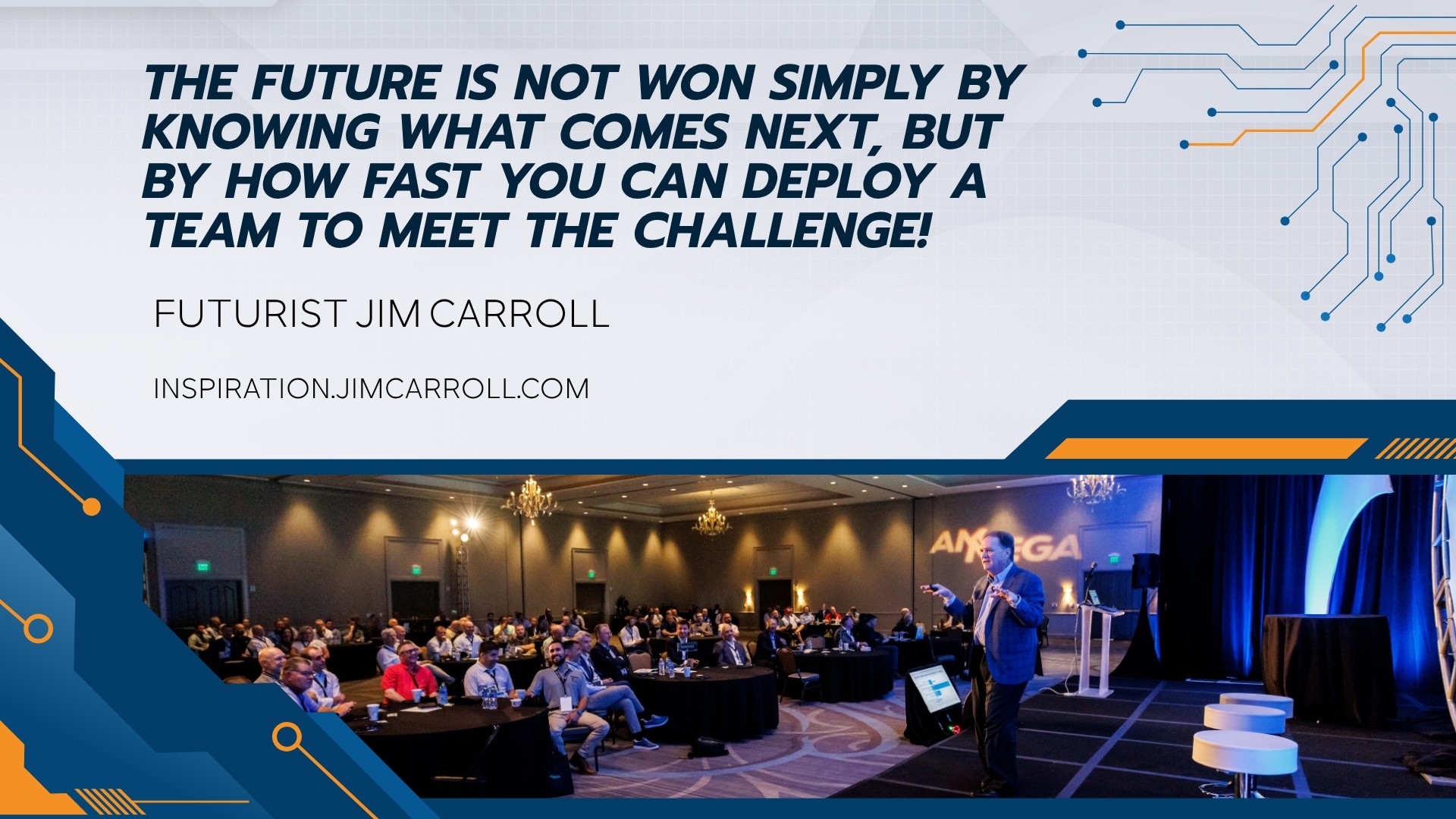
Daily Inspiration - The Future of Work: "The future is not won simply by knowing what comes next, but by how fast you can deploy a team to meet the challenge!" - Futurist Jim Carroll

A client approached me for a keynote that went into the topic of the future of work.

He didn't want the typical focus found with the topic, which tends to come from a typical HR focus.

He wanted to know how to relate future trends to the future skills needed to align with those trends.

Companies know they must upskill their workforce to deal with the trends that define tomorrow, and yet they believe their team is not ready. This means that while a forward-looking 85% of employers plan to prioritize upskilling for this new reality, their own managers are sounding the alarm, with 64% believing their employees cannot keep pace with future skill needs.

In other words, the workforce is not ready for the future!

This led me to create a new structure for a keynote topic - Solving the Acceleration Paradox: A New Playbook for the Future of Work. The full description is over on my Signature Keynotes page.

In the midst of this, I came across this fascinating Wall Street Journal article late last night. This is precisely the type of path forward that I'm building into the keynote. THIS is the future of work!

---

Inside the Bank Where Almost Every Employee Is a Gig Worker Wall Street Journal, Oct. 6, 2025

At Standard Chartered, a ‘talent marketplace’ lets workers take on in-house ‘gigs’ to smooth the way for AI adoption. And the idea is gaining traction elsewhere as the technology upends workforces.

-----

All of this got me thinking, and I began writing this post - but I originally started with this idea. "The future is not won by what your team knows now, but by how fast it learns what it needs to know next!”

And then I realized I was on to something!

Read the rest of the post for more!

----

Futurist Jim Carroll first explored the topic of the 'future of work' in his 1997 book, Surviving the Information Age.

**** **** **** **** **** **** **** **** **** ****

Original post: jimcarroll.com/2025/10/decodin

★ 1 • ↻ 0 original
Oct 8, 2025 · 10:21 AM UTC

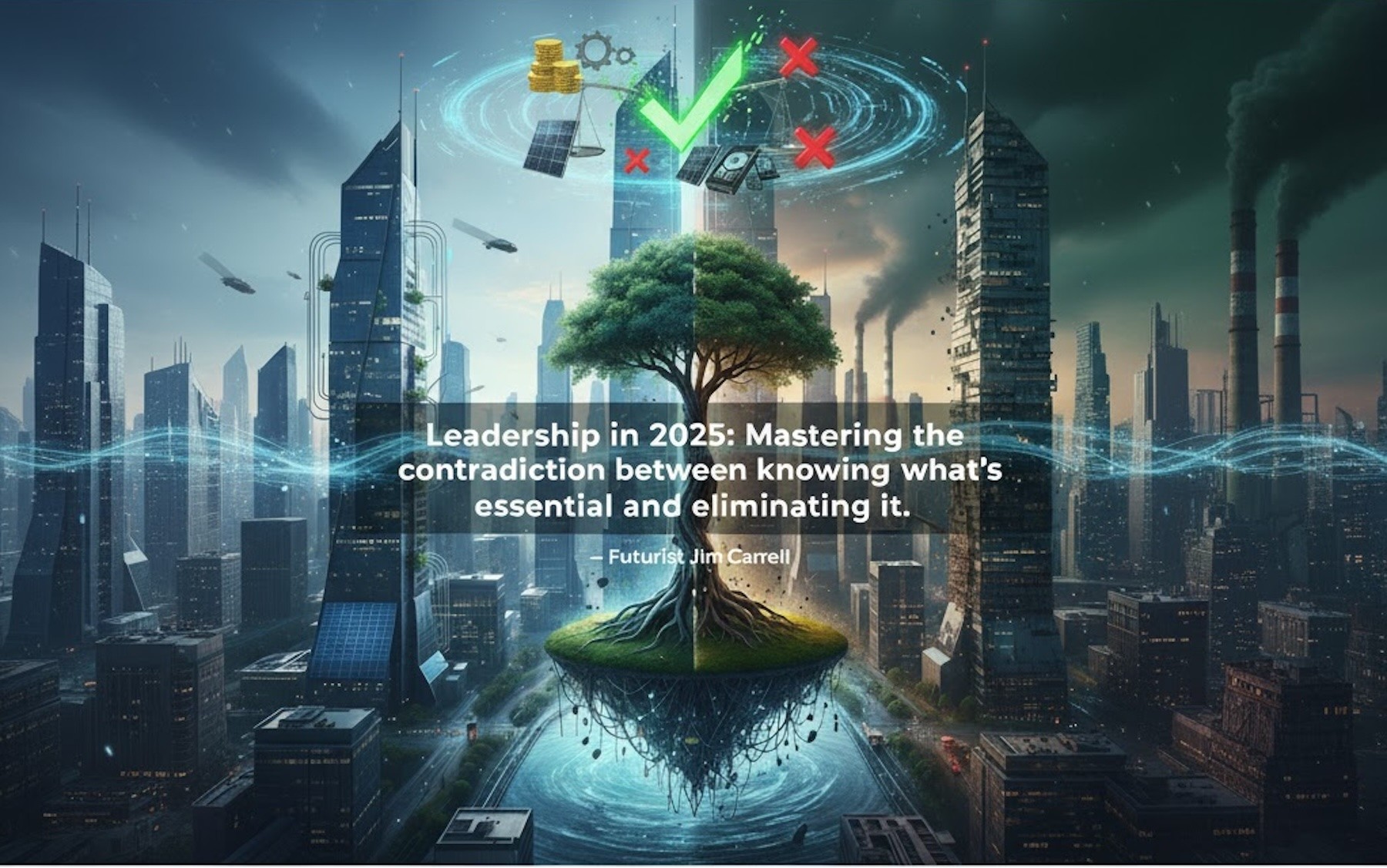
"Leadership in 2025: Mastering the contradiction between knowing what's essential and eliminating it." - Futurist Jim Carroll

If anything is real in 2025, it is the fact that organizations have mastered the art of saying one thing and doing another - often with a pretty negative intent.

No wonder people are jaded, confused, wound up, and upset.

Think about it. Organizations worldwide face an existential contradiction: the very investments needed to survive the future are being slashed to survive the present. The goals they set to live up to some pretty vast challenges have been torn asunder or set aside.

And the fact is, this "say-do gap" is everywhere. (That's the gap between what they 'say' they will do, and what they actually 'do.') I used Claude.AI and Google Gemini to do a deep research analysis of what's going on, and both came back with some pretty intense reading. I then used Gamma. App to summarize this into two slide decks - one generic, and one specific.

The first, "The 2025 Paradox Report: 50 Contradictions Between Corporate Rhetoric and Reality", will give you a pretty quick idea of the nature of the gap.

 To give just one example from that document:

"Organizations publicly declare workforce development as essential while simultaneously gutting the very programs and people needed to build future capabilities, creating a widening gap between skills rhetoric and investment reality."

I easily came up with 50 such contradictions. Give it a read - it's pretty stark.

The second one gets a little more specific - The Preparedness Paradox: How Organizations Are Cutting the Very Investments They Need to Survive the Future is an even more sobering read.

This one gets into actual corporate stories and observations., I ran the PDF through multiple AI systems for a fact check, and it's pretty spot on.

Consider the major contradiction between the escalating cybersecurity crisis and the slowing budget growth.

The number of breached accounts increased eightfold to 5.5 billion.
The average cost of a data breach rose by 10% to $4.88 million, reaching an all-time high of $9.36 million in the U.S.
The healthcare sector alone saw 276.7 million records exposed.
Despite these worsening threats, the growth of security budgets slowed to only 8% in 2024.

Say-do!

Read the list of 50 contradictions. It's pretty depressing.

---
Futurist Jim Carroll believes we are living through the era of 'shallow leadership' - a time when many organizations have lost the very essence of any type of corporate social responsibility. The extent of the damage will be evident in the years to come.

**** **** **** **** **** **** **** **** **** ****

Original post: jimcarroll.com/2025/10/decodin

★ 0 • ↻ 0 original
Oct 9, 2025 · 10:27 AM UTC

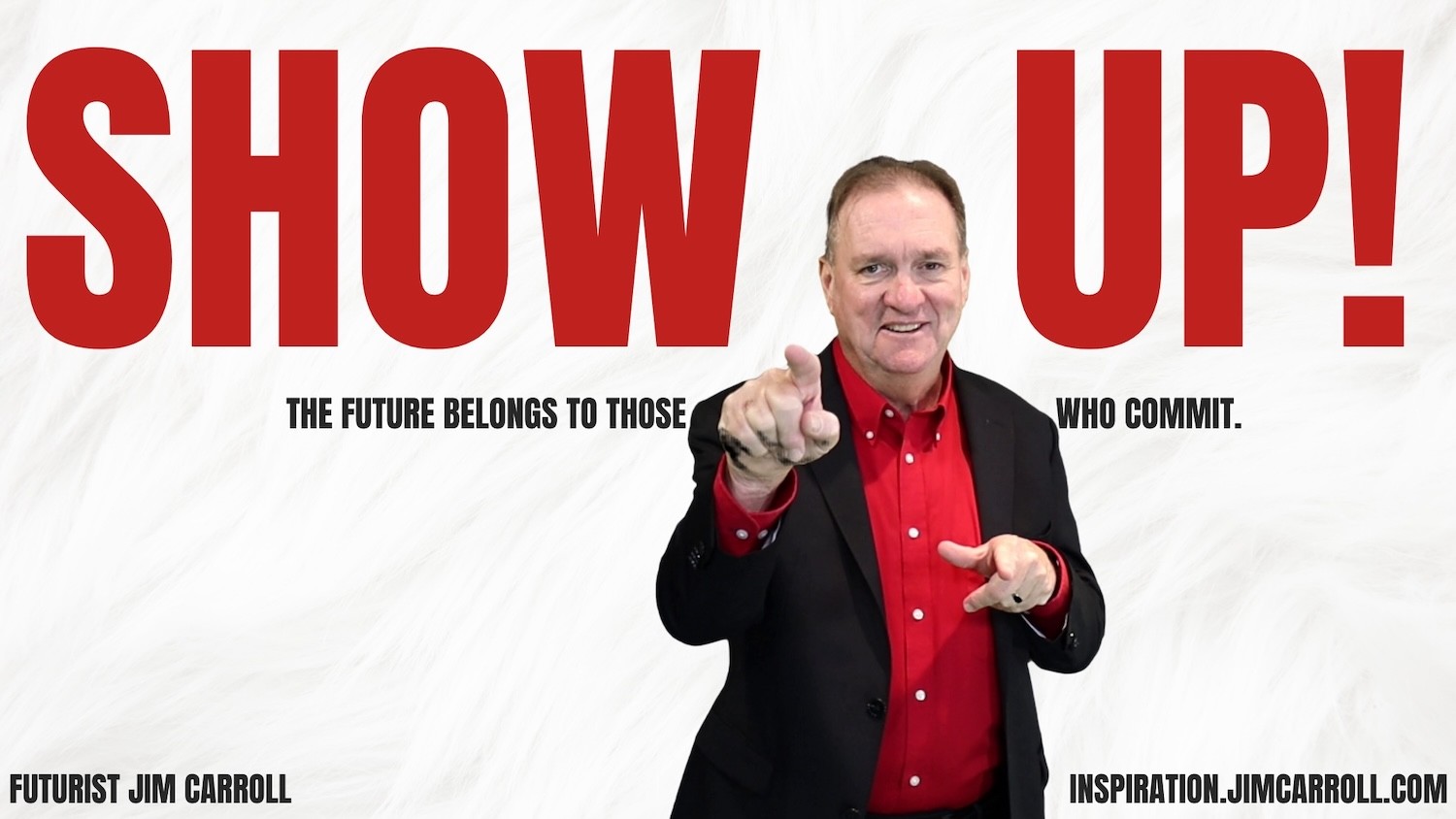
"Show up!" - Futurist Jim Carroll

The future belongs to those who commit!

So show up!

What brings about this line of thought today? Because I noticed a lot of visits to this post yesterday:

"To win in the race to the future, you need to decide to show up at the starting line.”

Read the post from February 2017. It's back when I was just starting this daily series years ago. Intrigued, I dug into my writing about the topic of showing up, and it's something I have covered a few times in the years since.

"If you are going to show up at the starting line for the future, make sure that you don't show up late!"

"Show up early!"

"It's a better idea to create the future than to just show up for it."

"Define your future, don't just show up for it."

So why not just show up? I mean, today! Show up!

Why does it matter?

Because the simple act of "showing up" is the most basic foundational principle for anyone who wants to succeed in a fast-changing world. It's a decision not just to participate in tomorrow, but a decision to engage with it, get involved, steer it, and direct it. It's the difference between being a spectator and being the architect of your own destiny.

I used Gemini to feed all of the above posts with a view to seeing what points I've raised about the importance of showing up. What I got was a list of 10 reasons why you must 'show up.' It's a good list!

Read the post for more!

So what should you do today?

Show up!

---

Futurist Jim Carroll shows up every day. His Daily Inspiration post has shown up every single workday since August 2016.

**** **** **** **** **** **** **** **** **** ****

Original post: jimcarroll.com/2025/10/decodin

★ 1 • ↻ 0 original
Oct 10, 2025 · 10:19 AM UTC

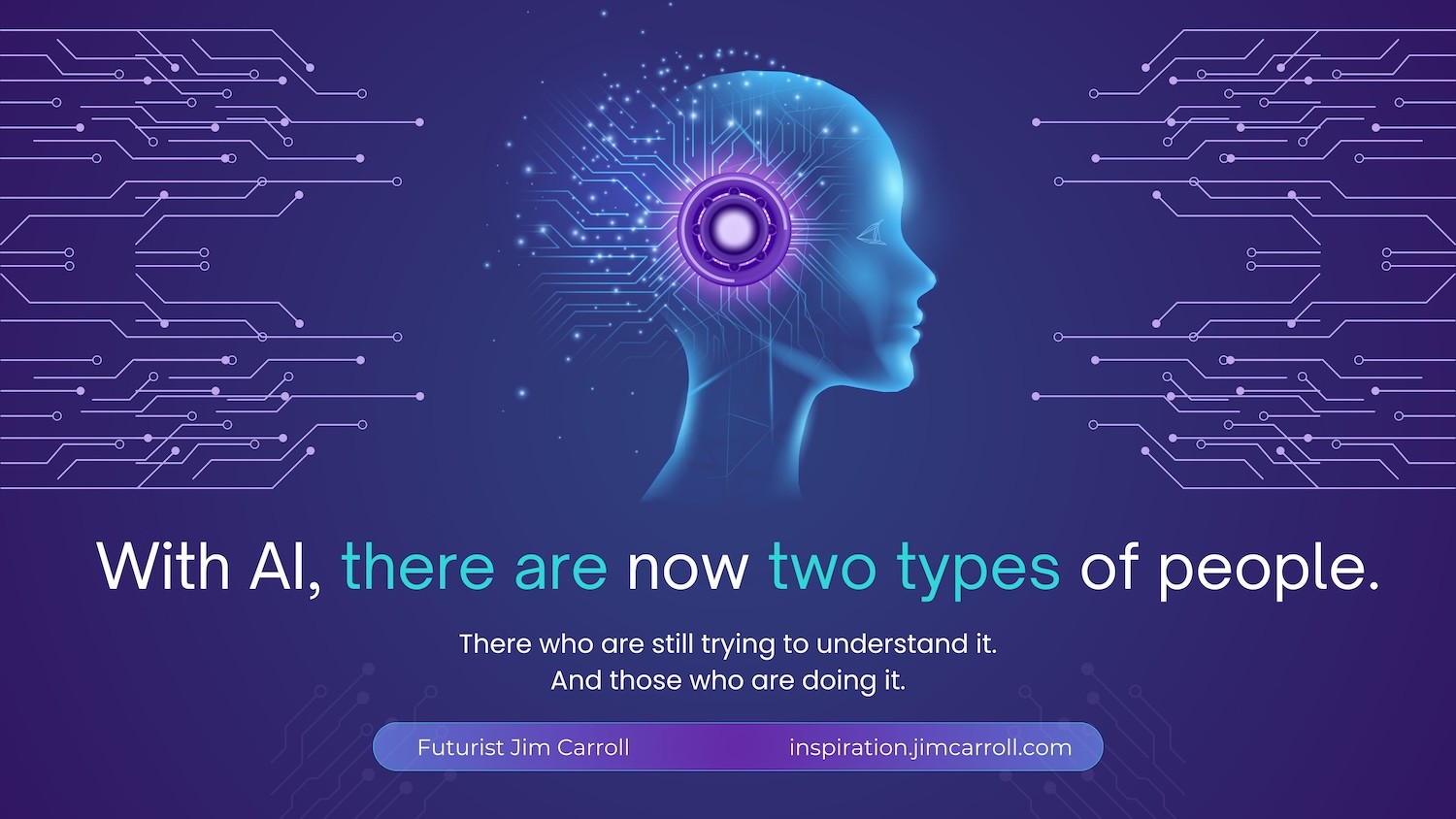
"With Al, there are now two types of people. There who are still trying to understand it. And those who are doing it." - Futurist Jim Carroll

As I prepared for and then delivered a presentation on AI yesterday, I couldn't help but think about how much I've integrated various tools into my workflow regularly - and how many people listening to my talk had their minds blown by what I was doing.

The difference is stark - and I've come to see this more and more with what I do.

So why is this happening?

One group operates from a place of curiosity and opportunity, while the other views AI with apprehension and uncertainty. It goes to the key point I've always raised as a futurist - some people see the future as a threat. Other people see the same future and see an opportunity. AI fits right into this mindset chasm - folks who have never been comfortable aligning themselves ot the trends of tomorrow, or even accepting those trends, are clearly stuck in the paradigms of yesterday.

Then there is the openness that people have to learning. One group is actively creating new workflows with AI - understanding it, exploring it, and integrating it into their routines. The other are still very much stuck in old ways of doing things, and have probably never really been a big fan of change in their daily routine.

And that comes to a core point - one group is full of enthusiasm for change, and the other hates it. One group is excited for its potential; the other is fearful.

The very nature of AI presents a conundrum for all of us, and how we rationalize it determines what we do with it. One group accepts that the debate over whether AI will be good or bad understands that, just like the Internet, the debate will never be solved. The other group is busy holding themselves back as some sort of personal rebellion. One decries the growth of AI 'slop,' while the other understands that the slop is inevitable, and so we might as well figure out how to deal with it.

I could go on.

Thirty years ago, I found myself very much in the midst of the same divergence of thinking as the Internet appeared on the scene. It didn't go away and came to have a profound impact on the future of all of us. Some of us aligned with it and built wonderful new careers - others dismissed it and didn't see the same opportunities.

The key thing is, right now, if you are in the second camp, you face a choice - how quickly can you become a member of the first camp?

Keep reading!

---

**** **** **** **** **** **** **** **** **** ****

Futurist Jim Carroll believes that "AI augmented" is quickly becoming a critical career success factor.

Original post: jimcarroll.com/2025/10/decodin

★ 0 • ↻ 0 original
Oct 14, 2025 · 10:35 AM UTC

"The way forward is not to wait for tomorrow, but to create it today." - Futurist Jim Carroll

----
In 2025, the headwinds are severe, and the path forward seems shrouded in fog. We’re living through one of the most volatile and unpredictable periods in recent memory. With that being the case, Jim wrote new series, The Way Forward: A Trends and Transformation Series, taking a look at the trends redefining industries, and actionable strategies organizations must pursue to align with these realities. The entire series can be found at forward.jimcarroll.com
---

In this series, I covered major trends in 9 major industries, taking a look at what will define those industries, the path forward and the barriers in the way.

You'll find the entire series at forward.jimcarroll.com. I also tried to outline a series of bold actions that could be pursued in each industry for those eager to find a way forward.

What's the overall picture? As I noted in the introduction, the future is no longer a distant destination but a "high-speed operating system we must run on and align to every single day". I've also indicated that the instinct to "hunker down and wait it out" during volatility is a trap; clarity must be created through action.

What I've tried to do is provide a clear, action-oriented guide for leaders in any sector to navigate the present chaos and thrive.

So how do I wrap it up? Let's take apart the universal forces of disruption that surrounds all nine industries and the common theme across those trends.
There are 3 big overriding themes.

Let's dig in - see the full post.

**** **** **** **** **** **** **** **** **** ****

Original post: jimcarroll.com/2025/10/decodin

★ 1 • ↻ 0 original
Oct 15, 2025 · 10:12 AM UTC

"When your confidence is shattered, trust your next step more than you fear your fall!" - Futurist Jim Carroll

The Korn Ferry This Week In Leadership newsletter is the insight gift that keeps on giving - it's always full of useful, powerful, and recent information. One article that caught my attention? Confidence: Shaken And Stirred. With the subtitle Can organizations handle massive, simultaneous disruptions? Corporate leaders aren't so sure; it fits right in with the types of issues I often cover here.

What's it about? Simply, a recent survey of 250 CEOs and board members revealed a stunning lack of confidence among corporate leaders regarding their ability to manage simultaneous, massive global disruptions.

That's no surprise, but it certainly helps to put things in context - I see a lot of organizations struggling with change, trends, volatility, and the sheer speed with which everything is unfolding.

But the article notes that, faced with geopolitical upheaval, accelerating AI change, and worldwide economic slowdowns, business confidence is at a modern low. Think about that! No wonder it seems like everyone is just spinning their wheels without moving forward, and is just focused on putting out all the fires around them.

The key points of this crisis are clear:

Massive simultaneous risk: Corporate leaders are grappling with a confluence of massive, out-of-control problems occurring simultaneously, including changing trade policies, geopolitical upheavals, and AI disruption.

An increased risk perception: 63% of leaders reported that their firm's risk had increased since 2024. Low Confidence Levels: Only 11% were extremely confident that their organizations could handle the current level of risk.

Geopolitical risk Concern: Leaders expressed the least confidence in their ability to handle geopolitical risk. No kidding.

There's not a lot of confidence in their ability to manage this risk. The survey reported that the only risk category where more than half (52%) expressed confidence was regulatory and compliance risk. The rest? A stunning lack of confidence!

The article goes on to note what leaders should be doing to try to mitigate this risk. First step? Project assurance that they can manage it (even though they think they can't), to prevent employee demoralization. Yikes! Didn't the captain of the Titanic do that? Yes, but at least he was showing confidence!

The article goes on to advise a few key actions. Read more!

---

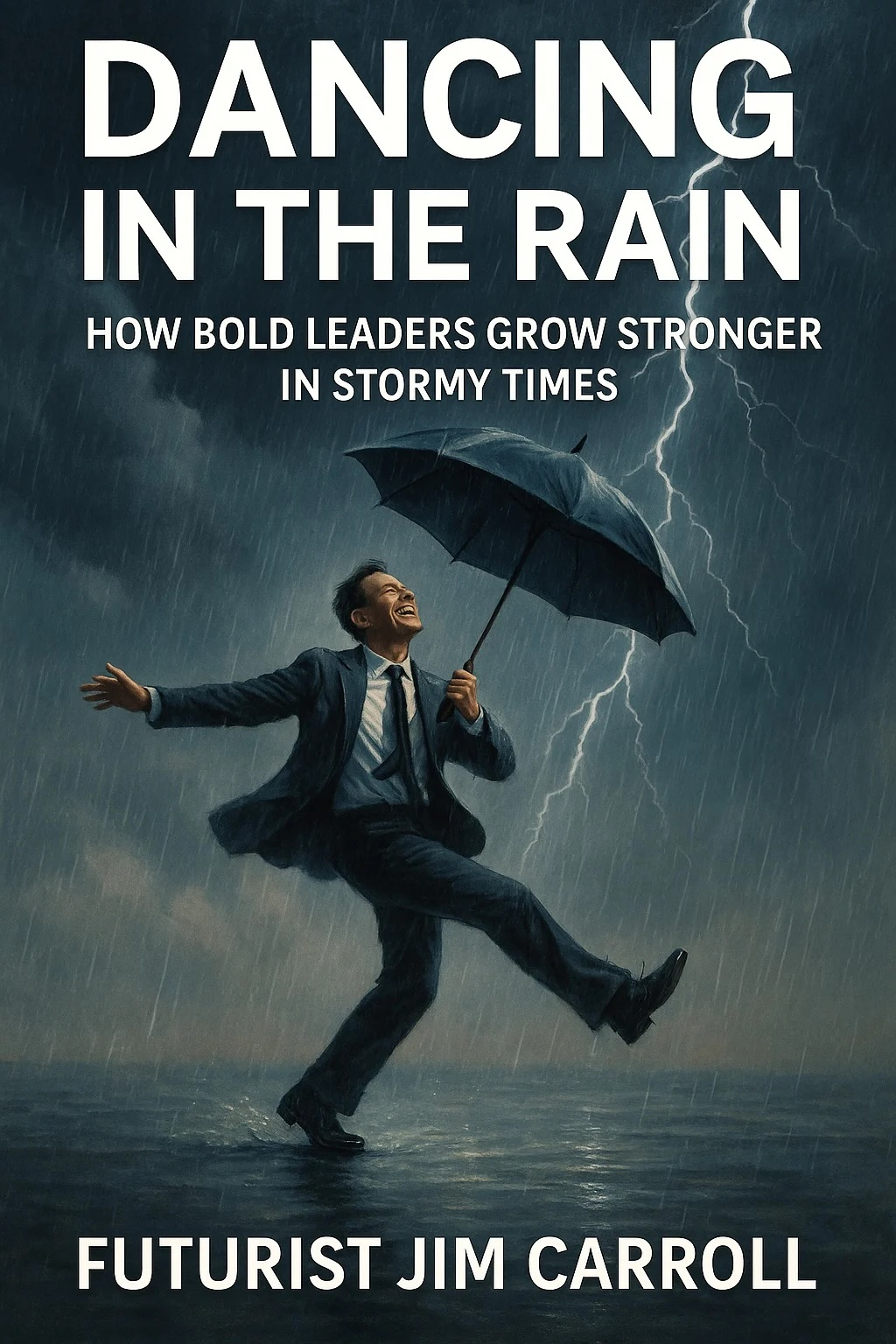
The issue of building and enhancing confidence in an era of uncertainty is covered in detail in Jim Carroll's latest book, Dancing in the Rain: How Bold Leaders Grow Stronger in Stormy Times. Learn more here.

**** **** **** **** **** **** **** **** **** ****

Original post: jimcarroll.com/2025/10/decodin

★ 0 • ↻ 0 original
Oct 16, 2025 · 6:27 AM UTC

"Sometimes, the most valuable work you might do is the quiet work of thinking nothing at all." - Futurist Jim Carroll

Let's get right to the point.
It's OK to daydream.
It's OK to get lost in your thoughts.
It's OK to be absent-minded.
It's OK to lose your focus.
It's OK to stare blankly out the window.
It's OK to let your mind wander.
It's OK to have a thought pop into your head unrelated to what you're doing.
It's OK to take a mental detour.
It's OK to let your thoughts drift.
It's OK to not have an immediate, practical goal for your thinking.
It's OK to be a little disorganized in your thoughts.
It's OK to mull things over slowly.
It's OK to take an unguided mental walk.
It's OK to space out.
It's OK to ponder an unlikely scenario.
It's OK to doodle without a plan.
It's OK to follow a train of thought to an unexpected destination.
It's OK to let your mind jump from one idea to the next.
It's OK to not check things off a list right now.
It's OK to mentally play with concepts.
It's OK to get stuck in your head.
It's OK to revisit old memories for inspiration.
It's OK to have an 'aha!' moment while doing nothing.
It's OK to trust your intuition over logic for a bit.
It's OK to embrace mental downtime.
It's OK!

Here's why: Have you ever been told to stop staring out the window and get back to work? It turns out that letting your mind wander might actually be one of the smartest things you can do. Scientists have discovered that daydreaming isn't laziness—it's your brain doing some of its most important creative work.

And as someone who has helped organizations around the world with concepts related to innovation, it's a story I often share from the stage.

Consider this: Your brain operates in two different modes: focused thinking and diffuse - or unfocused - thinking.Focused thinking is what happens when you're concentrating hard on a math problem or writing an essay. It's great for learning new information and working through things step-by-step. But here's the catch: you can't be creative while you're hyper-focused.

That's where daydreaming, drifting, imaging comes in - aka diffuse thinking - comes in. When you let your mind wander, space out, or daydream, your brain switches into a different mode that makes unexpected connections between ideas. This is when you have those "aha!" moments where a solution suddenly pops into your head.

So the next time someone tells you to stop daydreaming, you can tell them you're actually problem-solving.

You are doing important work!

You are being creative!

Futurist Jim Carroll zones out frequently.

**** **** **** **** **** **** **** **** **** ****

Original post: jimcarroll.com/2025/10/decodin

★ 2 • ↻ 1 original
Oct 17, 2025 · 10:11 AM UTC

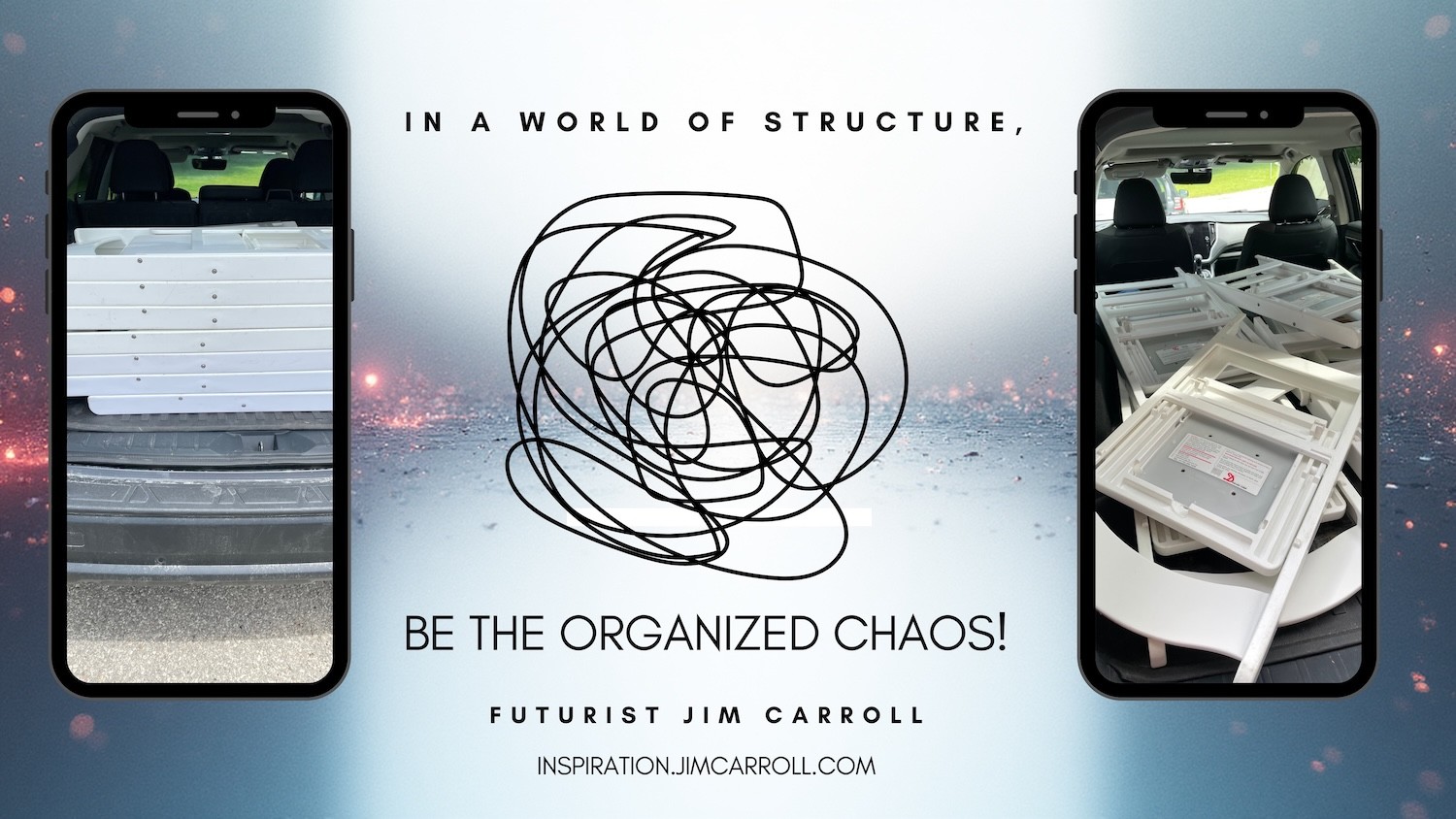
"In a world of structure, be the organized chaos!" - Futurist Jim Carroll

Is it OK to be helplessly, hopelessly disorganized?

Maybe so.

What got me thinking about this was an article I came across about the importance of the ability to see clarity through chaos. That's certainly a powerful capability right about now.

And it brought to mind this situation.

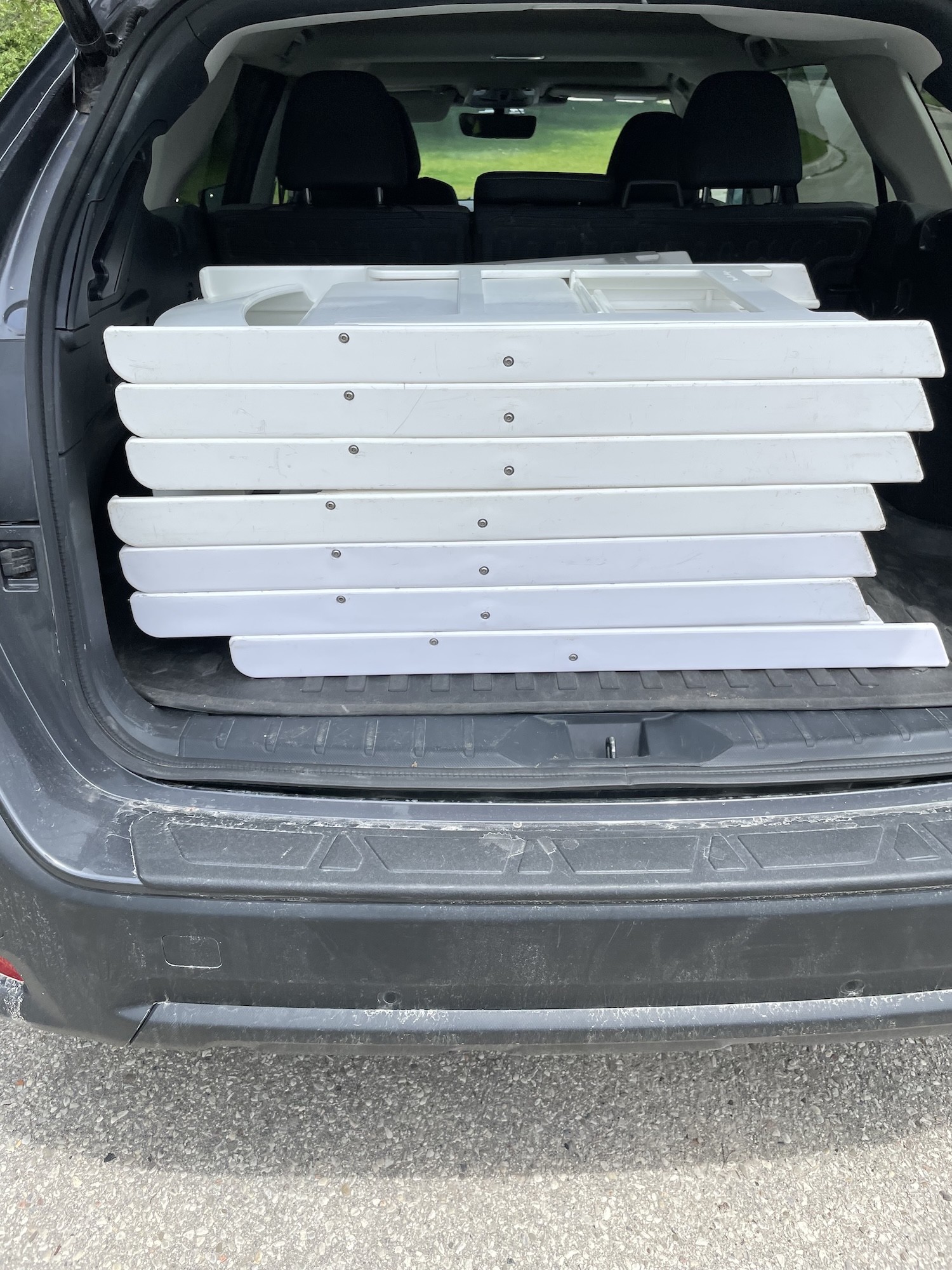
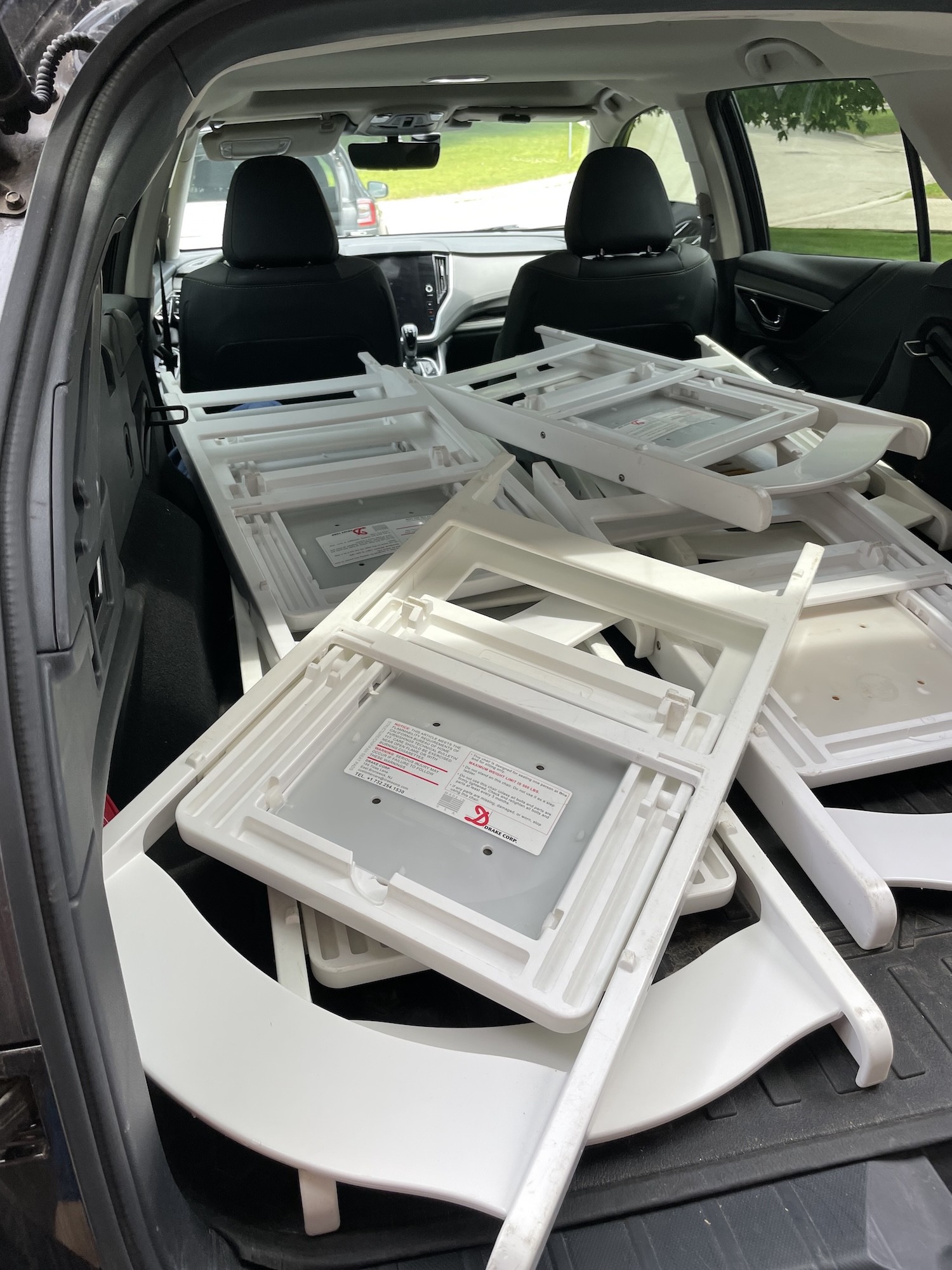
Picture this - you've had a wonderful baby shower for one of your sons and his wife. It's time to return the rental chairs. Two SUVs are enlisted in the process.

And unbeknownst to me, my wife snapped two photos once the loading was done.

There was hers: nicely stacked, neatly organized, structured to perfection. No wonder - she's a first-generation German Canadian, and has "Organized" as her middle name.

Then there was mine.

I guess that's how my mind works. Maybe that's why I'm so creative. I have little patience for structure, little time for routine, and precious little time to stack chairs properly. Who defines 'properly' anyways?

It was, by any reasonable standard, chaos.

But here’s the thing: They all fit.

And maybe that's the power of "organized chaos."

My wife’s method was elegant and beautiful; it’s ideal for a stable, predictable system. My method, however, was not.

It wasn't random—I knew where the space was and I used it. The result was the same: the job got done, perhaps even faster.

And here's the point - throughout our lives, we are constantly pushed into a "world of structure." We have rigid job descriptions, linear career paths, and step-by-step instructions for everything. These structures are essential for stability, but they can be paralyzing when the world demands speed and adaptability.

And right now, the world demands speed and adaptability. It's chaos out there, folks!

Organized chaos is the ability to maintain a clear objective while allowing the process to be messy, flexible, and dynamic.

It’s the startup team that rapidly pivots, not the corporate committee that takes three months to schedule a meeting.

It’s the artist whose studio is a beautiful disaster, but who can instantly locate the right tool or brush.

It's the problem-solver who breaks the established rules to achieve the established goal.

It's the guy who stacks chairs in an SUV without thought, but gets the job done.

When rigid systems inevitably fail or slow down, don't try to force a perfect stack. Know your destination, and then let your process be the slightly messy, highly dynamic, and profoundly effective power of organized chaos.

You'll be surprised how much you can fit in the trunk when you stop worrying about making it look pretty.

---

Futurist Jim Carroll has little patience for structure, routine, and organization.

**** **** **** **** **** **** ****-solving **** **** ****

Original post: jimcarroll.com/2025/10/decodin

★ 2 • ↻ 1 original
Oct 20, 2025 · 10:08 AM UTC

"Inattention is a betrayal of the future. Be aware, or be history!" - Futurist Jim Carroll

I've always tried to avoid writing about politics in this series; on the other hand, I can't help but watch things and learn from them.

With that in mind, I'm always reminded by what I see that, whether in politics, business, or technology, the biggest risks we often face rarely come from external threats, but from a deliberate, internal choice: inattention.

Two recent political headlines served as a powerful reminder of this universal rule of disruption and not paying attention:

“Democrats have a curiosity problem, and it’s losing us elections.”
“Democratic Leaders Tried to Crush Zohran Mamdani. They Should Have Been Taking Notes.”

If you watch or follow the news, you'll know there's a lot of political upheaval right now, and one thing that is happening is that many are complaining that the ('old') Democratic leadership is not listening to the disruptive ('younger') voices impacting their future.

That is exactly what happened with music companies, established retailers, automotive companies, and just about everyone else as ('young') upstarts came along and disrupted established ideas. And with that, these headlines give us some powerful insights into the universal challenge of change management. They describe a basic failure of leadership: ignoring new information, digging in against new ideas, and prioritizing comfort and control over the effort of exploring what’s next.

And that never works out well! This failure perfectly mirrors what happens in the business world when large, successful companies miss a massive economic shift—a seismic disruption. They essentially have an intellectual "curiosity problem" that makes them unwilling to "take notes" on the breakthrough ideas emerging from small startups or unusual sources. 

That's why I would suggest that "Inattention is a betrayal of the future. Be aware, or be history." Because history has taught us this lesson, one and over!
Companies and people often make three major mistakes that continually sabotage success in a fast-changing world:

Ignoring signals
Ignoring change
Losing time

To successfully navigate disruption, you need to have developed a constant, active habit of scanning the economic landscape, embracing curiosity, and treating every unfamiliar or challenging idea as a chance to learn, rather than dismissing it.

Because the moment we stop paying attention to the subtle shifts of the present, we start becoming irrelevant in the future.

---

Futurist Jim Carroll has long believed that too many older incumbents don't listen to young upstarts as much as they need to.

**** **** **** **** **** **** **** **** **** ****

Original post: jimcarroll.com/2025/10/decodin

★ 1 • ↻ 1 original
Oct 20, 2025 · 6:40 PM UTC

A year ago today, I spoke to 500 CEOs at a private, invitation-only event in NYC. I'm not allowed to discuss who was there with the NDA involved.

But I can say that Joe Manchin and Paul Ryan were on stage before me, and I sat in to listen to their message.

Both correctly predicted the election outcome.

From there?

Manchin? He believed the parties could achieve some wonderful bipartisanship going forward.

Ryan? He stated that he thought all the guardrails would hold.

Looking back, it's all LOL.

★ 2 • ↻ 0 original
Oct 20, 2025 · 9:07 PM UTC

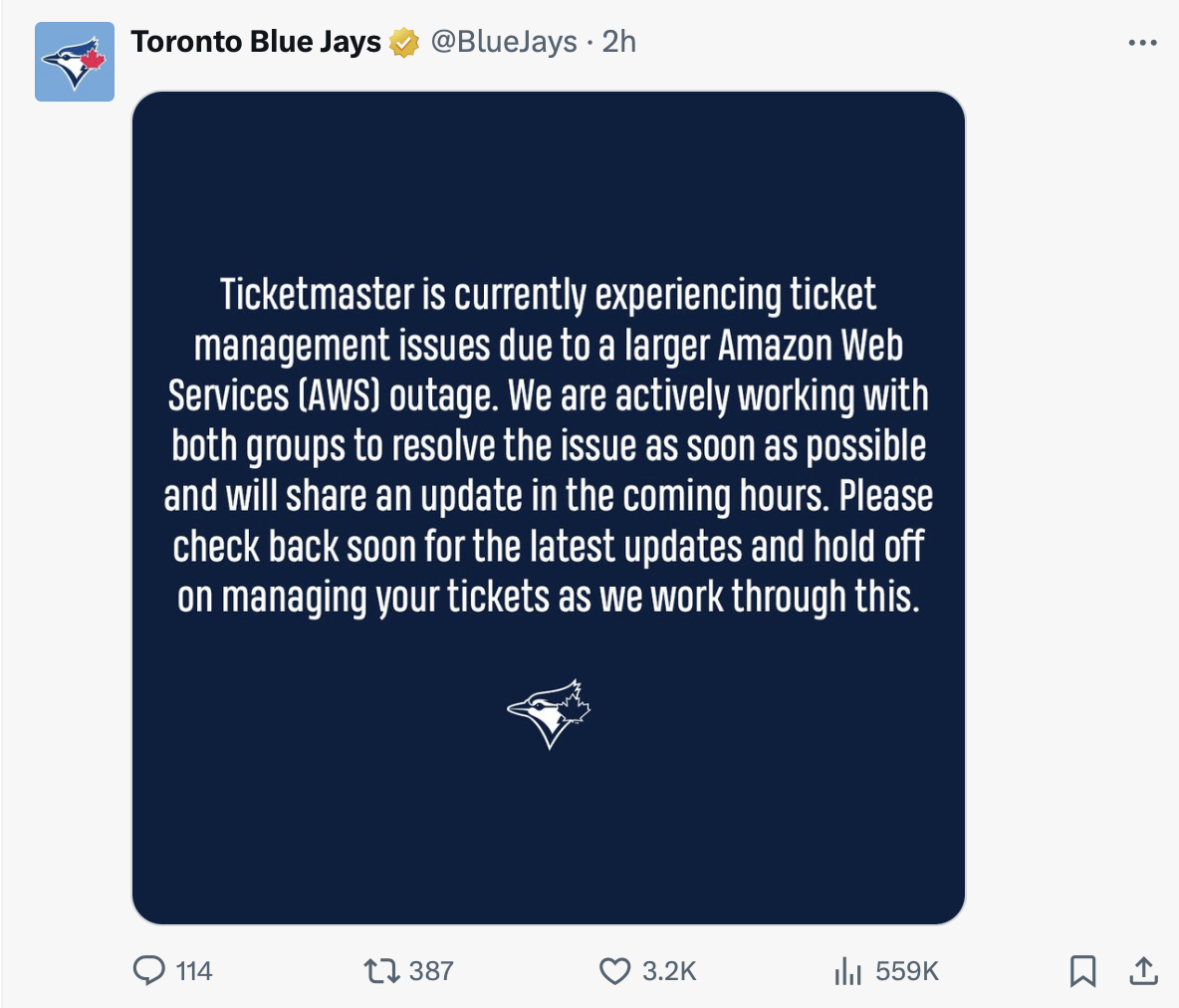
Change the random code dude to AWS.

★ 0 • ↻ 0 original
Oct 21, 2025 · 10:29 AM UTC

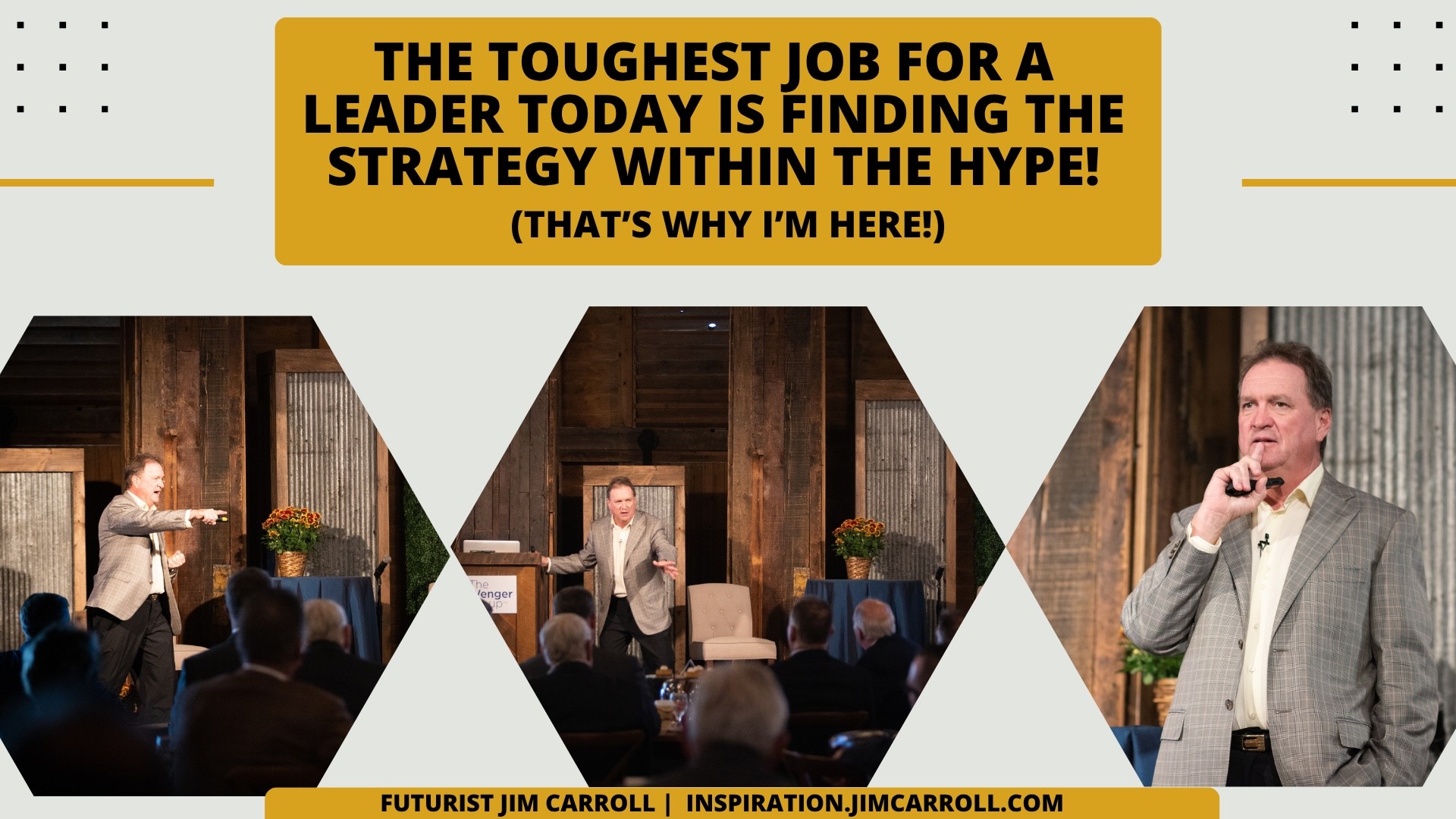
"The toughest job for a leader today is finding the strategy within the hype!" - Futurist Jim Carroll

Let's talk about what CEOs are thinking about!

What got me thinking about this? One year ago yesterday, I keynoted a pretty exclusive group in New York City - 500 handpicked CEOs from around the world who are members of an invitation-only networking organization. My NDA doesn't allow me to speak or write much about who was actually in the room - but I will note that two well-known Senators were on stage just before me. (I kind of laugh now at their message at the time that they believed the guardrails would hold and that bipartisanship would prevail! Like, LOL!)

I can say that I had companies that ranged from $200million to $4 billion there, and that there was pretty intense interest in the topic I covered of relating future trends to core business strategies. Why did the organization pick me? A few of the folks on the organizing committee had seen me before, and liked the way I specifically lined these trends to reality - and cut through the hype.

And heaven knows there's a lot of hype around us right about, particularly around AI, but also with respect to many other topics - and that's why I am relentlessly focused on providing clarity for this moment.

Right now, there seems to be a crushing need for CEOs and senior executives to find that reality. That's one reason why I just changed my LinkedIn banner to reference the fact that I'm the guy that CEOs trust!

Many of my talks don’t just include keynote presentations — I’m often engaged to come into small, intimate leadership meetings to help senior executives understand some of the trends that will shape their world. Over the years, this has included many presentations to small groups of CEOs within a forum for private equity capital.

I’ve also done quite a few of these presentations for very-high-net-worth families and firms. It has included such groups as the Wrigley family foundation and companies that manage the Rothschild wealth. And in one of the most fascinating events I’ve participated in, I was invited to Athens to address several hundred representatives of what are known as  ‘family offices’ — organizations that manage the wealth of the world’s wealthiest people.

In all of these cases, the room is full of senior executives eager to cut through the noise and find reality. And for them, the bottom line is this: Without a strategic purpose, there is no purpose!

And in that context, the essence of leadership today is finding the strategy within the hype.

Never forget that!

---

**** **** **** **** **** **** **** **** **** ****

Original post: jimcarroll.com/2025/10/decodin

★ 1 • ↻ 0 original
Oct 22, 2025 · 10:11 AM UTC

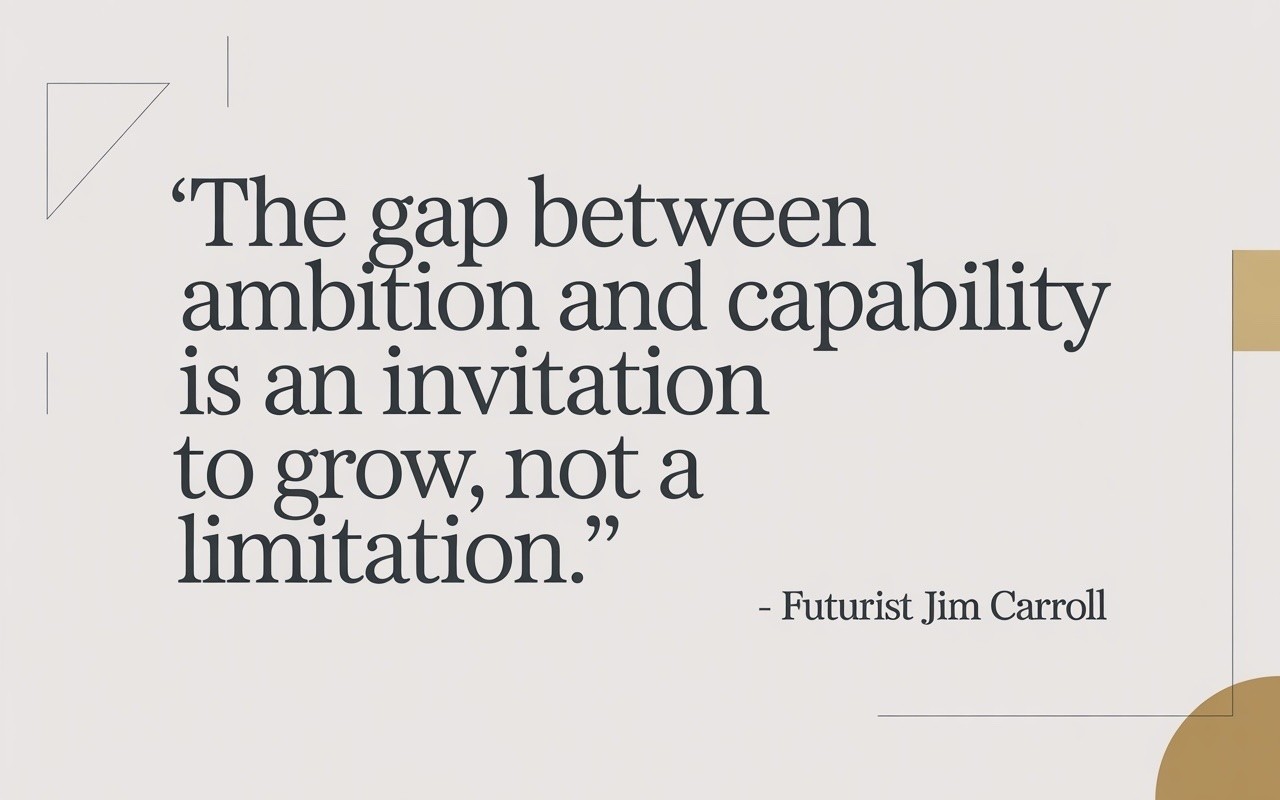
"The gap between ambition and capability is an invitation to grow, not a limitation." - Futurist Jim Carroll

Someone asked me how you can keep up when things are changing so fast; how you can grow when there is so much to master; how you can succeed when the challenges can seem so big.

You do it by refusing to be cowed by the scope of what's ahead of you!

Right now, everyone is faced with the same issue - we have a lot of ambition, but given that there is so much new 'stuff'to master, our capabilities are often lacking. That can seem like a setback, a barrier, a wall that we can't break through - because we focus on our limits, not our capabilities.

Shifting our focus from limitations to opportunity is the key to breaking through.

I went back and talked ot myself - that is, I fed this idea to Google Gemini to see how we can focus on growth, not limits. It came back to me with this: Your 25-Point Plan to Bridge the Ambition-Capability Gap. There's a great little inspirational PDF that might be useful - it's in the post.

Step 1? Make speed your primary strategy - stop waiting, start doing!

Then reject perfectionism - our chase for doing something without a mistake is often the very thing that holds us back.

Need more? It's in the post and the PDF - read more!

----
**** **** **** **** **** **** **** **** **** ****

Original post: jimcarroll.com/2025/10/decodin

★ 1 • ↻ 0 original
Oct 22, 2025 · 6:54 PM UTC

I keynoted CattleCon 2024 in Orlando, speaking to a few thousand of the top US cattle ranchers.

I keynoted the United Soybean Board in 2017, speaking to the top 500 soybean farmers in the room.

I've keynoted many other groups like this.

I read the news every day.

And every day, I am just keeping my mouth shut.

I want to scream into social media, but I'm not.

Instead, I'm going for a walk, and later, I'll see my grandson.

And I'll cheer on the Toronto Blue Jays, taking joy in knowing that I am Canadian.

★ 0 • ↻ 0 original
Oct 22, 2025 · 6:56 PM UTC↩ reply

@selfcaregentle No, but I wrote a book about it.

dancing.jimcarroll.com

★ 0 • ↻ 0 original
Oct 23, 2025 · 10:07 AM UTC

"Shift your focus from managing the known to mastering the next." - Futurist Jim Carroll

After all, today's comfort is tomorrow's vulnerability!

A session description just went out for my upcoming keynote for **BIFMA**.

Who's that? The Business and Institutional Furniture Manufacturing Association!

Here's what I'll be covering:

----

Harnessing Technology for Unprecedented Growth

The complex new future is not just happening with AI - we are seeing the maturity of industrial autonomous technologies, robots, machine intelligence and vision systems, digital twin and augmented reality technologies, the impact of ‘sensorworld,' drones, and more.

The scope of these technologies represents significant implications from very real business model disruption to unique legal and copyright issues, education, knowledge, and workforce skills challenges, as well as the emergence of disruptive new industry competitors and accelerated new product development and innovation opportunities. All of which require companies to pick up the pace. Join us as

Jim covers:
Technology applications for the product manufacturing Industry
Case studies on how technologies are being applied
Strategies in how and where to invest

---

The key theme for the people in the room? They need to shift their focus from the current reality to the next one. Yes, there's a huge amount of change, uncertainty, and volatility going on, and it's not an easy time to be moving forward. That said, if you don't do it now, the chasm between what's possible and what's actualized will only become bigger.

I've had a few calls with these folks to walk through the trends, technologies, and ideas that will define their future, and there's a lot to cover.

I've been going through the issues and the trends, and coming up with a list of ten key pieces of advice I'll offer to the manufacturing and technology leaders at the conference
Read the full list in the post!

---

Futurist Jim Carroll has spoken at dozens of conferences and leadership meetings on the topic of manufacturing innovation.

**** **** **** **** **** **** **** **** **** ****

Original post: jimcarroll.com/2025/10/decodin

★ 1 • ↻ 2 original
Oct 24, 2025 · 10:48 AM UTC

"For the first time, social media use might actually be declining. And that's probably a great thing!" - Futurist Jim Carroll

Some months ago, I became a first-time grandfather, and I must say, these are some of the most magical moments of my life!

But you wouldn't know it by my social media posts, because I haven't been posting any pictures.

And in fact, you probably won't see many photos of my grandchild online, all at the same time that my engagement with the online world continues to decrease. So I'll share, for a moment, this moment of joy that is my life at this moment!

My lack of posting comes at the request of the parents of the child, my son and his wife. Through a few conversations, they politely but firmly made it known that they were not supportive of sharing the child on social media.

I'm respecting that.

I'm also learning a lot.

It's become fascinating to me to realize that while they grew up with social media - MSN, MySpace, Facebook, Twitter, Tumblr - they've also come to almost entirely reject it going forward. In fact, other than their momentary scrolling of news feeds, they rarely post anything online, let alone engage. There was one single birth announcement that went out that made it " Instagram-official."

Think about that - the first social media generation seems to be rejecting social media going forward. And that's not just my own observation - it was recently covered in a comprehensive but barely noticed report in the Financial Times earlier this month. Time on social media actually began to peak in 2022!

With this, I've come to challenge my own involvement with social media and have dramatically scaled back as a result.

Read more:

----

Futurist Jim Carroll was an active participant on the earliest forms of 'social media' on services like CompuServe and Usenet, in the 80s and 90s.

**** **** **** **** **** **** **** **** **** ****

Original post: jimcarroll.com/2025/10/decodin

★ 3 • ↻ 1 original
Oct 27, 2025 · 11:25 AM UTC

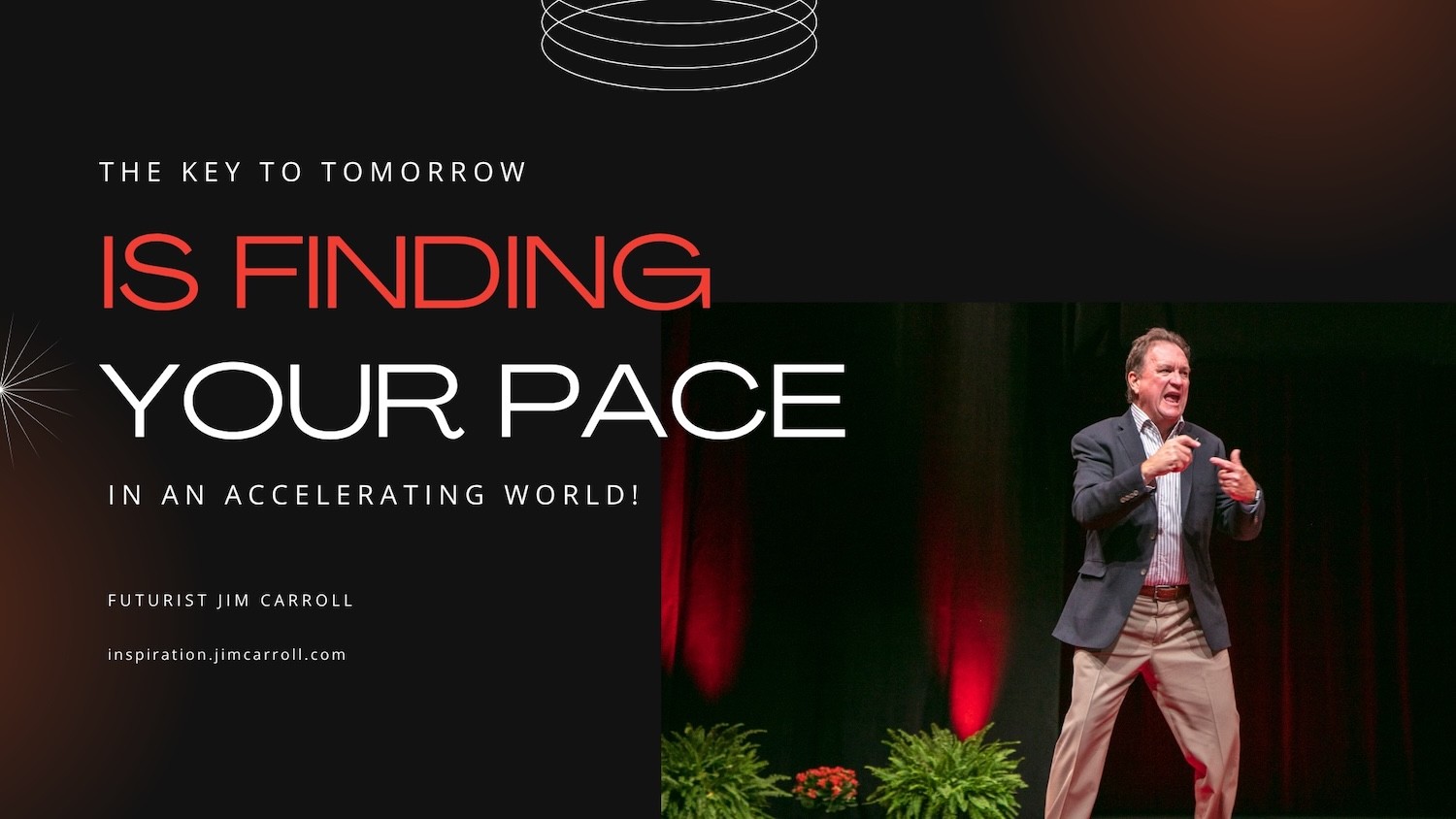
"The key to tomorrow is finding your pace in an accelerating world!" - Futurist Jim Carroll

I'm down in Arizona for an event tomorrow for a room full of executives from the utility and energy sector, and I've got a wonderful new slide deck chock full of trends impacting the industry I'll have a lot to cover in the days ahead.
That said, what' pretty clear is that this industry - like many - is struggling to adapt to the overwhelming pace of change. It's a slow industry in a fast world.

The biggest issue is that they are faced with unprecedented demand to bring new power to the market because of the juggernaut of AI data centers, but the industry is slowed by regulation, massive complexity to bring new power to market, system inertia, and more. On top of that, they are faced with extreme volatility and uncertainty because of political challenges and the 'culture wars,.' all in the face of new technologies and methodologies that continue to accelerate. (Think wind, solar, batteries, microgrids.)

Part of what I realized, building the deck, was that I can't just talk about speed - I need to talk about pace. It's about finding the right trends to follow, the right disruption to chase, the right innovations to integrate. It's not about moving quickly willy-nilly to try to scramble to solve big problems, but moving with deliberate intent to master those problems - if that makes any sense.

It means understanding the long arc of the trends, and committing to them i the long term despite short-term volatility.

That's why the key to tomorrow is finding your pace in an accelerating world!
You are probably caught in the same situation.

Speed without strategy is just expensive chaos. Action without reflection produces motion, not progress. Showing up everywhere means being fully present nowhere.

Your competitive advantage isn't doing everything faster—it's knowing exactly where speed matters and where patience wins.

Because the future belongs to those who can run the full race, not just the first mile.

---

Futurist Jim Carroll tries to pace his enthusiasm for fast change.

** **** **** **** **** **** **** **** **** **

Original post: jimcarroll.com/2025/10/decodin

★ 2 • ↻ 1 original
Oct 28, 2025 · 1:03 PM UTC

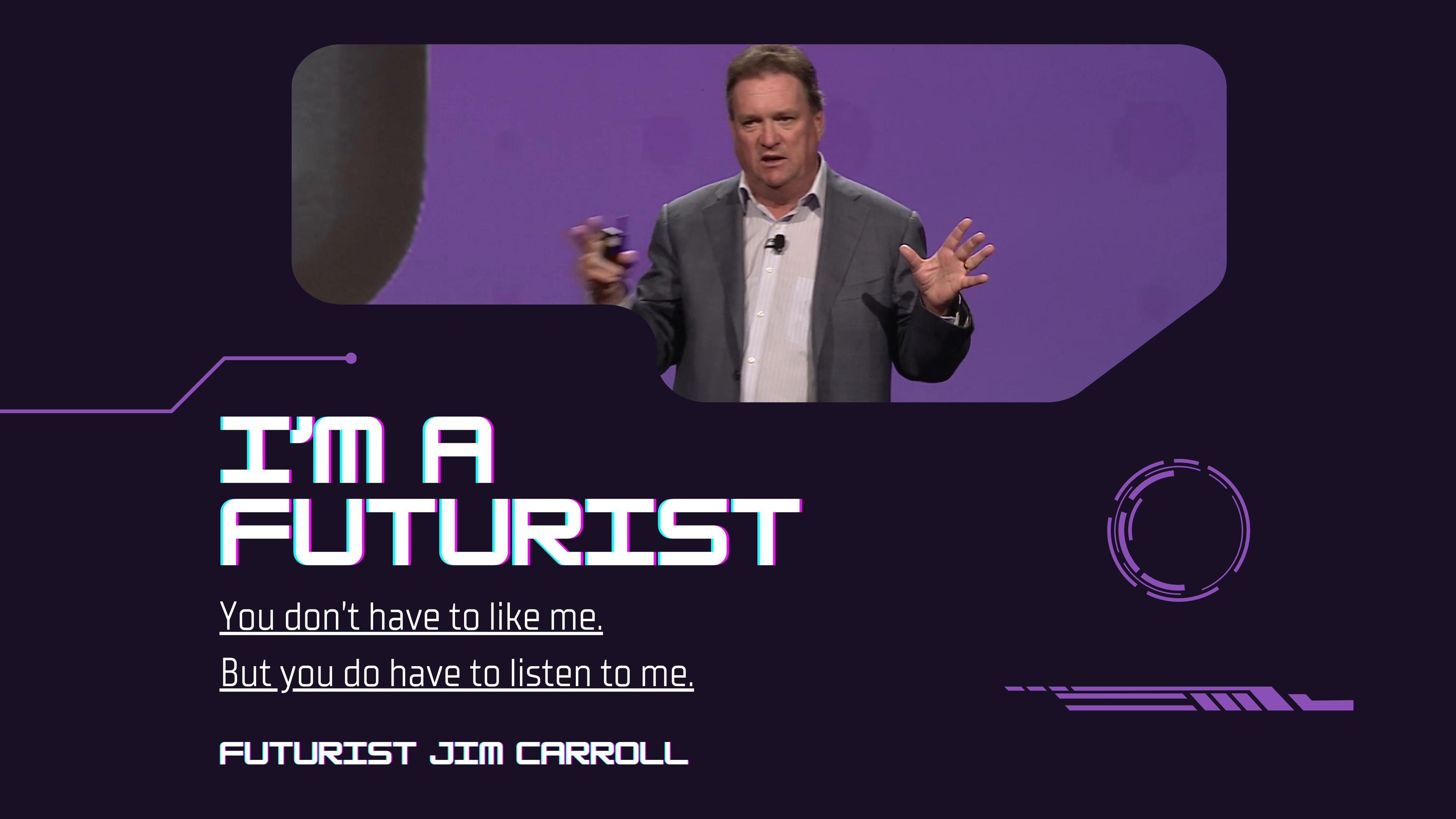
"I'm a futurist. You don't have to like me. But you do have to listen to me." - Futurist Jim Carroll

The interesting thing is that, being a speaker for 30+ years, you often find yourself speaking in the same conference and event centres where you've spoken before.

Such is the case with Tucson today, where I will speak at an energy and utility conference.

A few yards ago, I spoke to a few hundred cattle ranchers about the future of their industry in the same room. One of my core messages back then included details on the massive new markets that would come with globalization. My message was that they should evolve from a national focus to a global focus, and not become complacent with the effort it takes to build global market share in a vastly competitive world. Oops! If you catch the news these days, they aren't really having a very good time with things! Anyways, here's a photo pre-keynote.

But what is really interesting is that way back in January 1996, I spoke in the same facility for Nortel. Remember them - at one time, they were the world's largest telecom hardware and software provider, with a valuation in the billions. They brought me down for a business session they were running parallel to the Nortel Open, an event on the PGA tour circuit that they were sponsoring. (Mickelson won.)

My message back then was very much focused on the Internet; I found myself in an extensive number of corporate and association events, putting into perspective the impact it would have on business models, technological foundations, customer interaction, and more.

At this particular event, I put into perspective that the Internet was going to cause massive disruption for the telecom industry - the idea of long-distance would disappear, the cost for communications hardware would plummet as a result of voice-over-Internet technologies, and their business model and product line would get hammered if they didn't evolve. I pretty much suggested that the telecom industry, as they knew it, was disappearing, and they needed to adapt or die.

Word came back to me years later, the CEO, flying home on the corporate jet, fumed to his team - who invited this guy in? Didn't anyone vet the reality of his message? His predictions were too far off base, he told his team

What happened subsequently was that for a time, Nortel rode the telecom boom, selling vast amounts of hardware and software related to old infrastructure that was going out of date. And then, it died in 2002, a victim of the dot.com collapse and shrinking markets due to a massive telecom overbuild.

They didn't like my message, but boy, was I right in how things would evolve! 

---

**** **** **** **** **** **** **** **** **** ****

Original post: jimcarroll.com/2025/10/decodin

★ 1 • ↻ 1 original
Oct 29, 2025 · 11:15 AM UTC

"Stop seeking comfort in yesterday's wisdom. Start finding strategic courage in tomorrow's uncertainty!" - Futurist Jim Carroll

Tomorrow takes courage; yesterday is for wimps.

I was reminded of that yesterday when on stage, speaking to a traditionally extremely slow industry.

And then I realized, far too many people and far too many industries are still stuck in tomorrow's ideas, business models, and ways of thinking. doing things. Why? It's comfortable. There are no surprises. It's chicken soup for the innovation soul.

And it doesn't get you anywhere.

Look, I'm not disparaging operational excellence, which demands slow, deliberate thinking. I'm not discounting strategies that rely on achieving perfection today to deliver excellent customer service. I'm not discounting the efforts of folks who work hard to keep an organization surviving through the turbulent times that mark today.

I'm just trying to aggressively wake you up to the reality of what tomorrow might bring. And the fact is, the future is not comfortable at all. It's scary, overwhelming, and massively uncertain..

But you're going to end up there. So why not figure out what it is going to look like and get ready with a mindset that accepts what it is going to bring you?

Remember - the future belongs to those who view tomorrow not as a challenge, but as a competitive advantage. In that context, get going - keep in mind that in an era of relentless change, doing nothing is the greatest and most costly risk of all. And always remember that the world of tomorrow will not be built on old assumptions, but on new speed, agility, and the bold ideas we choose to implement today.

Bottom line? Shift your mindset from managing the known to mastering the next, for today's comfort is tomorrow's vulnerability.

---

Futurist Jim Carroll believes that far too many people find themselves in the trap of yesterday and don't yet know how to escape to tomorrow. He often shows the way.

**** **** **** **** **** **** **** **** **** ****

Original post: jimcarroll.com/2025/10/decodin

★ 1 • ↻ 0 original
Oct 30, 2025 · 10:48 AM UTC

"Our new reality? Irrational certainty now undermines almost every rational trend!" - Futurist Jim Carroll

So, how do you take on the unique times in which we find ourselves?

How do you carefully take on what is still, weirdly, a significant future trend that could, to some, be controversial? Carefully! How do you approach a delicate topic with appropriate delicacy at a time when delicacy is demanded? With delicacy!

A time in which science is fake, reality is false, and falsehoods are reality?
Well, you simply acknowledge that 'the future is now, well, just weird.'

That's how I took on the topic the other day, introducing an entirely new section to my slide deck in an energy keynote in Tucson.

So with that intro, I spoke to the audience about a topic I wrote about here a few weeks ago - the arrival of what I call "confident stupidity."

I then shared this screenshot with the audience, as an example of where we find ourselves today. Given that I was speaking to an energy/utility conference, my example had to do with that industry. This is but one of countless numbers of irrational things I see online.

Continue reading to see the whole story unfold!

After all, who cares about simple math?

----

**** **** **** **** **** **** **** **** **** ****

Futurist Jim Carroll still believes that math and science are real things.

Original post: jimcarroll.com/2025/10/decodin

★ 0 • ↻ 0 original
Oct 30, 2025 · 11:21 AM UTC
★ 0 • ↻ 0 original
Oct 31, 2025 · 9:54 AM UTC

"Beyond your fear lies your greatest success" - Futurist Jim Carroll

A little bit of AI magic with my face - if you study the picture carefully, that's me!

Happy Hallowe'en!

I seem to write about 'fear' or being ' afraid' a fair bit. I guess it comes with the topic of the future!

I asked Google Gemini to take a look at the thousands of Daily Inspiration posts I've written since 2016, where I've used the words 'fear' or 'afraid' in the title.

And yikes! There's a lot!

“Don’t fear the future. Change it!” (2016-12-23)
"Don't be afraid of failure. Fear inaction instead!" (2017-01-03)
“Don’t be afraid of moving too fast. Be afraid of not moving at all!” (2017-01-11)
“Don’t fear the future - fear your fear of the future!” (2017-01-31)
“Give me your mind for a moment, and I will share with you a future of opportunity, not a future of fear!” (2017-02-07)
“Don’t fear the results. Learn from them!” (2017-03-13)
....and dozens more.

That's a lot of ways to think about fear!

Here's what you need to be thinking about - the image of the fearful clown in my quote today is unsettling, isn't it? Clowns are meant to be joyful, but the AI image of me is not. Here's another fearful clown, also AI-generated. Timely!

Based on the philosophy from the rest of my posts, it's evident that the biggest obstacle you often face is not the change, the technology, or the competition that comes with the future. It's the fear of those things. And that's helpful because it becomes clear that it's often our fear of what comes next that is louder than our ambition.

Fear is a liar, designed to keep you stagnant. It whispers that you'll fail, that you're not ready, and that your fall will be worse than the climb.

But success is built on the willingness to act despite that fear.

Remember these three truths:

- Fear paralyzes. Action liberates. When you are frozen by uncertainty, any small step of purposeful action is the antidote. Momentum beats perfection.
- Hope must outweigh doubt. Your conviction in your own potential must be heavier than the hesitation caused by fear. Sell hope. Not fear.
- Courage is gained by action. You don't wait for courage; you earn it by confronting the new world. It's only when you face what you fear that you discover your true potential.

Stop running from the future.

Turn that fear into fuel, and take the next step.

--
Futurist Jim Carroll believes the biggest thing holding people back from their future is the fear of what it might bring.

Original post: jimcarroll.com/2025/10/decodin

★ 1 • ↻ 1 original
← September 2025November 2025 →