Future tune, apropos of nothing in particular.
★ 0 • ↻ 0 original

Future tune, apropos of nothing in particular.
"Letting FOMO drive your AI investment is a recipe for panic spending!" - Futurist Jim Carroll
Here's what Korn Ferry had to say about the current state of affairs:
"AI: It's among the most expensive keeping-up-with-the-Joneses games in corporate history" - Korn Ferry Report, 2025
Add to that this gem that I dug out in my research about how organizations are approaching AI:
"Step one: we're going to use LLMs. Step two: What should we use them for?" - IBM Report, 2025
All of this got me thinking quite a bit, since many of my keynotes cover the gap between the reality of the AI deployment and the promise - or what we might call a reality gap. I set out to do some research, gathering over 300 recent articles about this issue, and pulled together two reports. You should go through them.
The first is the Great AI ROI (Return on Investment) Reckoning of 2025.
Here's the reality check: despite unprecedented AI adoption, organizations face a critical disconnect between spending and results.
- a high adoption rate: From one survey, there is a 71-88% rate of enterprise AI adoption - organizations are busy implementing AI solutions globally
- a high failure rate: 95% all all pilots fail. There are far too many generative AI pilots with no measurable impact
- $0 Clear ROI: In many cases, organizations are seeing little tangible return from the majority of AI investments
Despite unprecedented adoption, organizations are seeing a huge disconnect between spending and results.
Even so, there is a massive AI investment surge, despite these poor results:
- 89% of organizations plan to increase AI investments in 2025
- 75% of companies are allocating up to half their IT budget to AI
- There is a 3x expected increase in AI spending this year compared to the previous year
And all this fits into the idea of the Confidence Paradox that I covered the other day. There is a lot of executive optimism about AI:
- 85% of respondents say their AI investments meet or exceed expectations
- 76% identify AI as the primary driver of long-term growth
The reality check compared to such optimism?
- Only 23% report initiatives delivering expected returns
- benefits often aren't readily evident to leadership
Yikes! What kind of magic is this?
Read the full post at the link.
-----
Futurist Jim Carroll has long believed that when it comes to AI, we are currently living at the top of the hype cycle.
**#AI** **#ROI** **#Investment** **#FOMO** **#Strategy** **#Implementation** **#Hype** **#Returns** **#Reality** **#Technology**
"We are now in the era of confident stupidity! (and it is having a tremendous impact on opportunities for innovation!)"- Futurist Jim Carroll
Idiocracy, the movie, is a documentary.
I've been saying for several months now that it's a pretty difficult time to be a futurist. Actually, sometimes it's maddening.
With that in mind, let's take on the issue of the "confident stupidity" that now surrounds us. The fact is, the rejection of expertise is reshaping business, innovation, and our future, and not in a good way. If you like, you can grab the little 10-page PDF I created - it's here - and share it around.
https://pdf.jimcarroll.com/The-Arrival-of-Confident-Stupidity.pdf
And I actually created two versions of the deck - here's the second one with a little more detail. It actually contains this nugget of information - the cost of confident stupidity!
- $2.8 trillion in lost market value - that's the estimated annual impact of misinformation on companies. Just ask anyone in the solar industry how things are going.
- 3.5x - the average delay in the adoption of new technologies and science
- 67% trust erosion - that's the decline in trust that people have in scientific institutions in the last decade.
Yikes.
What is "confident stupidity"?
It isn't about a person's intelligence. I'll use the phrase to describe individuals who firmly reject expert knowledge on significant subjects such as science, technology, and health, even when faced with overwhelming evidence.
This behaviour is not the same as honest questioning or healthy skepticism. It is characterized by the confident dismissal of well-established facts in favour of alternatives that are appealing but false. Examples can be seen across various fields:
-Climate Change: Rejecting many decades of climate science, despite a 99% agreement among experts.
-Vaccines: Dismissing the medical consensus on the safety and effectiveness of vaccines.
- Technology: Claiming that proven innovations like solar power and electric vehicles (EVs) are "failures".
It's bad, and getting worse.
With all this, the business impact is already here. Companies are losing contracts, people are losing jobs, and industries are being sent into an almost irreversible decline. Much of this didn’t need to happen.
Read the rest of the post.
----
Futurist Jim Carroll is baffled by the mindset of many of the people he meets.
**#Stupidity** **#Expertise** **#Misinformation** **#Science** **#Innovation** **#Trust** **#Rejection** **#Knowledge** **#Progress** **#Future**
"Define your future, don't just show up for it." - Futurist Jim Carroll
Do you make things happen, or watch things happen? Do you move forward with intention, or sit back as a passive observer? Do you take the initiative or wait for others to start you up?
Here's what I know - one of the most important things you can do is to stop simply showing up for whatever happens next. I fed 9 years' worth of my blog posts to Google Gemini and asked it, "What actions have I written about that show a proactive mindset?" It came back with the ideas below, and I must admit, these 25 "mindset hacks" are pretty powerful ideas designed to transform your approach to tomorrow, empowering you to build the future you envision - rather than simply letting it happen to you.
It all begins with a core philosophy: you are not a victim of circumstance but the designer of your own life. Every decision you make today is laying the foundation for tomorrow's reality. This transformation starts with one foundational mindset.
1. The Architect Mindset: See yourself as the architect of your future, not a passive tenant just living in it. Your daily choices, habits, and actions are the materials and blueprints for the life you are actively building.
25. The "Define, Don't Follow" Mindset. Don't wait for others to define your future for you. Be the one who asks the big questions, proposes the bold ideas, and takes the courageous first steps.
These are the two mindsets that should form your core philosophy: you are not a victim of circumstance but the designer of your destiny. Every decision you make today is laying the foundation for tomorrow's reality.
To get there, you need to adapt. Read the post for 23 more.
----
With a mindset of 'continuous personal reinvention,' Futurist Jim Carroll has never stood still.
**#Future** **#Proactive** **#Mindset** **#Action** **#Growth** **#Innovation** **#Leadership** **#Intent** **#Design** **#Purpose**
Original post: https://jimcarroll.com/2025/09/decoding-tomorrow-your-daily-future-inspiration-define-your-future-dont-just-show-up-for-it/
“Spend more of your time on the possibilities and the opportunities than you do on the setbacks and the roadblocks! — Futurist Jim Carroll
My post on 'mindsets' yesterday resonated with some folks - and a few asked me how we can be in a better frame of mind to adapt such mindsets, given all the negativity out there.
That got me thinking, and I came to the idea that we can best do that by focusing on opportunities and possibilities- and less time on the roadblocks that are in the way, or the setbacks we encounter along the way! With that in mind, I worked with Gemini to come up with some mindsets that fit that theme - by feeding it the several thousand blog posts that I've written since 2002. And here's what it came with - an actually kind of magical list. Then I used Gamma to build some slides for it. Also magical!
Why is the issue of a possibility-oriented mindset important? Think of this way - a mindset is the mental equivalent of keeping your eyes on the road ahead, not fixed on the rearview mirror. This doesn't mean you ignore that you hit a pothole; instead, you remain more focused on your destination and the open road that is in front of you. It is about allowing your future goals to pull you forward rather than letting past mistakes drag you back.
Having a mindset that is focused on opportunity - not barriers - is one of the most important things you can do to define your future, which was the idea behind yesterday's post.
Knowing that, you should also know that there are a few types of forward-oriented mindsets.
Read the rest of the post for more.
**#Possibilities** **#Opportunities** **#Mindset** **#Optimism** **#Growth** **#Solutions** **#Innovation** **#Resilience** **#Focus** **#Forward**
When it comes right down to it, Futurist Jim Carroll doesn't believe that our future sucks - because we can turn it into something that want it to be!
"If you keep tiptoeing around the truth, the lies will eventually consume you!" -
This post is not some personal validation or moral high ground type of thing.
It's about the fact that U.S. manufacturing - and, well, pretty much every US industry- is at a crossroads. Between yesterday and tomorrow, opportunity and challenge, success and failure.
Throughout the weekend, I saw numerous videos online about folks who are now complaining about the state of the economy in the US. There was one in particular that seemed to be widely shared - a news report featuring numerous farmers in Arkansas complaining of the likelihood of bankruptcy because, well, costs were going up, global markets were being closed, labor was becoming scarcer (I wonder why), and more. There were other videos involving other industries, including manufacturing.
Well, here we are!
So let's just take on manufacturing as but one industry in this fascinating new reality that really never needed to happen. It seems that lots of folks are learning that certain choices lead to certain outcomes, which many long suggested would be inevitable. The problem here is that folks bought into the lies - that a few simple edicts would restore a once great industrial sector to greatness - and that there wouldn't need to be any hard work to get to where the industry is going.
The fact is, the United States manufacturing sector (and most other sectors) stands at a critical juncture in 2025, caught between the imperative to reinvent itself for a technology-driven future and severe headwinds from volatile, protectionist policies that suggest that such reinvention and hard work aren't necessary. I decided to take on what happens when folks buy into the lies, using all the material I've written about the sector over the years (found in the manufacturing category of my blog), with where we are today. If you want a good overview of what's necessary in the new world of manufacturing, go through a few posts in that category.
The big question is whether U.S. manufacturing is "hitting the mark" against the blueprint for 21st-century success. Read the full PDF here.
And the answer is - no. The 2025 operating environment is one of the most challenging in recent memory. Aggressive tariff policies have created profound market uncertainty, stifling the investment needed for modernization.
Things don't seem so great right now, and unless things turn around, they will likely get worse in this sector (and many others). I don't want to come across as sanctimonious, but none of this really needed to happen. But here we are - it's not too late.
But when people buy into the lies and refuse to adapt to reality, reality always bites back and comes to consume them.
Read the full post here:
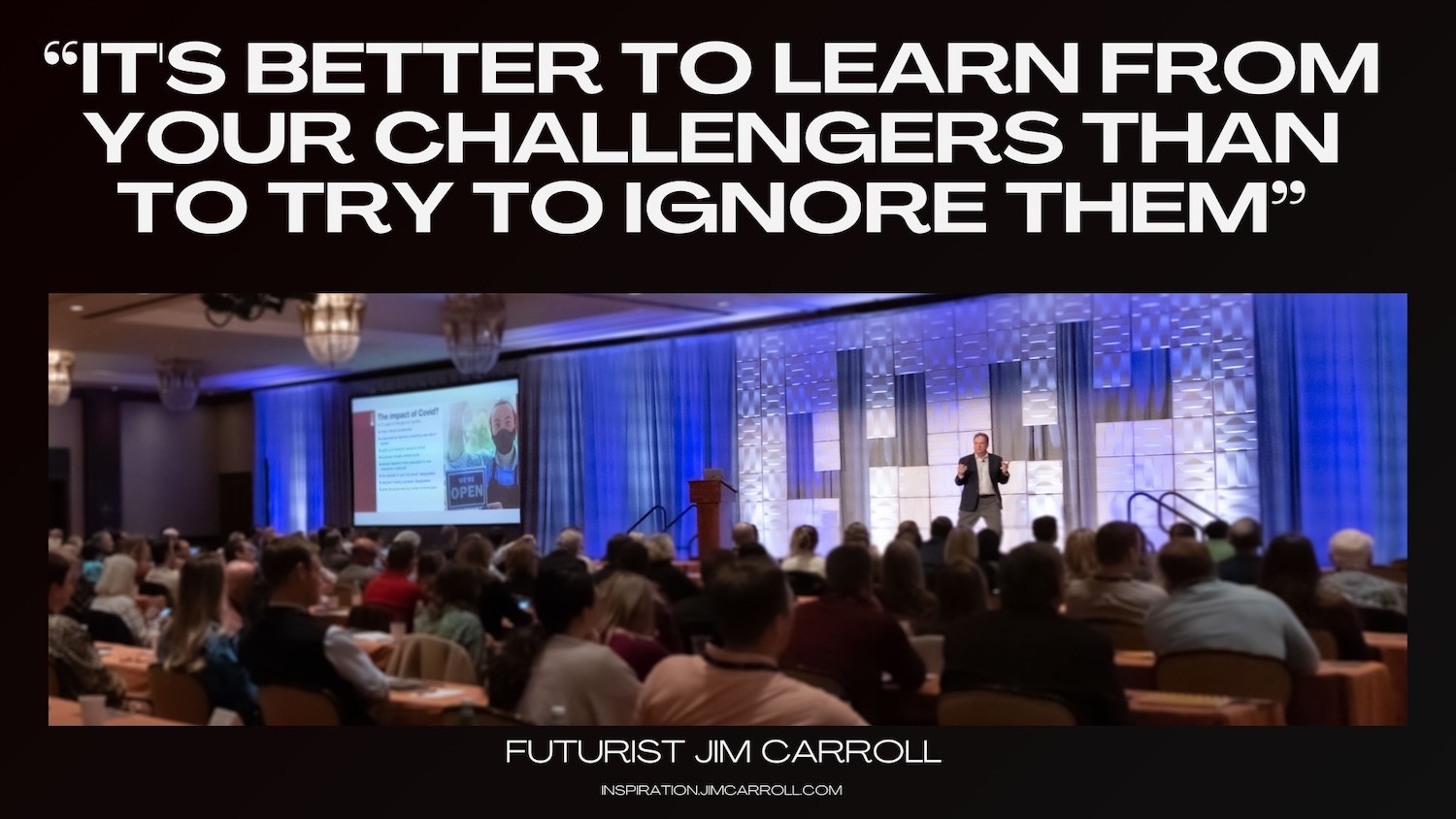
"It's better to learn from your challengers than to try to ignore them" - Futurist Jim Carroll
Let's get back to innovation, with a quick little observation: don't hide from your competition, but learn from them.
I was busy putting together a presentation idea for a client, and realized that one of the things they needed to be thinking about was the idea of 'competitive intelligence.' What's that? It's a topic I covered extensively in a post a few years back, where I noted that "A good leader knows how their strategy is performing. A great leader knows how everyone else is doing!"
What is it?
Investopedia describes it this way: "Competitive intelligence, sometimes referred to as corporate intelligence, refers to the ability to gather, analyze, and use information collected on competitors, customers, and other market factors that contribute to a business's competitive advantage."
The idea of "CI", as it's known, is particularly important in a fast-moving economy. Why's that? Because in a world in which change occurs at blinding speed, having a good idea of what's going on with your key competencies can be one of the most important sources of innovative ideas that you can have. You aren't necessarily copying them - you are making a key decision to at least keep up with them - and perhaps, outinnvate them.
I know that lots of folks don't like to acknowledge what their competition is doing, because it can often expose their very own weaknesses and outline where they're falling behind. But how are you supposed to ever move ahead if you can't acknowledge those realities?
You can't hide from your competition - that's the surest pathway to failure. Instead, study them, learn from them, and get inspired by them!
----
Futurist Jim Carroll actually offered competitive intelligence services to his clients in the early 90s, using sophisticated online research services to provide them a detailed overview of what their competition was up to. Twenty years later, he was invited to open the annual conference of what became the Society of Competitive Intelligence Professionals!
**#Competition** **#Intelligence** **#Strategy** **#Innovation** **#Learning** **#Analysis** **#Opportunities** **#Benchmarking** **#Adaptation** **#Growth**
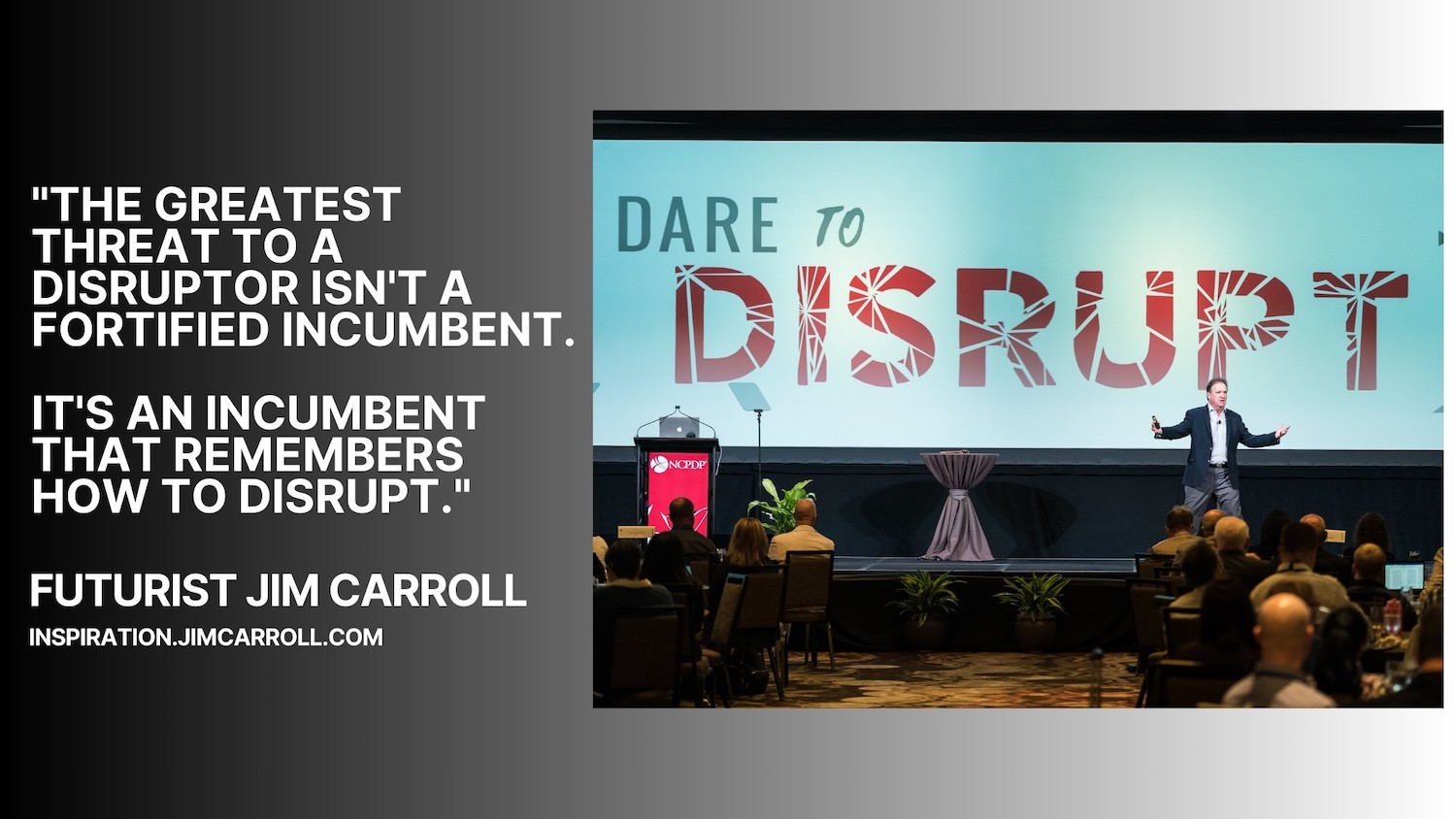
"The greatest threat to a disruptor isn't a fortified incumbent. It's an incumbent that remembers how to disrupt." - Futurist Jim Carroll
My post on 'competitive intelligence' yesterday drew a few comments from folks - what do you do if your industry is moving so fast that the competition seems to have an insurmountable advantage? What if they seem to own the disruption game?
Disrupt them instead.
With that idea in mind, turn that weakness into a strength. I decided that for this particular situation, I wanted to build a section into the outline that would cover "hidden lessons from business disruption battles," going beyond the typical Silicon Valley business model disruption stories that get into this type of idea. The fact is, some of the most compelling business-disruption stories often unfold far from Silicon Valley's spotlight - and provide some very valuable lessons.
I jumped into the Deep Research mode of Gemini with that question, and then. used Gamma to develop this set of slides. You can grab the associated PDF here.
These are some great stories, involving:
- Danish shipping giants are studying containerization to transform global trade.
- Turkish grocery startups are conquering Europe with local market insights.
- Century-old retailers beating Amazon at its own e-commerce game.
From Southeast Asian super-apps defeating Uber to Walmart outmaneuvering Amazon in e-commerce growth, these stories demonstrate that successful adaptation depends less on resources or technology than on being innovative with a counter-disruptive idea.
Read the whole post for more.
**#Disruption** **#Innovation** **#Competition** **#Strategy** **#Adaptation** **#Transformation** **#Business** **#Counter**-disruption **#Assets** **#Evolution**
"Your biggest weakness becomes a strength when you learn to see it differently." - Futurist Jim Carroll
I've been working with this observation for a while, trying to figure out what to do with it.
One of the interesting things about AI these days is how it can sift through vast volumes of information to come up with some interesting nuggets of insight. I took this quote, which I was thinking about one day while out on my early morning walk, while pondering the state of the world, and asked ChatGPT to go through the thousands of blog posts I've written since 2002 and find the areas where I've covered this theme.
This is actually a pretty cool list!
Mindset Shifts
1. See every weakness as the seed of a strength
2. Reframe setbacks as launching pads, not dead ends
3. Treat bad days as training for better ones
4. Make resilience your default reaction to volatility
5. Use diversity of viewpoints to turn blind spots into insights
6. Turn self-doubt into curiosity about what you haven’t learned yet.
7. Use uncertainty as motivation to experiment more.
8. Flip fear into fuel by acting while others hesitate.
9. Turn lack of clarity into a chance to build decisiveness
10. Reframe economic downturns as opportunities to outpace frozen competitors
Action-Oriented Approaches
11. Stop firefighting and start forecasting
12. Fail fast so experience velocity becomes your strength
13. Use wrong decisions as stepping stones for better ones
14. Break overwhelming problems into smaller, solvable ones
15. Treat indecision as a weakness to eliminate by building a bias for action
16. See mistakes as prototypes, not failures.
17. Use constraints as creativity triggers.
18. Turn impatience into urgency that accelerates results.
19. Make stress a signal to redesign systems.
20. Use criticism as free market research.
Leadership & Culture
21. Transform fear of disruption into excitement for reinvention.
22. Channel organizational weakness into a rallying call for innovation
23. Turn intergenerational friction into knowledge transfer
24. Flip hierarchical rigidity into collaborative agility.
25. Use employee turnover to bring in fresh thinking.
Keep reading for 25 more!
----
Futurist Jim Carroll is always finding great ideas within the many ideas he has often had!
https://jimcarroll.com/2025/09/decoding-tomorrow-your-daily-future-inspiration-personal-growth-your-biggest-weakness-becomes-a-strength-when-you-learn-to-see-it-differently/
"You should learn to grow from your disappointments...not hide from them!" - Futurist Jim Carroll
Life is a series of massive successes punctuated by moments of letdown.
Isn't that the way it works?
What keeps innovators going is their ability to bounce back from the latter. They don't let the lows define their highs. They refuse to allow the setbacks to define their steps forward. They never permit the failures to define their success.
This is the essential thinking of the innovator, the individual tuned into tomorrow, the person who lets their determination guide their future. I've covered this type of thinking before, since it seems to be core to who I am, what I do, and the message I share. I dug into the database of Daily Inspiration posts -there are over 2,324 of them so far - and here are the ones that tie into this type of thinking. (This is **#2**,325!)
"'Later' is the graveyard where great ideas go to die!"
"In the absence of clarity, taking initiative today is significantly better than finding a perfect plan tomorrow!"
"My optimism is my oxygen, the fuel for my future, the pathway to my purpose."
"Past success doesn't guarantee a future of winning. Resting on one's laurels is perhaps the best method to place oneself at the greatest risk in the future."
"Celebrate your flaws and highlight your mistakes - because one day soon, they will become your key currency for success!"
"It might be easier to deal with the hard stuff if you accept that the hard stuff is not going to be easy."
"When certainty becomes too uncertain, adaptability becomes your biggest opportunity."
"Guess what? If you didn't do anything today to get out of your rut, it just became deeper!"
"Fall in love with your mistakes. Don't be scared of making mistakes—be terrified of not making enough of them! Early failure isn't your enemy; it's your teacher. A failure while trying beats failing to try every single time."
"The future belongs to those who shape it, not those who fear it."
Do you sense a theme here?
Think of it this way: failure isn't your enemy, it's your teacher. The people and companies that really succeed are the ones who aren't afraid to mess up. They try new things, they take risks, and when they fall, they bounce back stronger. Don't wait around for someone to tell you what's next. By the time a trend is obvious, the opportunity is already gone. You have to anticipate what's coming and be bold enough to shape it yourself. So, stop fearing the future and start creating it.
It's how you define yourself that will define who you are.
Define appropriately!
**#Disappointment** **#Growth** **#Resilience** **#Innovation** **#Bounce**-back **#Learning** **#Future** **#Determination** **#Adaptability** **#Success**
---
Futurist Jim Carroll works hard to define himself each and every day.
"Look for the visionaries who get it... not the skeptics who oppose it." - Futurist Jim Carroll
I was thinking again about the state of affairs with trends and the future. It truly is astonishing how the script can flip in such a short time. Maybe I was onto something when I was sharing the Flintstones and Jetsons idea on stage.
So how do you ensure you are staying tuned to the right ideas, the important concepts, the trends that matter? Listen to the visionaries, those who have a close eye on the ground of tomorrow, an ear tuned to the trends. I asked Gemini what my blog posts suggest - what type of guidance have i shared over the years that helps us to think about this.
This is what you should do.
Lead from the future, not the present: Instead of focusing on current challenges, paint a clear picture of tomorrow and orient your team to move towards that vision.
Don't just follow trends, create them: Be a disruptor in your industry by anticipating what's next and building it before anyone else. This proactive approach sets you apart as a leader, not a follower.
Weaponize your curiosity: Cultivate a culture of relentless questioning. Reward yourself when you challenge assumptions and ask "what if," as this helps to eliminate stagnant thinking.
Lead with "decisive optimism": Acknowledge the challenges at hand, but consistently project confidence in your ability to overcome them. Your mindset is crucial in navigating uncertainty.
Embrace speed: Be quick and nimble. Adopt short-term plans and a mindset of continuous, iterative innovation to keep pace with a rapidly changing world.
Spend more time on possibilities than on roadblocks: Focus your energy on the opportunities and potential outcomes rather than dwelling on the setbacks and obstacles you encounter.
Don't just think outside the box - live there: Make unconventional thinking and living a core part of your personal and professional life, not just an occasional exercise.
To invent the future, be willing to throw away your past: You must be prepared to discard old methods and outdated successes to create something new and transformative.
Learn from your disappointments, don't hide from them: View your mistakes and letdowns as opportunities for growth. Use them as fuel for your next steps forward instead of allowing them to define you.
Learn from your challengers: Do not ignore your competitors. Instead, study them, learn from them, and get inspired by their strategies to fuel your own innovative thinking.
Above all, keep moving forward, not back!
Because, despite the oddness of our times, tomorrow knows where we are going!
---
Sometimes, Futurist Jim Carroll doesn't know where we are going, but knows that we are making great time.
**#Visionaries** **#Future** **#Innovation** **#Leadership** **#Trends** **#Optimism** **#Progress** **#Forward**
"Architect what isn't: Don't ask 'Why?', ask 'Why not?' and build it!" - Futurist Jim Carroll
Today's image is courtesy of Ideogram.AI. Things are moving so fast with online image generation; the possibilities are staggering, and the realities terrifying.
In any event, let's think about innovation a bit more today. I've often found that people tend to place the "Why" barrier in the way when confronted by big opportunities or big ideas. "Why would we want to do that?" "Why would we take the risk?" "Why would we change what we are doing?"
"Why" is one of the biggest barriers there is. "Why?" defends the present.
"Why not?", on the other hand, builds the future. Take apart the phrase, "Architect what isn't: Don't ask 'Why?', ask 'Why not?' and build it!" It’s there to challenge your assumptions, get you to embrace possibility, and, most importantly, dare to build.
With all that in mind, it got me thinking - maybe too many organizations have too many people who spend their time asking "Why?" and not enough who ask "Why not?". So I used Gamma to work with me and help me build a slide deck of the key strategic leadership roles that would help an organization 'architect what isn't. ' You can grab the PDF here.
https://pdf.jimcarroll.com/Architect-What-Isnt.pdf
It's a guidebook to reimaging our leadership structure!
And it helps us think about the executive roles designed to make it happen - having more people ask "Why not?" as the core mission! Read the post to learn more about each role!
The Chief Possibility Officer
The Chief Trust & Culture Officer
The Chief Exploration Officer
The Chief Obstacle Remover
The Chief Acceleration Officer
The Chief Idea Farmer
The Chief Iteration Officer
The Chief Deconstructionist
The Chief Ignition Officer
The Chief Customer Anthropologist
Put this team in place, and you've got the perfect setup for an innovation team!
Think about it! Start asking "Why not!" because you already know the 'why!"
**#Success** **#Family** **#Life** **#Perspective** **#Grandfather** **#Home** **#Joy** **#Present** **#Living** **#Balance**
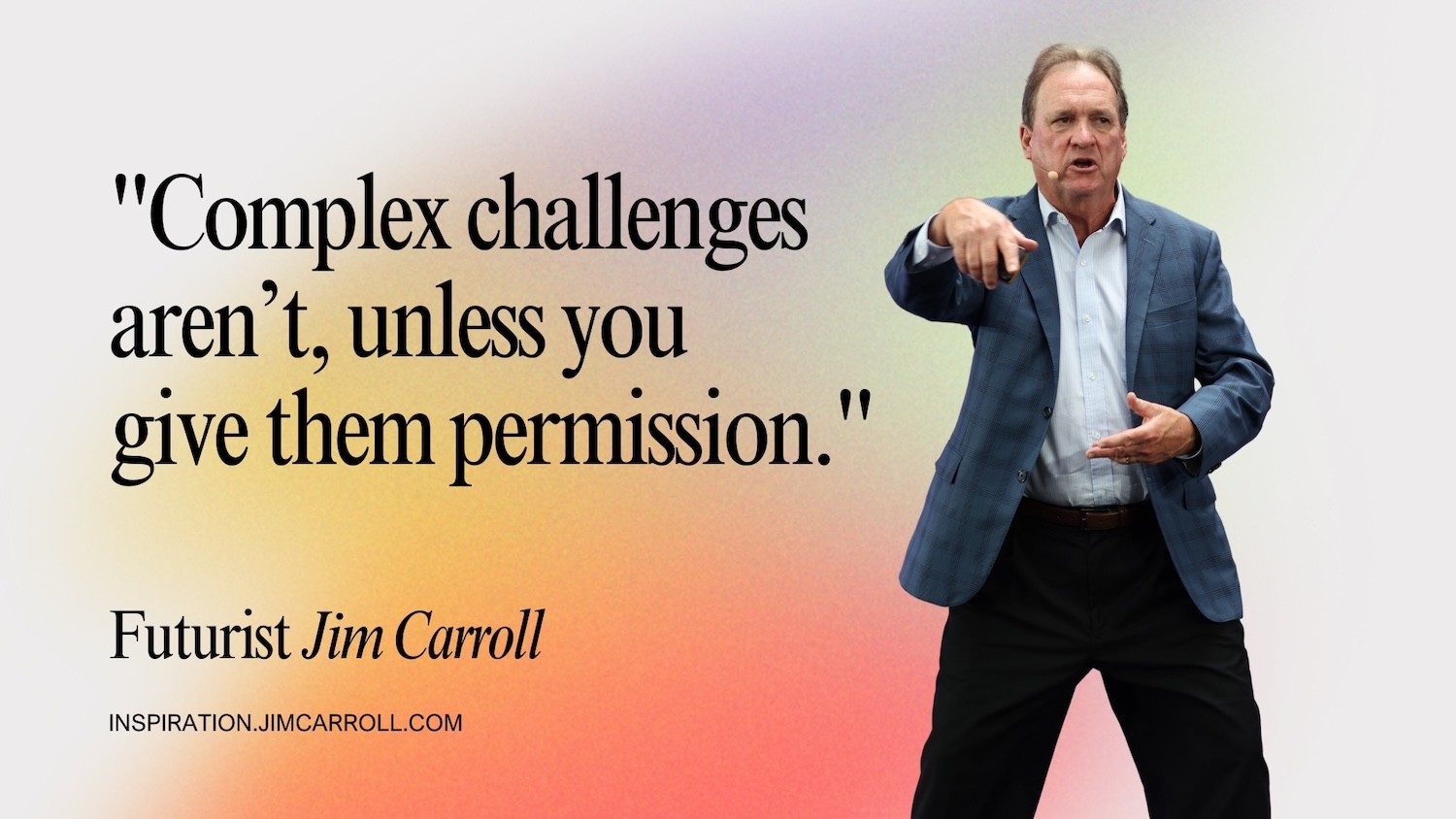
"Complex challenges aren’t, unless you give them permission." - Futurist Jim Carroll
The debate about AI and the future of work, skills, and knowledge rages on.
In the meantime, lots of folks are figuring out how to leverage this darned thing. I certainly am! I have an incredibly complex, rich, and sophisticated tech setup that has supported my business for over 3 decades. I'm a computer geek behind the scenes, with a ridiculous amount of tech gear in my life. There's a lot of automation throughout the house, and my home office and broadcast studio setups are pretty sophisticated.
Heck, I've even been called crazy, such as was the case in this magazine article from about 2002.
That said, it takes a lot of work to keep all of this running - and so for years, I've not only been the author and speaker and columnist and radio show host - I've been the tech support guy. Not only for me, but for my wife (who has worked with me in the home office for 30+ years), my two sons (who also do most of their career work out of their homes and have similar home automation setups!), and their two wives.
Enter AI.
In the last year, I've found that I have regularly turned to ChatGPT or Gemini or Claude with my tech support issues, ranging from simple requests for help to complex projects involving detailed programming in languages such as Python (which I know nothing about - more on that in a later post.)
I decided to take a look at one month's worth of the tech support requests I've made to Gemini - the full list, WITH MY QUESTIONS, is found below. And it's staggering to think about how much I've come to rely on this tool.
Augmented knowledge, as it were.
And if you think about what is happening here, there is a transformation underway - we are moving away from one type of traditional tech support to an AI-based partnership. Over time, we'll be fully integrating this knowledge augmentation into our daily lives, across a vast range of different skill sets.
I
And so while the debate about AI rages on, millions of people are learning how to augment their own knowledge. This one example involves my use of it for tech support - for others, it's about augmented knowledge, medical insight, engineering skills, science knowledge, or more.
Things are changing, folks, and the sooner you jump on board, the better positioned you will be! All of which comes to the key point - any complex challenges that we face today really aren't, unless you allow it to be. Your ability to master new knowledge and skills is what will now truly define your tomorrow!
You might find reading through this PDF to be pretty fascinating - it includes 20 examples of 20 different types of tech support I've been using AI for, questions and all.
It's a wild read!
#AI #Complexity #Technology #Support #Augmentation #Knowledge #Skills #Partnership #Solutions #Integration
----
Futurist Jim Carroll admits that when it comes to tech, he's always been a bit crazy and way ahead of his time.
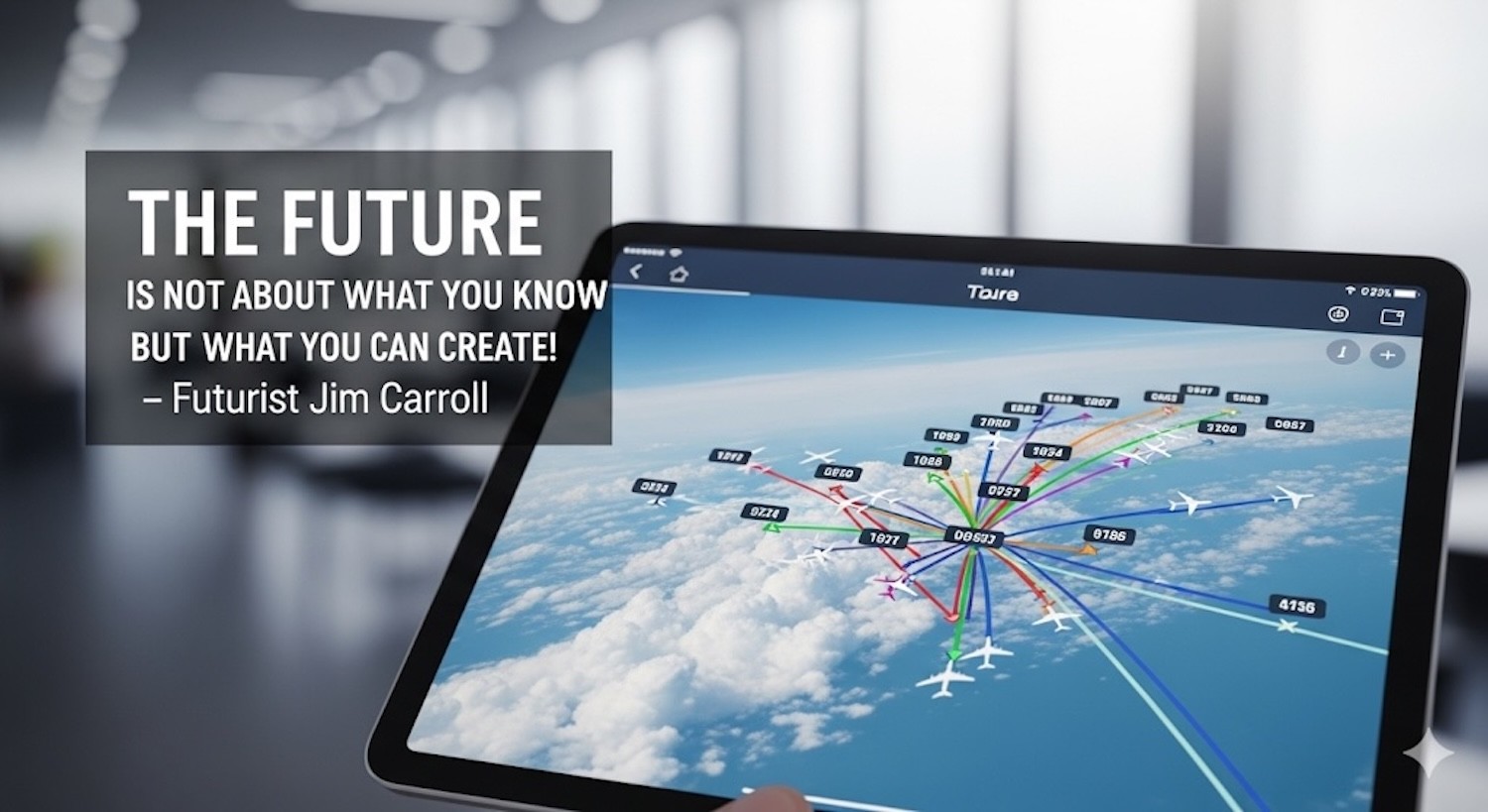
"The future is not about what you know but what you can create!" - Futurist Jim Carroll
I've become quite the Python programmer.
I know nothing about Python
This is both the conundrum and the wonderful possibility of the AI age.
As I type this out on the deck at 526am, there's a large jet lumbering overhead, a few thousand feet above. I know at this moment that it's a big old MD11 for UPS, flying a load of cargo from Louisville to Toronto. It's exactly 7,200 feet overhead, moving southeast. It is precisely this type of concise but useless information that I share with my wife that she finds crazy. She is unimpressed.
But this is one of the promises of the AI age. Yesterday, I wrote about how I was using AI to manage all the technical support around this complicated home office and home. Today, a short overview of how I can master a complex computer programming language without ever knowing much about the program.
Some cards on the table first - I do have some pretty intense coding skills. Enter AI. If you spend any time online, you will be hearing about the idea of 'vibe coding' - that's the idea where you are using it to help you write, structure. fix and test code. I've certainly been doing a lot of that - and this little project is a great example.
For a long time, in my home, I've been running an ADS-B receiver on a Raspberry PI - that's a little $35 computer that can be used for a wide number of small projects. The little antennae on the device pull in all the details on the various flights that pass over or around my home; each plane sends out an ADS-B signal with height, speed, callsign, tail number and more.
But the folks at FlightAware, FlightRadar, Planespotters, and other apps you might use to track flights or find arrival and departure information have developed programs that let you turn this raw data into magical maps. My Raspberry Pi, for example, takes the data above and turns it into this image, accessible via my Web browser. The same data is uploaded continuously to all those flight services - with tens of thousands of people participating in this hobby, that's how this live flight tracking app you might use on your iPhone or iPad came to be.
It's a fun little hobby that tens of thousands of people around the world participate in - having their own 'feeder' stations grab this ADS-B information, feeding it to tracking services.
Onwards. One day, I saw someone post about the FlightWall - a display that someone could place over a window in their apartment or home, to know exactly what plane was just outside the window.
I decided to build my own.
Here's the story, and why it matters.
**#Creation** **#AI** **#Programming** **#Python** **#Learning** **#Skills** **#Aviation** **#Technology** **#Innovation** **#Augmentation**
"The Secret to Creativity: Don't wait for the perfect moment; take this moment and make it perfect." - Futurist Jim Carroll
As someone who has spoken on the topic of innovation worldwide, I've long understood creativity to be one of the most important skills we can have.
But how do we build it, nurture it, develop it, and protect it?
There are many ways to do this! One of the interesting things I am learning about the use of AI is that it is a powerful tool to revisit large sets of data and examine them for key insights. Yesterday, I exported all of my blog posts - several thousand from 2002 - organized into categories. I picked one random category - Creativity - and started to work with it.
Through the years, I've covered the topic in a lot of depth, ranging from methods of fostering and accelerating innovation to aligning with trends to chasing your inner uniqueness. And it does form the core of my upcoming book, Being Unique: Turning Curiosity, Creativity, and Courage into Your Competitive Edge
I worked through the material in Gemini and came up with a list of 25 strategies that could help you think about this issue. It's a pretty good list!
Your Personal Creativity Action Plan is a PDF that I generated by examining all 150 posts and digging out the advice I've given over the years as to how to accelerate your creativity. You can grab it here.
https://pdf.jimcarroll.com/The-Secret-to-Creativity.pdf
Here goes - these are the ideas designed to help you build the habits and mindsets necessary to spark new ideas, adapt to change, and turn your unique vision into reality.
(Read the post for the list)
Creativity is core to your future.
Act accordingly.
---
Futurist Jim Carroll is busy discovering new nuggets of creativity buried deep within the insight he has been sharing for years!
#Creation #AI #Programming #Python #Learning #Skills #Aviation #Technology #Innovation #Augmentation
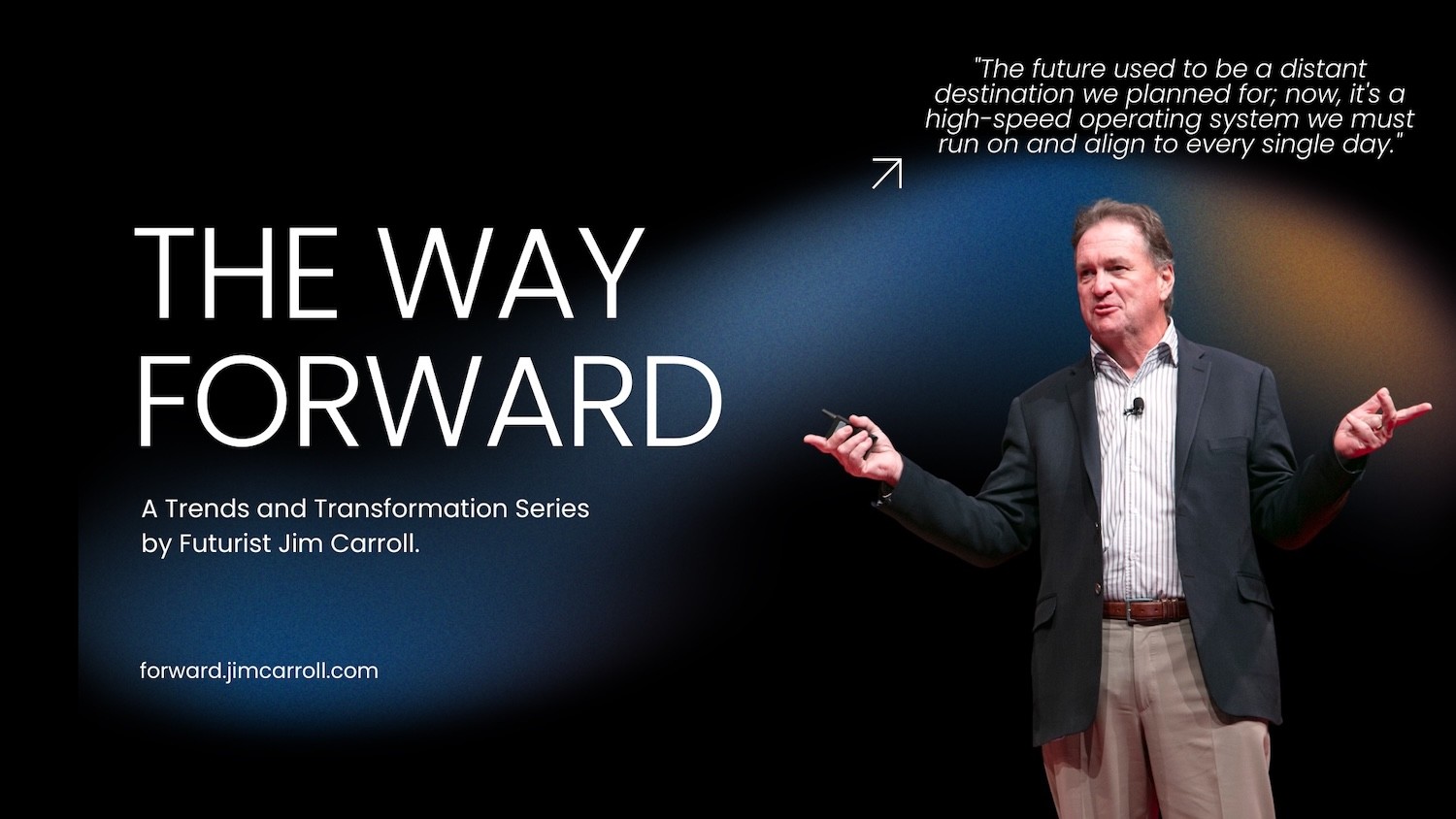
"The future used to be a distant destination we planned for; now, it's a high-speed operating system we must run on and align to every single day." - Futurist Jim Carroll
I'm starting another series here. This one should run for about two weeks, as I take on the trends that various industries should be aligning with.
I've gone back and examined the countless trend posts I've written on various industries - manufacturing, agriculture, healthcare, and more. These have been in relation to keynotes I've done, trends I've observed, or megatrends and other series I've written.
And I've realized there is a lot of insight in there!
Here in September 2025, the headwinds are severe and the path forward seems shrouded in fog. We're living through one of the most volatile and unpredictable periods in recent memory. This new, high-speed 'operating system' of the future is defined by relentless change, and the default reaction for many is to simply shut down—to "hunker down and wait it out." But as I outline in my new book, Dancing in the Rain: How Bold Leaders Grow Stronger in Stormy Times, you cannot wait for clarity; you must create it through action. The only viable strategy is to move forward, especially in a storm.
It is with that urgent mindset that I am launching this new series, The Way Forward: A Trends and Transformation Series. Think of it as the user manual for this new operating system—a detailed, actionable roadmap for what key industries must do to navigate the chaos and own their future. I
All the discussions have led me to realize - people might be climbing out of their cone of uncertainty and are starting to move. That means it's timely.
Viewing the future as a high-speed operating system is the critical mindset shift for 2025. Your legacy strategies are like outdated software—becoming slower, less secure, and incompatible with each passing moment of volatility. They were built for a different machine, a different era. This "Way Forward" series is designed to be your upgrade path! A reboot! A cold restart! Hitting the switch and letting things power up fresh!
Think of it as the essential user manual and developer kit for this new reality, providing the architecture and the code you need to not just run on this new OS, but to thrive within it. It's time to stop running legacy systems in a world that demands a complete rewrite.
Let's begin the upgrade. I'll start tomorrow with the topic of manufacturing.
---
Futurist Jim Carroll recently released the book, Dancing in the Rain: How Bold Leaders Grow Stronger in Stormy Times.
**#Future** **#Transformation** **#Innovation** **#Strategy** **#Industries** **#Adaptation** **#Leadership** **#Change** **#Trends** **#Action**
The Way Forward: A Trends and Innovation Series by Futurist Jim Carroll
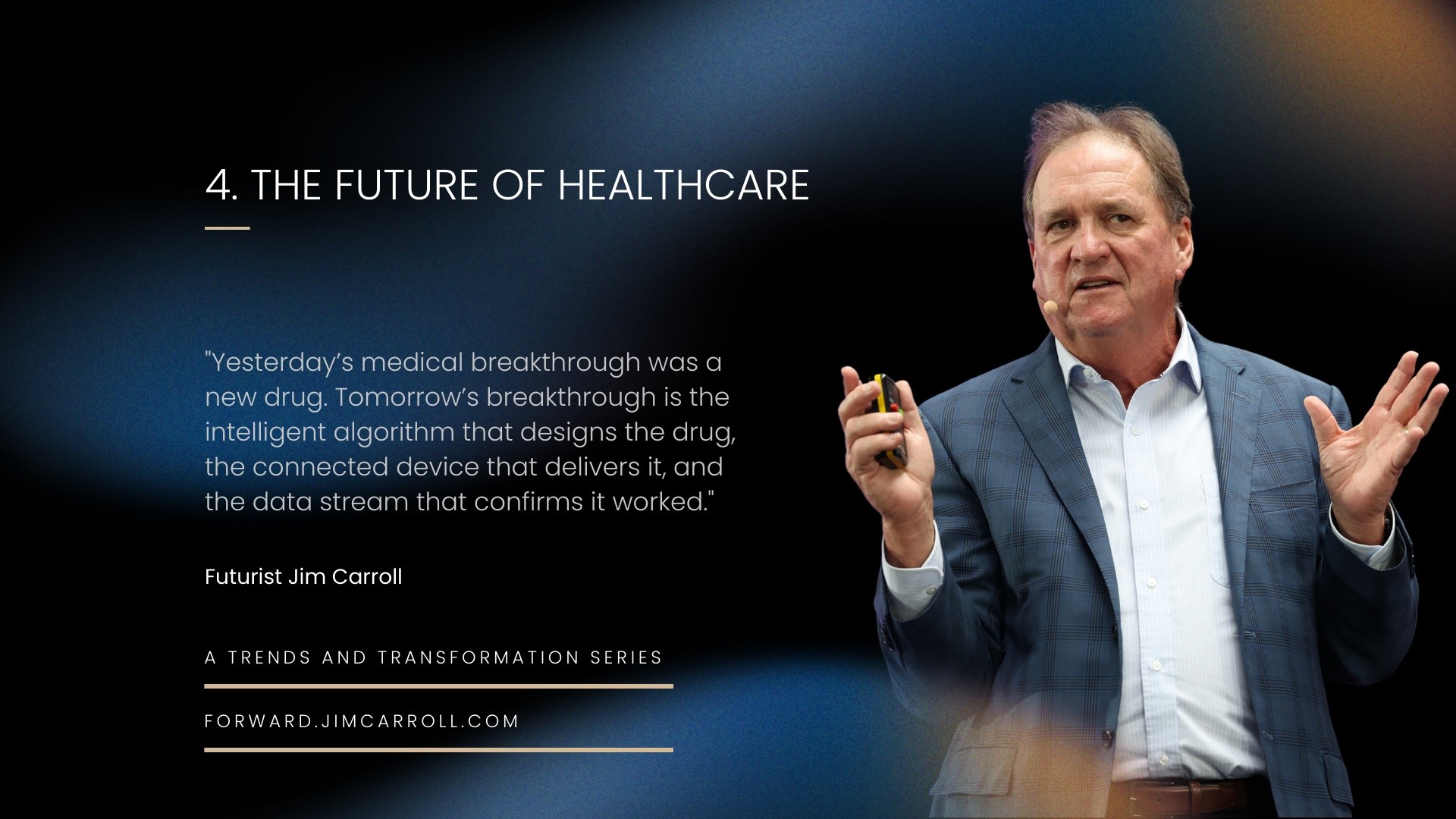
**#1** - Manufacturing: "The most valuable part of a modern manufacturing operation is the part you can't see: the algorithms that optimize flow, the data that predicts failure, and the agility that makes the entire process intelligent." - Futurist Jim Carroll
---
In September 2025, the headwinds are severe, and the path forward seems shrouded in fog. We’re living through one of the most volatile and unpredictable periods in recent memory. With that being the case, I am writing this new series, The Way Forward: A Trends and Transformation Series, taking a look at the trends redefining industries, and actionable strategies organizations must pursue to align to these realities. The entire series will be found at forward.jimcarroll.com
--
This single idea captures the profound shift underway in manufacturing.
Success is no longer measured by physical output alone, but by the intelligence embedded within the entire production process. That intelligence allows for flexible manufacturing, advanced product development, sophisticated production monitoring, and more.
For many Small and Medium-sized Enterprises (SMEs), however, accessing this new world of intelligent manufacturing can seem daunting. With that in mind it's a good time to summarize the critical trends transforming the industry, the significant barriers faced by SMEs, real-world examples of success, and an actionable path forward to navigate the future.
The Landscape: 10 Trends Redefining the Future of Manufacturing
To navigate the future, you must first accept the new reality. These are not distant, abstract concepts; they are the active forces reshaping our world today. I've covered these relentlessly on stage - they are often referred to as the trends of Factory 2.0 or Factory 4.0 or whatever number you want to give them!
Compressed Innovation Cycles & Agility
AI-Powered Automation & Robotics
Mass Customization & Personalization
Additive Manufacturing (3D Printing)
The Industrial Internet of Things (IIoT)
Digital Twin Technology
Supply Chain Reinvention & Resilience
Accelerated Materials Science
Advanced Skills
Data-Driven Decision Making
The Great Divide: Why SMEs Are Facing a Crisis of Catch-Up
The modern manufacturing landscape is defined by a stark dichotomy, creating a 'barbell economy' within the sector.
Three core barriers are holding them back.
Read the rest of the post ....
----
**#Manufacturing** **#Innovation** **#Technology** **#Automation** **#SMEs** **#Transformation** **#Digital** **#Industry** **#Strategy** **#Future**
Futurist Jim Carroll believes that many manufacturing organizations need to spend more time manufacturing their future and less time fretting about their inability to get there.
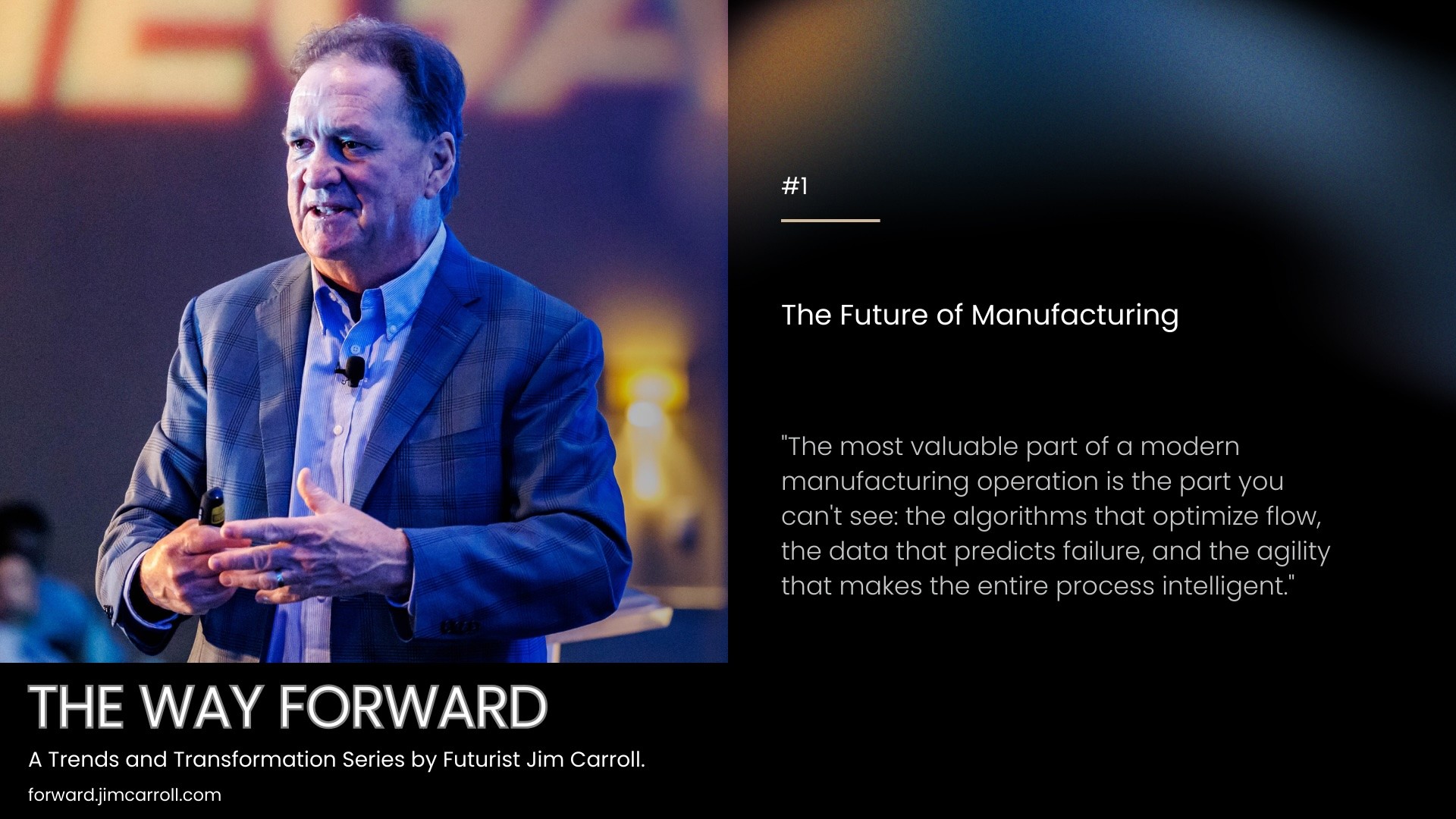
“The farmer of the future is part biologist, part data scientist, and part roboticist—but is still 100% an optimist who plants a seed and believes in tomorrow.” – Futurist Jim Carroll
This quote captures the essence of the modern agricultural professional!
The fact is, the sepia-toned image of a world-weary farmer with a pitchfork is a relic. Today’s farmers and ranchers are some of the most innovative people I know.
With that in mind, this summary is about the second type of farmer and provides a roadmap for that future-positive farmer.
The Landscape: 10 Trends Redefining Agriculture
To succeed tomorrow as a farmer today, you must understand the powerful forces reshaping your world. These trends are not distant possibilities; they are active realities creating massive opportunities.
AI-Driven Precision Agriculture. AI analyzes data from drones, sensors, and satellites to create precise maps, allowing farmers to optimize the use of irrigation, fertilizer, and pesticides, which boosts yields while reducing costs and environmental impact.
Autonomous Operations & 24-Hour Farming. The future of farming is happening faster than you think, with driverless tractors and weed-zapping robots becoming a reality.
Accelerated Agricultural Science & Genomics. Agriculture is fundamentally about science, and science is accelerating at an exponential rate. Advances in genomics, nanotechnology, and bioinformatics are transforming the industry.
Hyper-Connectivity & Livestock Monitoring. We are firmly in the era of the "connected cow," with "Fitbits for cows" providing a constant stream of data.
Vertical Farming & Controlled Environment Agriculture (CEA). As the global population grows and arable land shrinks, farming is moving indoors.
Data-Driven Decision Making. The modern farm generates a massive amount of data. AI and predictive analytics can process this data.
Generational Transformation. The tech-savvy "iPod generation" is taking over the family farm.
The Rise of "Just-in-Time Knowledge". The pace of change and scientific discovery has made it impossible for any single person to be an expert in everything.
Sustainability & Food Security. A core challenge is that global food production must double in the next 30 years, with little new arable land available.
Supply Chain Disruption & E-commerce. The agricultural supply chain is being reshaped by everything from global trade volatility to new technologies like blockchain for food safety and traceability.
These aren't crazy, science-fiction-like ideas - these are real trends happening now!
And they define the future of farming.
----
**#Agriculture** **#Innovation** **#Technology** **#Farming** **#Data** **#Robotics** **#Precision** **#Sustainability** **#Future** **#Optimization**
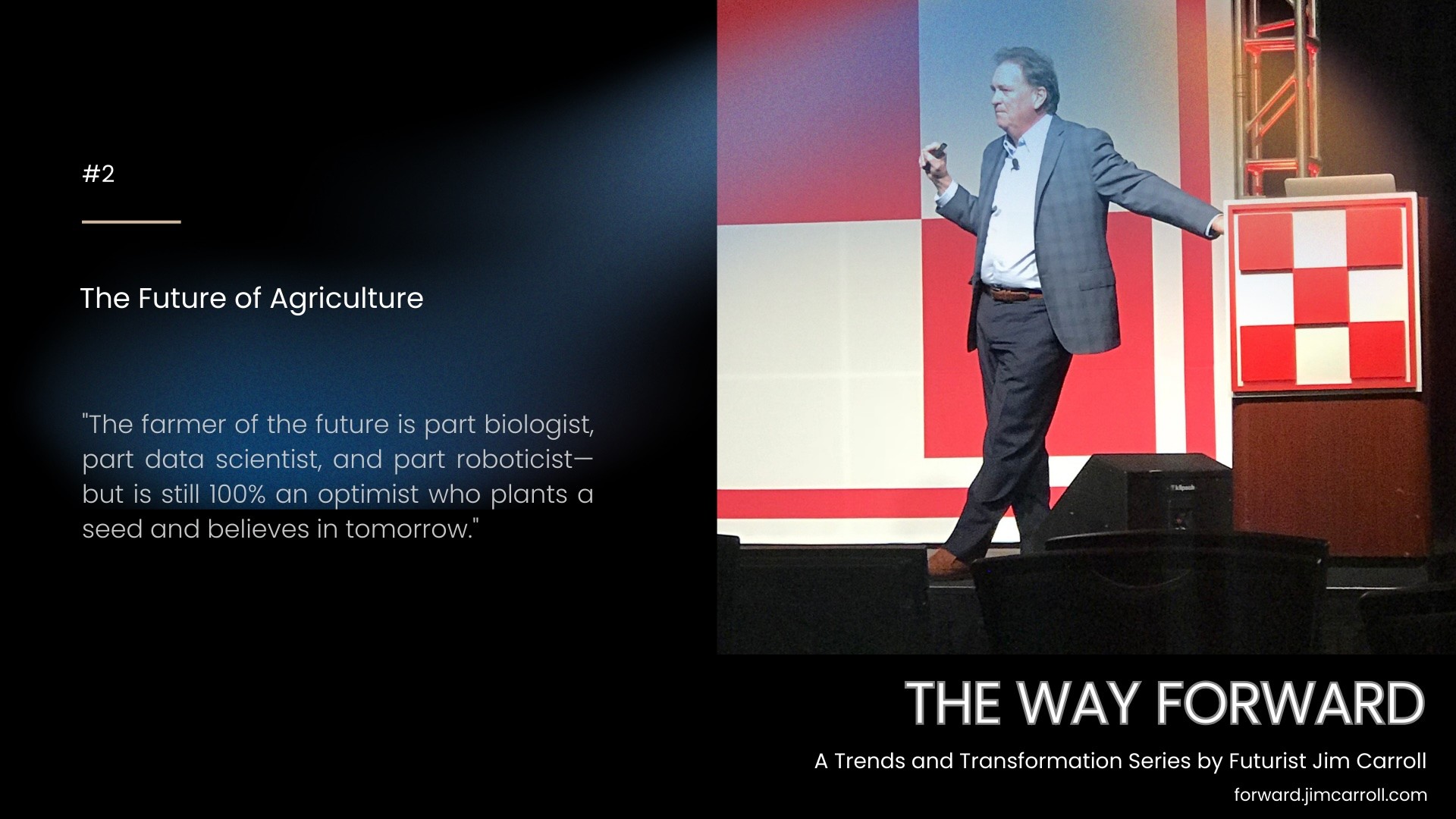
The Way Forward: The Future of Energy - "The power plant of the past was a smokestack on the horizon. The power plant of the future is the solar panel on your roof, the battery in your garage, and the intelligent software that connects them all." - Futurist Jim Carroll
Think about it: for decades, the energy and utility model has been simple: massive, centralized power stations push electricity in one direction to passive consumers. That era is decisively ending. We are witnessing a fundamental shift from a one-way delivery system to a multi-directional energy infrastructure, creating a stark divide between the incumbent organizations tied to the old grid and the agile innovators building the new one.
A lot of this has to do with technologies and ideas that are caught smack-dab in the middle of the craziness of the culture wars of 2025 - solar, renewables, batteries, and electric vehicles - but successful people take the long-term view, align to reality, know that science is real, and the disruptive trends always overcome short-term craziness. With that in mind, here are the key trends reshaping the energy and utility industry, the significant barriers to transformation, a playbook of actionable strategies, and real-world case studies of organizations navigating this new landscape.
The Landscape: 10 Trends Redefining Energy
The future of energy is arriving faster than you think. These are the powerful currents already reshaping our global power infrastructure.
- the electrification revolution.
- accelerating renewables & grid parity.
- the battery storage disruption
- energy decentralization & microgrids
- the rise of the "smart grid" & AI
- vehicle-to-grid (V2G) integration
- business model disruption
- the circular economy for energy
- the AI-driven demand shift
- climate-positive technologies
These trends are real, significant - and continue to emerge at breakneck speed on a global basis, despite the efforts of some nations to turn their back on them.
Even so, there are significant barriers in the way. Read the post for insight on the path forward.
----
**#Energy** **#Decentralization** **#Renewables** **#Grid** **#Innovation** **#Microgrids** **#Electrification** **#Storage** **#Transformation** **#Future**
Futurist Jim Carroll has spoken at dozens of energy-oriented leadership conferences and events through the years, including several with rooms full of nuclear scientists. Information about his work in this sector can be found at https://energy.jimcarroll.com. He will be headlining a conference on the topic later in October in Tucson.
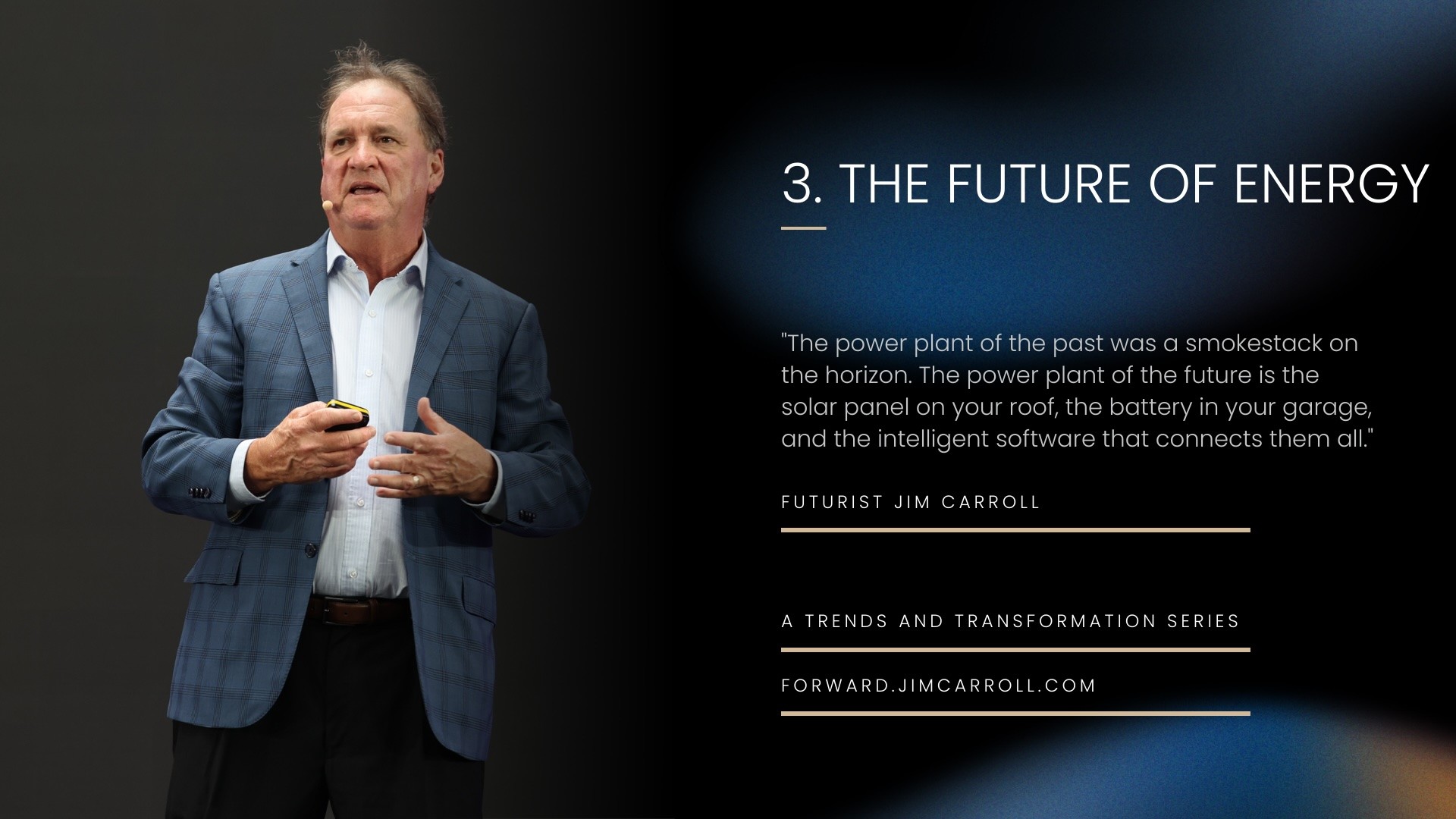
"Yesterday’s medical breakthrough was a new drug. Tomorrow’s breakthrough is the intelligent algorithm that designs the drug, the connected device that delivers it, and the data stream that confirms it worked."- Futurist Jim Carroll
This single idea captures the profound shift underway in healthcare.
Success is no longer measured by a single intervention, but by the intelligence of the entire system of care. It's a big undertaking, but one full of opportunity. Over the years, I've keynoted dozens of healthcare conferences, leadership meetings, and events, and have been writing on the topic extensively. Heck, in 1997, I released a book that predicted much of today's landscape called Good Health Online, not to forget that I predicted today's healthcare reality crisis - almost exactly as it is unfolding now - back in 2017.
Let's dig in.
If I look back at the topics I've covered, it's clear that the future of healthcare is being redefined at blinding speed. These are the 10 powerful trends creating both unprecedented challenges and massive opportunities.
The shift to preventative medicine
The acceleration of medical science
Bio-connectivity & the virtualization of care
The rise of the empowered, connected patient
AI-driven diagnostics and treatment
The data-driven healthcare dashboard
The gig economy and the "just-in-time" medical professional
The redefined pharmacy
Longevity science and brain health
The blurring of industries
All of this spells big opportunity - but also involves a huge effort.
The forces at play—accelerating science, transformative technology, and the empowerment of the patient—are not cyclical trends but the agents of a permanent, structural reinvention of the industry. The opportunities for innovation are immense, but they will not be captured by those who cling to the models of the past.
The future of healthcare will not be defined by a single piece of legislation or a singular miracle cure, but by the relentless pace of scientific discovery and the bold leaders who are willing to challenge the status quo. The future belongs to those who are fast, and the race to reinvent healthcare is on!
Read the whole post.
----
**#Healthcare** **#Innovation** **#Prevention** **#AI** **#Technology** **#Medicine** **#Digital** **#Transformation** **#Personalized** **#Future**
Futurist Jim Carroll covers the healthcare topic regularly in his blog - you can find dozens of posts at https://jimcarroll.com/category/health-care-trends/
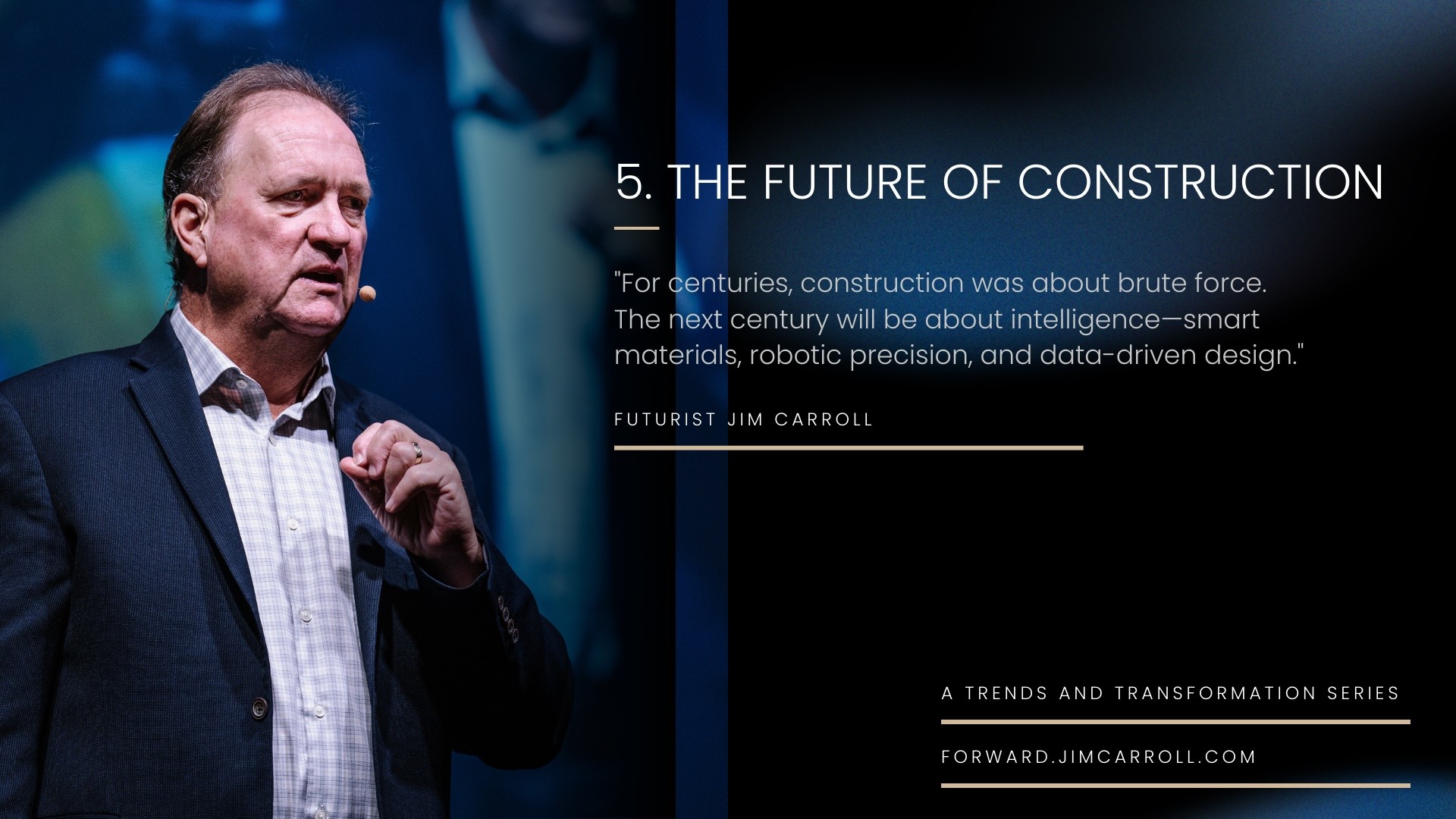
"For centuries, construction was about brute force. The next century will be about intelligence—smart materials, robotic precision, and data-driven design." - Futurist Jim Carroll
For centuries, the core principles of building have remained relatively unchanged. That's changing. Let's dig in.
These are the powerful currents reshaping the built environment.
Digital twin technology & virtualization. The industry is moving from 2D blueprints to dynamic, 4D digital twins—virtual replicas of physical assets used from design through to lifelong operational management.
AI-driven design and project management. Artificial intelligence is becoming the new engine of construction intelligence, used to generate optimized designs, predict project timelines, and identify potential safety risks.
Robotics & automation on the job site. Robots are moving out of the factory and onto the construction site, with autonomous vehicles for earthmoving, brick-laying robots, and drones for site surveys, addressing labor shortages and improving safety.
Off-site & modular construction. The process of building is shifting from the construction site to the factory floor, improving quality, reducing waste, and shortening project timelines.
Accelerated materials science. The very materials we build with are being reinvented, with innovations like self-healing concrete, transparent solar-generating glass, and carbon-negative building materials.
The rise of intelligent infrastructure. Our buildings, roads, and bridges are becoming smart and connected, with integrated IoT sensors creating "living" structures that can monitor their own health and manage energy in real-time.
Sustainability & the circular economy. Green building is moving from a niche market to a core business imperative, with a growing focus on "design for deconstruction" to reuse materials and eliminate waste.
The advanced skills gap. As construction becomes a technology-driven industry, there is a massive new demand for professionals with skills in data science, robotics, digital modeling, and systems integration.
The transformation of infrastructure investment. Massive global investment is shifting toward 21st-century infrastructure, including the build-out of a new distributed energy grid, 5G communication networks, and EV charging infrastructure.
Hyper-connectivity & location intelligence. The job site is becoming a fully connected, data-rich environment, with real-time data from drones, sensors, and wearables providing unprecedented visibility and control.
Read more.
**#Construction** **#Innovation** **#Technology** **#Digital** **#Robotics** **#Materials** **#Intelligence** **#Automation** **#Sustainability** **#Transformation**
---
The Way Forward - The Future of Insurance: “The future of insurance will be written by those who move from predicting the past to architecting the future, transforming risk from a liability to be avoided into an asset to be managed." - Futurist Jim Carroll
The insurance industry stands at a historic inflection point - moving from always looking back, to increasingly looking right now and looking forward.
Think about it - for centuries, the foundation of the industry has been the actuarial analysis of the past—a model that involves looking at what happened, and indemnifying customers based on that reality. That era is over. A powerful convergence of hyper-connectivity, artificial intelligence (AI), and accelerating, complex risk is forcing a new model, in which insurance is underwritten not just by looking at the past to predict future risk, but by underwriting that risk based on real-time information and concise information on what might happen next.
This is a huge change - and one that is massive both in terms of the challenge and the opportunity.
I've been covering trends in the industry for 30 years. Looking back at my keynotes and what I've written about the industry, 10 key trends stand out that are reshaping the global risk landscape identified above.
The shift to predictive analytics
Hyper-connectivity & the Internet of Things (IoT)
The acceleration of risk
AI-driven underwriting and claims
Just-in-time" & usage-based insurance (UBI)
The blurring of industries
The rise of the empowered, digital customer
The reinvention of distribution channels
The transformation of actuarial science
The emergence of "risk architecture" as a service
Despite the immense promise of these trends, the insurance industry has been notoriously slow to change. Like, really slow! It's said that more than half of the coding in the industry still runs on COBOL! This means there is a huge speed divide between the new InsurTech startups and legacy companies.
Like I said.
That's a big challenge.
And it's a huge opportunity!
---
Futurist Jim Carroll has covered the insurance industry extensively in his blog, which can be found at https://jimcarroll.com/category/insurance/
**#Insurance** **#Risk** **#Technology** **#AI** **#Predictive** **#Innovation** **#Digital** **#Analytics** **#Transformation** **#Future**