Futurist Jim Carroll

Mastodon post archive · 2022–2026
Archived from mastodon.futurist.info · 4209 posts
← All months

August 2025 · 21 posts

← July 2025September 2025 →
Aug 1, 2025 · 9:54 AM UTC

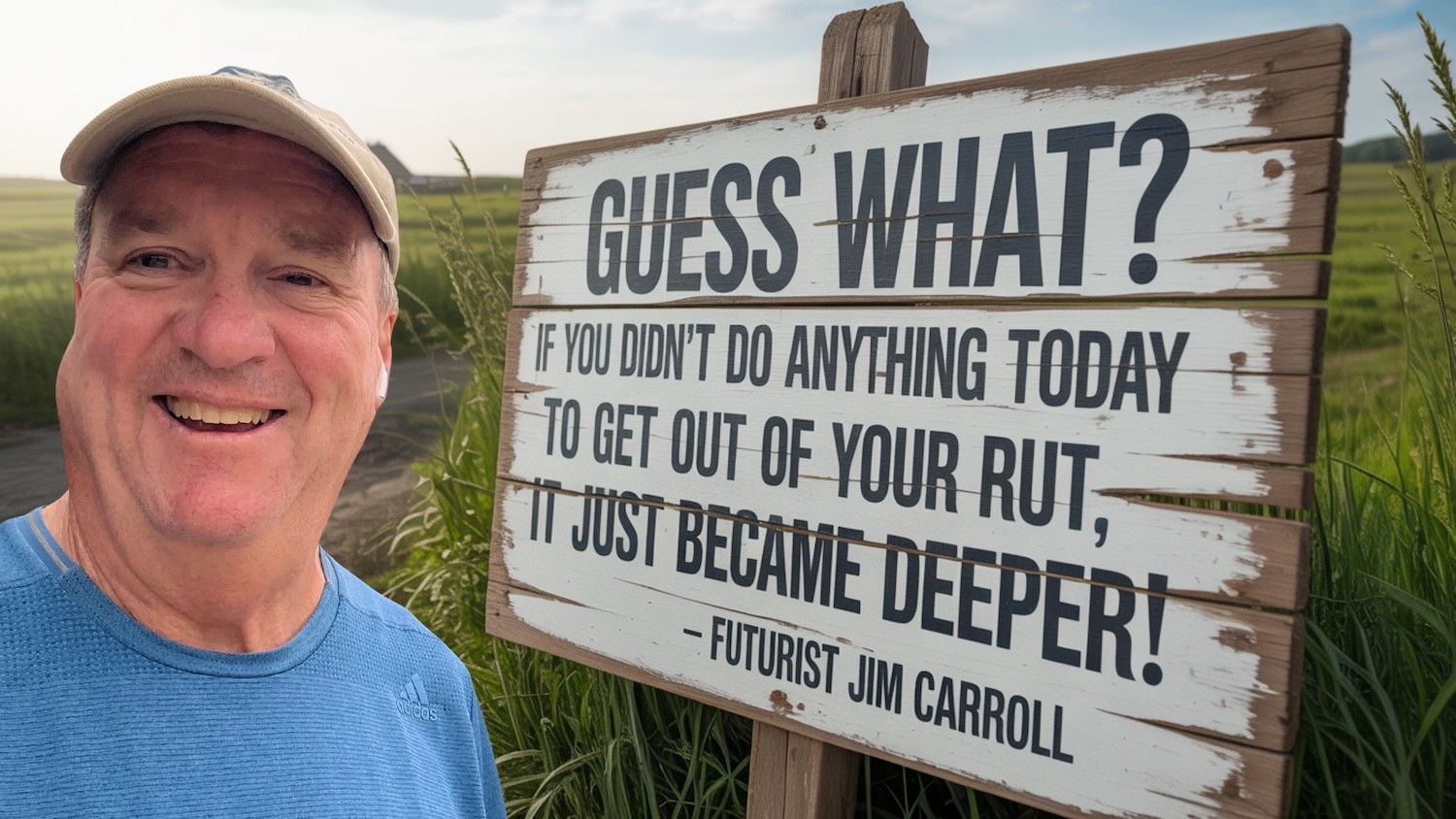
"Guess what? If you didn't do anything today to get out of your rut, it just became deeper!" - Futurist Jim Carroll

The thing about ruts is that you'll never get out of them if you don't start now!

Here are 10 signs that you're in a rut:

- clinging to the idea that "we've always done it this way."
- suffering from aggressive indecision.
- always displaying relentless negativity and pessimism.
- exhibiting deep complacency.
- over-reliance on past success and old glories.
- a culture that is risk-averse, fearing failure.
- a lack of urgency and procrastination.
- you rely on committees or rigid processes.
- you listen only to familiar voices.
- you resist adapting to change or new ideas.

That's a good overview of rut-thinking.

Stuck there? Here are 10 ways to get out of it:
- commit to decisive action.
- cultivate optimism, focus on opportunities.
- break old habits, abandon routines.
- embrace risks, learn from failure.
- seek diverse ideas, challenge old thinking.
- prioritize continuous learning and skill reinvention.
- think big, embrace transformative ideas.
- build urgency and restore a sense of purpose.
- seek partners, collaborate effectively.
- manage culture to foster innovation

Does this get you thinking? It should.

Are you in a rut? Maybe!

So here's a thing for your Friday! For one week only, get 25% off any of my books via my Books By Jim Carroll site. You'll find it at books.by.jimcarroll.com. Use the code ESCAPETHERUT

Remember - all 3 new books work well together.

You'll find other ones like Think Big, Start Small, Scale Fast, Ready, Set, Done, and The Future Belongs to Those Who Are Fast on the site as well.

I'll ship the book(s) to you as soon as I can!

---

Futurist Jim Carroll has done hundreds of corporate sessions around the theme of innovation, and knows that far too many people and far too many companies are stuck in an endless rut!

**** **** **** **** **** **** **** **** **** ****

Original post: jimcarroll.com/2025/08/decodin

★ 3 • ↻ 0 original
Aug 5, 2025 · 9:51 AM UTC

"π‘Šβ„Žπ‘’π‘› π‘π‘’π‘Ÿπ‘‘π‘Žπ‘–π‘›π‘‘π‘¦ π‘π‘’π‘π‘œπ‘šπ‘’π‘  π‘‘π‘œπ‘œ π‘’π‘›π‘π‘’π‘Ÿπ‘‘π‘Žπ‘–π‘›, π‘Žπ‘‘π‘Žπ‘π‘‘π‘Žπ‘π‘–π‘™π‘–π‘‘π‘¦ π‘π‘’π‘π‘œπ‘šπ‘’π‘  π‘¦π‘œπ‘’π‘Ÿ 𝑏𝑖𝑔𝑔𝑒𝑠𝑑 π‘œπ‘π‘π‘œπ‘Ÿπ‘‘π‘’π‘›π‘–π‘‘π‘¦." - Futurist Jim Carroll

Starting tomorrow, I will be wrapping up my 30 Megatrends series, with 5 more posts to go.

For those of you who use a Kindle, an e-book version of Dancing in the Rain is now available on Amazon.

---

We're more than halfway through 2025, and it's been a wild year for many.

And if one thing is clear, it's pretty clear that nothing is clear.

With that, let me take a moment to reinforce how you should be approaching things when volatility is the new normal:

- Embrace the chaos. Stop fearing volatilityβ€”start dancing with it! The fact that the future is uncertain shouldn't be a problem to solve but a reality to leverage. When everything around you is shifting, you have the ultimate freedom to reinvent, pivot, and create something extraordinary.

- Get uncomfortable. Complacency isn't just dangerousβ€”it's a death sentence. If your reaction to uncertainty is "We don't need to do anything right now," then the future would like to have a word with you!

- Learn faster. Your most important skill isn't what you knowβ€”it's your ability to learn what's next. Right now, your knowledge expires faster than milk, but your capacity to acquire just-in-time knowledge is your superpower.

- Turn your fear into fuel.Β Every trend that terrifies others should excite you. While pessimists see threats everywhere, champions see opportunity in the same circumstances.

- Fall in love with your mistakes. Don't be scared of making mistakesβ€”be terrified of not making enough of them! Early failure isn't your enemy; it's your teacher. A failure while trying beats failing to try every single time.

- Think bigger and start moving forward. Dream audaciously, then take one small step. Big things don't happen with small thinking, but they do start with small actions.

- Choose action over paralysis. Stop planning. Start doing! The solution to your indecision isn't found in avoiding itβ€”it's discovered through movement.

- Fuel up with optimism. Optimism isn't naiveβ€”it's strategic. It's your fuel for the future and the oxygen for opportunity. Make sure your hopes for tomorrow always outweigh your fears about today.

The question isn't whether you can handle what's coming.

It's whether you're ready to help shape it.

---

πΉπ‘’π‘‘π‘’π‘Ÿπ‘–π‘ π‘‘ π½π‘–π‘š πΆπ‘Žπ‘Ÿπ‘Ÿπ‘œπ‘™π‘™ π‘˜π‘›π‘œπ‘€π‘  π‘‘β„Žπ‘Žπ‘‘ π‘‘β„Žπ‘’ π‘“π‘œπ‘’π‘›π‘‘π‘Žπ‘‘π‘–π‘œπ‘› π‘“π‘œπ‘Ÿ π‘šπ‘’π‘β„Ž 𝑠𝑒𝑐𝑐𝑒𝑠𝑠 𝑒π‘₯𝑖𝑠𝑑𝑠 𝑖𝑛 𝑓𝑖𝑛𝑑𝑖𝑛𝑔 π‘‘β„Žπ‘’ 𝑏𝑖𝑔 π‘œπ‘π‘π‘œπ‘Ÿπ‘‘π‘’π‘›π‘–π‘‘π‘–π‘’π‘  π‘‘β„Žπ‘Žπ‘‘ 𝑒π‘₯𝑖𝑠𝑑 𝑖𝑛 π‘‘β„Žπ‘’ π‘π‘Ÿπ‘Žπ‘π‘˜π‘  π‘œπ‘“ π‘£π‘œπ‘™π‘Žπ‘‘π‘–π‘™π‘’ π‘“π‘œπ‘’π‘›π‘‘π‘Žπ‘‘π‘–π‘œπ‘›π‘ .

**** **** **** **** **** **** **** **** **** ****

Original post: jimcarroll.com/2025/08/decodin

★ 1 • ↻ 0 original
Aug 5, 2025 · 3:47 PM UTC

I pretty much nailed today back in 2017 in my post, "What Comes Next with the Decline of an Empire." TROTW ("The Rest of the World") now has to move to the next step, figuring out what to do as the US becomes an unstable, rogue nation in the next decade.

Read my list. I did not get one prediction wrong.

jimcarroll.com/2017/05/trends-

★ 0 • ↻ 0 original
Aug 6, 2025 · 10:34 AM UTC

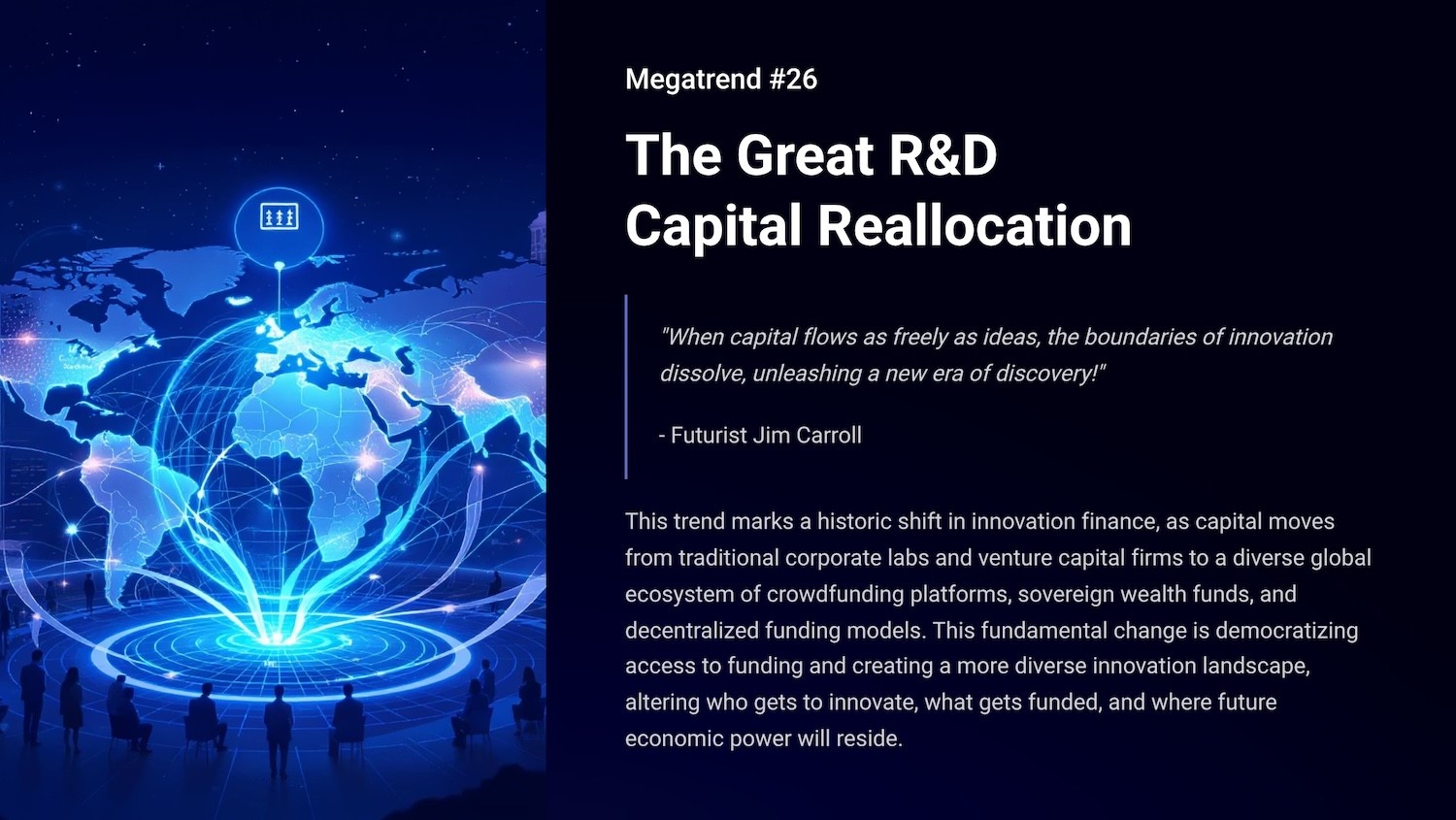
"When capital flows as freely as ideas, the boundaries of innovation dissolve, unleashing a new era of discovery!" - Futurist Jim Carroll

(Futurist Jim Carroll is writing a series on 30 Megatrends, which he first outlined in his book Dancing in the Rain: How Bold Leaders Grow Stronger in Stormy Times. The trends were shared in the book as a way of demonstrating that, despite any period of economic volatility, there is always long-term opportunity to be found. The book is now in print - learn more at dancing.jimcarroll.com)

Corporate research labs and government agencies used to be the core of most global R&D. Think Velcro and NASA. DuPont and Kevlar. Xerox PARC and the graphical user interface. Bell Labs and the transistor. DARPA and the internet. GE and the jet engine. These institutions were once the engines of breakthrough innovation, but that's no longer the case.

Yet one of the most significant and yet most underappreciated trends of our time has to do with the fact that the very nature of scientific discovery has shifted.

Let's start with the first trend - we are now in the midst of a historic shift in innovation finance, as capital moves from traditional corporate labs and venture capital firms to a diverse global ecosystem of crowdfunding platforms, sovereign wealth funds, and decentralized funding models. This fundamental change is democratizing access to funding and creating a more diverse innovation landscape, altering who gets to innovate, what gets funded, and where future economic power will reside.

Let's call it The Great R&D Capital Reallocation. Here's your PDF with more details on what I share below.

pdf.jimcarroll.com/Megatrend26

Where do we start? Let's go with my long-covered idea that involves 'building the unimaginable future':

"Companies that do not yet exist will build products not yet conceived using materials not yet invented with methodologies not yet in existence based on ideas not yet imagined."

Consider how things have changed by first thinking about the 'old' world of innovation. The pursuit of innovative ideas and discoveries was accessible primarily to a small group of founders and researchers operating within a few elite geographic corridors - Boston and San Francisco.Β 

The new 21st-century model breaks down these geographic and demographic barriers

But there's also a heck of a lot more going on - read the full post!

**** ****&D **** **** **** **** **** **** **** ****

Original post: jimcarroll.com/2025/08/decodin

★ 1 • ↻ 2 original
Aug 7, 2025 · 10:28 AM UTC

"It might be easier to deal with the hard stuff if you accept that the hard stuff is not going to be easy." - Futurist Jim Carroll

I was working yesterday afternoon on today's post, which will be Megatrend **#27**.

It's turned into an incredibly complicated post, and I have an early tee-time, so I decided to move it back to Friday! It is the summertime, after all! The post includes a pretty hard-hitting analysis of what I predicted in 2017, and where we find ourselves today. Let's just say, sadly, that I was stunningly accurate. More tomorrow.

So instead, I turned to my folder-inventory of inspiration quotes - the little thoughts that run through my head that I jot down - and came across this one. It seems to fit the times for many people who are going through challenges, and recognizes the fact that we can we can overwhelm ourselves when we are in the moment. I'm not sure of the context of the time that I jotted it down - I'm sure I was probably struggling with some complex moment of my own.

That said, the phrase is a good foundation for the reality of what happens when people try to get to the future without putting in the work, which relates to the core idea of the post I'll share tomorrow. While I've been writing the post I'll share tomorrow, I keep coming back to the idea that there's a seductive myth that keeps organizations stuck: the belief that the future will somehow be easier than the present. Those breakthrough innovations will simplify everything. That there's a silver bullet solution waiting around the corner. That waving a magic wand will simply bring back the success that once existed. All of this avoids the idea that you've got to put in the work.

There seems to be a core belief behind much of this thatΒ simply pretending the future doesn't exist will somehow bring back the magical success of the past. This couldn't be further from the truth. Building the future requires embracing complexity, hard work, and decisive action in the face of uncertainty.

That's what's missing in the current discourse.

Read the full post.

----

Futurist Jim Carrol, by his job title, puts in the work.

**** ****&D **** **** **** **** **** **** **** ****

Original post: jimcarroll.com/2025/08/decodin

★ 2 • ↻ 3 original
Aug 8, 2025 · 9:39 AM UTC

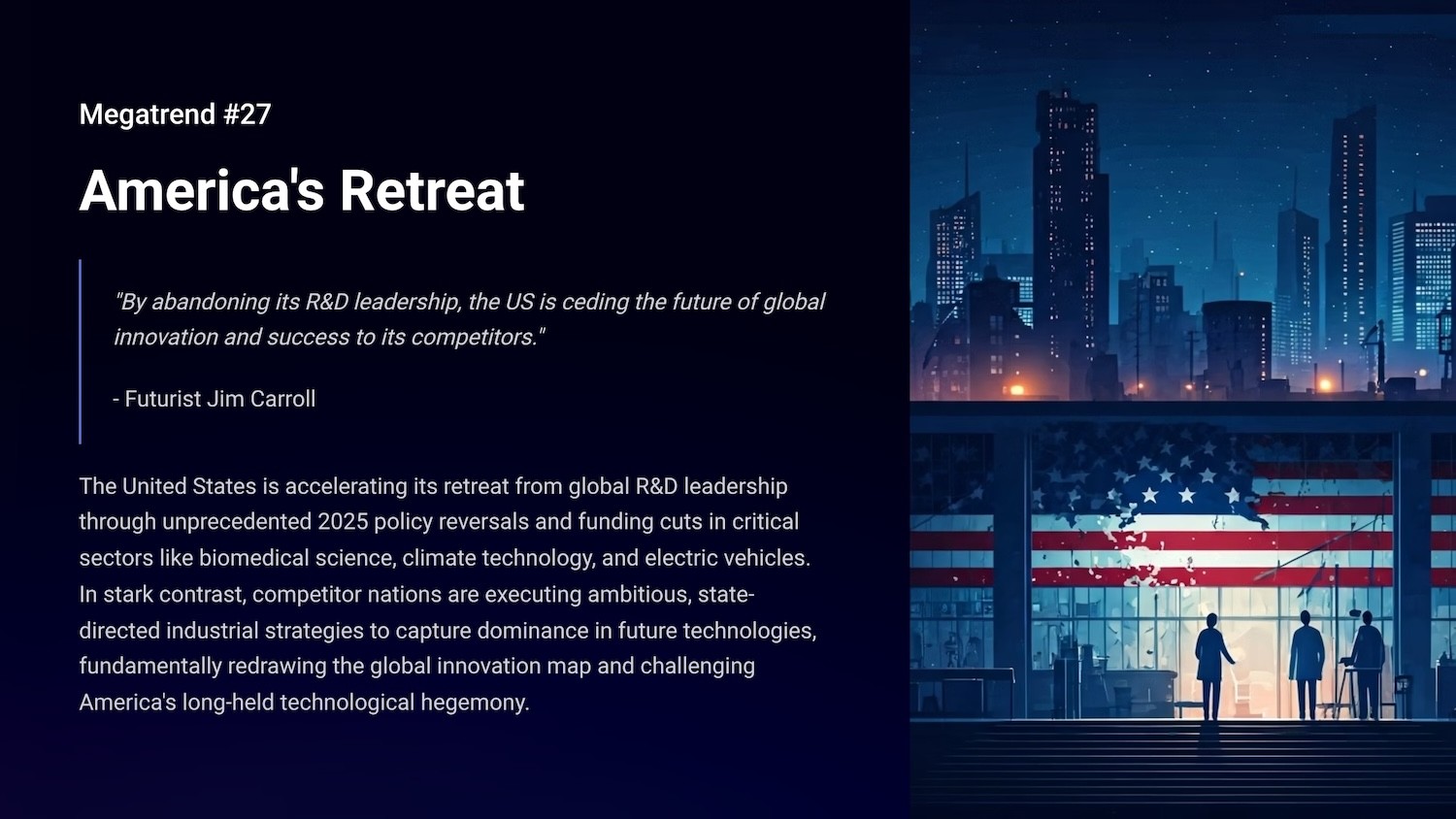
Megatrend **#27** - "By abandoning its R&D leadership, the US is ceding the future of global innovation and success to its competitors." - Futurist Jim Carroll

(Futurist Jim Carroll is writing a series on 30 Megatrends, which he first outlined in his book Dancing in the Rain: How Bold Leaders Grow Stronger in Stormy Times. The trends were shared in the book as a way of demonstrating that, despite any period of economic volatility, there is always long-term opportunity to be found. The book is now in print - learn more at dancing.jimcarroll.com)

This is a LONG post.

And yet, as one of the most consequential trends of our time, it deserves the attention it gets. You can't write about the biggest trends of the coming decade without acknowledging the massive reversal that is the US right now.

It pains me to write this, but it's pretty clear the United States is accelerating its retreat from global R&D leadership through unprecedented 2025 policy reversals and funding cuts in critical sectors like biomedical science, climate technology, and electric vehicles. In stark contrast, competitor nations are executing ambitious, state-directed industrial strategies to capture dominance in future technologies, fundamentally redrawing the global innovation map and challenging America's long-held technological hegemony.

What does it mean? Oh boy, this is a complicated post. I don't expect I have many followers in the 'other' camp, so let's go back to the post I wrote in 2017, which predicted, with stunning accuracy, where we find ourselves today. "What Comes Next with the Decline of an Empire" took my futurist's mind and applied it to what I saw happening. The original post can be found here. The updated PDF analysis of my predictions, found below, can be found here.

pdf.jimcarroll.com/AmericasRet

Let's start this post - "America's Retreat" - by examining my 2017 predictions in the light of where we are today in 2025.

I fed each prediction to Google Gemini, asking it to reflect upon its accuracy. My original prediction is printed verbatim.

So overall, how did I do?

Sadly, all too well. 9 of the 10 predictions were entirely accurate. As Google notes, "Carroll's predictions about the shifting global landscape proved to be remarkably prescient."

So what are the implications of this type of retreat? Let's dig in further. I took a look at how this will accelerate the global innovation power shift.

pdf.jimcarroll.com/Megatrend26

How bad is it? Pretty bad.

**** ****&D **** **** **** **** **** **** **** ****

Original post: jimcarroll.com/2025/08/decodin

★ 3 • ↻ 4 original
Aug 10, 2025 · 12:26 PM UTC

Me, this morning, thinking how wonderful it is to be a Canadian.

★ 4 • ↻ 2 original
Aug 11, 2025 · 10:44 AM UTC

Megatrend **#28** - The Chase for Authenticity: "Celebrate your flaws and highlight your mistakes - because one day soon, they will become your key currency for success!" - Futurist Jim Carroll

(Futurist Jim Carroll is writing a series on 30 Megatrends, which he first outlined in his book Dancing in the Rain: How Bold Leaders Grow Stronger in Stormy Times. The trends were shared in the book as a way of demonstrating that, despite any period of economic volatility, there is always long-term opportunity to be found. The book is now in print - learn more at dancing.jimcarroll.com)

As the market becomes saturated with AI-generated content, a significant shift is occurring where consumers and businesses increasingly value and pay a premium for verifiably human, live, and authentic experiences. This trend is reshaping strategies across communications, branding, and the workforce, making transparency and human-centric storytelling critical for building trust and maintaining a competitive advantage.

In the era of AI, being real might become a strategic advantage - meaning we're now in the weird situation in which it's certainly true that you have to master the skill of using AI, but not too much!Β 

Overall, the trend involves what I call the Authenticity Premium. There's a full PDF here. which dives into it in a lot more depth.

pdf.jimcarroll.com/Megatrend28

The core shift?Β We're entering a market where synthetic content is cheap, constant, and often indistinguishable from the real thing.

The very ubiquity of AI-enhanced messaging, visuals, and personas is creating fatigue. People are already getting tired of "AI slop." In that fatigue, a counterforce is emerging: people will seek signals that what they're seeing, buying, or trusting is genuine. With that being the case, the "authenticity gap" is becoming a competitive battleground - organizations, professions, and industries are already finding value in "being real."

What does all of this mean for you?

I am certainly a big advocate that we need to learn and master all the various AI tools that are coming our way - after all, you won't lose your job to an AI, but you might lose your job to someone using an AI!

That being the case, you just might be able to keep your job by ensuring that you've got an element of reality in all the work that you are doing with AI,
because being real will matter!

---

Futurist Jim Carroll predicts the words 'real' and 'authentic' will see a sudden resurgence in just about everything people and companies do.

**** ****&D **** **** **** **** **** **** **** ****

Original post: jimcarroll.com/2025/08/decodin

★ 1 • ↻ 2 original
Aug 12, 2025 · 10:06 AM UTC

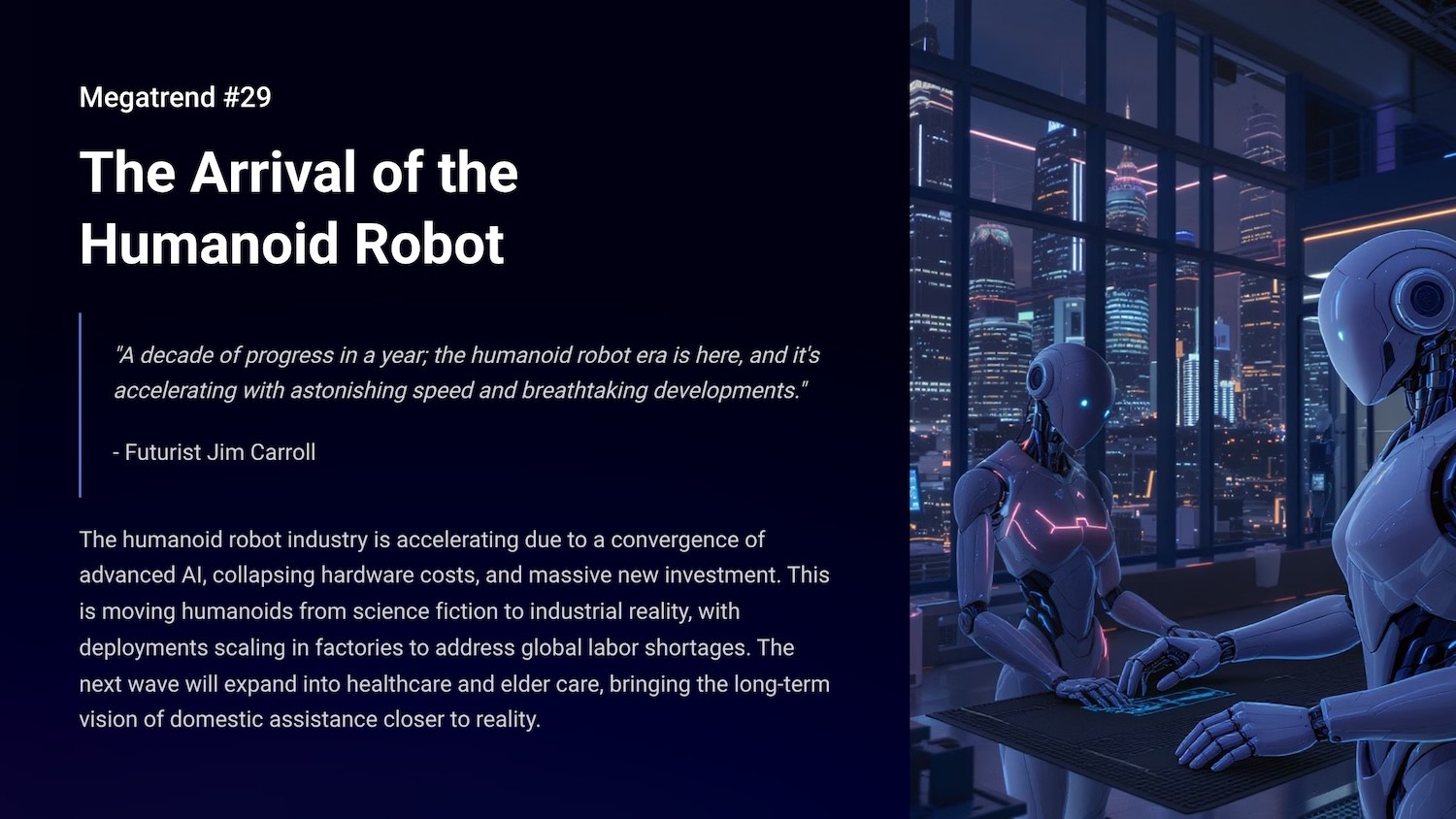
Megatrend **#29** - The Arrival of the Humanoid Robots: "A decade of progress in a year; the humanoid robot era is here, and it's accelerating with astonishing speed and breathtaking developments." - Futurist Jim Carroll

The humanoid robot industry is accelerating due to a convergence of advanced AI, collapsing hardware costs, and massive new investment.

This is moving humanoids from science fiction to industrial reality, with deployments scaling in factories to address global labor shortages. The next wave will expand into healthcare and elder care, bringing the long-term vision of domestic assistance closer to reality.

What does it mean? Well, for one thing, my family keeps telling me that I'll need to have some sort of hobby when I eventually retire. So I've settled on the idea that within 5 years, I'll probably have a humanoid robot in the house that I can train and work with. I've been telling the guys on the golf course that I'll be showing up with my robot caddy at some point - it will carry my bag, and perhaps offer up some golf advice.

I made a short little video imagining this.

youtube.com/watch?v=Q5ErU70RdqY

Most of them were not amused. My wife, in particular, is not excited by the idea and has registered an emphatic NO. I can see this is going to take some work.

That said, the cost for these fascinating little devices is fast approaching the PC-cost collapse curve, with the Chinese-made Unitree R1 now available for $5,900 US. Give it a few years, and you'll be able to grab one forΒ $999.

We stand at a historic inflection point in humanoid robotics, driven by the powerful convergence of exponential AI advances, unprecedented capital investment, revolutionary training technologies, and rapidly falling hardware costsβ€”all unfolding within a distinct geopolitical landscape that will shape the future of work.

There's a full PDF right here if you want to dig in further.

pdf.jimcarroll.com/Megatrend29

All of this means that what we thought was far away is suddenly... at our doorstep.

**** **** **** **** **** **** **** **** **** ****

Original post: jimcarroll.com/2025/08/decodin

★ 1 • ↻ 2 original
Aug 13, 2025 · 10:34 AM UTC

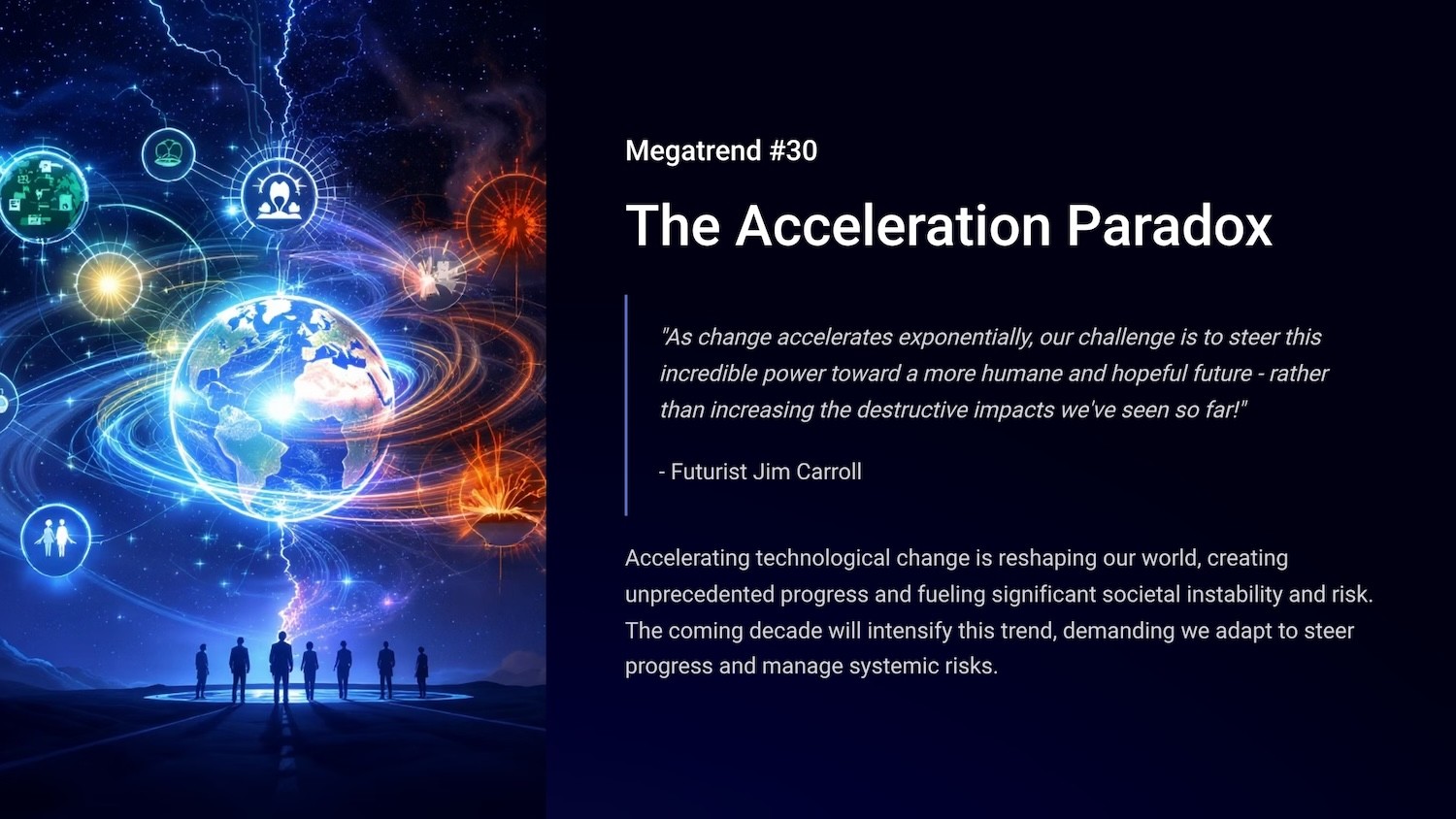
Megatrend **#30** - The Acceleration Paradox: "As change accelerates exponentially, our challenge is to steer this incredible power toward a more humane and hopeful future, rather than increasing the destructive impacts we've seen so far!" - Futurist Jim Carroll

(Futurist Jim Carroll is writing a series on 30 Megatrends, which he first outlined in his book Dancing in the Rain: How Bold Leaders Grow Stronger in Stormy Times. The trends were shared in the book as a way of demonstrating that, despite any period of economic volatility, there is always long-term opportunity to be found. The book is now in print - learn more at dancing.jimcarroll.com)

We live in a time of incredible promise and yet one of terrible peril.

We are the most advanced species we have ever been, and yet, we are ultimately capable of not living up to the demands for success that history places upon us.

It seems that we are failing the test.

As someone who has built his career on. The issue of speed - how leaders can align to it, companies can adapt to it, and people can respond to it - I thought it fitting that the final megatrend in my series should have to do with this issue. Right now, accelerating technological change is reshaping our world, creating unprecedented progress and fueling significant societal instability and risk. The coming decade will intensify this trend, demanding we adapt to steer progress and manage systemic risks.

So what's it all about? The world is changing at an unprecedented pace, a phenomenon I call the Acceleration Paradox. We are witnessing not just incremental progress but an exponential surge in technological capabilities that presents both incredible opportunities and profound challenges. Put it another way, we're doing well at discovering new things, but aren't good at dealing with the reality of those things. Your PDF for the full report is here.

pdf.jimcarroll.com/Megatrend30

We are, as they say, living in the best of times, but doing our best to make it the worst of times!

Let's start here by considering just a few of the things around us that keep moving faster, and then consider how it is all going off the rails as entire nations turn their back on the promise of tomorrow.
Read the full post.

---

Futurist Jim Carroll has focused on the issue of 'speed' in many of his books: The Future Belongs to Those Who Are Fast; Thing Big, Start Small, Scale Fast; and Ready, Set Done. Even his book, What I Learned from Frogs in Texas, featured a quirky story of what happens when you don't align yourself with the speed of change.

**** **** **** **** **** **** **** **** **** ****

Original post: jimcarroll.com/2025/08/decodin

★ 3 • ↻ 3 original
Aug 14, 2025 · 10:15 AM UTC

"You need a thinking queue!" - Futurist Jim Carroll

Now that I've finished my Megatrends series, I can move on to the other ideas that are on my list.

Let's start here.Β One of the most popular blogs, and one of the longest running, is Seth's Blog.

Running for a long time, he's an iconoclast who offers up thoughts on everything from leadership to culture to knowledge to teamwork to creativity and marketing. With millions of followers, he's the original 'original thinker.' (In fairness, both he and I started around the same time in 2002!)

And for a long time, the image on his site was just an upper picture of his head - his mind, his thinking machine, his creative engine. Or, we might think, his thinking queue.

A thinking queue? That's the phrase recently shared with me by a good friend over in Australia. She had asked me a science and career-related question regarding one of the posts I had just written in my Megatrends series. I promised to get back to her with a detailed response, probably once I got through writing the series. (And I will now probably get around to it Monday or Tuesday next week.)

In my response, I noted that I had an entire list of ideas and issues and topics and stories, and inspirations I'm always thinking about for my blog - this Daily Inspiration series, which you follow - and that I would add it to the list. That way, I could ponder the issue in my mind over time while I'm busy with other things, along with all the other thoughts and ideas, and issues I'm thinking about.

She responded, "I think it's great you've got a thinking queue!".

And with that, the very idea and importance and concept of a 'thinking queue' became another item in my 'thinking queue!' In my queue, I've got a whole list of trends, news reports, daily inspiration ideas, innovation thoughts, client stories, and so much more floating around up there. I'm always, somehow or other, thinking about all these things at one moment or another. It's a pretty busy queue! In that way, my queue is my way of managing the space I live within.

Here's the thing - all of us should have a thinking queue.

Here's why!

Original post: jimcarroll.com/2025/08/decodin

★ 1 • ↻ 0 original
Aug 14, 2025 · 10:19 AM UTC

Canada has the opportunity to do the funniest thing ever.

★ 1 • ↻ 2 original
Aug 15, 2025 · 10:21 AM UTC

β€œβ€˜Later’ is the graveyard where great ideas go to die!β€β€Šβ€”β€ŠFuturist Jim Carroll

I continue to get a great reaction from folks who have bought copies of two of my books, Embracing Mediocrity and Escaping Mediocrity - so much so that in the fall, I'm going to make it a trilogy when I pull together the third book, Eradicating Mediocrity!

There's a reason I wrote both books (and why I will write the third) - I've seen a lot of innovation efforts go off the rails, and I've documented that in all the various books I wrote along the way. These two books helped, in a fun way, what I've learned, and what we should do about it. The fact is, I've spent over 30 years on stages around the world, from NASA to Disney, talking about the future. And if there's one timeless truth I've observed, it's this: People who say "I'll do it tomorrow" never arrive there in good shape.

That isn't just a catchy phrase; it's a fundamental barrier to success in the high-velocity economy we live in. Delay is a decision. Inaction is a strategy. And both are recipes for failure. Need more recipes? Dive into the books like many others have.

The theme I cover in the books isn't something new - it's battle-tested insight covered in many of my books, many of which you can find over at books.by.jimcarroll.com

I dug into some of these past works to pick up on where I've covered this reality, and it's been a key theme!

Because if you keep saying "I'll do it tomorrow," you'll find that the future has already happened without you.

Read the full post. Do it now!

---

Futurist Jim Carroll tries to commit to action as often as he can.

**** **** **** **** **** **** **** **** **** ****

Original post: jimcarroll.com/2025/08/decodin

★ 1 • ↻ 0 original
Aug 18, 2025 · 10:22 AM UTC

"The future of human health is not waiting to be discovered - it is waiting to be built!" - Futurist Jim Carroll

Some weeks ago, in my Megatrends series, I wrote about the future of healthcare, in particular, the impact of preventative medicine, predictive medicine, and accelerating longevity.

Those posts drew the interest of a good friend of mine in Australia - a medical doctor and healthcare researcher. She wrote to me asking what this might mean in terms of a future career.

Here's what I want to tell her.

----
What's fascinating is how these three megatrends are converging in ways that make your expertise essential:

Predictive and Preventative Healthcare (#10) requires someone who understands population health patterns and can design systems that identify risk before symptoms appear.

Longevity Science (#11) focuses on healthspan, not just lifespan – companies need professionals who understand how health behaviors compound across populations.

Personalized Medicine (#12) moves from universal pills to individualized treatments, but requires scaling personalized approaches without widening health disparities.

As I wrote in Megatrend #10, the medicine of tomorrow isn't about the miracle cure; it's about the predictive insight that makes the cure unnecessary. These companies desperately need people who understand health from a systems perspective, not just a technology perspective.

Here's the key point to consider - the future of health is being written right now. The question isn't whether public health professionals belong in tech companies – it's which companies will be smart enough to recognize they need you. It also involves having the courage and belief in your skills to make a big, bold leap at this moment in your career, jumping in when you are most uncomfortable with a career change, and yet doing so at the exact right time that the private sector needs someone like you.

Need a bit of encouragement?

I've been having some fun with AI lately, exploring what these new career paths might look like by 2030, and specifically, thinking about the new careers that could exist in 5 or 10 years. Imagine yourself in one of these roles. These are the very jobs you might find yourself working in. If you want the full document I prepared, the PDF is right here.

pdf.jimcarroll.com/FutureHealt

Explore the new jobs that are likely to exist - and know that these aren't mere jobs – they're missions. Here's how they break down:

The data is flowing, the technology is here, and the future of human health isn't waiting to be discovered – it's waiting to be built.

The only question is: who will be the architects?

You?

Original post: jimcarroll.com/2025/08/decodin

★ 0 • ↻ 0 original
Aug 19, 2025 · 9:57 AM UTC

β€œBy the time a trend is obvious, the opportunity has already passed. That’s why winners don’t follow trends – they anticipate them!” – Futurist Jim Carroll

I’ve built a career on this one simple truth. In every boardroom and on every stage, I see two types of leaders: those who react to the future and those who create it. The first group waits for a trend to become a headline in *The Wall Street Journal* before they act. The second group is the reason it became a headline in the first place.

Think about that.

In our high-velocity world, waiting for a trend to become obvious is the same as deciding to come in last place. The reactive mindsetβ€”waiting for certainty, following the crowd, looking for a perfectly paved pathβ€”is a recipe for irrelevance. The real growth, the disruptive breakthroughs, and the market leadership all belong to the organizations and individuals who have mastered the art of anticipation.

Those who have mastered the art of understanding tomorrow before tomorrow is here.

Look, I am the first to admit that for many people, avoiding the future always seems to be the easy way out. But as I’ve said many times before, the future always wins in the long run. That’s why making early, big, bold leaps forward is the only smart strategy – and why there is an extremely high cost of following the crowd! There is no second mover advantage! That’s why following trends instead of getting ahead of them might feel safe, but it’s one of the riskiest strategies you can adopt.

When you only react to what’s already established, you’re not innovating; you’re just playing catch-up.

How do you avoid this fate? How do the winners anticipate tomorrow/ They build an effective trends radar, by which they build an organizational capability for anticipation. This involves a systematic way of looking beyond the immediate noise to see the signals of what’s next. Building this radar isn’t about having a crystal ball; it’s about changing where and how you look for insights.

Anticipation is a discipline. It’s about building a culture of curiosity that relentlessly asks, β€œWhat’s next, and how do we lead it?”

The future is never truly a surprise; it’s a series of whispers that gradually become a
roar. The question is, are you listening to the whispers, or are you waiting for the roar? By the time you hear the roar, you’re already in the middle of the stampede.

Winners don’t get caught in the stampede. They’re the ones who saw which way the herd was turning and were already waiting in the next valley.

Original post: jimcarroll.com/2025/08/decodin

★ 0 • ↻ 0 original
Aug 20, 2025 · 10:15 AM UTC

"When your canaries flee, it's a sign your innovation oxygen is dying." - Futurist Jim Carroll

As CEOs rush to get their people back to the office, they are forgetting one key thing: the best ones aren't excited about coming back to widely dysfunctional organizations. And since they have the skills that are needed the most, they'll choose who to work for, where they'll do the work, and the corporate 'culture' they'll choose to subscribe to.

In other words, the CEOs still aren't necessarily in charge.

What's my point? You departed talent knows your future. Are you listening?

When your best peopleβ€”your canariesβ€”flee, it means your innovation's oxygen is gone, and only the suffocating routine of your failure is left. I've stood on stage in front of countless leadership teams, and I often tell them a stark truth: your company's most profound insights into the future aren't coming from a market research report. They're walking out your door every single day.

I've prepared a pretty detailed PDF that goes into my post below. Read it, share it, ponder it. It's right here.

pdf.jimcarroll.com/Your-Depart

I call them "industry expatriates," a phrase I coined in my book Ready, Set, Done! in 2007.

These aren't just employees who found a better salary. These are your passionate visionaries, your rebels, your future-builders. They are the ones who became so fundamentally frustrated with the institutional sclerosis that attack every new idea that they left. They didn't just quit a job; they went out and founded the very companies that will disrupt you tomorrow.

They are your canaries in the coal mine, and the silence you hear after they leave is the sound of your future suffocating.

It's in that context that I believe we are witnessing what I might call "The Great Miscalculation," in which CEOS and companies are forcing a return to a broken culture.

The question you need to ask yourself is this: Who has left your organization in the last two years? Where did they go? More importantly, what are they building now?

Don't just track who is leaving. Track what they do next.
Their new venture is your roadmap to the disruption you failed to embrace. The future of your organization is walking out the door.

The only question is whether you're going to listen to what it's telling you on its way out.

Read the full post for more.

----

Futurist Jim Carroll became a nomadic worker in 1989, leaving the stifling innovation-adverse culture of the global professional services firm he had been with for a decade. Since then, he's provided his skills and insight to thousands of globally recognized organizations.

Original post: jimcarroll.com/2025/08/decodin

★ 0 • ↻ 0 original
Aug 21, 2025 · 10:07 AM UTC

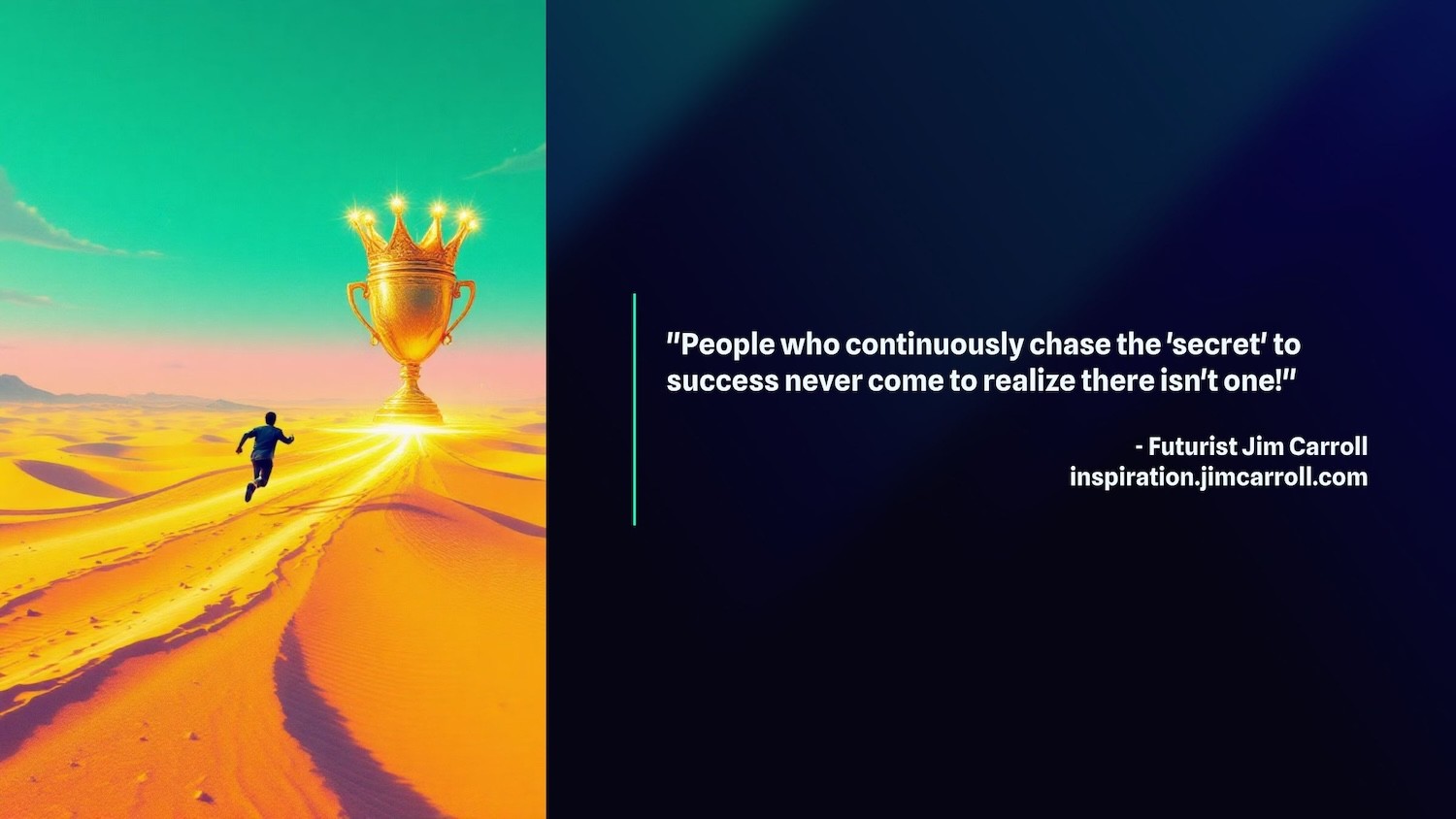
"People who continuously chase the 'secret' to success never come to realize there isn't one!" - Futurist Jim Carroll

There are no secrets to success β€” only effort.

There is no easy way forward.

Here's what I've learned from decades of working with organizations around the world, helping them navigate change, embrace innovation, and accelerate their journey into the future: there are no secrets to success, only effort. There is no easy way forward - you've got to put in the work.

Think about the myth of the 'magic formula.' We live in a world obsessed with shortcuts. We want the five-step program, the secret methodology, the hidden key that successful people supposedly use but don't want to share. This thinking is not just wrong – it's dangerous. It keeps us focused on seeking instead of doing, on finding instead of building, on waiting instead of acting.

The truth is far simpler and far more challenging: success comes from sustained effort, continuous learning, and the courage to take action even when the path isn't clear.

Here's what I tell every leader, every entrepreneur, every individual looking to make their mark: Stop searching for secrets and start taking action. The path forward isn't hidden – it's built step-by-step through consistent effort, bold decisions, and a relentless focus on growth.

Success isn't about running faster than change – it's about running with it, growing through it, and transforming because of it. It's about doing things differently, challenging assumptions, and acting decisively.

If there's any secret at all, it's this: there are no secrets.

Success is earned through effort, sustained by learning, and accelerated by action.
It's available to anyone willing to do the work.

So stop chasing. Start building.

Stop seeking. Start doing.

Inspired by these ideas and want to get moving? I used Gamma to create a slide overview of this blog post. Grab it here.

The future you want isn't hidden behind some mysterious formula – it's waiting for you to create it through consistent, determined effort.

After all, the future takes hard work.

Are you ready to put in the work?

Start with this PDF!

pdf.jimcarroll.com/People-who-

Futurist Jim Carroll has never understood how so many people can fall prey to the scams that always seem to make the future easy.

Original post: jimcarroll.com/2025/08/decodin

★ 0 • ↻ 0 original
Aug 22, 2025 · 10:21 AM UTC

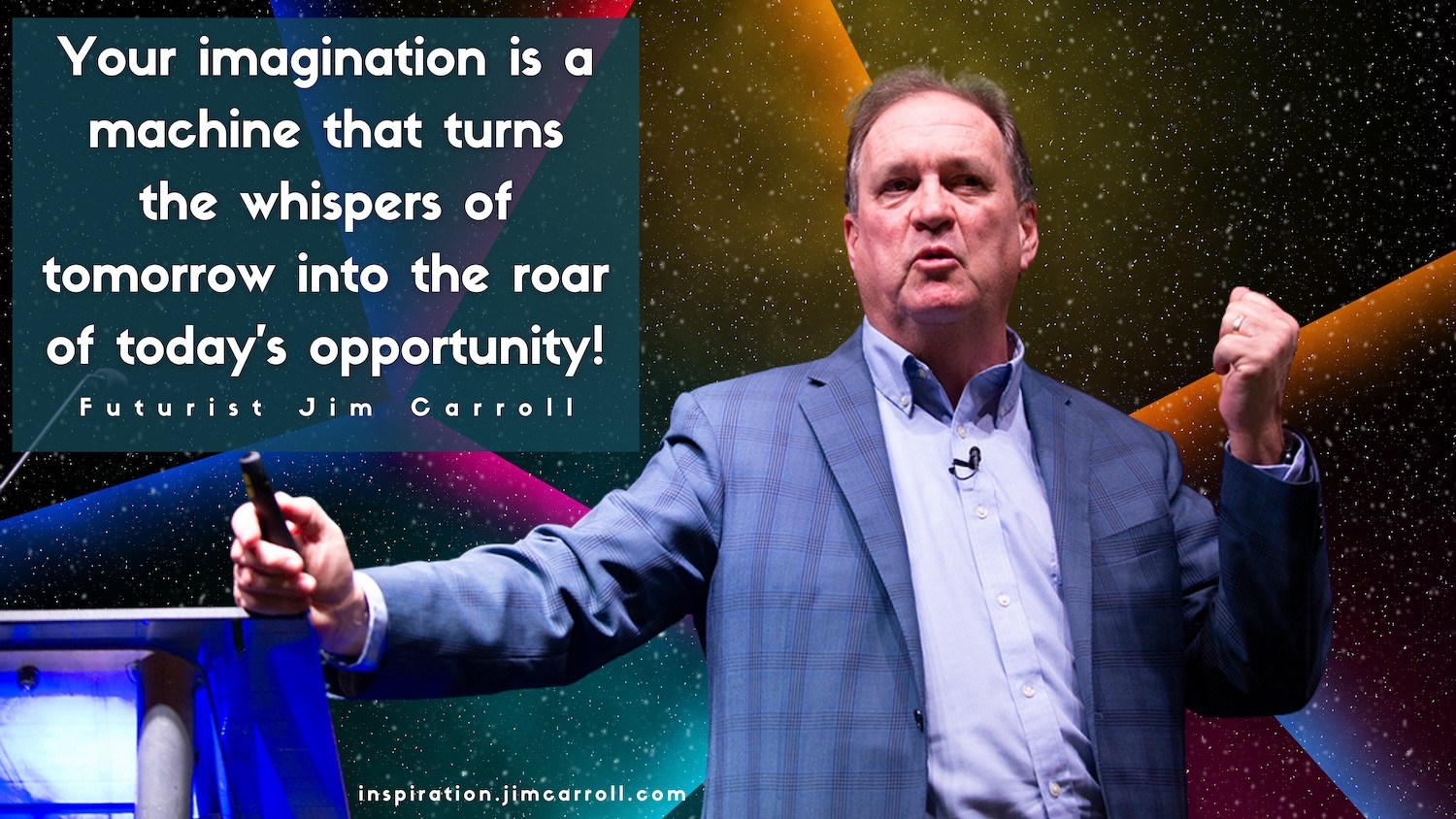
"Your imagination is a machine that turns the whispers of tomorrow into the roar of today's opportunity!" - Futurist Jim Carroll

Tomorrow is talking to you.

Are you listening?

It's like a radio that picks up tomorrow's signals before they become today's strategies.

The way I will often share this idea from the stage is that the future is constantly whispering to us. The trick is learning to listenβ€”and then actually doing something about what you hear. Sometimes you need your imagination to help you do that.

In that way, I've discovered that the best stories aren't just good entertainment. They're like amplifiers for those faint signals we might otherwise miss. Here's how to turn each whisper into real movement: by understanding what those whispers are telling you. I'll do that by sharing a few client stories - the signal that the future was whispering and what it means for action.

You don't need a massive strategy document. You need clear signals that lead to easy decisions. Then you take what works and scale it fast.

The future is talking to you.

Make sure you're ready to listenβ€”and act.

By the way, I used Gamma.app to turn this post into a great little PDF - access it here!

pdf.jimcarroll.com/Tomorrow-is

The future is telling us we can accelerate our imagination in ways that we might have never previously imagined.

Original post: jimcarroll.com/2025/08/decodin

★ 0 • ↻ 0 original
Aug 25, 2025 · 10:36 AM UTC

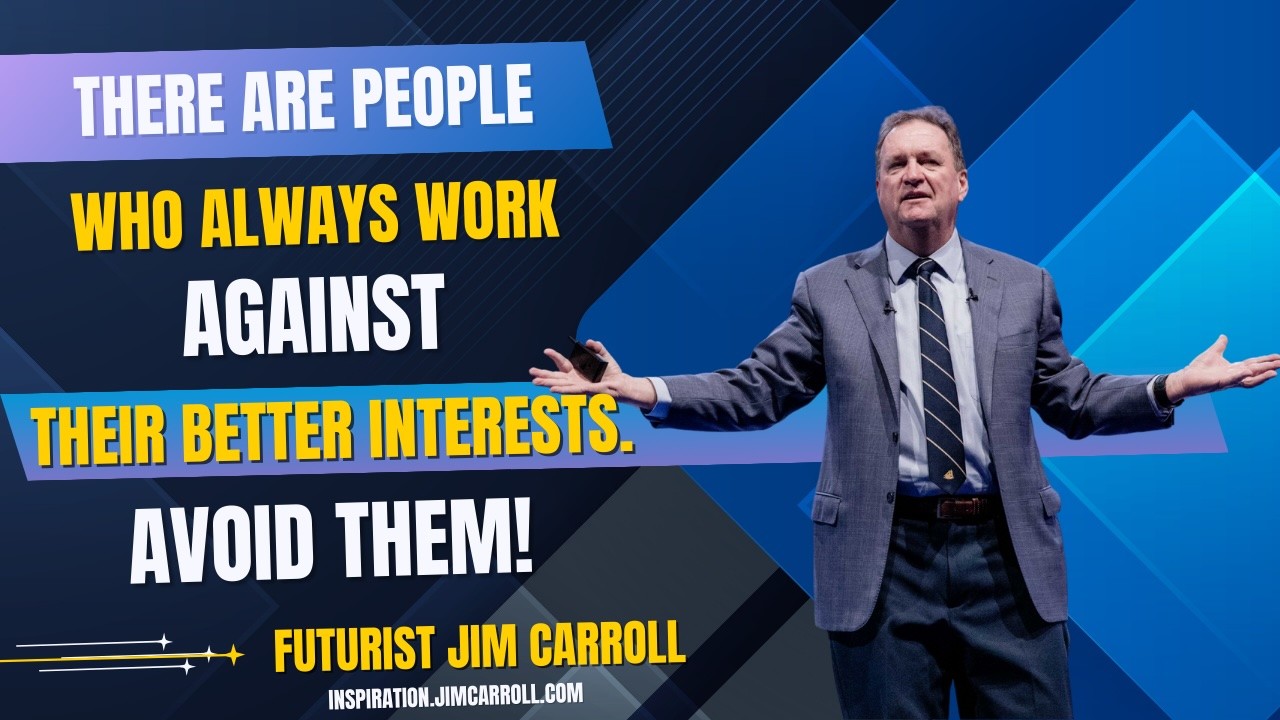
"There are people who always work against their better interests. Avoid them!" - Futurist Jim Carroll

You should spend more time trying to break free from those who work against themselves.

And this isn't just about avoiding difficult people. It's about recognizing that their self-sabotage not only brings down an organization and its goals, but they also bring you down as well.

Avoid them if you can!

So why is it that smart people do counterproductive things? It seems that while we are wired for success, we are often haunted by the fear of what it takes to achieve it.

The result of this is that we can often refuse to make the effort we need to move forward. The result is that we created a culture that drags everything down - brilliant leaders making decisions based on ego rather than effectiveness, talented employees staying silent when they have breakthrough ideas, and organizations clinging to past successes while the future rushes forward.

And in many cases, it's top leadership that is the biggest problem;

I've watched brilliant executives destroy their own companies through ego-driven decisions and resistance to feedback. Years ago, I spent time with a major global company in the print and media business. Top leadership knew they had to innovate their way into new lines of business, and they needed to get in place a company-wide culture of innovation. We worked hard to build an entire day-long program that would celebrate potential pathways into the future, rather than the courses of action that would lead everyone to cling to their past. We had potential brilliance in mind - until the CEO came in and burst the bubble at the very start of the day by effectively stating that the status quo would still be enough.

Oops.

Today, a decade later, I'm watching the organization die in real time.

Read the rest of the post.
---

Futurist Jim Carroll has witnessed a lot of self-sabotage and can recognize it in an instant!

Original post: jimcarroll.com/2025/08/decodin

★ 2 • ↻ 0 original
Aug 28, 2025 · 10:09 AM UTC

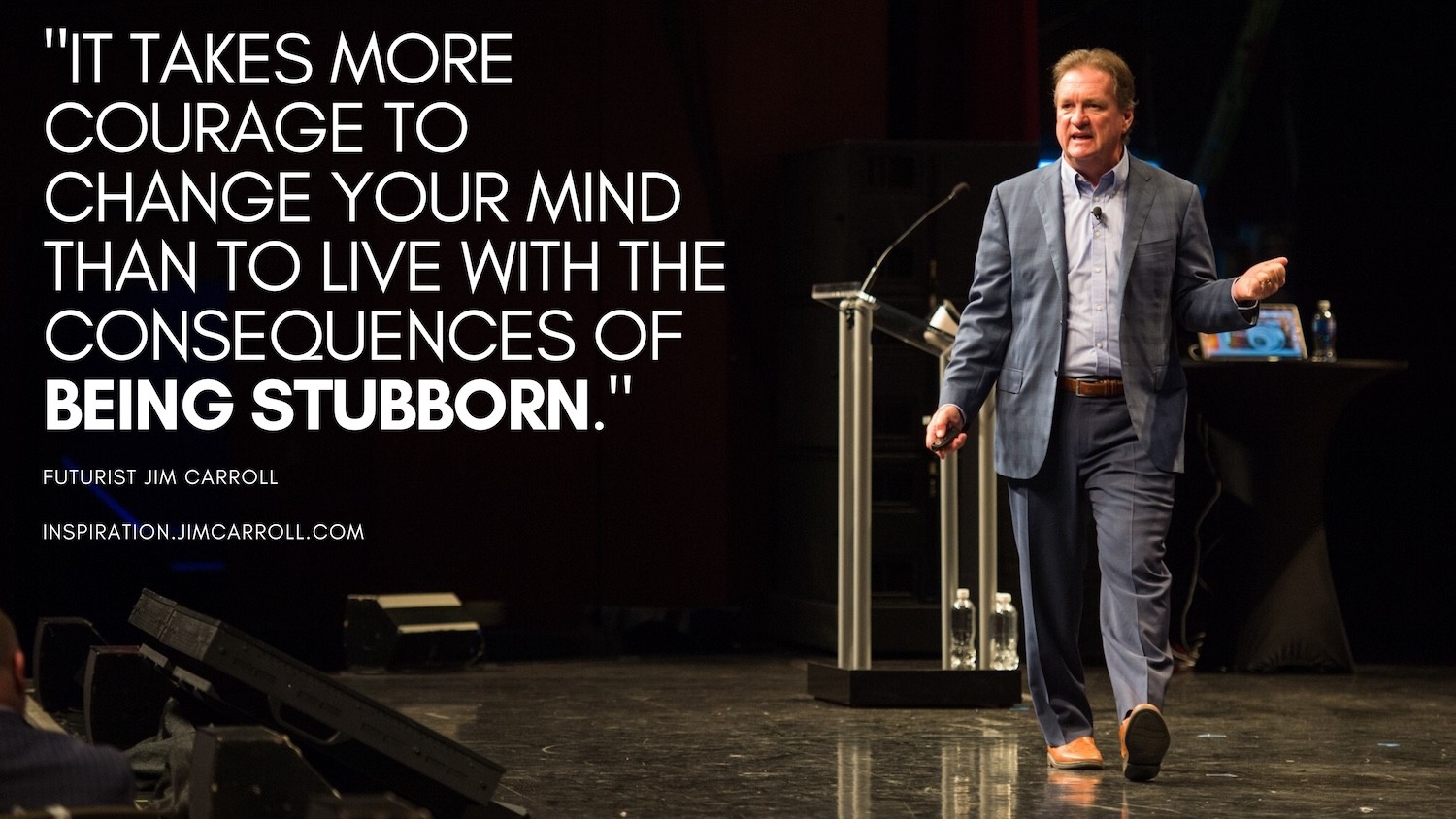
"It takes more courage to change your mind than to live with the consequences of being stubborn." - Futurist Jim Carroll

Why is it that so many smart people kill their own ideas?

Stubbornness.

That's often the culprit.

In thirty years of watching companies rise and fall, I've seen this truth play out countless times. The graveyard of business history is littered with organizations that had all the right instincts initially but lacked the courage to change direction when the market demanded it.

Here's what fascinates me about innovation: the very conviction that drives breakthrough thinking can become its greatest enemy. I've watched brilliant entrepreneurs pour years into products nobody wanted, simply because they couldn't summon the courage to admit their original vision was flawed.

Over the last few weeks, I've been helping one of my sons and his wife prep their new home for their move-in. I've been assigned the glorious task of doing the 'dump runs' - taking loads of old carpet, flooring, and other junk to the municipal landfill site. And every day that I do that, I drive past the Lazaridis School of Business and Economics at the University of Waterloo - they're close by. I've also gone past the Perimeter Institute for Theoretical Physics, established by Jim Balsillie. He also helped to establish the Balsillie Executive Institute - Professional Development at the University.

This is what happens when you donate a lot of money to your alma mater.
In any event, given the abject ultimate failure that was their company, Research in Motion (of Blackberry Fame), I wonder what one might learn at such institutions. A degree in the Master's of Stubbornness?. A Master of Doubling Down When Wrong? A PhD in Ignoring Market Signals or a Certificate in Advanced Denial Management? Or how about a Strategic Vision Impairment Certification or an Executive MBA in Dismissing Disruptive Technology?

Think about it. They revolutionized mobile communication with the Blackberry, once the most popular mobile device in the world, but when touchscreens emerged, they stubbornly clung to physical keyboards. Their engineering prowess became their prison. Meanwhile, Apple dared to cannibalize its own iPod business to create the iPhone.

This isn't just about technology companies.
It impacts everyone.

Remember: in a world of exponential change, the ability to change course isn't a sign of weakness or inconsistency.

It's the ultimate competitive advantage.

The future belongs to those with the courage to continuously reinvent it.

**** **** **** **** **** **** **** **** **** ****

----

Futurist Jim Carroll has met a lot of stubborn people in his time - it comes with his focus on innovation.

Read the full post: jimcarroll.com/2025/08/decodin

★ 2 • ↻ 0 original
Aug 29, 2025 · 10:38 AM UTC

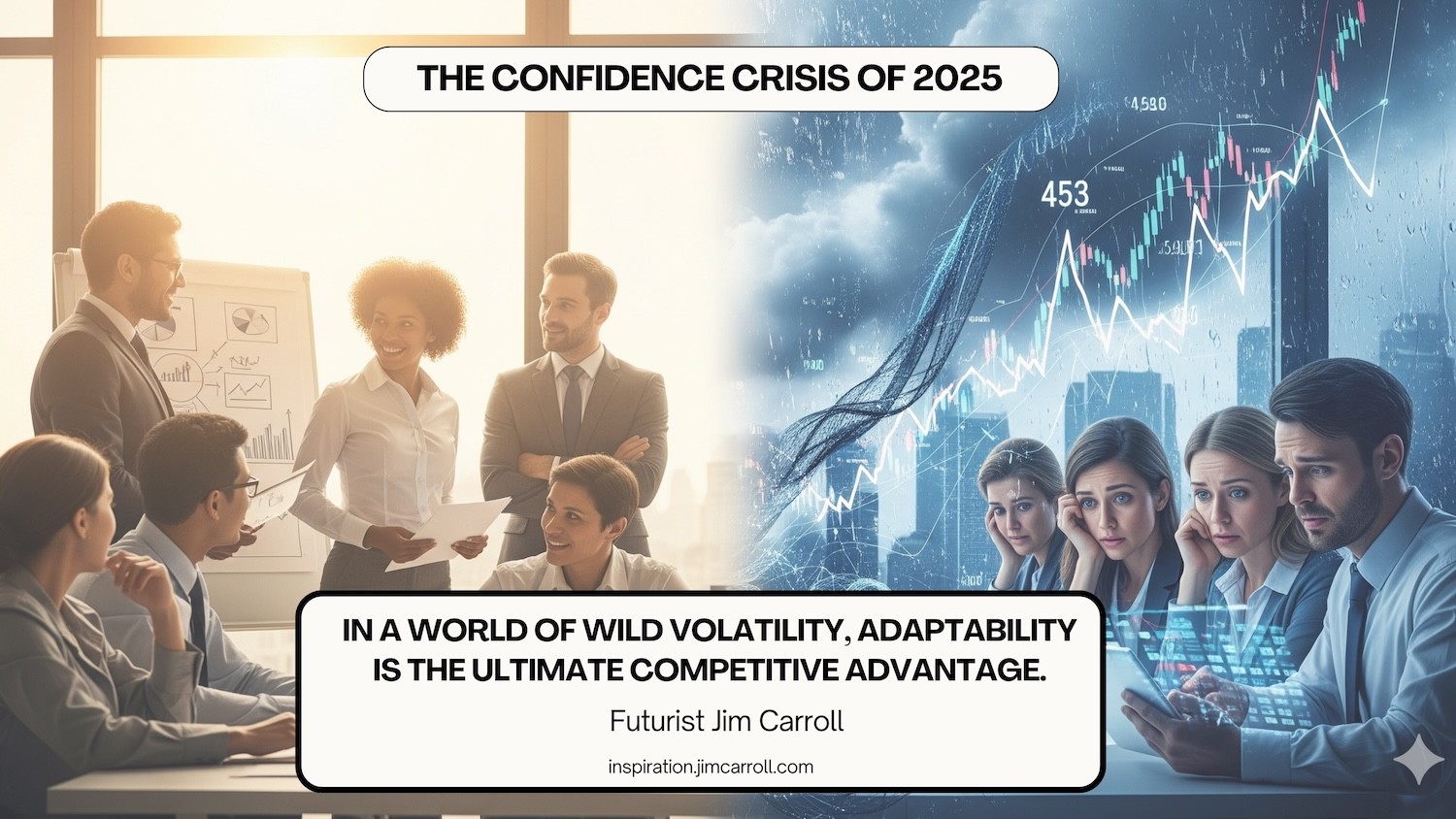
"The Confidence Crisis of 2025: In a world of wild volatility, adaptability is the ultimate competitive advantage." - Futurist Jim Carroll

One of my favorite newsletters among the flood of content out there is **Korn Ferry** This Week in Leadership. It's a regular short overview of key trends with links to longer articles, and I often find nuggets of powerful insight in there.

One of the most recent reports on the issue of 'risky business' with a summary of a survey from 250 global CEOs and Board directors about the issue of risk.

It's a powerful overview of the state of mind in the C-suite today, but I asked Google Gemini to summarize the findings in the newsletter.

----

𝐴 π‘Ÿπ‘’π‘π‘’π‘›π‘‘ πΎπ‘œπ‘Ÿπ‘› πΉπ‘’π‘Ÿπ‘Ÿπ‘¦ π‘ π‘’π‘Ÿπ‘£π‘’π‘¦ π‘œπ‘“ 250 𝐢𝐸𝑂𝑠 π‘Žπ‘›π‘‘ π‘π‘œπ‘Žπ‘Ÿπ‘‘ π‘šπ‘’π‘šπ‘π‘’π‘Ÿπ‘ , 𝑑𝑖𝑑𝑙𝑒𝑑 "π‘…π‘–π‘ π‘˜π‘¦ 𝐡𝑒𝑠𝑖𝑛𝑒𝑠𝑠," π‘Ÿπ‘’π‘£π‘’π‘Žπ‘™π‘  π‘‘β„Žπ‘Žπ‘‘ π‘Ž π‘ π‘–π‘”π‘›π‘–π‘“π‘–π‘π‘Žπ‘›π‘‘ π‘šπ‘Žπ‘—π‘œπ‘Ÿπ‘–π‘‘π‘¦ (63%) π‘œπ‘“ π‘œπ‘Ÿπ‘”π‘Žπ‘›π‘–π‘§π‘Žπ‘‘π‘–π‘œπ‘›π‘  β„Žπ‘Žπ‘£π‘’ 𝑒π‘₯π‘π‘’π‘Ÿπ‘–π‘’π‘›π‘π‘’π‘‘ π‘Ž π‘Ÿπ‘–π‘ π‘’ 𝑖𝑛 π‘œπ‘£π‘’π‘Ÿπ‘Žπ‘™π‘™ π‘Ÿπ‘–π‘ π‘˜ 𝑒π‘₯π‘π‘œπ‘ π‘’π‘Ÿπ‘’ 𝑖𝑛 π‘‘β„Žπ‘’ π‘™π‘Žπ‘ π‘‘ π‘¦π‘’π‘Žπ‘Ÿ, π‘€π‘–π‘‘β„Ž 𝑙𝑖𝑑𝑑𝑙𝑒 𝑒π‘₯π‘π‘’π‘π‘‘π‘Žπ‘‘π‘–π‘œπ‘› π‘œπ‘“ π‘‘β„Žπ‘–π‘  π‘‘π‘Ÿπ‘’π‘›π‘‘ π‘ π‘™π‘œπ‘€π‘–π‘›π‘” π‘‘π‘œπ‘€π‘›. π‘‡β„Žπ‘’ π‘ π‘’π‘Ÿπ‘£π‘’π‘¦ β„Žπ‘–π‘”β„Žπ‘™π‘–π‘”β„Žπ‘‘π‘  π‘Ž π‘€π‘–π‘‘π‘’π‘ π‘π‘Ÿπ‘’π‘Žπ‘‘ π‘™π‘Žπ‘π‘˜ π‘œπ‘“ π‘π‘œπ‘›π‘“π‘–π‘‘π‘’π‘›π‘π‘’ π‘Žπ‘šπ‘œπ‘›π‘” π‘™π‘’π‘Žπ‘‘π‘’π‘Ÿπ‘  𝑖𝑛 π‘‘β„Žπ‘’π‘–π‘Ÿ π‘Žπ‘π‘–π‘™π‘–π‘‘π‘¦ π‘‘π‘œ π‘šπ‘Žπ‘›π‘Žπ‘”π‘’ π‘‘β„Žπ‘’π‘ π‘’ π‘Ÿπ‘–π‘ π‘˜π‘ . π»π‘’π‘Ÿπ‘’ π‘Žπ‘Ÿπ‘’ π‘‘β„Žπ‘’ π‘˜π‘’π‘¦ π‘‘π‘Žπ‘˜π‘’π‘Žπ‘€π‘Žπ‘¦π‘  π‘“π‘Ÿπ‘œπ‘š π‘‘β„Žπ‘’ π‘Ÿπ‘’π‘π‘œπ‘Ÿπ‘‘:

πΆπ‘œπ‘›π‘“π‘–π‘‘π‘’π‘›π‘π‘’ πΆπ‘Ÿπ‘–π‘ π‘–π‘ : 𝐴 π‘ π‘‘π‘Žπ‘”π‘”π‘’π‘Ÿπ‘–π‘›π‘” π‘™π‘œπ‘€ π‘π‘’π‘Ÿπ‘π‘’π‘›π‘‘π‘Žπ‘”π‘’ π‘œπ‘“ π‘™π‘’π‘Žπ‘‘π‘’π‘Ÿπ‘  𝑓𝑒𝑒𝑙 π‘π‘Ÿπ‘’π‘π‘Žπ‘Ÿπ‘’π‘‘ π‘‘π‘œ β„Žπ‘Žπ‘›π‘‘π‘™π‘’ π‘šπ‘Žπ‘—π‘œπ‘Ÿ π‘‘β„Žπ‘Ÿπ‘’π‘Žπ‘‘π‘ . 𝑂𝑛𝑙𝑦 11% π‘Žπ‘Ÿπ‘’ "𝑓𝑒𝑙𝑙𝑦 π‘π‘œπ‘›π‘“π‘–π‘‘π‘’π‘›π‘‘" 𝑖𝑛 π‘‘β„Žπ‘’π‘–π‘Ÿ π‘œπ‘£π‘’π‘Ÿπ‘Žπ‘™π‘™ π‘Ÿπ‘–π‘ π‘˜ π‘šπ‘Žπ‘›π‘Žπ‘”π‘’π‘šπ‘’π‘›π‘‘ π‘π‘Žπ‘π‘Žπ‘π‘–π‘‘π‘¦. π‘‡β„Žπ‘–π‘  π‘™π‘Žπ‘π‘˜ π‘œπ‘“ π‘π‘œπ‘›π‘“π‘–π‘‘π‘’π‘›π‘π‘’ 𝑒π‘₯𝑑𝑒𝑛𝑑𝑠 π‘‘π‘œ 𝑠𝑝𝑒𝑐𝑖𝑓𝑖𝑐 π‘Žπ‘Ÿπ‘’π‘Žπ‘ , π‘€π‘–π‘‘β„Ž 𝑒𝑣𝑒𝑛 π‘™π‘œπ‘€π‘’π‘Ÿ π‘“π‘–π‘”π‘’π‘Ÿπ‘’π‘  π‘“π‘œπ‘Ÿ π‘”π‘’π‘œπ‘π‘œπ‘™π‘–π‘‘π‘–π‘π‘Žπ‘™ π‘Ÿπ‘–π‘ π‘˜ (7%), π‘’π‘π‘œπ‘›π‘œπ‘šπ‘–π‘ π‘£π‘œπ‘™π‘Žπ‘‘π‘–π‘™π‘–π‘‘π‘¦ (9%)....

---

This caught my interest!

The answer is, obviously, a lot! It led to my PDF report: The Confidence Crisis: Why Leaders Are Losing Faith in the Future (And What to Do About It). Grab it here.

pdf.jimcarroll.com/The-Confide

What's up?

There's a massive confidence crisis haunting corporate boardrooms in 2025.

The data tells a stark story.

And reveals what they know about the pathway forward.

Read the whole post.

----

**** **** **** **** **** **** **** **** **** ****

Original post: jimcarroll.com/2025/08/decodin

★ 1 • ↻ 0 original
← July 2025September 2025 →