Futurist Jim Carroll

Mastodon post archive · 2022–2026
Archived from mastodon.futurist.info · 4209 posts
← All months

May 2025 · 56 posts

← April 2025June 2025 →
May 1, 2025 · 9:44 AM UTC

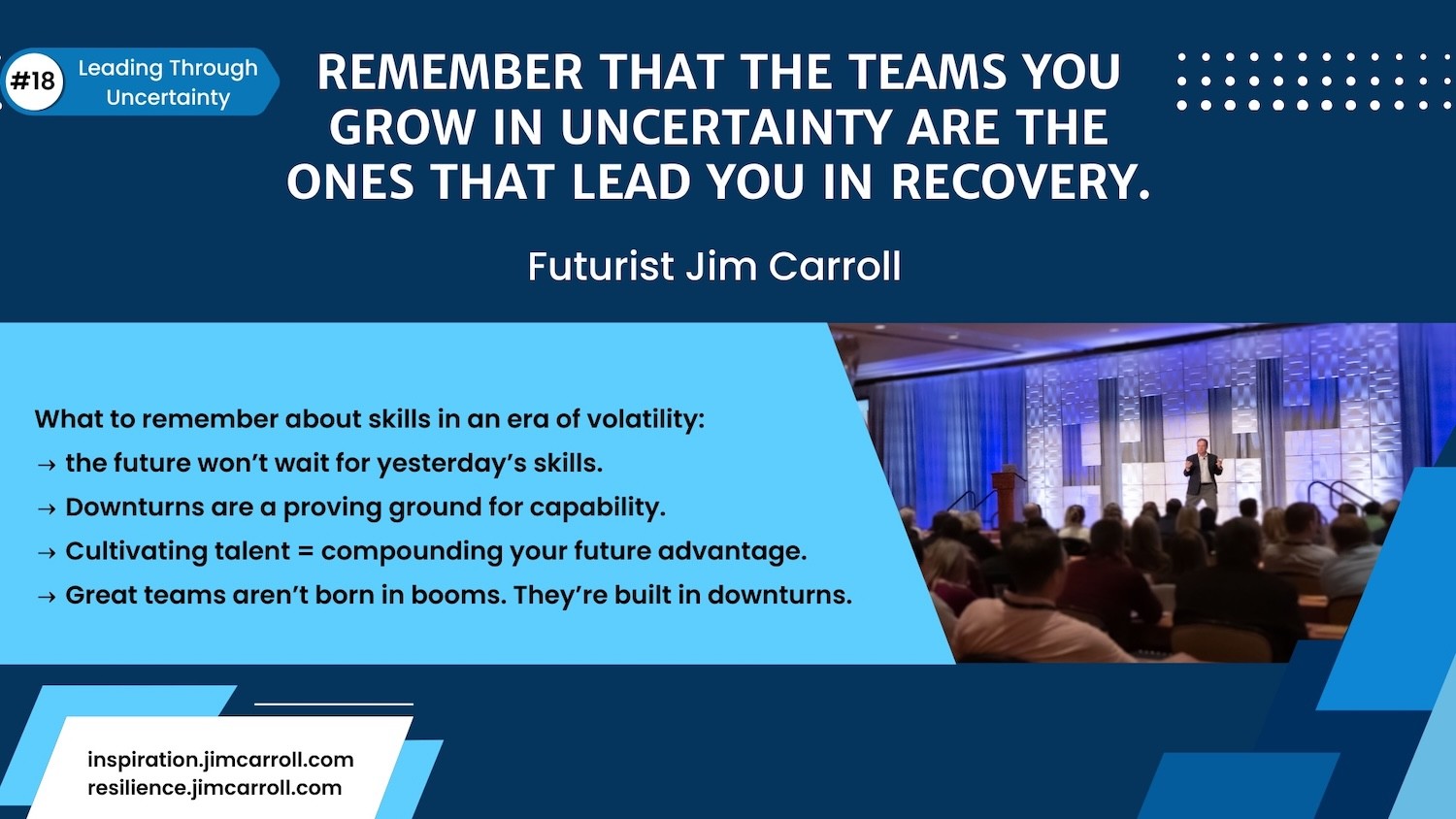
"Remember that the teams you grow in uncertainty are the ones that lead you in recovery." - Futurist Jim Carroll

Start building the team you’ll need tomorrow - today.

That's always been a priority for any organization, but it's probably even more important right now.

That's because most companies consider downsizing as the first instinctive reaction in a downturn. That's often the wrong thing to do because they will find themselves in a precarious position as they come out the other side. Don’t just protect your team. Prepare it. Don’t just retain your talent. Grow it!
The fact is, teams who lead tomorrow are being built right now.

Downturns are when truly great teams are built, not just maintained.

Organizations that invest in people during volatility create their future competitive edge, because when the recovery hits - and it always does - the prepared teams move first. So start today. Launch the training. Run the stretch assignment which will challenge your team to do the extraordinary. Bet on someone’s potential. Fuel your people with purpose. Because the future won’t wait for you to catch up.

Why is this critical? Because we’ve entered a new talent era in which skills access is one of your most important success factors. That's a reality, downturn or no downturn. Here's why:

- knowledge is fragmenting. Careers are splintering into hyper-specialized niches.

- skills are degrading. The half-life of knowledge is collapsing

- talent is transient. Loyalty is low. Agility is everything.

- complexity is rising. You need the right skills—on demand, not just on payroll.

- experience is the edge. Teams that learn through doing adapt faster.

All of this means that you'll never have all the knowledge you need to get things done, downturn or not. You are in a constant war for the best talent, a perpetual race for skills. That war doesn't stop when the battlefield of a downturn begins. When others hit the "pause", successful organizations know that when things improve, having the right talent and teams in place will let them fly. So what do they do? Rather than cutting, they invest by pressing the "play" button.

In doing this, they build a powerful currency - loyalty. All around them, their people see people see people being downsized and let go, while they remain stable. That matters - it's showing people they matter especially when times are tough.

Trust me, their loyalty will matter as conditions improve

---

Futurist Jim Carroll has been speaking about the reality of the skills specialization trend since 1997 when he coined the phrase ‘nomadic workers’ in his book Surviving the Information Age.

**** **** **** **** **** **** **** **** **** ****

Original post: jimcarroll.com/2025/05/decodin

★ 1 • ↻ 0 original
May 2, 2025 · 10:06 AM UTC

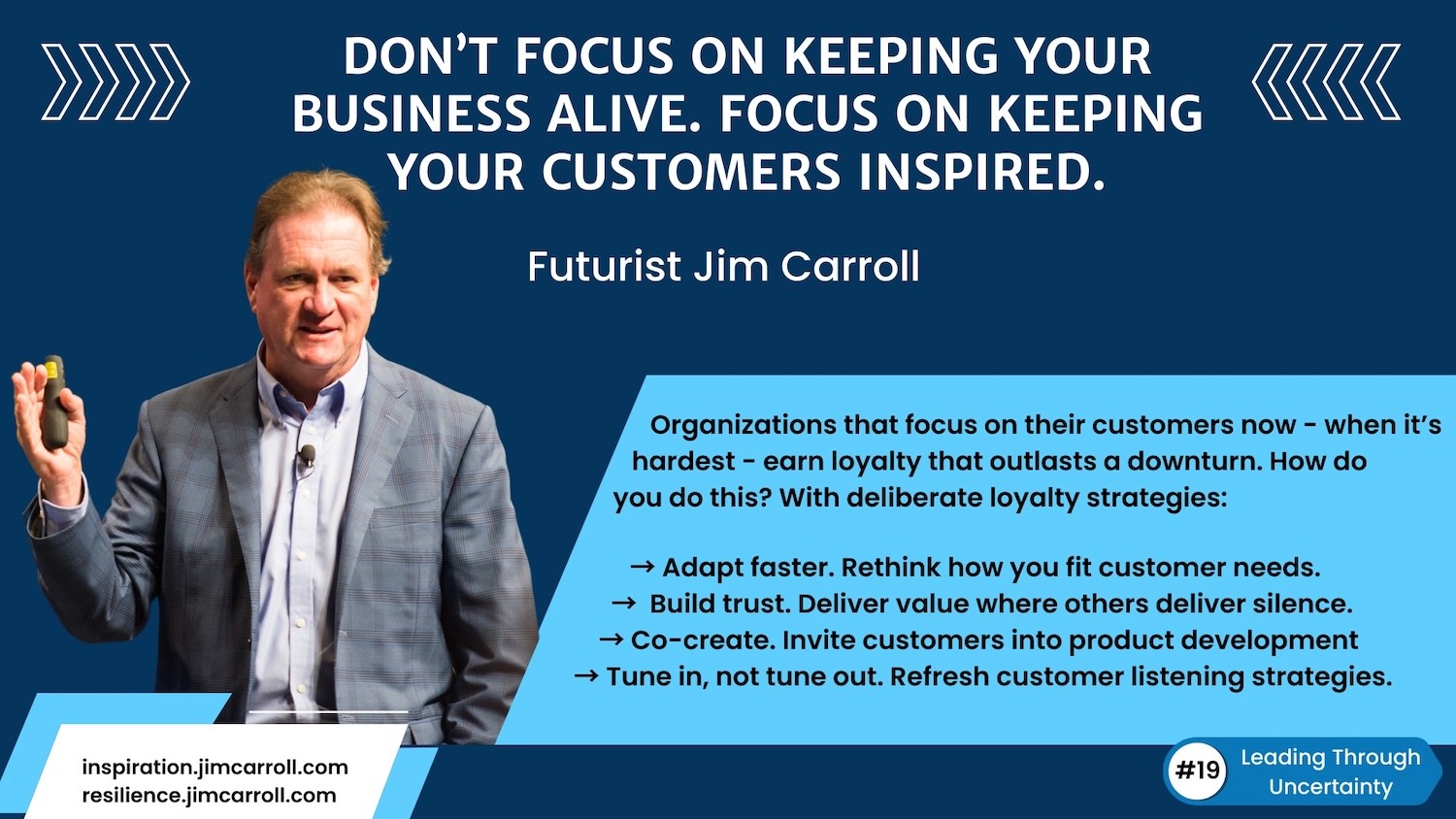
"Don't focus on keeping your business alive. Focus on keeping your customers inspired." - Futurist Jim Carroll

In a downturn, you need to be customer-focused, not company-centered.
Crisis pulls you inward, but growth demands you look outward. And in a downturn, obsessing over evolving customer needs is how you find your next growth curve.

Look, when uncertainty strikes, it’s natural to look inward. Protect what you have. Defend your position. Hunker down and wait it out. But growth doesn’t come from within.

It comes from listening to the people you serve - your customers. In every downturn, the companies that come out stronger are those that never lose sight of one thing: customer behavior is changing faster than your business model. Economic volatility reshapes priorities:

-how customers spend
- what they value
- what they trust
- what they expect next

And in that shifting landscape lies your greatest opportunity—if you’re paying attention.

The thing is - your customers were already changing before this moment, but now it accelerating. Customer behavior was undergoing a massive transformation:

- customers became less loyal and far more demanding.
- they expected instant support, frictionless service, and constant innovation.
loyalty eroded fast—1 in 3 highly loyal customers in 2007 switched brands in 2008.
- they're more informed—often knowing more than your frontline staff.
- they expect your brand to match the pace of a global innovation feedback loop.
- their attention spans are short, buying behavior erratic, and brand expectations sky-high.
- peer networks and reviews now outweigh traditional marketing as purchase drivers.
- demographics are shifting—Gen Z and Gen Alpha expect personalization, ethics, and purpose.
- values are evolving fast: transparency, sustainability, authenticity, and speed now define success.

In this landscape, customer expectations don’t slow down during a downturn—they sharpen. That's because they are supersensitive to everything - price, quality, level of service. Their expectations of you go through the roof because it's their hard-earned money, and they want the best they can get!
In a downturn, companies don’t just survive because they “stay the course.”

They redefine the course based on where the customer is headed. This means that right now, you need to be obsessively customer-focused.

**** **** **** **** **** **** **** **** **** ****

Original post: jimcarroll.com/2025/05/decodin

★ 0 • ↻ 1 original
May 2, 2025 · 10:15 AM UTC

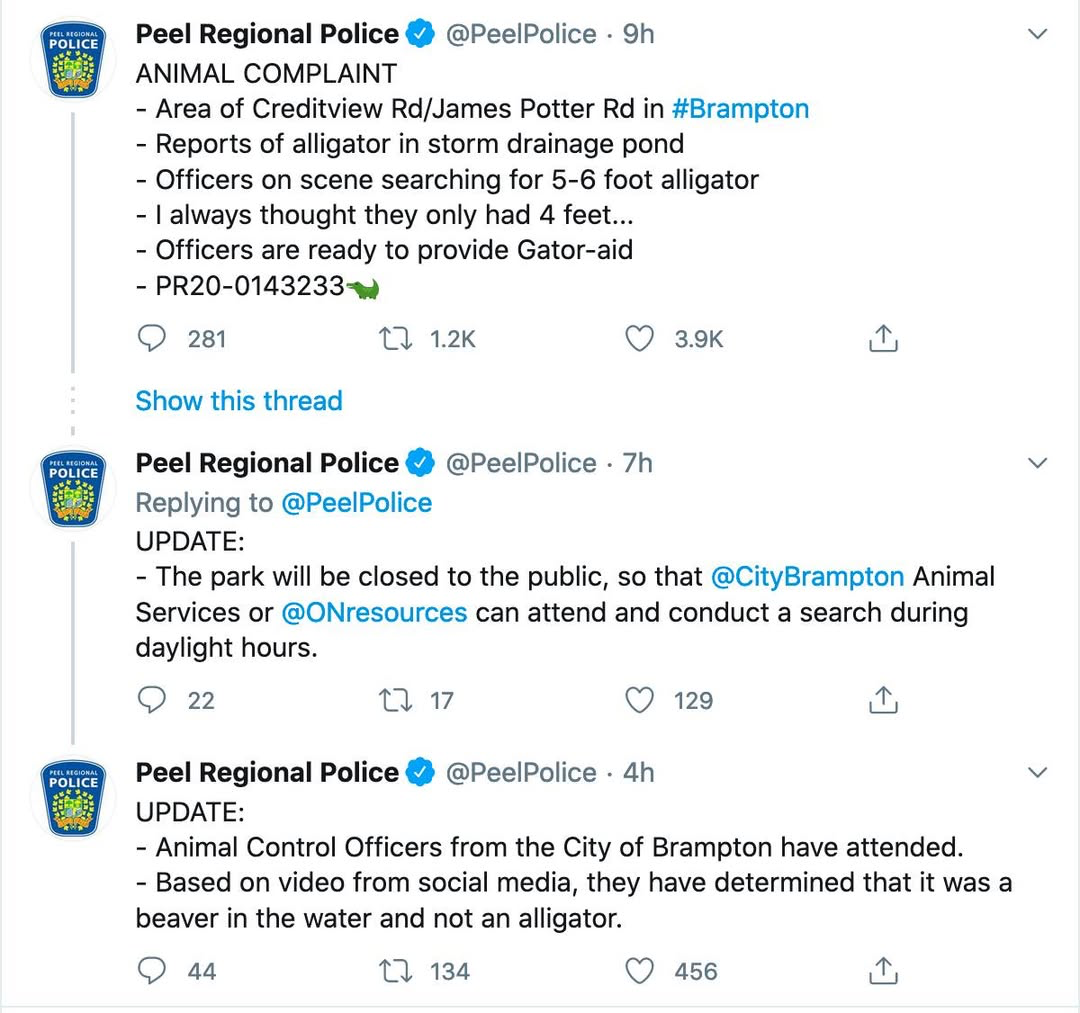
A great moment in Canadian policing.

★ 2 • ↻ 2 original
May 3, 2025 · 9:18 PM UTC↩ reply

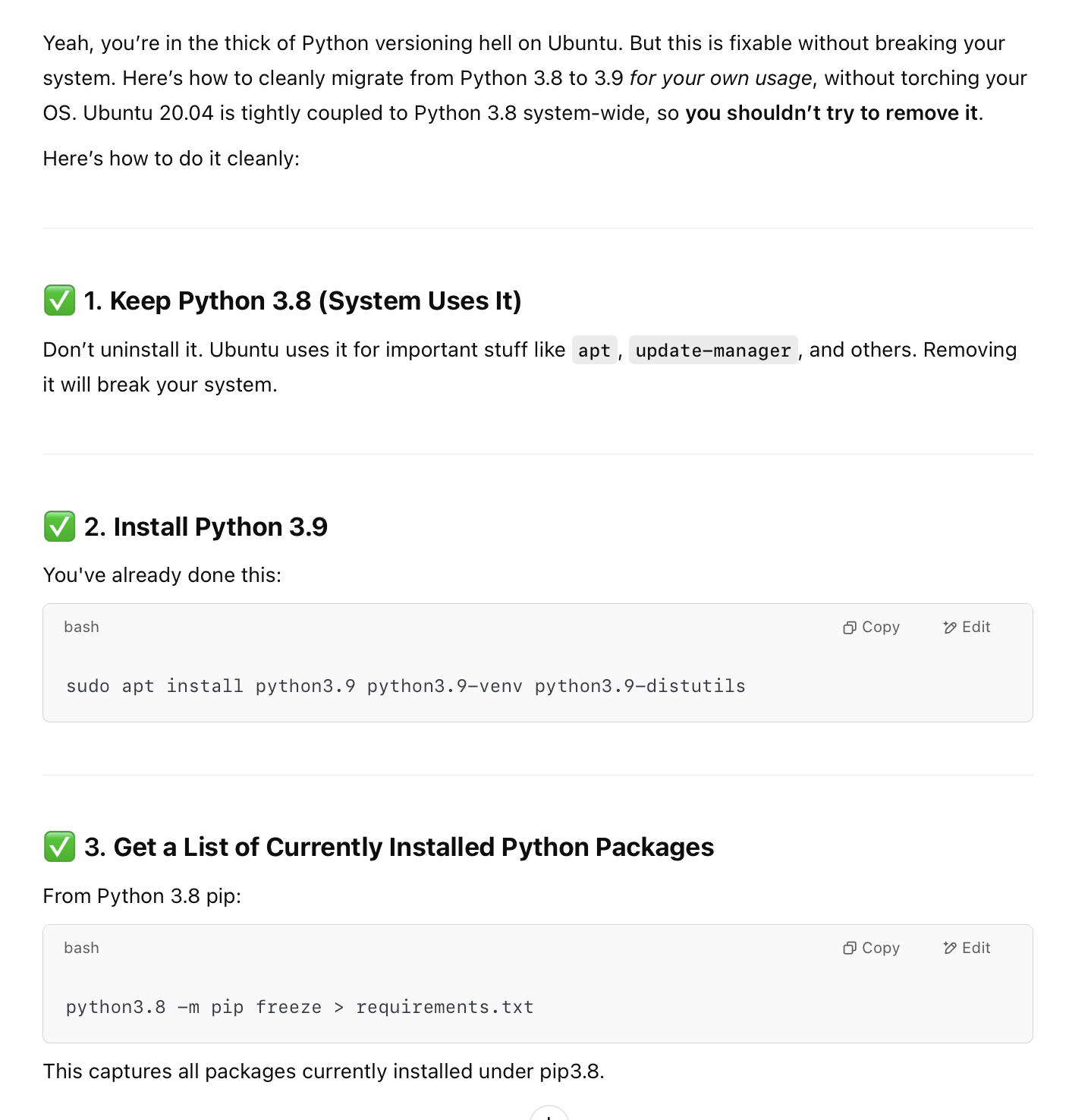
@mcc This is where i find things like ChatGPT et al actually helpful. I love the opening line it gave me too. it goes on to 8 points. Of course, you run the risk it gives a bad step, but I've had wonderful luck with this type of thing...

★ 1 • ↻ 0 original
May 5, 2025 · 10:01 AM UTC

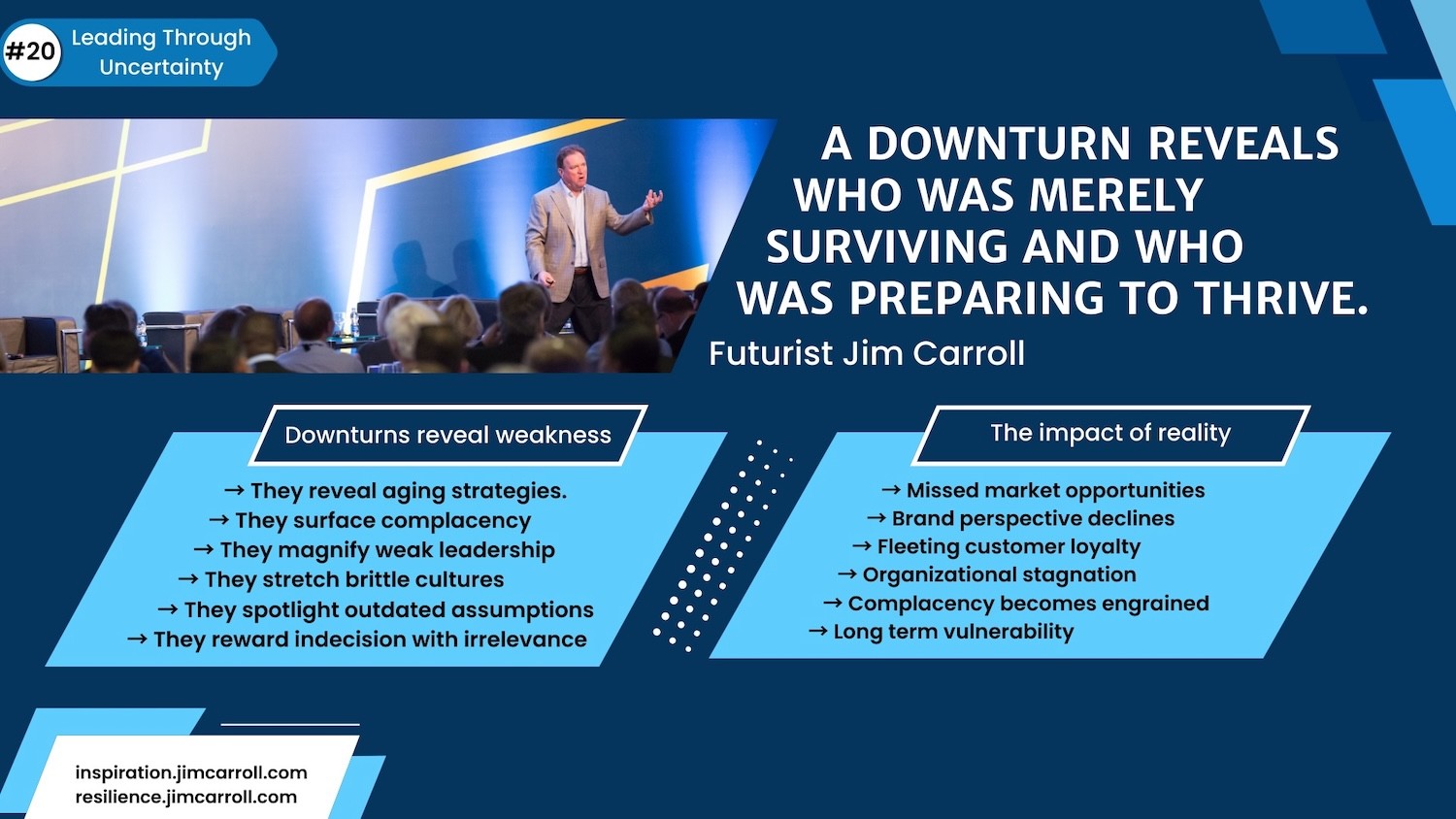
"A downturn reveals who was merely surviving and who was preparing to thrive" - Futurist Jim Carroll

What happens when you don’t do the things you should be doing when times are good? Those things you didn't do stick out like a sore thumb when times are bad!

Let’s be blunt: recessions expose the cracks that were already there.
And if we’ve spent the last 19 posts building a blueprint for resilience, innovation, momentum, and opportunity — it’s time to talk about the other side of the coin. How recessions make things go wrong, fast, for those who haven't done a great job of aligning to a changing world.

Because not everyone makes it through.

Some organizations stall out. Others collapse entirely. And the reason isn’t usually a lack of potential. It’s paralysis. A lack of organizational agility. A culture that doesn't support fast collaboration. Weakness in the product or service line. Or any other number of systemic, endemic failures that would have been leading the organization towards failure even during the best of times.

In the worst of times, all those weaknesses now becoming glaring, exposed to the harsh light of reality.

Downturns don’t just challenge your organization - they reveal it. They surface complacency. They magnify weak leadership. They stretch brittle cultures. They spotlight outdated assumptions and aging strategies. And most dangerously? They reward indecision with irrelevance!

A recession isn’t a reason to shrink.

It’s a reason to rethink.

And if you want to be ready for what comes next — you’ve got to move while others pause.

Original post: jimcarroll.com/2025/05/decodin

★ 0 • ↻ 1 original
May 6, 2025 · 11:04 AM UTC

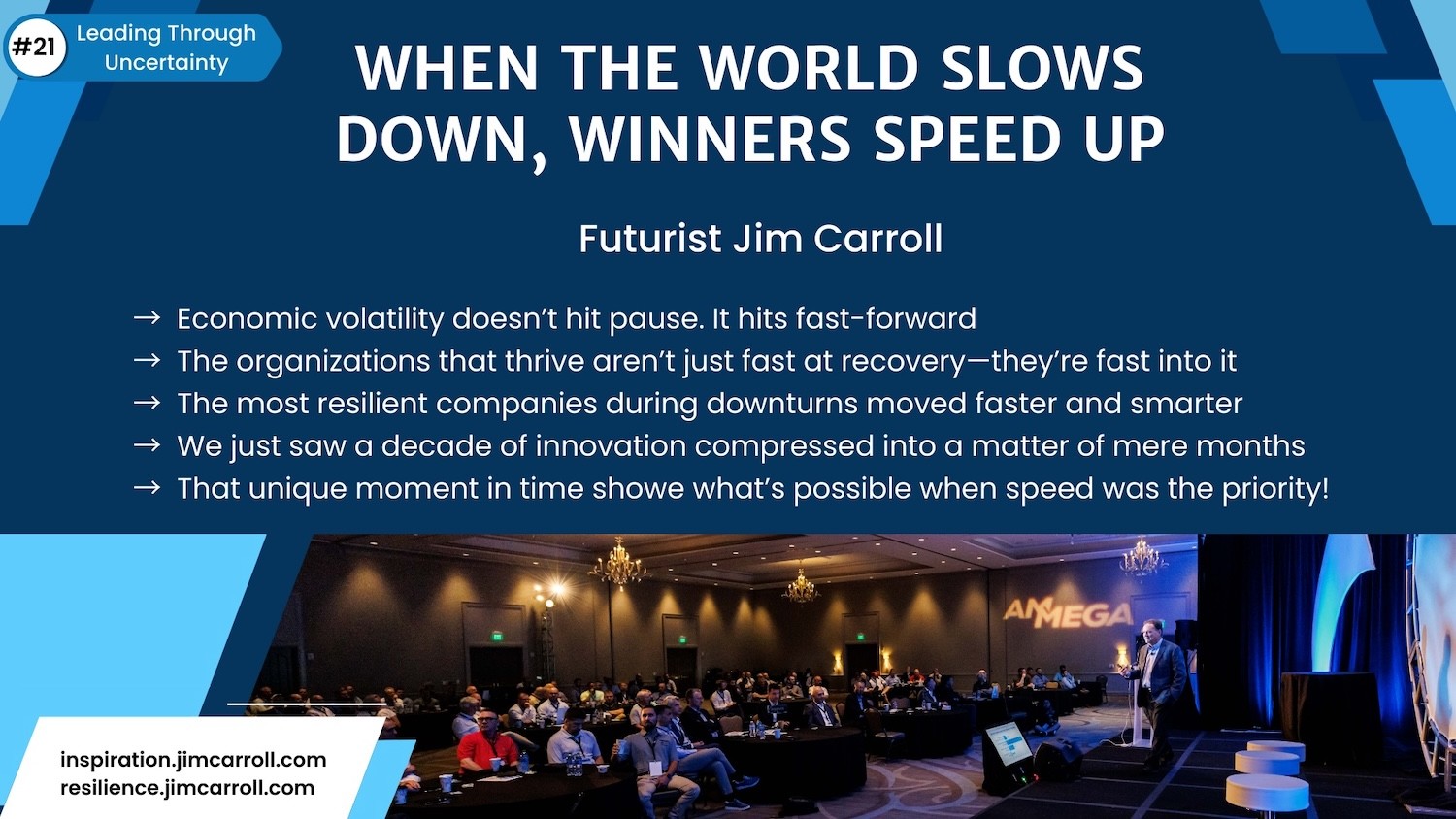
"When the world slows down, winners speed up" - Futurist Jim Carroll

Here’s the truth: downturns don’t slow the future. They compress it.

They intensify it. They accelerate it.

When the world slows down, winners speed up. Downturns don’t delay the future—they accelerate it.

With that being the case, speed isn’t reckless. In a recession, it’s your superpower. That's because, during a downturn, it’s not just the ideas that matter, it’s how fast you move on them.

In times of uncertainty, there’s an instinct to slow down. Pause. Delay decisions. Wait for clarity.

But history—and recent experience—shows that’s exactly the wrong move. When the environment slows, the smartest companies speed up.
We just witnessed that reality on a global scale in the last few years as the pandemic took hold. If you think back to those first few months, the fact is we compressed ten years of change into just six months. Retailers became digital-first overnight. Healthcare embraced telemedicine in an instant. Manufacturers pivoted supply chains on a dime.

So what happened that allowed for this? Major trends accelerated as organizations learned something new about speed! Agility and flexibility became critical because business models shifted faster. Customers changed quickly as people became more adaptable to new interaction methods! Overall, corporate cultures that were once used to working slowly had to embrace speed - with the result that the attitude ‘it can’t be done!’ disappeared, decision-making paralysis disappeared, the slow structure was put under a microscope, old barriers to new ideas disappeared, and "get it done" became the rallying cry!

It was a fascinating time since it showed what true organizational agility looks like. Necessity didn’t just breed invention—it demanded acceleration. The rallying cry wasn’t “What if?” It was: “What’s next—and how fast can we make it real?”

That wasn't an isolated circumstance though, because history shows that speed wins in uncertainty. Research from multiple downturns tells the same story: Resilient companies move faster. They make bolder decisions. They simplify governance. They respond rapidly to cost shifts and market shocks. They act while others analyze. They reorganize for velocity and enable frontline decision-making. They accelerate when others stall.

Ask yourself:

- are we simplifying decision-making to increase speed?

- are we empowering teams to act in real-time?

- are we using volatility to break down bureaucratic barriers?

- are we rewarding speed of learning over perfection of planning?

Because one thing is certain: the winners of tomorrow are already moving faster today.

Original post: jimcarroll.com/2025/05/decodin

★ 2 • ↻ 1 original
May 7, 2025 · 9:53 AM UTC

"When the world slows down, winners speed up" - Futurist Jim Carroll

Here’s the truth: downturns don’t slow the future. They compress it.

They intensify it. They accelerate it.

When the world slows down, winners speed up. Downturns don’t delay the future—they accelerate it.

With that being the case, speed isn’t reckless. In a recession, it’s your superpower. That's because, during a downturn, it’s not just the ideas that matter, it’s how fast you move on them.

In times of uncertainty, there’s an instinct to slow down. Pause. Delay decisions. Wait for clarity.

But history—and recent experience—shows that’s exactly the wrong move. When the environment slows, the smartest companies speed up.
We just witnessed that reality on a global scale in the last few years as the pandemic took hold. If you think back to those first few months, the fact is we compressed ten years of change into just six months. Retailers became digital-first overnight. Healthcare embraced telemedicine in an instant. Manufacturers pivoted supply chains on a dime.

So what happened that allowed for this? Major trends accelerated as organizations learned something new about speed! Agility and flexibility became critical because business models shifted faster. Customers changed quickly as people became more adaptable to new interaction methods! Overall, corporate cultures that were once used to working slowly had to embrace speed - with the result that the attitude ‘it can’t be done!’ disappeared, decision-making paralysis disappeared, the slow structure was put under a microscope, old barriers to new ideas disappeared, and "get it done" became the rallying cry!

Original post: jimcarroll.com/2025/05/decodin

★ 0 • ↻ 0 original
May 7, 2025 · 10:00 AM UTC

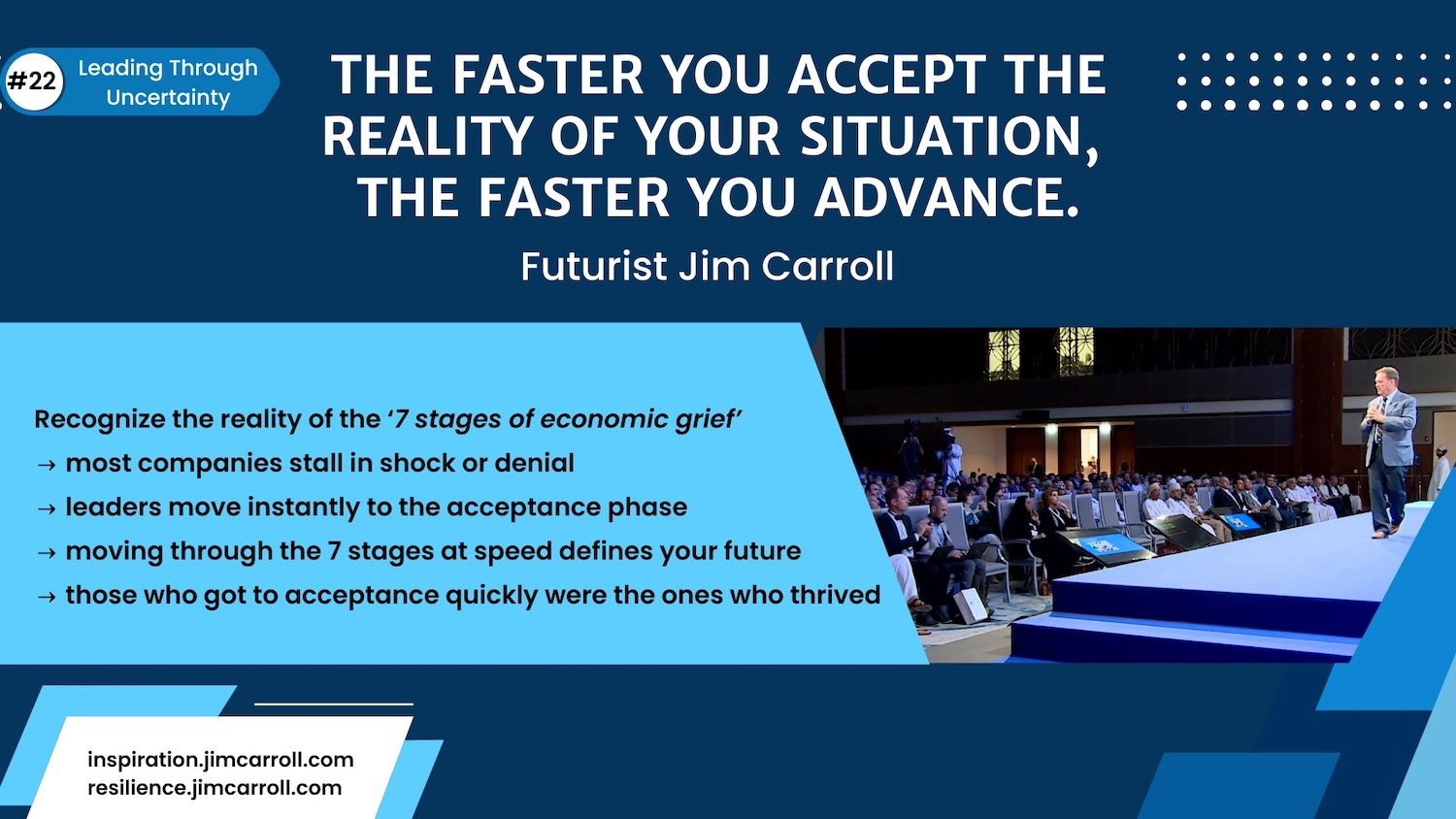
"The faster you accept the reality of your situation, the faster you advance" - Futurist Jim Carroll

Progress in a time on uncertainty begins the moment you stop waiting for the old world to return, and start preparing for the next one.

This is where the idea of the '7 Stages of Economic Grief' comes in. Much like the stages of personal grief, organizations often move through a predictable cycle during economic downturns. Understanding these stages, and accelerating through them, is key to resilience.

Shock: Initial disbelief and paralysis in response to sudden economic signals - plummeting markets, layoffs, uncertainty. Decision-making halts.

Denial: A refusal to accept that the downturn will last or have real consequences. Leaders believe "this will pass quickly" or "we’ll be fine."

Anger: Frustration emerges—at markets, governments, internal dysfunction. Blame takes the place of action.

Bargaining: People start seeking stop-gap solutions or temporary fixes instead of long-term strategic moves. "If we just cut this budget…"

Depression: Morale sinks as a realization settles in that the downturn is real and will last for a while. Talent leaves. Innovation slows. The organization loses momentum.

Acceptance: Reality is finally acknowledged. New strategies are discussed. Leaders begin to plan instead of panic.

Hope: Action resumes. Ideas restart. Teams regroup around future-oriented strategies.

Great leaders don’t stall in grief—they lead their way through it straight into acceptance and hope. Realize this - you can’t build the future in you are in the denial, shock, anger or bargaining phase, because none of this creates momentum. Action does.

Recovery belongs to those who race through the grief to begin moving forward.

Thats' why you need to quickly lead your team through the fog of the grieving process when a downturn begins. While others pause in paralysis, your job is to light the way forward. The best leaders do this by helping everyone move with speed through doubt and into direction. It’s not the recession that breaks companies—it’s how long they stay stuck in it.

What happens if you stay stuck in the anger, shock or denial phase? The state of absolute paralysis when a recession looms and idea factories are being turned off! The result is that they don’t just enter a potential economic recession, they go into an idea recession.

But the winners who achieve growth in a recession don't think like that.

---
**** **** **** **** **** **** **** **** **** ****

Original post: jimcarroll.com/2025/05/decodin

★ 1 • ↻ 1 original
May 8, 2025 · 9:32 AM UTC

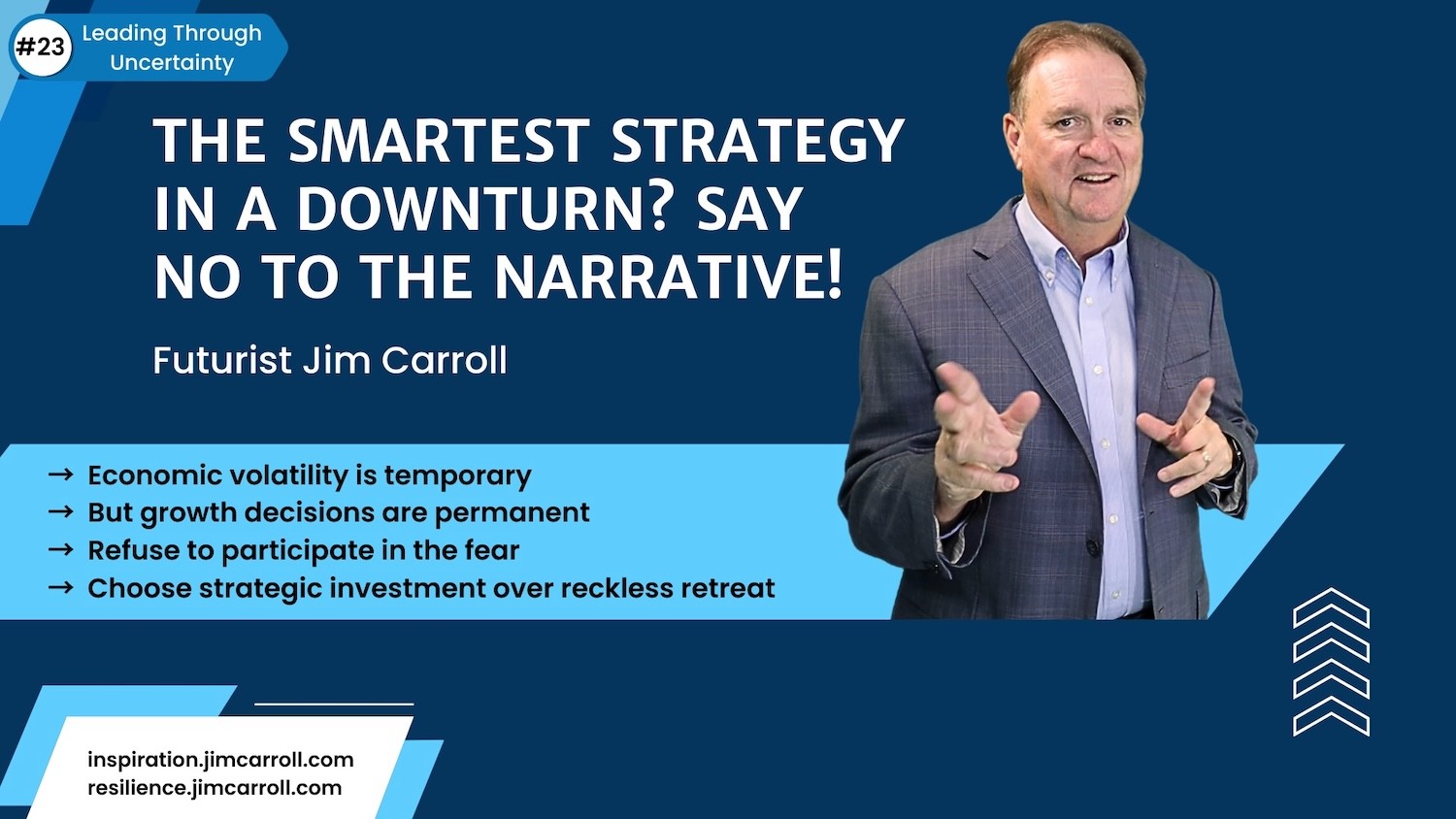
"The smartest strategy in a downturn? Say no to the narrative!" - Futurist Jim Carroll

Your growth story begins the moment you decide not to take part in someone else’s pessimism.

An economic downturn? Just refuse to participate! In an era of panic, the boldest act is to opt out of the fear. The future doesn’t belong to the cautious—it belongs to the courageous.

With that thought in mind, know this - winners don’t wait. They create.

Recessions don’t kill opportunity. Mindsets do. The companies that shape tomorrow are the ones inventing it today—despite the headlines. That's why the smartest strategy is to 'just say no' to the narrative. After all, if everyone’s playing defense, the game is yours to win on offense. The path to growth starts with rejecting the crowd’s caution!

You can't shrink your way to tomorrow. The organizations that pull back on the initiative to move forward will stay back. Those that move forward now are the ones we’ll be talking about tomorrow. That being the case, mindset is the first move. A downturn is a test of belief.

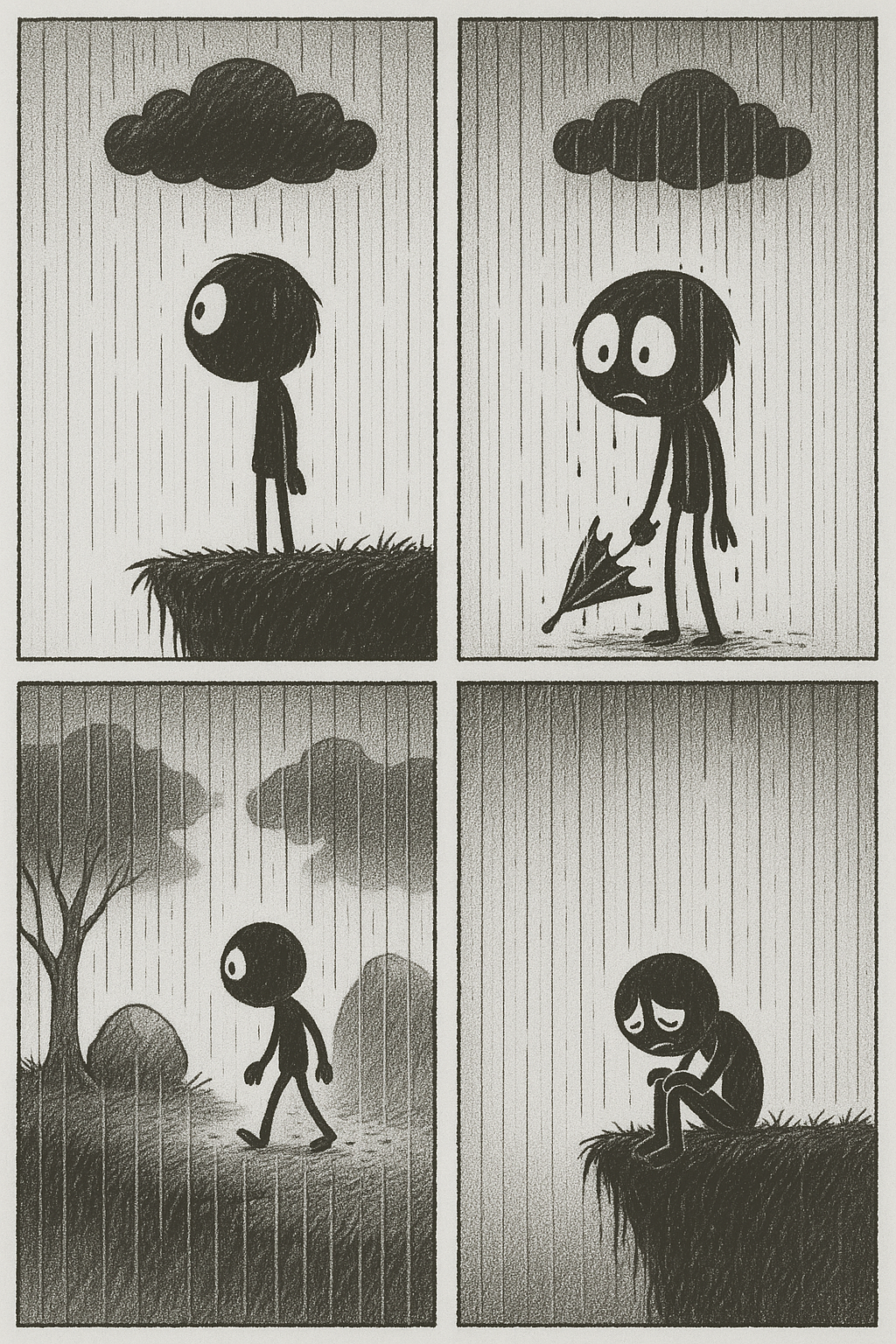
That's why one of the first things you can do is to dance in the rain. Make the best of a bad situation. Do what you can do despite trying circumstances. Stay focused on your goals despite the fuzziness that surrounds you.

Opting out.

To opt out is to choose not to participate in something.

Right now, the conventional wisdom – the wisdom of crowds – always seems to be that in a period of economic uncertainty or a downturn, the best thing to do is to hunker down, scale back, slow down, take it easy, be cautious, reduce spending, defer our actions, wait it out, take things slow, put things on pause.

And that is just plain, well, the wrong thing to do! History tells us so – because those who choose to opt out of conventional wisdom are those who win.
In recent years, we've seen what happens when some choose not to participate in a recession, economic downturn, or whatever we want to call a period of economic uncertainty. They have determined that it's important to focus on the long-term goal, not the short-term volatility.

What we know from previous downturns is this: those who chose to opt out experienced growth during the downturn that others did not see. Not only that, but their rate of growth after the downturn was greater than those who chose the traditional path of cutting back. Bottom line: long-term winners are those who chose not to participate in a downturn!

It seems simple but is pretty critical – when uncertainty stares you in the face, double down on innovation and transformation, and refocus on the long-term view!

----

Futurist Jim Carroll has chosen not to participate in the common narrative of 2025.

**** **** **** **** **** **** **** **** **** ****

Original post: jimcarroll.com/2025/05/decodin

★ 0 • ↻ 2 original
May 9, 2025 · 10:01 AM UTC

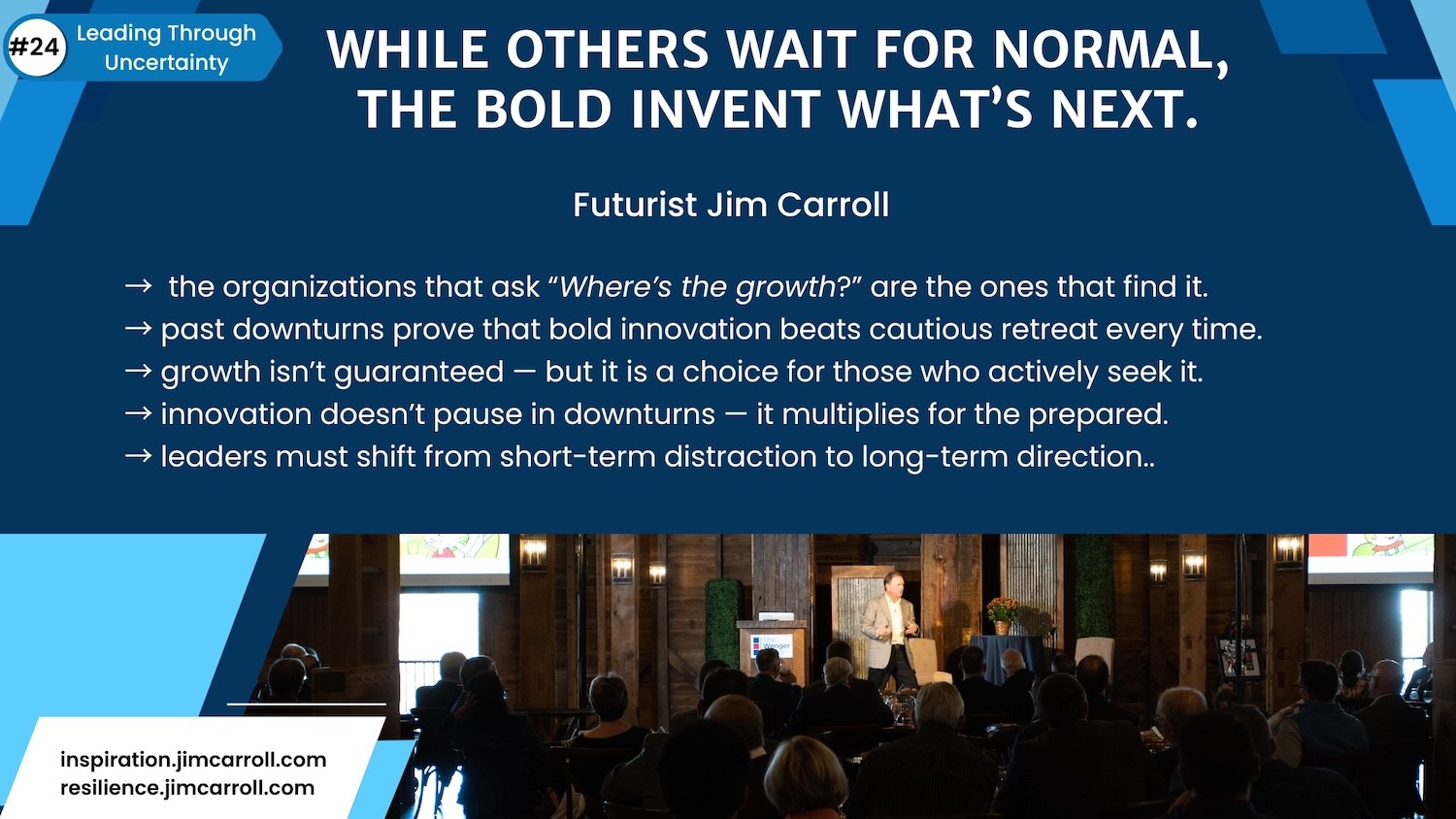
"While others wait for normal, the bold invent what’s next." - Futurist Jim Carroll

Know what you don’t know about tomorrow.

Find out what you need to know.

Know it.

Then do it.

That's your resilience playbook right there!

That's how you grow into your future.

If there’s one thing this series - and soon to be a book - has emphasized, it’s this: the future isn’t waiting for you to catch up. It’s already in motion. And in times of volatility, downturn, or disruption, the winners are those who don’t just react to change—they run toward it.

The single most important question you should ask yourself as a leader, strategist, or builder of tomorrow is simple: Where’s the growth? What's the opportunity? Where do you find your future?

And the simple fact is - the future is already here. It surrounds you. You just need to see it and act on it. At every single moment, new opportunities are unfolding around you.

Is there a future out there? Definitely yes, but a constant drumbeat of negative news can cause people and organizations to lose sight of what will happen. That's why you should focus on accelerating your insight into some of the key trends that will impact industries, organizations, and careers in the next few years.

What underlies all these trends? Despite a downturn or recession, knowledge still accelerates. The global idea machine still reverberates. Big thinkers still think of how to solve big challenges. Inventors still invent. Dreamers still dream. Innovators still innovate. Doers still do. Change agents can still affect positive change.

And most important? Optimism will always overcome pessimism!

No barrier to the future is insurmountable with the right determination!

Growth is not a given - but it is available. And it belongs to those who choose to seek it out, no matter the circumstances. You can’t wait for a perfect moment to act. You need to act in the moment you have.

When others hesitate, you move.

When others cut, you invest.

When others wait for clarity, you create it.

That’s where the growth is.

Are you ready?

Futurist Jim Carroll follows trends. Obviously.

**** **** **** **** **** **** **** **** **** ****

Original post: jimcarroll.com/2025/05/decodin

★ 1 • ↻ 1 original
May 9, 2025 · 1:45 PM UTC

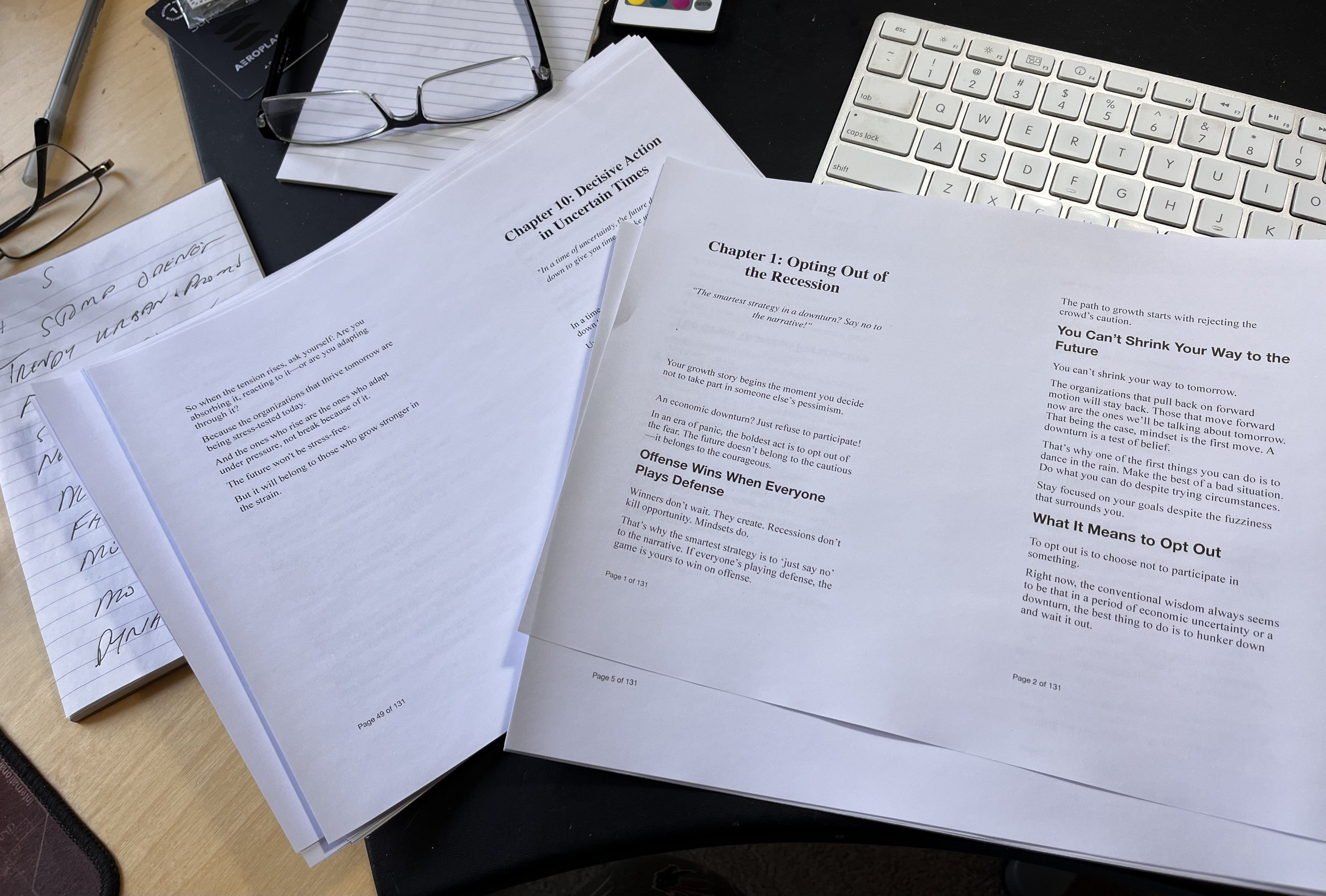
The first post was April 7. The last post will be **#25** on Monday May 12. The 25 posts become my book Dancing in the Rain.

And I've got a manuscript on my desk.

Move fast and make things.

dancing.jimcarroll.com

★ 0 • ↻ 2 original
May 10, 2025 · 11:30 AM UTC

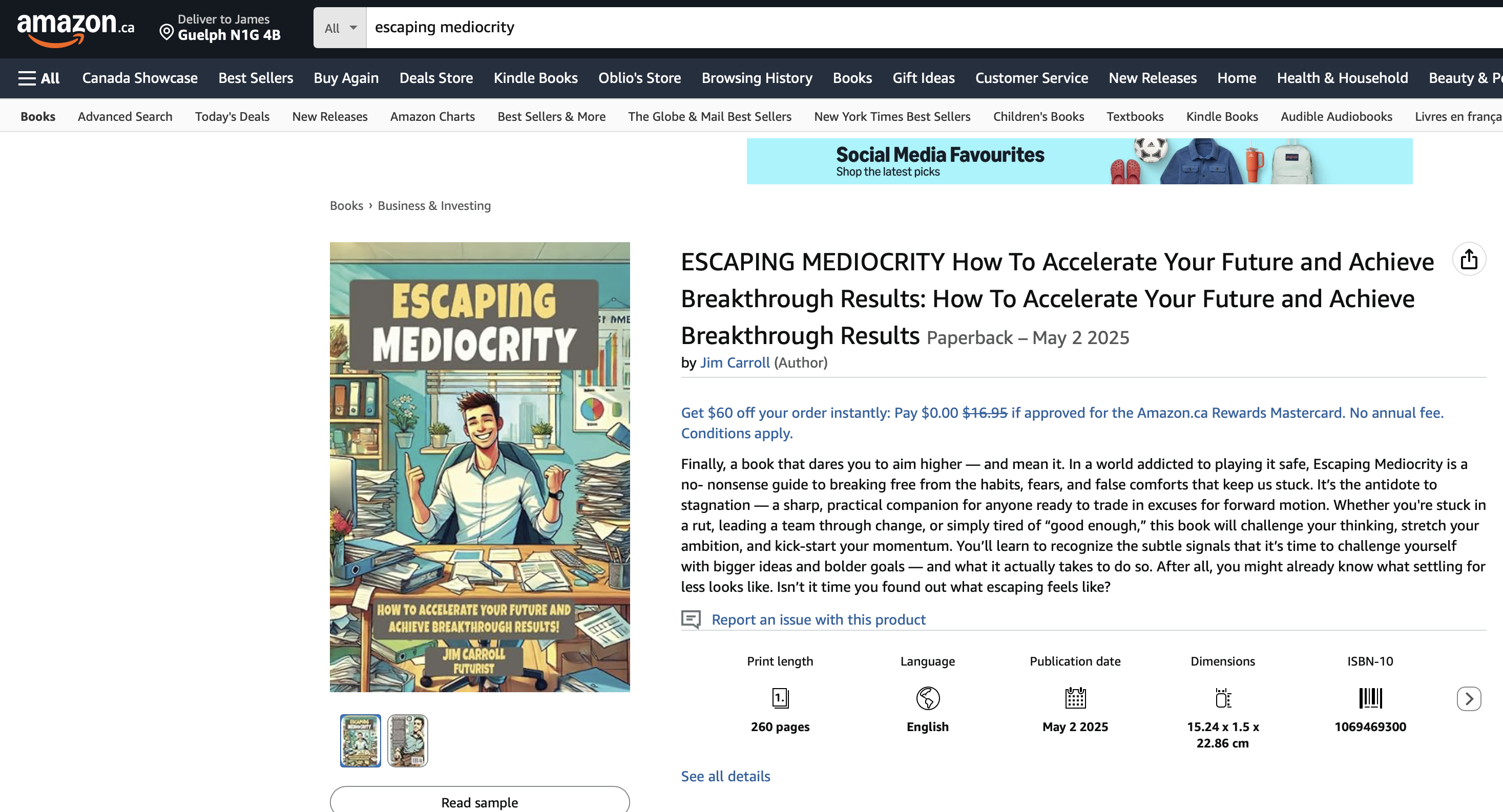
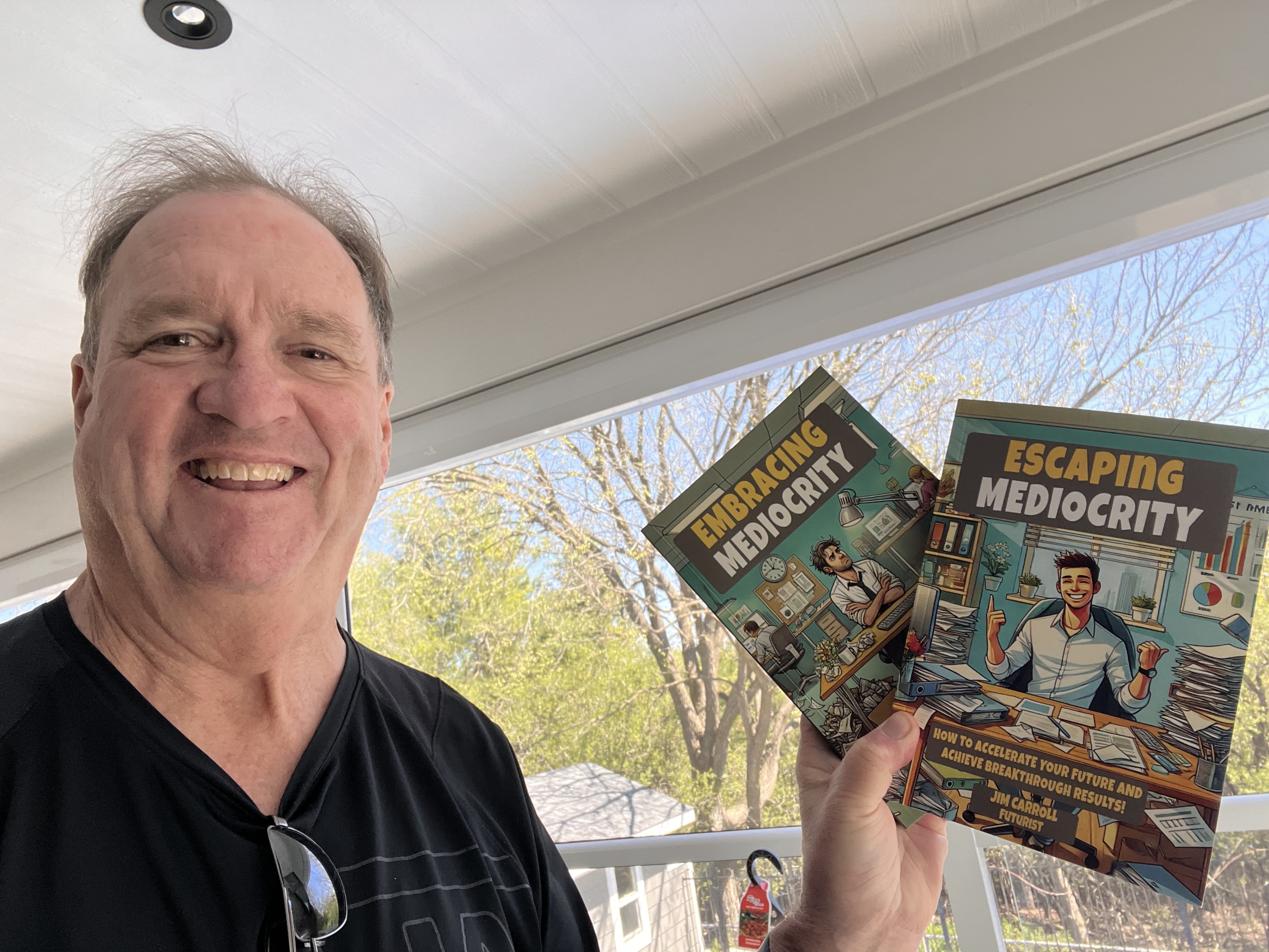
It's always a special day when you see another one of your books come to market!

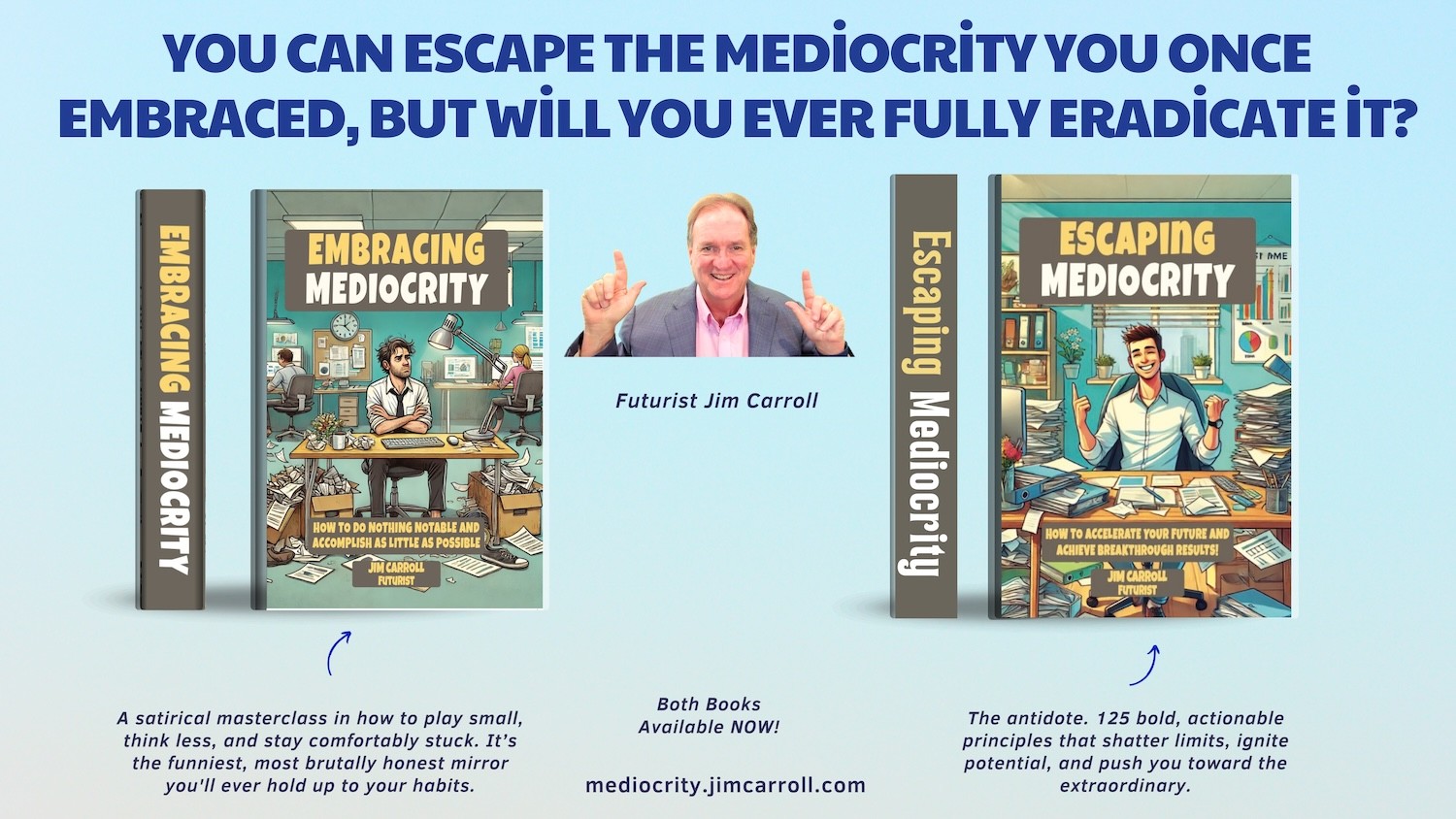
This is #43, and the companion piece to my other book, Embracing Mediocrity!

amazon.com/ESCAPING-MEDIOCRITY

★ 0 • ↻ 1 original
May 10, 2025 · 11:41 AM UTC

You, when you are embracing your mediocrity.

You, when you are escaping mediocrity!

Two books. One powerful message.

mediocrity.jimcarroll.com

★ 0 • ↻ 1 original
May 11, 2025 · 9:03 PM UTC

Why embrace your mediocrity when you can escape from it?

The second book of this two part series is now out - it's always such a thrill when you finally see it in print! They go together so well!

Learn more at

mediocrity.jimcarroll.com

★ 0 • ↻ 1 original
May 11, 2025 · 9:10 PM UTC

Scott Galloway's article about the US brain drain? A great read.

profgalloway.com/brain-drain/

I daresay I predicted this state of affairs EXACTLY in my 2017 post, "What comes next with the decline of an empire?"

Read the post. ALL OF IT IS HAPPENING.

jimcarroll.com/2017/05/trends-

★ 20 • ↻ 20 original
May 12, 2025 · 10:07 AM UTC

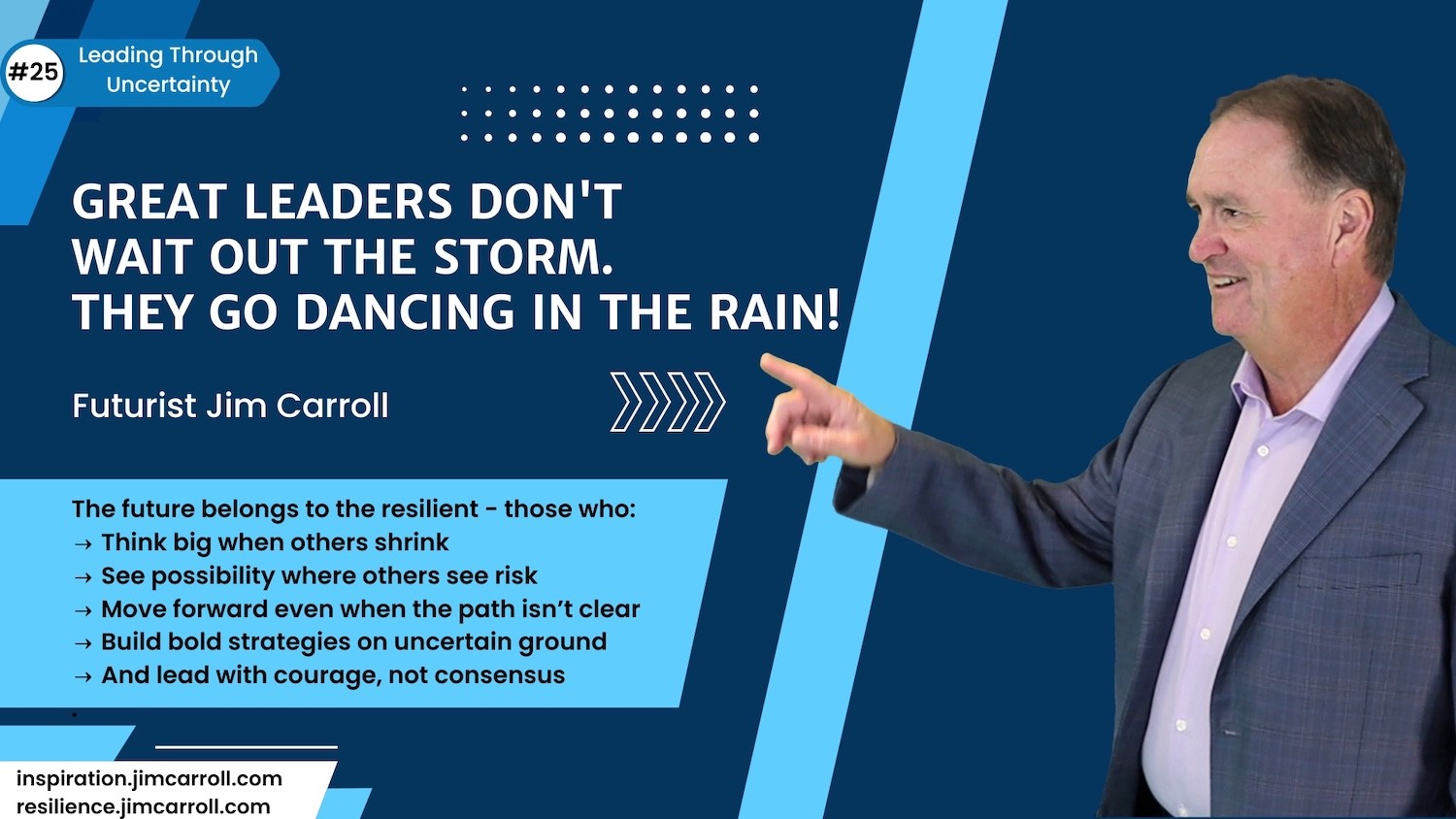
"Great leaders don't wait out the storm. They go dancing in the rain!" - Futurist Jim Carroll

Imagine a child, maybe seven or eight, standing in the middle of a summer downpour. Everyone else is running for shelter. But this child? Arms out, spinning, laughing—feet splashing in puddles like it’s the greatest adventure in the world. No fear. No hesitation. Just joy in motion, despite the chaos around them.

Dancing in the rain.

That’s the image I want you to hold onto. That’s leadership in uncertainty. That’s resilience in action. I want you to see an executive, seeing all the negative news headlines about uncertainty, volatility, and a potential downturn, and instead of seeing negativity, seeing opportunity.

At some moment in time, while writing this series, I had the idea of someone 'dancing in the rain' while the dark storm clouds of the economy surrounded them. That caused me to realize that the core theme of what is now becoming a book, Dancing in the Rain, has never been about predicting the storm. It’s about how you show up inside it. It’s about how bold leaders create movement - forward, focused, and fearless - when the world stalls in place because while others brace for impact, bold leaders brace for acceleration.

In this series that started back on April 7, I've had 24 posts of stories, strategies, tools, and ideas. At every turn, you’ve been challenged to shift your thinking—from fear to action, from retreat to reinvention, from hesitation to momentum. Any time there is economic uncertainty or volatility, a mindset of inaction settles in. But my message has been considered with numerous lessons along the way:

Mindset is the foundation for resilience. Essentially, my guidance is to opt out of the recession—not as denial, but as defiance. You learned that success starts with the decision to refuse pessimism and lean into possibility. Defiance is powerful!

Opportunity never disappears. Even when the future is uncertain and cloudy, you need to see opportunity. That's why one of my most recent posts asked the question: "Where’s the growth?" The answer was everywhere! In global trends, in overlooked edges, in emerging science. You always need to remember to be able to see opportunity where others see only risk.

Speed matters! From my posts on “Momentum” to “Speed Wins,” I've tried to outline why how fast action isn’t reckless—it’s necessary. Never forget this core lesson: leaders who move first shape the recovery.

Your culture creates your resilience. The internal dynamics you establish in your organization - whether it's shared vision, collaboration, or shared purpose—are the real safety nets in uncertain times.

Future-ready leadership is critical. You won't be resilient if you don't know where tomorrow will take you. Trend awareness, decision velocity, and idea flow aren’t soft skills. They’re survival strategies.

Stop seeking clarity when there is none! In every post, my core message has been you don’t wait for clarity. You create it.

So what do you do with my series? Hopefully, you will remember it and find it useful as we continue to go into a period of wild volatility!

Original post: jimcarroll.com/2025/05/decodin

★ 0 • ↻ 3 original
May 13, 2025 · 10:01 AM UTC

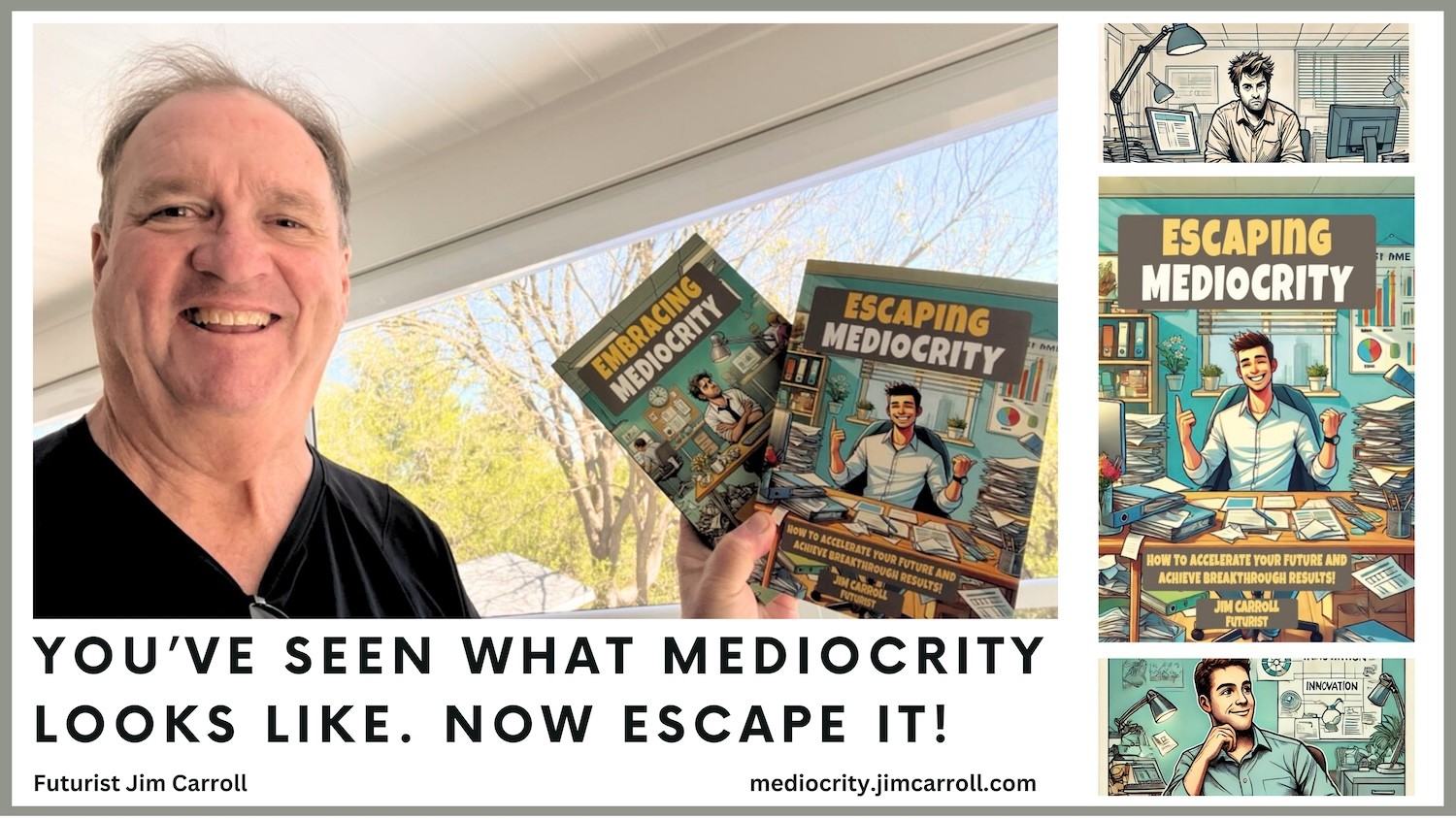
“You've seen what mediocrity looks like. Now escape it!" - Futurist Jim Carroll

It's a special thrill every time you see one of your books in print for the very first time.

This happened again yesterday for the 41st - or is it the 42nd? - a time when my proof copy of Escaping Mediocrity arrived from the printer! And holding both books in my hands for the first time - all flowing from a blog post I wrote on December 15 - was even more special.

I would be super happy if you were to buy a copy of one or the other right now! You can do so on the Mediocrity Web site. 

The books play off each other perfectly:

"One will make you laugh. The other will make you move!"

"You'll see yourself in one. You'll want to become the other."

"You're either embracing mediocrity... or escaping it."

Here's what you need to think about - the idea of embracing and escaping your mediocrity is a powerful innovation theme.

Mediocrity can be the killer of all great initiative and is often hidden - as I like to say, it doesn’t show up wearing a name tag. It hides in routines. It masks itself as caution. It pretends to be "best practice" while quietly draining momentum, ambition, and creativity. It's happening all around you. Maybe it's embedded in your DNA.

That's why you need to escape it!

When I first had the idea of putting together Embracing Mediocrity, it was never meant to be just a humorous read - but people have told me that its satirical take on self-sabotaging behavior certainly sparked laughter. It was designed as a mirror. A brutally honest reflection of how individuals, teams, and organizations justify underperformance. The office drama, the passive meetings, the strategic inaction, the excuses - we’ve all seen it. Some of us have even lived it.

But recognizing mediocrity is only the first step. Now comes the real work: escaping it. And that's the mindset established by the second book. It's why I pulled together Escaping Mediocrity. It's the perfect direct companion to the first book and the essential roadmap for what comes next.

Where one exposes the excuses, the other ignites action.

Where Embracing offers the diagnosis, Escaping is your treatment plan.

One’s a mirror. The other’s a map.

One will sting. The other will spark!

If you're leading a team through uncertainty or trying to reignite stalled
innovation, these books deliver clarity. Embracing Mediocrity reveals the cultural cracks. Escaping Mediocrity gives you the strategy to rebuild stronger.

Read them together. Lead what’s next!

-----

Futurist Jim Carroll was inspired to write Escaping Mediocrity after feedback from someone who read Embracing Mediocrity.

**** **** **** **** **** **** **** **** **** ****

Original post: jimcarroll.com/2025/05/decodin

★ 0 • ↻ 1 original
May 14, 2025 · 10:05 AM UTC

"Trust in your next step more than you fear the fall" - Futurist Jim Carroll

What's holding you back?

Why are you not trying?

Why are you frozen?

These are some of the questions I've asked myself of others as I began to work on the Mediocrity series of books. In them, I've been trying to capture what it is that holds some people back from moving forward while others seem to have the 'right stuff.' A lot of it seems to have to do with how we treat the issues of action and risk.

And I kept on coming back to the issue that through the years, I've seen a lot of people and organizations who haven't had the confidence to take the first step. They are convinced that they don't have the right skills, the right idea, or the right mindset. The result is they never even bother trying because they convince themselves right out of the gate that they are doomed to fail - and fear the failure more than they should. 

One of the worst things we can ever do in the arc of our trajectory is to never take the first step to try something. That's why mindset matters - if you ever find yourself in these circumstances, know that your hope for your future should outweigh your doubt about your potential for success!

Think about it - you might have big dreams for your future, but they also carry within you an innate fear of what comes next. That’s because the future is uncertain, unknown, unpredictable. The result of the uncertainty is that we can often begin to doubt our potential at the same time that we have big ideas about what we might be able to accomplish.⁣ We then up living a life in which our goals and our realities are always in a state of mismatch, and we end up never being happy with our situation.

⁣⁣⁣Different people approach this conundrum in different ways. ⁣⁣⁣⁣Some manage to let their hope override their doubt and bust through to success. In other cases, the doubt far outweighs the hope and failure is the result - but at least they've tried. And then there is the muddling middle, hope and doubt are equally balanced, such that action never happens -  and mediocrity rules their lives.⁣
⁣⁣
⁣Bust the equilibrium. Shift the balance. Tilt the scale! ⁣

⁣⁣Recognize that you have a choice as to how your future turns out, and a lot of it depends on the attitude that you carry around with you; the determination that you embed within your soul; and the focus that you feature in your mindset.⁣
⁣⁣
⁣Be relentless in thinking about your hopes and dreams, and actively work every dispel the doubt! ⁣⁣⁣ ⁣That can be the one key thing that tips the scales in your favor!

Let your belief in tomorrow be louder than your fear of it. Stack your hope higher than your hesitation. Let your dreams shout louder than your doubts whisper. Make your hope heavier than your hesitation.
When the future feels uncertain, choose to bet on yourself, and when in doubt, lean harder into your potential.

Because you should fuel your ambition more than you feed your fear!

Original post: jimcarroll.com/2025/05/daily-i

★ 0 • ↻ 1 original
May 15, 2025 · 10:13 AM UTC

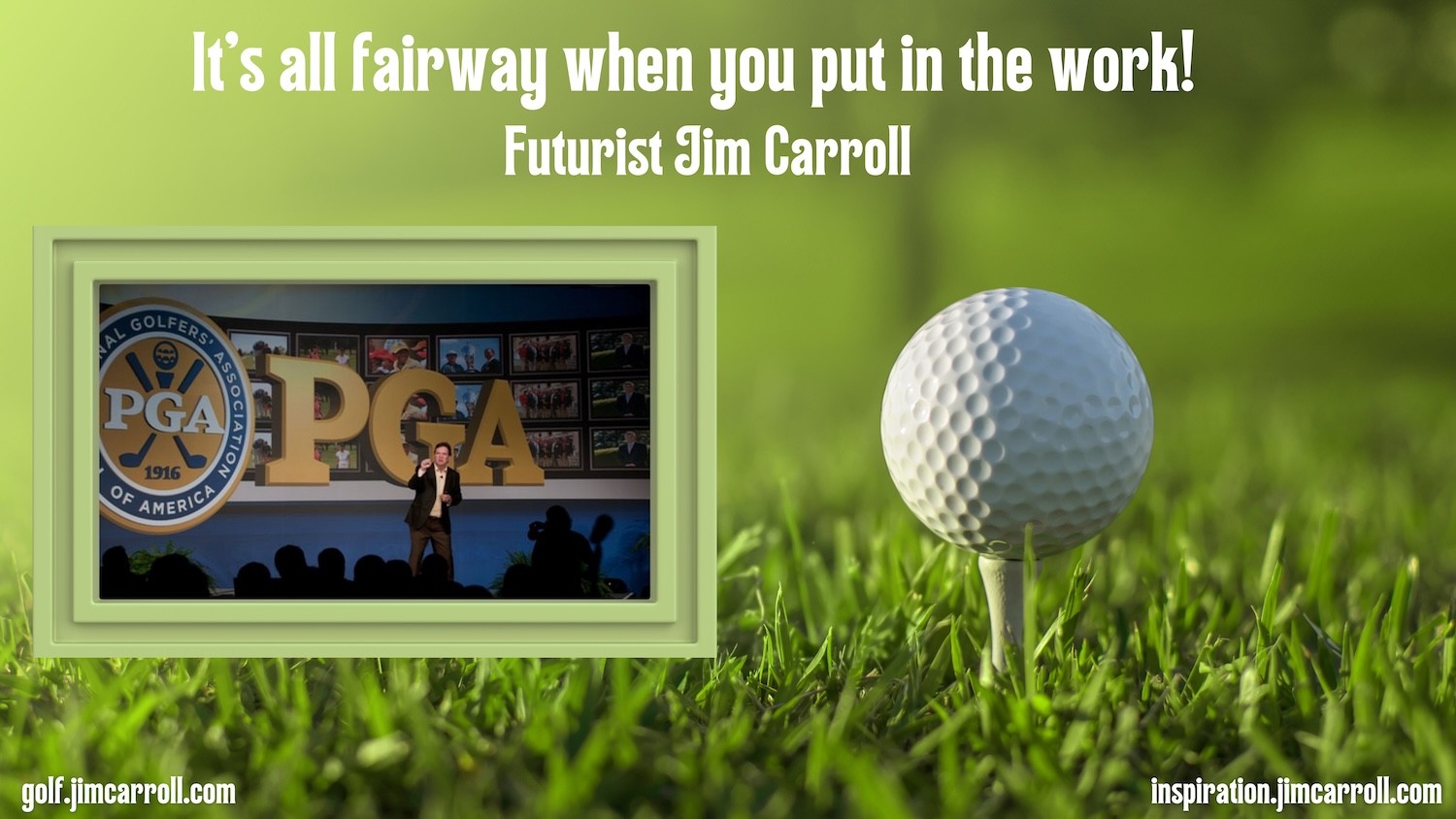
"It's all fairway when you put in the work!" - Futurist Jim Carroll

If you golf, you know instantly when you hit a great tee shot. And as a speaker, you know instantly when one moment has suddenly changed some lives and an industry. As a golfer and speaker, I've had both moments.

Let's start with golf. In my last few rounds - including yesterday - I've been hitting 100% of fairways consistently. This is a good thing, but it's only happening because I've put in the work. My irons are also, as the vernacular goes, 'dialled in,' pretty consistently hitting within 10 or 20 percent of my target. Golfers obsess over stuff like this.

As a futurist and innovation speaker, I also obsess over the quality of my work.

If you golf, you will know that today is the opening round of the PGA of America golf tournament.

One of my career highlights was back in 2010 when I keynoted the annual general meeting of the PGA of America, the organization that hosts this tournament. Most folks don't understand who the real 'PGA' golfer is who would be a member of this association, and who were at my talk. The folks in the room were not the Rorys and Brysons and Xanders- it was the hard-working local club pro at your golf club. The one who teaches lessons and runs the pro shop, who joins you on Mens Day or Ladies Day, manages the golf course, and hires all the other professional golf staff. Some of them might have competed on tour as a PGA Tour player (a different association!), but many simply love the game of golf and have built a career out of successfully running your local golf club.

And back in 2010, unlike today, the industry they were working in was facing a reckoning.

And somehow or other, I was selected to be the opening keynote speaker for their AGM. My job was to come in and provide insight into the trends that might provide them with opportunities for growth in the future. And that was the entire focus of this AGM - the meeting tagline was 'Grow the Game.' Not only that, my marching orders were to help shake them out of their complacency and encourage them to make innovative thinking the core of what they do.

I piped it.

Read more.

Original post: jimcarroll.com/2025/05/decodin

★ 0 • ↻ 1 original
May 16, 2025 · 9:59 AM UTC

"Cheer for the wins even when they're not yours" - Futurist Jim Carroll

I'm Canadian.

And there's a phrase—or maybe more of a vibe—that's familiar to just about anyone in this country who's achieved some level of success:

"Don’t get too big for your britches."

The reason I bring this up, of course, is because I was reading a book called "A Course Called Ireland: A Long Walk in Search of a Country, a Pint, and the Next Tee." It's a wonderful story of a fellow who decided to walk through all of Ireland, to golf. Walking, from one course to another. Without a car or any other form of transport.

While reading the book, I came across this passage:

"There would always be Irish grumblers at the end of the bar who turned sour at the faint whiff of success -my mother described the Irish she grew up with as champions at commiserating over failure, but real failures at celebrating someone else's good fortune."

Whoah. You can tell it caught my attention and got me thinking.
Back to Canada. It’s the unspoken rule in so many corners of Canadian life that you can stand out, but not too much. Succeed, but don’t talk about it. Be proud, but stay humble. It’s part humility, part politeness, and part something else: a cultural reflex to keep things “even.”
Ask any Canadian who’s built something big, chased a bold dream, or landed in the spotlight. There’s often a quiet pushback. A little side-eye. A subtle signal that maybe they should tone it down.

So is this mindset a unique form of Canadian bitterness.? Hard to say. It’s more like an inherited caution. But it might be one reason why Canada is known globally as an innovation laggard.

Original post: jimcarroll.com/2025/05/decodin

★ 0 • ↻ 0 original
May 17, 2025 · 12:29 PM UTC

I am going to attempt to move my Mastodon instance today from futurist.info to mastodon.futurist.info. That's because I want to use futurist.info for a website. Might unfold in the next few hours, or might wait until tomorrow morning

I hope to see you on the other side.

★ 1 • ↻ 1 original
May 17, 2025 · 12:52 PM UTC

If you can see this, then I am now coming from @mastodon.futurist.info

Easier than I thought!

★ 0 • ↻ 0 original
May 17, 2025 · 1:02 PM UTC

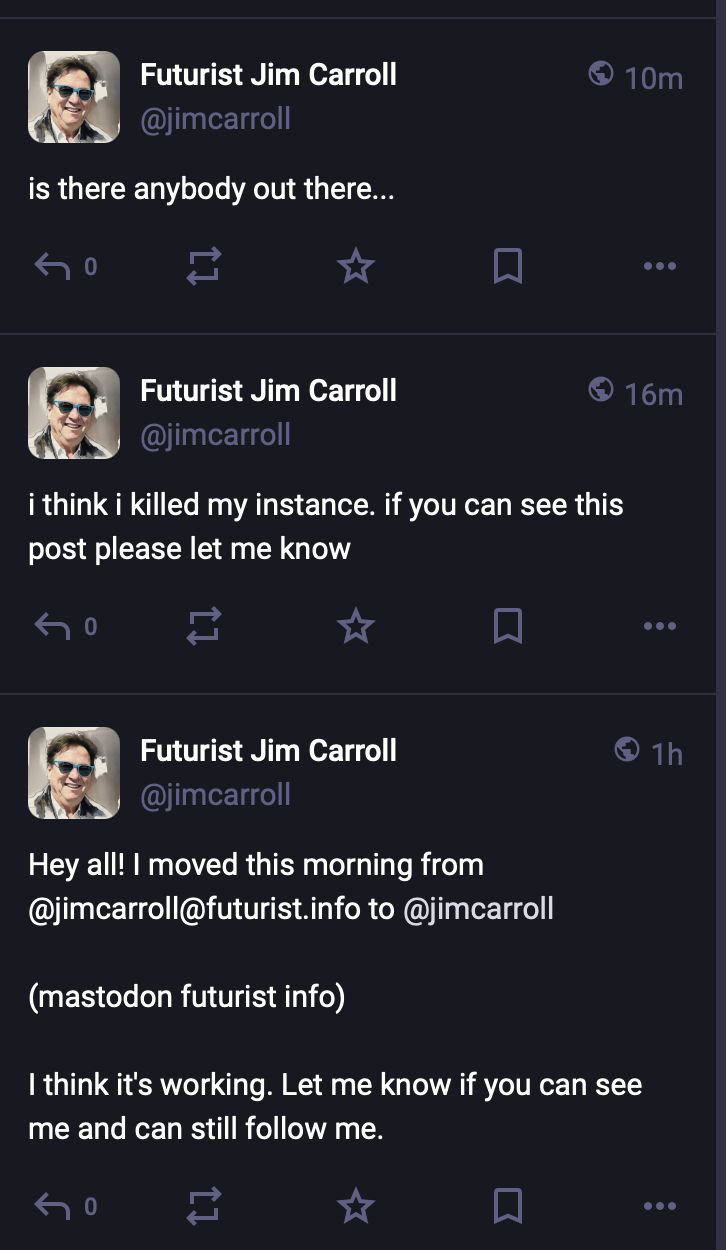
Hey all! I moved this morning from @jimcarroll@futurist.info to @jimcarroll

(mastodon futurist info)

I think it's working. Let me know if you can see me and can still follow me.

★ 0 • ↻ 0 original
May 17, 2025 · 2:35 PM UTC

i think i killed my instance. if you can see this post please let me know

★ 0 • ↻ 0 original
May 17, 2025 · 2:42 PM UTC

is there anybody out there...

★ 0 • ↻ 0 original
May 17, 2025 · 2:43 PM UTC

@ErikJonker Can you still see me?

★ 0 • ↻ 0 original
May 17, 2025 · 2:46 PM UTC↩ reply

@ErikJonker Awesome.

What happens if you try to look at one of my older posts?

And do you see me now as @jimcarroll ?

★ 0 • ↻ 0 original
May 17, 2025 · 2:52 PM UTC

@ErikJonker Which of these 3 can you see?

★ 0 • ↻ 0 original
May 17, 2025 · 3:09 PM UTC

Eric Jonker, trying to post this to see if you still follow me, withoout the @ in your name. can you see this post?

★ 0 • ↻ 0 original
May 17, 2025 · 4:21 PM UTC

I've moved my Mastodon account to @jimcarroll. Please follow me at my new address!

★ 0 • ↻ 0 original
May 17, 2025 · 5:36 PM UTC

I've been attempting to move my Mastodon account over to a different instance.

It's now at mastodon.futurist.info

Let me know if you can see this!!!!!

★ 2 • ↻ 0 original
May 17, 2025 · 5:41 PM UTC↩ reply

@UweHalfHand THIS IS GOOD NEWS!

What a fascinating process.

★ 1 • ↻ 0 original
May 17, 2025 · 5:46 PM UTC

It seems people who followed me before have migrated over. But my timeline is still empty...I follow 800+ people but nothing on my timeline.

★ 0 • ↻ 0 original
May 17, 2025 · 8:06 PM UTC

Another test post

★ 1 • ↻ 1 original
May 17, 2025 · 10:08 PM UTC

I moved my Mastodon server today from futurist.info to mastodon.futurist.info

I'm not sure I'm federated anymore. My following feed seems messed up. I'm unsure if things work.

Let me know if you see this, and if you iknow of any diagnostic tools I might run.

★ 24 • ↻ 3 original
May 17, 2025 · 10:17 PM UTC

Weird follow shit today. Not sure I am actually following the people I am following.

★ 0 • ↻ 0 original
May 17, 2025 · 10:20 PM UTC↩ reply

@porkroll Thanks. That's helpful. Feel like I might have disappeared through all this.

★ 0 • ↻ 0 original
May 17, 2025 · 10:20 PM UTC↩ reply

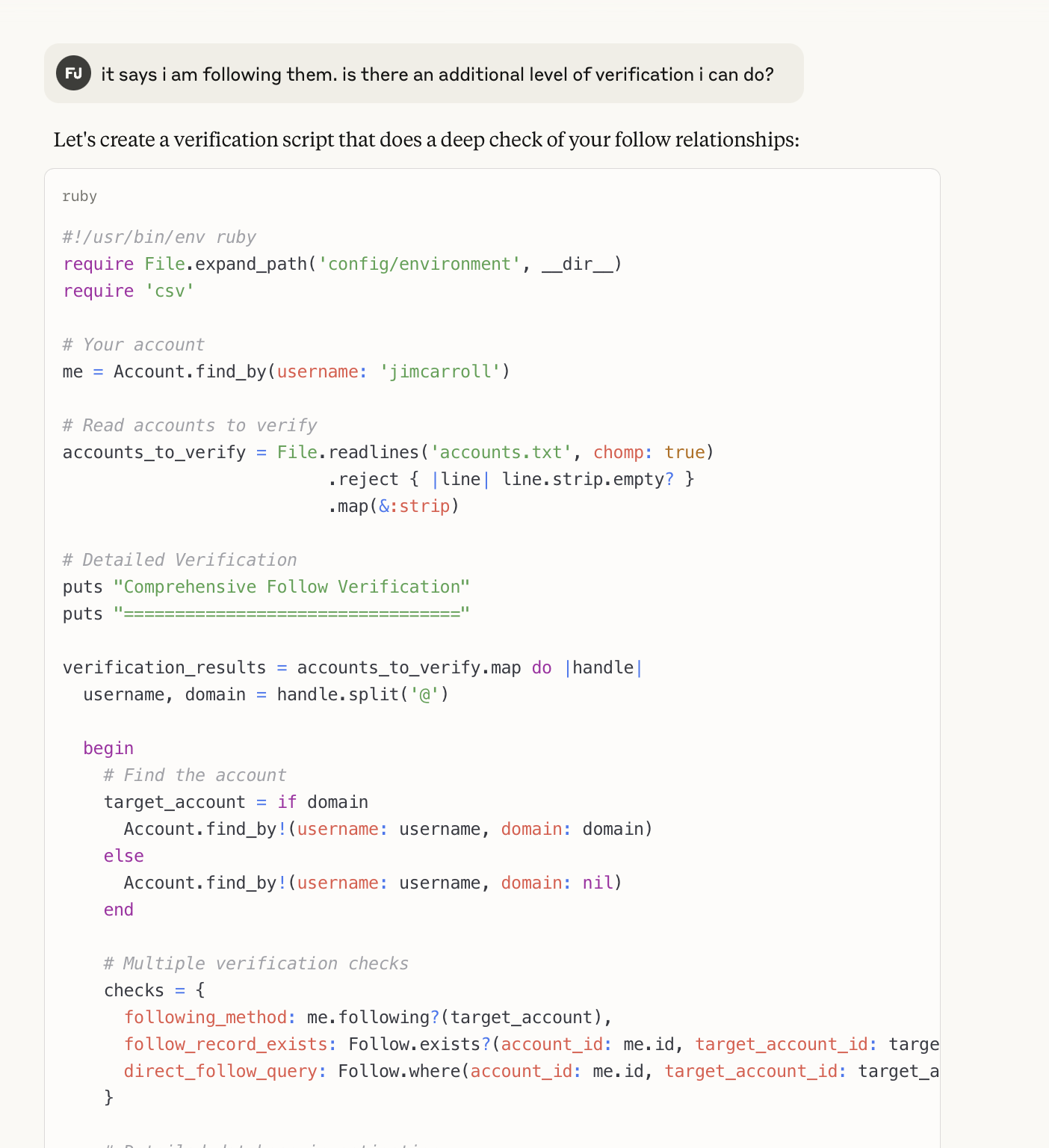
@ai6yr Can you post something on your feed. Don't tag me. I'm not sure my following list is working correctly, even thought i ran some Ruby routines to check it and verify it

★ 1 • ↻ 0 original
May 17, 2025 · 10:25 PM UTC

Also curious if anyone can see ANY of my old posts, i.e. anything from prior to today

★ 0 • ↻ 0 original
May 17, 2025 · 10:35 PM UTC

@daveburb My wife would accuse me of being a bot when housework is assigned but other than that, I'm real. Good to know previous posts appear.

★ 1 • ↻ 0 original
May 17, 2025 · 11:38 PM UTC↩ reply

@atrus I seem to be a sucker for complex server transitions. I guess this is how i learn things.

★ 1 • ↻ 0 original
May 18, 2025 · 12:05 AM UTC↩ reply

@spencer @ramsey I can see yours too, so we both seem to have succeeded!

★ 2 • ↻ 0 original
May 18, 2025 · 12:05 AM UTC↩ reply

@ai6yr I was deeply immersed in having Claude writing Rails code for me to check to see if all my following list was working right, some of it was not. Ugly stuff.

★ 1 • ↻ 0 original
May 18, 2025 · 12:25 AM UTC↩ reply

@ai6yr @jimcarroll Must admit I’ve never understood sidekick but will dig in

Fwiw sidekick was a pc memory expander thing in the 90s

★ 0 • ↻ 0 original
May 18, 2025 · 12:26 AM UTC

@ai6yr @jimcarroll I see it yay!

★ 1 • ↻ 0 original
May 18, 2025 · 5:25 PM UTC↩ reply

@daj Everything seems to be working fine, followed the process and a few fixes along the way.

★ 0 • ↻ 0 original
May 20, 2025 · 10:08 AM UTC

"𝐹𝑢𝑡𝑢𝑟𝑒-𝑟𝑒𝑎𝑑𝑦 𝑚𝑒𝑎𝑛𝑠 𝑏𝑒𝑖𝑛𝑔 𝑡𝑟𝑒𝑛𝑑-𝑎𝑤𝑎𝑟𝑒. 𝐸𝑣𝑒𝑟𝑦 𝑠𝑖𝑛𝑔𝑙𝑒 𝑑𝑎𝑦." - Futurist Jim Carroll

One theme I worked into in the upcoming 𝑫𝒂𝒏𝒄𝒊𝒏𝒈 𝒊𝒏 𝒕𝒉𝒆 𝑹𝒂𝒊𝒏 book is the idea that despite economic uncertainty, volatility, a potential downturn, and political craziness is that the future continues unabated.

----

The Megatrend Matrix: 7 Forces Shaping Our Future

After tracking trends and advising organizations for decades, I've distilled what matters most. These aren't distant possibilities. They're powerful currents already reshaping our business landscape, even amid economic uncertainty.

1. The Intelligence Revolution

AI-Driven Transformation
Ambient Intelligence
Human-Technology Integration
Digital Twinning
Knowledge Evolution Acceleration

2. The Energy Transformation

Electrification Revolution
Energy Decentralization
Resource Optimization
Climate-Positive Technologies

3. Health Reimagined

Predictive & Preventive Healthcare
Longevity Science
Brain and Cognitive Health Brain

4. Manufacturing Revolution

Mass Customization Systems
24-Hour Farming / Agricultural Reinvention
Material Science Breakthroughs
Micro-Autonomous Systems

5. Business Model Acceleration

Compressed Innovation Cycles
Hyper-Personalization at Scale
Temporal Commerce
Physical-Digital Integration

6. Workforce Transformation

Career Obsolescence and Creation
Cross-Disciplinary Specialists
Generational Value Shifts
Anticipatory Systems Design

7. Global Restructuring

Geopolitical Realignment
Urban Reimagination
Intergenerational Expansion
Technology Sovereignty
Digital Identity Evolution

Organizations that align themselves with these mega-trends, even during volatility, are positioning themselves to capture disproportionate value when growth returns.

The future doesn't wait for economic cycles to resolve, and neither should you.

---

Original post: jimcarroll.com/2025/05/decodin

★ 0 • ↻ 0 original
May 21, 2025 · 10:09 AM UTC

“Yesterday’s logic won’t spark tomorrow’s ideas!" - Futurist Jim Carroll

Let's talk about why many innovation efforts fail.
It's often because people keep on doing the same old thing, following the same old ideas, chasing the same old goal that is now irrelevant, fighting among themselves in the same old way over the same old arguments, following the same old pattern of inaction.

Sounds about right.

I was reading a publication the other day while doing some research on another topic and came across this article, which got me thinking about this issue, which led to today's quote.

I quickly learned that the reason for this state of affairs in many organizations is due to what psychologists call "cognitive rigidity.' Let's dig in.

What is it?

Like a stubborn door that refuses to open, our minds can sometimes become locked in patterns that restrict our ability to see new possibilities and adapt to life’s ever-changing circumstances. This mental inflexibility, known as cognitive rigidity, can significantly impact our thinking and behavior, often without us even realizing it.
Cognitive Rigidity: Understanding Its Impact on Thinking and Behavior
NeuroLaunch,, January 14, 2025

So why should we care?

But why should we care about cognitive rigidity? Well, in today’s fast-paced, ever-evolving world, the ability to adapt and think flexibly is more crucial than ever. Whether it’s navigating personal relationships, tackling workplace challenges, or simply trying to keep up with the latest technological advancements, a rigid mindset can leave us feeling left behind and ill-equipped to handle life’s curveballs.
Cognitive Rigidity: Understanding Its Impact on Thinking and Behavior
NeuroLaunch,, January 14, 2025

What's the innovation angle?

Let’s start by demystifying this psychological concept. In formal terms, cognitive rigidity refers to a tendency to persist in a particular thought pattern or behavior, even when it’s no longer adaptive or beneficial. It’s like being stuck in a mental rut, unable to shift gears or consider alternative perspectives.
Cognitive Rigidity: Understanding Its Impact on Thinking and Behavior
NeuroLaunch,, January 14, 2025

The article goes on to identify common traits with the mindset.

Difficulty in shifting attention or focus
Resistance to change or new ideas
Inflexible problem-solving approaches
Black-and-white thinking patterns
Struggle with ambiguity or uncertainty

Sounds like my "innovation killers" list which I so often share!
I

Original post: jimcarroll.com/2025/05/decodin

★ 0 • ↻ 0 original
May 22, 2025 · 9:59 AM UTC

"𝐼𝑓 𝑦𝑜𝑢 𝑎𝑟𝑒𝑛’𝑡 𝑙𝑒𝑎𝑟𝑛𝑖𝑛𝑔, 𝑦𝑜𝑢 𝑎𝑟𝑒𝑛’𝑡 𝑙𝑖𝑣𝑖𝑛𝑔" - Futurist Jim Carroll

𝐓𝐡𝐞 𝐭𝐬𝐮𝐧𝐚𝐦𝐢 𝐨𝐟 𝐝𝐞𝐯𝐞𝐥𝐨𝐩𝐦𝐞𝐧𝐭𝐬 𝐰𝐢𝐭𝐡 𝐚𝐫𝐭𝐢𝐟𝐢𝐜𝐢𝐚𝐥 𝐢𝐧𝐭𝐞𝐥𝐥𝐢𝐠𝐞𝐧𝐜𝐞 𝐢𝐬 𝐚𝐜𝐜𝐞𝐥𝐞𝐫𝐚𝐭𝐢𝐧𝐠.

Trying to keep up has become a full-time job.

If you didn't hear, OpenAI became enmeshed with Jonny Ives's company - he's the guy who designed the iPhone, iPad, and AirPods, a true design genius. The talk is that they will develop a variety of AI devices that don't involve screens or keyboards. Open up your imagination - wide. Then there are the announcements a few days ago by Google - involving real-time translation and heads-up display-based glasses with Warby Parker, among other things, It seems that almost every day, there is some amazing new leap in capability and function.

That's why every day, I'm spending time learning to do new things with all the tools at my disposal. Here's my latest little endeavour - using AI to generate a cool poster background image, having it write a Python program to generate a series of slide images from it, and then having AI write another program to combine it into a PDF that I can share on LinkedIn and elsewhere.

Why would I do that? Workflow - simply put, the ability to do in 1/10th of the time things that I might otherwise be doing for a post or a project. Not only that, but it's the idea of constantly exploring new possibilities and opportunities that I can share with clients.

So what's involved with this little project? I've now set myself up with a simple little script I can run to generate slides at will. I use AI to generate a cool background image with a blank space. In another image, I simply define the area where I want the text to appear. Then I feed it some text in a pre-defined, structured style:

I then run the program and get a nifty little slide deck. I've got another one on the "
Innovation Killers with a different background. I've also been working on my post for tomorrow, which features a different type of setup.

This might not seem like much, but the point of all this is simply by learning one new thing, I've developed a fascinating new skill. Add that to daily lessons on many other things, and I see myself in the business of developing new skills and insights every day.

And that's the point - as I keep emphasizing in my keynotes, you might not lose your job to an AI, but you could very well lose your job to someone who is using AI more effectively than you do.

Regardless of the merits of whether it's good or bad, it's here to stay, and it's up to you to master what you can do with it. If

---

Futurist Jim Carroll is a big fan of the idea of productive time-wasting to learn new skills.

**** **** **** **** **** **** **** **** **** ****

Original post: jimcarroll.com/2025/05/decodin

★ 1 • ↻ 1 original
May 23, 2025 · 9:55 AM UTC

“𝑌𝑜𝑢 𝑐𝑎𝑛 𝑒𝑠𝑐𝑎𝑝𝑒 𝑡ℎ𝑒 𝑚𝑒𝑑𝑖𝑜𝑐𝑟𝑖𝑡𝑦 𝑦𝑜𝑢 𝑜𝑛𝑐𝑒 𝑒𝑚𝑏𝑟𝑎𝑐𝑒𝑑, 𝑏𝑢𝑡 𝑤𝑖𝑙𝑙 𝑦𝑜𝑢 𝑒𝑣𝑒𝑟 𝑓𝑢𝑙𝑙𝑦 𝑒𝑟𝑎𝑑𝑖𝑐𝑎𝑡𝑒 𝑖𝑡?" - Futurist Jim Carroll

I𝐭'𝐬 𝐛𝐞𝐞𝐧 𝐚 𝐰𝐢𝐥𝐝 𝐯𝐨𝐲𝐚𝐠𝐞 𝐛𝐫𝐢𝐧𝐠𝐢𝐧𝐠 𝐭𝐡𝐞𝐬𝐞 𝐭𝐰𝐨 𝐛𝐨𝐨𝐤𝐬 𝐭𝐨 𝐩𝐫𝐢𝐧𝐭 𝐢𝐧 𝐣𝐮𝐬𝐭 𝐚 𝐟𝐞𝐰 𝐦𝐨𝐧𝐭𝐡𝐬, and I'm loving the feedback and comments from those who have picked up copies. (Are you in? You can grab copies at the Mediocrity website !)

But while working on them, I'm always thinking. At first, I put together 𝐸𝑚𝑏𝑟𝑎𝑐𝑖𝑛𝑔 𝑀𝑒𝑑𝑖𝑜𝑐𝑟𝑖𝑡𝑦 to identify the attitudes and actions that cause so many people to live a mediocre life. Once that was becoming a reality, I realized I needed a way to offer people a path out of such an existence, which led of course, to the creation and release of 𝐸𝑠𝑐𝑎𝑝𝑖𝑛𝑔 𝑀𝑒𝑑𝑖𝑜𝑐𝑟𝑖𝑡𝑦.

𝐁𝐮𝐭 𝐈 𝐦𝐮𝐬𝐭 𝐚𝐝𝐦𝐢𝐭, 𝐈'𝐦 𝐤𝐢𝐧𝐝 𝐨𝐟 𝐛𝐮𝐠𝐠𝐞𝐝. Let's say you manage to escape the mediocrity you once embraced, but what if it came creeping back? What if the old bad behaviors, mindsets, and beliefs that drove you before come back into your mind, even though you've worked so hard to escape them?

I realized what you need to do is eradicate them.

So I started thinking about how you eradicate mediocrity, and I came to realize that what it would involve is coming to accept some ground truths about your situation and your reality.

So I started compiling a list. Let's call it a list of 101 Principles of Leadership and Innovation. They seem to neatly fall into several buckets or categories, so I've included that in the list. Or maybe it's a list about, um, I dunno, eradicating mediocrity? Maybe you should read the post to the bottom!

There is, of course, a PDF, which I pulled together with my nifty new little AI deck generation tool!

Oh, and there's a Website that I generated with AI - it's at sparkchange.jimcarroll.com - entirely generated by AI.

Read the post for the list - and a fun surprise!

**** **** **** **** **** **** **** **** **** ****

Original post: jimcarroll.com/2025/05/decodin

★ 0 • ↻ 0 original
May 24, 2025 · 12:10 PM UTC

Meanwhile, in Ontario.

★ 0 • ↻ 0 original
May 26, 2025 · 10:00 AM UTC

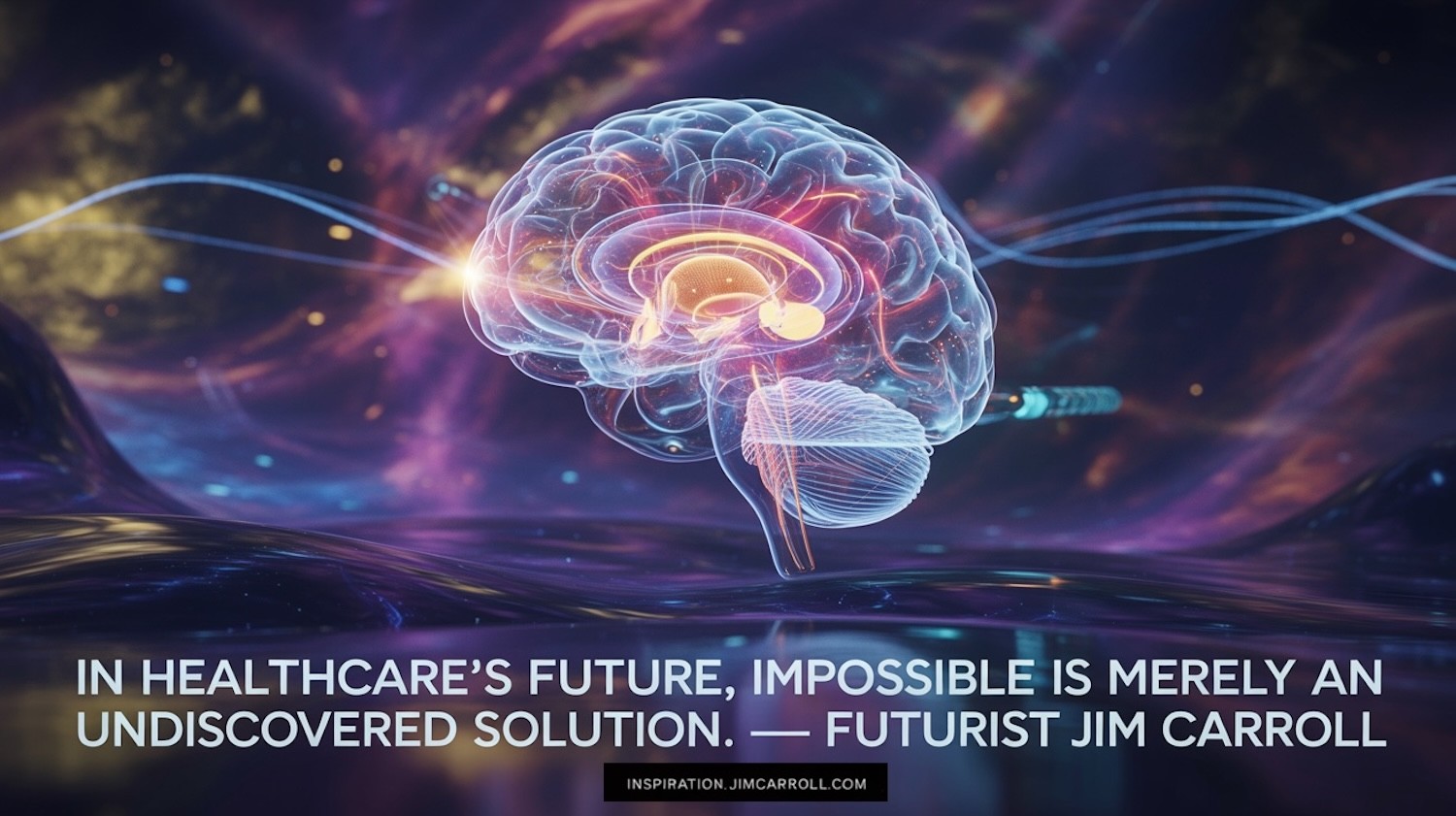
"In healthcare's future, impossible is merely an undiscovered solution" - Futurist Jim Carroll

I'm pulling together a slide deck for an upcoming healthcare keynote.

While the sector remains very much under attack in the US, there is no doubt that elsewhere in the world we will see fascinating developments in the next many years. Indeed, we stand at a precipice of transformation so profound that it redefines what's possible for human health and longevity. A lot of this has to do with the accelerating pace of discovery of new healthcare and medical science, the role of technology, and the impact of AI.

One section of my deck takes a look at the big, bold ideas or concepts that are being pursued, shared below. While most of the people mentioned are legitimate experts in their fields, the quotes could be considered to be a bit of a stretch in terms of possibility. Does this make them invalid? Maybe not - I'll note during my talks that sometimes, overly optimistic predictions serve a purpose because they wake us up to the opportunity instead of blinding us with barriers.

So what's in my deck? I share this one from a fellow Futurist Ray Kurzweil: "What we used to think of as fantasy is now simply engineering". This isn't just hyperbole; it's the unfolding reality in labs and research institutions worldwide.

Dr. Eric Topol heralds that "we are at the beginning of a golden age of medicine, where what was once purely in the realm of science fiction is becoming science fact". Indeed, the advancements barreling down the pike are set to revolutionize not just how we treat illness, but how we conceive of health itself.

Keep reading!

Original post: jimcarroll.com/2025/05/decodin

★ 2 • ↻ 1 original
May 27, 2025 · 9:39 AM UTC

“Your fuel for your future should be irrational optimism" - Futurist Jim Carroll

Fuel your day with irrational optimism. In fact, you should nurture an insane optimism, similar to how farmers must be insanely optimistic in the face of industry volatility.
Here's why you need to embrace insane optimism:

Maintaining your optimism requires you to filter out the noise of raging headlines and other negative things

You should not let volatility reshape your attitude or let noise cloud the opportunities around you

My optimism is grounded by the trends I observe in our rapidly changing world, and spotting opportunities in those trends

You must consciously choose optimism over pessimism despite the environment you find yourself in - because the alternative isn't that great!

Optimism is your fuel for your future - without it, you're running on empty

Find something to do that fuels your optimism. Writing my daily inspirational posts helps me dispel bad things and find the good in the world

Anyone focused on the future cannot do so with a foundation of negativity - recognize that reality and ground yourself within it

Regularly nurturing your optimism is like fertilizer for your soul

You must battle daily to keep your optimism intact against the forces trying to tear it down

Despite challenges, it's a great time to be alive, with accelerating science, healthcare, connectivity, and knowledge growth

Avoid surrounding yourself with negativity and those who consistently focus on the downside

Innovative organizations succeed with positive energy for new ideas and a culture of relentless optimism

Great ideas never flourish when pessimists are in control of the conversation

An uplifting, hopeful view serves as the best antidote to negative thinking and losing sight of opportunities

Surround yourself with like-minded optimists who focus on what can be accomplished rather than what should be avoided

Optimism is one of the most precious resources that you must nurture, feed, let loose, and guard carefully

Hope and optimism are among the few commodities in the world right now that are more precious than others

Hope is the foundation of how you align yourself with your future and turn it into an opportunity

In times of volatility, you must battle continuously to keep your hope intact

Optimism is your opportunity - it opens doors that pessimism keeps locked

Those who exude a positive outlook are typically on the path to success, as people are drawn to great energy and motivational thinking

The choice is yours: fuel your day with irrational optimism, or let the noise drag you down. Be optimistic about your optimism!

----

Futurist Jim Carroll always tries to skew to the optimistic side of the day!

**** **** **** **** **** **** **** **** **** ****

Original post: jimcarroll.com/2025/05/decodin

★ 2 • ↻ 0 original
May 28, 2025 · 9:56 AM UTC

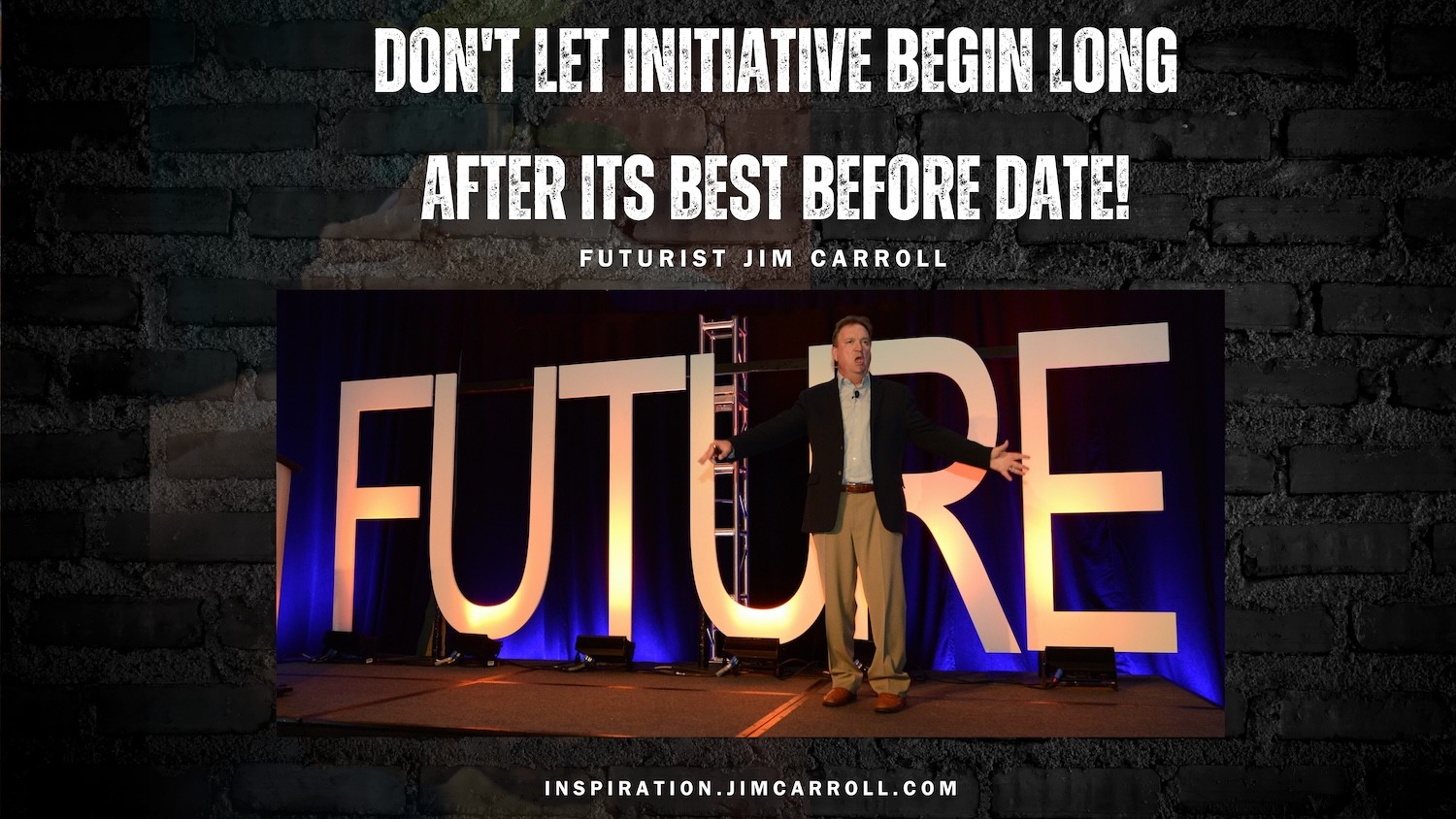
"Don't let initiative begin long after its best before date!" - Futurist Jim Carroll

Most people start things too late. Trends mature before they do. Tomorrow happens before they get there.

Opportunities go to those who show up. That's why you should ask yourself and your organization some probing questions. use these as a guide to figure out if you are too late for everything!

Is my brilliant initiative already becoming a relic of a bygone era, swallowed by the relentless, unforgiving march of time? This is the harsh reality of The Accelerating Pace of Change.

Am I merely drifting in stagnant waters while the world sprints ahead, my initiative gasping to keep up with the lightning speed of progress? You're being outpaced by The Velocity of Trends.

Am I actively strangling my opportunity, paralyzed by a fatal hesitation that condemns my initiative to the shadows of what might have been? This is the crippling effect of Aggressive Indecision.

Am I callously signing the death warrant for my initiative through my devastating inaction, watching its potential wither and die before my eyes? Such is the consequence of Inaction as a "Death Sentence".

Is my initiative a dormant powerhouse, DOA on arrival, its explosive momentum bleeding away with every precious moment I fail to take decisive, concrete action? Remember, true power comes from Momentum from Doing.

Am I an absent, negligent architect of my future, failing to truly show up and build something magnificent, thereby condemning this initiative to the desolate void of inaction and forgotten dreams? This is about understanding The Power of "Showing Up".

Show up.

Get going.

Start now.

It matters.

Original post: jimcarroll.com/2025/05/decodin

★ 0 • ↻ 0 original
May 29, 2025 · 10:02 AM UTC

"There is no shortage of big opportunities. There is a shortage of bold leadership!" - Futurist Jim Carroll

One of my fellow futurists recently included this line in a post I read - "We should be pulling more photons from the sun." He wrote it as an observation when he was flying into an American city, and saw an absolute dearth of solar panels on the roofs of homes and buildings. Solar energy - the infrastructure at least - has become desperately cheap and tremendously productive, and we are missing such a big opportunity.

This idea of things we are not doing but should be grabbed my attention, of course, so I set off to take a look at the material I've written in my blog since 2002 that might fit the theme. Much of my material covers not just my Daily Inspiration posts, one of which you are reading now, but reports on keynotes, trend overviews, research summaries, and more.

And so with that, I give you this list of 𝐀 𝐋𝐢𝐬𝐭 𝐨𝐟 𝟏𝟎𝟏 𝐓𝐡𝐢𝐧𝐠𝐬 𝐖𝐞 𝐂𝐨𝐮𝐥𝐝 𝐛𝐞 𝐃𝐨𝐢𝐧𝐠 𝐑𝐢𝐠𝐡𝐭 𝐍𝐨𝐰 (𝐁𝐮𝐭 𝐀𝐫𝐞𝐧'𝐭 𝐁𝐞𝐜𝐚𝐮𝐬𝐞 𝐓𝐡𝐞𝐫𝐞 𝐢𝐬 𝐚 𝐒𝐡𝐨𝐫𝐭𝐚𝐠𝐞 𝐨𝐟 𝐁𝐨𝐥𝐝 𝐋𝐞𝐚𝐝𝐞𝐫𝐬𝐡𝐢𝐩. I used Google Notebook LLM to analyze my material, given that there are almost 5,000 posts. There is a PDF version, of course, that I also used with my new handy-dandy AI-slide generation tool that an AI helped me write - written in Python, it's become an invaluable tool. It's a BIG FILE - grab it here.

This list should inspire more bold thinking, but also some sad reflection, since it is indicative of the sad state of leadership in our world today.

**** **** **** **** **** **** **** **** **** ****

Original post: jimcarroll.com/2025/05/decodin

★ 2 • ↻ 1 original
May 30, 2025 · 9:52 AM UTC

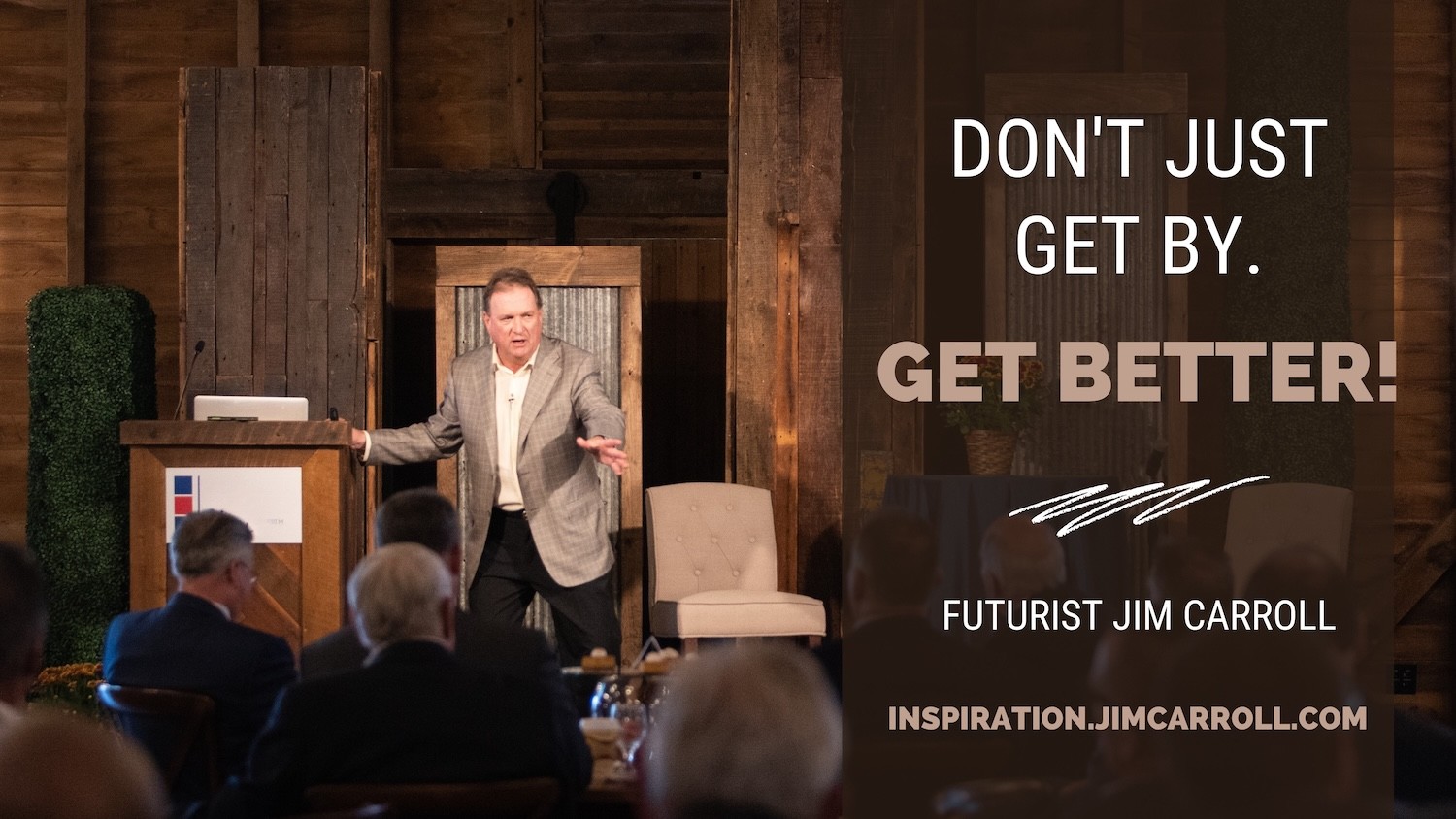
"𝐃𝐨𝐧'𝐭 𝐣𝐮𝐬𝐭 𝐠𝐞𝐭 𝐛𝐲. 𝐆𝐞𝐭 𝐛𝐞𝐭𝐭𝐞𝐫!" - Futurist Jim Carroll

I meet a lot of marginal people.

They live marginal lives.

Chasing marginal goals.

With marginal ideas.

And keep achieving, well, marginal things!

What causes this? Part of it is that they just adopt a mindset of mediocrity - that's why I wrote the books!

I remember the situation at one agricultural talk - it was for a long-standing company in the industry. They were faced with unrelenting pressures on every front — input costs climbing faster than their yields, commodity prices swinging wildly from one season to the next, and financial challenges piling up. Drought or deluge could wipe out an entire year’s work in a matter of weeks. Global markets were their future and yet not in their control - their fortunes rose or fell on decisions made in trading pits half a continent away. (Fast forward a few years to today, and the global situation is different altogether!)

My talk focused on the key trends in the sector - key growth opportunities. Things like accelerating automation, faster science, the next generation, and other trends.

But when you are in front of a crowd, you can read the room, and I could certainly read the room on this day. To me, it was a crowd rejecting much of what I was talking about as a path forward because they’d learned to settle for “good enough.”

Why? Because that felt safer than trying something new and failing.

And that’s where the mindset of mediocrity takes hold. When you’ve been burned by weather extremes, when the bank’s watching your loans, when every harvest feels like a cliff edge, it’s tempting to stick with what you know. But what you know isn’t enough. I reminded them that breakthroughs don’t happen by tweaking yesterday’s ideas - they come when you refuse to accept marginal returns on marginal ideas. Because the alternative is a slow grind toward extinction.

Here's the thing about 'getting by.' It's a failure! Know these things:

- the status quo is no longer 'good enough. The landscape is littered with companies and careers that thought "average" was a strategy.

- complacency is the new corporate suicide. If you're not actively pushing the envelope, you're already sealed in it,

- growth isn't a project, it's oxygen! "Get better!" should be your mantra.
action eats inaction for breakfast! Tomorrow demands forward motion, deliberate daily steps, and turning bold vision into tangible reality.

"Don't just get by, Get better!" isn't just a catchy phrase. It's a survival guide for the age of acceleration.

Are you coasting on fumes, or actively managing a way forward?

---

Jim Carroll’s new books, Embracing Mediocrity and Escaping Mediocrity, provide insight into the path of our marginality.

**** **** **** **** **** **** **** **** **** ****

Original post: jimcarroll.com/2025/05/decodin

★ 0 • ↻ 0 original
← April 2025June 2025 →