Futurist Jim Carroll

Mastodon post archive · 2022–2026
Archived from mastodon.futurist.info · 4209 posts
← All months

March 2025 · 30 posts

← February 2025April 2025 →
Mar 3, 2025 · 11:07 AM UTC

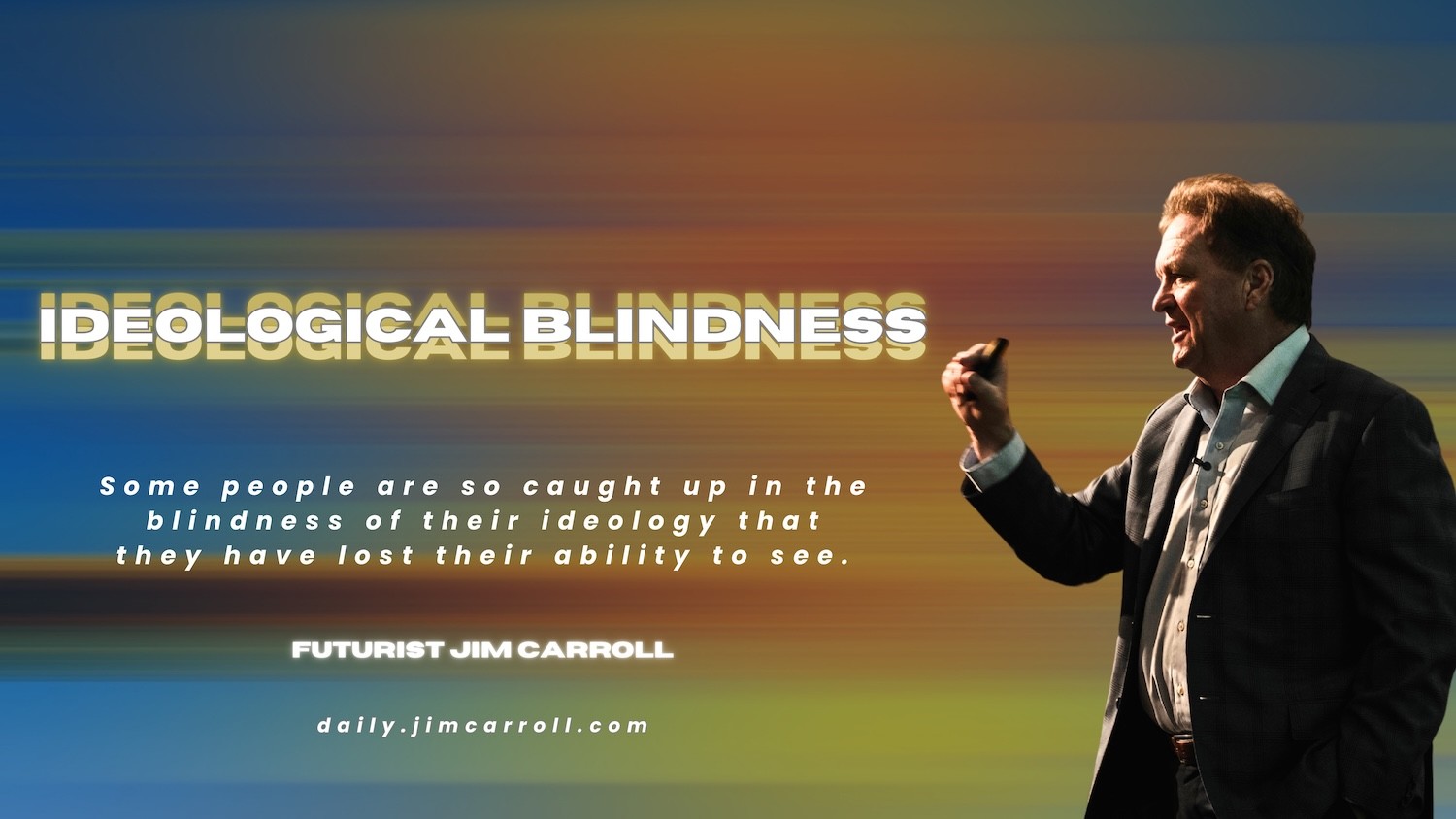
"Some people are so caught up in the blindness of their ideology that they have lost their ability to see" - Futurist Jim Carroll

(Note: I've started two new websites in the last few days, all while pounding out hundreds of meters downhill at my ski club. The first, at volatility.jimcarroll.com, is a response to my belief that a global downturn is now inevitable. The second? It's a little more fun - it's at now.jimcarroll.com - and is simply a little Website about some things I'm doing ... now!)

The future belongs to those who see it coming.

But another side of this coin is that the future never belongs to those who refuse to see it coming.

When I say "Some people are so caught up in the blindness of their ideology that they have lost their ability to see," I'm speaking of a fundamental truth about innovation in our accelerating world. (You thought I was talking about something else. I am! The delusional insanity is real!)

There are a lot of people who refuse to see the reality of the future that is coming. They don't realize the errors of their ways (or the imperviousness of the cult of which they are a member) until it is far too late. It's a sad fact that in my 30+ years advising global organizations on future trends, I've witnessed a recurring pattern: those who cling to outdated thinking consistently miss the massive disruption happening right in front of them!

Here's the brutal reality: Your rigidity is your biggest innovation killer.

Has complacency become your comfort zone? In today's era of hyperchange, that's a death sentence for your organization!

What I see time and again is people waiting for clarity that might never come - waiting for perfect information in an imperfect world. Meanwhile, your competitors are shifting fast and stealing your future!

The path forward requires a radical mind shift:

- abandon short-term thinking and embrace longer transformational horizons
stop ignoring obvious trends that are causing massive upheaval

- break free from past success patterns that blind you to future opportunities
challenge EVERY assumption about where your industry is headed

- create a culture where inaction is the only unacceptable option

And please, banish the myth that innovation is only for "special people"! In today's world, everyone must be an innovator.

The future belongs to those who see it coming!

Oh, and on that other thing?

Let's just hope those people get some clarity before it's too late!

Futurist Jim Carroll coined this phrase while carefully responding to an inflammatory comment that he saw.

**** **** **** **** **** **** **** **** **** ****

Original post: jimcarroll.com/2025/03/daily-i

★ 1 • ↻ 1 original
Mar 4, 2025 · 11:26 AM UTC

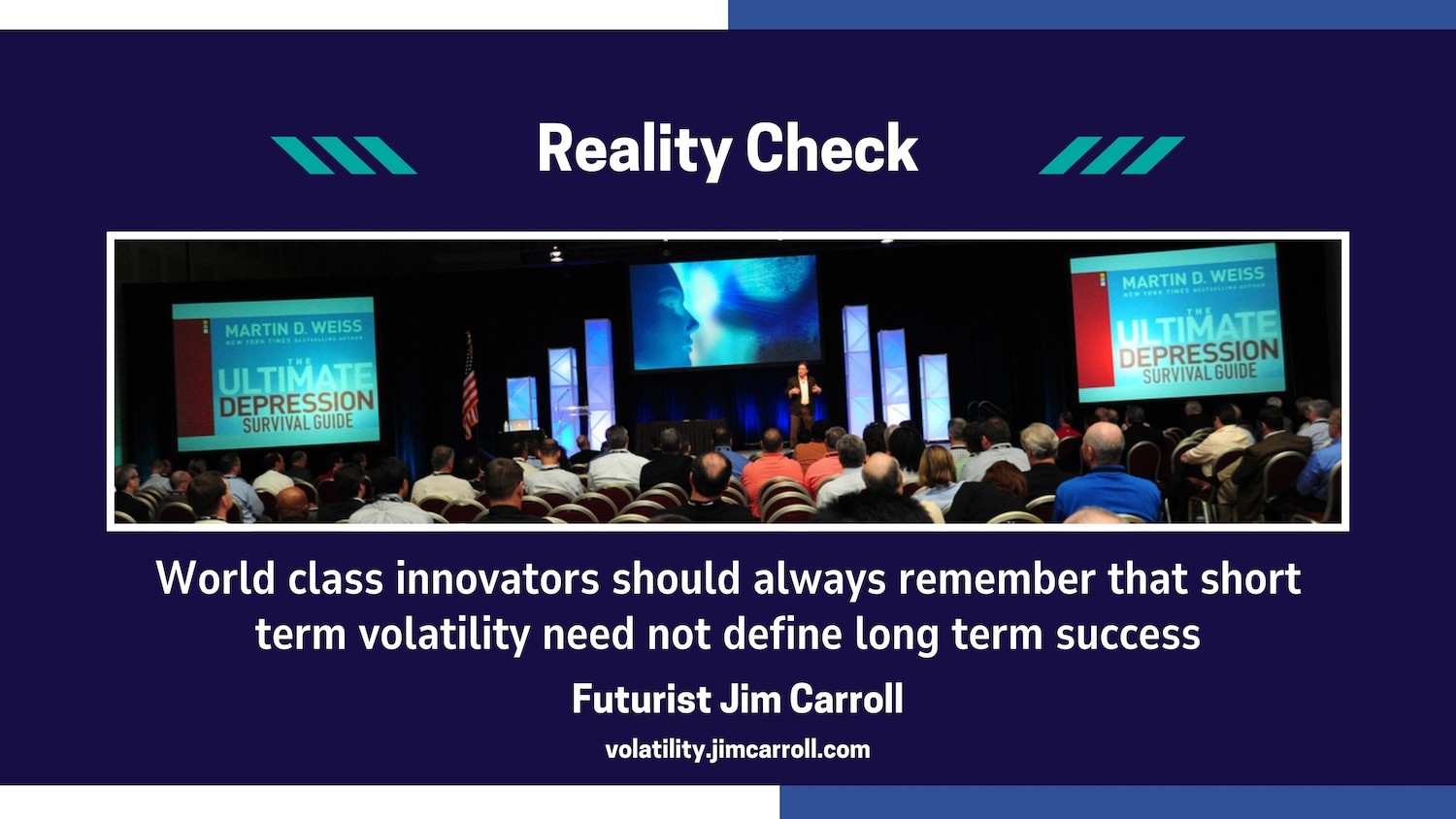
"World-class innovators should always remember that short term volatility need not define long term success" - Futurist Jim Carroll

The most powerful thing I've ever seen is when the CEO of the global food services powerhouse Compass Group went on stage just before I did, in 2008, just as the global economy was melting down.

You had to be there.

I was there to follow his message to share my insight on the future and innovation - and that day, all of a sudden, everything about the future and innovation had changed, in a very significant fashion.

Here's what unfolded.

The headlines that morning were pretty stark and ugly.

He opened the event  - a day of meetings for his leadership team of several hundred - looked at his audience - and said this in his very first moment: "We can panic. We can do nothing. Or we can innovate, change, and adapt."

Sitting in the audience, I quickly began reworking my slide deck to catch the new tone of the day. The room was dark, in more ways than one; the pre-event chatter was ominous; people looked nervous and worried.

The opening section of my deck - which I still have to this day (I have all of them!) - was quickly being locked into a new key theme. If they had asked me to talk about the future and innovation, then I was going to speak about that in the context of this sudden new world of a different future and a new sort of innovation!

I listened intently to his talk and his core message, modifying my slide deck furiously all the time.

Then, I went on stage and delivered.

I started with an entirely new section to my slide deck - that I had finished off just moments earlier - noting that what they needed to do right now was to establish a relentless focus on growth - and that I was going to explain why.

Original post: jimcarroll.com/2025/03/daily-i

★ 0 • ↻ 0 original
Mar 4, 2025 · 2:04 PM UTC

How it's starting.

Where it's going.

Congrats America.

How are those cheaper eggs doing?

★ 7 • ↻ 4 original
Mar 5, 2025 · 11:07 AM UTC

"Remorse we can feel. Regret is what we live. But consequence is what lingers" - Futurist Jim Carroll

Let's talk about the science of regret.

I mean, why not?

It seems like a timely topic.

And I've most recently covered The Science of Stupidity and The Science of Mistakes.

So why not The Science of Regret?

I'm on a roll here. Buyers remorse and all that.

What should we know about regret? What should we understand about its nature, impact, and how our brains process it? After all, we might find ourselves around people (at this moment in time, in particular) who are deep in their emotions of regret, and are now thinking about the consequences.

First, what is the definition and nature of regret? I asked Google Notebook after pulling in a large number of articles and YouTube videos related to the science of regret.

"Regret is a negative emotion stemming from a disappointing life event, unchangeable choices, or things said that can't be taken back. It is a painful experience that includes blaming ourselves for a bad outcome.

Ok, that makes sense.

It went on:

- It's a complex emotion involving sorrow and responsibility for the consequences of one's actions.

- Regret is related to choice; it is felt when a wrong decision is made and one wishes they had decided differently.

- Feelings of regret show increased activity in the medial orbitofrontal cortex of the brain.

OK, since it might seem there is some regret unfolding around some areas of the world right now, faster than ever before, what can we understand about the emotions of those who are going through it? The answer is ... um ... interesting.

How Regret Differs From Other Emotions:

- Regret involves comparison and blame, differing from disappointment, which lacks the element of personal fault.

- While guilt is responsibility for specific wrongdoing and shame is a feeling of being flawed, regret combines elements of both, along with a desire to rectify harm.

...along with a desire to rectify harm... that sounds promising.

But wait. There's a lot more about the science of regret that might help you understand today's world.

**** **** **** **** **** **** **** **** **** ****

Original post: jimcarroll.com/2025/03/daily-i

★ 0 • ↻ 1 original
Mar 6, 2025 · 11:07 AM UTC

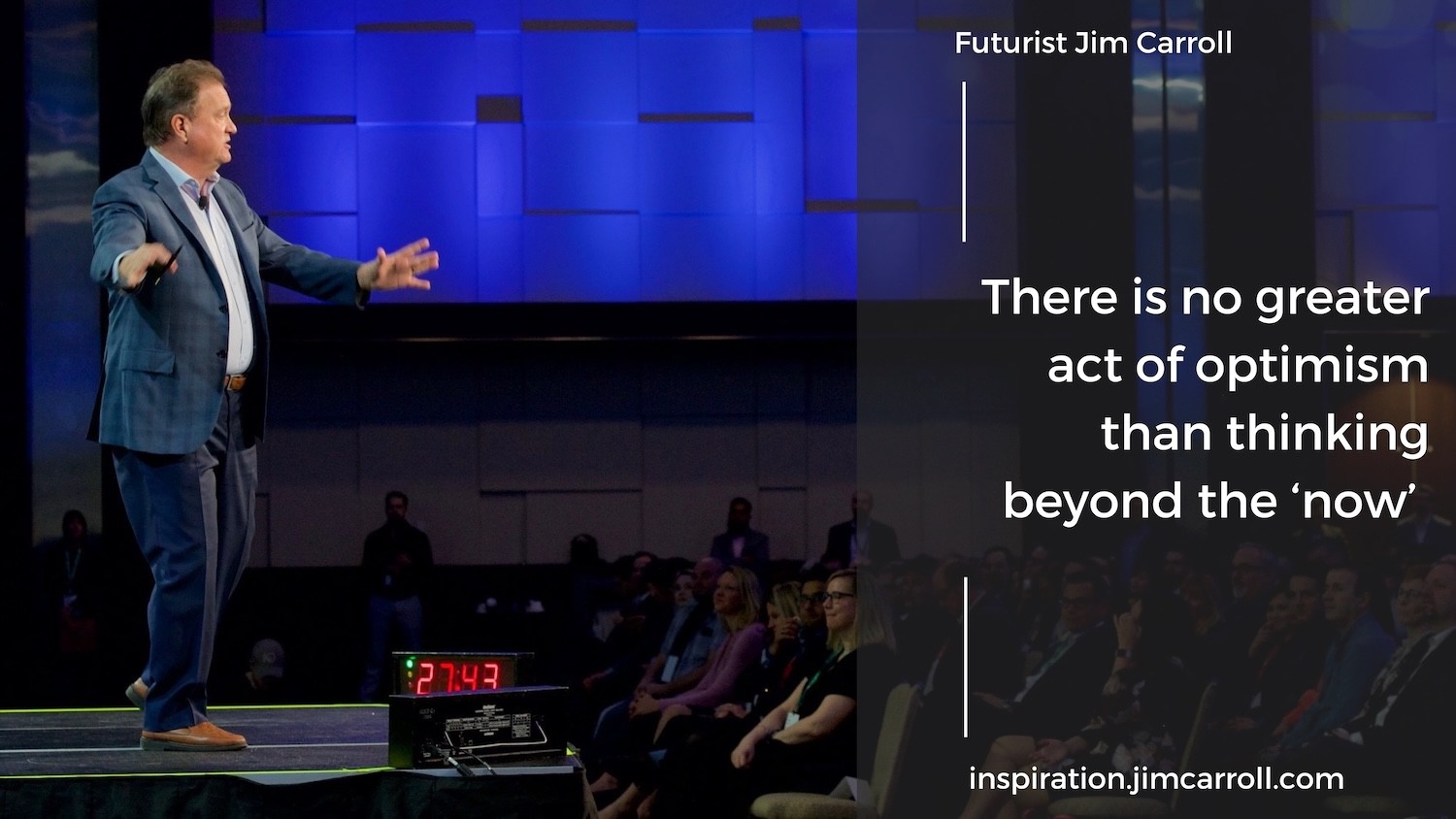
"There is no greater act of optimism than thinking beyond the ‘now’" - Futurist Jim Carroll

When people are struggling and in difficulty, it's important to try to instill some sense of hope, a belief that things can get better and that there is a way forward. Thinking about that, the phrase "There is no greater act of optimism than..." came to mind.

It's a wonderful starter phrase because it has so many potential pathways forward!

Thinking beyond 'right now' is the most wonderful of all, though, because it helps you get into a mindset of thinking beyond the difficulties of this very moment.

That said, there are a lot of other ways to use the phrase, all of which can help you do that

There is no greater act of optimism than...

... empowering yourself with kindness
... finding the strength to question
... focusing on what you can control
... remembering your capacity to change
 ... renewing your sense of purpose
... trusting in your ability to rebound
 ... defining yourself through imagination
... thinking 'what can be done?'

...and many, many more!

The fact is, there are many greater acts of optimism!

Read the post for more....

----
Futurist Jim Carroll sometimes finds it hard to keep his optimism ahead of his pessimism. This is one of those times.

**** **** **** **** **** **** **** **** **** ****

Original post: jimcarroll.com/2025/03/daily-i

★ 0 • ↻ 0 original
Mar 7, 2025 · 10:57 AM UTC

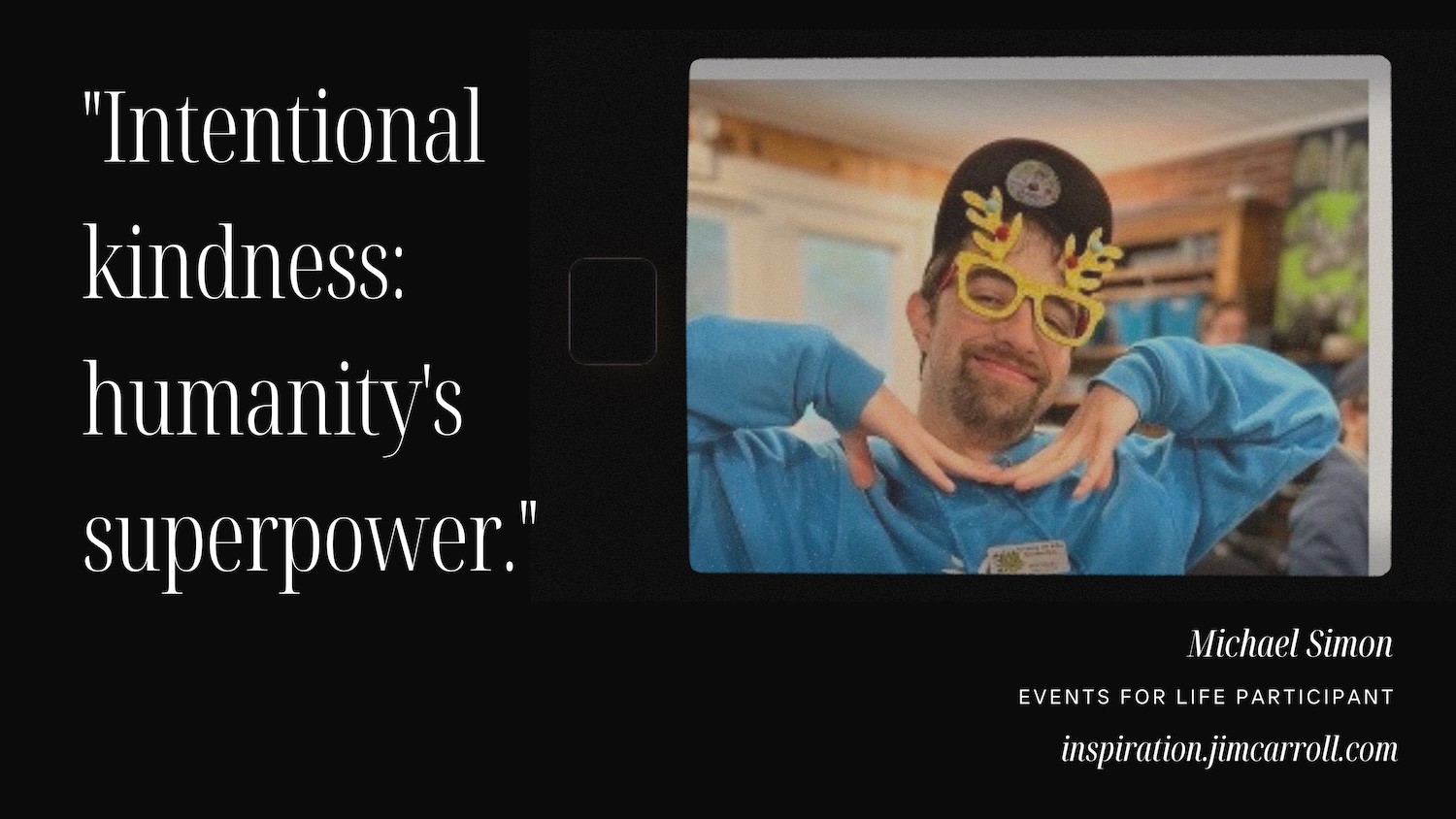
"Intentional kindness: humanity's superpower" - Futurist Jim Carroll, with a shoutout to Drew Sullivan, APB Speakers

The image in today's Inspiration features my good friend Michael Simon; the phrase, "intentional kindness," comes from one of my speaker bureau agents, Drew Sullivan. One teaches us the importance of finding moments of joy when we need it most and the importance of 'giving back'; the other involves intentionally making those moments of joy for others because they truly matter.

It's a long post, but I want you to read it.

Why? We seem to be living in a world in which the core values of human decency seem to be disappearing at the speed with which societal norms are unraveling. As an example, I have read that one of the latest trends with the tech oligarchs - folks like Elon Musk and the young men who worship them - is that they find it to be fashionable to use denigrating words and phrases. They seem to think that it is all one big joke and that somehow, this provides them a boost to their 'machismo' - far from it. Most recently, their childish immaturity has extended to the regular use of the 'retard,' as if that somehow empowers them and makes them stronger

I do not know what darkness lies in the depths of their soul, but I know I and others will fight this darkness with all our might.

So let me start with my friend Michael. Here's a photo from a few weeks ago when we were both wrapping up a wonderful ski day.

I've known Michael since he was 2 years old.

Now 29, he is a special needs young adult who has a unique genetic condition that has limited his full abilities - and yet, he has achieved capabilities that experts have said might never be possible.  It was said he could never ski - he learned to ski. It was said he would never be able to master a snowboard. Today, he 'shreds' with the best of them.  

He has accomplished many other things in his life - and he has the most infectious smile of any person I have ever known.

You can't see Michael smile and, in these moments of despair, worry, and concern, find some joy some sort of joy creeping into your own heart. Michael's smile is a crucible of joy and a cauldron of inspiration.

We all need more moments like this. We should all find the joy around us because those are the moments that matter. You can help to 'generate it by getting involved, giving back, and supporting those who are under attack, marginalized, or who need attention and help. That's why social causes are even more important today than they were before.

Read the rest of the post.

Original post: jimcarroll.com/2025/03/daily-i

★ 1 • ↻ 1 original
Mar 10, 2025 · 10:21 AM UTC

"Lost trust? A lost future!" - Futurist Jim Carroll

Let's talk about trust - or rather, the lack of it.

Somewhere along the way, I came across the 2025 Edelman Trust Barometer 2025 - it's worth a look.

The fact is, it's a pretty depressing read! They call it a crisis of grievance. As I've been saying - that tracks.

What are the findings? 3 key facts.

Fact 1: Majority hold grievances against government, business, and the rich
Sixty-one percent globally have a moderate or high sense of grievance, which is defined by a belief that government and business make their lives harder and serve narrow interests, and wealthy people benefit unfairly from the system.

Fact 2: Widespread grievance is eroding trust across the board
Those with a high sense of grievance distrust all four institutions (business, government, media, and NGOs).

Fact 3: Hostile activism is seen as a legitimate tool to drive change
To bring about change, 4 in 10 would approve of one or more of the following forms of hostile activism: attacking people online, intentionally spreading disinformation, threatening or committing violence, damaging public or private property. This sentiment is most prevalent among respondents ages 18-34 (53 percent approve of at least one).

The report makes plain that over a decade of crises have helped to fuel this crisis of grievance.

So where does it leave us? We are witnessing nothing short of a societal transformation – one driven by a profound crisis of grievance that threatens to reshape our institutions, our economy, and our very future! And we all know we are living through this in real-time, since we know that a mindset of grievance is driving a lot of the change swirling around us right now.

What can we conclude? Several things. Keep reading!

**** **** **** **** **** **** **** **** **** ****

Original post: jimcarroll.com/2025/03/daily-i

★ 0 • ↻ 1 original
Mar 11, 2025 · 10:19 AM UTC

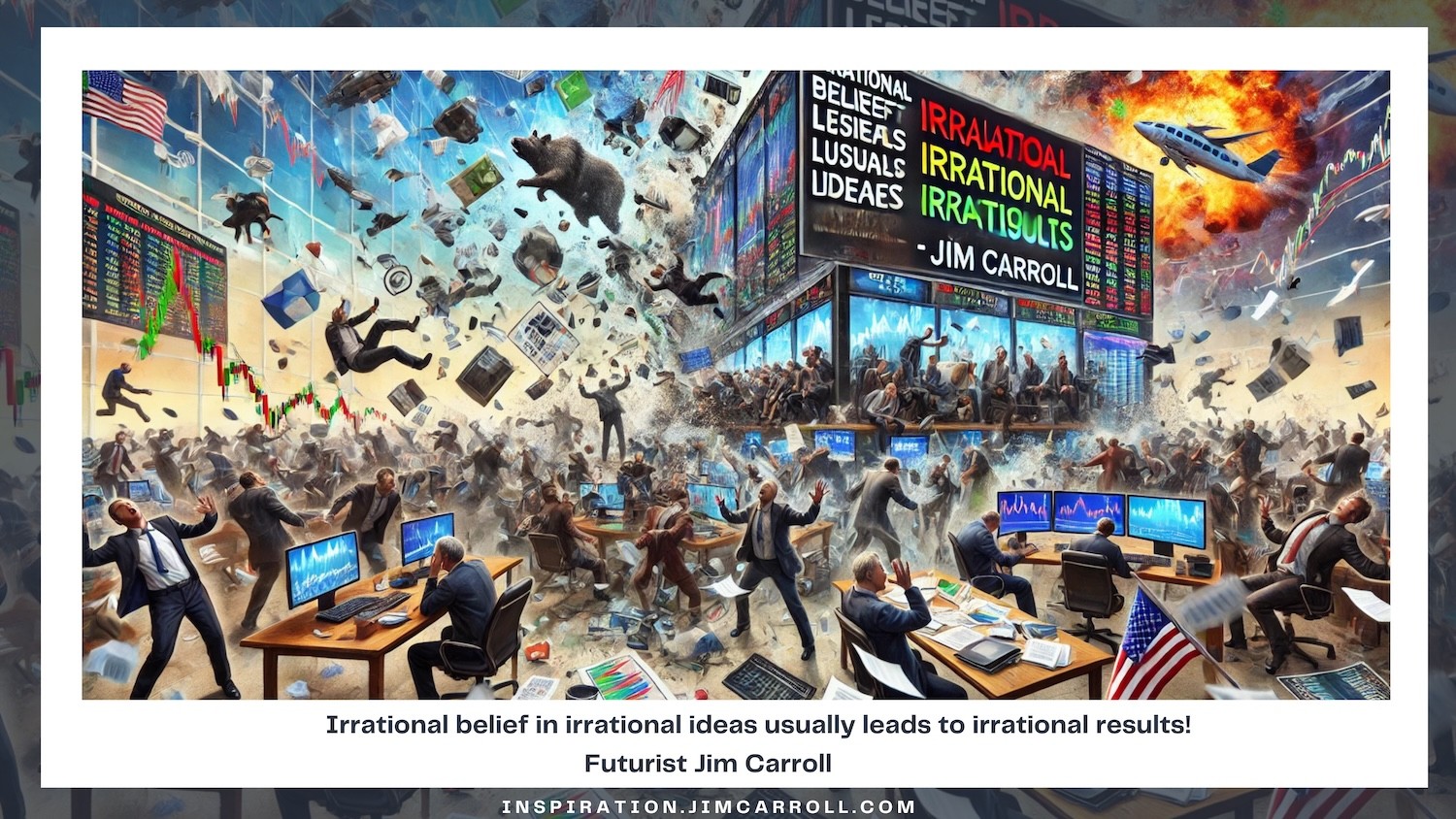
"An irrational belief in irrational ideas usually leads to irrational results" - Futurist Jim Carroll

So let's try and figure out what's going on.

I took today's quote, fed it to ChatGPT, and got the picture above which I used for today;'s 'inspiration' image.

Look, in the last little while, I've looked into the Science of Stupidity,  the Science of Mistakes, and The Science of Regret. So why not the Science of Irrational Decisions, which I learned is often referred to as "cognitive distortions." There's a lot to be found online to explain where we are.  Charts and stuff that explain the many different types of irrational decisions aka cognitive distortions.

There's even a course or two to take on it.

It's a fascinating topic, and as expected, there's a lot of research to be found. It's a wonderful rabbit hole to plunge into because you will find such papers as 
Overcoming Cognitive Distortions; How to Recognize and Challenge the Thinking Traps that Make You Miserable.

That tracks. People seem to be pretty miserable right now because of the cognitive distortions they've gone through that got us to where we are today.
And, as might expected, there is to be a leadership / personal growth book about it, with the title Predictably IrrationalL: The Hidden Forces that Shape our Decisions, released back in 2008. It probably could use an update!

So let's dig in, shall we? Let's talk about why folks make poor choices about big economic and political issues that end up hurting everyone. 

Here's what the science tells us. When people vote against their economic interests or support harmful policies, it's rarely because they're stupid. Their brains just don't always work in their best interest when dealing with complex global systems. Why is that? Our brains take shortcuts. We use mental rules of thumb that help us make quick decisions. This works fine for everyday choices but fails miserably when considering trade policy, inflation control, voting, or healthcare systems.

What happens to people in this circumstance? They get emotional about political and economic issues. Fear, anger, and tribalism cloud their judgment. When someone supports tariffs that will ultimately hurt local businesses because they sound "tough on foreign competition" - that's emotional reasoning drowning out economic reality. It's cognitive dissonance, plain and simple.

The kicker is that the condition leads to great uncertainty, which fuels itself creating more uncertainty in a vicious spiral.

It's complex, folks, and there is no easy way out.

Buckle up.

Read the rest of the post.

**** **** **** **** **** **** **** **** **** ****

Original post: jimcarroll.com/2025/03/daily-i

★ 1 • ↻ 1 original
Mar 12, 2025 · 8:39 AM UTC

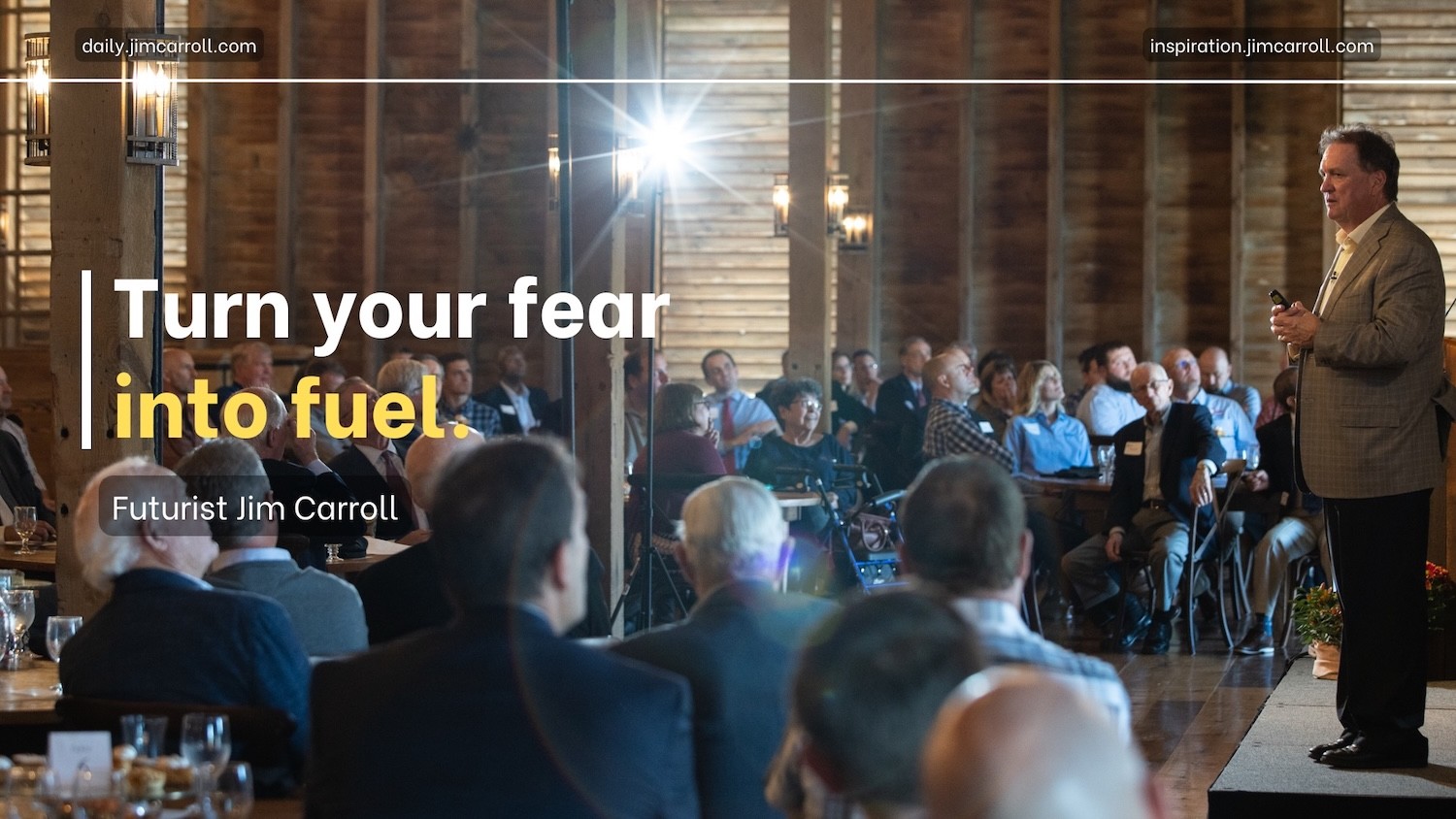
"Turn your fear into fuel" - Futurist Jim Carroll

This photo was taken in October 2019. I'm in the room with a farming community in Lancaster County, Pennsylvania. It's about as conservative as you can get.

They're worried. Farming is evolving too fast. Global competition is increasing. The science of agriculture is accelerating. Cost pressures are relentless. Automation is at the door. They can't hire enough people to work on the farms. They had big goals for global market opportunities for American agricultural products; then a tariff war cut into those hopes around 2017, and those goals weren't realized. Oops.

They're scared.

They're still scared but decided recently that even though the old plan didn't work the first time, it might work the second time.

It won't.

And so here we are.

If you get behind all of this and try to understand what is going on, the fact is they're scared of the future. They make often irrational decisions based on that fear - something I dug into yesterday. When I spoke to this crowd in 2019, they were, like many groups I speak to all over the US, terrified of what tomorrow represents. The result is that rather than trying to go forward, they undertake actions in an attempt to take themselves back to the 'good old days.' Make it great again, simply by stating it should be so, and then throwing a tantrum to try to make it happen.

Except, that never works.

Let that be a lesson - the key to tomorrow comes confronting your fear and turning it into opportunity.

How do you do this? This is what I would share with them today. What do you do if you are scared of tomorrow? Turn that fear into fuel. Think like this:

View future trends as opportunities, not threats It is important to adopt an innovative frame of mind and recognize the potential for growth and advancement. Move forward, not back.

Shift your focus. Far too many people view the future with fear rather than thinking about opportunity. An innovative mindset doesn't quiver from the fear of what might be coming next. Instead, it's alive from breathing the oxygen of opportunity.

Banish complacency and skepticism. Realize that in an era of rapid change, anything is possible. But only if you choose to chase it.

Take action. Rapid times require bold change. Don't avoid the future and fail to do the tough things needed to get there.

Challenge assumptions and eliminate habit. If your approach to the future is based upon your past success, ask yourself whether that will guarantee you similar results in the future. (Hint: it won't.)

Innovate! Innovators don’t make a difference by redoing the status quo — they accomplish great things by being different. And they don’t constrain their difference with traditional thinking: they simply think differently.

Re-engage with the future Shift your focus to the future with enthusiasm, motivation, and imagination. Turn it from an enemy into a friend that gives back to you!

There are many reasons for our current global state of affairs.

Like I've said many times, one reason is this.

It's better to align to the future than fear it.

You do that by turning the fear into fuel.

Original post: jimcarroll.com/2025/03/daily-i

★ 1 • ↻ 0 original
Mar 13, 2025 · 10:51 AM UTC

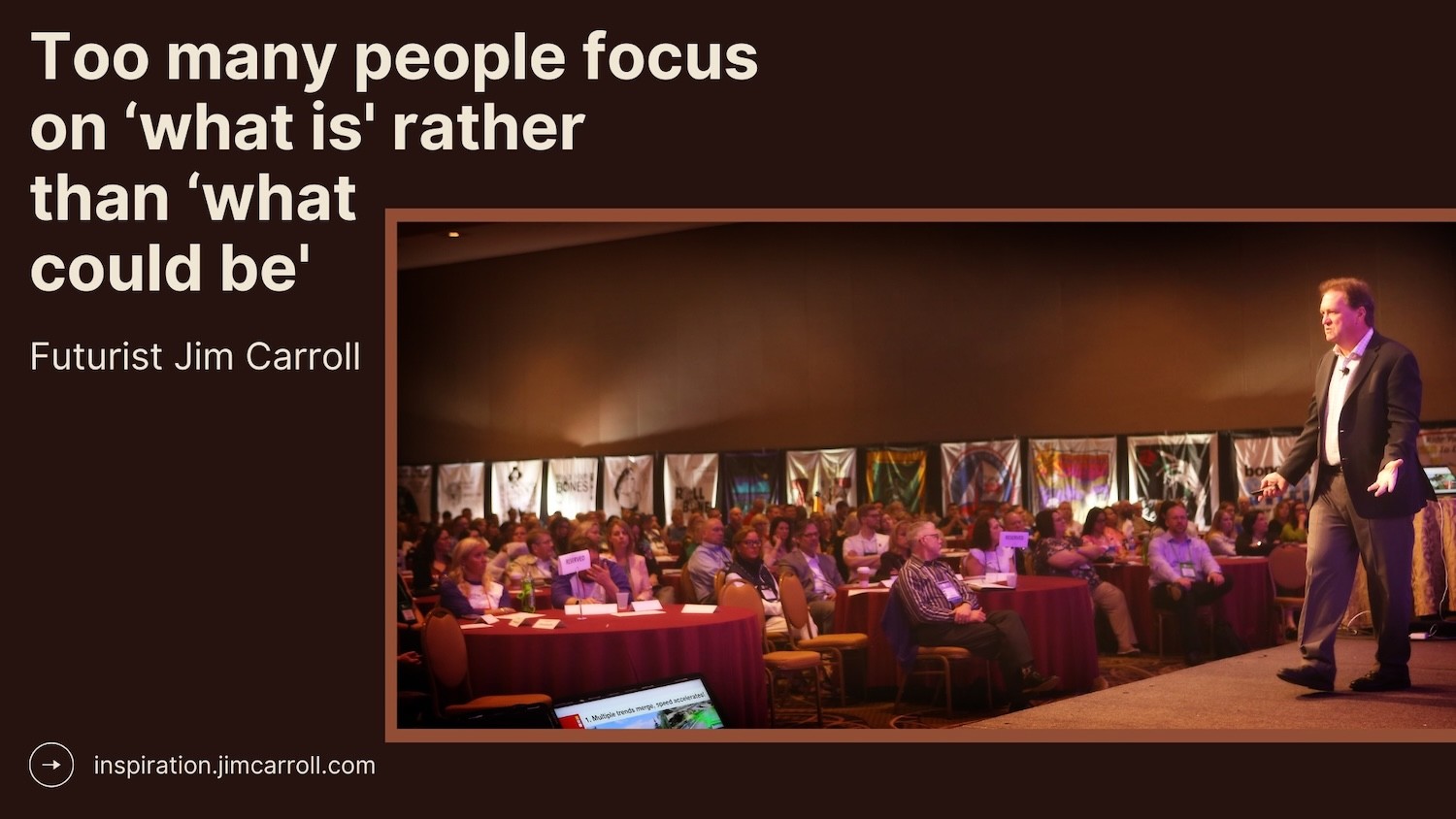
"Too many people focus on 'what is' rather than 'what could be'" - Futurist Jim Carroll

I'm in Georgia, where later today, I'll speak on behalf of a corporate group on the topic of the future of healthcare. (Before that, I'll be hard at work studying the nature of turf science, particularly concerning the actions of a small spherical object as it encounters the turf after being struck by a long object, particularly when the turf in question is quite dormant. There is much to learn.)

I digress.

The photo for today's image comes from my keynote for the American Association of Orthopedic Executives, and I'm speaking to them about the emerging reality of 3d printed body parts - knees on order via a Web site. A crazy idea? Not really - it's a fast-emerging reality. They needed not to just think about what is today, but would be tomorrow!

I'll walk through several slides having to do with the science of healthcare and medicine, the acceleration of new forms of treatment, and other issues. It's an interesting time to be covering this type of material from the stage, given that I'm doing so in a country where the very science of healthcare is under attack.

Even so, one of my jobs is to help the group - all involved in the health benefits community - understand the big sweeping trends and ideas that provide so much potential for society. Such as the statement, "What we did for heart health in the 20th century, we can do for brain health in the 21st century" from Dr. Deepak Chopra, an integrative medicine advocate

I've got several slides with these big, bold ideas or observations in my deck.

All around the idea of thinking big about tomorrow, not thinking small about where we are today.

Read more.

---

Futurist Jim Carroll has been speaking about the future of healthcare for 25+ years, and has seen a lot of the ‘big crazy ideas’ he’s predicted from the stage become real over time.

**** **** **** **** **** **** **** **** **** ****

jimcarroll.com/2025/03/daily-i

★ 2 • ↻ 1 original
Mar 13, 2025 · 10:57 AM UTC

@lkngrrr Fantastic! It's available at mediocrity.jimcarroll.com

I dare anyone to find fewer than 5 or 10 of the identified patterns on their team!

★ 1 • ↻ 0 original
Mar 14, 2025 · 9:31 AM UTC

"Too many people focus on 'what is' rather than 'what could be'" - Futurist Jim Carroll

I'm in Georgia, where later today, I'll speak on behalf of a corporate group on the topic of the future of healthcare. (Before that, I'll be hard at work studying the nature of turf science, particularly concerning the actions of a small spherical object as it encounters the turf after being struck by a long object, particularly when the turf in question is quite dormant. There is much to learn.)

I digress.

The photo for today's image comes from my keynote for the American Association of Orthopedic Executives, and I'm speaking to them about the emerging reality of 3d printed body parts - knees on order via a Web site. A crazy idea? Not really - it's a fast-emerging reality. They needed not to just think about what is today, but would be tomorrow!

I'll walk through several slides having to do with the science of healthcare and medicine, the acceleration of new forms of treatment, and other issues. It's an interesting time to be covering this type of material from the stage, given that I'm doing so in a country where the very science of healthcare is under attack.

Even so, one of my jobs is to help the group - all involved in the health benefits community - understand the big sweeping trends and ideas that provide so much potential for society. Such as the statement, "What we did for heart health in the 20th century, we can do for brain health in the 21st century" from Dr. Deepak Chopra, an integrative medicine advocate

I've got several slides with these big, bold ideas or observations in my deck.

All around the idea of thinking big about tomorrow, not thinking small about where we are today.

Read more.

---

**** **** **** **** **** **** **** **** **** ****

jimcarroll.com/2025/03/daily-i

★ 0 • ↻ 0 original
Mar 14, 2025 · 9:31 AM UTC

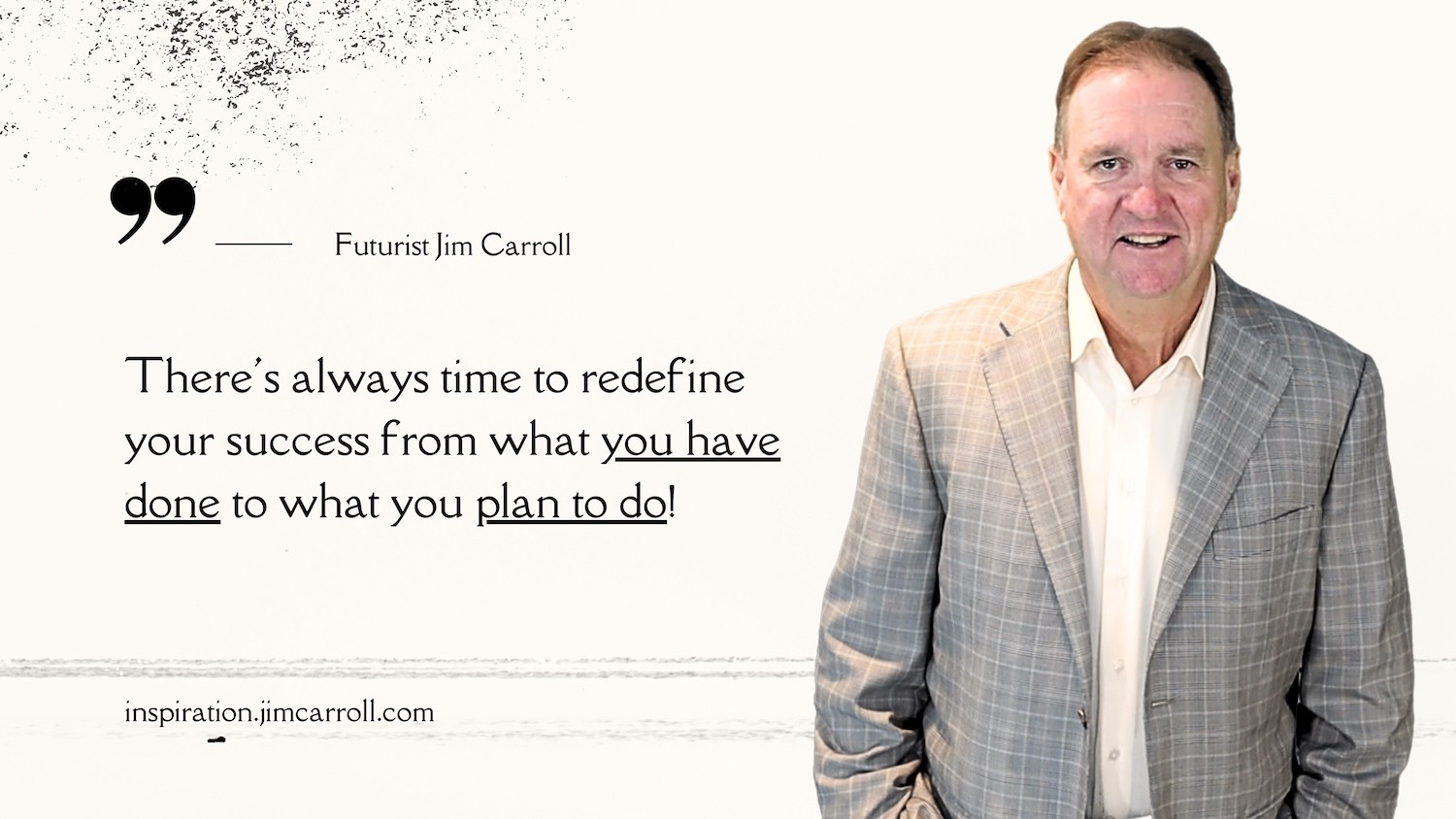
"There's always time to redefine your success from what you have done to what you plan to do!" - Futurist Jim Carroll

I've always believed that true success isn't about what you've done – it's about what you plan to do next.

Let me share some thoughts on how you can redefine success in your own life:

Embrace continuous learning. The world changes at lightning speed these days. Your past accomplishments are valuable, but they're not your ticket to future success or happiness! To truly thrive, become relentlessly curious and eager to teach yourself something new every day. Build your "experiential capital" by jumping into fresh challenges that prepare you for whatever comes next.

Challenge the assumptions you have used to define yourself. We all develop mental scripts about what success should look like. Take a moment to question these beliefs! Ask yourself: "Am I chasing this goal just because it's what I've always done or what others expect?" Don't get trapped in the "we've always done it this way" mindset. It might be time to write your own personal definition of success.

Focus on growing. Instead of defining success by achievements alone, think about how you're growing as a person. Are you gaining new skills? Expanding your understanding? Evolving into someone you're proud to be? True success is the journey of personal transformation, not just reaching destinations.

Maintain a future-positive mindset. Always focus on opportunity, not threat. When redefining success, adopt this same positive outlook! Rather than dwelling on past wins or losses, get excited about future possibilities. The most innovative people I've met share this trait – they see potential where others see problems.

Get unstuck. Too many of us get stuck in endless planning without action. Redefining success means actually pressing "play" on your ideas instead of just thinking about them. Take that first step, however small, toward your new vision of success. The future belongs to those who take action, not those who merely contemplate it.

Reinvent regularly. The traditional career ladder is rapidly fading. We're moving toward "itinerant careers" and "active life-design" where you can blend personal passions with making a living. Success might mean creating a flexible, fulfilling path that doesn't look like anyone else's. The question changes from "what do you do?" to "what do you love to do?"

In the end, redefining success is about switching from constantly looking in the rearview mirror to focusing on the road ahead. It's about being proactive, embracing change, challenging yourself, spotting opportunities, and having the courage to pursue what truly matters to you.

**** **** **** **** **** **** **** **** **** ****

Original post: jimcarroll.com/2025/03/daily-i

★ 1 • ↻ 0 original
Mar 17, 2025 · 12:53 PM UTC

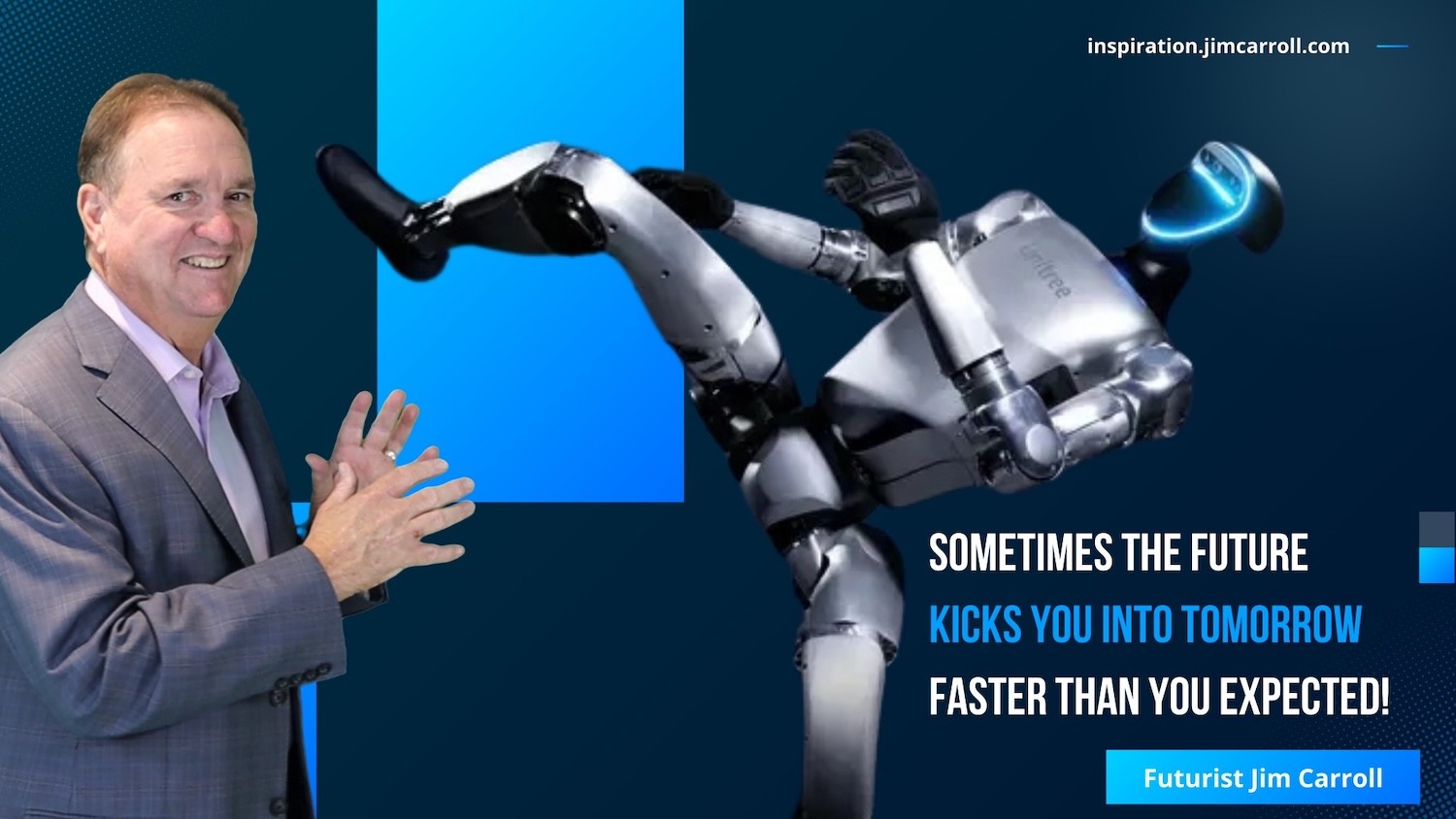
"Sometimes the future kicks you into tomorrow faster than you expected!" - Futurist Jim Carroll

Let's talk about the rise of humanoid robots in 2025.

I told my wife the other day that within 5 years, I'm probably going to be bringing one into our home. She is not amused. Such is the life of living with a futurist! The image in today's inspiration is of the Unitree G1, a robot from one of one of the hottest start-ups in China. They purport to offer the robot for sale on their Website for about USD 16,000, and given the pace of change, buying one for a few thousand dollars sometime in the future might not be farfetched.

You can't use your credit card to buy it directly online yet, but if you like, you can buy its counterpart, the Unitree Go2, for about USD 2,800. Enter your credit card, provide shipping details, and the fun begins! 

Such is the state of the humanoid robotic industry in 2025. Suffice it to say, it's moving fast.

As with any development in the hype-driven technology industry, you have to take all of this with a bit of a grain of salt, but suffice it to say, things are happening.

I'll admit I've long been a skeptic of developments in this particular aspect of robotics - it's always seemed a little too close to science fiction to be real. And yet, things are evolving quickly. Yet I shared this slide the other day at an event where I was speaking about the future of healthcare, and the crazy idea that we might one day see such devices emerge within the industry.

Essentially, four key trends are coming together all at once. First, there is a LOT of venture capital money flowing into the industry. With that, we are starting to see the typical cost reduction curve we see with any new technology. Third, there's a lot of development with software and technology occurring out in the open-source community, and that type of collaboration always drives the future forward faster. Finally, one of the most fascinating trends has to do with the arrival of digital training tools - essentially, software that allows you to train your robot to do what you want it to do (such as the often-used example of washing the dishes.)

Many are comparing this to a "ChatGPT moment" for robotics, with a potential turning point coming by 2027 or the late 2020s.

Read more!

**** **** **** **** **** **** **** **** **** ****

Original post: jimcarroll.com/2025/03/daily-i

★ 0 • ↻ 0 original
Mar 18, 2025 · 12:39 PM UTC

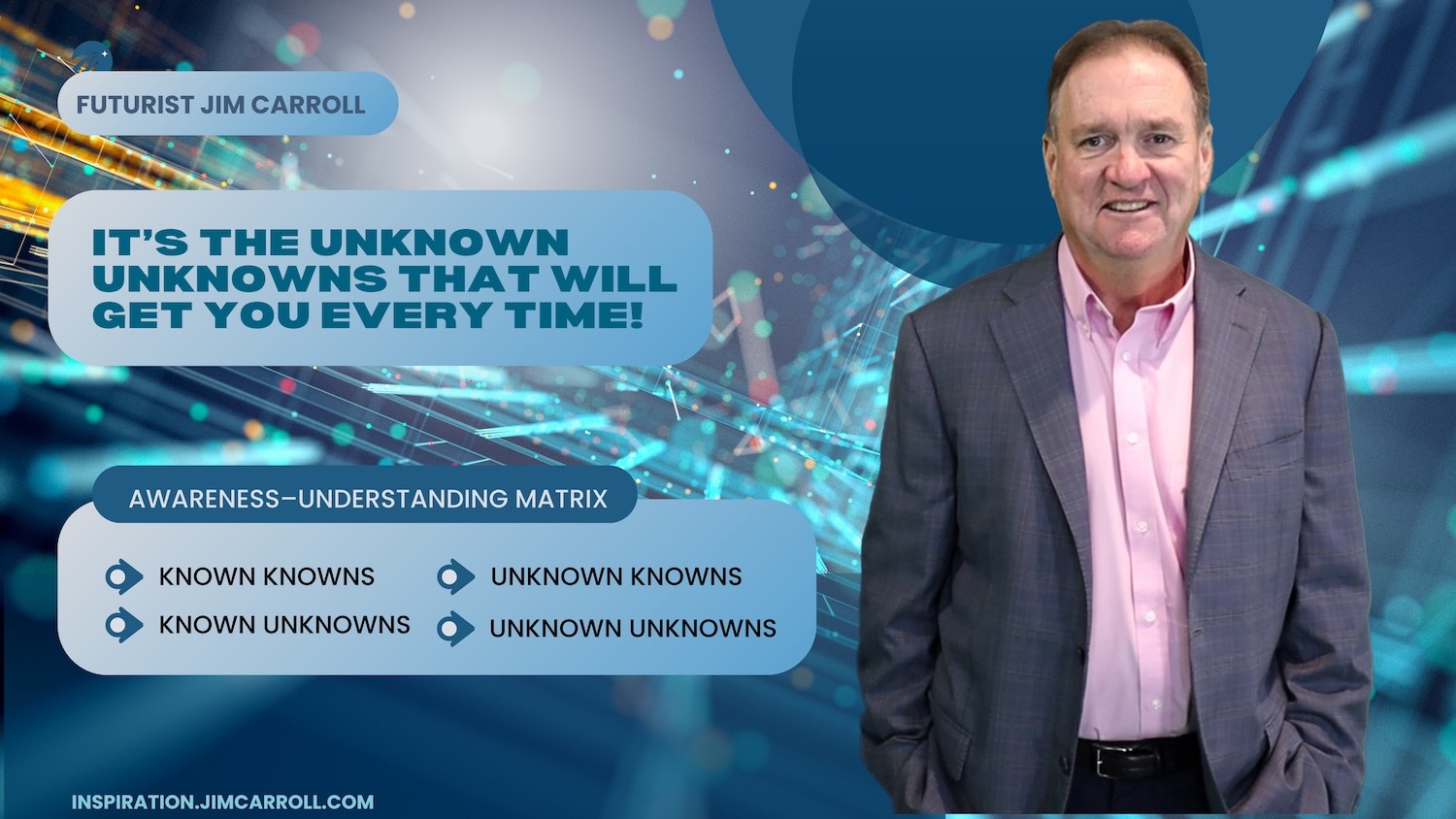
""It’s the unknown unknowns that will get you every time!" - Futurist Jim Carroll

On February 12, 2002, United States Secretary of Defence Donald Rumsfeld answered a question at a U.S. Department of Defence (DoD) news briefing about the lack of evidence linking the government of Iraq with the supply of weapons of mass destruction to terrorist groups. His answer has since answered the lexicon of lore, as many people thought that it was fully intended to shield the department from any sort of criticism.

"Reports that say that something hasn't happened are always interesting to me, because as we know, there are known knowns; there are things we know we know. We also know there are known unknowns; that is to say we know there are some things we do not know. But there are also unknown unknowns—the ones we don't know we don't know. And if one looks throughout the history of our country and other free countries, it is the latter category that tends to be the difficult ones."

His answer, though, was based on what is known as the "Awareness-understanding matrix", which provides that there are known knowns, known unknowns, unknown knows, and unknown unknowns. Complicated but helpful - when you study it, it makes sense. Things we are aware of and understand; things we are aware of but don't understand; things we are not aware of but understand or know implicitly; and then, the things we are neither aware of nor understand.

In that context, later this morning I'll speak to a room full of insurance CEOs and other senior executives from the industry at a major insurance conference. To get ready for the event, I grabbed about 1,500 articles about the latest trends impacting the insurance industry and used Google Notebook to analyze these articles for key bits of insight.

I will be speaking, among many other issues, about the future of insurance risk, and in that context, will impress upon them that it's the "unknown unknowns" they should worry about - the things they are neither aware of nor understand.

What are those unknown unknowns? In a brief moment of inspiration, I fed it this prompt, in effect asking the AI to analyze these 1500 articles and summarize them.

This is what it came back with, which I worked into my slide deck:

"The insurance industry is caught in a whirlwind: climate volatility, liability inflation, data chaos, talent scarcity, and relentless regulatory pressures, all while battling public mistrust and the nagging fear that tomorrow's risks are growing faster than our capacity to cover them”

That pretty much summarizes my slide deck!

Futurist Jim Carroll has spoken at over 200 insurance and risk-related events throughout the years.

**** **** **** **** **** **** **** **** **** ****

Original post: jimcarroll.com/2025/03/daily-i

★ 2 • ↻ 1 original
Mar 19, 2025 · 10:49 AM UTC

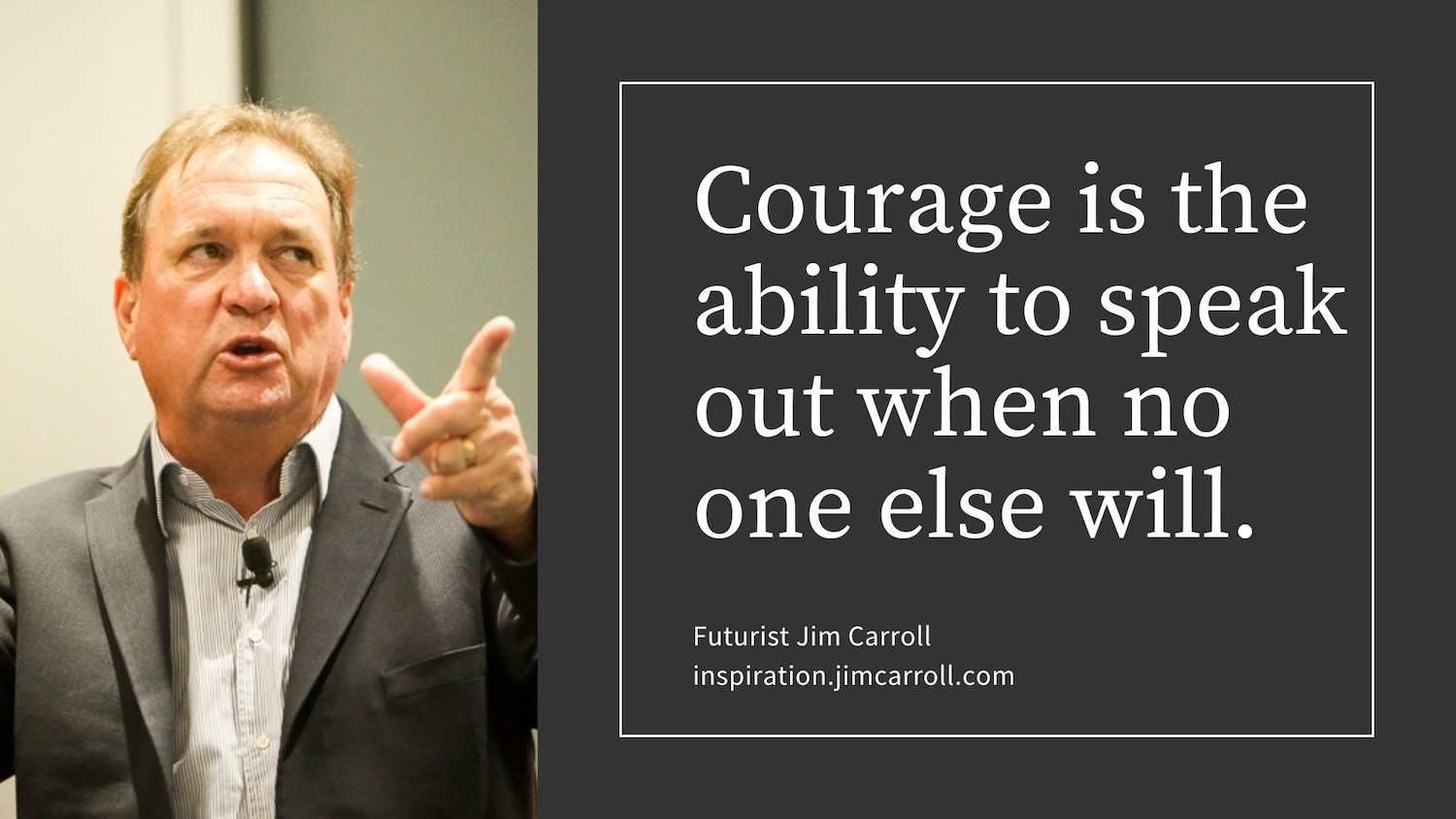
"Courage is the ability to speak out when no one else will" - Futurist Jim Carroll

No one seems to be willing to speak up while the damage is being done. Courage has disappeared. Corporate leadership seems to be excelling at mastering the art of being a wimp.

Sure, several top business leaders are 'expressing concern' about how tariff policies might affect companies and the broader economy. But few are willing to do anything. Meanwhile, all the uncertainty from the whiplash of insanity leads to a vortex of crashing consumer confidence, wild volatility, and the likelihood of an economic downturn.

Public comments are weak at best. Jamie Dimon of JPMorgan Chase recently changed his view on tariffs, noting that "uncertainty is not a good thing" and suggesting businesses may need to adjust their operations. With that, his team has increased their recession probability estimate from 30% to 40%. BlackRock CEO Larry Fink told CNN that "the economy is weakening as we speak" due to current policies, causing both individuals and business leaders to hesitate and reduce activity.

But aside from a few weak comments like this, few are speaking up. There is no courage. The fact is, while many other CEOs have expressed similar concerns privately, it seems few are willing to speak up. The lack of courage is palpable. This became the subject of an article in the Wall Street Journal the other day.

Consider the article.

---

How business leaders talk about the Trump administration in private has been markedly different than what they are game to say in public. The dissonance was on full display here this week. 

Early on Tuesday, dozens of corporate executives and others assembled at a Yale CEO Caucus not far from the White House just as news emerged that the Trump administration planned to potentially double tariffs on steel and aluminum from Canada. Those in the room responded with a mix of groans and shocked laughter. 

“There was universal revulsion against the Trump economic policies,” said Jeffrey Sonnenfeld, a professor at the Yale School of Management, who organized the invite-only summit that included corporate bosses such as JPMorgan Chase’s Jamie Dimon, billionaire Michael Dell and Pfizer’s Albert Bourla. “They’re also especially horrified about Canada.” 

That sentiment wasn’t apparent hours later, when many of the same chief executives from the Yale event attended a question-and-answer session with President Trump at the Business Roundtable. There, the exchange was largely cordial and executives didn’t ask the president any pointed questions about his tariff strategy, according to people familiar with the event. 

They're all silent. Scared of their shadows. These are the leaders taking the world into the future. 

**** **** **** **** **** **** **** **** **** ****

jimcarroll.com/2025/03/daily-i

★ 0 • ↻ 2 original
Mar 20, 2025 · 10:07 AM UTC

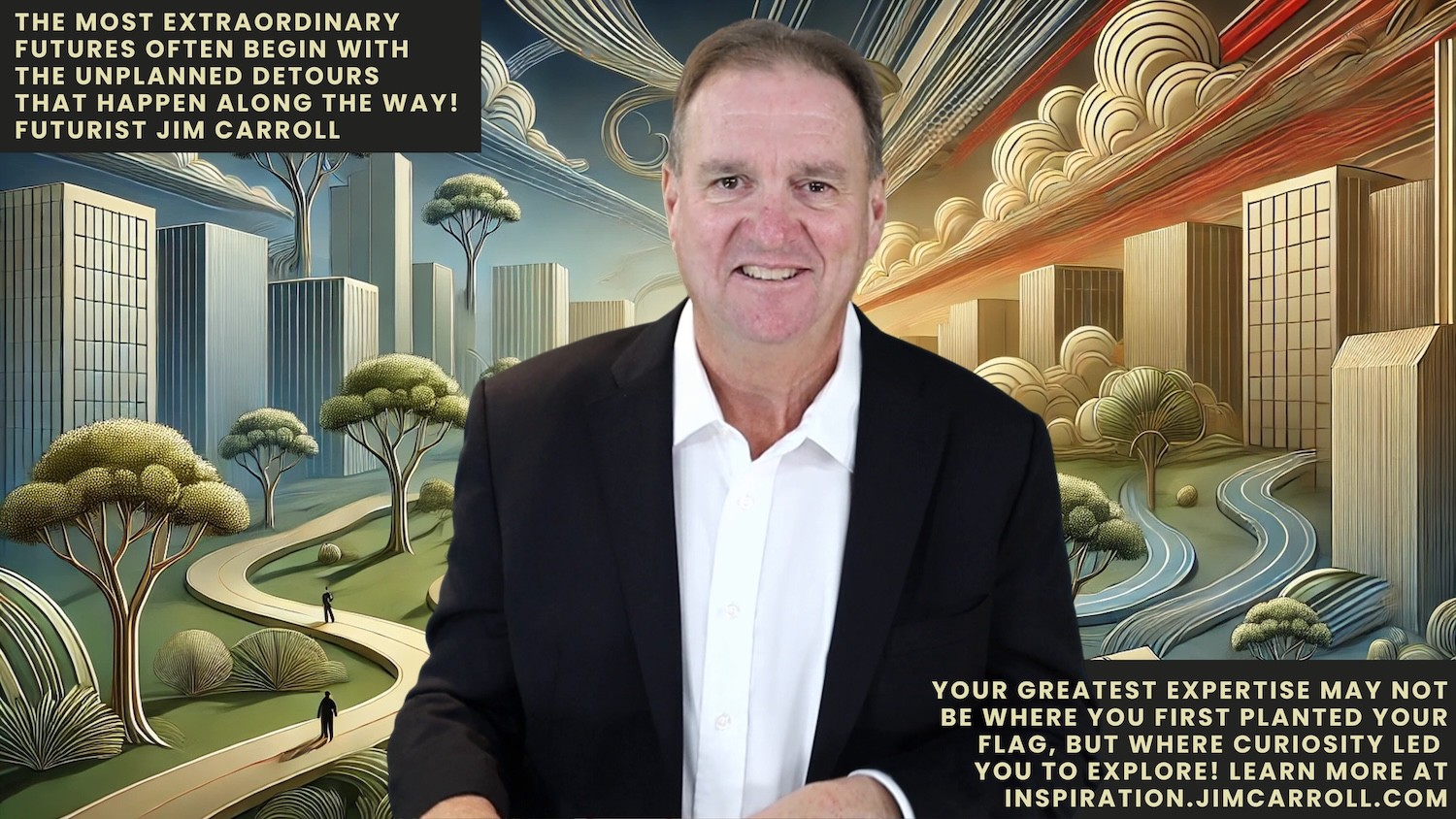
"The most extraordinary futures often begin with the unplanned detours that happen along the way!" - Futurist Jim Carroll

Believe in serendipity and happenstance, because you never know what might happen! That's because your greatest expertise may not be where you first planted your flag, but where curiosity led you to explore!

That's how ChatGPT summarized a profile article about me that just came out. And it's wonderful wisdom that very much seems to match my mindset!

The article, "The Accidental Oracle," appears in the spring issue of Pivot Magazine, which goes out to over 220,000 Canadian Chartered Professional Accountants. You can access the PDF here. A few comments: The Family Guide to the Internet is still available on YouTube, and yes, it's embarrassing. Unlike the article suggests, I did 'rock and roll and party all night' - while doing my stint as an auditor while on the road, I served as a DJ at the local pub. I don't know how I ever survived. And yes, I did a short stint with KISS!

Enjoy! I did!

See the full article in the post.

Original post: jimcarroll.com/2025/03/daily-i

★ 2 • ↻ 0 original
Mar 20, 2025 · 1:02 PM UTC↩ reply

@cstross This is the type of argument we should be having these days!

And so I'll chime in to start a flame war.

**SysVinit vs SystemD**

**Clearly, SysVinit.**

★ 8 • ↻ 0 original
Mar 20, 2025 · 2:50 PM UTC↩ reply

@sleepyfox @etchedpixels @LinuxAndYarn @cstross @samir Isn't this wonderful though! Here we are debating Linux stuff and not talking politics! My goal is being achieved!

★ 5 • ↻ 1 original
Mar 20, 2025 · 7:28 PM UTC

This is actually funny!

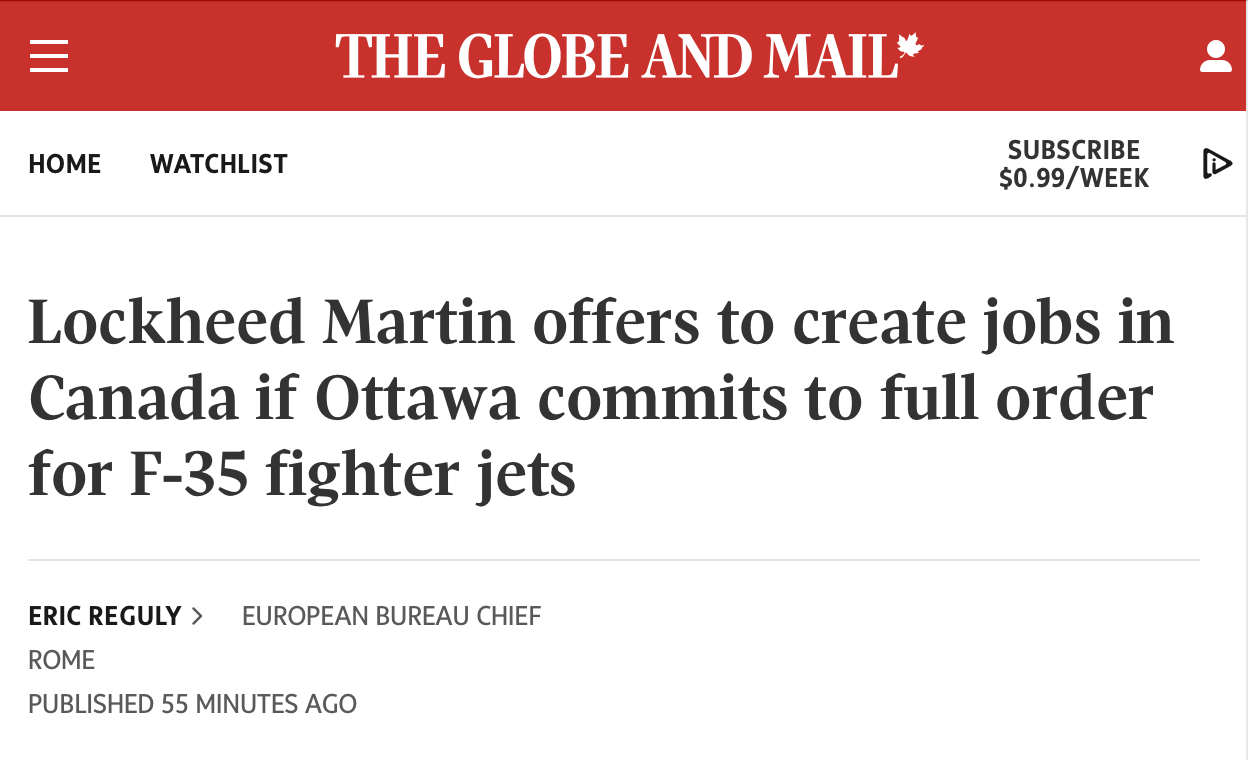
Weren't tariffs going to create American jobs?

So Canada says because of the idiocy, it will cancel the F35 order and will source new jets from Europe instead. And .... Lockheed Martin says, wait, we'll create Canadian jobs!

★ 153 • ↻ 137 original
Mar 20, 2025 · 8:44 PM UTC

@energisch_ MAKE CANADA GREAT AGAIN! SO MUCH LOL!

★ 7 • ↻ 1 original
Mar 21, 2025 · 10:54 AM UTC

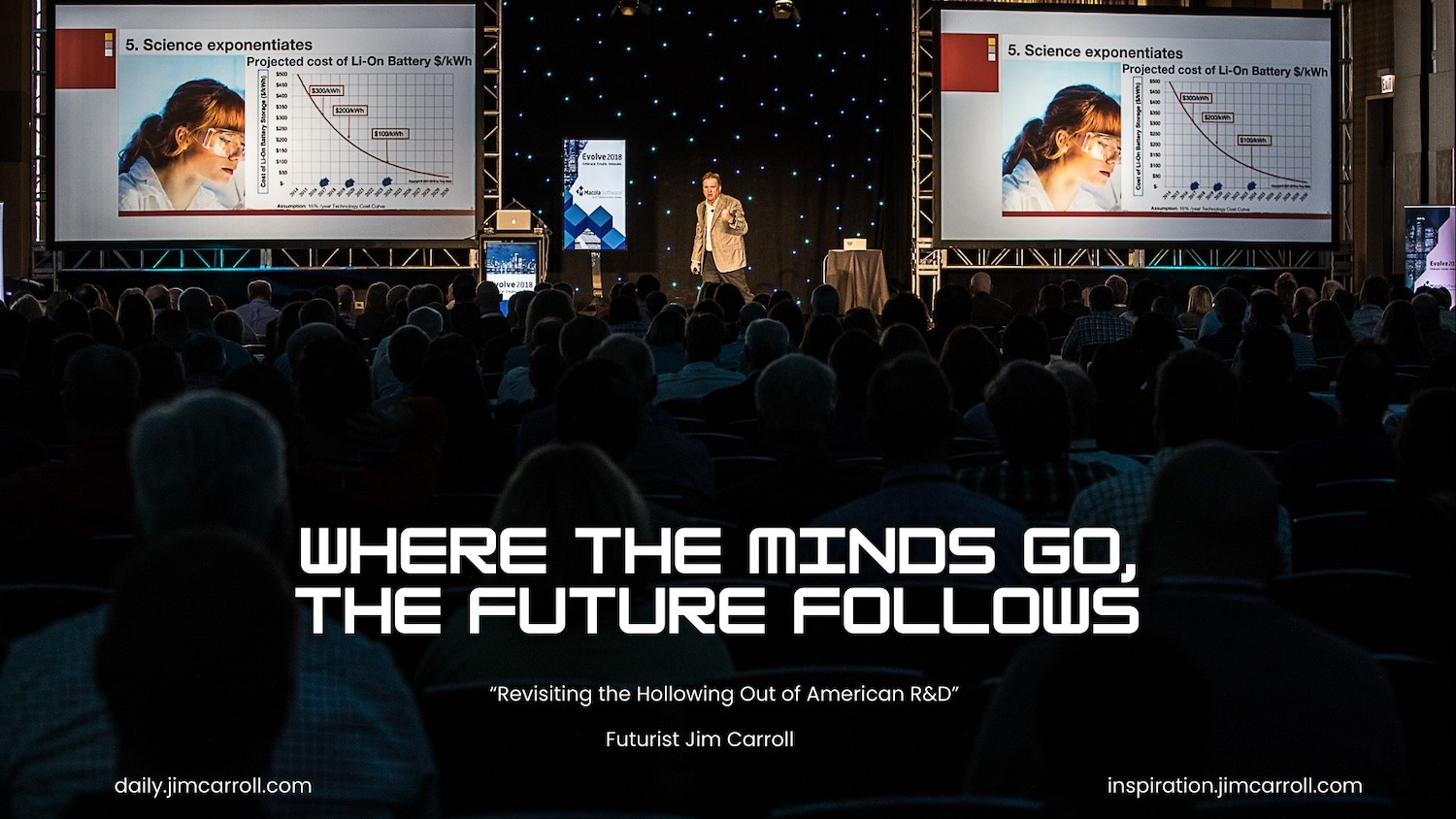
"Where the minds go, the future follows" - Futurist Jim Carroll

Let's talk about how once great nations lose their place in the global R&D background, and as a result, lose their future!

In 2009, I was the opening keynote speaker for the annual PMDA conference on innovation - with a talk on the 'hollowing out of corporate R&D." As noted on their site, "The Product Development and Management Association is a global community of professional members whose skills, expertise and experience power the most recognized and respected innovative companies in the world." The association membership includes key individuals involved in R&D for the 3M's, Duponts, Dow and other industrial powerhouses of the world.

They asked for a hard-hitting message on how the US was losing its position as the pre-eminent R&D 'factory' of the world, and I obliged. I took them on that tour, and wrote the blog post "The Hollowing Out of Corporate R&D." Essentially, I told the story of how the US was losing its dominance as other (mostly Asian) companies took the lead, as open source innovation took on new momentum, and small collaboration was beating 'big collaboration.'

Fast forward - we now have a nation that is turning its back on science, as it shutters entire R&D arms of government, as many begin to reject the essence of science itself, and as immigration and other policies begin to attack the individuals who undertake scientific research. This never ends well. Scientists will always pursue their work in the nations that welcome them, and which create an environment that is conducive to their slow, collaborative research.

History shows what happens when industrial or government policies decimate R&D.

The minds of science develop the future - the discoveries that are made fuel the innovations that are pursued which create the products that evolve. Keep in mind my key mantra for tomorrow: "Companies that do not yet exist will build products not yet conceived using materials not yet invented with methodologies not yet in existence with ideas yet to be imagined." That context provides the factory for the future, the jobs of tomorrow, and the possibilities for companies and nations to thrive. Thrive they won't when science is rejected.

In that context, how is global R&D science changing today compared to the trends I spoke about years ago? The "hollowing out" of traditional corporate R&D has accelerated, creating a more globally distributed innovation landscape where the U.S. maintains strength in software and AI but has lost ground in manufacturing innovation and materials science

And all this has happened before the nation decided to turn its back on science.

What's the future impact? Where the minds move, the future follows!

**** **** **** **** **** **** **** **** **** ****

Original post: jimcarroll.com/2025/03/daily-i

★ 0 • ↻ 0 original
Mar 24, 2025 · 10:04 AM UTC

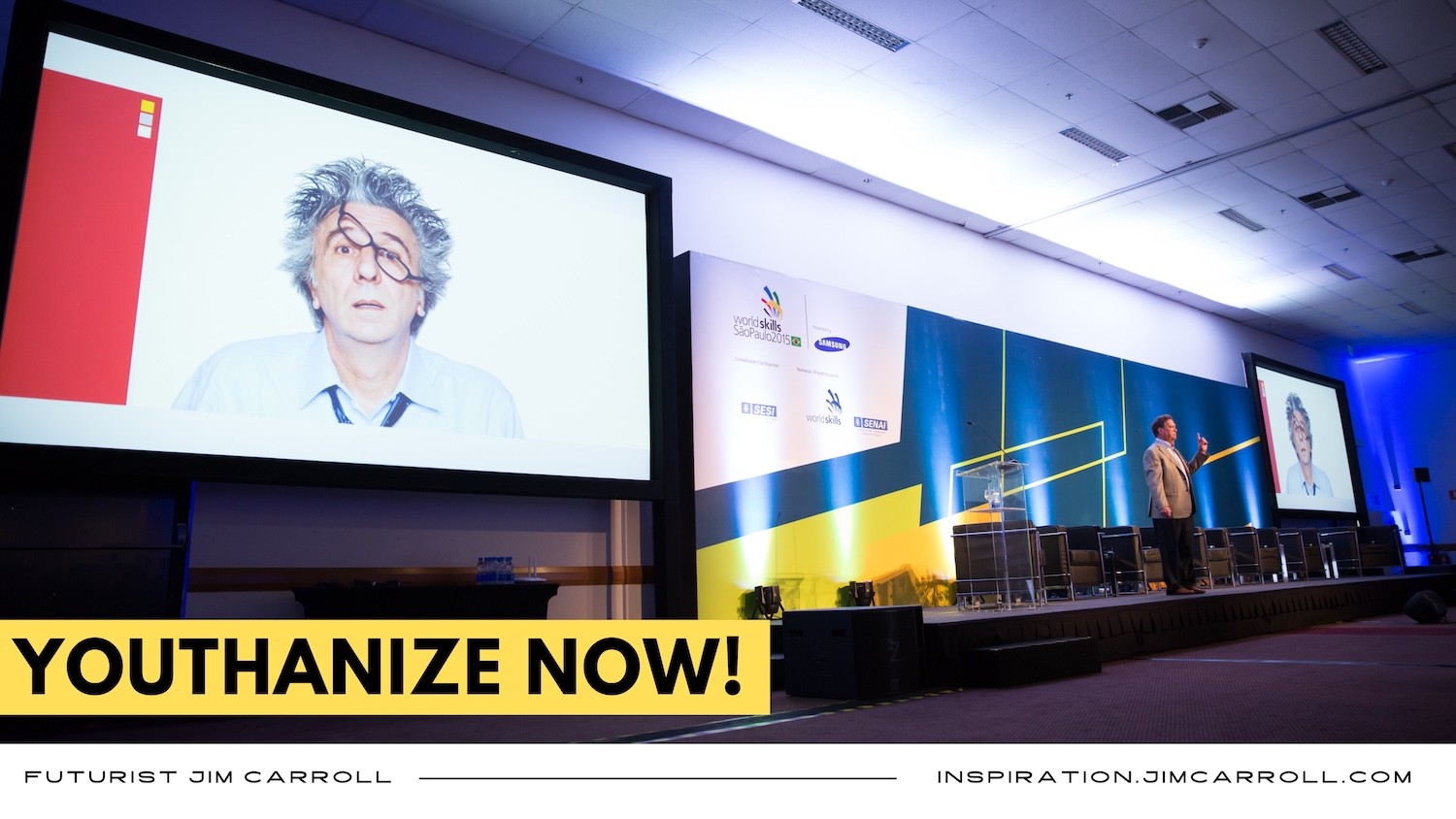
*Youthanize now!”* – Futurist Jim Carroll

In Season 4, Episode 17 of the show The Office, the inept manager Michael spends a moment to explain why he wants to recruit young interns for the office - and says he wants to euthanize things (which means ending a person's life by a serum to end suffering from an incurable disease.). Since then, some have suggested that he was coining a new phrase, "Youthanize".

Let's run with it!

The world's in a bit of a mess. Some folks are hanging around too long. Have you noticed how the political leadership in the US seems to be getting, well... a bit long in the tooth? Some wonder if RBG and Joe had retired when they should have, things might have been different.

Let's look at the Senate, where the average age is pushing 65, but many are in their 80s and 90s! We've got the so-called Silent Generation and Baby Boomers dominating the scene, while Millennials—who represent a huge chunk of the population—barely have a seat at the table. And the fact is, this isn't just about numbers on a birth certificate; it's about who's making decisions about the future. So far, it's not going well, because these old folks don't seem to know how to battle back in this new era of fast-moving, social media-driven events. We're not at a Chuck-e-Cheese restaurant anymore.

Don't slam me for ageism - that's not my intent. Many of us will live longer, with minds as sharp as yesterday - but with wisdom, we should also know when to get out of the way.

I've spent my career watching how organizations evolve and adapt, and I can tell you this: for today's younger generations, constant change is like oxygen. They've grown up with technology transforming around them daily. They don't fear innovation—they expect it! Meanwhile, we're seeing concerning signs in the political leadership, from public "freezing episodes" to declining cognitive health, with a Pentagon study even flagging dementia among aging officials as a national security concern. (Um, ponder that for a moment. Like, ponder it. Are they trying to tell us something?)

Here's what fascinates me: industries that welcome young people as idea generators tend to have massive agility and a high "change quotient." But the current political system seems designed to keep them out! Between gerrymandering, polarization, and the incredible advantages of incumbency, we've created a system where someone who is 74 years old and battling terminal cancer—can still be chosen for leadership because, in his words, "I've never had my chance." Meanwhile, a younger person who has the fire-breathing dragon anger needed in these complex times - is shut out of that opportunity because she's 'too young'.

Does this sound like an organization positioned for future success? NOT!

Original post: jimcarroll.com/2025/03/decodin

★ 0 • ↻ 1 original
Mar 25, 2025 · 10:28 AM UTC

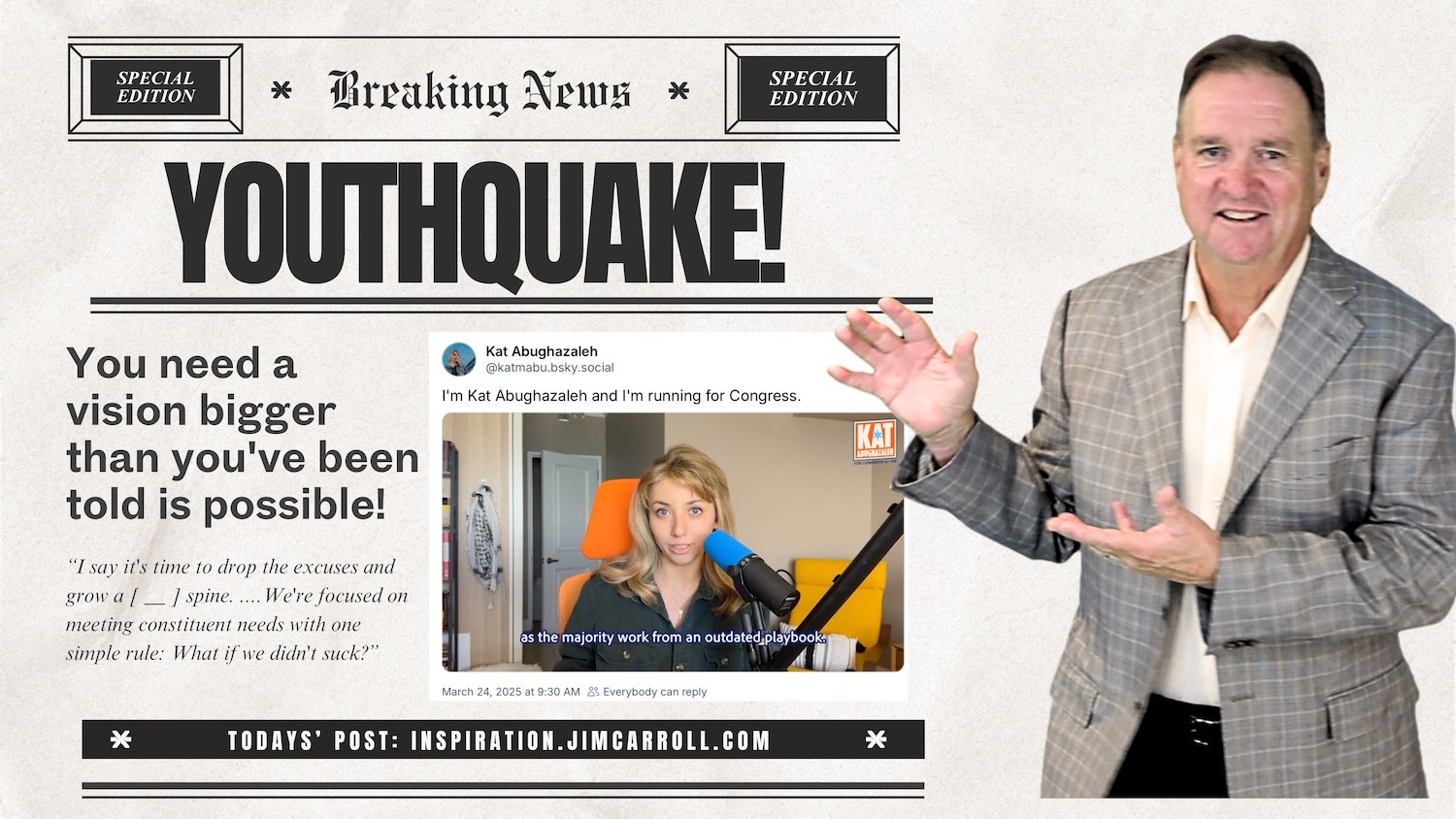
"You need a vision bigger than you've been told is possible!"  - Kat Abughazaleh 

That's her phrase, not mine! She's 26-year-old Kat bAbughazaleh, and she's running for Congress. In the middle of her announcement video, she stated: "You need a vision bigger than you've been told is possible!"
I'm always a sucker for a good inspirational phrase - and I can also spot the nascent signs of what might be a major trend early on. This might be one of those moments.

Look, I swear to god I'm not working to turn my daily post into a political journal, but the timing of this video yesterday was just too perfect in light of my post earlier that day about the need for the system to get 'youthanized.'

So what's this post about? It's about what might happen when the social media/influencer generation gets aggressively involved in politics. Later in the video, she said this: “I say it’s time to drop the excuses and grow a fucking spine," And then, "We're focused on meeting constituent needs with one simple rule: What if we didn't suck?"

Talk about message clarity!

Watch the video for yourself, and try and tell me that this might not be the early sign of something happening in US politics right now.

youtube.com/watch?v=Z7OhclGO3CY

And since US politics has a huge impact on whether the future unfolds or not, well, it's in the territory of this daily post. Yesterday, I was listening to The Daily podcast from the New York Times, and one political expert said that the Democrats might be having their own Tea Party moment, what with the anger at aging politicians and all. Maybe this was the moment stuff was thrown in the harbor.

The video is blowing up on social media right now - and no wonder. What we might be seeing right now is the first of a sudden groundswell of today's 20 and 30-year-olds launching themselves into a system that has become geriatric by design

**** **** **** **** **** **** **** **** **** ****

Original post:jimcarroll.com/2025/03/decodin

★ 1 • ↻ 2 original
Mar 26, 2025 · 10:13 AM UTC

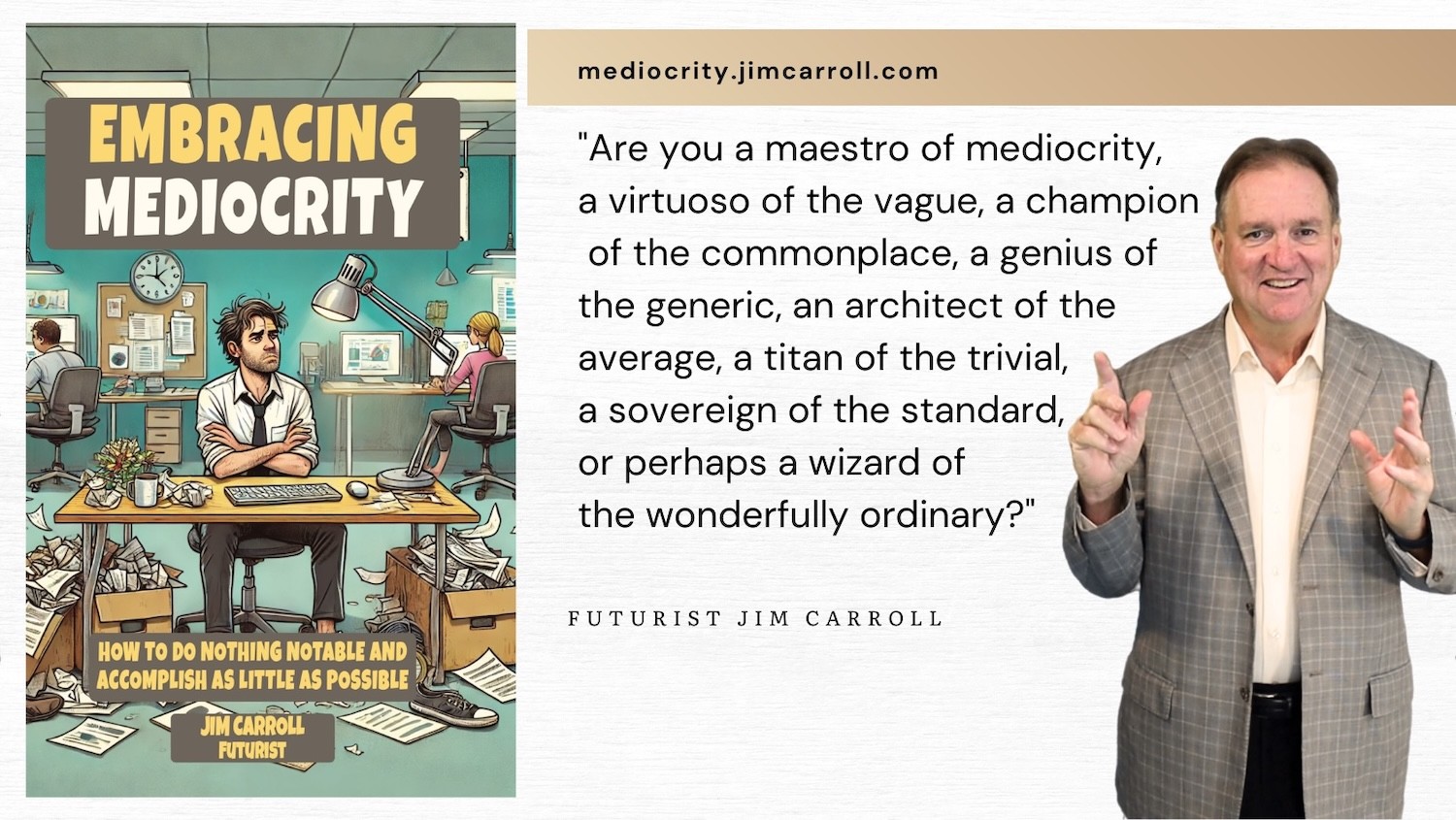
"Are you a maestro of mediocrity, a virtuoso of the vague, a champion of the commonplace, a genius of the generic, an architect of the average, a titan of the trivial, a sovereign of the standard, or perhaps a wizard of the wonderfully ordinary?" - Futurist Jim Carroll

I'm having a lot of fun with my new book, and the initial reactions from the folks who have bought it have found it to be inspiring, albeit in a roundabout way! After all, it identifies the things we should NOT be doing to move forward, and yet, we can find many of those behaviors that we are guilty of.

One of my biggest thrills came when the technical product lead for the world's largest mobile-robotic fleet at Amazon - 750,000+ robots! - had a short post about the book.

I need YOU to buy the book though - you are reading my Daily Inspiration post every day, so why not move to the next step and offer up a little bit of support? You can do that right now via the book Website at
mediocrity.jimcarroll.com. Spend a moment to grab a copy, and then come back and learn a bit more about how you might use its anti-inspirational guidance - and bring a smile to my face!

With that in mind, I'm also thrilled to note that we've moved to the next stage of the follow-up companion sequel Escaping Mediocrity, and have just about finalized the text content. The next step is to generate the images and format the book; the cover is already complete and ready to go.

We might be about a month out from delivery.

The key to the Escaping Mediocrity book is figuring out how to use it, and that's why I note in the Foreword that it's a teambuilding book!
When I wrote it, my goal was to shine a light on the all too comfortable habits that secretly sabotage our potential. Once I started pulling it together, I realized that it would be perfect for team-building exercises at corporate events! After all, it can be used as a humorous tool to make what could be uncomfortable conversations both productive and enjoyable.

Think about it - by playfully examining mediocrity together, your team can develop stronger awareness and create practical strategies for excellence without pointing fingers.

Here are some thoughts on how to deploy Embracing Mediocrity within your team -- read the full post for more!

Remember, you can grab a copy of Embracing Mediocrity right now - just visit the main Website for the book - at mediocrity.jimcarroll.com

Bonus for Canadians - buy it directly from me, and not only will I scribble in your custom message and sign it - but you will know that you are supporting a Canadian printer! I have a wonderful fellow in Burlington, Ontario, who did a bulk print run for me!

I look forward to your order!

Futurist Jim Carroll believes that by it is by examining the mediocre behaviors that define us we can best figure out how to escape from them.

jimcarroll.com/2025/03/decodin

★ 0 • ↻ 0 original
Mar 27, 2025 · 10:16 AM UTC

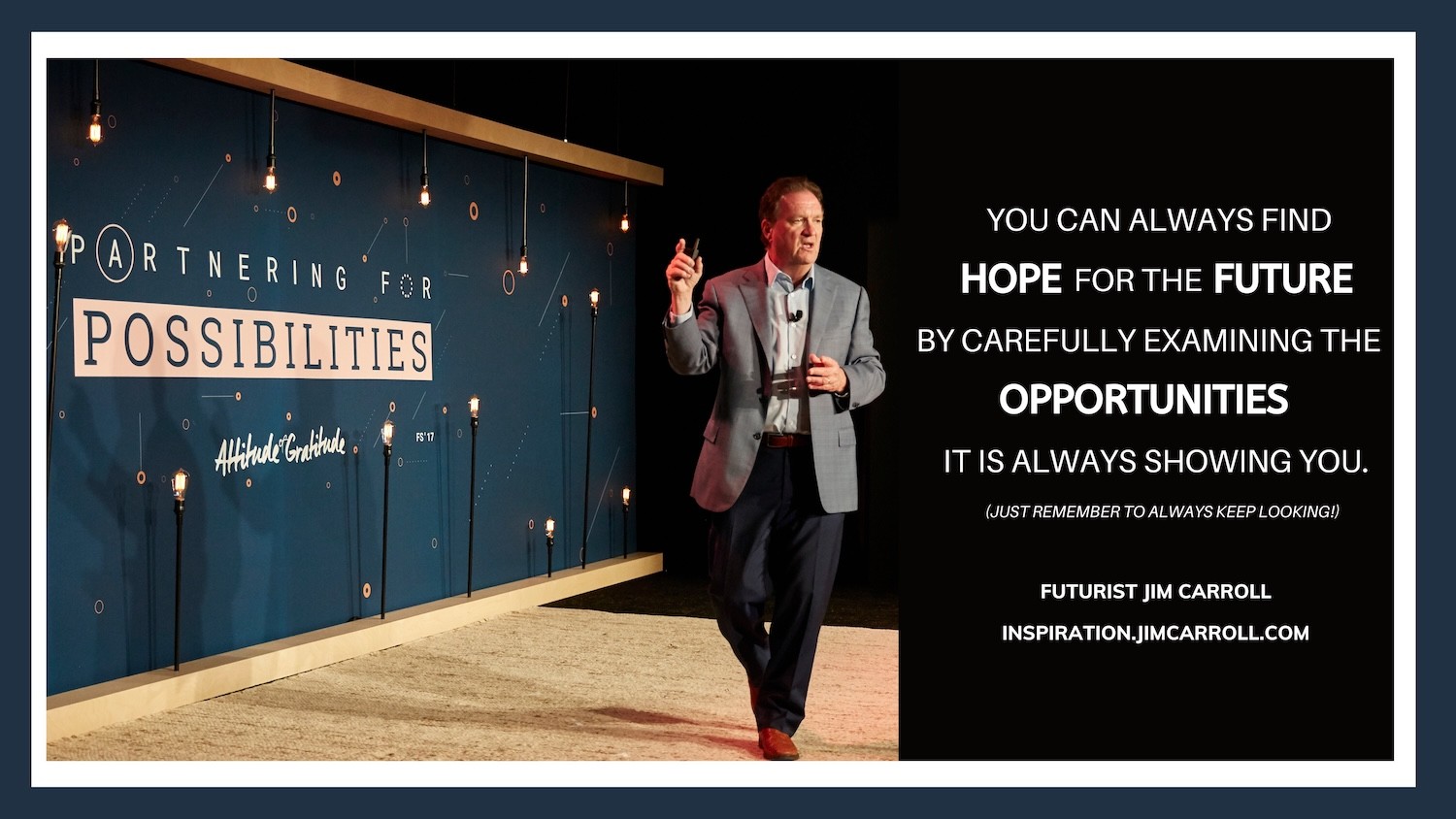
"You can always find hope for the future by carefully examining the opportunities it is always showing you. (Just remember to always keep looking!)" - Futurist Jim Carroll

The most popular post on my Website has to do with the 'growth of knowledge.', from my 2023 trends series.

In it, I lay out the basic statistics and observations having to do with that trend - but also outline what it means. In simple terms:

"It used to be about what you know. Now it’s not only about what you know, but how fast you need to know it!"

I also make note of this observation:

"The volume of medical knowledge was doubling every 8 years before Covid; it’s now doubling every 78 days."

Fast forward - things are moving even faster still. No one in any career knows everything they need to know - our ability to get the right knowledge at the right time - what I call just-in-time knowledge - is one of the most important career skills need to continually develop and enhance.

With that thought in mind, I was taking a look at the current widespread destruction of the future all around us - science shutting down, valuable research programs being decimated, and careers and jobs being destroyed with reckless abandonment. There is a chainsaw being taken to the future, and its destructive damage is yet to be determined. In the context of such a crazy world, how do those of us who want to ensure we have hope for tomorrow continue to sustain that hope, feed it, and nurture it? By keeping an eye on the good things that are out there and that might somehow survive!

This brings me to how I am using my relentless study of the trends of tomorrow to sustain my hope for tomorrow, albeit while doing so in the era of the information flood. To do that, I'm turning to, of course, AI. Here's a good example: for years, I've subscribed to many different trend newsletters, each of which is carefully filtered and goes into a folder in my email account. I try to get to them when I can, but I often fall behind. One I track is Ground Truths by Eric Topol - it's a great, fairly regular update on important trends in healthcare science.
Searching for some hope for the future of medicine and healthcare the other day, I took a look and realized I had 194 long messages from him about these issues- far too many to read! Google Notebook LLM to the rescue! I took them all, worked them into a PDF, and 'fed it to the machine.,' With a few iterations, I got back the summary below - a nice, tidy, short, and concise overview of some of the key trends he has been talking about, and why this matters for our future.

Far easier to digest, scan, and read - and provide me a short, sharp shock of hope!

This brings me back to the main point of today's post - in the face of volatile turmoil, we need to feed and further our hope for the future.

How we do this doesn't matter - the mechanics are quite irreverent, but use the tools if you can. I am!

You can always find hope for the future by carefully examining the opportunities it is always showing you.

You just need to remember to always keep looking!

Original post: jimcarroll.com/2025/03/decodin

★ 0 • ↻ 1 original
Mar 28, 2025 · 10:12 AM UTC

"Compassion can outshine the chaos!" - Futurist Jim Carroll

Every day, I start with my image and quote, and then write my post. Today, I started with this image and quote:

“Grant me the ability to avoid the stress, rage & anxiety over things I cannot control, the courage to change the things I can, & the wisdom to know the difference!”

Then I noticed that what I wrote about - leadership empathy - had nothing to do with the original quote! So I changed it! I still like this version of the Serenity Prayer though!

Anyways ... to my original point. Have you noticed that a lot of people seem to be asking one another, pretty regularly: "How are you doing with all this stuff?" I need not explain the "stuff" - suffice it to say, there's volatility, upheaval, uncertainty, disruption, polarization, confusion, destabilization, turmoil, chaos - all of which is quite dystopian.

Aside from providing you with a comprehensive list of disquieting nouns, the fact is a lot of people are feeling discomfort, but are also expressing concern about those around them. At least the ones who have a soul left within their inner core.

Look, I'm from the old school that believes that human kindness is an important personal trait - perhaps one of the most important. I also know that in this current male-machismo-driven world of rage and revenge, there are simply some folks who will never understand that. I don't have any expectations that folks like that follow my writings here.

But maybe the rest of us can work on it a bit more. After all, it matters. Lots of folks might have been having a rough day, and a little expression of empathy can go a long way.

How can we do that? Here are the key elements of what is known as 'leadership empathy', and how to practice them!
.... read the full post.

----

Futurist Jim Carroll would like to hear how you are doing. He might be able to offer up a comforting thought or two.

Original post: jimcarroll.com/2025/03/compass

★ 0 • ↻ 1 original
Mar 28, 2025 · 6:22 PM UTC

"One of the nastiest countries on earth."

Um, you sure about that?

Every American needs to watch this, and think about what is going on.

★ 18 • ↻ 21 original
Mar 31, 2025 · 9:54 AM UTC

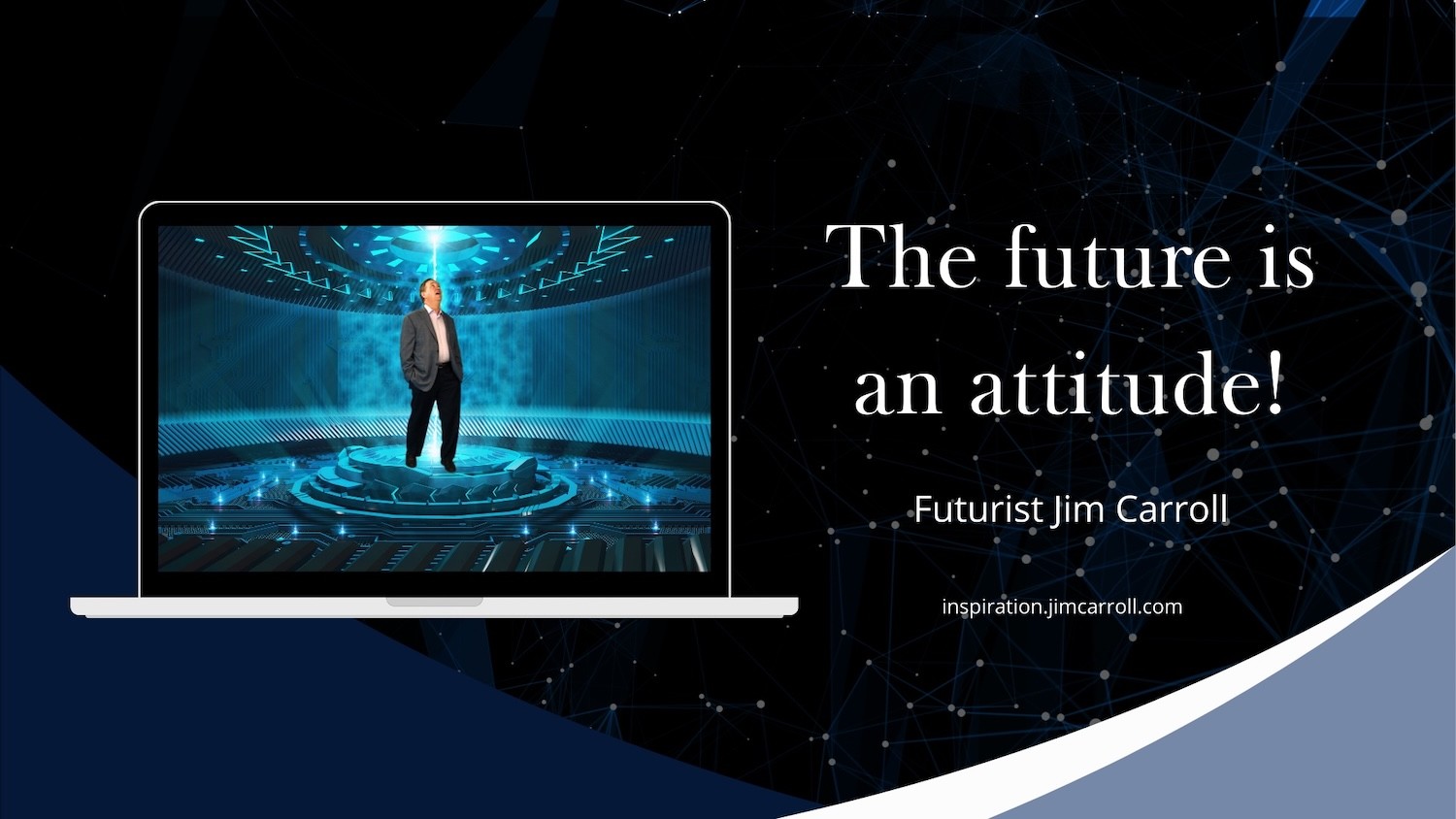
"The future is an attitude!" - Futurist Jim Carroll

It's Monday morning. What are you waiting for?

With that being the case, why not have an image where I'm staring up into a teleportation portal? It's my future, and I get to imagine it!

You should do the same thing.

If you're feeling too comfortable right now with the future, you probably aren't thinking hard enough about the trends that will reshape your reality. You need to be scared; you need to be nervous; you need to have big ideas; you need to stretch your imagination; you need to be prepared to accept that everything is going to change—and most importantly, you need to be ready for action. After all, there might one day be teleportation portals - not in our life, but sometime!

That's why you need to think about this simple fact - the future isn't just. something you Watch - it's something you embody. The future is an attitude. While everyone else is busy tracking trends and technologies, they're missing something crucial: it's not just about knowing what's coming—it's about how you approach it, internalize it, and act on it.

The most successful people don't just observe the future; they have a mindset that embraces it and takes immediate steps to make it real. Anyone can read about emerging trends, but those who truly thrive in tomorrow's world cultivate specific attitudes that transform challenges into opportunities—and then act on them without hesitation. With that being the case, think about the mindsets that will help you stay ahead.

And most important - do something today - right now - Monday morning - that will get you moving! Here are 10 ideas you should think about right now - and 10 things you should commit to doing THIS MORNING.

----
Later this morning, Futurist Jim Carroll will have his winter tires swapped out. He’s preparing for a future that involves warmer weather.

Original post: jimcarroll.com/2025/03/decodin

★ 0 • ↻ 1 original
Mar 31, 2025 · 1:18 PM UTC↩ reply

@david_chisnall

Ya, which is why we never stick Canadian flags on our luggage when we are travelling.

★ 0 • ↻ 0 original
← February 2025April 2025 →