Futurist Jim Carroll

Mastodon post archive · 2022–2026
Archived from mastodon.futurist.info · 4209 posts
← All months

January 2025 · 29 posts

← December 2024February 2025 →
Jan 1, 2025 · 1:08 PM UTC

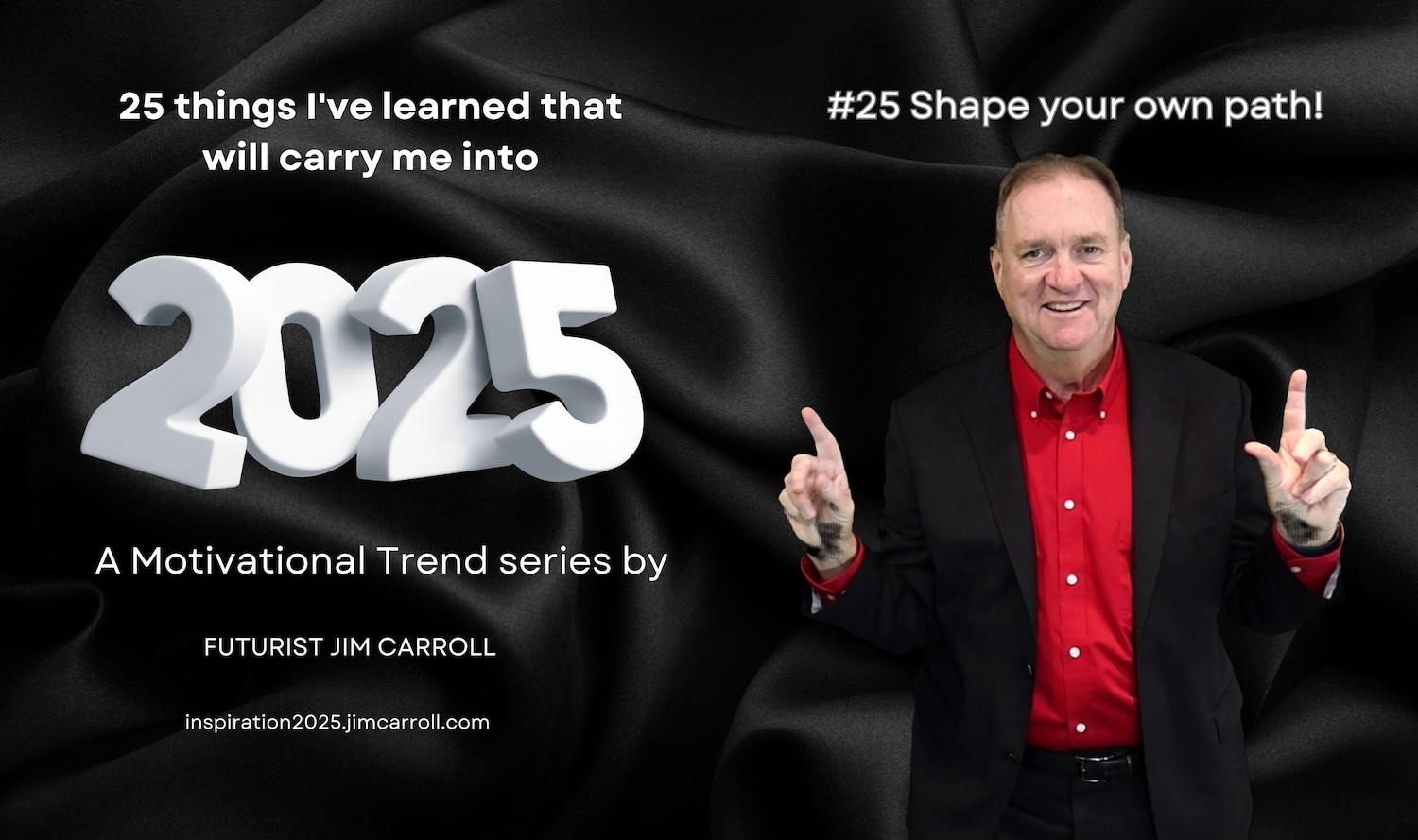
Daily Inspiration: "Shape your own path!" - Futurist Jim Carroll

Happy New Year!

Start the year with some great success - by shaping your path!

Let me inspire you with a story of where my previous 23 posts on ideas that we can take into 2025, will allow us to shape our path in 2025.....

-----

Chapter 1: The Path Less Traveled

"System check complete. All parameters nominal."

Dr. Elena Chen exhaled slowly, studying the banks of servers humming in Quantum Horizons' development lab. Behind her, Marcus Rodriguez tapped commands into his console. It was 3 AM on January 1, 2026 - mere moments after the New Year's Eve celebrations of 2024 into 2025 wound down. A small group of slightly inebriated team members looked on, cautious and wondering. And then, everyone, glancing at each other, came to the sudden realization that after eighteen months of forging their unique path, they now stood at the threshold of something extraordinary.

Dr. Chen's eyes lingered on the framed article above her desk – Jim Carroll's final post of 2024, "Shape Your Own Path" from a year earlier. They'd found it so inspiring that it had become their company manifesto. Below it hung their mission statement: "In a world where everyone follows, we choose to lead."

She was determined that this should be the guidance to carry them into a volatile and unpredictable year because she knew they had a path they could own.

Their own.

To shape.

"They all said we were crazy," Marcus said, glancing up from his screen. "Taking the unconventional route, refusing the buyout offers, developing something entirely new instead of following the standard playbook."

Elena smiled, remembering Carroll's words about how true innovators must "reverse their setbacks sooner and find redemption faster."

They'd faced plenty of setbacks, but each one had only strengthened their resolve to stay on their chosen path.

(read the full post...)

---

Original post: jimcarroll.com/2025/01/daily-i

★ 1 • ↻ 0 original
Jan 2, 2025 · 11:13 AM UTC

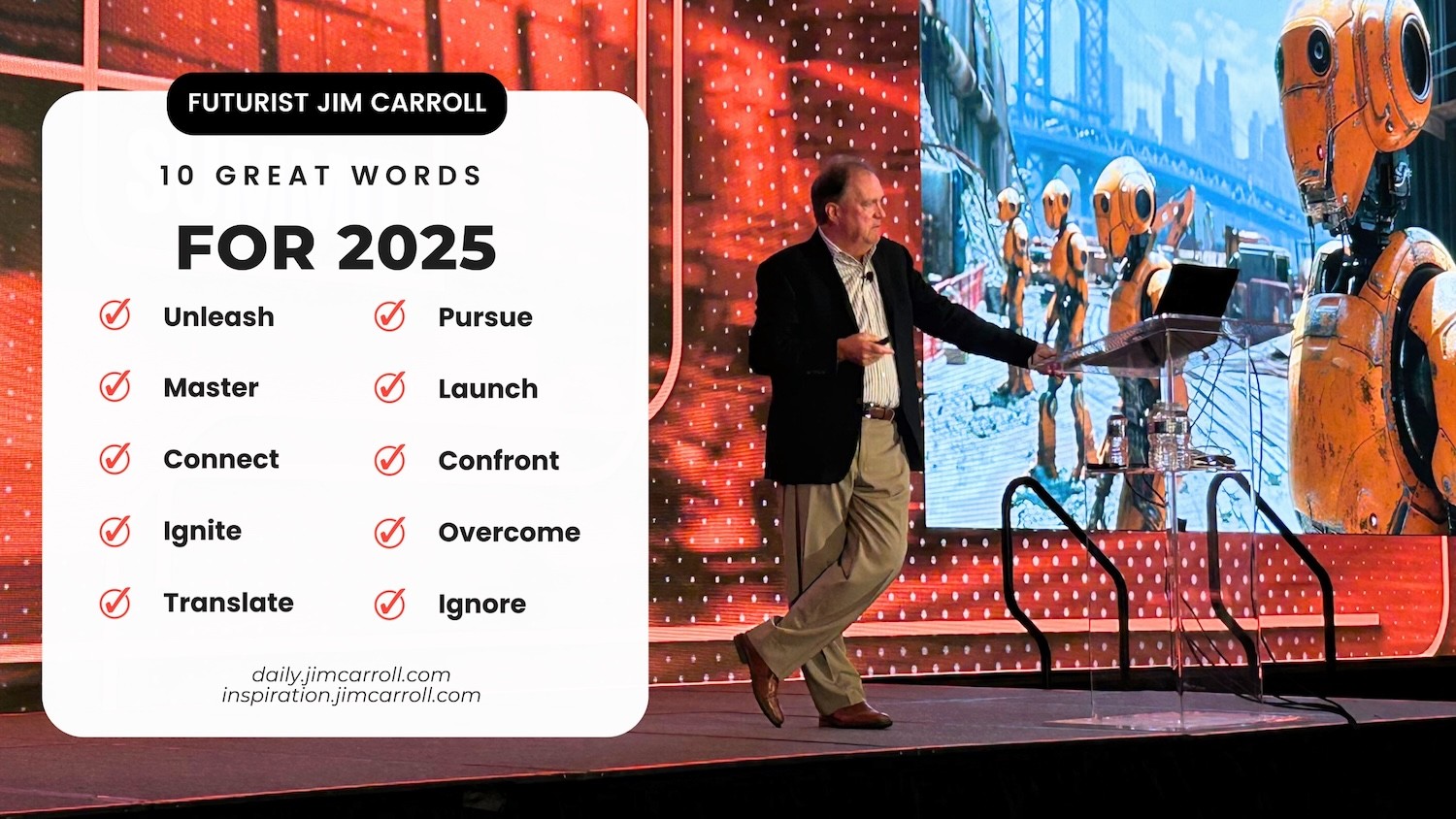
Daily Inspiration: "Unleash. Master. Connect. Ignite. Translate. Pursue. Launch. Confront. Overcome. Ignore!" - Futurist Jim Carroll

Every year, I put together a list of '10 great words' that I use to try to define a way of approaching. the year to come. They involve the overarching themes of future-oriented thinking, innovation, action, and personal growth while excluding the words I have already used, and focusing on action. These words are intended to serve as powerful motivational guidance.

This tradition goes back to 2006 when I released my first list of '10 great words.' That took off as a stage story - I closed many an event with them as a powerful closing storyline

In that vein, here are the 10 Great Words for 2025.

"Unleash" potential with the mindset that despite volatility in 2025, there will be opportunity. To do that, you should continue to...

"Master" new skills that are critical for applying this knowledge effectively. To make the most of this, you plan to...

"Connect" more dots by using these skills and knowledge to see bigger patterns and opportunities. Once you see them, you need to make sure to .....

"Ignite" every idea that emerges from these connections, sparking innovation and creativity. That will involve your ability to...

"Translate" those ideas into actions to make tangible progress and bring concepts to life. Once that happens, you will be able to...

"Pursue" the right opportunities that emerge from your actions, selecting those that promise the greatest impact. You'll need to make sure to...

"Launch" those actions into full-scale initiatives, executing your plans with precision. Be ready though, to ....

"Confront" the barriers that inevitably arise, addressing challenges head-on. And not only that but you will need to ...

"Overcome" the obstacles by adapting and refining your strategies as necessary. And above you, given the volatility that is to come, you will need to
...

"Ignore" the noise that distracts from your goals, focusing solely on what truly matters.

How can you do all these things? Small steps!

**** **** **** **** **** **** **** **** **** ****

jimcarroll.com/2025/01/daily-i

★ 0 • ↻ 0 original
Jan 2, 2025 · 7:09 PM UTC

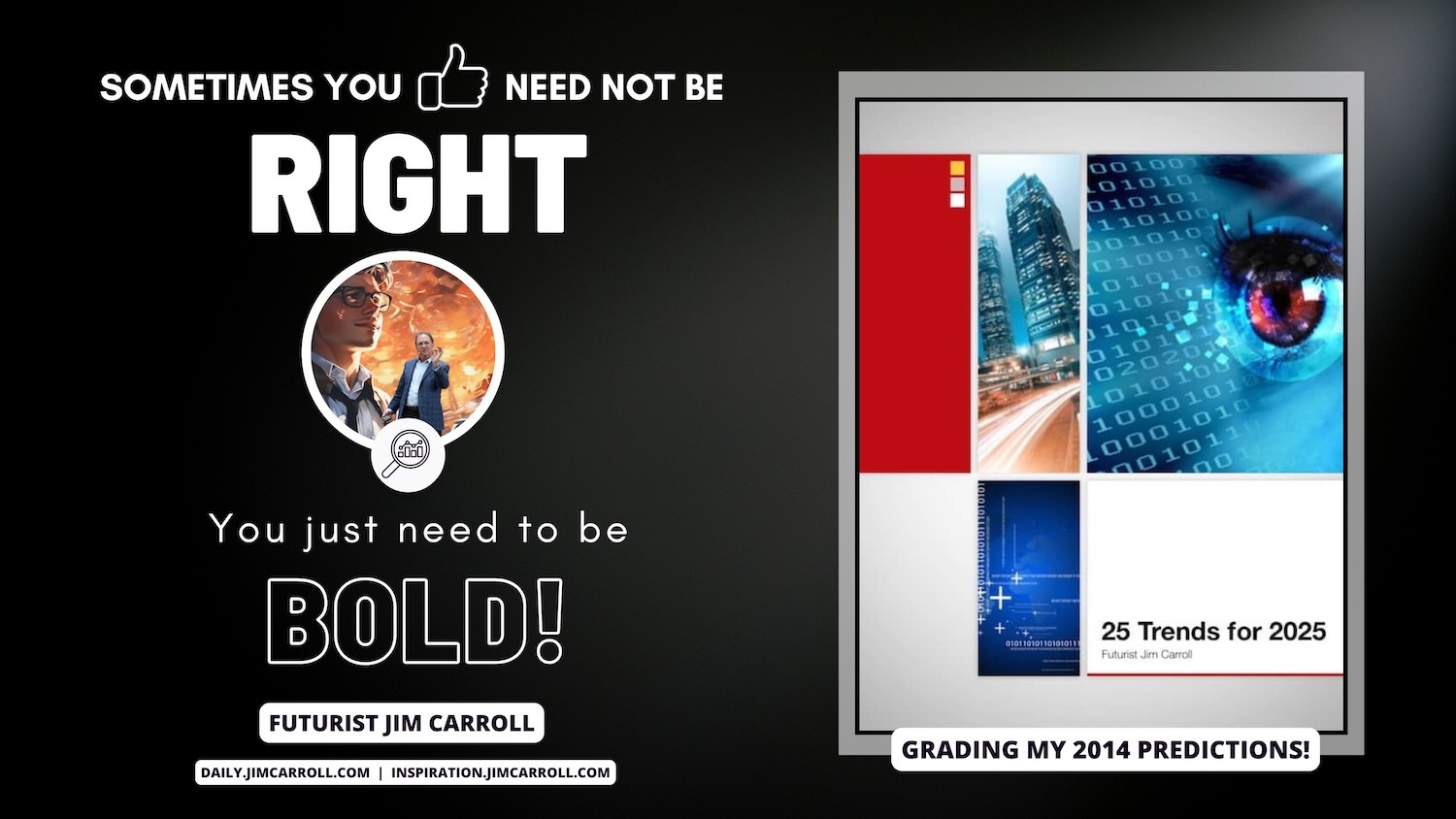
In 2014, I wrote a piece: "25 Trends for 2025".

So how did I do?

Stay tuned - tomorrow morning I'll have a long blog post that takes apart each trend, ranks me, & gives insight going forward.

Are futurists full of it, or do they bring some value to the table? Find out! (I have my thoughts, obviously)

★ 0 • ↻ 0 original
Jan 2, 2025 · 7:13 PM UTC

For years, I've been saying that the era of Detroit, Stuttgart, and Tokyo with the global auto industry is coming to an end.

Legacy auto has long been missing the mark with the shift to electric and with cars-becoming-computers. They've become fat on SUVs, have failed to innovate, and don't have the digital bench strength - they are a Kodak in the era of Apple. On the other hand - China? Big on electric - and they get digital.

In that context, read this post by Bob Lefsetz - one of the smartest guys I know. Been following him for 30 years. He's ALWAYS right.

lefsetz.com/wordpress/2024/12/

**** **** ****

★ 1 • ↻ 0 original
Jan 3, 2025 · 11:36 AM UTC

Daily Inspiration: "Sometimes you need not be right - you just need to be bold!" - Futurist Jim Carroll

Welcome to 2025!

Back in 2014, I wrote a series of predictions about 2025 - in a document titled, of all things, '25 Trends for 2025'. (Intuitive!) At the time I wrote it, most of the news media were busy, as they are every year, contacting futurists, trend forecasters, and guys like me to bang together their year-end articles about "what comes next? It's at 2025.jimcarroll.com

When I put together this particular trends document in 2014, it was a rather hurried affair and reflected much of what I was talking about at various events throughout the year earlier. As a result, it wasn't something very comprehensive - it was just a grab bag of stuff. And my goal wasn't just to predict the future - it was to demonstrate how we should think about it. It goes right to the heart of the observation by Bill Gates: "People tend to overestimate what will happen in two years and underestimate what will happen in ten."

I thought it might be fun to go back, take a look at each prediction, and then see how I did. I enlisted Claude.AI to help me in this process and asked it to give me a grade for each prediction.

Read the post for the analysis of each of the 25 trends.

Out of 24 verifiable predictions:

Correct: 4 (16.7%)
Somewhat Correct: 10 (41.7%)
Didn't Happen: 8 (33.3%)
Ridiculous: 1 (4.2%)
Unknown: 1 (4.2%)

"Carroll's predictions were most accurate in areas of technological advancement, particularly in healthcare, agriculture, and digital transformation. 

So what's the point of all this?

The real value in futurism isn't about getting predictions exactly right - it's about developing frameworks for thinking about what's next. When I look at those 2014 predictions now, I see the methodology that still guides my work today:

The key isn't to predict the future perfectly - sometimes, it's just about being bold enough to try to predict it!

** **** **** **** **** **** **** **** **** **

---

Original post: jimcarroll.com/2025/01/daily-i

★ 0 • ↻ 1 original
Jan 6, 2025 · 10:59 AM UTC

Daily Inspiration: "You can't do extraordinary things with an ordinary mindset!" - Futurist Jim Carroll

You know what separates the disruptors from the disrupted? It's not their technology. It's not their budget.

It's their mindset.

That's why one of the best things we can do to move forward to to stop thinking about what is and start thinking about what could be. Because here's the thing: if you're still operating with an ordinary mindset in these extraordinary times, you're not just standing still - you're moving backward.

Think about it - you will never:

- find new opportunities if you're always clinging to old habits

- outpace the competition by doing what everyone else is doing

- learn new things if you're afraid to let go of old ones

- find your passion if you fear exploration

- move forward if you keep looking back

- reach your destination if you're afraid to take the first step

- build resilience if you shy away from adversity

- truly live if you're afraid to take risks

- find true success if you are chasing someone else's definition of it

The fact is, you will never achieve greatness if you settle for mediocrity. That's why the title of my upcoming satirical book is titled "Embracing Mediocrity."

All of the ideas above, if you think about them, emphasize how important it is to break free from conventional thinking, embrace change, take risks, and focus on the future to achieve extraordinary results. It's all about having a proactive, innovative, and resilient mindset. The fact is this - the future isn't some distant concept we're waiting for - it's being created right now, by people who refuse to accept "that's how we've always done it" as an answer.

They aren't settling for mediocrity.

**** **** **** **** **** **** **** **** **** ****

Original post: jimcarroll.com/2025/01/daily-i

★ 0 • ↻ 0 original
Jan 7, 2025 · 11:32 AM UTC

"You will never see the intelligence if you never try to use the tools!" - Futurist Jim Carroll

I've long believed that you can't talk about something if you don't do that something.

I certainly can't talk about climbing Mt. Everest because I never have. My good friend Scott Kress has, and so he talks about building an effective team to accomplish such a goal. He's pretty good at it.

Which brings me to skiing and AI.

One thing I've learned by becoming a skier at the age of 40 is that you can learn a lot from people on the chair ride open - most people are friendly and eager to talk. Conversations during the minutes on the ride up can cover anything and everything, from family to career, politics to sports - and of course, snow conditions.

I've found that I can learn a lot - particularly from younger generations - about important trends and personal motivations. Many years ago, I found that they don't talk about what they do for a living - they talk about what they like to do., I worked that into other observations I was seeing at the time, and turned it into a full workforce trend.

For some reason, I ended up spending some time on the 'ride up' with several young adults who had carved out a career in IT, and our conversations turned to AI. Among the many observations I learned was this key one - most are very cognizant that artificial intelligence is rapidly changing the very nature of software coding, and while they aren't concerned about losing their jobs to an AI, they sure as heck are spending time learning how to use it to their advantage.

In other words, they are thinking that if they are busy writing computer code, they might as well use AI as an ally to help them do so, to be more efficient, master more complex tasks, and further enhance their skills. In that vein, they are learning how to find the intelligence in the AI by actively using the tools.

That's a wildly important concept that everyone should follow.

With this idea firmly planted in my mind, in addition to skiing writing a book, and doing various holiday things over. the break, I've also spent a lot of time working with AI coding tools to find its intelligence. And, it's, wow ...

Learn more:

**** **** **** **** **** **** **** **** **** ****

---

Original post: jimcarroll.com/2025/01/daily-i

★ 2 • ↻ 2 original
Jan 8, 2025 · 1:35 PM UTC

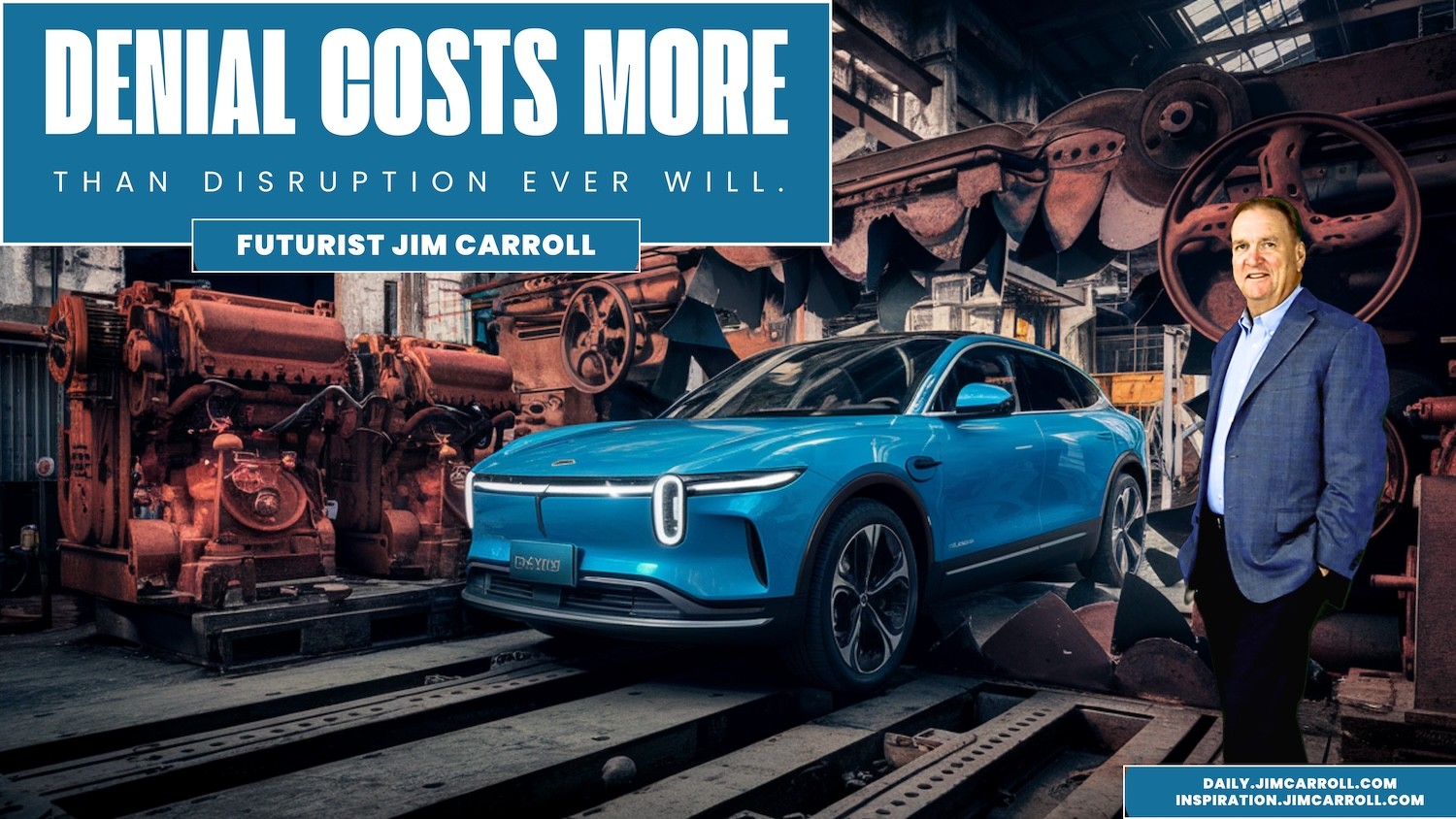
Daily Inspiration: "Denial costs more than disruption ever will" - Futurist Jim Carroll

Are we witnessing the end phase of the auto industry's lost battle and the cost of cultural denial?

That might be the case. Watch this short video clip with Ford CEO Jim Farley at the recent DealBook summit.

youtube.com/watch?v=J6uUdjKWgyU

His comments mirror what I've come to believe over the last few years - it brings me no joy to realize that it's pretty likely that the North American, German, and Japanese automotive industries have lost the battle for the future. I apologize for the bluntness of this assessment, but as a futurist, my role isn't to comfort - it's to confront reality. Given everything that has happened, and where we stand today, it seems to be an uncomfortable truth.

The implications, of course, are staggering.

What makes this loss particularly tragic is that it didn't have to happen. But somewhere along the way, transformative technologies like electric vehicles became casualties of the unprecedented cultural war. We've entered an era where scientific and technological progress has become entangled with identity politics, where choosing an electric vehicle isn't seen as an economic or environmental decision, but as a cultural statement. The same phenomenon has infected attitudes toward renewable energy, genomic science, and other breakthrough technologies that should represent economic opportunity rather than ideological battlegrounds.

I've posted about this before here, but the real implications are becoming more clear day by day.

The cost of this cultural warfare against the future isn't just measured in polar ice or parts per million of carbon - it's measured in trillion-dollar markets lost, in jobs never created, in innovations stunted. While we've been arguing about whether climate change is real, China has been building the future.

Farley's recent comments read like a case study of what happens when an industry awakens too late to a transformative shift.

It didn't have to happen. And in the weeks and months and years to come, the implications will become clear.

Futurist Jim Carroll tries to always bring a positive tone to his posts, but the staggering impact of some trends is just too big to ignore.

**** **** **** **** **** **** **** **** **** ****

---

jimcarroll.com/2025/01/daily-i

★ 1 • ↻ 0 original
Jan 8, 2025 · 9:09 PM UTC↩ reply

@kmjreade

See inspiration.jimcarroll.com

I started writing these in week one - shortly after 6/26/2016 (see bio)

They are now the first thing I do every day.

I have not missed one workday.

They are now my morning meditation, the first thing I do every day.

It is a critical part of my journey. The beauty of the clarity brings me peace.

Write more!

★ 0 • ↻ 0 original
Jan 9, 2025 · 11:06 AM UTC

"People aren't impressed by what you say you can do - they're impressed by what you actually do!" - Futurist Jim Carroll

Prove it.

That's what matters.

People remember people who get things done. People who get things done are the ones who succeed with the future and trends.

Here's what I know about initiative and moving forward -talk is cheap. Really cheap. I've watched countless organizations and individuals tell me about all the amazing things they're going to do - and then watched most of them do, literally, absolutely nothing after the fact. They've booked me for a keynote on innovation, but they don't innovate. They ask for hard-hitting insight on disruptive trends and then watch as others disrupt their business. They seek insight on how to accelerate their creativity but fall right back into their old mindsets.

What happens in these situations? A lack of commitment, but more importantly, a lack of initiative.

That's why I have often said that motivational insight is, for some, a bit like Chinese food. It's great at the moment, but you're hungry 20 minutes later.

Here's what it all comes down to: success isn't about having the best ideas - it's about having the courage and capability to act on them. Organizations that align themselves with the speed of change, that foster a culture of action over discussion, and that understand the importance of immediate implementation are the ones that consistently succeed in shaping their future rather than being shaped by it.

Remember: in today's rapidly evolving world, the gap between opportunity and obsolescence isn't determined by what you know - it's determined by what you do with what you know.

Think about that.

Stop talking about what you're going to do.

Start doing it.

Because that's what people remember.

Action matters.

**** **** **** **** **** **** **** **** **** ****

jimcarroll.com/2025/01/daily-i

★ 2 • ↻ 0 original
Jan 10, 2025 · 12:46 PM UTC

"If you aren’t relearning how to learn, you aren’t really learning!" - Futurist Jim Carroll

Let's go back for a moment to item **#3** on my list of '25 Strategies for 2025" - which was to be relentless in knowledge discovery. As I wrote, we are seeing massive growth in the generation of information.

- the total amount of digital data created worldwide doubled approximately every two years in the 2010s and early 2020s

- scientific research publications have been growing at a rate of about 8-9% per year, doubling roughly every 9 years

- in emerging technology fields like machine learning and genomics, the volume of research papers is doubling approximately every 2-3 years

- in many scientific fields, about half of what we know today was discovered in the last 15-20 years

- the average half-life of professional skills has dropped from about 10-15 years to 5 years, meaning skills learned today may be only half as valuable in 5 years

One of our key goals every day, as we use search engines, is to learn how to turn this vast trove of information into actual knowledge. Without that, this is just a lot of information.

Most of us turn to Google to do that - it's still the most popular search engine out there. And yet, many people (or most people?) are very frustrated, as the typical search results page is full of unwanted information. A typical search results page is now just full of sponsored results, advertising links, information summaries, and more.
 
Enter Kagi - a paid search engine. I was drawn to it after a recent post in which the founder was interviewed. He was explaining in eloquent detail the problem with Google, Bing, and the other main search engines - the fact that the search results page is just too full of clutter.

I was intrigued and decided to give it a try.

Learn more about what I learned by using it.

**** **** **** **** **** **** **** **** **** ****

---

Original post: jimcarroll.com/2025/01/daily-i

★ 3 • ↻ 1 original
Jan 11, 2025 · 11:36 AM UTC↩ reply

@breiti @kagihq Tnanks. Will look into that.

★ 0 • ↻ 0 original
Jan 13, 2025 · 8:22 PM UTC

"Every weakness carries the seed of strength!" - Futurist Jim Carroll

Turn your weakness into strength!

That isn't just some feel-good motto – it's the rocket fuel that's propelling the most successful organizations and individuals into the future. They've learned how to bounce back from the downturns, recover from the upsets, and move forward from the things that would push them back.

I've been through that, a few times. After the dot-com collapse, my speaking engagements, newspaper columns and book deals dried up completely - because no one was interested in what I was offering.. But you know what? That apparent weakness became my launching pad. Instead of staying stuck in pure technology, I expanded my focus into innovation and creativity. With a lot of work I was connecting with entirely new audiences – and building a new career trajectory. My weakness - too much of a focus on one topic area - became my strength as I used my experience to broaden my horizons.

There are powerful lessons in this type of thinking. In periods of economic volatility, companies can be at their weakest if they succumb to the negativity - but can build their strength by opting out. During every global economic downturn, companies split into two camps. The "play it safe" crowd cut costs and scaled back R&D. But the innovators? They doubled down on growth and innovation. The result? A stunning 13% compound annual growth rate compared to a measly 1% for the fear-frozen competition. That's not just a statistic – that's the power of turning weakness growth.

So how can you focus on turning weaknesses into strength:
Stop fighting fires Too many organizations are stuck in fire-fighting mode, constantly asking "Whoah, where'd that come from?" Their weakness is they aren't looking forward - their strength should be doing that. The real innovators are asking "What comes next, and what do we need to do about it?"

Supercharge your experience velocity! Here's what one CEO told me that really caught my attention during a planning call.: "We don't have a knowledge problem. We have an experience velocity problem." Think about that! Innovation isn't just about having good ideas – it's about rapid experimentation, gathering real-world data, and failing fast to adapt quickly.

Start seeing your weaknesses as the launching pad for your next big opportunities!

jimcarroll.com/2025/01/daily-i

★ 0 • ↻ 0 original
Jan 14, 2025 · 11:27 AM UTC

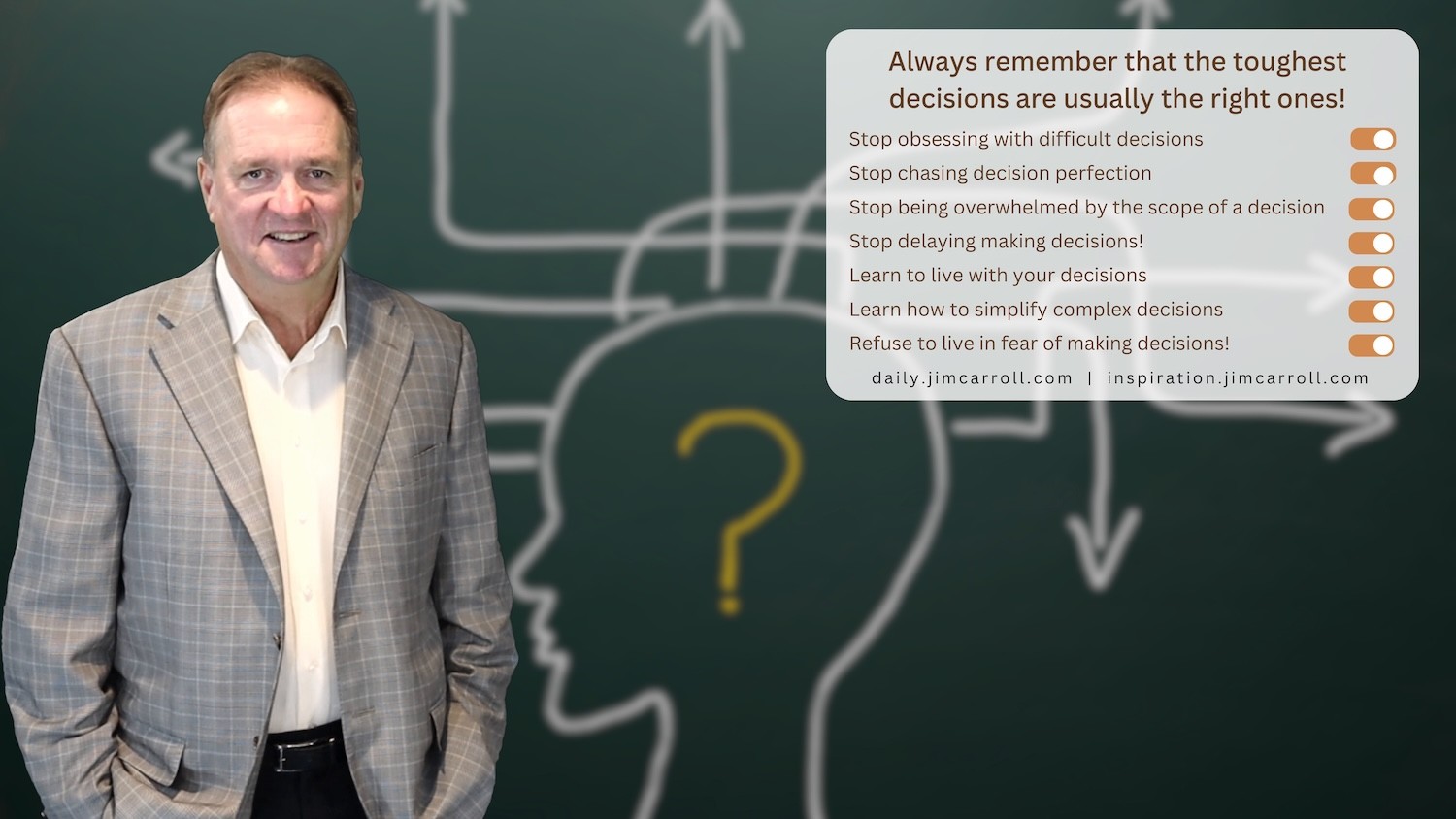
"Always remember that the toughest decisions are usually the right ones!" - Futurist Jim Carroll

It's difficult to make difficult decisions!

That doesn't' mean they shouldn't be made - because the very action of not making the decision will make the impact of the decision even bigger, one way or another. 

I wrote about this reality some years ago. noting that "life is a wonderful voyage, often rudely interrupted by the need to make difficult, complex, sometimes staggering decisions." Today's post offers up a number of things that come with the territory:

- Stop obsessing with difficult decisions

- Stop chasing decision perfection

- Stop being overwhelmed by the scope of a decision

- Stop delaying making decisions!

- Learn to live with your decisions

- Learn how to simplify complex decisions

- Refuse to live in fear of making decisions!

That's some good, general guidance in how to deal with complex situations. In that context, have you ever thought about how you might challenge your innovation and creativity capabilities by concentrating a little more on what you can do to get better at managing those decisions?

- first and foremost, don't seek perfection in the decisions you have to make

- turn a complex decision into several simple ones by breaking it down into smaller ones

- refuse to be overwhelmed by the potential implications of a wrong decision - you can always 'pick up the pieces' later!

- don't fear making the decision - be afraid of not making it

Always think of this way - difficult decisions are like physical exercise - they may hurt in the moment, but make you stronger in the long run!


---
Original post: jimcarroll.com/2025/01/daily-i

★ 0 • ↻ 0 original
Jan 14, 2025 · 8:32 PM UTC

Has anyone done an install of Mastodon built on top of AAPanel for Nginx, Redis and Postgresql management? Thinking of migrating servers and looking to make some of the process easier.

★ 0 • ↻ 1 original
Jan 14, 2025 · 10:34 PM UTC↩ reply

@lautreg Ok this looks interesting! Deeply familiar with CloudPanel and AAPanel but not Yunohost. Gonna dive in.

★ 0 • ↻ 0 original
Jan 15, 2025 · 11:01 AM UTC

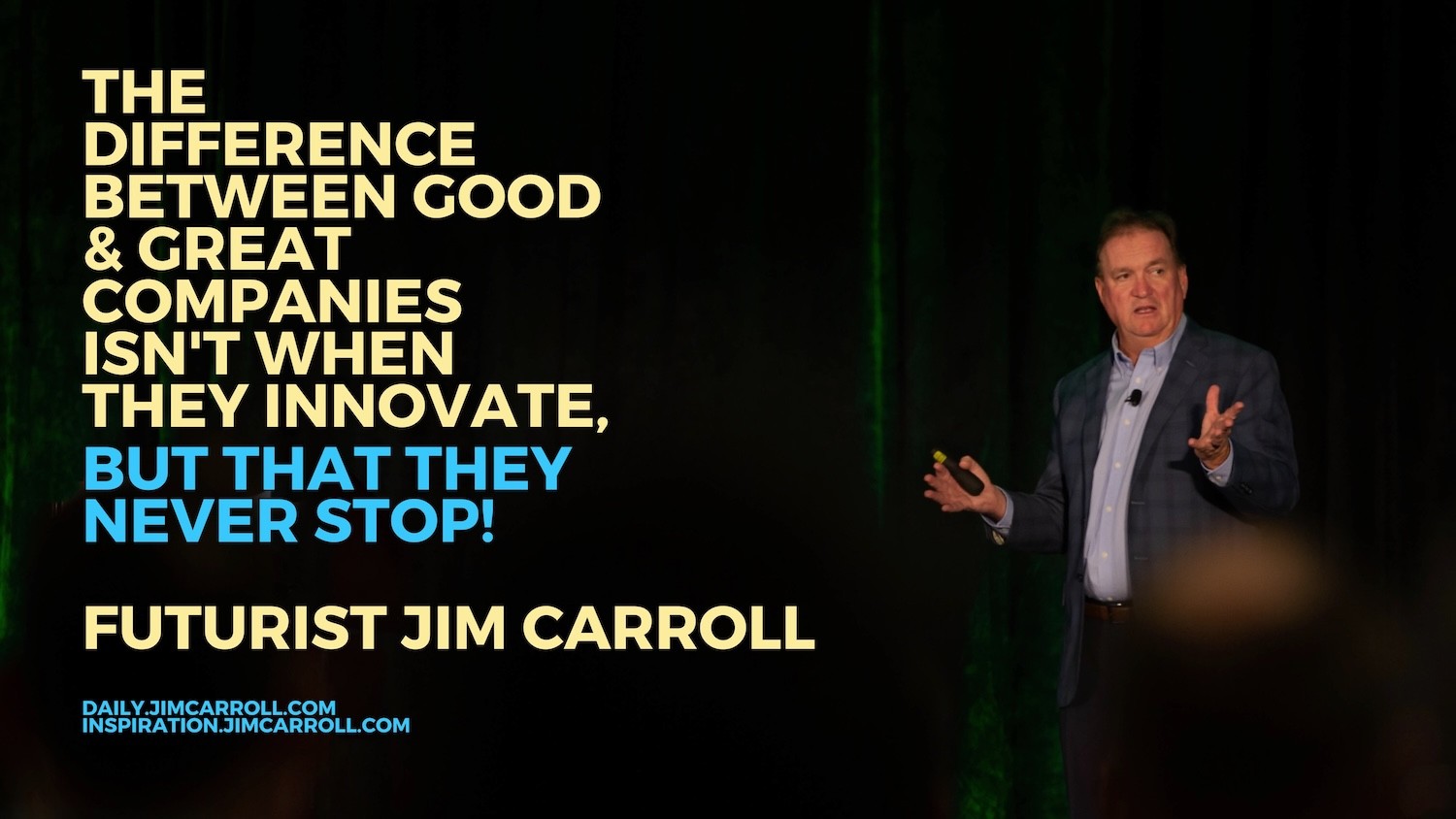
Daily inspiration: "The difference between good & great companies isn't when they innovate, but that they never stop!" - Futurist Jim Carroll

Over the years, I've had several companies come to me, seeking a speaker for a leadership or annual conference, stating that their 'theme this year is innovation.'

I tried hard not to crack up.

As in, you only do this once?

You are going to 'do' innovation and then move on to the next thing?
Shouldn't you be innovative all the time?

I've always been sure that their intentions are good, and in most cases, it has been - they are in an innovative mind space and are always prepared to explore their opportunities through creativity.

But there have been many others for whom innovation seems to have been a 'one-time thing,' an afterthought, an item to address on a checklist before moving on to the next leadership buzz thing.

Um, OK.

The reality is this: innovation isn't an annual event - it's the daily heartbeat of progress that keeps organizations alive. When you schedule innovation for a conference as a one-time topic, you've already missed the point. True innovation lives in every moment of every day. And in fact, the most dangerous words in business aren't 'We're failing,' but 'We'll innovate next quarter.' Innovation isn't a theme - it's the very air successful organizations breathe. The fact is, if you have to declare an innovation season, you're already living in the depths of a pretty brutal leadership winter.

The difference between average companies and great companies is that tomorrow's leaders don't schedule creativity or innovation  - they cultivate it in every conversation, decision, and moment.

The companies that survive don't ask when to innovate - they ask why they ever stopped!

---

Original post: jimcarroll.com/2025/01/daily-i

★ 1 • ↻ 0 original
Jan 16, 2025 · 11:50 AM UTC

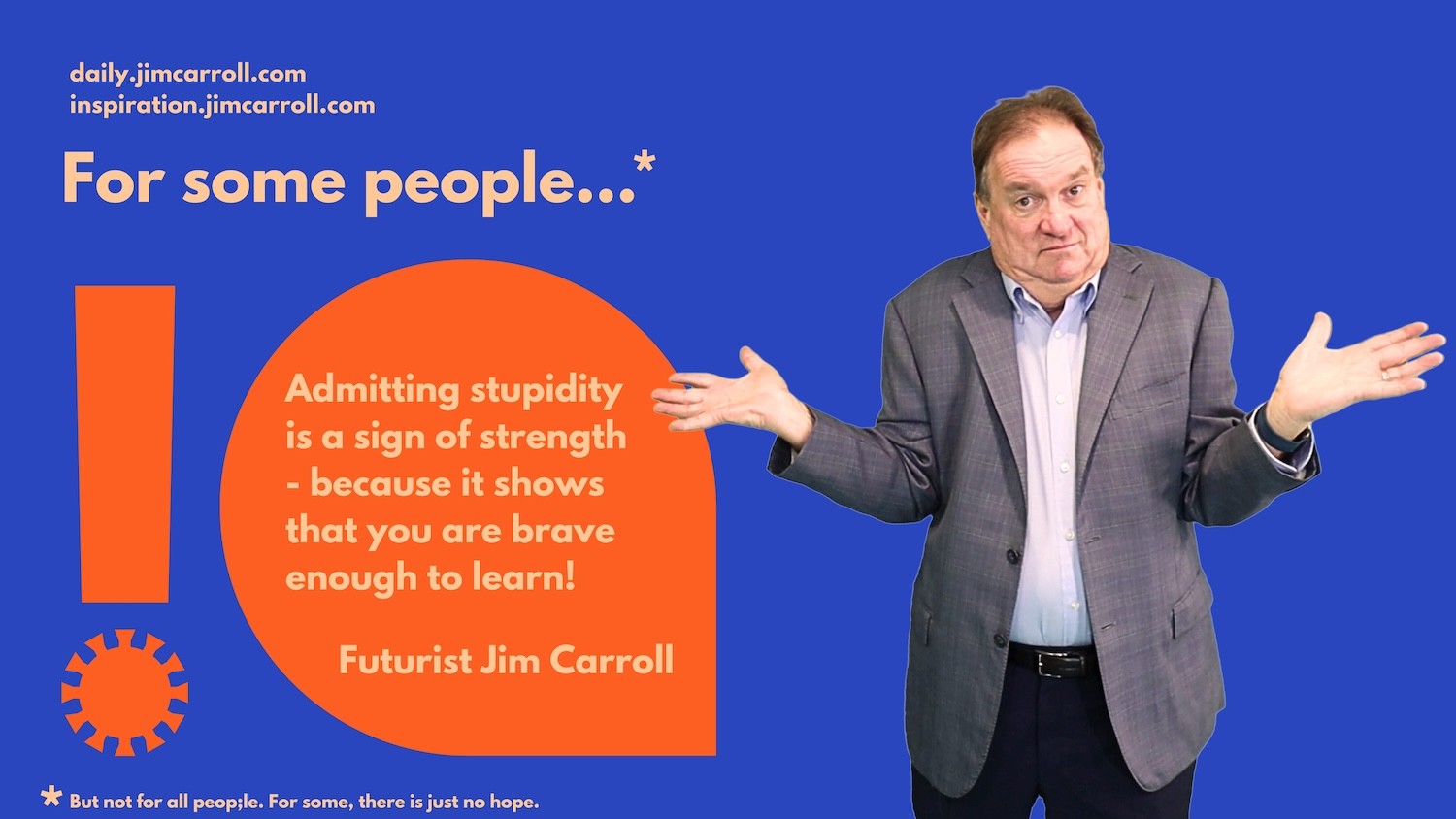
“Admitting stupidity is a sign of strength – because it shows that you are brave enough to learn!” – Futurist Jim Carroll

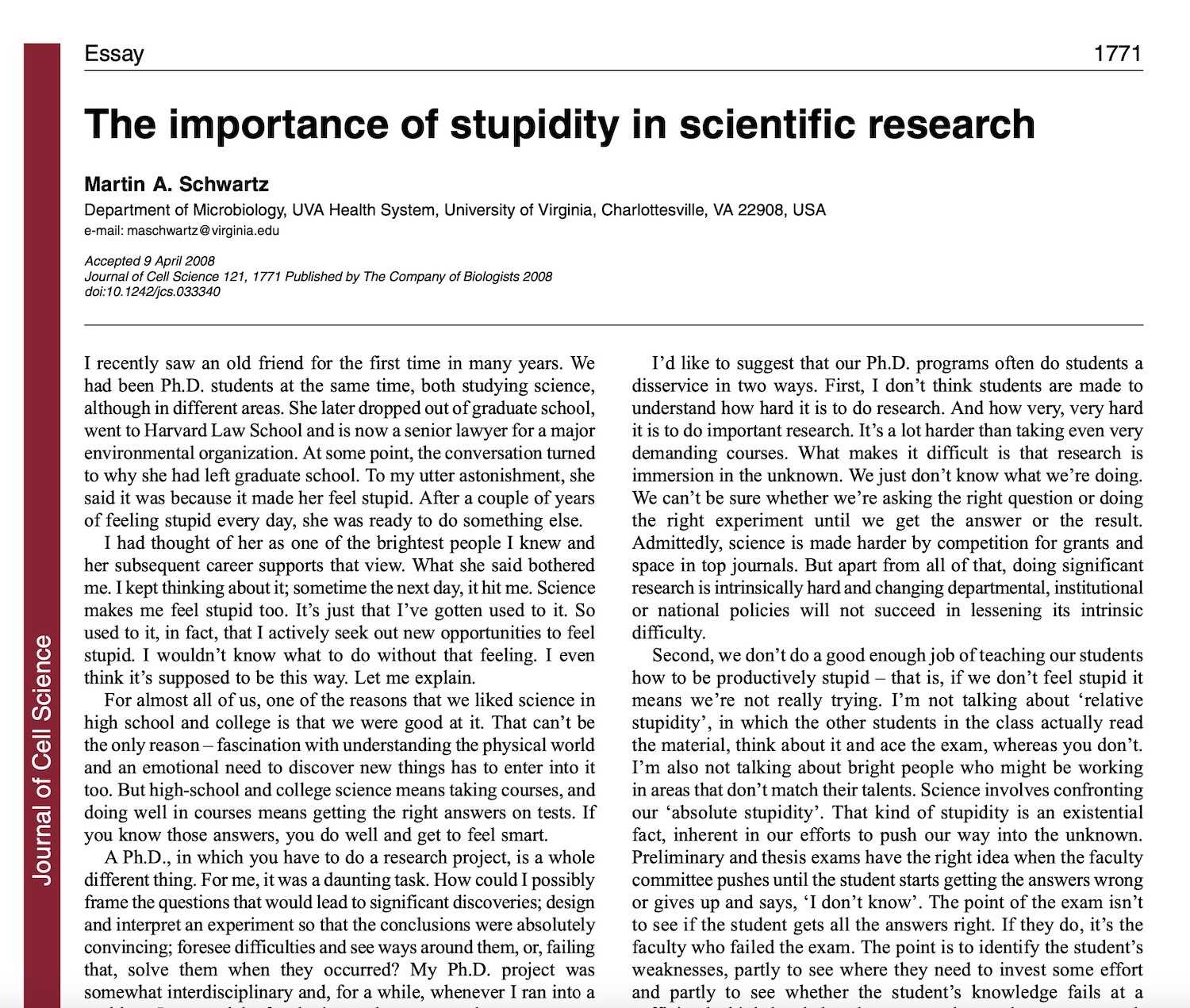
So I came across this scientific paper which suggested that there is power to be found in stupidity.

This article seemed to fit within the vibe of what someone suggested on social media – “This weekend might very well be the last normal weekend for the next 100 years.” Though your opinion might vary, some believe we are truly entering an era of stupidity.

Eager to find some sort of upside to the downside, I eagerly read the article – and I discovered much more than I expected. Here’s what the paper suggests:

- the feeling of stupidity in scientific research isn’t a weakness – it’s a necessary and valuable state that indicates you’re pushing into genuinely unknown territory. As the author says, “If we don’t feel stupid it means we’re not trying.”

- research is fundamentally different from coursework because it requires confronting “absolute stupidity” – the vast realm of things we don’t yet know. Recognizing this infinite scope of unknowns is liberating because it permits us to “muddle through as best we can,” figuring things out as we go.

- being “productively stupid” means intentionally choosing to be ignorant by pursuing important questions that push us beyond current knowledge. This is different from relative stupidity (just being less prepared than peers) or working in areas that don’t match your talents.

- The scientific process thrives on this kind of stupidity – it allows researchers to “bumble along, getting it wrong time after time, and feel perfectly fine as long as we learn something each time.” This iterative process of learning through failure is essential for discovery.

The core message is that feeling stupid isn’t a bug in scientific research – it’s a bonus feature! It’s the necessary state of mind for pushing beyond current knowledge boundaries and making genuine discoveries! It’s the ultimate aphrodisiac for chasing new knowledge!

Believing that I’m on to something and to fit with the modern times, I dare believe that there is innovation power to be found in stupidity!

Hear me out!

**** **** **** **** **** **** **** **** **** ****

jimcarroll.com/2025/01/daily-i

★ 2 • ↻ 0 original
Jan 17, 2025 · 11:41 AM UTC

"Maybe you should do more than have a plan to create a plan!" - Futurist Jim Carroll

My news clipping service recently picked up this gem of insight from a Conference Board leadership survey:

----

"Outside of Japan, few CEOs are looking to raise prices in 2025. Instead, the focus is on innovation, tech, and product development.

Innovation leads: Worldwide, 37% of CEOs say innovation is a top priority for growing profits, followed by introducing new products/services (29%) and investing in technology, including AI (26%)."

----

This was a bit of music to my ears since it's always good to see an indication that one of the most important actions for future growth comes to the forefront.

On the other hand, this took me back to my post the other day where someone commented that 'we decided to do innovation this year,' implying it was a one-time thing. (It's not!). I thought it might be a good idea to look back at a lot of my guidance on innovative thinking to provide a detailed structure for organizations to pursue so that they are doing much more than talking about innovation - they are embracing it as a core value and key strategy.

Why is that? Because I have learned that many organizations when they come to decide that innovation is a priority, start to plan on what to do, but are never quite sure exactly where to start. In doing so, they often spend more time planning to have an innovation plan than actually pursuing any type of innovation activity!

With that in mind, I went back to GoogleNotebook LLM, which has now become one of my go-to AI tools, to ask it what it could find in my more than 4,000 posts that I've written about the future, trends, and innovation, as to what organizations should do to align to the innovation opportunity.
Given this, provide a list of 50 things that organizations should do at a strategic, planning, investment, and execution level to provide for successful innovation.

It came back to me with quite the list!

I'm often reluctant to share a lot of AI-generated material, but this was such a good result that I thought it would be worthwhile to include it in its entirety. I also summarized this into a 4-item strategic framework.

**** **** **** **** **** **** **** **** **** ****

Original post: jimcarroll.com/2025/01/daily-i

★ 1 • ↻ 0 original
Jan 20, 2025 · 11:14 AM UTC

"On some days, focused distraction is the best action!" - Futurist Jim Carroll

Sometimes, you just don't need to pay attention.

You can choose not to tune in but you can drop out.

Timothy Leary said that.

This can be particularly important when you don't feel like you have any control over events.

In that case, do what you can to control the things you can. Let the rest of it go!

Here's what I'm doing today in the home office. I've got a project that has me building an AI tool that will read a variety of newsletters and news articles that are sent to me regularly, and which will summarize the information. I've got some projects involving some cleanup of various technical aspects of my Web servers and stuff. There's some additional research to do for a keynote that involves the landscaping industry. My wife will be working on the edits and preparation of my forthcoming Embracing Mediocrity book, and I will probably spend some time building out the Website for that.

I've got lots of distractions in my future today that can keep me wonderfully and blissfully distracted.

What a plan!

Here's the thing you need to think about - being distracted might be a good thing! Not only that, but planned distraction might be a great strategic idea! The very idea of "focused distraction" might not just be helpful for complicated times - it might very well be a key survival skill for the 21st-century innovation economy! After all, when things become volatile, unpredictable, uncertain and make no sense, taking time away from worry and concern, and devoting it to personal growth, might be one of the best things you can do!

The fact is, when you feel overwhelmed by massive, seemingly unsolvable challenges, strategic task-switching isn't procrastination - it's an investment in yourself! You're allowing your mindset to reconfigure, creating new pathways for breakthrough thinking and creative ideas. 

Staying wonderfully focused on distractions is sometimes a way to accomplish that!

Futurist Jim Carroll plans to do a lot of inconsequential things today, with a focus on chasing focused distraction.

**** **** **** **** **** **** **** **** **** ****

jimcarroll.com/2025/01/daily-i

★ 2 • ↻ 0 original
Jan 21, 2025 · 11:26 AM UTC

"It's easy to overpromise, but even easier to underdeliver" - Futurist Jim Carroll

Nothing great is ever achieved when the gap between expectations and reality is never closed!

Leaders can become trapped by their rhetoric - the more ambitious their promises, the more pressure they face to maintain the illusion of progress, often leading to cover-ups, denial, or doubling down on failed approaches rather than acknowledging reality. The lesson isn't to avoid ambitious goals, but rather to maintain a clear-eyed view of actual capabilities and progress, and to prioritize honest communication over maintaining appearances.

Yet too many leaders do that.

The situation becomes worse when the gap between promise and delivery is vast simply because of fraud, dishonesty, or plain incompetence. The fact is, leadership failures that are based on this of overpromised under-delivery aren't just setbacks - they can be extinction-level events for organizations. Just ask Elisabeth Holmes of Theranos or Adam Neumann of WeWork.

In the next few years, we are likely to see some pretty significant expectation mismatches. It's easy to make a promise - it's tough to deliver on it. Particularly so when people have high expectations that will be almost impossible to deliver!

Why does this come about? In some cases, it can be due to what I call the "velocity gap" - leaders make vast promises but underdeliver because they can't align the organization to the speed of change. In other cases, it underestimates the effort to achieve the stated goals - call that the "delivery gap." Elsewhere, it's an innovation mismatch - and the lack of a "perpetual innovation engine," such that the organization is not rethinking fast enough.

Remember, in 2025 and beyond, the gap between promise and delivery isn't just a credibility issue - it's a survival metric in the age of exponential expectations!

**** **** **** **** **** **** **** **** **** ****

Original post: jimcarroll.com/2025/01/daily-i

★ 1 • ↻ 0 original
Jan 22, 2025 · 11:26 AM UTC

Daily Inspiration: “Sometimes, satire can become all too real” – Futurist Jim Carroll

There’s no doubt that there might not be a lot of logical, rational stuff going on in the next few years. That’s why I keep stressing that volatility is the new normal.

With that in mind, I can’t help but reach back to a post I wrote in 2009, which I reshared in 2013. I wrote it at the time when there was yet another hiccup in the sometimes-hot, sometimes-not relationship that exists between Canada and the US.

The post, ‘A “blast from the past from 2009 – “Canada announces end of economic relationship with the US, & a bold new strategy to 2020“‘ – was satirical. I wrote it when our then-current Prime Minister, Stephen Harper, was making a point that perhaps Canadians should be less hostile towards their southern neighbor when some sort of dust-up in the long-standing relationship happened.

It was satire.

And yet, here we are.

Sometimes, I suppose, satire just isn’t funny anymore.

I thought I would share the post. You might find what I wrote in 2009 to be interesting if not a prescient pathway that should have been followed.

Hit the link to read "A “blast from the past from 2009 “Canada announces end of economic relationship with the US, & a bold new strategy to 2020″‘ Futurist Jim Carroll, May 2009

Futurist Jim Carroll is proudly Canadian.

Original post: jimcarroll.com/2025/01/daily-i

★ 0 • ↻ 0 original
Jan 23, 2025 · 11:26 AM UTC

"Your biggest opportunity right now is to keep moving forward while others are going backward!" - Futurist Jim Carroll

There's a pretty big divide between forward thinkers vs. backward movers.

The fact is, the divide is very pronounced right now, and those who were always moving forward are feeling pretty dispirited about things. What do you do about that?

Like I said months ago - follow the science. Keep the long-term trends in mind. Focus on growth. Chase your opportunities.

Above all, don't give up - because your greatest opportunity right now is to continue going forward while others are going backward!.

We've got a fundamental divide that goes far beyond traditional political boundaries. It's a divide between those embracing the future and those desperately trying to turn back the clock to an idealized past that never really existed.

This isn't about left or right – it's about forward or backward!

When change accelerates (and it's accelerating faster than ever), forward thinkers see opportunity in our increasingly diverse, interconnected world. They understand that innovation knows no borders and that talent flows freely across artificial boundaries. Meanwhile, backward movers are building walls – not just physical ones, but walls of ideology and resistance in a vain attempt to block tomorrow and preserve the past. That usually never goes well.

I've dealt with this issue from the stage for decades. As a futurist, I speak about the realistic trends that define tomorrow. Some folks get inspired by what I share on the stage - and I've learned that others hate me and what I represent. There's not a lot I can do about that, except work harder to reach and inspire the former, particularly when times are tough.

The question isn't whether change will come – it's already here.

The real question is: Which side of history will you be on?

Will you join those who fearfully retreat into nationalist nostalgia, or will you help build a future of sustainable innovation and shared prosperity?

The future belongs to those who embrace it, not those who fear it.

At times the path might be a challenge, but that doesn't mean it's the wrong path.

Futurist Jim Carroll has long believed there is a lot of powerful leadership insight to be found in children’s stories. Just ask Oblio.

**** **** **** **** **** **** **** **** **** ****

Original post: jimcarroll.com/2025/01/daily-i

★ 1 • ↻ 1 original
Jan 24, 2025 · 11:18 AM UTC

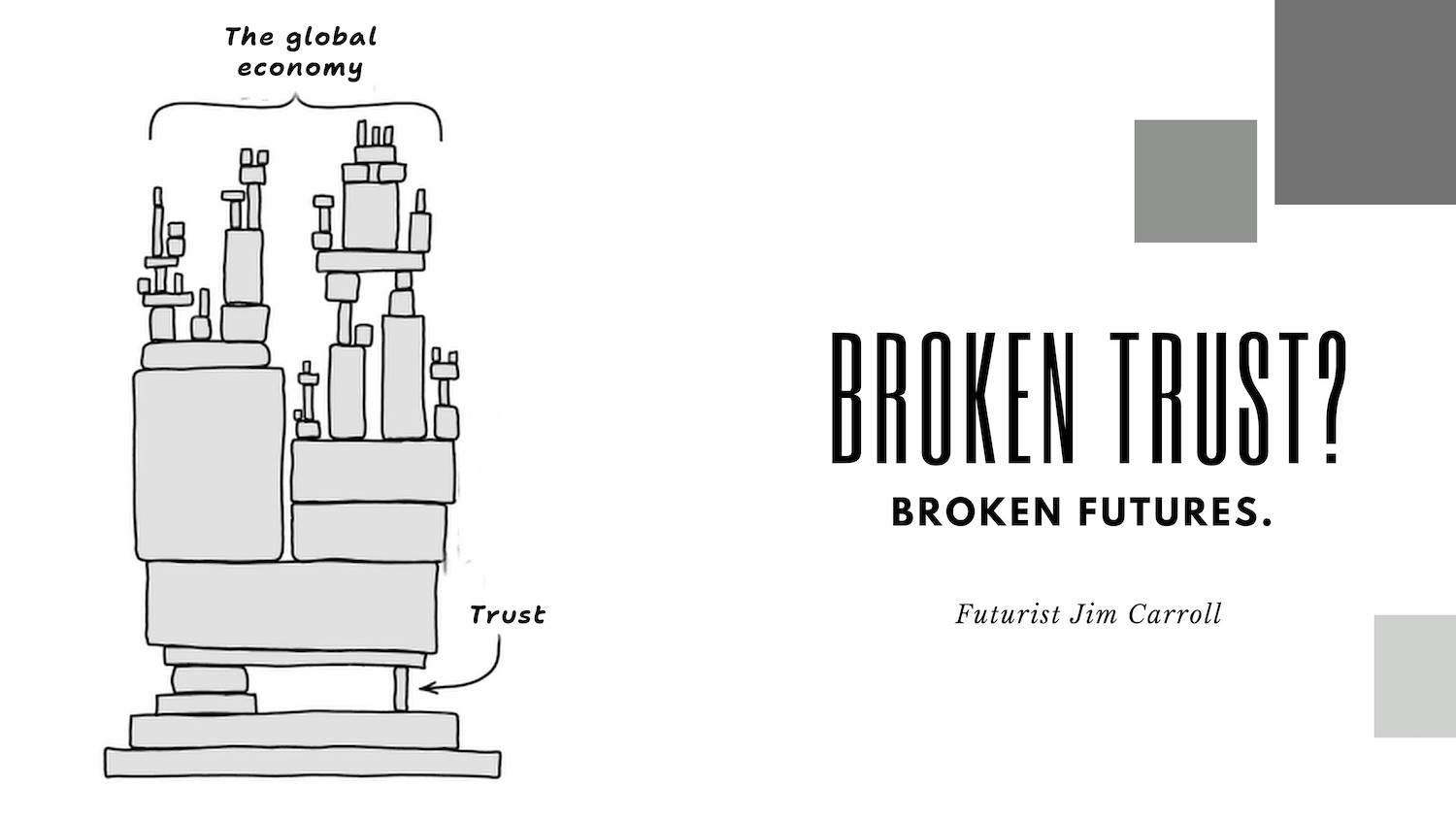
"Broken trust? Broken futures." - Futurist Jim Carroll

I didn't like season one. I sure as heck am not enjoying season 2.

Anyway, while I'm doing my damndest to try to avoid the news, my trend news tracking service did bring up these comments about Agriculture Secretary nominee Brooke Rollins at her confirmation hearing yesterday.

----

The committee's ranking Democrat, Amy Klobuchar (Minn.), also expressed concern in opening remarks about tariff increases and the impact on the agriculture industry. “I hope that, if confirmed, Ms. Rollins will make the case for sensible trade policy that will work for our farmers in rural America," Klobuchar said.

*Rollins sought to reassure lawmakers. “I sincerely believe that if I do my job,” USDA will be able to help “bring in new trade partners, to expand access for new trade products and for all, whether it’s specialty crops or the row crops or the livestock industry.”*

---

Got it. New trade partners. Expanded access.

Right.

There's a famous tech cartoon that is often used to share the precarious nature of our global software and technology infrastructure today:

That's pretty much the nature of global trade.

It's built on a small but significant foundation of trust.

Lose the trust, you lose the foundation. 

With that in mind, I thought I would simply share a post I wrote in 2017, from
Season 1. Give it a read.

I weep for logic.

----

2017: Tariffs, Trade Wars, the Conundrum of Politics, and My Good Friend Jim Carroll of the Arkansas Soybean Board!

Just over 18 months ago, I opened the annual meeting of the United Soybean Board in St. Louis, a group that represents most of the US soybean industry. I was on stage with a message for over 300 soybean farmers about opportunities for future growth. In addition, I spent 2 hours in a private session with the Board of Directors talking about opportunity. To see what I covered, read my blog post from my keynote "Accelerating Innovation: My Time With the United Soybean Board."

We talked a lot about China and global markets as a big opportunity.

--> Read the rest of the post.

**** **** **** **** **** **** **** **** **** ****

 Futurist Jim Carroll is proudly Canadian.

Original post: jimcarroll.com/2025/01/daily-i

★ 1 • ↻ 0 original
Jan 27, 2025 · 11:15 AM UTC

"Fictional utopias are usually just that!" - Futurist Jim Carroll

We are living in the era of grand, sweeping tech utopian visions promoted by the technology titans of our time.

Yesterday, this post by Marc Andreessen - that AI would eventually lead to some sort of future nirvana where work becomes easy and where everything costs almost nothing - drew both ridicule and scorn online.

It reminds me of a post from Popular Mechanix magazine in the 1930s - we would all be working one or two hours a week because machines would be doing all the work. Right.

The thing is, these folks are on a bit of a utopian roll - there are dozens if not hundreds of grand predictions. A few months prior, Larry Ellison of Oracle suggested that AI monitoring would lead us to some type of perfect society, because, well, in the face of constant camera monitoring technology, we would all behave.

I think there was a book about that. Oh, ya,

1984 by George Orwell.

The latest, of course, involves the madman-du-jour Elon Musk, who suggests that tossing a massively complex technology known as blockchain at a massively complex challenge will prove to be a simple solution.

Right. Got that.

It's going to be a very tiresome number of years.

**** **** **** **** **** **** ****

jimcarroll.com/2025/01/daily-i

★ 0 • ↻ 0 original
Jan 28, 2025 · 11:14 AM UTC

"Never forget that yesterday's assumptions are today's vulnerabilities!" - Futurist Jim Carroll

It was a wild day for AI yesterday. And it was also a wild day for stocks. The two are interrelated. You might have noticed that tech stocks took a beating.

All of this came about as the result of the release of a new model called DeepSeek.

There are a lot of human-friendly explanations as well as deeply technical treatises on what this is all about. Suffice it to say, that the nature of the underlying technology and the cost to bring it to the world changed every single assumption as to what it takes to bring a sophisticated AI model to the world.

The fact is, it was a very disruptive announcement, and is a great reminder of the truth that any assumption that a business or industry might make yesterday about its future could be entirely disrupted today and tomorrow. Later in this post, I'll share a note from tech visionary Peter Diamandis which does a great job of putting in perspective this reality.

Naturally, I was curious as to whether all the hype lived up to the reality.
One of the key things about the new model is not only does it cost a fraction of the cost of ChatGPT and other similar models, but it can pretty well offer much of the same performance if run locally, i.e. on your computer. Without being technical, this doesn't mean all computers, and the sophistication of what you can do on your machine is limited by the power of your machine.

That said, I went and installed one of the smaller data sets for the model - 9GB, vs 460GB for the full model and asked it to ponder on today's quote.

What I got back was pretty sophisticated for the small size of the model on my Mac.
My conclusion?

Always remember - assumptions about the longevity of a business model, product, technology, or industry can always disappear in a moment.

Assumptions are often the dangerous drug that leads us down the path of invincibility- and as history has shown, no one and nothing is ever invincible!

jimcarroll.com/2025/01/daily-i

★ 1 • ↻ 0 original
Jan 29, 2025 · 9:54 AM UTC

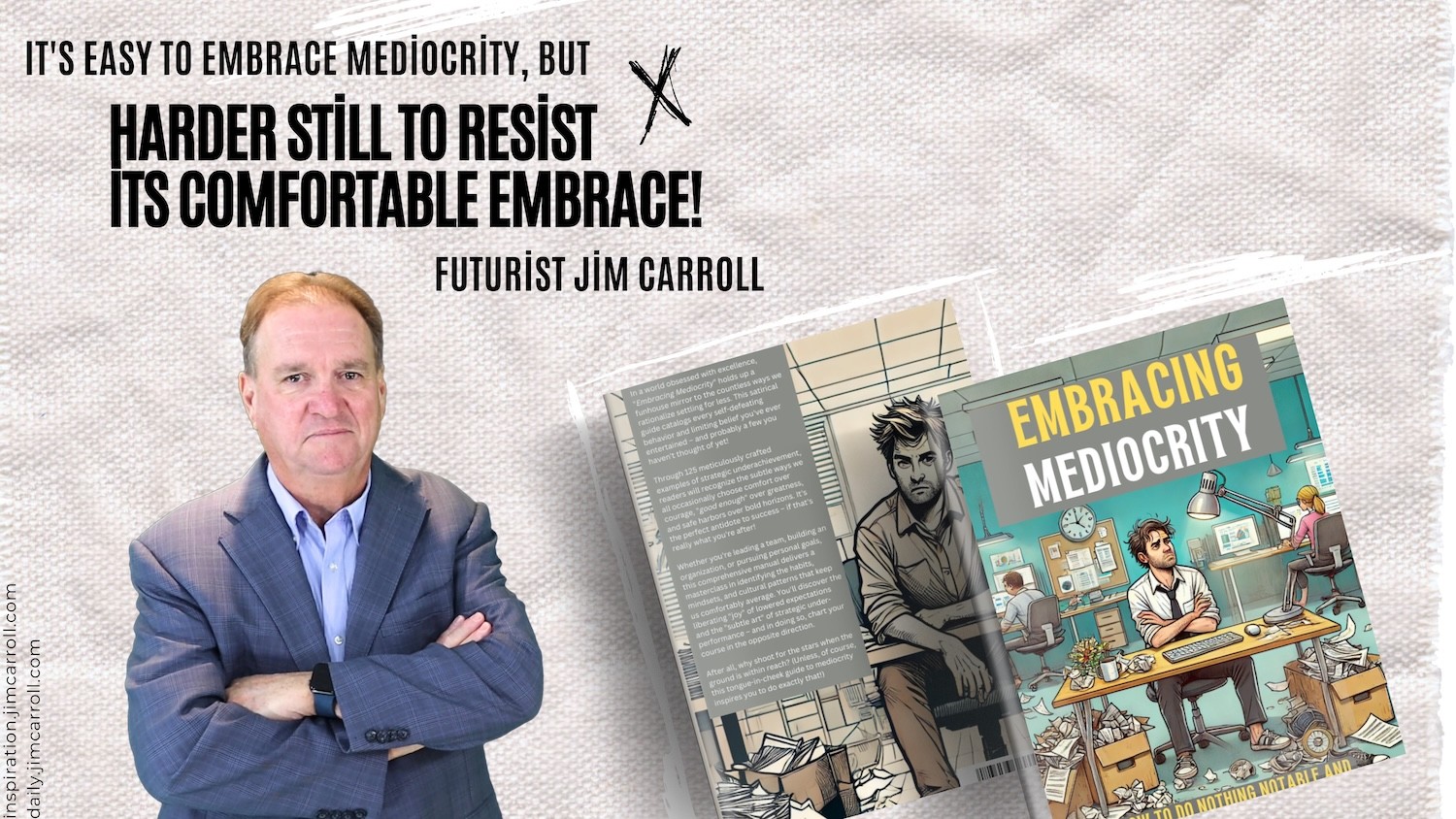
"It's easy to embrace mediocrity, but harder still to resist its comfortable embrace!" - Futurist Jim Carroll

For someone who loves to rush into a project, the process of seeing a project through to completion can be sometimes maddening. With that in mind, my wife and business partner is a very patient woman.

More on that below, but first, your moment of mediocrity!

What do I mean when I say "It's easy to embrace mediocrity, but harder still to resist its comfortable embrace!" I'm suggesting that it is very easy for you to fall into a mediocrity trap - because it can just be so easy there! With that in mind, here's a risk assessment you can do - are you at risk of any of these issues, all of which lead to mediocre performance?

- Death by routine thinking: You know I hammer home the idea that the future belongs to those who innovate at speed. Yet organizations and people cling to legacy mindsets, muttering "We've always done it this way" while their competitors master emerging technologies and business models at light speed.

- Innovation paralysis: When confronted with disruptive change, many retreat into analysis paralysis rather than taking bold action. This "aggressive indecision" is corporate and career suicide in an era where market opportunities emerge and vanish in digital microseconds.

- Regular 'idea assassination:' Organizations are killing their future by strangling innovative thinking. In a world of rapid disruption, this is like choosing to compete with a bow and arrow in a laser gunfight.

- The 'comfort zone catastrophe': Seeking safety in the familiar is a fast track to irrelevance. Tomorrow's winners are those willing to pivot fast, fail fast, and accelerate through change.

- 'Purposeful deficit disorder': Running on autopilot equals death in the innovation economy. Without a clear future focus, you're simply managing your extinction.

- 'Decision velocity crisis': Over-analysis is the enemy of agility. While you're studying spreadsheets, your more nimble competitors are already executing and learning from real-world results.

The brutal truth: Mediocrity is a choice to become obsolete. In an era of relentless disruption, the only viable path for you is to avoid mediocrity or face extinction. Your future depends on which path you choose.

Read more.

jimcarroll.com/2025/01/daily-i

★ 1 • ↻ 0 original
Jan 30, 2025 · 1:36 PM UTC

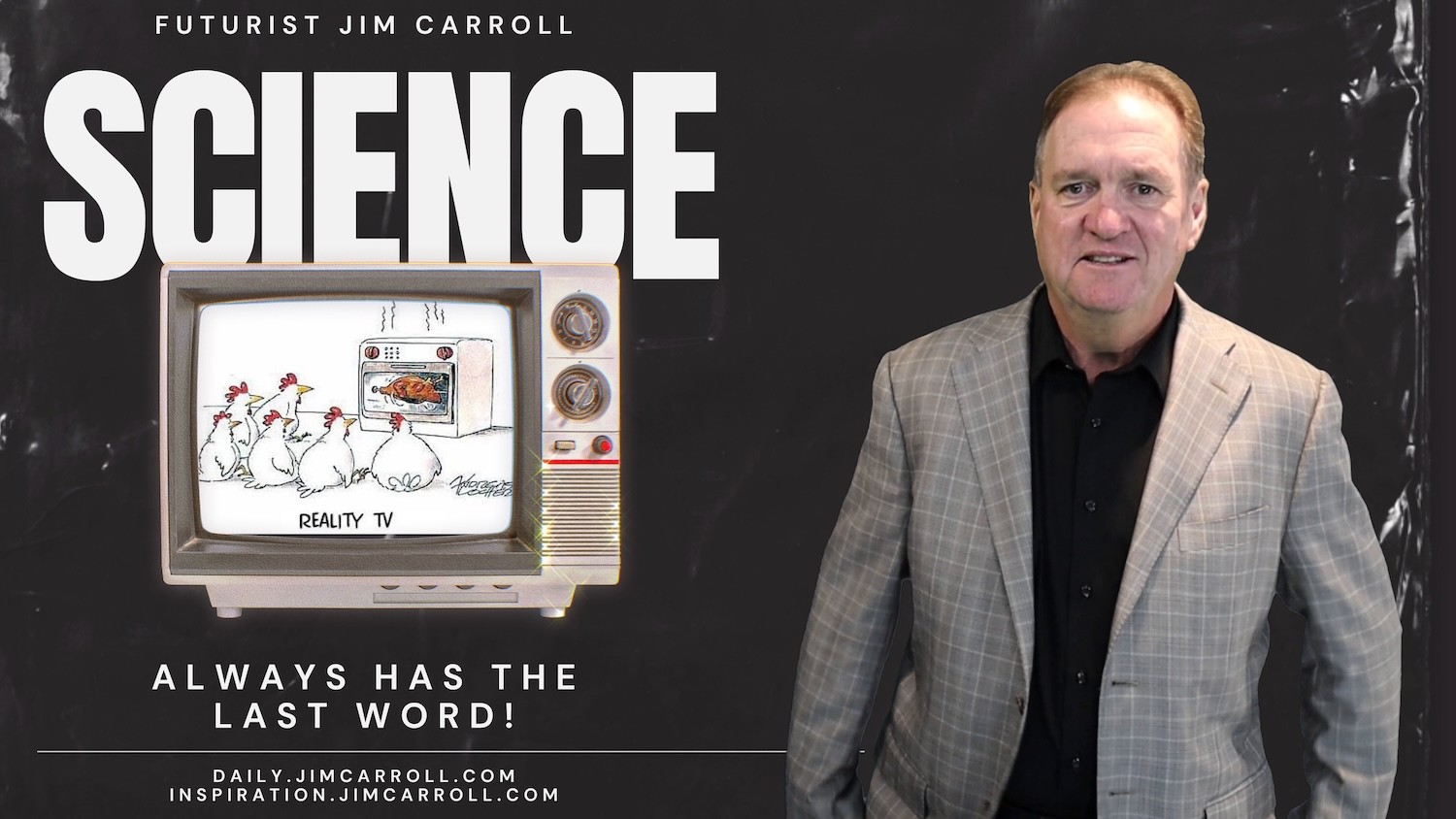
“Science always has the last word!” – Futurist Jim Carrol

My wife is a much smarter person than I am, always suggesting that I should stay away from some of the controversial topics of the day.

But I’m not very smart, and as a futurist, it’s my job to connect the dots. I just draw lines between various interconnected trends, so here goes, with a few of the items of interest that caught my attention, all in the context of the recent news, and which seem to connect a lot of dots and link a lot of lines.

At the end, I’ll share a post I wrote in 2017 about what I call the Healthcare Reality Crisis.

Draw your conclusions.

Here goes.

The first is an article in The Atlantic that gives a practical, science-oriented overview of what happens when the eradicated diseases of our time – polio, measles, whooping cough – come back to society. It’s a sobering read and a brutal reality.

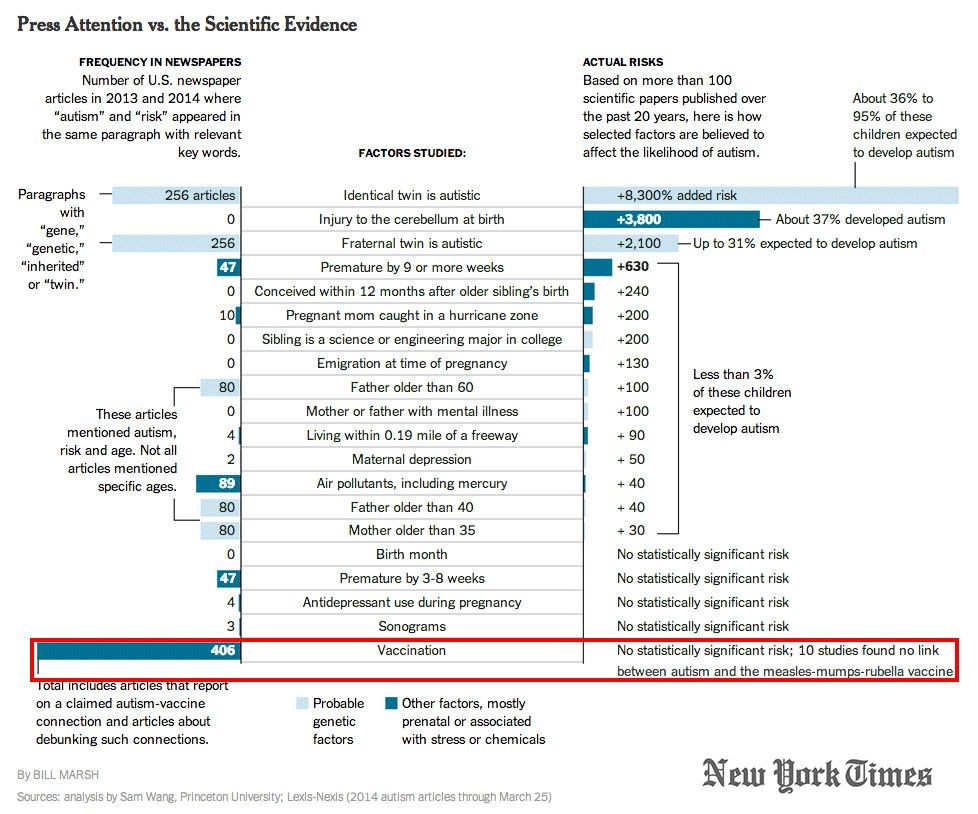
The second is a screenshot that I grabbed of some science-based stuff from the New York Times one day.

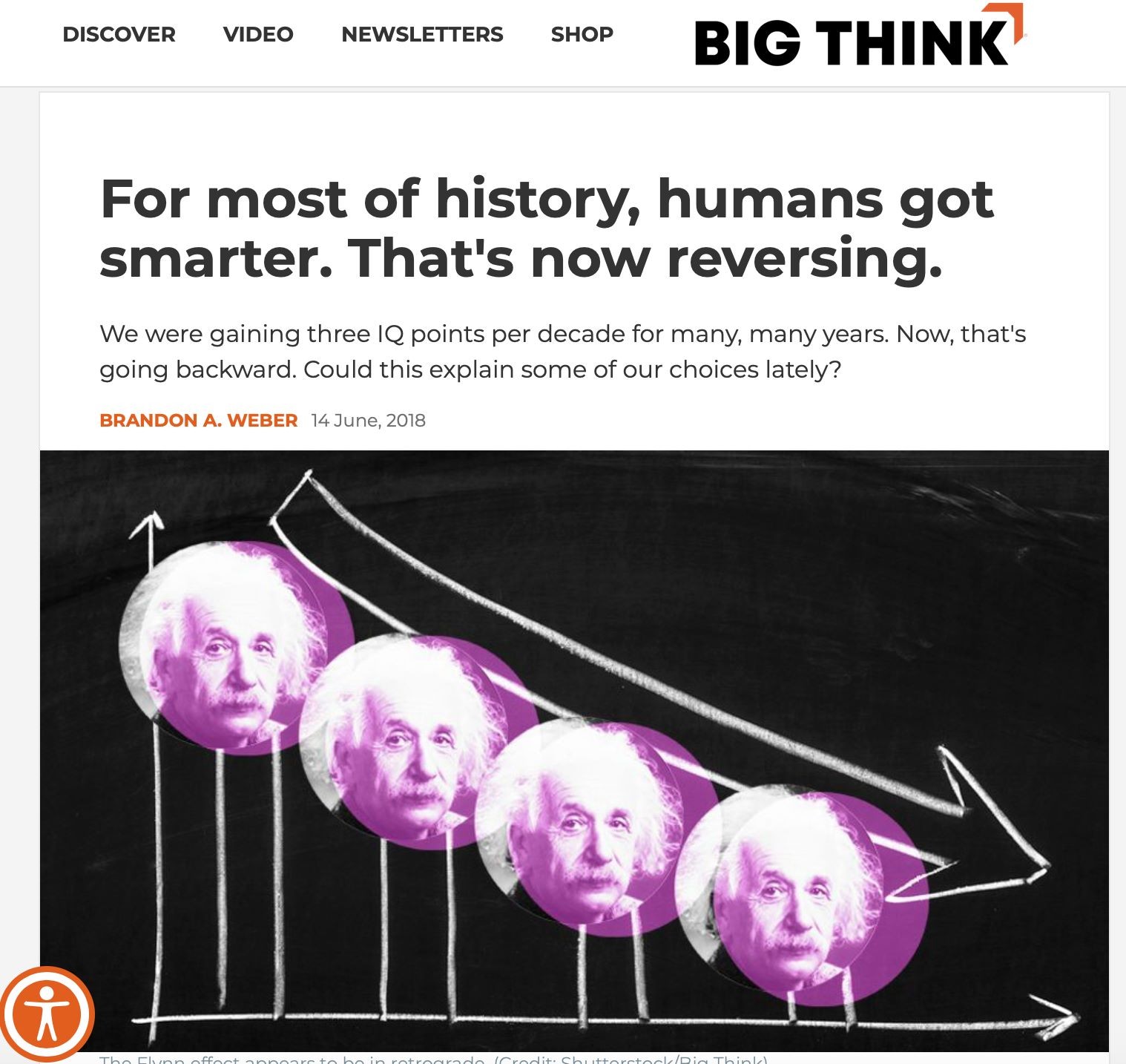
The third is a screenshot of another article that just crossed my desk.

The article is based on a scientific study out of Norway.

To summarize things:

- for a significant period, humans were becoming smarter, with IQ scores increasing by about three points per decade. This trend is known as the Flynn effect.

- however, this study from Norway found that average IQ scores are now decreasing, with a loss of approximately seven IQ points per generation.

- if this downward trend continues, it is predicted that in about ten generations, the number of individuals with IQ scores in the “Very Superior” range (>130) will significantly decrease

The fifth item is a screenshot of a few news articles about the impact of digital media, perhaps related to this trend.

With that, I bring you a post that I wrote in 2017 – about what I called The Emerging Healthcare Reality Crisis. The funny thing is, this predictive post turned out to be eerily correct.

Look, all I’m doing is connecting the dots.

Because most of us know that in the long run, science always wins.

Trend: The Emerging Healthcare Reality Crisis
by Futurist Jim Carroll, October 2017

jimcarroll.com/2017/02/trend-t

**** **** **** **** **** **** **** **** **** ****

Original post: jimcarroll.com/2025/01/daily-i

★ 1 • ↻ 2 original
Jan 31, 2025 · 12:05 PM UTC

"Innovation thrives in the building of sandcastles!" - Futurist Jim Carroll

That's me in the photo above, taken yesterday during a sandcastle-building competition in Costa Rica.

Later this morning, I'll keynote the National Association of Landscape Professionals leadership forum. Naturally, my attention was drawn to this item which was on the agenda the day before - a sandcastle competition!

This was music to my ears because Sandcastles put a rocket launcher onto my career as a global speaker way back in 2006!

My wife and I wandered down to the beach to watch the competition - and it brought me back to my 2006 post. Even the kids were getting involved!

Sadly, I didn't get any great pictures of the result - but I did overhear one fellow telling a story in the pool later. They were building a lighthouse, someone poured too much water on it so it collapsed - so they turned it into a volcano instead! That's innovation!

Ok, so what's the backstory here? Way back in 2006, inspired by the arrival of summer, I wrote about how innovation thrives in the building of sandcastles! I wrote it after my sons and I spent a lot of time over the years involved in this glorious pastime. I couldn't help but think about how there was an innovation story somehow to be found in the magic that comes with sandcastle building - and I wrote it into a blog post.

I didn't think much more of it until one day I discovered that made it into
BusinessWeek, as a part of a feature where I was noted as being '1 of 4 leading innovation gurus' in the world. That led to some pretty hard-core recognition, a lot more publicity, and some pretty significant speaking gigs.

All because of what I was thinking about while my sons and I were building sandcastles!

With that, here’s my list of “10 Reasons Why Innovation Thrives in the Building of Sandcastles: and What We Can Learn From Such Creativity.” It's a simple visual journey.

The full list can be found in the post.

---

Futurist Jim Carroll can find inspirational insight in the strangest of circumstances!

jimcarroll.com/2025/01/daily-i

★ 1 • ↻ 0 original
← December 2024February 2025 →