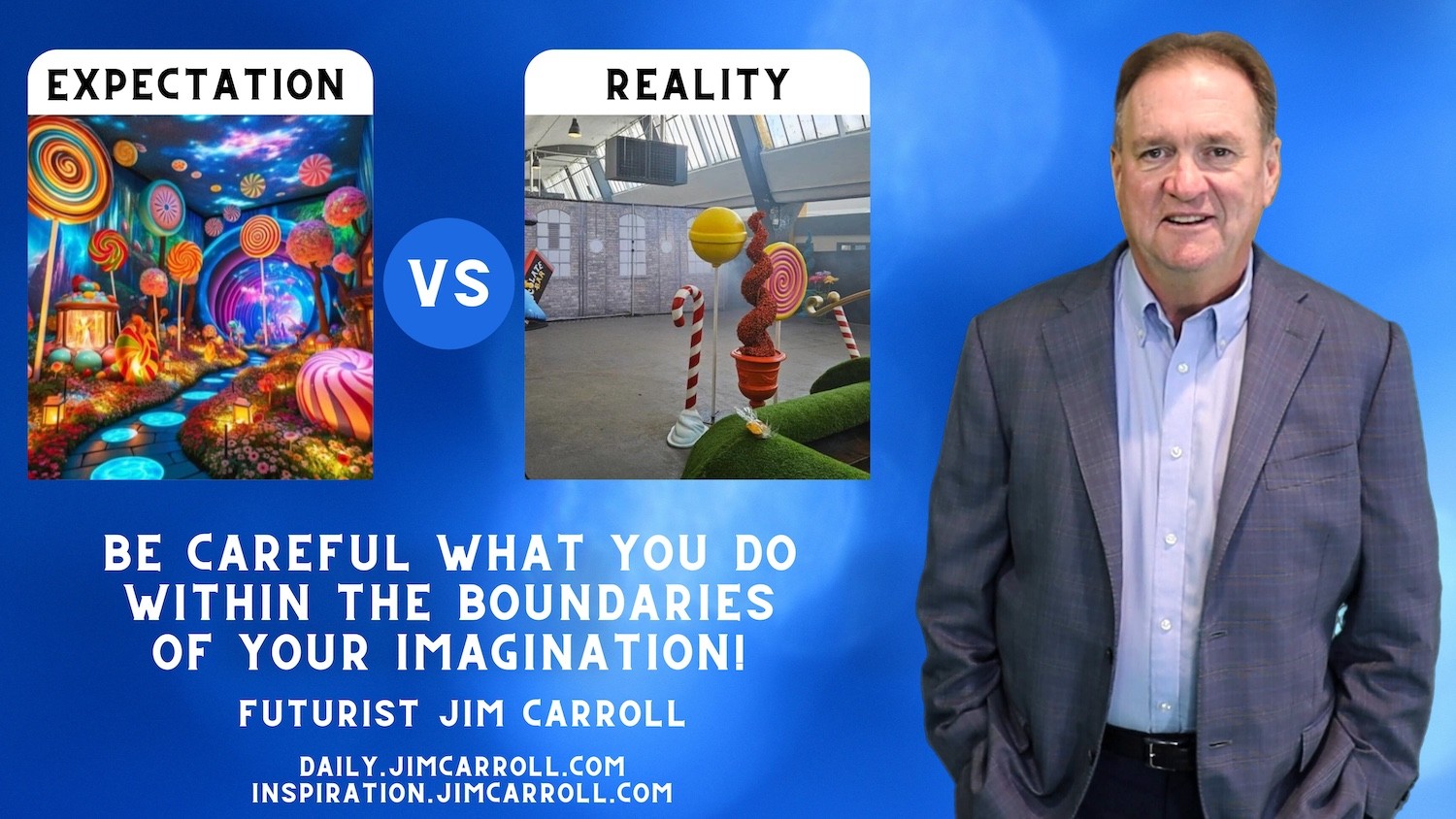
Daily Inspiration: "Be careful what you do within the boundaries of your imagination!"- Futurist Jim Carroll
AI has had its Fyre Festival moment! It was bound to happen.
The Fyre Festival? Remember that? The wildly exotic Caribbean music festival that promised so much and yet delivered so little! Remember the promotional clip?
An unmitigated disaster, what was delivered was vastly different. The gap was so wide that there was not just one full-length documentary, but two - in addition to countless other videos, reports, and investigations. It resulted in charges and jail time for the founder - for fraud.
With that, I bring you the Willy Wonka Chocolate Experience. I'm sure you've seen news of it - it went rather viral last week, being the first widely watched instance of a vast difference between what was promised vs. what was delivered with the promise part being based upon AI.
AI? Maybe the badly worded Website with obvious errors should have been a clue. What is catcagating anyways?
A quick summary for you if you have not tuned in to this week's viral sensation.
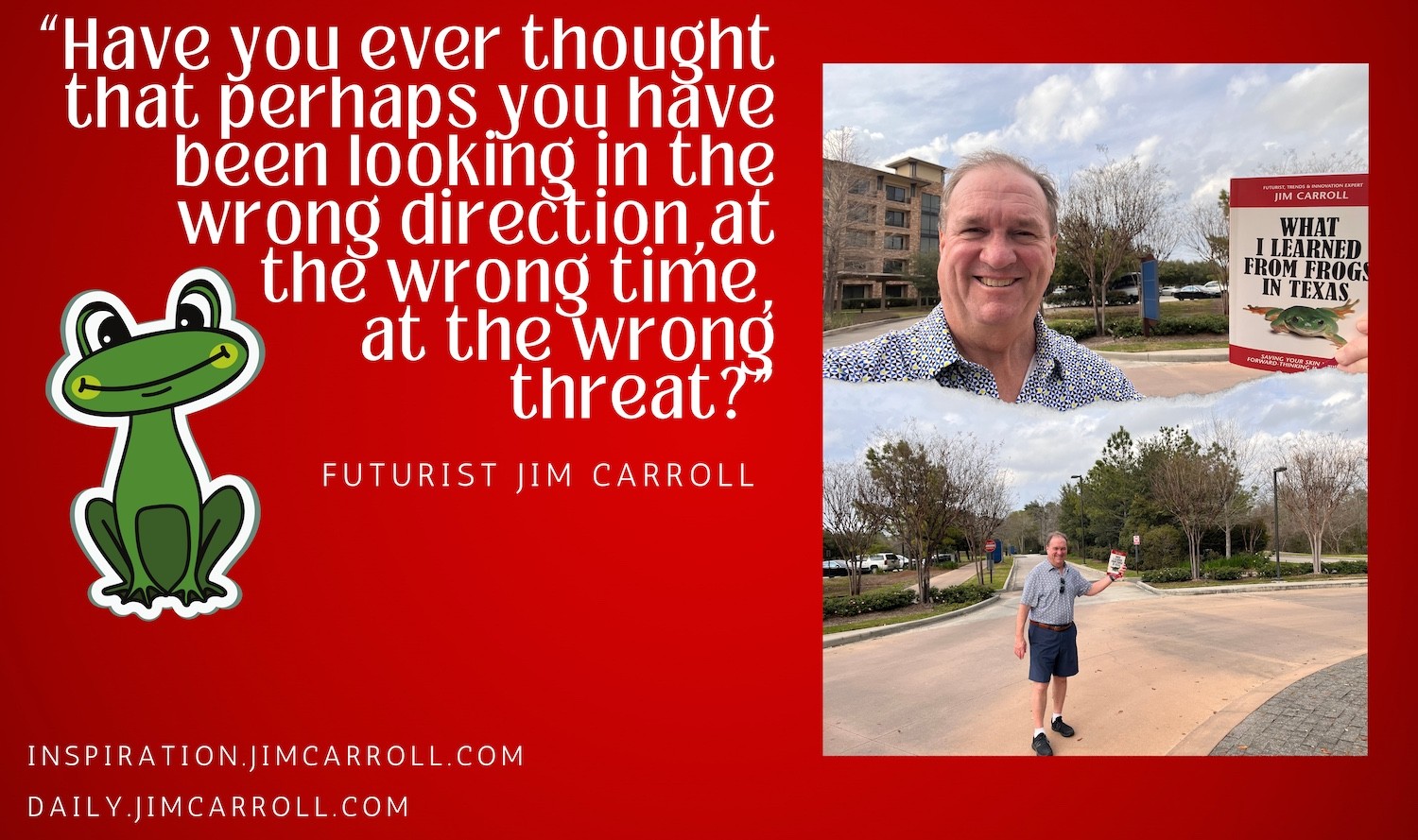
Daily Inspiration: "Have you ever thought that perhaps you have been looking in the wrong direction, at the wrong time, at the wrong threat?" - Futurist Jim Carroll
The story that unfolds today involves my 2004 book, "What I Learned from Frogs in Texas," and it's pretty exciting - at least for me. That's because today I am in the exact location where this business parable involving the frogs unfolded - The Woodlands Resort in Houston!
It's kind of exciting because this particular book was the culmination of a pretty massive transformation in my career and focus that occurred from about 2000 to the time of the publication of the book in 2004.
As to what happens to the frogs on the road in Texas? I tell the story in the opening chapter of today's post. The story speaks for itself.
And so for me today, it's a bit of a thrill to be standing in the exact same spot some 21 years later where the story unfolded.
As for the story? You can read the opening chapter It’s important to get that issue out of the way, so I can put the most important theme of this book into perspective: it isn’t the fact that the frogs get crushed, it’s the reasons why.
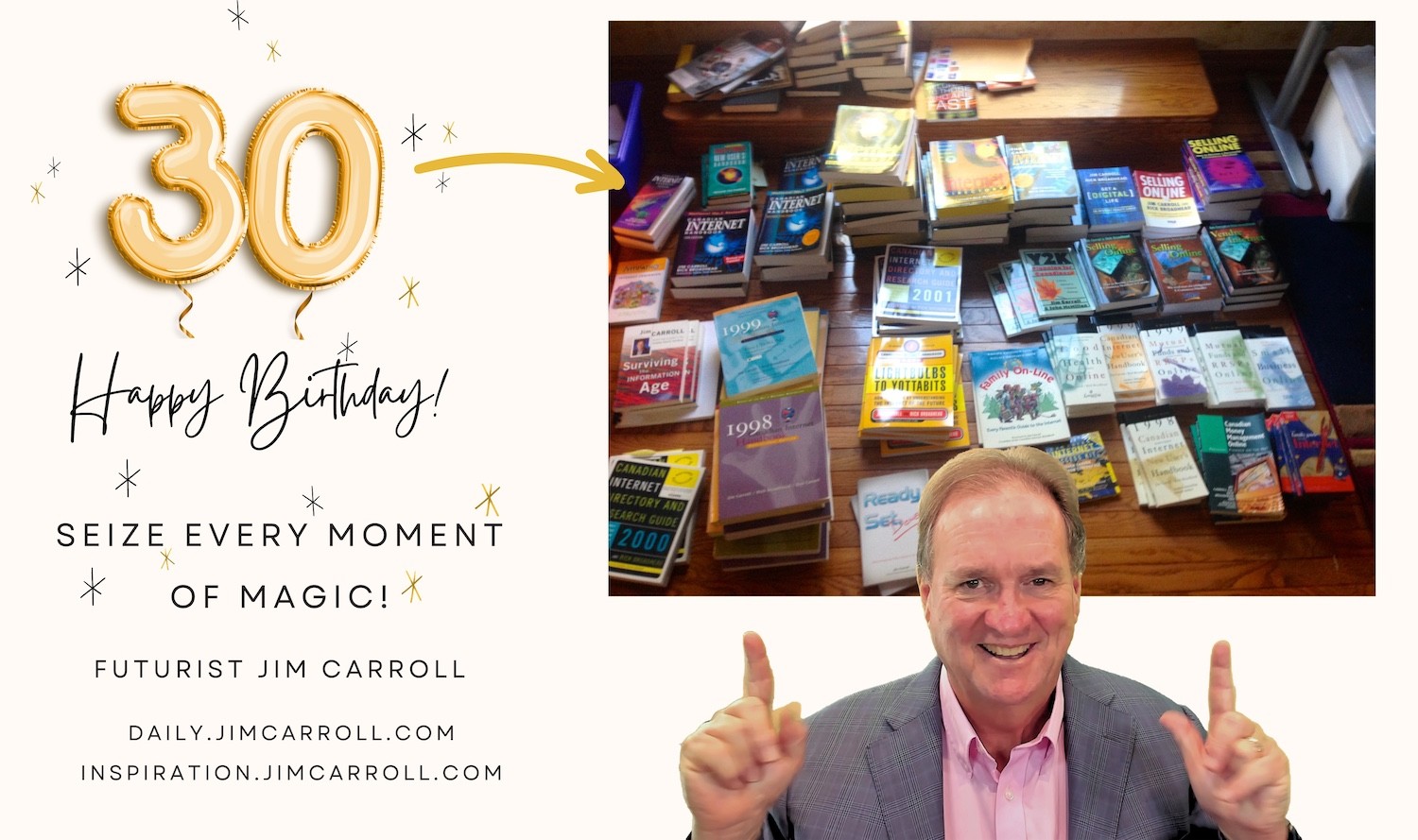
Daily Inspiration: "Seize every moment of magic!" - Futurist Jim Carroll
The first edition of the Canadian Internet Handbook launched 30 years ago today!
The arrow in today's inspiration image points directly at the first book of many in a magical voyage in which I found myself in the 90s - the 1994 edition of the Canadian Internet Handbook. Looking back, I've learned that if you ever have the chance to have magic happen in your career, grab it with all you've got and run with it.
It's kind of stunning to think that it was 30 years ago today that the original little book that truly launched my writing and speaking career was published.
Coming in at a mere 140 pages and a 4x9 print format, the book arrived from the printer on March 5, 1994, and the very next day was covered in the Toronto Star. Mere a few weeks later, it entered the national bestseller list - where it hit the #1 spot in June, where stayed for many weeks. By that time, my co-author Rick Broadhead and our publisher knew that we had a wild beast on our hands, and were already writing the 1995 edition of the book, as well as a new side project, The Canadian Internet Directory - essentially, a set of yellow pages about the Internet in Canada.
It wasn't long before our rocket ride took off, and so today is not a marker of just one book - but all the different books that Rick and I took on together through the next seven years - writing 34 titles and selling well over one million copies.
If magic happens in our life - run with it as fast as you can!
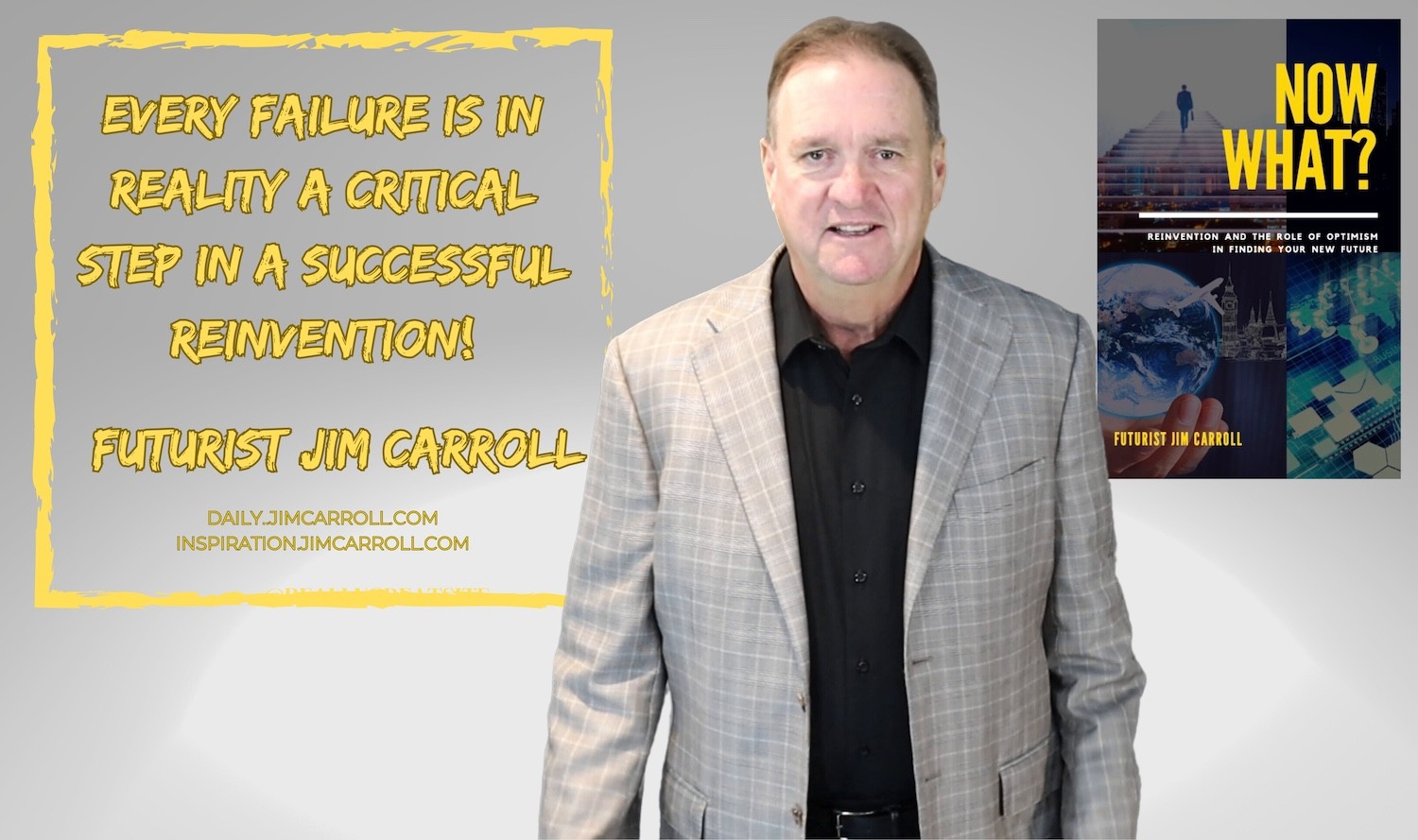
Daily Inspiration: "Every failure is in reality a critical step in a successful reinvention!" - Futurist Jim Carroll
It’s book week! Each day, a post involving one of my books! Today, my biggest book failure!
Life is sometimes full of wild success punctuated by staggering failure. In that context, let's take a look a look at my biggest book failure - I think it has sold, what, maybe 10 copies? (That's a bit of an understatement, but I can assure you that the sales numbers are less than overwhelming.)
Released at the tail-end of the global pandemic, Now What? Reinvention and the Role of Optimism in Finding Your New Future, is probably my biggest book failure, and yet to me, is a remarkable success. That's because, in my mind, the very action of writing the book clarified in my mind some valuable lessons, many of which have made their way into my stage presentations and other material. You can find the book at my site at https://books.jimcarroll.com or on Amazon.
The book itself? it comes at an interesting time in the publishing industry - quite simply, in the last few years, the market for many types of books has evaporated with the collapse of attention spans and the dominance of short content.
The book discusses the stories of individuals who faced challenges and reinvented themselves through the pandemic, or earlier than that - all of whom I knew before or met during the global lockdown. They discovered new careers, new opportunities, or new skills - some sort of reinvention from who they were into who they could become. It was based on a series of interviews I did from my virtual broadcast studio during lockdown - and those interviews are still available at https://reinvention.jimcarroll.com.
In but 140 pages, it covers a remarkable amount of ground as to how to reinvent your personal life, career or business.
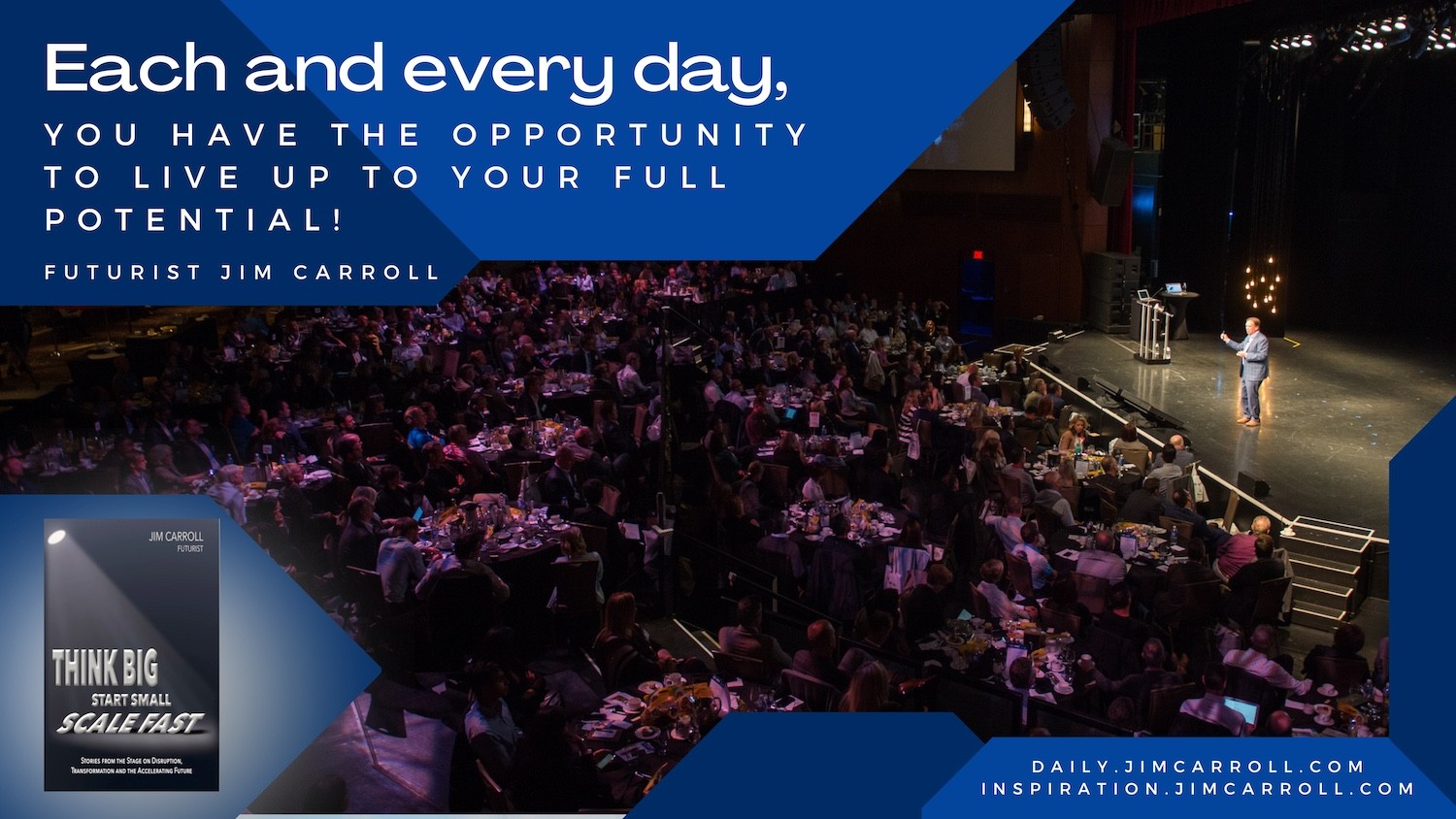
Daily Inspiration: "Each and every day, you have the opportunity to live up to your full potential!" - Futurist Jim Carroll
The title of my book Think Big, Start Small, Scale Fast comes straight from my Daily Inspiration series, one of which you are reading right now. By my count, this is post 1,946 in this series which I began writing early in August 2016. Have I ever mentioned that I have not missed one workday post since then? (I have, and I have not!)
How did this book come about? What does it actually cover?
-----
It is a story of inspiration, observation and transformation. I’ve been speaking to organizations around the world for well over 25 years about the future and the attitudes and actions that can help us to turn it into a world of opportunity.
Somewhere along the way, I came to realize that this unique experience, a life on the stage, had provided me with some very unique insights into how people try to deal with a world of massive change and challenge.
In late July 2016, through a variety of colliding circumstances, the opportunity to focus my thinking into a message of hope and inspiration took on a life of its own. Since that moment in time, I have started each and every workday, without fail, very early in the morning, with my coffee, my laptop, and a moment of quiet reflection. They are a critical part of a very important journey, that of painting a picture of hope and optimism each and every day for what the day might bring. These observations - usually inspirational, sometimes controversial - are layered on top of a photo where I had appeared on stage and then shared with people via my social networks.
----
Given the subtitle Stories from the Stage on Disruption, Transformation and the Accelerating Future, the book features several of what I considered to be some of my most powerful Daily Inspiration posts, rewritten to emphasize the story behind the stage picture used for the quote.
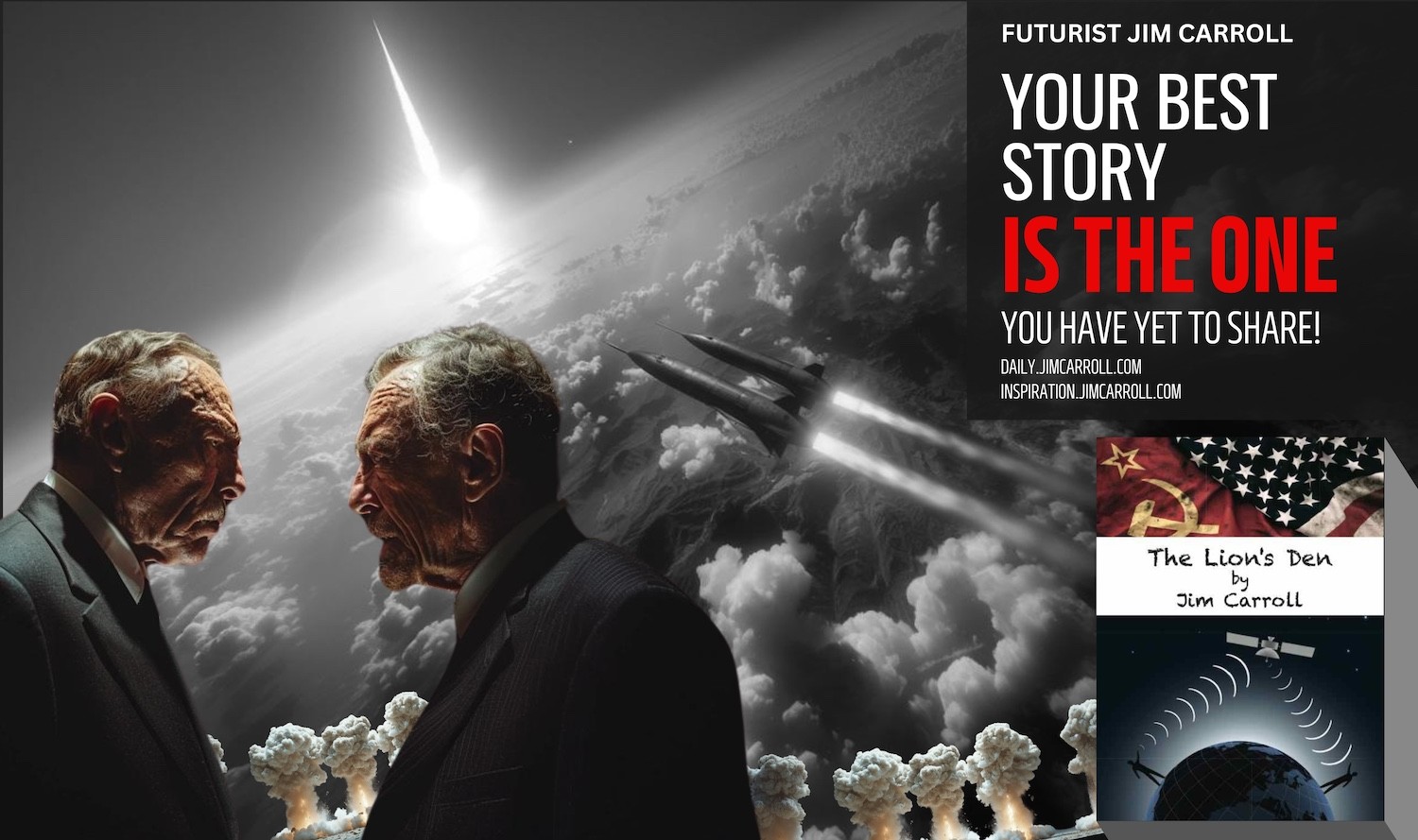
Daily Inspiration: "Your best story is the one you have yet to share!" - Futurist Jim Carroll
I wrote a novel when I was 15. I still have it - and one day, will bring it into print.
-----
In this final post of the week in which I've been sharing a few stories about a few of the books I've written, let me tell you about The Lion's Den, a Soviet vs. America vs. China Cold War thriller novel that I wrote at the age of 15.
Simply because I wanted to avoid an entire high school term on poetry.
The book is a US-Soviet Cold War-style thriller that involved a global crisis; there were nuclear explosions, fascinating and complex spies, geopolitical maneuvering, and yes, even a sex scene. Not a bad effort for a 15-year-old kid! Back in 2012, on Christmas morning, my family gave me a fully formatted manuscript ready to go to print - typed in from the original typewritten manuscript by my wife Christa, and with a fabulous cover design by my son Willie. The back cover copy tells a bit more about this remarkable project.
With that, I offer up the inspiration that sometimes the best story is the one yet to come!
And since I am in full-on reminiscing mode, let's start here with the story of how this book came about. What prompts a kid to write a full-length novel at the age of 15?
On this International Woman's Day, I would like to shout out into the void some thoughts about my wife of 35 years.
She is the type of woman who is not often recognized but should be; not appreciated enough when she gives everything to her all; not cheered enough when her efforts demand a standing ovation.
I know one thing - without her backing, support, encouragement, and love, I would NEVER have enjoyed the success I have had.
We have worked together in a home office for 30 years. That alone says it all.
She has edited my books, managed my contracts, organized my calendar, helped me with my research, loved me unequivocally, and has never let me down. She has managed the complexities of a demanding speaking career, a husband who has tried his best to manage the rigors of the road, and who is always jumping with a far-too-busy-mind into the next project.
A professional CPA, she was on track to a global career in Unilever/Thomas J. Lipton - she was Manager of Tax, Controller, and other functions. Previously with Deloitte, she met me when I was with a predecessor firm of KPMG. She had career goals, aspirations, and big goals and plans
And then, we got married and had two delightful children (now young men of 28 and 30). When my books and speaking career took off, the two of us knew we had a choice - I could find an office and hire staff, or she could quit her job, and help me out.
2 of 2/ Because of that, she did have the delight of being at home and raising her children, and she is so thankful for the opportunity - she has such a loving relationship with her sons and their wives today.
But I also KNOW that at various moments along the way, she has had serious pangs of regret. Regret for the fact that she gave up her career; regret for never knowing how far she might have gone with that career; regret for what might have been.
In the last 8 years, she has also become my travel companion, traveling with me to all of my keynotes, simply because I came to detest road life after 25 years, and because it would be more fun, and easier, to go into the twilight of my career together. She is the highly intelligent woman you see in business class with her knitting needles, meditating in her mind as she undertakes one of her relaxation joys. I call her my bodyguard, and she is, in more ways than people might ever know.
And so, on this International Women's Day, I would just like to shout out to the void and say thank you, knowing how lucky I have been to have such a wonderful woman in my life.
To me, she embodies everything so RIGHT, so WONDERFUL, so AWE INSPIRING. And the thing is - I know there are so many other women just like her. Not selfish, but caring, kind-hearted, with deep ethical values and love embedded in their souls,
Any of us who have had the good blessing to meet one of them, and share our life, has enjoyed one of the greatest gifts of our lives.
Daily Inspiration: "World-class innovators refuse to accept the way things were" - Futurist Jim Carroll
How do you become a world-class innovator? Not someone who merely pokes around the edges of innovative thinking and explores a few ideas here and there, but someone who truly tries to infuse the mindset of everything you do, or into every goal and action that your organization pursues.
I head to Orlando tomorrow, where I've got a repeat engagement with a client; they had me in exactly 10 years ago this week for a talk to their core client group. I dug out the slide deck I used back then to get a bit of a sense of the ground I covered with them, and it's going to provide quite a wonderful structure as I take a look at where we were a decade ago compared to now.
That said, what also caught my interest was the title slide in my keynote for them 10 years ago - "What Do World Class Innovators Do?" That's because this is a theme that played into a tremendous number of keynotes from 2009 up until the pandemic in 2020.
It continues to do so. The original list used in the slide deck I used with them contained 10 key themes or actions that 'world-class innovators' undertake - valuable guidance in a fast-changing world. With that in mind, I thought it would be a good idea to take on these topics in the next two weeks of Inspiration posts. Hence, starting tomorrow and running for just over two weeks, I'll cover each of these themes.
The over-arching theme in this leadership guidance? World-class innovators refused to accept that the way things were is the way things should be; they infuse the acceptance of change into everything they do. They refused the status quo, complacency, and standing still. The way things were in terms of action, strategy, mindset, and innovation won't carry them forward into the future - it will only bind them to the past. Think about that - it's a core issue that you need to adopt with everything you do!
Daily Inspiration: "World class innovators possess a relentless focus on growth"- Futurist Jim Carroll
I'm running a series of posts on the idea of "World Class Innovaton" - what I saw my global clients focusing on during volatile times. The series unfolds here over the next two weeks.
----
It seems intuitive to know that every organization focuses on growth - after all, what's the point if not otherwise?
But what world-class innovators do is stay focused on that growth despite any volatility or negativity. That's what differentiates them, and it's a powerful lesson that I learned while watching what organizations did during the economic meltdown of 2008 and previously, with the downturn of 2001-02. I used this fact in the opening to many of my talks that would unfold in the years that followed: "I’ve had a unique first-hand opportunity to witness what’s happening on the ground throughout corporate America as the events of the recession unfold.”
What I was witnessing was a series of CEOs and senior executives at the events that I was keynoting - often speaking before me - with a message that was essentially a relentless focus on growth.
And it's this leadership trait that I worked into the first point of my list of 'world-class innovators.'
The commonality of all of these CEOs was that despite an uncertain future, it was critical to focus on opportunity, trends, tomorrow, and the future - and growth. That became item #1 in my list of "what world-class innovators do."
Growth matters because the optimism you focus upon in aligning tomorrow is one of the most important things you can do!
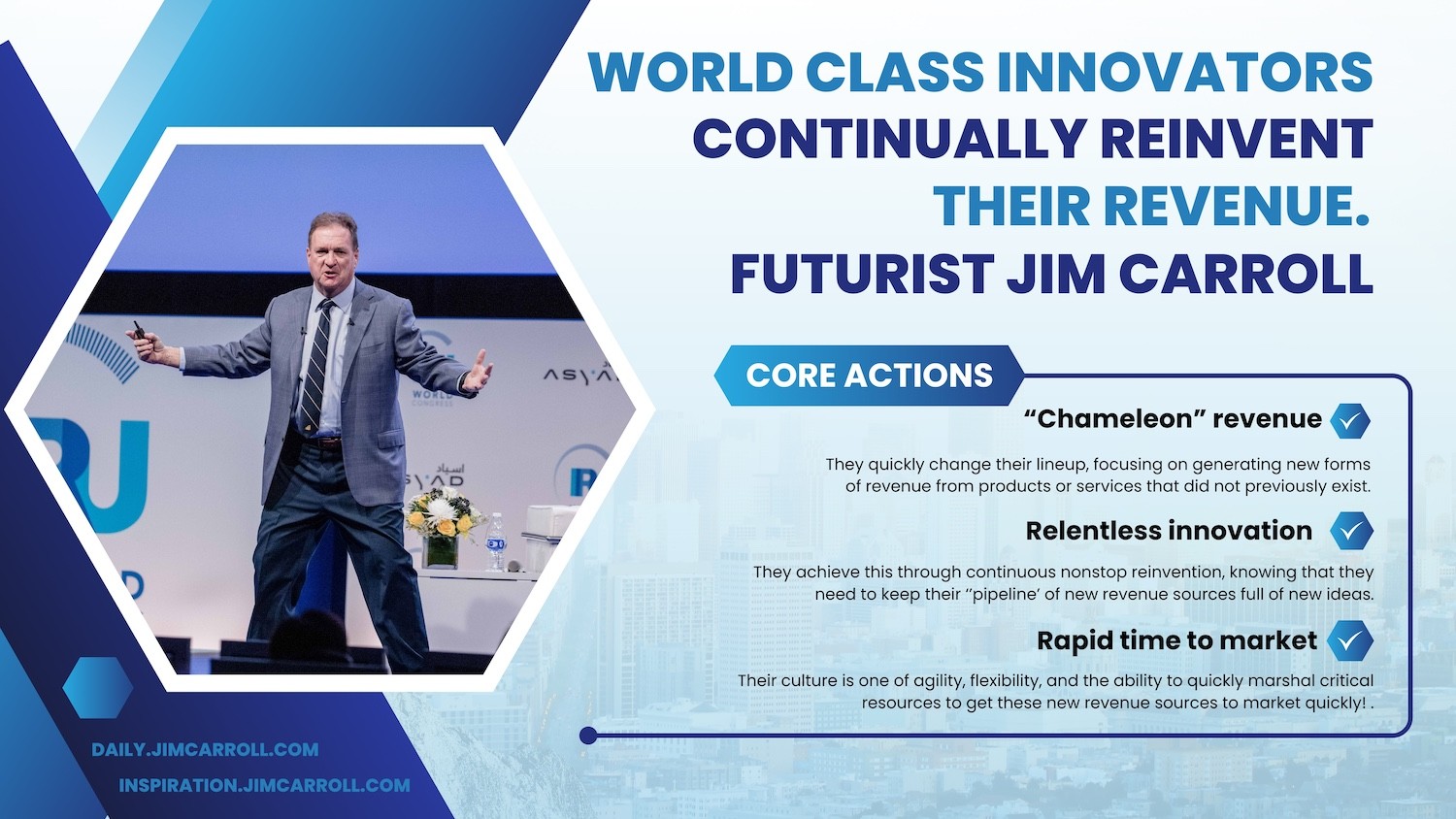
"World class innovators continually reinvent their revenue- Futurist Jim Carroll
Futurist Jim Carroll is running his Daily Inspiration series for the weeks of March 11/18 on the theme of "What is it that World Class Innovators Do That Others Don't Do?" The leadership ideas are based on an original keynote he gave early in 2009 after a client asked him to identify these issues. He developed this carefully curated list based on 15 years of observations of how his global clients responded to fast-paced change. The concept worked it's way into a 2010 video project that he undertook for Deloitte - and these posts will share relevant content from that video project when applicable.
---
World class innovators don't stand still - they continually reinvent their structure, skills base, culture, and concepts. They are also aware that they must continually reinvent their products and services, knowing that their ability to come up with new sources of revenue will be fundamental to their future success.
They do this by following three fundamental ideas.
They pursue the concept of 'chameleon revenue.' They quickly change their lineup, focusing on generating new forms of revenue from products or services that did not previously exist.
They are relentless in innovation. They achieve this through continuous, nonstop reinvention, knowing they need to keep their "pipeline' of potential new revenue sources full of new ideas.
They master 'fast time to market.' Their culture is one of agility, flexibility, and the ability to quickly marshal critical resources to get these new revenue sources to market quickly!
That's the second item on my list of 10 things that world-class innovators do that others don't do.
Daily Inspiration: "World class innovators focus on customer-oriented innovation" - Futurist Jim Carroll
When I started compiling my list of 'world-class innovation,' I knew that I had to include the fact that I was seeing a significant shift in the source of innovation within many of my global clients.
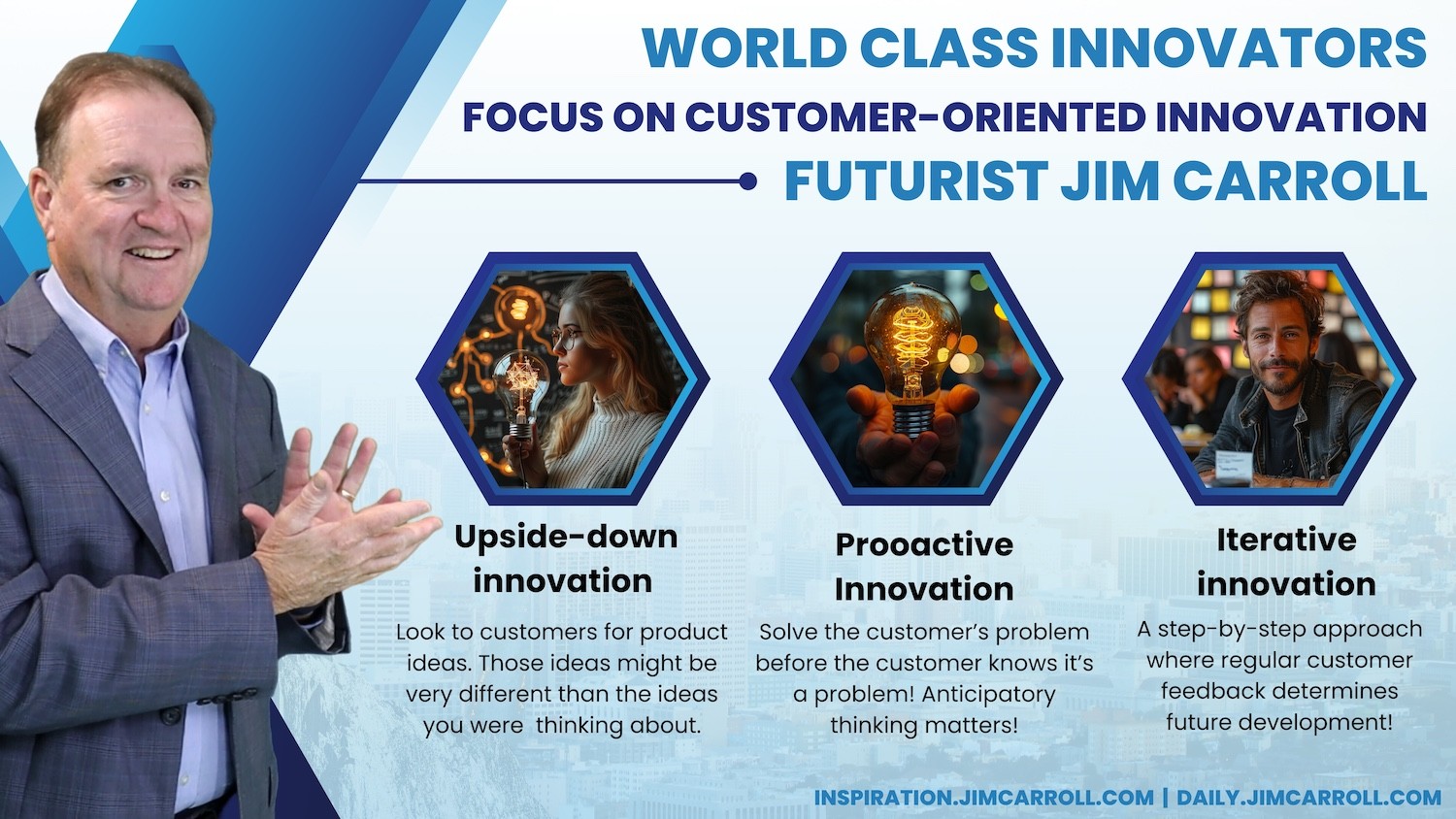
What was the shift? Rather than pursuing an innovation pathway in which their internal R&D or leadership teams were always the origin of most new product and service development ideas, there was an increasing focus outward. There was a realization that the key source for innovation ideas would come from customers - what is now routinely called 'customer-oriented innovation.' It seems like an obvious thing to do, but to this day, many organizations don't enshrine this as a core value in their innovation culture and methodology - which is a real missed opportunity.
In my view, three fundamental trends were underway with 'world-class innovators' that would forever shake up the world of ideas and invention:
Upside-down innovation: That's looking to customers for product ideas. Those ideas might be very different than the ideas you were thinking about.
Proactive Innovation: Solving the customer's problem before the customer knows it's a problem! Anticipatory thinking matters!
Iterative innovation: A step-by-step approach where regular customer feedback regularly determines future development!
The importance of this shift can't be understated; I previously wrote about it this way:
"Turn your creativity and imagination engine upside down! Make your R&D strategy less about what you see as opportunities – and more about what your partners and customers see.. Adopt the mindset that ‘customer-oriented and partner-based innovation’ will be a key strategy – and you might find that solution to challenges come faster!"
2. There won't be a legal system after it consumes itself preparing for trials that will never happen, because it's failed efforts to try to lead to trial will lead to its very destruction in January 2025.
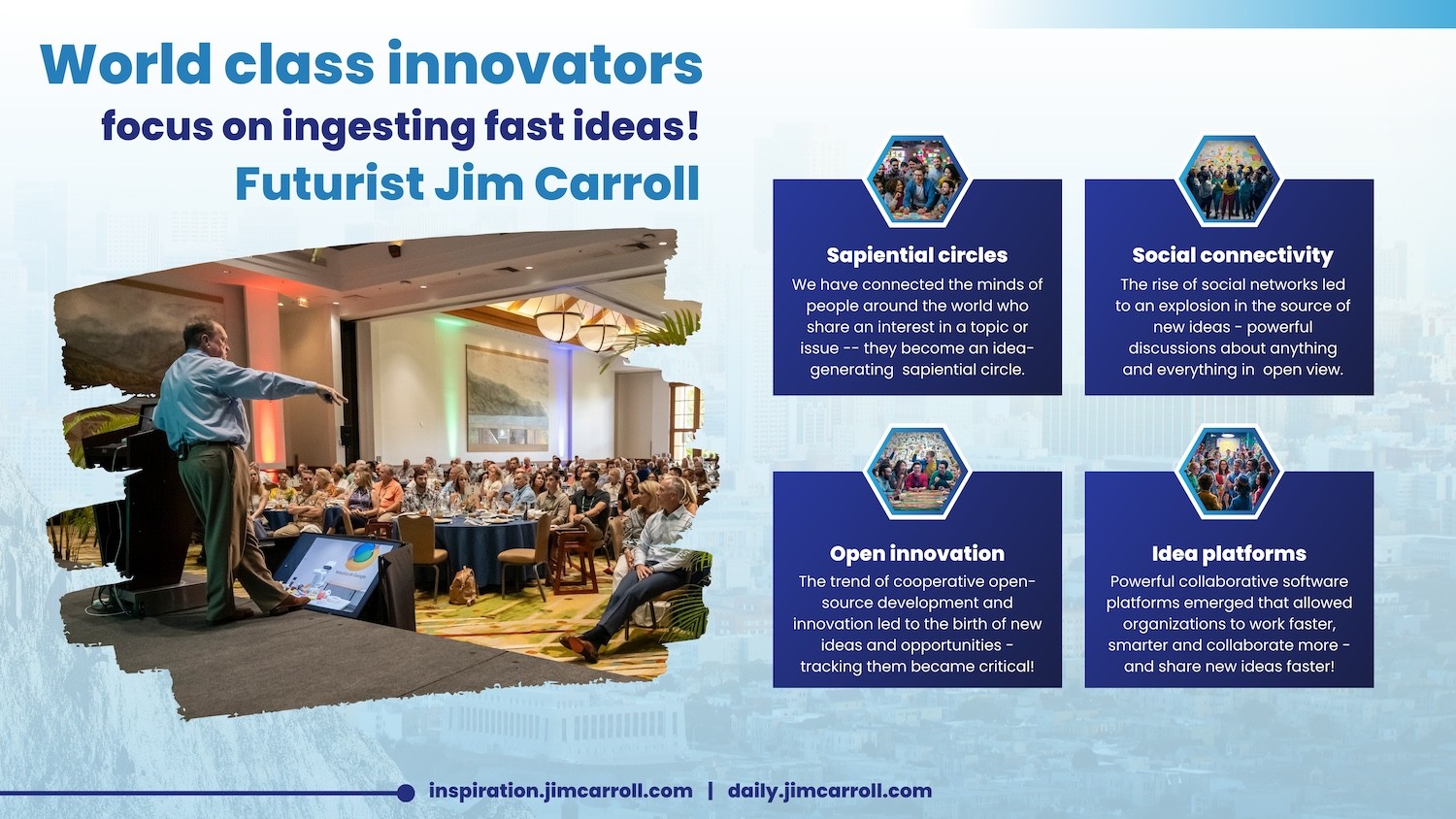
Daily Inspiration: "World class innovators focus on ingesting fast ideas" - Futurist Jim Carroll
An idea on its own is just an idea.
Shared ideas are different - they accelerate innovation through faster discovery of opportunities!
The fact is, if you have an idea and I have an idea, we have two ideas. If we share those ideas, we have something powerful!
We can never be too short of great ideas. In that context, world-class innovators recognize that ideas are their most powerful asset, knowing that the smallest of shared ideas can become the most powerful opportunity.
When compiling my list of world-class innovations was this: world-class innovators were becoming relentlessly focused on doubling down on their ability to share ideas, chase ideas, find ideas, develop ideas, and internalize ideas. It seemed they came to realize that ideas were becoming the new currency of success - and in that context, the convergence of a variety of trends suddenly allowed organizations to accelerate their 'idea machines,' and hence, accelerate their capabilities for innovative thinking.
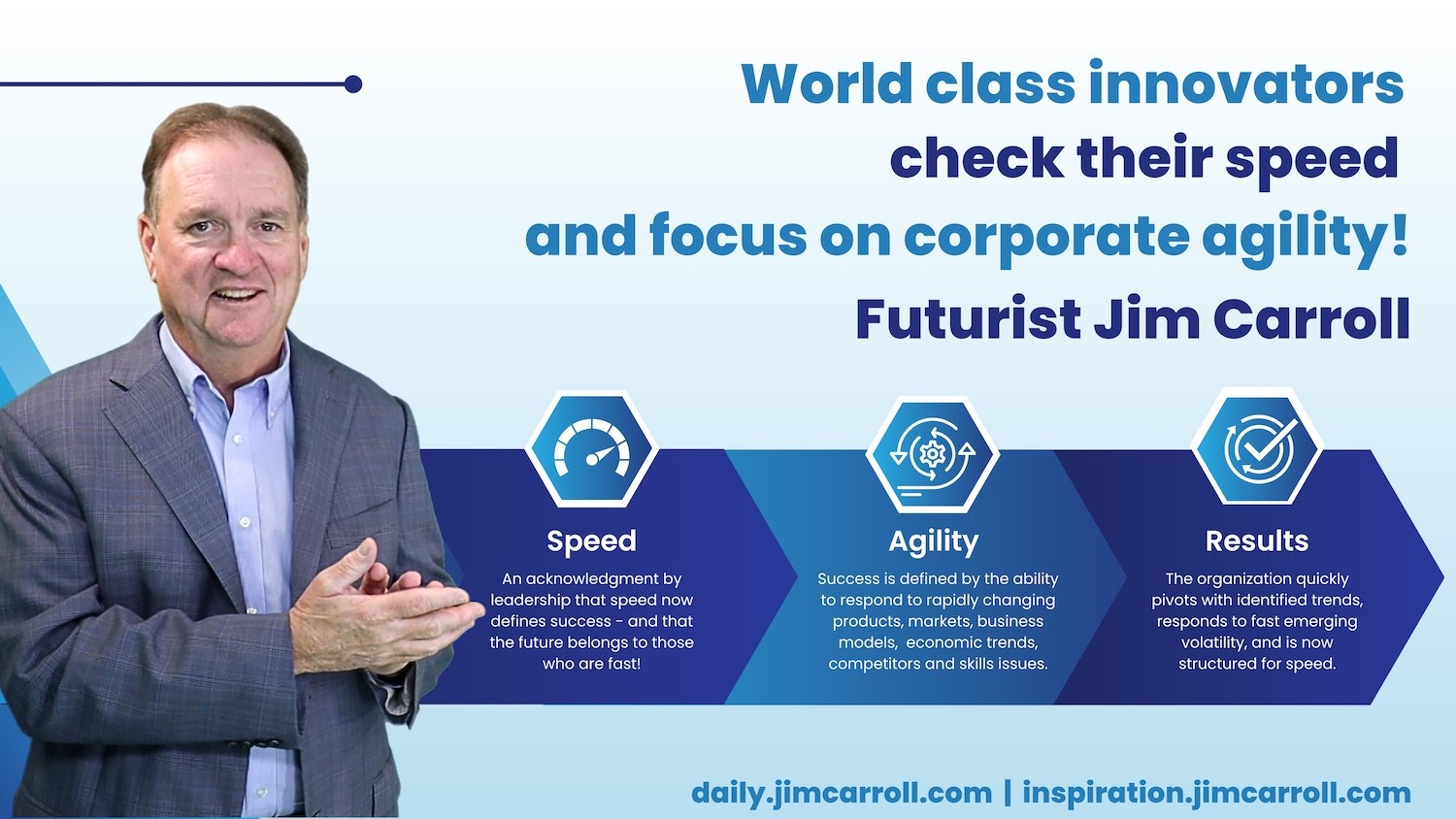
Daily Inspiration: "World class innovators check their speed and focus on corporate agility" - Futurist Jim Carroll
You would think that I'm somewhat focused on the issue of speed as a core metric of success.
I come by it honestly.
After all, several of my books play into the theme - The Future Belongs to Those Who Are Fast being one of them. (Another one carries the theme in the subtitle: Ready, Set, Done: How to Innovate When Faster is the New Fast.)
And yet, this isn't just a simple idea to latch onto to write a few books.
At the time I was compiling my list of 'world-class innovators' during the global economic recession of 2008-09, there was a clear focus on the issue of responding to speed through corporate agility. Check the Google Trends insight chart for that!
All around me, I witnessed organizations and their leadership teams becoming focused on their speed of response to rapidly changing circumstances - there was a lot of talk about the need for corporate agility and flexibility. I saw this within the discussion points raised by the companies who were booking me around that time - the CEO or other individual responsible for bringing me into a corporate event needed examples and stories of how 'world-class innovators', were learning to respond to fast change with fast action.
The idea that the future belongs to those who are fast and that organizations need to think big, start small, and scale fast?
It directly comes from the fact that world-class innovators focus on those ideas as key factors for thriving in a world that is becoming ever faster, and which the era of acceleration is clearly upon us!
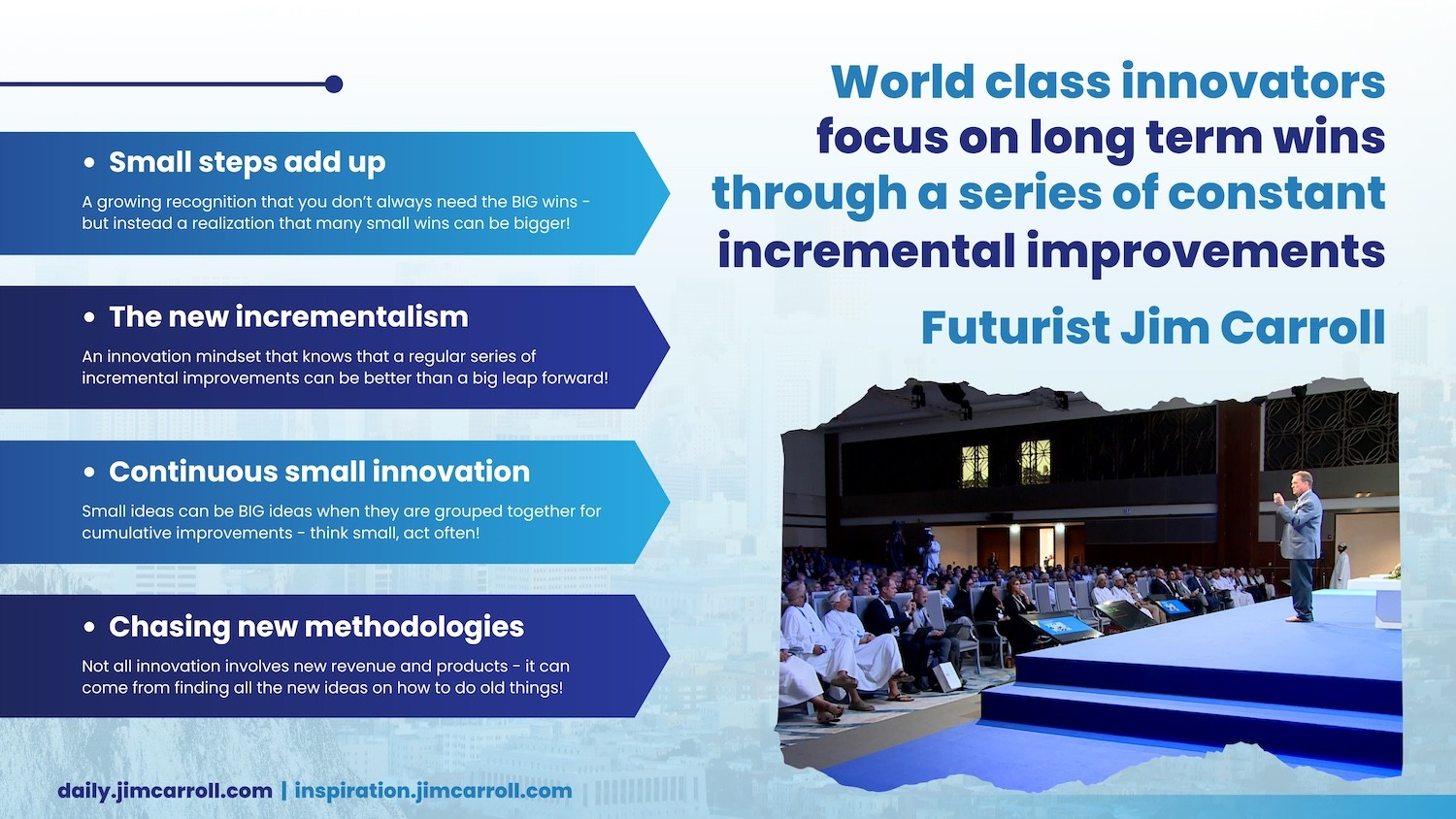
Daily Inspiration: "World class innovators focus on long term wins through constant incremental improvements" - Futurist Jim Carroll
Want something boring? This is it! It's the BIG impact of the new SMALL incrementalism!
Huh what?
It involves thinking like this: “How can we continue to evolve our solutions in small ways that provide regular, continuous improvement for our customers?” And a realization that success can come from pursuing a mindset that success can be a cumulative process with these key attributes:
Small steps add up: a growing recognition that you don’t always need the BIG wins - but instead, a realization that many small wins can be bigger!
The new incrementalism: an innovation mindset that knows that a regular series of incremental improvements can be better than a big leap forward!
Continuous small innovation: knowing that small ideas can be BIG ideas when they are grouped for cumulative improvements - think small, act often!
Chasing new methodologies: not all innovation involves new revenue and products - it can come from finding all the new ideas on how to do old things!
This might not seem like terribly exciting stuff - after all, when people are focused on innovation, they are often thinking about the BIG ideas, the BIG inventions, the BIG initiatives, the BIG thinking. And yet, at the same time, there can be a lot of innovation to be found in thinking incrementally, achieving small wins, and taking small steps that add up to BIG returns.
That's what I found that world-class innovators were often focused on, and so it made its way onto my list of "What World Class Innovators Do That Others Don't Do."
There might be some powerful thinking for you here: what are the small incremental steps that you might start taking today that will start you on your larger voyage to a BIGGER future?
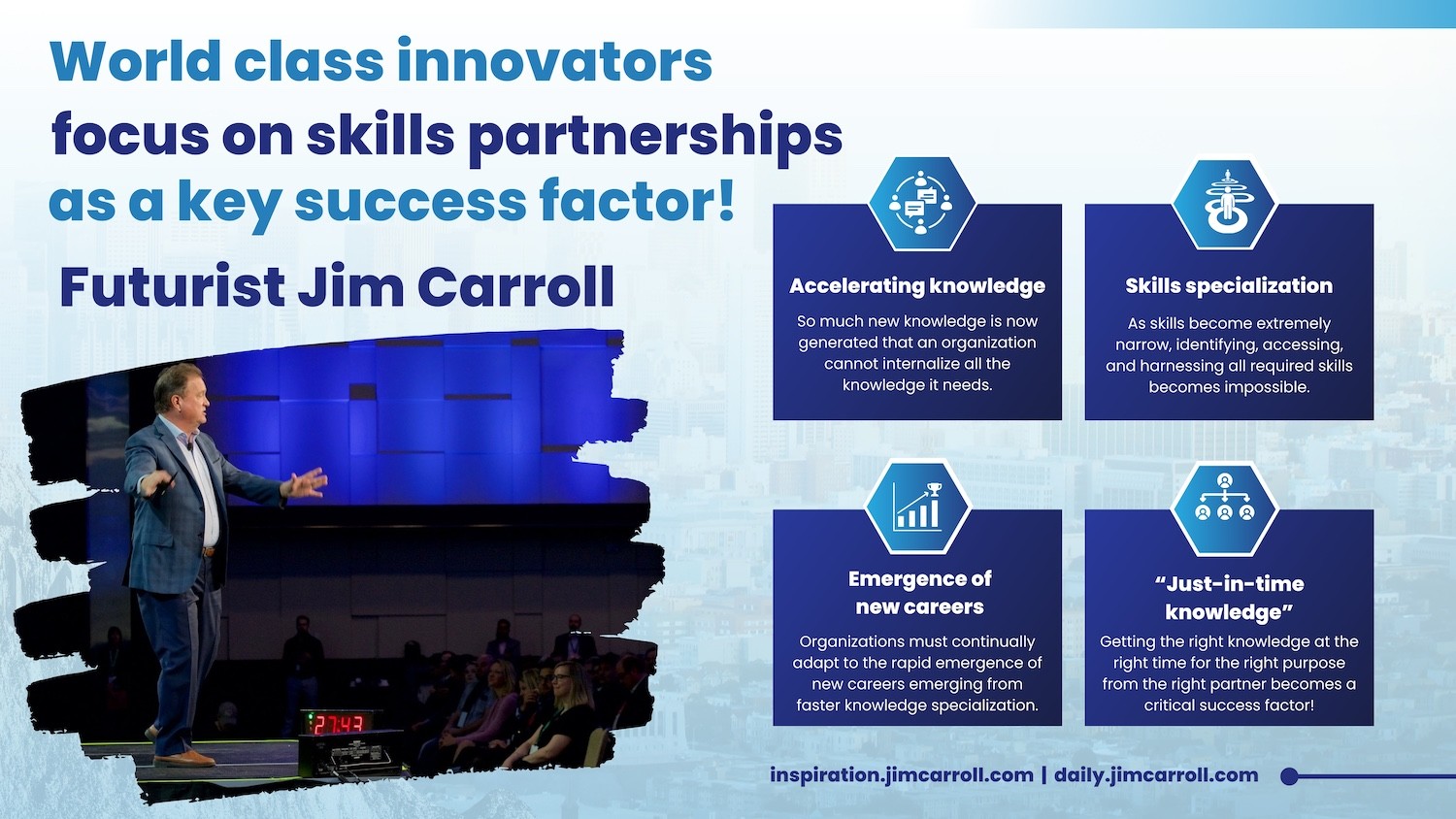
Daily Inspiration: "World class innovators focus on skills partnerships as a key success factor!" - Futurist Jim Carroll
Organizations used to hire all the people they needed to do all the things that needed to be done. In a world of massive knowledge acceleration and specialization, this no longer makes sense - and indeed, is impossible. World-class innovators, as a result, pursue a strategy in which their ability to quickly form external knowledge partners will define their success going forward.
What I saw twenty years ago when compiling my list of world-class innovators was a group of companies who realized this reality - and innovated their way through it. World-class innovators realized early on that this business model of a structure that had all key skills in place was no longer possible.
Mastering this skill is one of the most important success factors today. Think about it: these are the issues faced by organizations today:
- Accelerating knowledge: So much new knowledge is now generated that an organization cannot internalize all the knowledge it needs.
- Skills specialization: As skills become extremely narrow, identifying, accessing, and harnessing all required skills becomes impossible.
- Emergence of new careers: Organizations must continually adapt to the rapid emergence of new careers emerging from faster knowledge specialization.
- "Just-in-time knowledge": Getting the right knowledge at the right time for the right purpose from the right partner becomes a critical success factor!
Today, some organizations understand that relentless workforce and skills innovation is a key component of their overall innovation strategy, and you can see it in their success. Others still seem to cling to the command-and-control hierarchical business structure of the late 20th century - and in their actions, one can see the dinosaurs of a long-gone era lumber along in complacency!
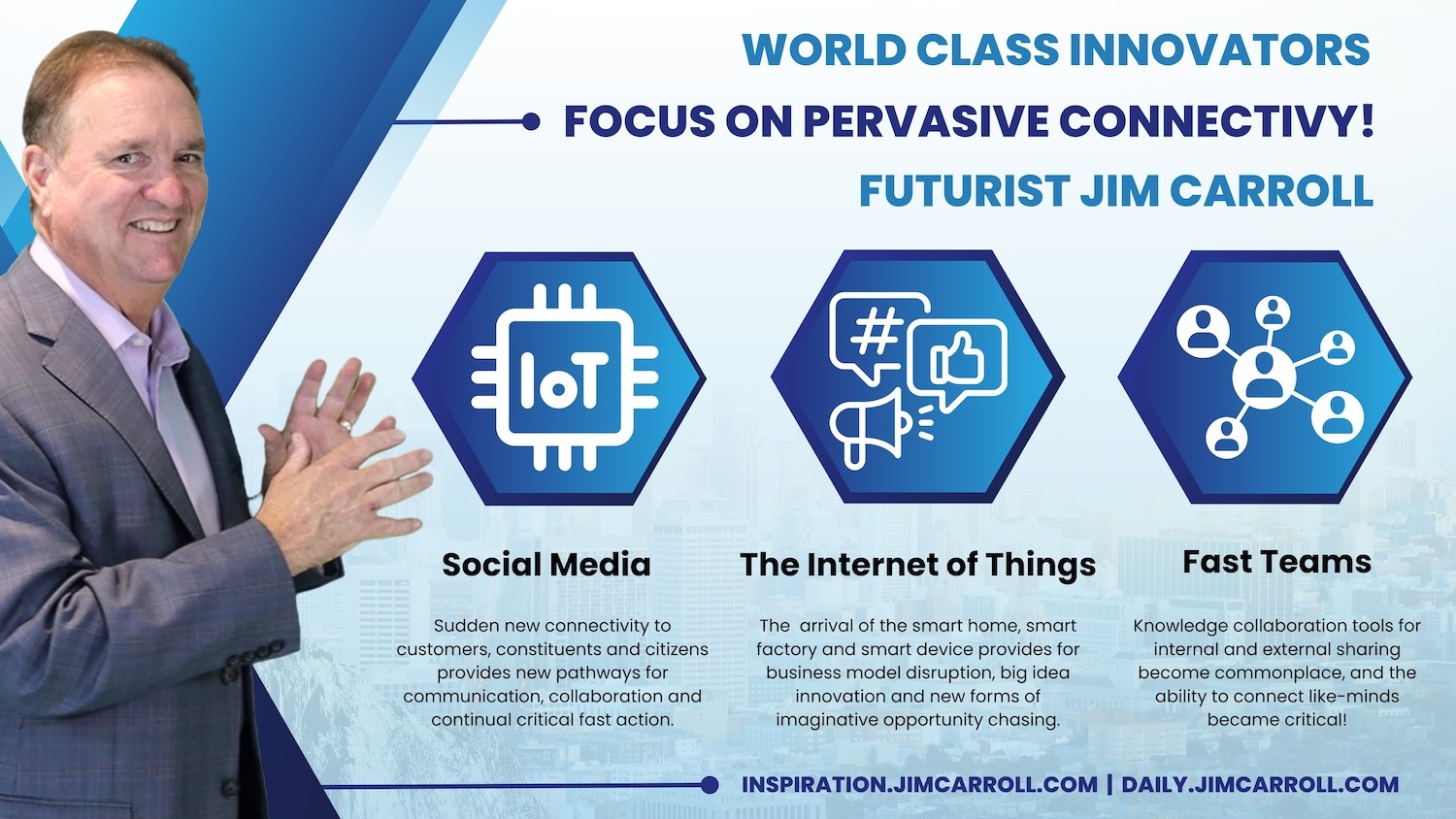
Daily Inspiration: "World class innovators focus on pervasive connectivity" - Futurist Jim Carroll
Connectivity changes everything!
When I was compiling my list of 'what world-class innovators do that others don't do,' it was obvious that all of them were chasing the new pervasive connectivity that was emerging in our world.
Pervasive connectivity? It takes many shapes and forms, including:
Social media: Sudden new connectivity to customers, constituents, and citizens provides new pathways for communication, collaboration, and continual critical fast action.
The Internet of Things: The arrival of the smart home, smart factory, and smart device provides business model disruption, big idea innovation, and new forms of imaginative opportunity chasing.
Fast teams: Knowledge collaboration tools for internal and external sharing become commonplace, and the ability to connect like-minds became critical!
All of these fast-emerging trends provided both big opportunities and massive new challenges.
Put all of these connectivity trends together - and add a few more - and suddenly the world of hyper-connectivity was providing a new form of product, a new style of organization, and a new means of communication. All the old rules, ideas, and thinking that applied to a previous world of separate, disparate, and unconnectedness no longer mattered, and indeed, were suddenly leadership ideas from the olden days.
And it became a reality as world-class innovators realized that it was within the reality of hyper-connectivity that their future opportunities could be found!
Today? These new forms of connectivity matter even more!
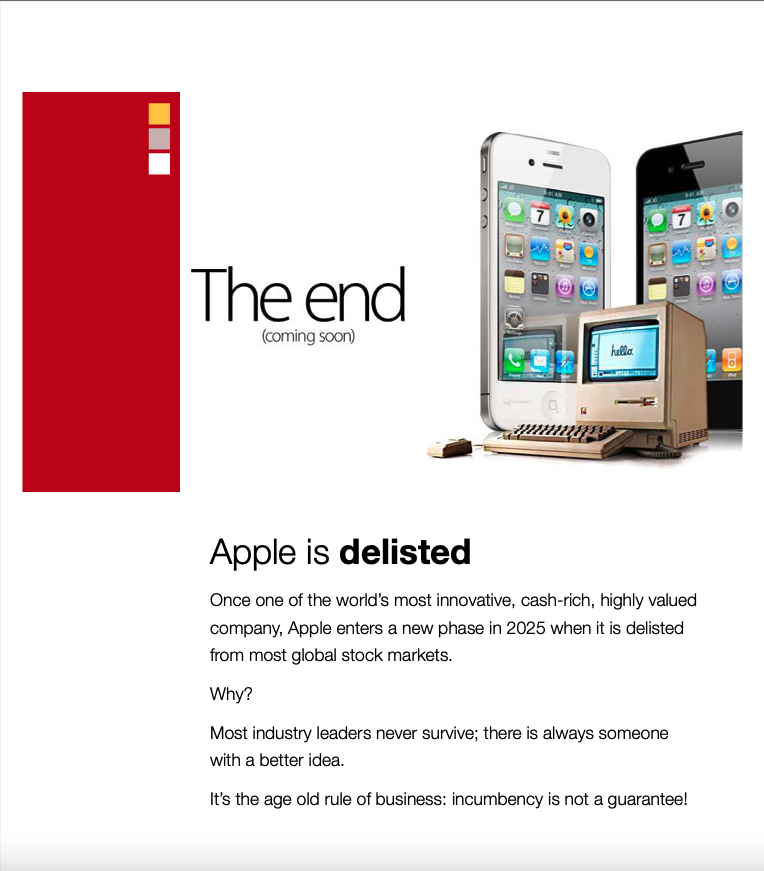
What I wrote in 2014 in my "25 Trends for 2025" series.
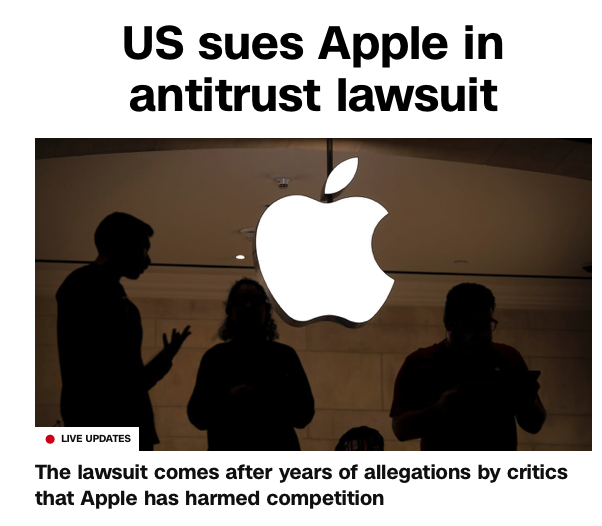
Today's news headline.
Apple won't disappear. But it's recent arrogance with the EU with it's App Store battles show that it is a far different organization than that which was established by Steve Jobs.
Read what I wrote: "Most industry leaders never survive; there is always someone with a better idea. It’s the age old world of business."
Daily Inspiration: "World-class aren't afraid of big ideas!" - Futurist Jim Carroll
Being bold matters.
Being bolder matters more!
The era of 'moonshot thinking' and 'moonshot innovation' envelopes the mindset of world-class innovators. When I was compiling my list of what world-class innovators do that others don't do, it was evident that it didn't just inhabit their minds - it was fundamental to everything they do.
What is moonshot innovation? It's the philosophy and approach to innovation that focuses on achieving radical breakthroughs and innovations, rather than just making small steps. The term "moonshot," of course, originates from the ambitious scale of the Apollo 11 mission, which successfully landed the first humans on the Moon—a feat that seemed almost impossible at the time. Moonshot innovation involves ambitious goals, thinking about big opportunities with radical ideas, within available and yet-to-exist breakthrough technologies and materials - in other words, chasing the impossible to make it possible. After the dot.com collapse of 2000-2001, many people soured on the potential and promise of technology, connectivity, and the future - a sour mindset was pervasive, negativity was persistent, and small minds returned to doing small things.
Not so for moonshot thinkers - the following years saw one of the biggest bursts of innovative thinking of all time.
Moonshots matter. Bold thinking is everything. Big bets are necessary.
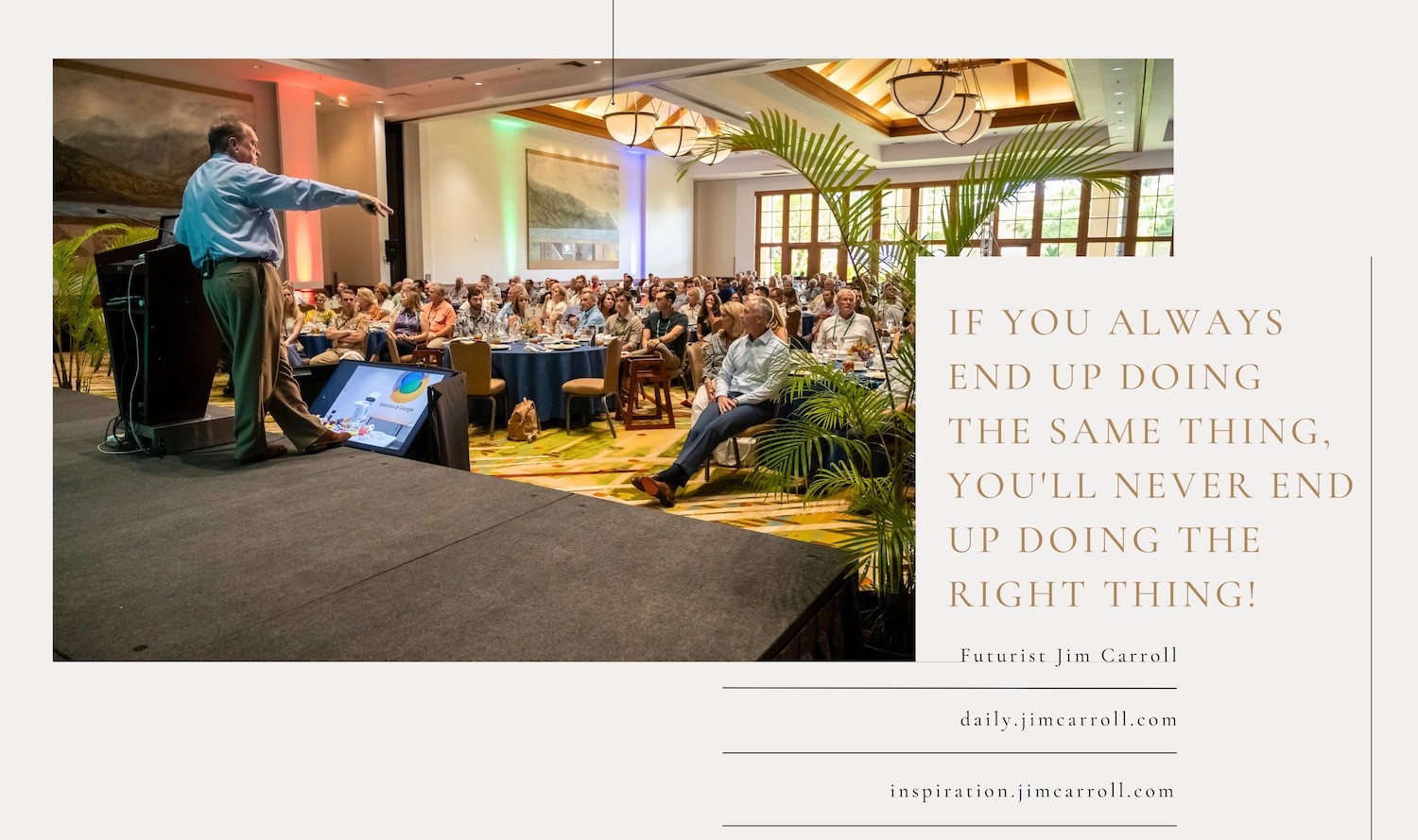
Daily Inspiration: "If you always end up doing the same thing, you'll never end up doing the right thing!" - Futurist Jim Carroll
You'll never do the right thing if you keep doing the same old thing - because doing the same old thing is always the wrong thing! Got it?
The photo in today's quote is from my keynote last fall for the Western Growers Association out in Hawaii. The WGA represents mostly family farms in California, Arizona, Nevada, and New Mexico; the talk was on the impact and opportunities of artificial intelligence in the farming sector.
And today's quote? Think about the modern farmer of today - in the face of new technologies and methodologies, they certainly can't keep on 'doing the same old thing.' Years ago, I would joke about the imminent arrival of 'weed-zapping robots.' Today, it's no longer a joke - it's a fast-emerging reality. Trends in the industry are very much impacted by access to and management of scarce water resources - particularly in this region of the world - and so there is a never-ending flood (if you pardon the pun) of new irrigation concepts, ideas, and sophisticated technologies they can try out. Science has a major role to play, and the modern farmer of today's world could probably be called a scientist-farmer.
Everywhere you look there are new ways of doing 'things,' and the only to do the 'right thing.'
And that's the situation in pretty much every single industry, job, career, and profession today - nothing is ever the same, everything is changing, and the only right thing to do is to change with it!
Some people see the future and never do what needs to be done to get there. Innovators see the same future and change everything they do to be a part of it.
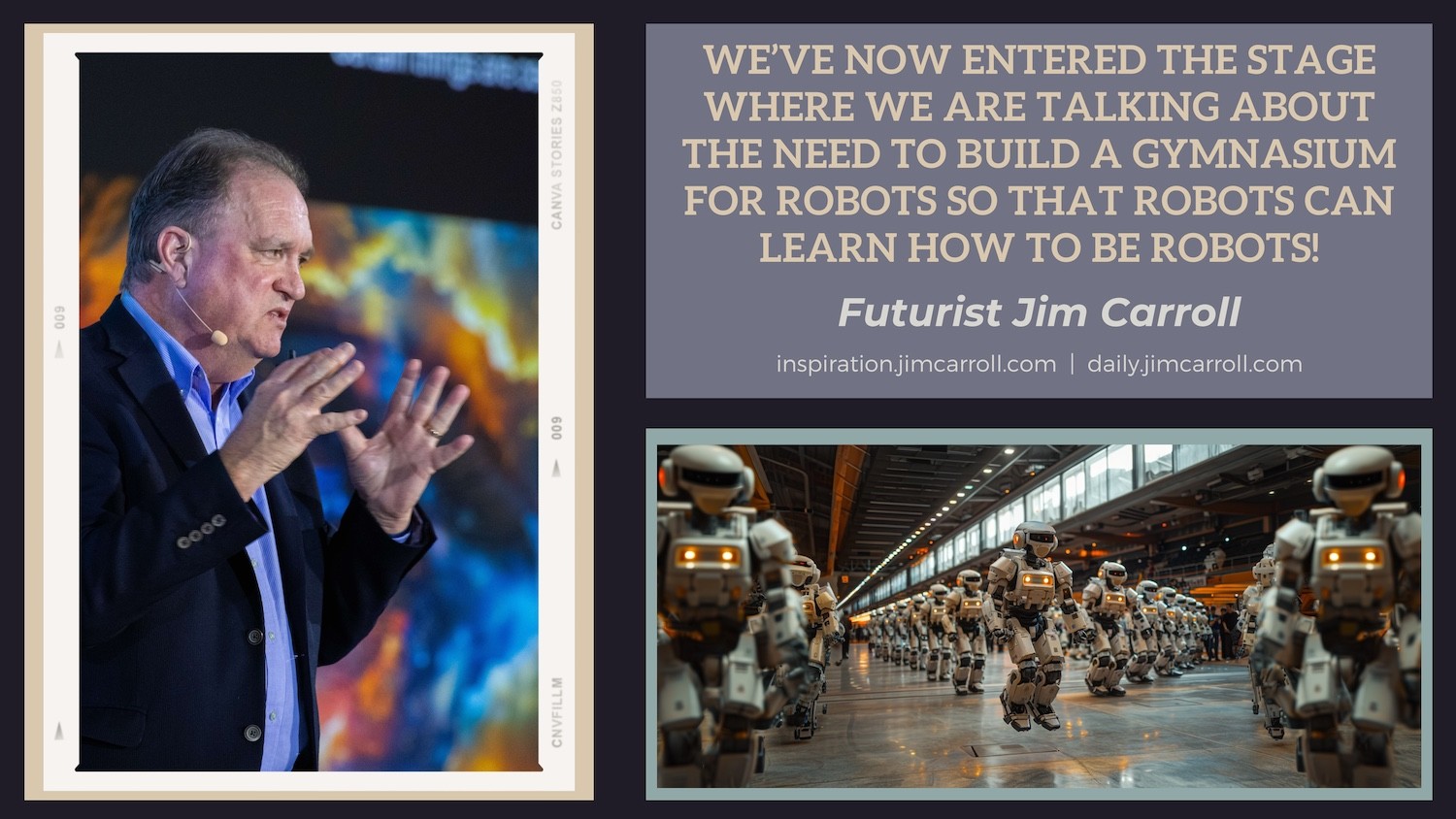
Daily Inspiration: "We've now entered the stage where we are talking about the need to build a gymnasium for robots so that robots can learn how to be robots!" - Futurist Jim Carroll
If you follow the world of artificial intelligence at all or are an active investor, you will know that Nvidia has, suddenly it seems, become the world's hottest company.
A manufacturer of chip and computer board technology, its main focus was designing and manufacturing this technology for computer gaming. At the risk of simplifying things, whether by luck or design, everyone discovered that the very same chips could be used to run the incredibly complex software used as the backbone for most artificial intelligence systems. With that, the company has become the most significant player in the A.I. hardware marketplace over the last few years.
Last week, the company held its developer conference - that's where it brings together key customers, computer developers, and others to hear about its plans for the future. It was not unnoticed that the event was held in the same stadium as the NHL's San Jose Sharks, and that the overall attendance exceeded that of a typical game night.
These talks are often as much aspirational as they are reality-oriented - often a tech company developer keynote is full of promises as to where the company intends to go as opposed to where they are. One section in particular, involving what he announced as Project Groot, caught my attention. In particular, the line that observed that what they planned to do was to allow the building of gymnasiums so that robots could learn how to be robots.
The key section to watch in the video starts at about 01:33:40 on the timeline. A gym for robots! That phrase certainly captures the attention of a futurist, and it caught mine. With that in mind, let me try and explain what this is all about
@mimsical You've heard of the Halifax explosion in 1917. The pilot, William McKay, was unfairly blamed. He took to drink, and could no longer give adequate care to his daughters. My mom's family ended up taking them in and raising them - and so Aunt Mona and Aunt Marjorie were always to me, members of the family. I never learned the whole details till later.
So, what do I do in my day job? I take people into their future.
Have you been to those events where some keynote speaker offers you the same old stale content - saying to you the same thing they said at a completely different event the previous week?
It's a weird industry that I'm in. Every speaker tells you they do a 'customized' keynote. Few do it, it would seem.
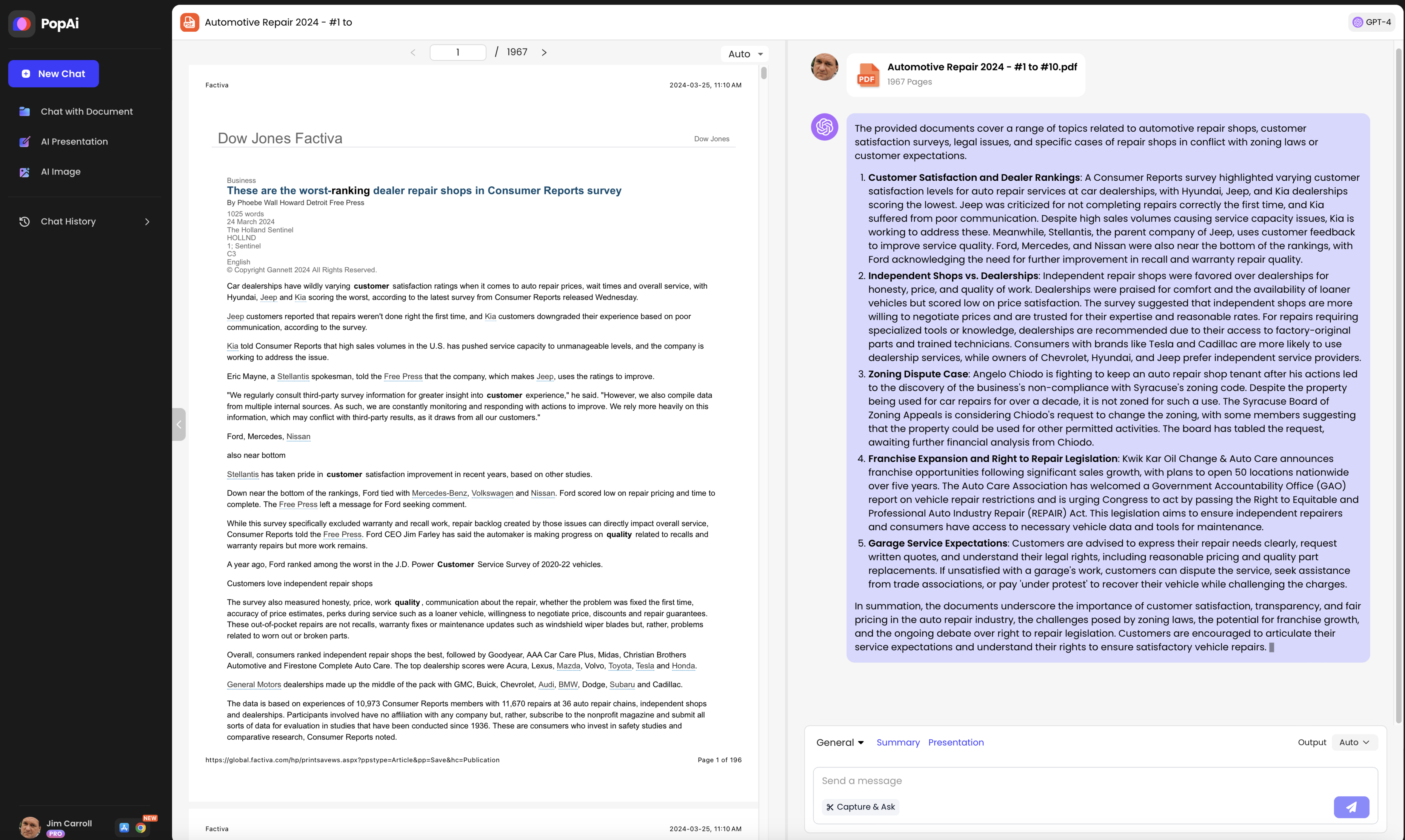
I'm keynoting an automotive repair conference for a few hundred folks in Birmingham, UK, in about a month. I've downloaded about 2,000 pages of articles from global publications - newspapers, magazines, research journals, news and press release wires, corporate websites - of articles about the industry. I do this with Dow Jones Factiva, my go-to tool for the last 30 years (it and predecessor services) for which I pay a *substantial* usage fee each month ... about $1,000.
I then do a high-level scan to bring my insight into this industry up to date (I've done similar events over the years.) Not only that, but I now feed them into my AI tool of choice - in this case, PopAI.Pro, which will let me query, ask questions, and summarize the information nuggets from my research service.
By the time I get on stage, I'll be so deep in the world of automotive repair, that they'll get something so relevant to them that it will speak right to their soul.
I once did an agricultural talk based on similar research, and one farmer came up to me later and asked me how long I had been a farmer.
So this morning, I hit up my broadcast studio, and tried to explain why I think Nvidia's announcement of 'creating a gym where robots can learn how to be robots' is so important. I attempt to bring together robots, digital twins, and virtual reality into one cohesive whole.
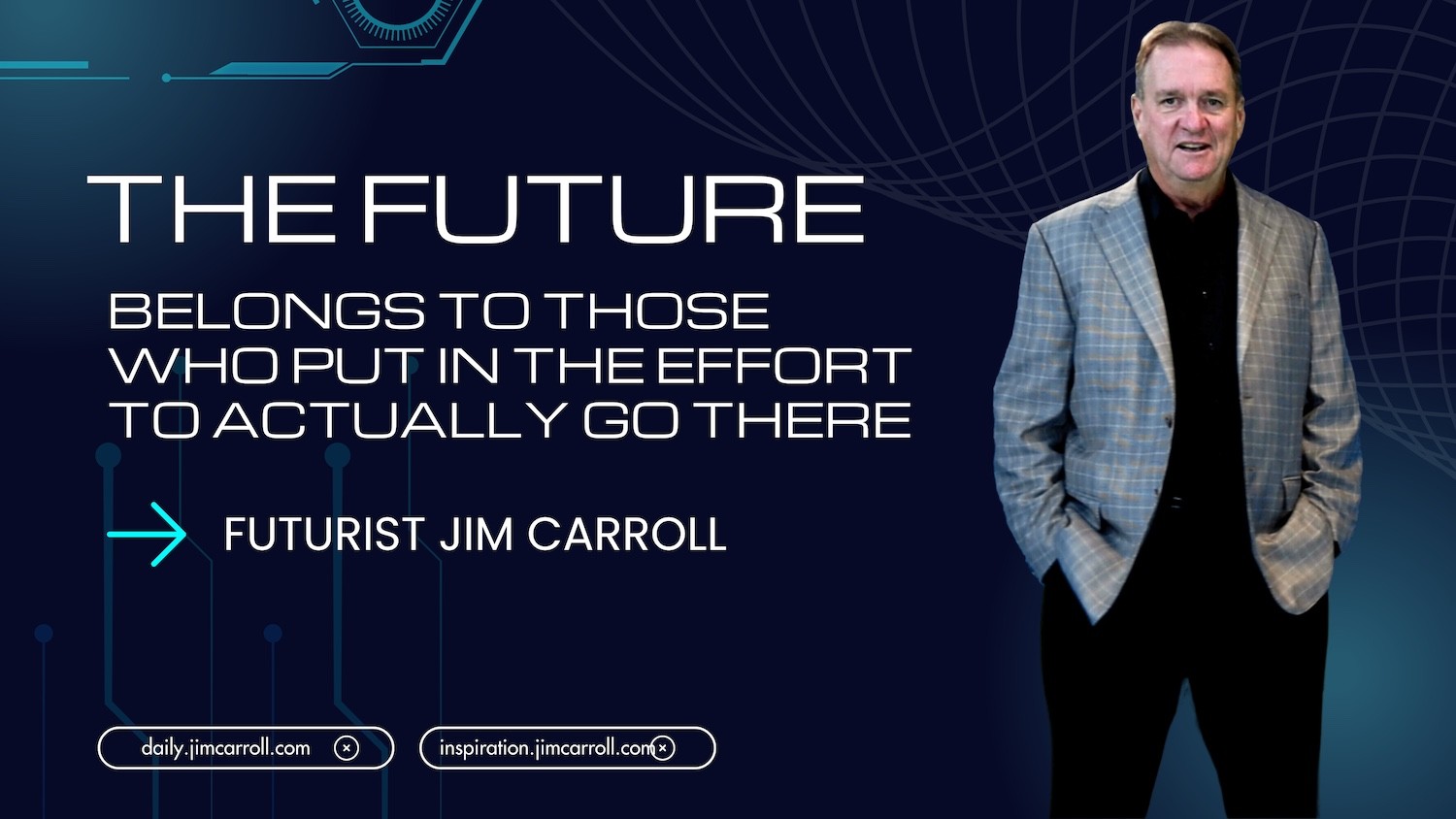
Daily Inspiration: "The future belongs to those who put in the effort to actually go there!" - Futurist Jim Carroll
I went into the broadcast studio yesterday to film a voyage about yesterday's inspiration, in a clip involving artificial intelligence, advanced robotics, and virtual reality - and how these trends all come together into a fascinating, accelerating future! You might find it a little bit more illuminating on what's going on with the idea of 'gyms for robots,' which is really a pretty significant trend.
While continuing to think through the implications of these trends, I kept on coming back to the realization that many organizations will not realize how quickly their industry - and hence their future - is changing. The result is that they won't do what is necessary to get to that future, and they will increasingly fall behind. There will be an increasing gap between the speed and impact of the trends and their ability to deal with those trends.
They'll be decimated by a widening of the 'acceleration gap.' What is the acceleration gap? It's simple - the future used to be fast; now it's faster, and you are falling behind all the time. The gap is the difference between the speed at which the future is changing, and your ability to keep up with that speed of change. The 'acceleration gap' has always been there, and the question I've put to my organizations over the years is this: Are you prepared to do the hard work, the heavy lifting, and the necessary effort to bridge the gap?
The acceleration gap is real, it’s growing, and your inability to narrow it will increasingly impact your future! In other words - the future is yours only if you decide to put in the effort to go there!
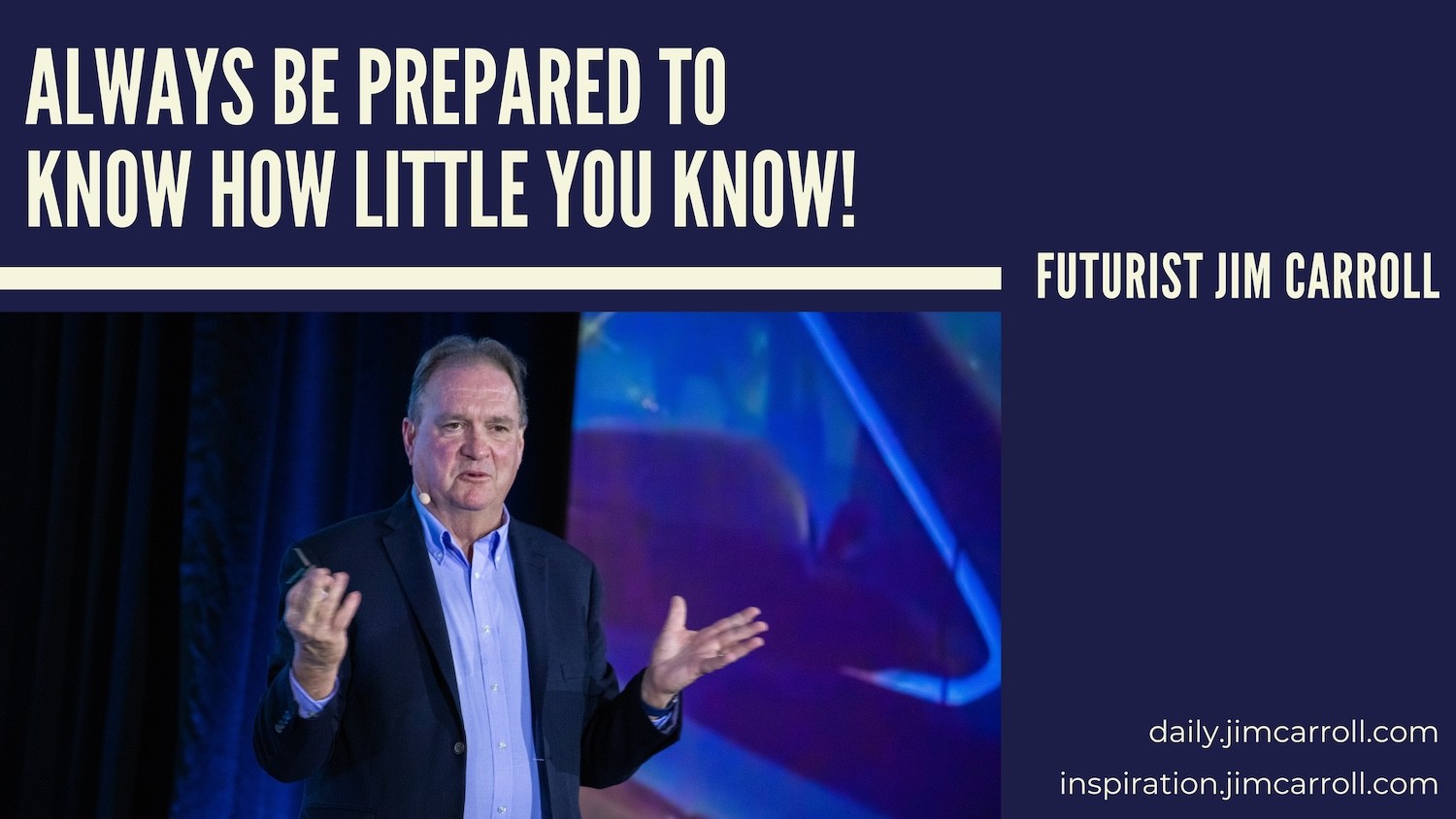
Daily Inspiration: "Always be prepared to know how little you know!" - Futurist Jim Carroll
One thing that I have always understood about my ability to interpret the future is that while I know a lot of stuff, there is a lot I do not know. I think that's a good thing, because that fact is the basis for my relentless curiosity, and I have long believed that curiosity is the key to success for anyone. If you ever lose your creativity, you lose your initiative. Lose your initiative, and you lose your future!
Yesterday, with a bit of downtime between events, I went down a few rabbit holes on my ship of curiosity, the vehicle of my imagination, and my infrastructure for exploration. To me, this is wasted time well spent, because it helps me to understand the gaps in my knowledge, the insight I need to chase, and the skills I need to continue to develop.
Yesterday was rather marvelously unproductive and yet, at the same time, massively productive!
It was all entirely irrelevant to anything important that I should be doing, and yet, had everything to do with what I should be doing, because I know that one thing I just always be doing is continuing my voyage of knowledge exploration!
You? Waste time well - because you should always know how little you know!